Increased crop yields
High-yield seeds and inputs raised output per acre.
AP Exam Clue: Link HYV seeds to productivity gains.
Unit 5 Learning Journey · Agriculture and Rural Land Use
The Green Revolution was a major change in agriculture that used high-yield seeds, irrigation, fertilizer, pesticides, and machinery to increase crop production. In AP Human Geography, students must understand both the benefits and the costs: more food, higher yields, environmental pressure, uneven access, and changing rural economies.
The previous page, Von Thünen Model, explained how distance and market access shape agricultural land use. This page shifts from location to agricultural technology. The Green Revolution shows how new seeds, irrigation, fertilizers, pesticides, and machinery changed food production around the world. After this page, students should study agribusiness, sustainable agriculture, food security, and rural land-use consequences.
The Green Revolution AP Human Geography topic connects Unit 2 population pressure to Unit 5 farming change. When a prompt mentions HYV seeds, fertilizer, irrigation, or food production technology, explain both increased yields and uneven social or environmental effects.
Green Revolution
Technology and inputs changed yields worldwide.
The Green Revolution was the spread of new agricultural technologies that increased crop yields, especially in developing countries. It used high-yield seed varieties, irrigation, synthetic fertilizers, pesticides, and mechanization to produce more food from the same amount of land. In AP Human Geography, the Green Revolution is important because it changed food security, rural economies, environmental impacts, and global development patterns.
The Green Revolution was input-intensive. Compare this table with intensive vs extensive agriculture when you need to explain why yields rose but land pressure increased.
| Input | What It Means | How It Increased Food Production | AP Exam Clue |
|---|---|---|---|
| High-yield seeds | Crop varieties bred to produce more grain | Increased output per acre | HYV seeds or miracle seeds |
| Irrigation | Controlled water supply for crops | Made farming more reliable | Water access and canals |
| Fertilizer | Added nutrients to soil | Helped crops grow faster and larger | Nitrogen, phosphorus, potassium |
| Pesticides | Chemicals that reduce pests | Protected crops from damage | Higher yields but environmental risk |
| Mechanization | Use of machines like tractors | Increased speed and scale of production | Fewer workers needed |
| Double cropping | Growing more than one crop per year | Increased annual production | Multiple harvests |
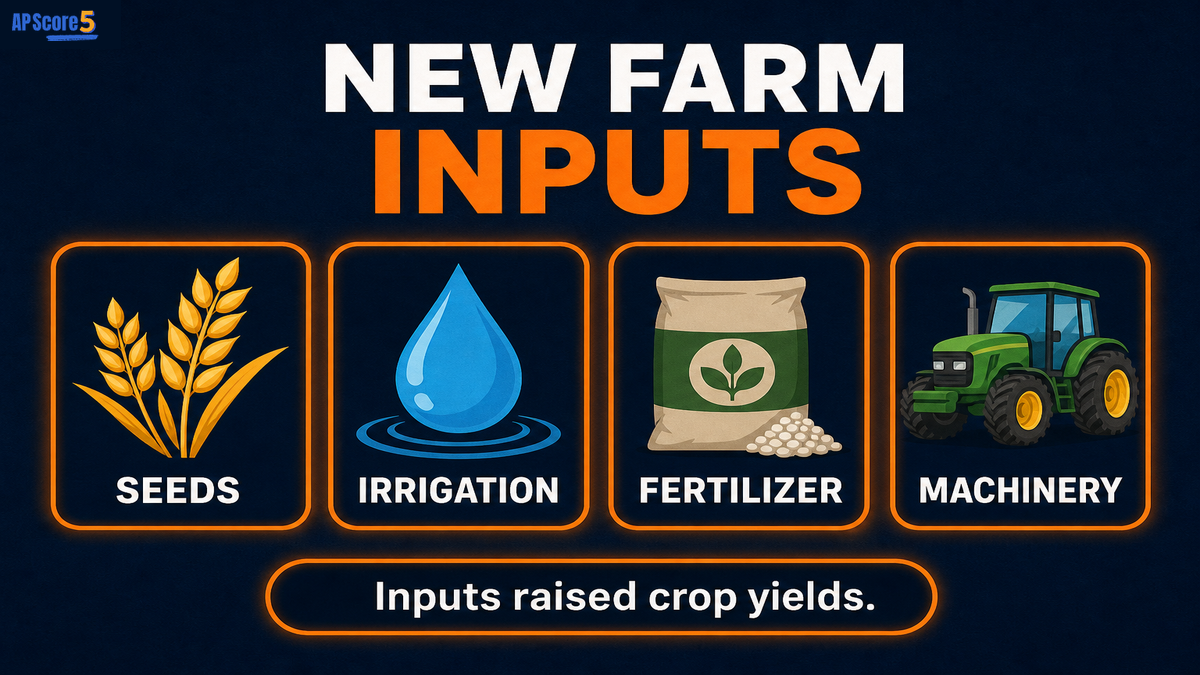
High-yield seeds rarely worked alone. Farmers paired them with water, fertilizer, and machinery—creating dependence on capital and technology similar to commercial agriculture systems.
The Green Revolution increased food production because farmers could grow more crops per acre. High-yield seeds worked best when paired with water, fertilizer, pesticides, and machinery. This made farming more intensive and helped countries increase grain production, especially wheat and rice.
The Green Revolution is easier to understand when you compare farming before and after high-yield seeds, irrigation, fertilizer, pesticides, and machinery became widely used.
| Before the Green Revolution | After the Green Revolution | AP Exam Meaning |
|---|---|---|
| Traditional seeds | High-yield seed varieties | More output per acre |
| Rain-dependent farming | Irrigation-supported farming | More reliable crop production |
| Lower chemical input | More fertilizer and pesticide use | Higher yields but environmental tradeoffs |
| More local production systems | More commercial and input-dependent farming | Stronger links to agribusiness |
| Lower mechanization in many regions | More machinery and modern farm technology | Labor needs and farm scale changed |
| Lower yields in many farming regions | Higher grain production in many regions | Food supply increased, but impacts were uneven |
AP Human Geography rewards balanced answers. Start with these benefits, then always pair them with costs on FRQs.
High-yield seeds and inputs raised output per acre.
More grain helped countries feed growing populations.
More food supported demographic growth in some areas.
Wheat and rice production rose sharply in adopting countries.
Farms adopted irrigation, chemicals, and machinery.
Market-oriented farming spread with new inputs.
Production gains came with tradeoffs. Link these costs to agricultural pollution and soil salinization when you explain environmental consequences on FRQs.
Fertilizers and pesticides can contaminate soil and water.
Irrigation increased demand on aquifers and rivers.
Repeated irrigation and chemicals can damage soil.
Seeds, chemicals, and machinery require capital.
Small farmers could not always afford new inputs.
Fewer varieties replaced traditional local crops.
Farmers rely on purchased seeds, fertilizer, and fuel.
Mechanization reduced demand for farm workers.
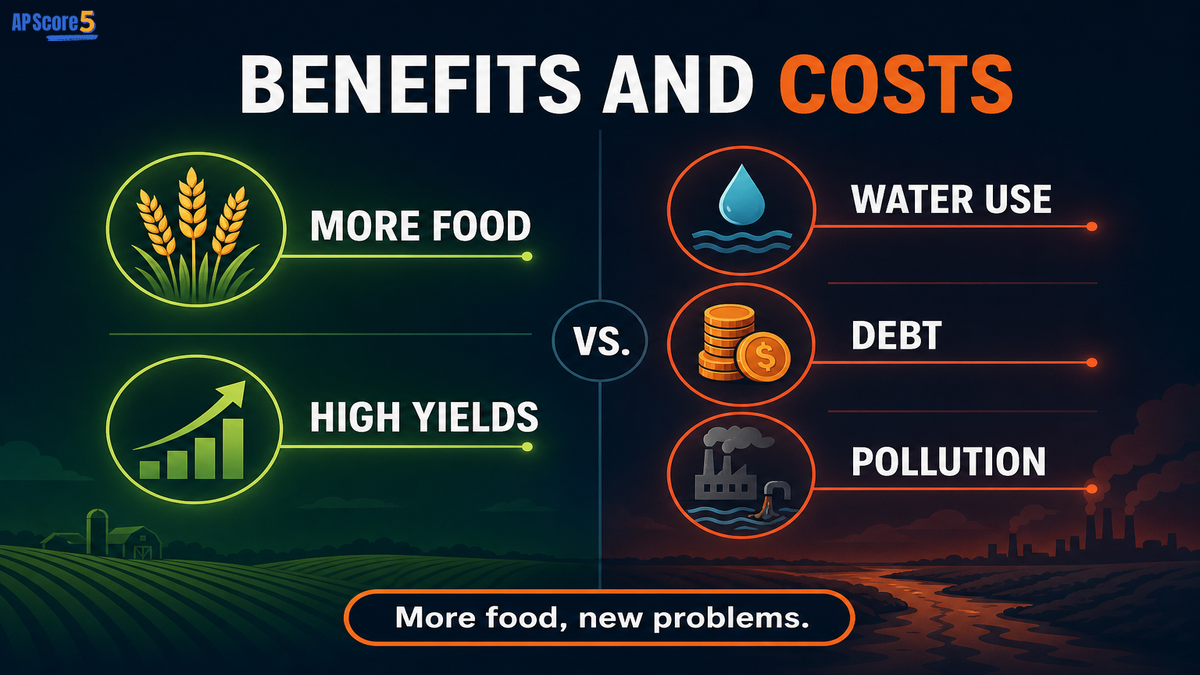
| Benefit or Cost | Explanation | AP Human Geography Connection |
|---|---|---|
| Higher yields | More output from the same land | Agricultural productivity |
| Food security | More food can reduce famine risk | Population and development |
| Irrigation demand | More water is needed | Environmental impact |
| Fertilizer runoff | Chemicals can pollute water | Agricultural pollution |
| Farmer debt | Inputs cost money | Rural inequality |
| Mechanization | Machines reduce labor needs | Rural economic change |
| Crop uniformity | Fewer crop varieties may be grown | Biodiversity loss |
| Commercialization | Farming becomes more market-oriented | Agribusiness |
Mexico: Wheat improvements linked to Norman Borlaug's research helped launch global HYV seed diffusion.
India: Wheat and rice production increased with new seeds, irrigation, and fertilizer—reducing famine risk in some periods.
Pakistan: Wheat output rose with Green Revolution inputs, though benefits varied by farm size and capital access.
Philippines: Rice research and high-yield rice varieties boosted productivity through institutions like IRRI.
Asia and Latin America: Many regions saw higher grain production, though environmental and social costs followed.
Sub-Saharan Africa: Impact was uneven because infrastructure, capital, water access, and political conditions varied widely.
The Green Revolution is often treated as part of the Third Agricultural Revolution. The Third Agricultural Revolution includes broader scientific and technological changes in farming, while the Green Revolution specifically focuses on high-yield seeds, fertilizers, irrigation, pesticides, and increased crop production.
| Revolution | Key Change | AP Significance |
|---|---|---|
| First Agricultural Revolution | Humans domesticated plants and animals | Farming begins |
| Second Agricultural Revolution | Mechanization and improved farming methods | Industrial-era productivity |
| Green Revolution | HYV seeds, fertilizer, irrigation, pesticides | Modern yield increase |
| Concept | Main Meaning | AP Exam Use |
|---|---|---|
| Green Revolution | Spread of high-yield seeds and farm inputs | Explain increased food production and consequences |
| Third Agricultural Revolution | Broader modern agricultural technology shift | Connect technology, mechanization, biotechnology, and productivity |
Later biotechnology in agriculture and GMOs in agriculture extend the Third Agricultural Revolution beyond the original Green Revolution package.
Use this four-step method on MCQs and FRQs when a prompt describes new seeds, irrigation, fertilizer, or rising yields.
Name HYV seeds, irrigation, fertilizer, pesticides, or machinery.
Connect the input to higher yields or output per acre.
Add a social, economic, or environmental consequence.
Link to food security, rural development, or a named country.
Use this sentence pattern when an FRQ asks for both benefits and consequences.
The Green Revolution increased agricultural productivity by using __________, which caused __________. However, it also created __________ because __________.
Example: The Green Revolution increased agricultural productivity by using high-yield seeds and fertilizer, which caused crop yields to rise. However, it also created environmental problems because fertilizer runoff and irrigation increased pressure on soil and water systems.

| Concept | What Changed | AP Clue |
|---|---|---|
| First Agricultural Revolution | Humans domesticated plants and animals | Farming begins |
| Second Agricultural Revolution | Mechanization and improved farming methods | Industrial-era productivity |
| Green Revolution | HYV seeds, irrigation, fertilizer, pesticides, machinery | Modern yield increase |
Saying the Green Revolution was only good
Saying it solved hunger everywhere
Forgetting environmental consequences
Confusing Green Revolution with First Agricultural Revolution
Forgetting the role of capital and technology
Naming fertilizer or seeds without explaining how they changed production
Read each scenario, predict the cause or effect, then reveal the answer. This trains the same reasoning AP Human Geography uses on technology prompts.
Revealed: 0 of 4 scenarios
A country introduces high-yield wheat seeds, irrigation canals, and fertilizer. Grain output rises sharply. Which agricultural change is shown?
Answer: Green Revolution, because new seeds and farm inputs increased crop yields.
A small farmer cannot afford seeds, fertilizer, and machinery used by larger farms. What Green Revolution criticism does this show?
Answer: Inequality, because farmers with more capital benefit more from expensive agricultural inputs.
A farming region uses more irrigation and later experiences soil salinization. What consequence does this show?
Answer: Environmental cost, because intensive irrigation can contribute to soil degradation and salinization.
A country produces more rice per acre after adopting high-yield varieties. What AP concept is shown?
Answer: Increased agricultural productivity, because output per unit of land rises.
Answer all eight questions. Choices shuffle each time you reload, so focus on reasoning—not letter memorization.
Open each card, draft your response, then reveal the rubric and sample when ready. Strong Green Revolution FRQs name a technology, explain productivity gains, and describe one social, economic, or environmental consequence.
Explain how the Green Revolution increased agricultural productivity and describe one social or economic consequence.
The Green Revolution increased agricultural productivity by spreading high-yield seed varieties that produced more grain per acre, especially when combined with irrigation and fertilizer. This helped increase food supplies in some countries. However, the new inputs often cost money, so wealthier farmers could benefit more than small farmers. This created uneven effects in rural areas because some farmers gained higher profits while others faced debt or were unable to adopt the new technology.
Status: Draft your answer first—then open the rubric or sample.
Describe one environmental impact of the Green Revolution and explain why it occurred.
One environmental impact of the Green Revolution was water pollution from fertilizer runoff. Farmers used synthetic fertilizers to increase crop yields, but excess fertilizer could wash into rivers and lakes. This happened because Green Revolution farming was more input-intensive, meaning it depended heavily on chemicals, irrigation, and repeated cultivation to produce high yields.
Status: Draft your answer first—then open the rubric or sample.
The Green Revolution was the spread of high-yield seeds, irrigation, fertilizer, pesticides, and machinery that increased agricultural production, especially in parts of Asia and Latin America.
The Green Revolution was caused by agricultural research, high-yield crop varieties, irrigation systems, chemical fertilizers, pesticides, machinery, and the need to increase food production for growing populations.
Benefits included higher crop yields, increased food supply, reduced famine risk in some regions, and agricultural modernization.
Negative effects included fertilizer runoff, pesticide pollution, heavy water use, soil salinization, farmer debt, inequality, and reduced crop diversity.
The Green Revolution improved food security in some regions by increasing food production, but it did not eliminate hunger everywhere because access to food also depends on income, infrastructure, politics, and distribution.
The Green Revolution is often considered part of the Third Agricultural Revolution. The Green Revolution focuses on high-yield seeds and modern inputs, while the Third Agricultural Revolution is a broader shift toward modern agricultural technology.
The Green Revolution had uneven effects because farmers and regions differed in access to capital, irrigation, infrastructure, land, technology, and markets.
Name a specific technology, explain how it increased production, and then describe one social, economic, or environmental consequence.