Large land area
Extensive agriculture uses large areas of land with lower input density per acre or hectare.
AP clue: Wide fields, ranch land, open range
Unit 5 Learning Journey · Agriculture and Rural Land Use
Intensive agriculture and extensive agriculture compare how much labor, capital, technology, or other inputs are used per unit of land. Intensive agriculture uses higher inputs on a smaller area of land, while extensive agriculture uses larger areas of land with lower inputs per unit area. In AP Human Geography, this comparison helps students explain land use, productivity, labor, capital, population pressure, and market patterns.
The previous page, Subsistence vs Commercial Agriculture, compared farming purpose: local needs versus market sale. This page compares farming intensity: how much labor, capital, technology, or other inputs are used per unit of land. After this page, students should study the Von Thünen Model to see how market distance and transportation costs help explain agricultural land use.
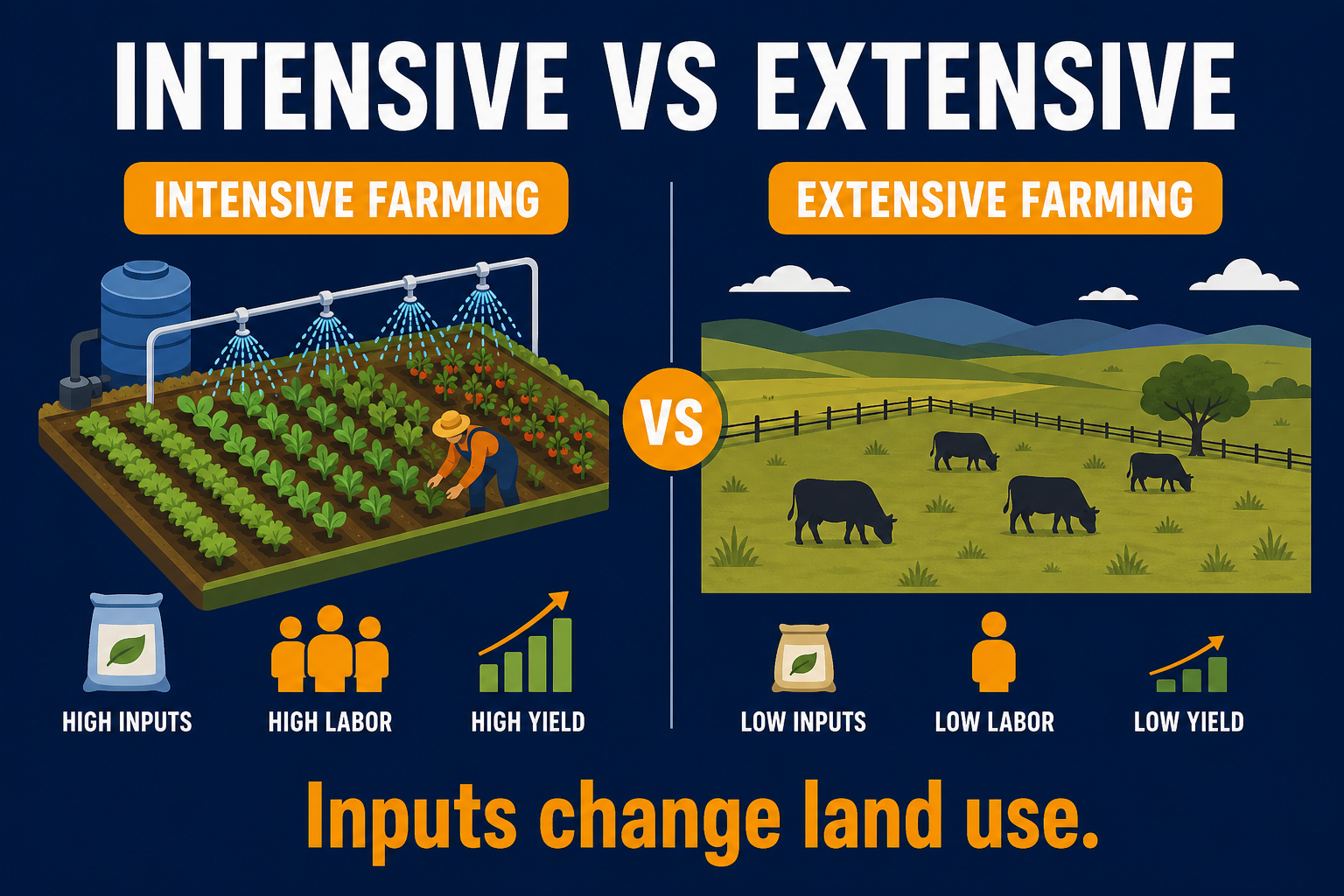
The intensive vs extensive agriculture AP Human Geography comparison connects input density to land use, labor, capital, and productivity—after classifying farming purpose, students explain how much input each system applies per unit of land.
Subsistence vs Commercial Agriculture
Local needs versus market-oriented production.
Intensive vs Extensive Agriculture
Input density and land area.
Intensive vs extensive agriculture compares input density: intensive agriculture uses high labor, capital, technology, fertilizer, irrigation, or management per unit of land, while extensive agriculture uses larger areas with lower inputs per unit of land. In AP Human Geography, classify by input density and land area—not whether the farm is subsistence or commercial.
Intensive and extensive agriculture differ by input density, land area, labor, capital, and examples. Use the explorer, then review the full comparison table.
Intensive agriculture uses more inputs per unit of land. Extensive agriculture uses fewer inputs per unit of land.
Intensive agriculture often uses smaller areas more heavily. Extensive agriculture often uses larger areas less intensively.
Some intensive systems require high labor inputs, while extensive systems often require less labor per unit of land.
Intensive agriculture may use irrigation, fertilizer, machinery, greenhouses, or other capital inputs. Extensive agriculture may rely more on land availability.
Intensive examples can include wet rice farming, market gardening, dairy in some contexts, or greenhouse production. Extensive examples can include ranching, shifting cultivation, or large-scale grain farming in some contexts.
Classify by input density. Do not classify only by crop name.
| Feature | Intensive Agriculture | Extensive Agriculture |
|---|---|---|
| Main comparison | High inputs per unit of land | Lower inputs per unit of land |
| Land area | Often smaller or more valuable land | Often larger land area |
| Labor | Often more labor per land area | Often less labor per land area |
| Capital | Often more machinery, irrigation, fertilizer, or technology | Often lower capital per land area |
| Output | Often higher output per unit of land | Often lower output per unit of land |
| AP clue | high input density | large land area, lower input density |
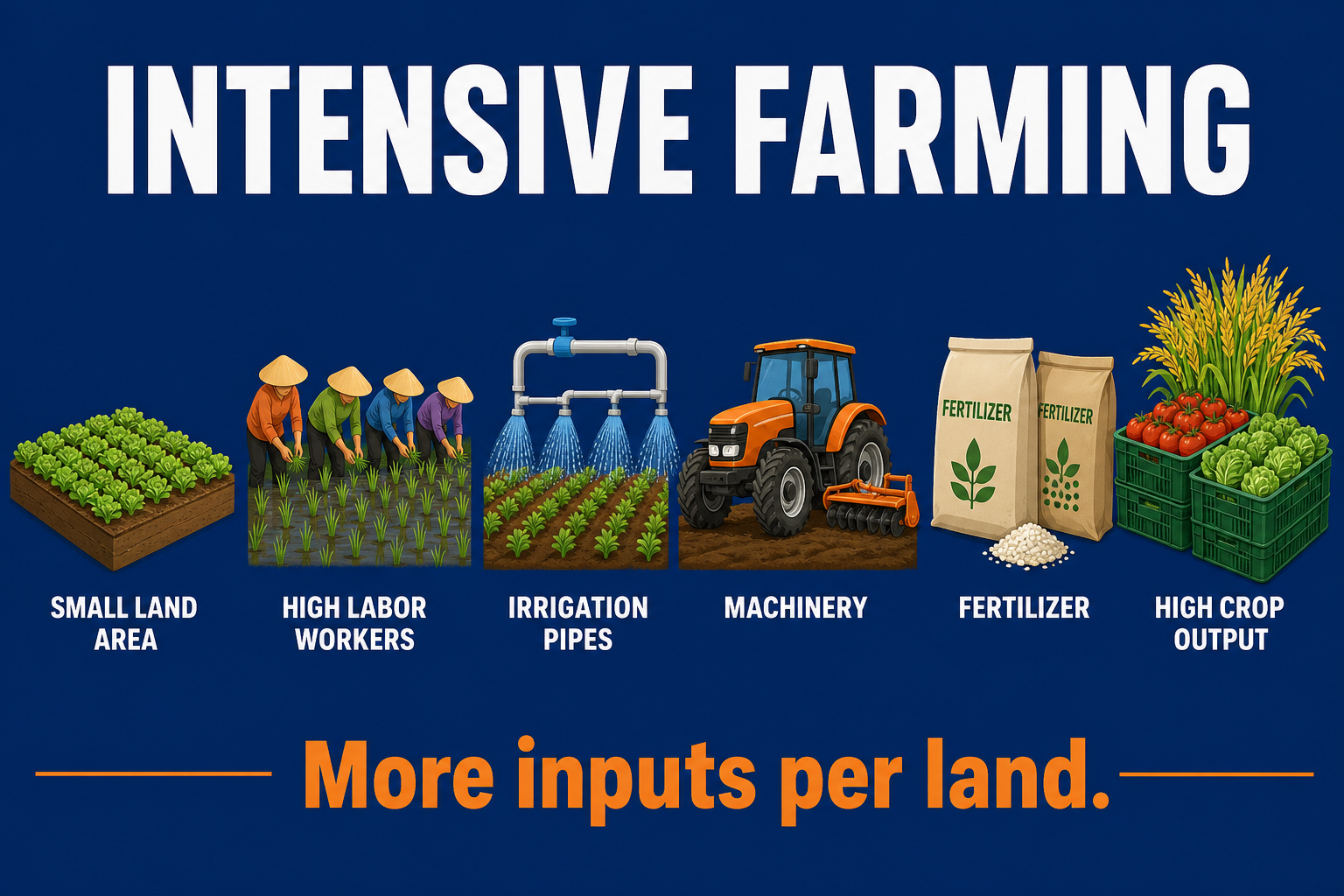
Extensive agriculture uses large areas of land with lower labor or capital inputs per unit of land. It often appears where land is abundant, population density is lower, or farming requires large open spaces.
Extensive agriculture uses large areas of land with lower input density per acre or hectare.
Fewer labor or capital inputs are applied per unit of land compared with intensive systems.
Workers are spread across a larger land base rather than concentrated on small plots.
Total output may be high, but yield per unit of land is often lower than intensive farming.
Extensive systems often appear where land is plentiful and population density is lower.
Cattle or livestock grazing over wide areas is a classic extensive pattern.
Commercial grain farms may cover many hectares with relatively low labor per unit of land.
Extensive farms may be farther from markets because land rent is lower on the periphery.
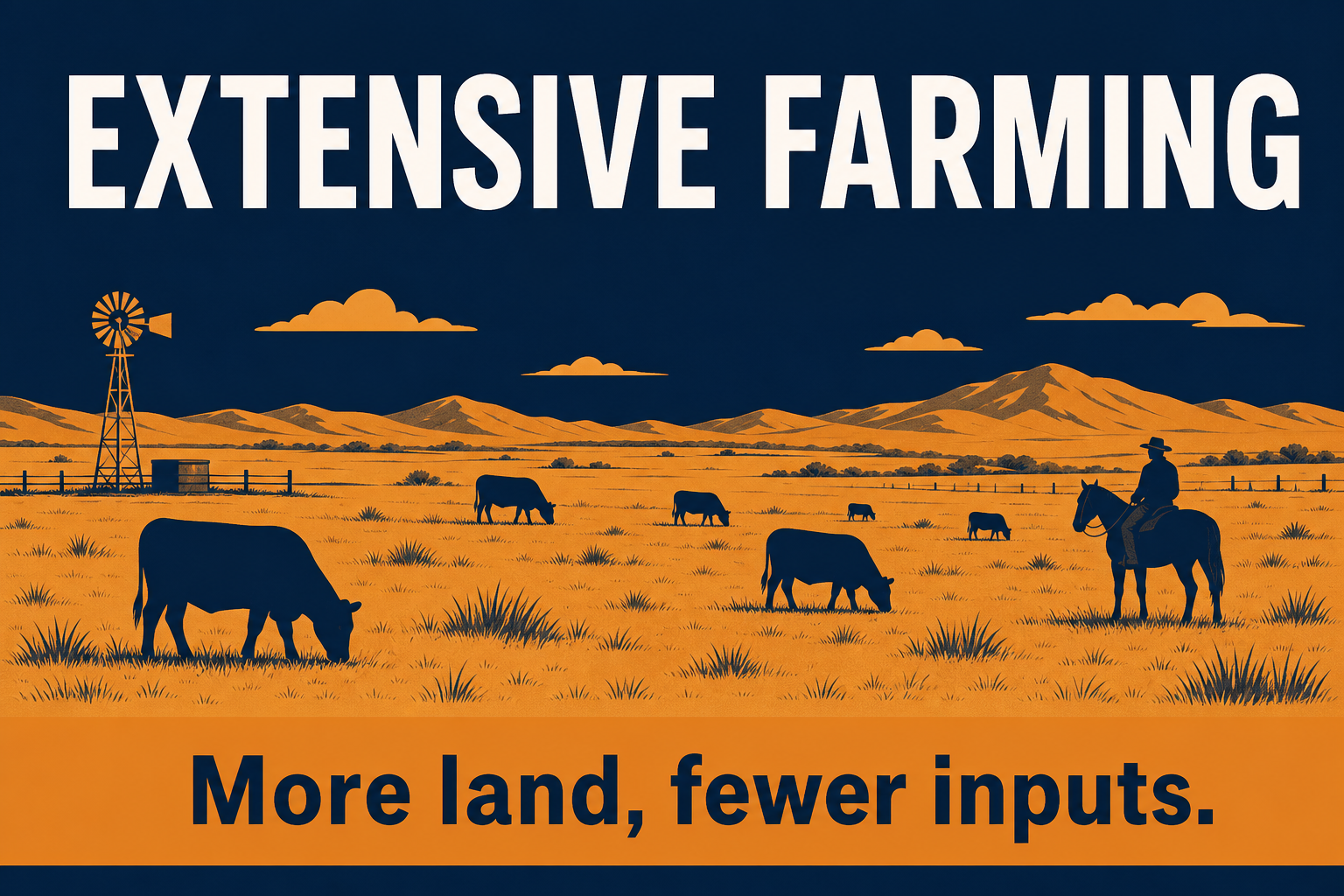
Intensive agriculture uses high levels of labor, capital, technology, irrigation, fertilizer, management, or other inputs per unit of land. It often appears where land is scarce, valuable, close to markets, or where farmers need high output from limited space.
More labor, capital, technology, or fertilizer is applied per unit of land.
Limited or expensive land is used heavily to maximize output.
Intensive systems often require high labor or machinery relative to land area.
Farmers aim to produce more from each acre or hectare.
Capital inputs such as irrigation and fertilizer increase productivity on limited land.
High-value vegetables near cities often use intensive methods on small plots.
Wet rice cultivation in East and Southeast Asia is a classic labor-intensive system.
Greenhouses and high-value crops use capital-intensive methods on limited land.
Subsistence vs commercial agriculture compares purpose. Intensive vs extensive agriculture compares input density and land area. These comparisons can overlap, so do not treat them as the same thing.
| Comparison | What It Compares | AP Clue |
|---|---|---|
| Subsistence vs commercial | Farming purpose | Local needs vs market sale |
| Intensive vs extensive | Inputs per unit of land | High input density vs large land area |
| Intensive subsistence | High labor on limited land for local needs | Wet rice or small high-labor farms |
| Extensive subsistence | Larger land with lower inputs for local needs | Shifting cultivation in some cases |
| Intensive commercial | High capital/labor for market sale | Market gardening or greenhouse farming |
| Extensive commercial | Large land area for market sale | Ranching or commercial grain farming |
Review subsistence vs commercial agriculture when a prompt tests farming purpose instead of input density.
AP questions usually test this comparison through clues about labor, capital, land area, and output. Identify input density first, then classify the farming system.
| Question Clue | Likely Type | Why |
|---|---|---|
| High labor per acre | Intensive | More labor per land unit |
| High capital per hectare | Intensive | More input density |
| Irrigation, fertilizer, machinery on small land | Intensive | Higher inputs per unit area |
| High output from limited land | Intensive | Land is used heavily |
| Large ranch with few workers per acre | Extensive | Large area, lower input density |
| Large grain farm with low labor per acre | Extensive | More land, fewer inputs per unit |
| Wide grazing lands | Extensive | Animals use large land area |
| Low population density farming region | Often extensive | Land is more abundant |
The Von Thünen Model helps explain why intensive, high-value, or perishable agriculture may be located closer to markets, while extensive land uses may be farther away. This page focuses on input density, while the Von Thünen Model focuses on land rent, transport cost, perishability, and market distance.
Land near markets is often more valuable, encouraging intensive use of limited space.
Intensive, high-value crops may locate closer to markets; extensive uses may sit farther out.
Perishable products often require intensive production near consumers.
Higher transport costs encourage intensive production closer to markets.
High-value crops justify more inputs per unit of land near markets.
Ranching and other extensive systems often use cheaper land farther from the market.
AP Human Geography often tests farming intensity through labor density, capital inputs, land area, and output per unit of land.
| Question Clue | Likely Concept | What to Explain |
|---|---|---|
| High inputs per unit of land | Intensive agriculture | Labor, capital, technology, or fertilizer density |
| Small land area but high output | Intensive agriculture | Land is used heavily |
| Large land area with low input density | Extensive agriculture | More space, fewer inputs per unit |
| Ranching over large areas | Extensive agriculture | Large land requirement |
| Market gardening near cities | Intensive agriculture | High value and high input land use |
| Wet rice cultivation with high labor | Intensive agriculture | Labor-intensive land use |
| Commercial grain over large areas | Extensive agriculture | Large land, lower labor per acre |
| Question asks input per land area | Intensive vs extensive | Compare input density |
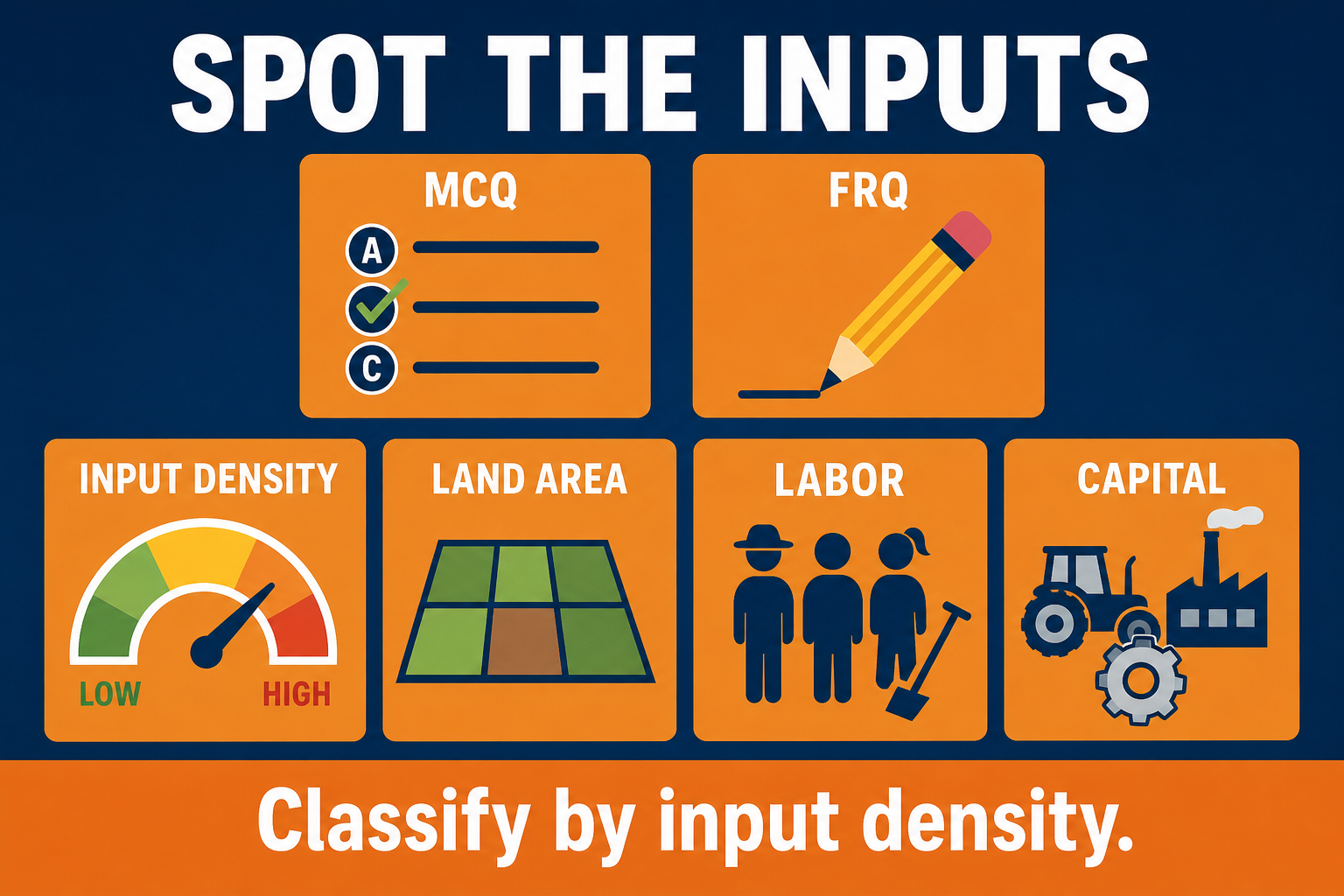
Use this four-step method whenever a prompt asks you to classify or compare farming by input density.
Look for labor, capital, irrigation, fertilizer, or machinery relative to land area.
Connect the classification to concrete clues in the prompt.
Apply the input-density label with supporting geographic evidence.
Connect the farming system to a human geography outcome.
The farming system is __________ agriculture because __________. This affects land use by __________.
Example: The farming system is intensive agriculture because farmers use high labor and irrigation on a small area of land. This affects land use by increasing output per unit of land where land is limited or valuable.
Use this sentence when an FRQ asks you to compare farming systems by input density.
| Concept Pair | Difference | AP Clue |
|---|---|---|
| Intensive vs extensive | Input density and land area | More inputs per land vs more land |
| Subsistence vs commercial | Farming purpose | Local needs vs market sale |
| Intensive vs high population density | Intensive is farming input density; population density is people per area | Farm inputs vs people |
| Extensive vs unproductive | Extensive uses large land and lower input density; it is not automatically unsuccessful | Land area vs output judgment |
| Intensive agriculture vs Green Revolution | Intensive is input density; Green Revolution is modern technology-driven yield increase | Classification vs historical process |
Confusing intensive/extensive with subsistence/commercial
Thinking intensive means hard work only
Thinking extensive means bad farming
Classifying by crop name only
Ignoring inputs per unit of land
Ignoring land area
Assuming all commercial agriculture is intensive
Forgetting that one farm can be commercial and extensive
Read each scenario, predict the farming system, then reveal the answer. This trains the same reasoning AP Human Geography uses on scenario prompts.
Revealed: 0 of 4 scenarios
A farm uses irrigation, fertilizer, and high labor on a small plot of land. Which type is shown?
Answer: Intensive agriculture, because it uses high inputs per unit of land.
A ranch covers a large area with relatively few workers per acre. Which type is shown?
Answer: Extensive agriculture, because it uses large land area with lower input density.
A farm grows vegetables close to a city using greenhouses and high capital investment. Which type is shown?
Answer: Intensive agriculture, because the farm uses high capital inputs on valuable land.
A commercial grain farm covers many hectares with low labor per hectare. Which type is shown?
Answer: Extensive agriculture, because land area is large and labor input per unit of land is lower.
Answer all eight questions. Choices shuffle each time you reload, so focus on reasoning—not letter memorization.
Open each card, draft your response, then reveal the rubric and sample when ready. Strong farming-intensity FRQs define input density, cite evidence, and explain land-use effects.
Compare intensive agriculture and extensive agriculture in terms of inputs and land use.
Intensive agriculture uses high labor, capital, or technology inputs per unit of land, while extensive agriculture uses larger areas of land with lower inputs per unit of land. Intensive systems may use irrigation, fertilizer, machinery, or high labor to increase output from limited land. Extensive systems, such as ranching, often require more land but use fewer inputs per acre.
Status: Draft your answer first—then open the rubric or sample.
A farming region near a city uses small plots, irrigation, and high labor to grow vegetables. A distant region uses large areas of land for ranching. Explain which region is intensive and which is extensive.
The vegetable farming region near the city is intensive agriculture because it uses small plots, irrigation, and high labor inputs. These inputs increase output from limited or valuable land. The ranching region is extensive agriculture because it uses large areas of land with lower input density. This difference shows how land value, labor, and input levels shape agricultural land use.
Status: Draft your answer first—then open the rubric or sample.
Intensive agriculture is farming that uses high levels of labor, capital, technology, or other inputs per unit of land.
Extensive agriculture is farming that uses larger areas of land with lower labor or capital inputs per unit of land.
The main difference is input density. Intensive agriculture uses more inputs per unit of land, while extensive agriculture uses more land with lower inputs per unit of land.
No. Intensive vs extensive compares input density and land area, while commercial vs subsistence compares farming purpose.
Yes. Commercial ranching or large-scale grain farming can be commercial and extensive because it produces for sale while using large land areas with lower input density.
Examples can include wet rice cultivation, market gardening, greenhouse farming, and some forms of dairy or high-value crop production.
Examples can include ranching, shifting cultivation, and large-scale grain farming in some contexts.
Identify the input density, use scenario evidence, classify the farming system, and explain how land area, labor, capital, or technology affects land use.