Suitable plant and animal species
Some regions had species that could be domesticated for food, fiber, or labor.
AP clue: Name crops, livestock, or selective breeding.
Unit 5 Learning Journey · Agriculture and Rural Land Use
Agricultural hearths are the early regions where farming and domestication first developed. In AP Human Geography, agricultural hearths matter because they explain where crops and livestock originated, how farming spread, and how early agriculture reshaped settlement, population, trade, and cultural landscapes.
The previous page, Origins of Agriculture, explained how farming began through domestication, food surplus, and settlement change. This page explains where early farming developed. Agricultural hearths help students connect crop origins, livestock domestication, environmental conditions, and the diffusion of agriculture. After this page, students should study the First Agricultural Revolution.
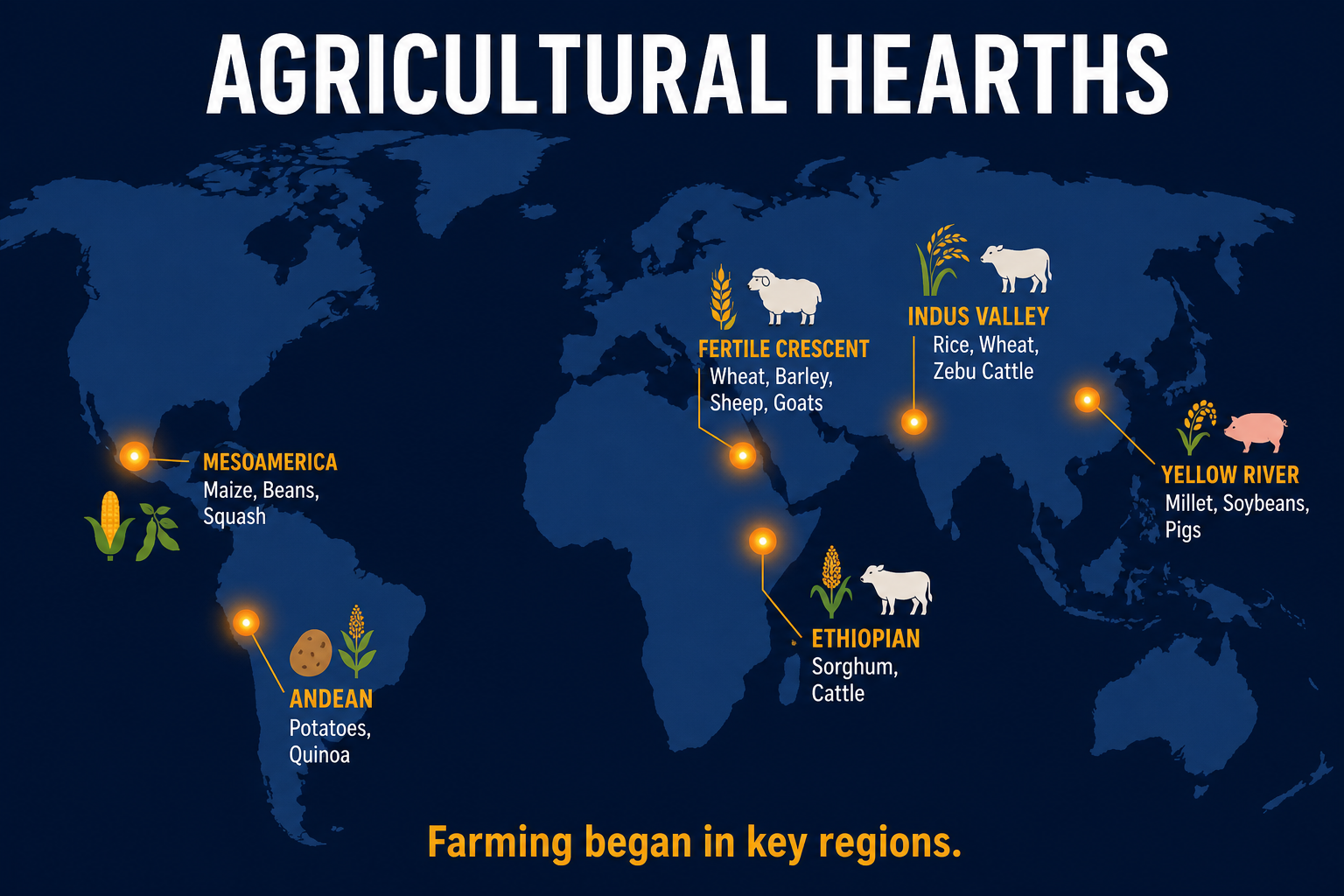
The agricultural hearths AP Human Geography topic connects process to place—after learning how farming began, students identify the regions where domestication first developed and how crops and livestock spread outward.
Agricultural Hearths
Where farming and domestication first developed.
Agricultural hearths are regions where agriculture and domestication first developed. In AP Human Geography, agricultural hearths help explain where important crops and livestock originated and how farming spread through migration, trade, cultural diffusion, and environmental adaptation.
Agricultural hearths developed independently in several world regions. Each hearth produced different domesticated crops and animals based on local environments—avoid overclaiming exact dates; focus on region, domestication, and geographic impact.
Often associated with early domestication of wheat, barley, sheep, goats, and cattle. This region is frequently linked to early farming and permanent settlement.
Associated with early rice and millet domestication, especially in river valley environments that supported intensive cultivation.
Associated with early farming and animal domestication connected to river valleys, monsoon patterns, and regional crop systems.
Associated with maize, beans, squash, and other crops that became central to settlement, diet, and cultural landscapes.
Associated with potatoes, quinoa, llamas, alpacas, and highland agricultural adaptations.
Associated with crops such as sorghum, yams, millet, and regional forms of domestication adapted to varied climates.
| Agricultural Hearth | Examples of Domestication | AP Exam Clue |
|---|---|---|
| Southwest Asia | Wheat, barley, sheep, goats | Early cereal grains and livestock |
| East Asia | Rice, millet | River valleys and intensive cultivation |
| South Asia | Regional crops and animals | Monsoon farming and river systems |
| Mesoamerica | Maize, beans, squash | Maize-based agriculture |
| Andes | Potatoes, quinoa, llamas, alpacas | Highland adaptation |
| Sub-Saharan Africa | Sorghum, millet, yams | Climate-adapted crops |
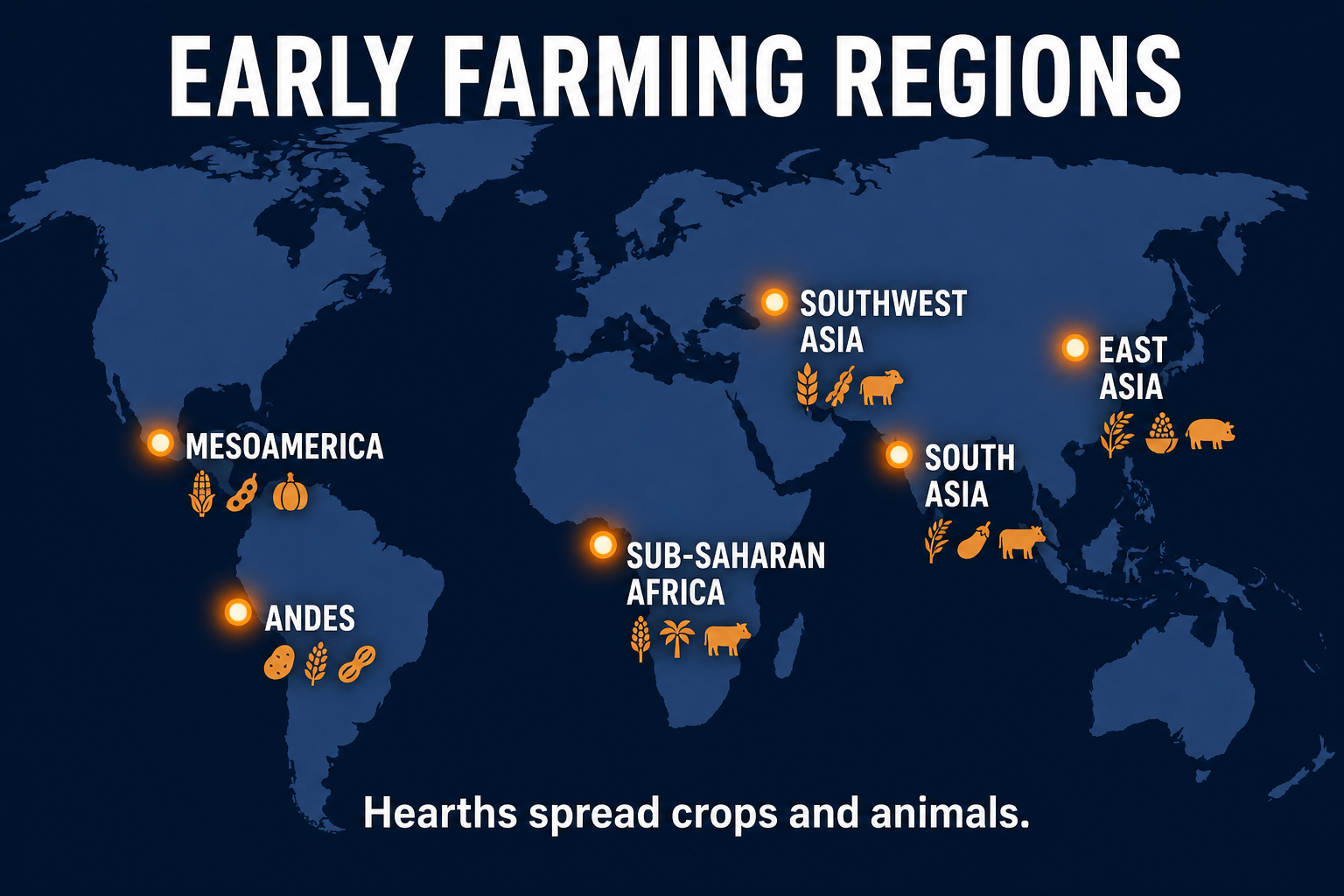
For AP Human Geography, you do not need to memorize every crop origin, but you should recognize the most common hearth clues.
| Agricultural Hearth | Quick Memory Clue | AP Exam Meaning |
|---|---|---|
| Southwest Asia | Wheat, barley, sheep, goats | Early cereals and livestock |
| East Asia | Rice and millet | River valleys and intensive cultivation |
| South Asia | River valley and monsoon farming | Regional crop and animal systems |
| Mesoamerica | Maize, beans, squash | Crop complex supporting settlement |
| Andes | Potatoes, quinoa, llamas, alpacas | Highland adaptation |
| Sub-Saharan Africa | Sorghum, millet, yams | Climate-adapted regional crops |
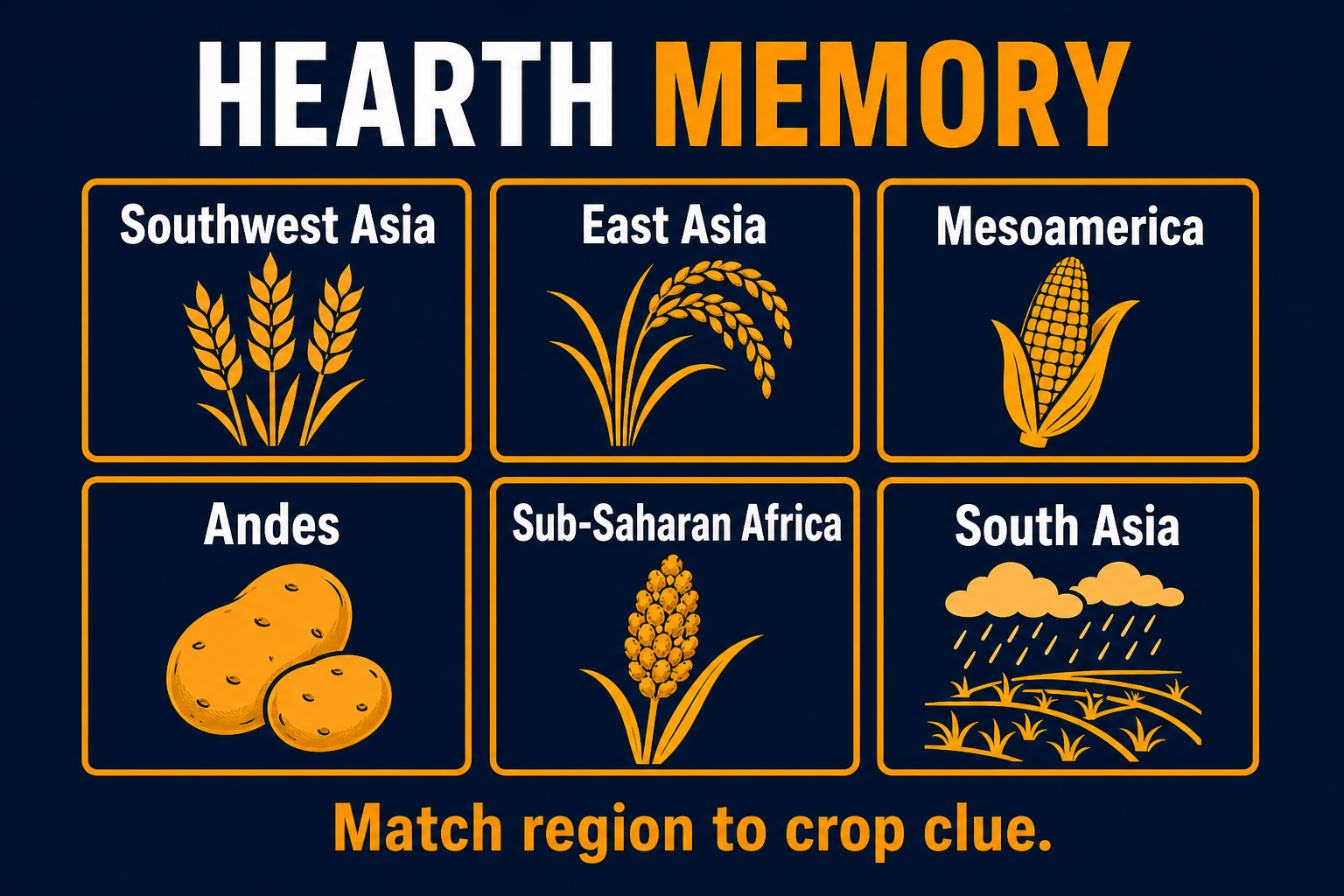
Origins of agriculture explains how farming began. Agricultural hearths explain where farming and domestication first developed. AP questions often require students to separate the process from the place.
| Concept | Meaning | AP Clue |
|---|---|---|
| Origins of agriculture | The process by which farming began | Domestication, surplus, settlement |
| Agricultural hearths | Regions where farming first developed | Early farming regions and crop origins |
| Agricultural diffusion | Spread of crops, animals, and farming practices | Migration, trade, cultural exchange |
Review the process on origins of agriculture. On AP questions, use “origins” for the process and “hearths” for the places.
Agricultural hearths formed because multiple environmental and human factors worked together—not because farming randomly appeared in one lucky spot.
Some regions had species that could be domesticated for food, fiber, or labor.
Rich soils supported early cultivation and repeated planting.
Rivers, rainfall, or groundwater helped crops survive.
Temperature and precipitation had to support farming.
Predictable seasons helped planting and harvest cycles.
People tested seeds, herding, and storage over time.
Growing groups needed more reliable food sources.
Valleys often combined water, soil, and transport advantages.
After farming developed in hearth regions, crops, animals, tools, and farming knowledge spread to other places through migration, trade, cultural diffusion, and adaptation to local environments.
| Spread Process | How It Works | AP Example Clue |
|---|---|---|
| Relocation diffusion | Farmers move and bring crops, animals, and techniques | Migration with farming knowledge |
| Expansion diffusion | Farming spreads outward from a hearth to nearby places | Neighboring regions adopt crops |
| Trade | Crops and animals move through exchange networks | Goods, seeds, and livestock circulate |
| Cultural diffusion | People borrow farming practices without moving permanently | New techniques adopted locally |
| Environmental adaptation | Farming changes as it enters new climates | Crop or technique adjusted to place |
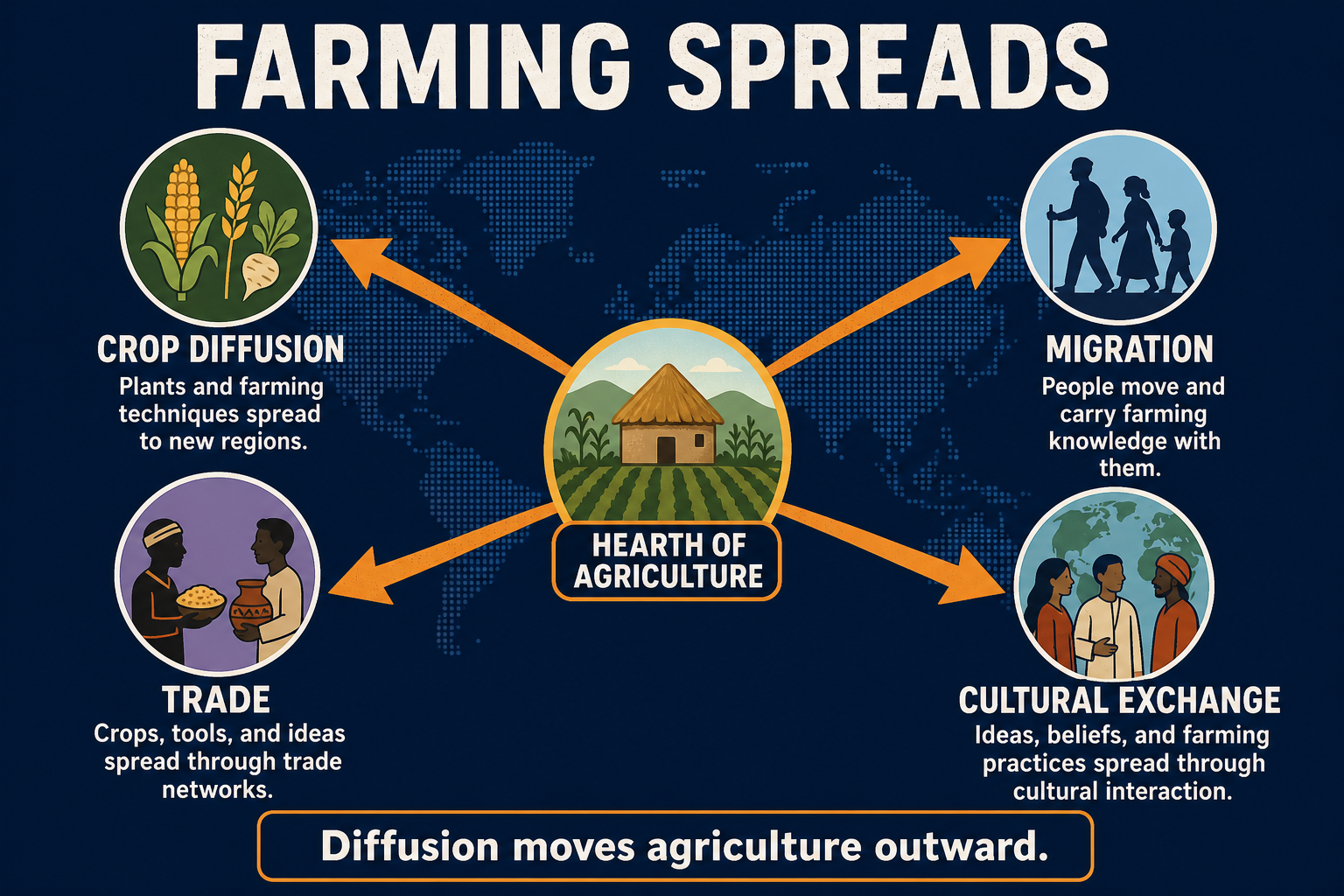
You do not need to memorize every crop, but you should know that different hearths produced different domesticated plants and animals.
| Crop or Animal | Likely Hearth Association | Why It Matters |
|---|---|---|
| Wheat | Southwest Asia | Early cereal crop linked to farming and settlement |
| Barley | Southwest Asia | Early domesticated grain |
| Rice | East Asia | Major crop tied to intensive wet-rice agriculture |
| Millet | East Asia and Africa | Adapted to varied climates and dry regions |
| Maize | Mesoamerica | Major crop supporting settlement and population growth |
| Beans and squash | Mesoamerica | Crop complex often associated with maize systems |
| Potatoes | Andes | Highland crop adapted to cool mountain environments |
| Llamas and alpacas | Andes | Domesticated animals adapted to highland environments |
| Sorghum and yams | Sub-Saharan Africa | Important regional crops adapted to local environments |
| Sheep and goats | Southwest Asia | Early livestock linked to pastoral and farming systems |
Agricultural hearths set the geographic foundation for food systems, settlement, and cultural landscapes that AP Human Geography tests across Unit 5.
Hearth regions produced more food than immediate need.
Reliable crops encouraged villages near fields.
More food could support larger groups.
Each hearth developed distinct crop and livestock patterns.
Farming shaped diet, rituals, and rural identity.
Domesticated species moved beyond hearths.
Regional foods reflected hearth domestication.
Farming practices spread outward from origin regions.
Surplus goods moved between settlements.
Hearth domestication preceded later farming changes.
AP Human Geography often tests hearths through crop clues, origin regions, and maps showing farming spreading between places.
| Question Clue | Likely Concept | What to Explain |
|---|---|---|
| Where a crop was first domesticated | Agricultural hearth | Origin region of farming or domestication |
| Maize, beans, squash | Mesoamerica | Crop complex and settlement support |
| Wheat, barley, sheep, goats | Southwest Asia | Early cereals and livestock |
| Rice or millet | East Asia | Early crop domestication and intensive cultivation |
| Potatoes or llamas | Andes | Highland adaptation |
| Farming spreads from one region to another | Agricultural diffusion | Migration, trade, or cultural exchange |
| Domestication in a specific region | Agricultural hearth | Place-based origin of agriculture |
| Same crop grown in distant regions | Diffusion and adaptation | Spread from hearth, then local adjustment |
Use this four-step method whenever a prompt asks where a crop originated or how farming spread from an early region.
Name Southwest Asia, East Asia, Mesoamerica, the Andes, or another hearth.
Link maize to Mesoamerica, wheat to Southwest Asia, rice to East Asia, etc.
Connect species, water, soil, climate, or human experimentation.
Link to diffusion, settlement, population, diet, or cultural landscapes.
The agricultural hearth was __________ because __________. This mattered because __________ spread or changed __________.
Example: Mesoamerica was an agricultural hearth because crops such as maize, beans, and squash were domesticated there. This mattered because maize-based agriculture supported settlement, population growth, and the diffusion of farming practices.
Use this sentence when an FRQ asks where agriculture began or how farming spread.
| Concept Pair | Difference | AP Clue |
|---|---|---|
| Origins vs hearths | Origins means how farming began; hearths are where farming began | Process vs place |
| Hearth vs diffusion | Hearth is the source region; diffusion is the spread | Start point vs movement |
| Domestication vs cultivation | Domestication adapts species; cultivation grows crops | Adaptation vs production |
| Agricultural hearth vs cultural hearth | Agricultural hearth focuses on farming; cultural hearth can include broader cultural traits | Farming origin vs broader culture origin |
| First Agricultural Revolution vs agricultural hearths | First Agricultural Revolution is the broad transition; hearths are the regions where farming developed | Event/process vs region |
Saying all agriculture began in one place
Confusing hearths with diffusion
Treating every crop as coming from the same region
Forgetting animals can be domesticated too
Memorizing crops without explaining impact
Confusing agricultural hearths with the Green Revolution
Forgetting local adaptation after diffusion
Not connecting hearths to settlement, surplus, or population growth
Read each scenario, predict the hearth concept, then reveal the answer. This trains the same reasoning AP Human Geography uses on map and scenario prompts.
Revealed: 0 of 4 scenarios
A question describes maize, beans, and squash as crops that supported early farming settlements. Which agricultural hearth is most likely involved?
Answer: Mesoamerica, because maize, beans, and squash are strongly associated with early farming systems in that region.
A question describes wheat, barley, sheep, and goats as early domesticated species. Which agricultural hearth is most likely involved?
Answer: Southwest Asia, because early cereal grains and livestock are commonly associated with that hearth.
A map shows farming spreading outward from an early farming region through migration and trade. Which concept is shown?
Answer: Agricultural diffusion, because farming practices are moving from a hearth to other regions.
A question asks why early farming developed in a region with fertile soils, water access, and useful plant species. Which concept is being tested?
Answer: Agricultural hearth formation, because the question asks why a specific region supported early domestication.
Answer all eight questions. Choices shuffle each time you reload, so focus on reasoning—not letter memorization.
Open each card, draft your response, then reveal the rubric and sample when ready. Strong hearth FRQs define the region, connect domestication, and explain diffusion or geographic impact.
Define agricultural hearth and explain one way agricultural hearths influenced the spread of farming.
An agricultural hearth is a region where farming and domestication first developed. Agricultural hearths influenced the spread of farming because crops, animals, and techniques moved outward from these origin areas. This spread could happen through migration, trade, or cultural diffusion. As farming spread, it changed settlement patterns, diets, population growth, and cultural landscapes in new regions.
Status: Draft your answer first—then open the rubric or sample.
Choose one agricultural hearth and explain how one crop or animal associated with that hearth affected human settlement or land use.
Mesoamerica was an agricultural hearth associated with maize. Maize affected human settlement because it provided a reliable crop that could support food surplus and more permanent communities. As maize farming expanded, it shaped land use through fields, storage, settlement growth, and cultural landscapes based around crop production.
Status: Draft your answer first—then open the rubric or sample.
Agricultural hearths are regions where farming and domestication first developed. They are origin regions for crops, livestock, and farming practices.
Agricultural hearths are important because they show where farming began, where crops and animals were domesticated, and how agriculture spread to other regions.
Origins of agriculture means the process by which farming began. Agricultural hearths are the specific regions where farming and domestication first developed.
Examples include Southwest Asia, East Asia, South Asia, Mesoamerica, the Andes, and Sub-Saharan Africa.
Mesoamerica is strongly associated with maize, beans, squash, and related crop systems.
Southwest Asia is often associated with wheat, barley, sheep, goats, and other early domesticated species.
Agriculture spread from hearths through migration, trade, cultural diffusion, and adaptation to local environments.
Identify the hearth region, connect it to a crop or animal, and explain how domestication or diffusion affected settlement, population, land use, or cultural landscapes.