Climate change after the last Ice Age
Warmer and more stable climates could support farming in some regions.
AP clue: Connect environmental change to where farming became possible.
Unit 5 Learning Journey · Agriculture and Rural Land Use
The origins of agriculture explain how humans shifted from hunting and gathering to the deliberate cultivation of plants and domestication of animals. In AP Human Geography, this matters because agriculture changed settlement patterns, population growth, labor systems, food surplus, cultural landscapes, and the diffusion of farming practices.
The previous page, Introduction to Agriculture, defined agriculture as a land-use system. This page explains how farming began. Students learn how domestication, food surplus, environmental conditions, and human decisions helped shift societies from foraging to farming. After this page, students should study Agricultural Hearths and the First Agricultural Revolution.
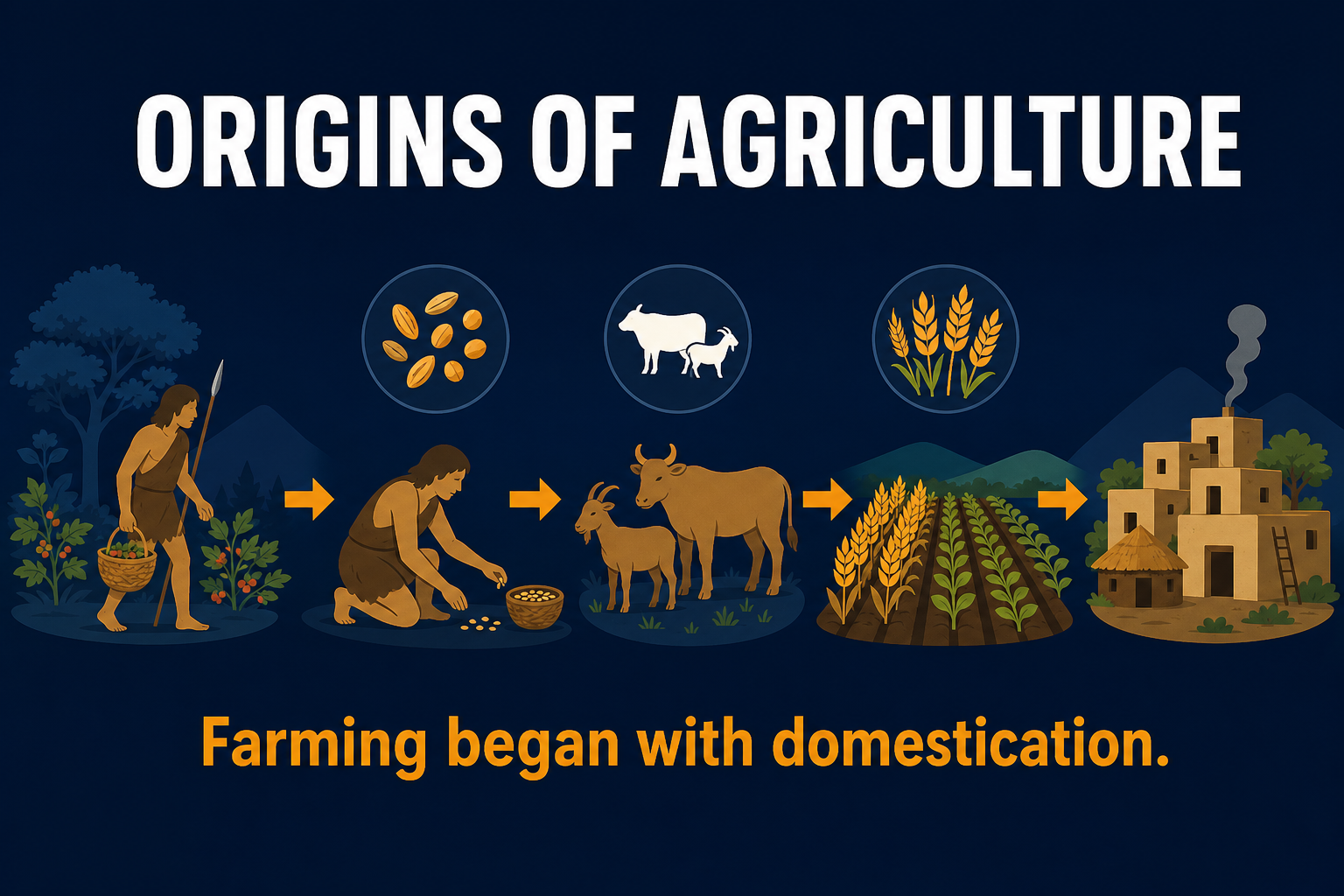
The origins of agriculture AP Human Geography topic builds on the Unit 5 foundation because every later farming concept—from hearths to the Green Revolution—starts with domestication and the shift from foraging to controlled food production.
Origins of Agriculture
How and why farming began.
The origins of agriculture refer to the transition from hunting and gathering to the domestication of plants and animals. In AP Human Geography, this transition matters because farming allowed food surplus, more permanent settlement, population growth, labor specialization, property systems, cultural landscapes, and the diffusion of crops and livestock across regions.
Agriculture did not appear overnight. Early farming emerged as humans domesticated species, produced surplus food, settled near fields, grew in number, and spread crops and livestock to new regions—often in environments that supported cultivation.
Domestication is the process of adapting wild plants and animals for human use. It allowed people to intentionally grow crops and raise livestock.
Agriculture made it possible to produce more food than a group needed immediately. Surplus supported storage, trade, specialization, and population growth.
Farming encouraged more permanent settlements because people needed to stay near fields, stored food, livestock, and water sources.
A more reliable food supply could support larger populations, although it also created new challenges such as disease, inequality, and land pressure.
Agricultural practices spread from early farming hearths to nearby and distant regions through migration, trade, and cultural diffusion.
Agriculture often began in places with useful soils, water access, plant and animal species suitable for domestication, and climates that supported farming.
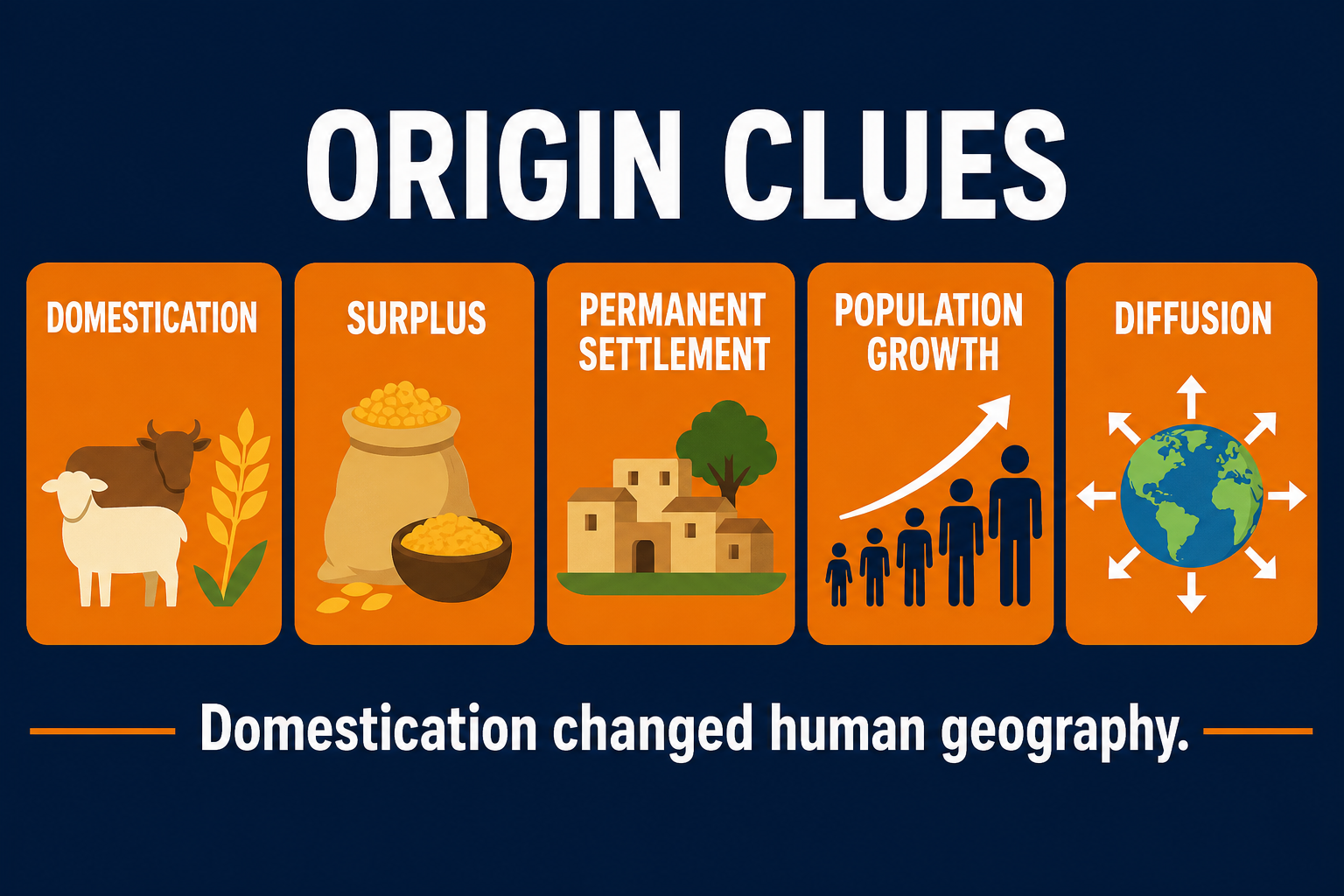
| Origin Factor | What It Means | AP Exam Clue |
|---|---|---|
| Domestication | Plants and animals adapted for human use | Crops, livestock, selective breeding |
| Food surplus | More food produced than immediately needed | Storage, trade, specialization |
| Permanent settlement | People live closer to fields and animals | Villages, houses, stored grain |
| Population growth | Food supply supports larger populations | More people, denser settlements |
| Diffusion | Farming spreads to new regions | Migration, trade, crop movement |
| Environment | Conditions support early farming | Water, soil, climate, suitable species |
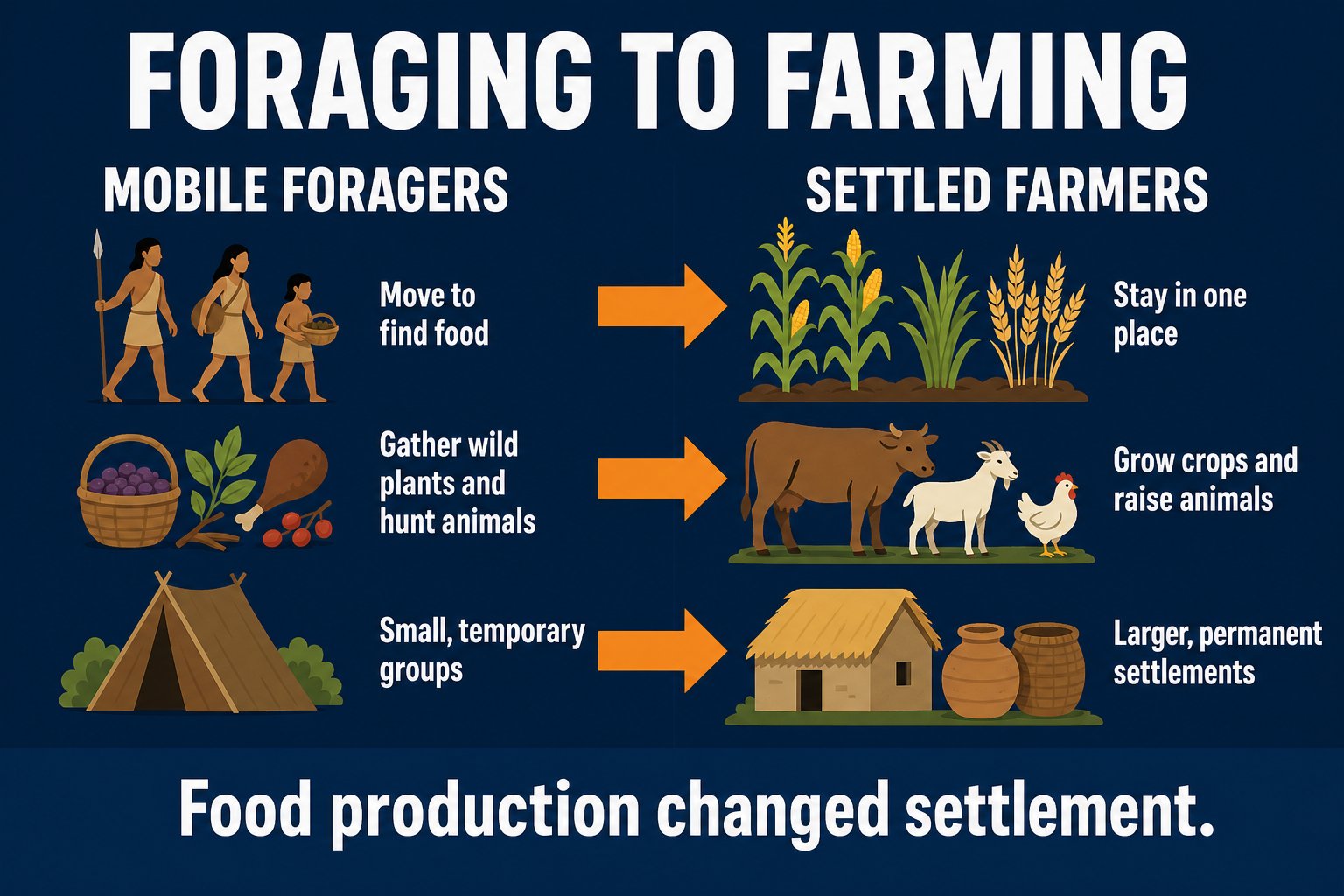
Before agriculture, most people relied on hunting, gathering, fishing, and foraging. Farming changed human geography because food production became more controlled, more place-based, and more connected to settlement.
| Feature | Foraging | Farming |
|---|---|---|
| Food source | Wild plants and animals | Domesticated crops and animals |
| Mobility | More mobile | More settled |
| Settlement | Temporary camps or seasonal movement | Villages and permanent settlements |
| Food supply | Seasonal and variable | More controllable and storable |
| Population | Smaller and more mobile groups | Larger and denser populations possible |
| Labor | Hunting, gathering, fishing, foraging | Planting, herding, irrigation, harvesting |
| Landscape impact | Lower permanent modification | Fields, pastures, storage, roads, villages |
| AP clue | Mobility and wild resources | Domestication and land-use change |
Agriculture developed because multiple factors interacted—not because of one single cause. Climate, species, population pressure, soils, water, experimentation, settlement, and storage all played roles in different places and times.
Warmer and more stable climates could support farming in some regions.
Some species could be adapted for food, fiber, or labor.
Growing groups needed more reliable food sources.
Farming could reduce dependence on seasonal wild resources.
Rivers, valleys, and good soils supported early cultivation.
People tested planting, herding, and storage over time.
Groups already near water or rich land could farm more easily.
Stored food made farming more valuable than immediate consumption.
Origins of agriculture means the process by which farming began. Agricultural hearths are the specific regions where farming and domestication first developed.
| Concept | Meaning | AP Clue |
|---|---|---|
| Origins of agriculture | The process of farming beginning | Domestication, surplus, settlement, population growth |
| Agricultural hearths | Regions where farming began | Southwest Asia, East Asia, Mesoamerica, Andes, Sub-Saharan Africa |
| Agricultural diffusion | Spread of farming from hearths | Migration, trade, cultural exchange |
Read the full hearth guide on agricultural hearths. On AP questions, origins explains how farming began; hearths name where it began first.
The First Agricultural Revolution, also called the Neolithic Revolution, describes the broad transformation from hunting and gathering to agriculture. The origins of agriculture explain how that transformation began.
| Idea | What It Explains | AP Exam Meaning |
|---|---|---|
| Origins of agriculture | How farming began | Domestication and early farming causes |
| First Agricultural Revolution | The large-scale shift to farming | Food surplus, settlement, population growth |
| Domestication | Human adaptation of plants and animals | Foundation of farming |
| Food surplus | Extra food beyond immediate need | Supports settlement and specialization |
The full guide is on the First Agricultural Revolution. Use origins language for domestication and early causes; use First Ag Rev language for the large-scale shift to farming societies.
Early agriculture reshaped human geography in ways AP Human Geography tests repeatedly. Each effect below links a change to the clue language you may see on maps and FRQs.
Villages formed near fields, water, and stored food.
Extra food supported storage, trade, and specialization.
More reliable food could support larger groups.
Not everyone had to forage full time.
Fields and animals created claims to land.
Some groups controlled more land or surplus than others.
Clearing land, irrigation, and grazing altered landscapes.
Farming shaped diet, rituals, and rural identity.
Surplus goods moved between settlements.
Domesticated species spread beyond hearths.
AP Human Geography often tests origins through scenario clues—domesticated crops, stored grain, permanent villages, population growth, or farming spreading between regions.
| Question Clue | Likely Concept | What to Explain |
|---|---|---|
| Domesticated wheat, rice, maize, or animals | Domestication | Humans adapted species for food production |
| Permanent villages near fields | Farming settlement effect | People stayed near crops, animals, and stored food |
| Stored grain or food surplus | Food surplus | Extra food supports population and specialization |
| Population grows after farming begins | Agricultural transition | More reliable food can support larger groups |
| Farming spreads from one region to another | Agricultural diffusion | Migration, trade, or cultural exchange spreads farming |
| Early farming region | Agricultural hearth | Specific place where domestication began |
| Hunting and gathering replaced by farming | First Agricultural Revolution | Shift from foraging to agriculture |
| Soil erosion or land clearing | Environmental impact | Farming modifies landscapes |
Use this four-step method whenever a prompt describes domestication, surplus, early settlement, hearths, or the spread of farming.
Name domestication, surplus, settlement, hearth, or diffusion.
Point to crops, livestock, villages, stored grain, or migration routes in the source.
Connect environment, domestication, or human decisions to why farming began.
Link to settlement, population, labor, environment, or cultural diffusion.
The origin of agriculture involved __________ because __________. This changed human geography by __________.
Example: The origin of agriculture involved domestication because humans began adapting plants and animals for controlled food production. This changed human geography by encouraging permanent settlement, food surplus, and population growth.
Use this sentence when an FRQ asks how farming began or why agriculture changed human geography.
| Concept Pair | Difference | AP Clue |
|---|---|---|
| Origins of agriculture vs agricultural hearths | Origins means how farming began; hearths are where farming began | process vs place |
| Domestication vs diffusion | Domestication adapts plants/animals; diffusion spreads farming | creation vs spread |
| Foraging vs farming | Foraging uses wild resources; farming uses domesticated species | mobility vs fields |
| Food surplus vs population growth | Surplus is extra food; population growth is one possible result | cause vs effect |
| First Agricultural Revolution vs Green Revolution | First is domestication; Green is modern input-based yield increase | beginning farming vs modern technology |
Saying agriculture began everywhere at the same time
Confusing origins of agriculture with agricultural hearths
Defining domestication as simply "finding food"
Forgetting livestock is part of agriculture
Saying farming only had positive effects
Ignoring food surplus as a major effect
Forgetting diffusion after farming begins
Confusing the First Agricultural Revolution with the Green Revolution
Read each scenario, predict the origins concept, then reveal the answer. This trains the same reasoning AP Human Geography uses on map and scenario prompts.
Revealed: 0 of 4 scenarios
A group begins planting selected seeds near a river and returning to the same fields each season. Which origins concept is shown?
Answer: Domestication and early farming, because people are intentionally cultivating plants for human use.
A village stores extra grain after harvest. Which origins effect is shown?
Answer: Food surplus, because the group produced more food than it needed immediately.
A settlement becomes more permanent because people need to stay near crops, animals, and stored food. Which effect is shown?
Answer: Permanent settlement, because agriculture encouraged people to live near fields and food storage.
A crop first domesticated in one region spreads to nearby regions through migration and trade. Which concept is shown?
Answer: Agricultural diffusion, because farming practices and crops moved from one place to another.
Answer all eight questions. Choices shuffle each time you reload, so focus on reasoning—not letter memorization.
Open each card, draft your response, then reveal the rubric and sample when ready. Strong origins FRQs define domestication or surplus, explain cause and effect, and connect farming to settlement or population.
Define domestication and explain one way domestication changed human settlement patterns.
Domestication is the process of adapting plants or animals for human use. It allowed people to grow crops and raise livestock instead of relying only on wild resources. This changed settlement patterns because people often stayed near fields, animals, water sources, and stored food, which encouraged more permanent villages and rural land-use patterns.
Status: Draft your answer first—then open the rubric or sample.
Explain how the origins of agriculture could lead to food surplus and population growth.
The origins of agriculture involved controlled food production through domesticated crops and animals. This could create food surplus because farming sometimes produced more food than people needed immediately. Surplus could support larger populations, storage, trade, and labor specialization. However, larger settlements could also create problems such as disease, inequality, land pressure, or environmental change.
Status: Draft your answer first—then open the rubric or sample.
The origins of agriculture refer to the transition from hunting and gathering to the domestication of plants and animals for controlled food production.
Domestication is the process of adapting wild plants and animals for human use, such as crops, livestock, food, fiber, labor, or other needs.
Agriculture began because multiple factors worked together, including climate change, useful plant and animal species, population pressure, fertile soils, water access, food storage, and human experimentation.
Agriculture encouraged more permanent settlement because people often needed to stay near fields, livestock, water, and stored food.
Food surplus means producing more food than a group needs immediately. Surplus can support storage, trade, population growth, and labor specialization.
Origins of agriculture means the process by which farming began. Agricultural hearths are the specific regions where farming and domestication first developed.
They are closely related. The origins of agriculture explain how farming began, while the First Agricultural Revolution describes the broad transformation from foraging to farming.
Identify the origin concept, such as domestication or food surplus, use evidence, and explain an effect on settlement, population, labor, environment, or diffusion.