Crop rotation
Farmers alternate crops with different nutrient needs instead of planting the same crop every year.
AP Exam Clue: Reduces nutrient depletion and can break pest cycles.
Unit 5 Learning Journey · Agriculture and Rural Land Use
Sustainable agriculture uses farming methods that produce food while protecting soil, water, biodiversity, and rural communities. In AP Human Geography, students use sustainable agriculture to explain how farming can reduce environmental damage, support long-term productivity, and respond to the costs of intensive commercial agriculture.
The previous page, Land Survey Patterns, explained how property boundaries divide rural land. This page shifts to how farming can protect land, water, soil, biodiversity, and rural communities over time. Sustainable agriculture helps students connect Green Revolution tradeoffs, agribusiness pressures, environmental impacts, and long-term food production. After this page, students should complete Unit 5 practice questions.
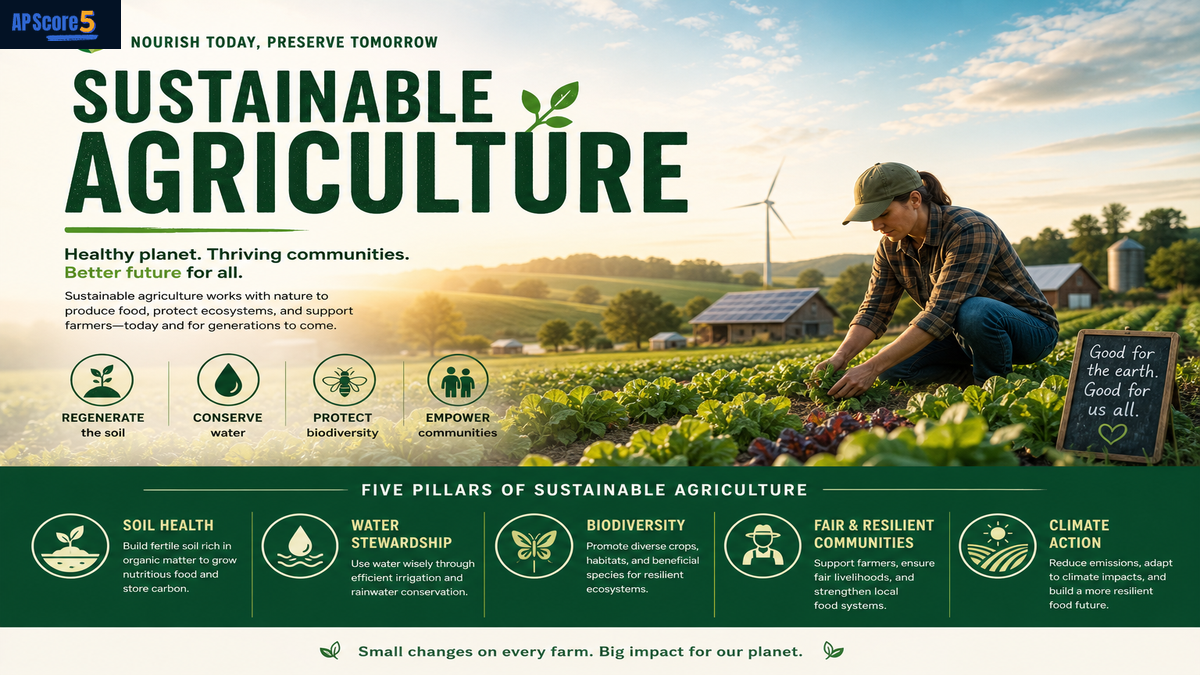
The sustainable agriculture AP Human Geography topic connects intensive farming pressures to long-term resource protection. When a prompt mentions soil conservation, reduced chemical use, water savings, or biodiversity, identify a sustainable method and explain the problem it addresses.
Sustainable Agriculture
Farming methods protect soil, water, and communities.
Sustainable agriculture is farming that meets current food needs while protecting the environmental, economic, and social resources needed for future farming. In AP Human Geography, sustainable agriculture includes methods that conserve soil, reduce water waste, protect biodiversity, limit pollution, support rural communities, and reduce dependence on harmful or expensive inputs.
AP prompts often ask students to explain how farming can balance food production with environmental protection, economic viability, and social well-being. Use all three goal types when a question asks about sustainability broadly.
| Goal | What It Means | AP Human Geography Clue |
|---|---|---|
| Environmental sustainability | Protect soil, water, biodiversity, and ecosystems | Conservation, pollution reduction, resource protection |
| Economic sustainability | Keep farms productive and financially viable | Lower risk, stable production, efficient resource use |
| Social sustainability | Support rural communities and fair access | Local food, labor, community resilience |
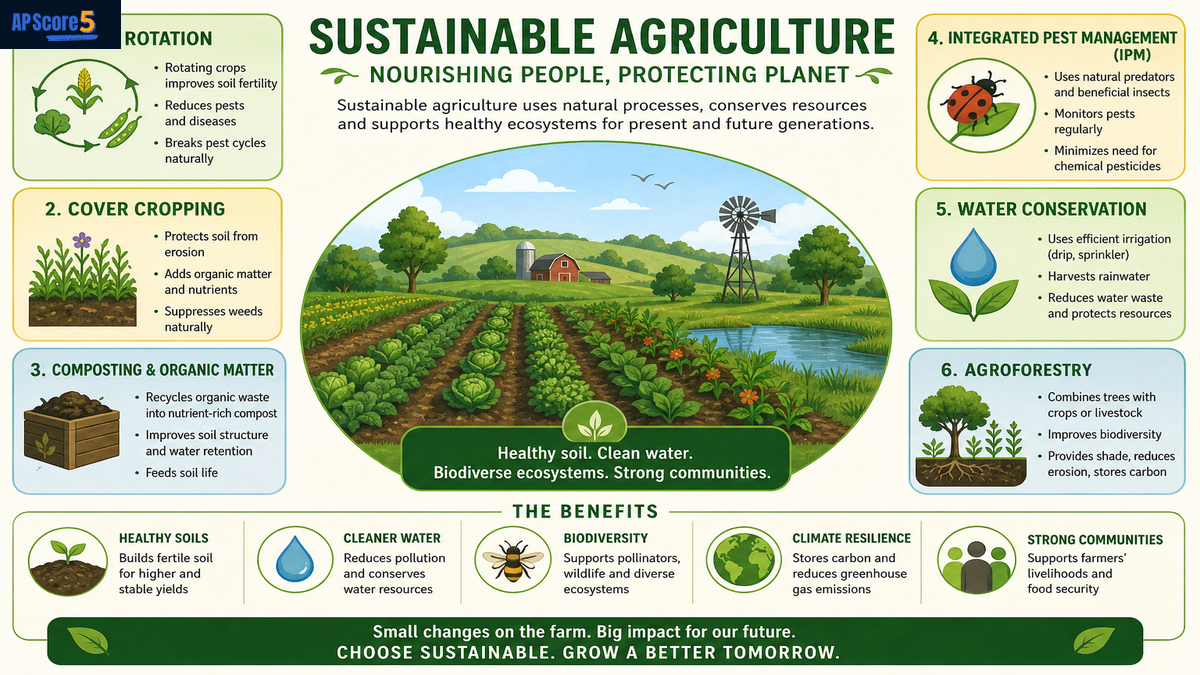
These methods appear on MCQs, FRQs, and map-based agriculture prompts. Name the method, connect it to a problem, and explain one benefit or tradeoff.
Farmers alternate crops with different nutrient needs instead of planting the same crop every year.
Farmers plant crops mainly to cover and protect soil between main harvests.
Farmers disturb less soil when planting and managing fields.
Organic waste is recycled into nutrient-rich soil amendment.
Water is delivered directly to plant roots through tubes or emitters.
Pest control combines monitoring, biological controls, and targeted pesticide use.
Trees and crops are grown together on the same land.
Farmers limit fertilizer and pesticide use when possible.
Farmers grow multiple crops or combine crops and livestock.
Food is produced and consumed closer to where it is grown.
Sustainable methods respond to problems created by intensive commercial farming, including soil erosion, water waste, pesticide pollution, and biodiversity loss. Compare with intensive vs extensive agriculture when a prompt contrasts farming intensity with conservation.
AP questions often ask students to connect an agricultural problem to a sustainable farming response. Use the problem, method, and effect together.
| Agricultural Problem | Sustainable Method | Why It Helps |
|---|---|---|
| Soil erosion | Cover crops or conservation tillage | Keeps soil in place and reduces topsoil loss |
| Water waste | Drip irrigation | Sends water directly to plant roots |
| Pesticide pollution | Integrated pest management | Reduces dependence on chemical pesticides |
| Loss of soil nutrients | Crop rotation or compost | Restores nutrients and improves soil health |
| Biodiversity loss | Diversified farming or agroforestry | Adds species variety and reduces risk |
| High input dependence | Reduced chemical inputs | Lowers costs and environmental pressure |
Green Revolution farming increased yields through high-yield seeds, irrigation, fertilizer, pesticides, and machinery. Sustainable agriculture responds to some of the environmental and economic costs of intensive input-dependent farming.
| Feature | Green Revolution Farming | Sustainable Agriculture |
|---|---|---|
| Main goal | Increase crop yields | Produce food while protecting long-term resources |
| Inputs | High-yield seeds, fertilizer, irrigation, pesticides | Soil conservation, water efficiency, biodiversity, reduced inputs |
| Environmental impact | Can increase runoff, water use, and soil stress | Tries to reduce pollution and resource depletion |
| Economic issue | Can increase dependence on costly inputs | Tries to reduce risk and improve resilience |
| AP clue | Yield increase and input dependence | Conservation and long-term productivity |
Agribusiness focuses on the business system around farming, including inputs, processing, transportation, retail, and consumers. Sustainable agriculture focuses on whether farming practices can continue without damaging the resources needed for future production.
| Concept | Main Meaning | AP Clue |
|---|---|---|
| Agribusiness | The business system around agriculture | Inputs, processing, transport, retail, corporations |
| Sustainable agriculture | Farming that protects long-term resources | Soil, water, biodiversity, reduced pollution |
| Where they overlap | Some businesses may market sustainable products | Look for both market and conservation language |
Sustainable agriculture can protect soil, water, and biodiversity, but it is not free of cost, labor, or scale challenges. AP answers should name both a benefit and a tradeoff when possible.
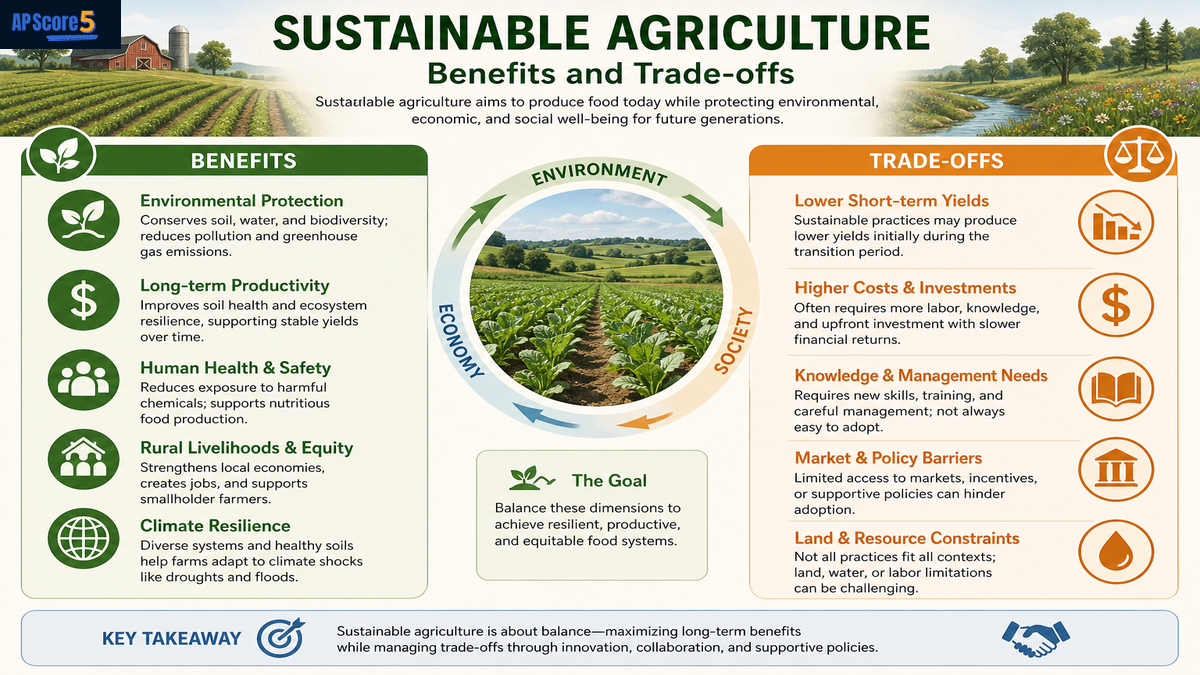
Use this table when an AP question asks how farming priorities change when sustainability becomes the goal.
| Before | After | AP Exam Meaning |
|---|---|---|
| Focus only on short-term yield | Focus on long-term productivity | Sustainability protects future farming |
| Heavy chemical dependence | Reduced or targeted inputs | Lower pollution and input risk |
| Water applied broadly | Water used efficiently | Conservation reduces waste |
| Single-crop risk | More diversified systems | Biodiversity improves resilience |
| Soil treated as replaceable | Soil treated as a resource | Soil health supports future yields |
Use this four-step method on MCQs and FRQs when a prompt describes soil erosion, water waste, pesticide pollution, or long-term food production.
Name erosion, water waste, pollution, or nutrient loss from the prompt.
Match cover crops, drip irrigation, crop rotation, or IPM to the problem.
Connect the method to environmental, economic, or social benefit.
Note cost, labor, planning, or short-term yield challenges.
Sustainable agriculture addresses __________ by using __________. This helps because __________, but one tradeoff is __________.
Example: Sustainable agriculture addresses soil erosion by using cover crops. This helps because plant roots hold soil in place and reduce topsoil loss, but one tradeoff is that farmers may need extra labor or planning.
One Perfect AP Sentence: Sustainable agriculture uses practices such as crop rotation, conservation tillage, drip irrigation, and integrated pest management to produce food while protecting soil, water, biodiversity, and long-term rural productivity.
Use this sentence when an FRQ asks how farming can reduce environmental harm while maintaining food production.
| Concept | Main Meaning | AP Clue |
|---|---|---|
| Sustainable agriculture | Long-term farming that protects resources | Soil, water, biodiversity, resilience |
| Organic farming | Farming that limits many synthetic chemicals | Chemical restrictions, certification, organic labels |
| Subsistence agriculture | Farming mainly for family or local consumption | Local needs, limited market sale |
| Commercial agriculture | Farming mainly for sale and profit | Market-oriented production |
Saying sustainable agriculture means no technology
Saying sustainable agriculture always produces higher yields immediately
Confusing sustainable agriculture with organic farming
Naming a method without explaining the problem it solves
Forgetting economic or social sustainability
Ignoring tradeoffs such as cost, labor, or scale
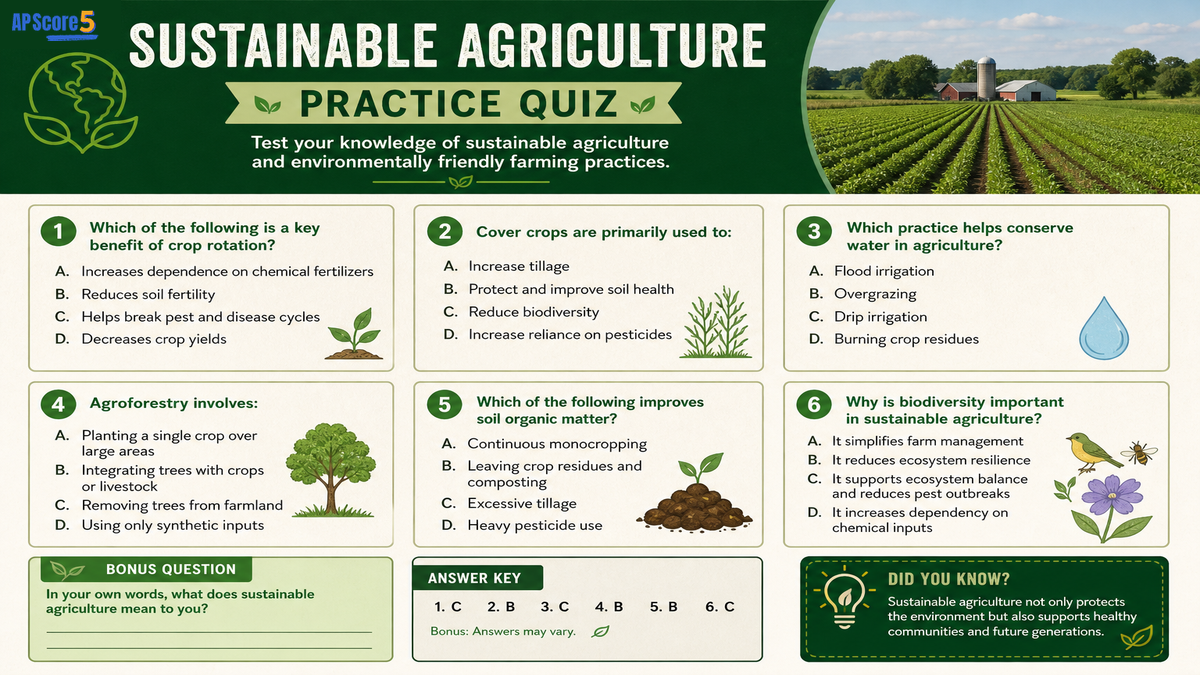
Read each scenario, predict the sustainable method, then reveal the answer. This trains the same reasoning AP Human Geography uses on agriculture and environmental impact prompts.
Revealed: 0 of 4 scenarios
A farm loses topsoil after heavy rain and wind. Which sustainable method could help?
Answer: Cover crops or conservation tillage, because plant cover and reduced soil disturbance help prevent erosion.
A farm wastes water by flooding entire fields. Which sustainable method could help?
Answer: Drip irrigation, because it sends water directly to plant roots and reduces waste.
A farm uses large amounts of pesticides every season. Which sustainable method could reduce chemical dependence?
Answer: Integrated pest management, because it combines monitoring, biological controls, and targeted pesticide use.
A farm grows the same crop every year and soil nutrients decline. Which sustainable method could help?
Answer: Crop rotation or composting, because they can restore soil nutrients and improve soil health.
Answer all eight questions. Choices shuffle each time you reload, so focus on reasoning—not letter memorization.
Open each card, draft your response, then reveal the rubric and sample when ready. Strong sustainable agriculture FRQs name a method, explain the problem it addresses, connect to food production, and note one tradeoff.
Explain how one sustainable agricultural practice can reduce environmental damage while maintaining food production.
One sustainable agricultural practice is crop rotation. Crop rotation can reduce soil nutrient depletion because farmers alternate crops with different nutrient needs instead of planting the same crop every year. This can help maintain food production because healthier soil supports future yields. One limitation is that farmers may need more planning, knowledge, or market access for multiple crops.
Status: Draft your answer first—then open the rubric or sample.
A region has water shortages caused by irrigation-heavy farming. Describe one sustainable response and explain one possible benefit.
One sustainable response is drip irrigation. Drip irrigation reduces water use because it delivers water directly to plant roots instead of flooding entire fields. This can conserve water and help farms continue producing crops in a region where water is limited.
Status: Draft your answer first—then open the rubric or sample.
Sustainable agriculture is farming that meets current food needs while protecting soil, water, biodiversity, rural communities, and long-term productivity.
Examples include crop rotation, cover crops, conservation tillage, composting, drip irrigation, integrated pest management, agroforestry, reduced chemical inputs, and diversified farming.
It is important because intensive farming can cause soil erosion, water waste, pollution, biodiversity loss, and dependence on costly inputs. Sustainable methods try to reduce these problems.
It can protect soil through cover crops, crop rotation, composting, and conservation tillage, which reduce erosion and improve soil health.
It can conserve water through drip irrigation, water-efficient crops, soil moisture monitoring, and farming practices that reduce runoff and evaporation.
No. Organic farming limits many synthetic chemicals, while sustainable agriculture focuses more broadly on long-term environmental, economic, and social balance.
Tradeoffs can include higher initial costs, more labor, more planning, possible lower short-term yields, and difficulty scaling some methods everywhere.
Name a sustainable method, explain the agricultural problem it addresses, describe how it helps, and include one benefit or tradeoff.