More food supply
Higher productivity helped produce enough food to support growing urban populations.
AP clue: Food supply, urban growth
Unit 5 Learning Journey · Agriculture and Rural Land Use
The Second Agricultural Revolution was a major increase in agricultural productivity tied to improved farming methods, crop rotation, selective breeding, enclosure, mechanization, and the rise of industrialization. In AP Human Geography, it matters because it changed labor systems, increased food supply, supported population growth, encouraged urbanization, and helped connect agriculture to industrial economies.
The previous page, Von Thünen Model, explained how market distance, transportation costs, perishability, and land rent help shape agricultural location. This page explains a later productivity shift: the Second Agricultural Revolution. After this page, students should study the Green Revolution to compare earlier mechanization and improved methods with modern high-yield seeds and inputs.
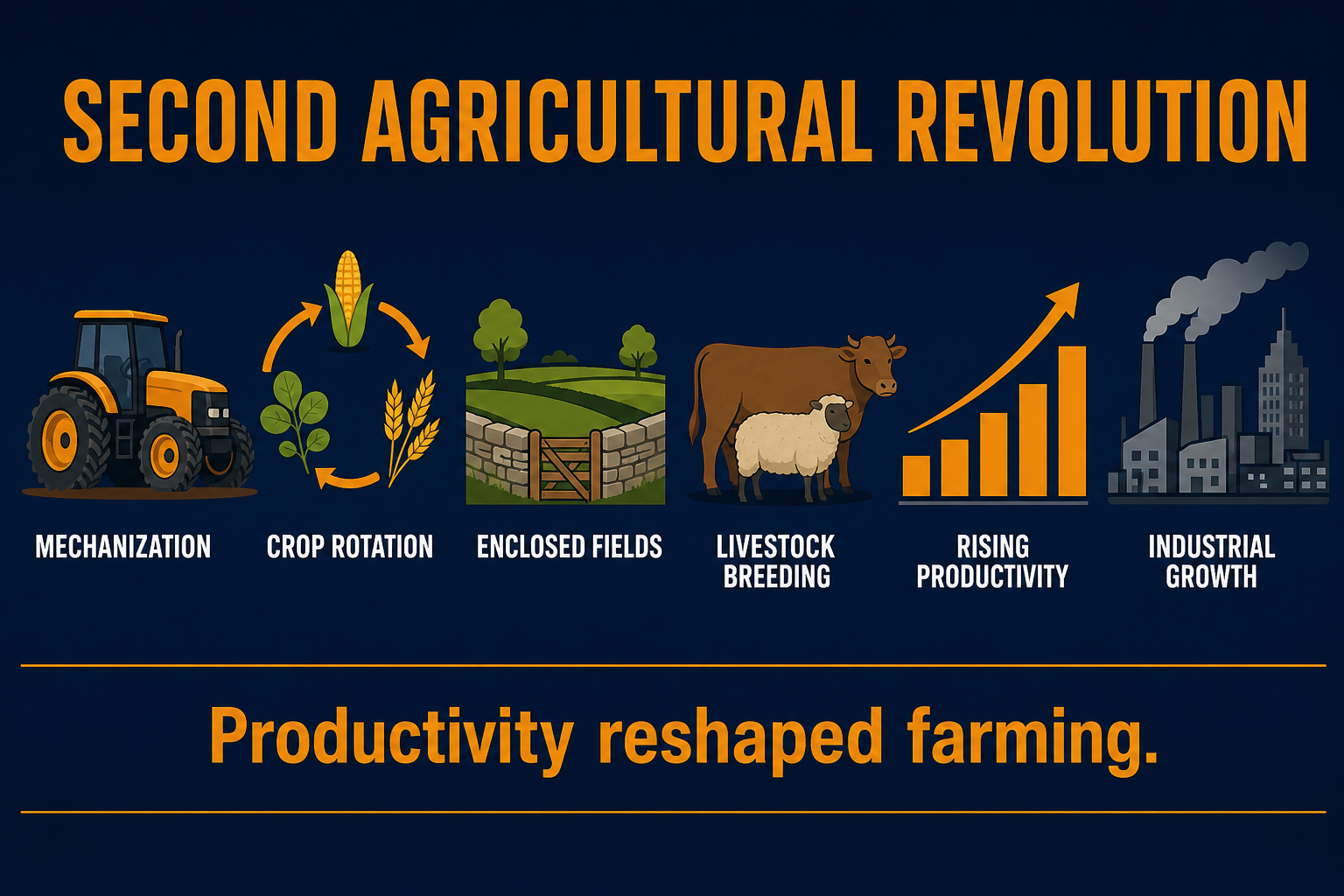
The Second Agricultural Revolution AP Human Geography topic connects improved methods to productivity gains—students explain how crop rotation, mechanization, enclosure, and selective breeding reshaped labor, food supply, cities, and industry.
Second Agricultural Revolution
Mechanization, crop rotation, and productivity gains.
The Second Agricultural Revolution was a major increase in agricultural productivity caused by improved farming methods, crop rotation, selective breeding, enclosure, mechanization, and connections to industrialization. In AP Human Geography, it matters because it increased food supply, reduced some farm labor needs, supported population growth, encouraged urbanization, and helped agriculture become more connected to industrial economies.
The Second Agricultural Revolution changed food systems, settlement, population, labor, and landscapes. Use the explorer to review each change before comparing origins, hearths, and effects.
Crop rotation improved soil fertility and helped farms produce more reliable yields by changing what was planted over time.
New tools and machines increased efficiency and reduced the amount of labor needed for some agricultural tasks.
Farmers improved crops and livestock by choosing traits that increased productivity, size, strength, or usefulness.
Enclosure reorganized land into larger, more controlled farms, changing rural land ownership, labor, and settlement patterns.
The revolution increased output per worker and per unit of land, helping support population growth.
Higher agricultural productivity helped feed growing cities and freed labor for industrial work.
| Change | What It Means | AP Exam Clue |
|---|---|---|
| Crop rotation | Rotating crops to maintain soil fertility | Improved yields and soil use |
| Mechanization | Using machines and tools to farm more efficiently | Labor and productivity change |
| Selective breeding | Choosing useful plant or animal traits | Higher output or improved livestock |
| Enclosure | Consolidating and reorganizing land | Property, rural labor, and land-use change |
| Productivity growth | More output per worker or land area | Food supply and population growth |
| Industrialization | Agriculture supports factory-based economies | Urbanization and labor shifts |
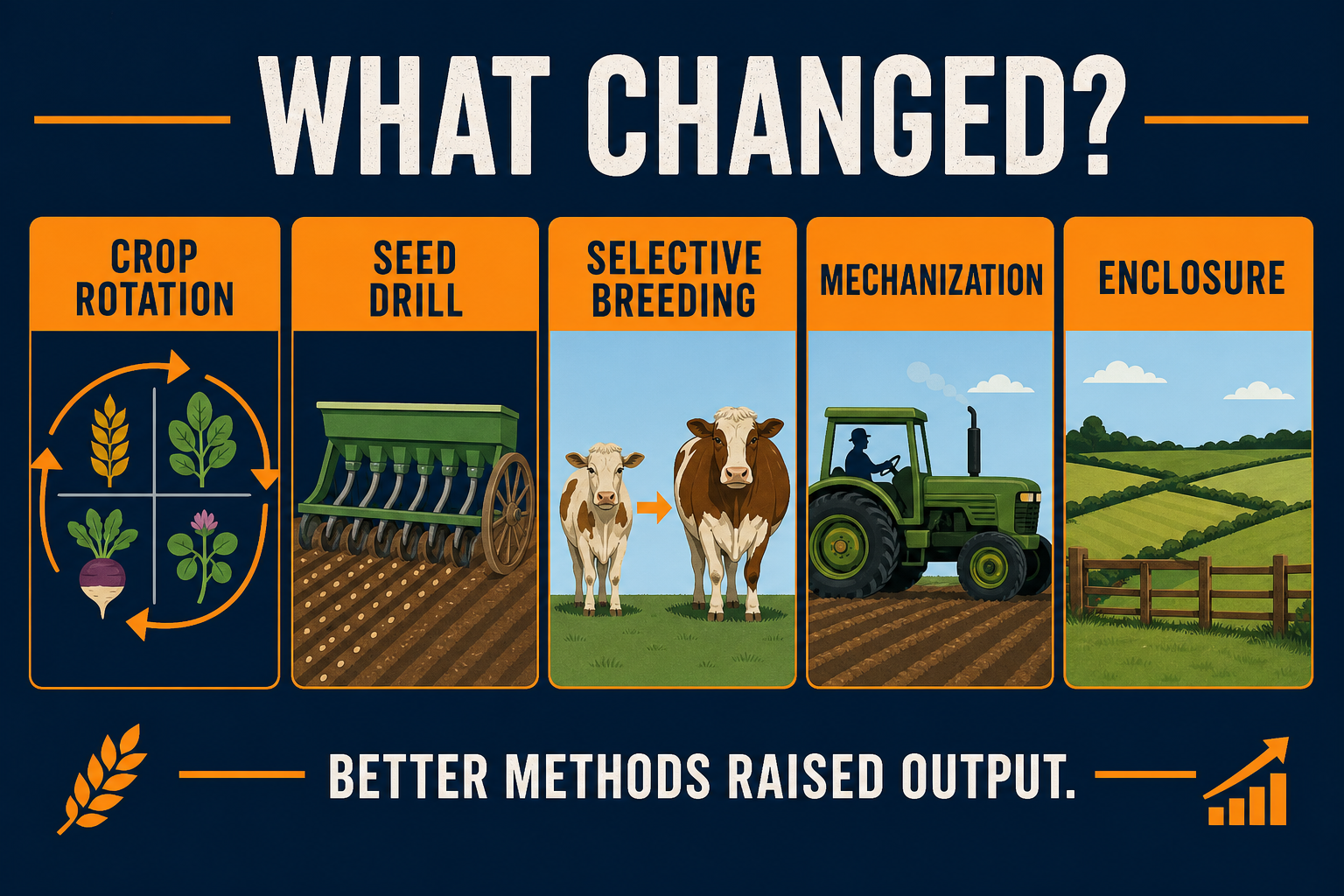
Compare how the First Agricultural Revolution began farming with how the Second Agricultural Revolution later increased productivity through improved methods and mechanization.
| Concept | Main Change | AP Clue |
|---|---|---|
| First Agricultural Revolution | Shift from foraging to farming through domestication | Origins, domestication, surplus, villages |
| Second Agricultural Revolution | Increased productivity through improved methods and mechanization | Crop rotation, enclosure, mechanization |
| Agricultural hearths | Regions where farming first developed | Crop and livestock origins |
| Green Revolution | Modern yield increase through high-yield seeds and inputs | HYVs, irrigation, fertilizer, pesticides |
Review the First Agricultural Revolution for domestication and the shift to farming. See agricultural hearths for where farming first developed. Compare later changes on the Green Revolution page.
Students often confuse the Second Agricultural Revolution with the Green Revolution. The Second Agricultural Revolution is earlier and tied to improved methods, mechanization, enclosure, and industrialization. The Green Revolution is later and tied to high-yield seeds, irrigation, fertilizer, pesticides, and modern input packages.
| Feature | Second Agricultural Revolution | Green Revolution |
|---|---|---|
| Time/context | Earlier productivity shift linked to industrialization | Later modern productivity shift |
| Main tools | Crop rotation, mechanization, selective breeding, enclosure | High-yield seeds, irrigation, fertilizer, pesticides, machinery |
| Main effect | More productivity and labor change | Higher crop yields, especially in developing regions |
| AP clue | enclosure, mechanization, industrialization | HYVs, Borlaug, fertilizer, irrigation |
| Tradeoffs | rural displacement, land ownership changes, labor shifts | input dependence, water use, runoff, inequality |
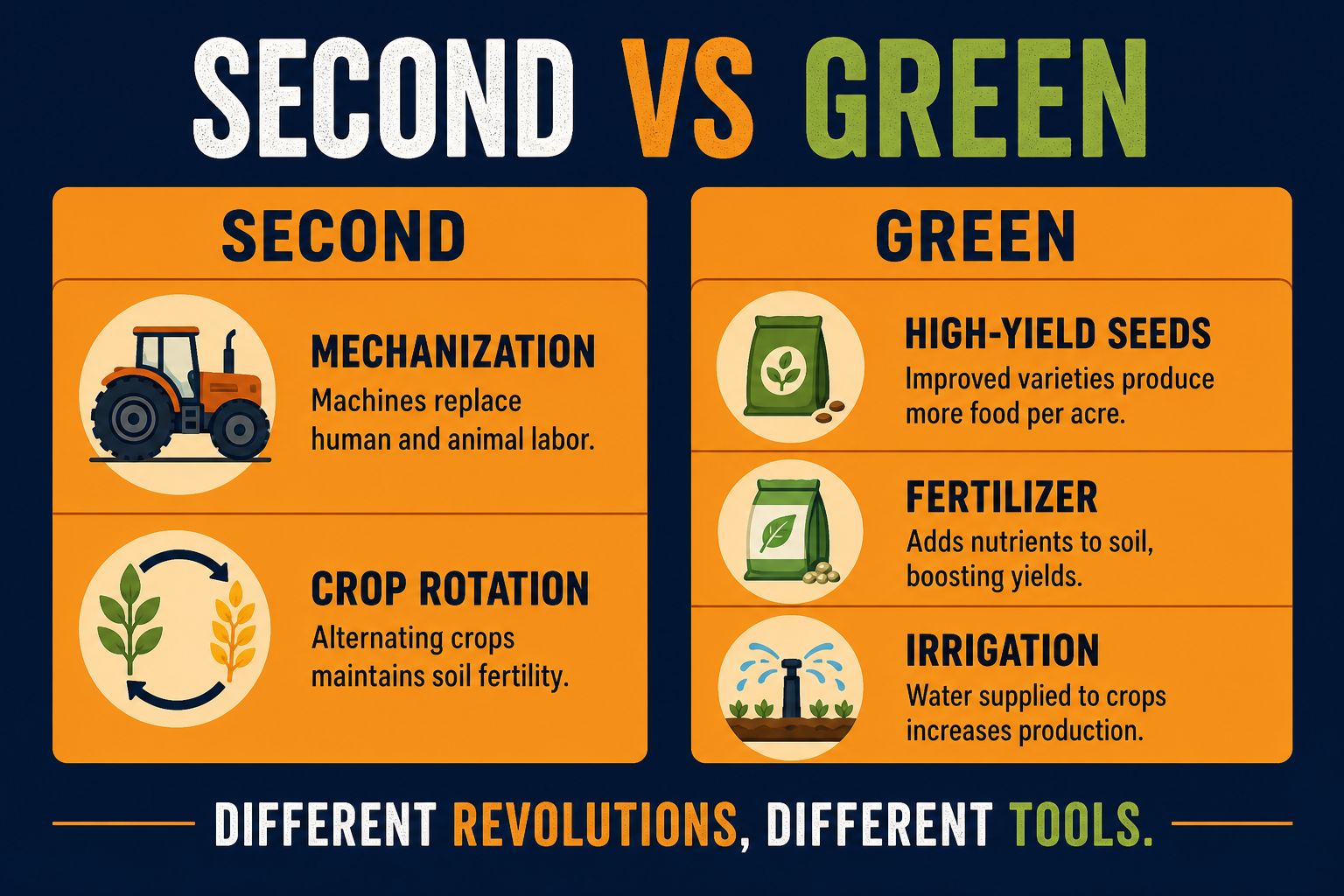
AP questions often ask students to explain the Second Agricultural Revolution as a cause-effect chain. Use the event, the change, and the geographic effect together.
| Cause or Change | Immediate Result | Human Geography Effect |
|---|---|---|
| Crop rotation | Better soil fertility and yields | More reliable food supply |
| Mechanization | Faster farming tasks | Fewer workers needed for some farm jobs |
| Selective breeding | Improved crops and livestock | Higher productivity |
| Enclosure | Larger organized farms | Changed rural labor and land ownership |
| Higher productivity | More food production | Population growth and urbanization support |
| Industrialization | Demand for food and labor shifts | Agriculture tied to factory-based economies |
The Second Agricultural Revolution created major benefits, but it also produced environmental and social tradeoffs that AP Human Geography expects students to explain.
The Second Agricultural Revolution helped industrialization by increasing food supply and reducing the share of workers needed on farms. More food could support growing urban populations, while displaced or freed rural workers could move into industrial jobs. This connection makes the Second Agricultural Revolution important for both agriculture and economic development.
Higher productivity helped produce enough food to support growing urban populations.
Mechanization and efficiency reduced the share of workers needed on farms.
More reliable food supported denser urban settlement during industrialization.
Workers freed from some farm tasks could move into industrial jobs.
Productivity gains connected farms more strongly to urban and industrial demand.
Enclosure reorganized who controlled land and how farms were managed.
Output per worker and per land area rose through improved methods.
Agriculture became more tied to industrial economies and urban markets.
AP Human Geography often tests the Second Agricultural Revolution through crop rotation, mechanization, enclosure, selective breeding, productivity, and industrialization.
| Question Clue | Likely Concept | What to Explain |
|---|---|---|
| Crop rotation improves yields | Second Agricultural Revolution | Better soil management and output |
| Mechanization changes farm labor | Second Agricultural Revolution | Productivity and labor shift |
| Enclosure reorganizes land | Second Agricultural Revolution | Land ownership and rural displacement |
| Selective breeding improves livestock | Second Agricultural Revolution | Increased productivity |
| Agriculture supports industrialization | Second Agricultural Revolution | Food supply and labor movement |
| High-yield seeds and fertilizer | Green Revolution | Modern input-based yield increase |
| Domestication of plants and animals | First Agricultural Revolution | Beginning of farming |
| Productivity increases before modern HYVs | Second Agricultural Revolution | Earlier improvement in farming systems |
Use this four-step method whenever a prompt asks about the Second Agricultural Revolution.
Name how output, labor, or farming methods improved.
Connect the revolution to concrete farming clues in the prompt.
Link improved methods to more output or fewer workers on some tasks.
Explain a human geography effect beyond the farm field.
The Second Agricultural Revolution increased agricultural productivity through __________, which changed human geography by __________.
Example: The Second Agricultural Revolution increased agricultural productivity through crop rotation and mechanization, which changed human geography by increasing food supply, reducing some farm labor needs, and supporting urbanization during industrialization.
Use this sentence when an FRQ asks how later farming methods transformed human geography.
| Concept Pair | Difference | AP Clue |
|---|---|---|
| First vs Second Agricultural Revolution | First begins farming; Second improves productivity | Domestication vs mechanization |
| Second Agricultural Revolution vs Green Revolution | Second is earlier methods/mechanization; Green is modern HYV input package | Enclosure/crop rotation vs high-yield seeds |
| Second Agricultural Revolution vs Von Thünen Model | Second is historical productivity change; Von Thünen explains location | Process vs model |
| Enclosure vs land survey patterns | Enclosure reorganizes land ownership; land survey patterns divide parcels | Ownership change vs parcel system |
| Mechanization vs agribusiness | Mechanization uses machines; agribusiness is the business system around farming | Tools vs supply chain |
Confusing the Second Agricultural Revolution with the Green Revolution
Confusing the Second Agricultural Revolution with domestication
Forgetting crop rotation
Forgetting enclosure and rural displacement
Saying mechanization only affects machines, not labor
Ignoring industrialization and urbanization
Treating productivity as only a modern Green Revolution concept
Ignoring social tradeoffs
Read each scenario, predict the revolution concept, then reveal the answer. This trains the same reasoning AP Human Geography uses on scenario prompts.
Revealed: 0 of 4 scenarios
A prompt describes crop rotation increasing yields and maintaining soil fertility. Which revolution is shown?
Answer: Second Agricultural Revolution, because crop rotation improved productivity before the modern Green Revolution.
A farming region adopts machines that reduce the need for some farm labor. Which concept is shown?
Answer: Second Agricultural Revolution, because mechanization changed agricultural productivity and labor systems.
A rural area reorganizes land into larger enclosed farms, displacing some small farmers. Which concept is shown?
Answer: Enclosure within the Second Agricultural Revolution, because land ownership and rural labor patterns changed.
A prompt describes high-yield seeds, fertilizer, irrigation, and pesticides. Which revolution is shown?
Answer: Green Revolution, not the Second Agricultural Revolution, because the clue points to modern input-based yield increases.
Answer all eight questions. Choices shuffle each time you reload, so focus on reasoning—not letter memorization.
Open each card, draft your response, then reveal the rubric and sample when ready. Strong Second Agricultural Revolution FRQs define productivity change, cite evidence, and explain effects on labor, cities, or industry.
Define the Second Agricultural Revolution and explain one way it changed agricultural productivity.
The Second Agricultural Revolution was a period of increased agricultural productivity through improved methods such as crop rotation, mechanization, selective breeding, and enclosure. Crop rotation increased productivity by helping maintain soil fertility and improving yields. This mattered in human geography because greater food production supported population growth, changed rural labor needs, and helped supply growing industrial cities.
Status: Draft your answer first—then open the rubric or sample.
Compare the Second Agricultural Revolution and the Green Revolution.
The Second Agricultural Revolution was an earlier increase in agricultural productivity linked to crop rotation, mechanization, selective breeding, and enclosure. It helped increase food supply and supported industrialization and urbanization. The Green Revolution was a later increase in crop yields using high-yield seeds, irrigation, fertilizer, pesticides, and machinery. It increased food production but also created tradeoffs such as input dependence, water use, fertilizer runoff, and inequality.
Status: Draft your answer first—then open the rubric or sample.
The Second Agricultural Revolution was a major increase in agricultural productivity caused by improved methods, crop rotation, selective breeding, enclosure, mechanization, and connections to industrialization.
It was caused by multiple changes, including crop rotation, mechanization, selective breeding, enclosure, improved tools, and growing connections between agriculture and industrial economies.
It increased food supply and productivity, which helped support larger populations and growing cities.
It produced more food and reduced the need for some farm labor, helping feed urban populations and allowing more workers to move into industrial jobs.
The First Agricultural Revolution began farming through domestication. The Second Agricultural Revolution increased productivity through improved methods, mechanization, crop rotation, selective breeding, and enclosure.
The Second Agricultural Revolution was earlier and linked to improved methods and mechanization. The Green Revolution was later and linked to high-yield seeds, irrigation, fertilizer, pesticides, and modern inputs.
Enclosure reorganized land ownership and farming systems, often creating larger farms while displacing some rural workers or small farmers.
Identify the productivity change, use evidence such as crop rotation or mechanization, and explain effects on food supply, labor, population, urbanization, industrialization, or rural land ownership.