Domestication
Humans adapted plants and animals for controlled food production.
AP clue: Connect crops, livestock, and selective human control.
Unit 5 Learning Journey · Agriculture and Rural Land Use
The First Agricultural Revolution, also called the Neolithic Revolution, was the major shift from hunting and gathering to farming through plant and animal domestication. In AP Human Geography, this matters because it created food surplus, permanent settlements, population growth, labor specialization, new social systems, property patterns, and long-term changes to rural landscapes.
The previous page, Agricultural Hearths, explained where farming and domestication first developed. This page explains the broad transformation caused by agriculture: the shift from foraging to farming societies. The First Agricultural Revolution helps students connect domestication, food surplus, permanent settlement, population growth, labor specialization, social inequality, and rural landscape change. After this page, students should study Subsistence vs Commercial Agriculture.
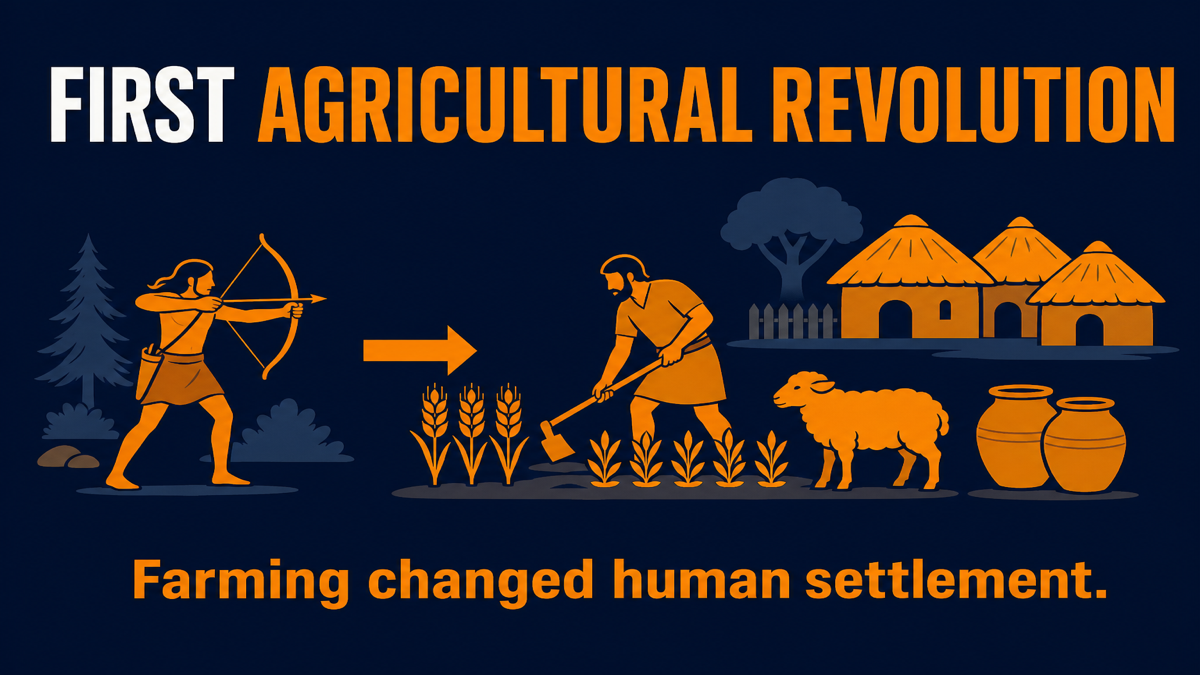
The First Agricultural Revolution AP Human Geography topic connects process to transformation—after learning where farming began, students explain how the shift from foraging to farming reshaped settlement, population, labor, and landscapes.
First Agricultural Revolution
The broad shift from foraging to farming societies.
The First Agricultural Revolution was the transition from hunting and gathering to agriculture through the domestication of plants and animals. In AP Human Geography, it matters because it allowed food surplus, more permanent settlements, population growth, labor specialization, property systems, social inequality, and environmental change.
The First Agricultural Revolution changed food systems, settlement, population, labor, and landscapes. Use the explorer to review each change before comparing origins, hearths, and effects.
Humans began adapting plants and animals for controlled food production. This changed food systems from wild resource use to cultivation and livestock raising.
Farming could produce more food than people needed immediately. Surplus supported storage, trade, population growth, and labor specialization.
Because farmers needed to stay near fields, animals, water, and stored food, agriculture encouraged more permanent villages and rural land-use patterns.
More reliable food supplies could support larger populations, though dense settlement also increased disease risk, land pressure, and inequality.
Food surplus allowed some people to do work beyond food production, such as toolmaking, building, trade, leadership, or religious roles.
Agriculture changed landscapes through land clearing, irrigation, soil disturbance, domesticated species, and permanent settlement.
| Change | What It Means | AP Exam Clue |
|---|---|---|
| Domestication | Plants and animals adapted for human use | Crops, livestock, controlled food production |
| Food surplus | Extra food beyond immediate needs | Storage, trade, larger populations |
| Permanent settlement | People live near fields, water, animals, and storage | Villages and sedentary life |
| Population growth | Larger groups supported by food production | Denser settlements |
| Labor specialization | Not everyone must farm all the time | Crafts, trade, leadership, social roles |
| Environmental change | Farming modifies land and resources | Land clearing, irrigation, soil impacts |
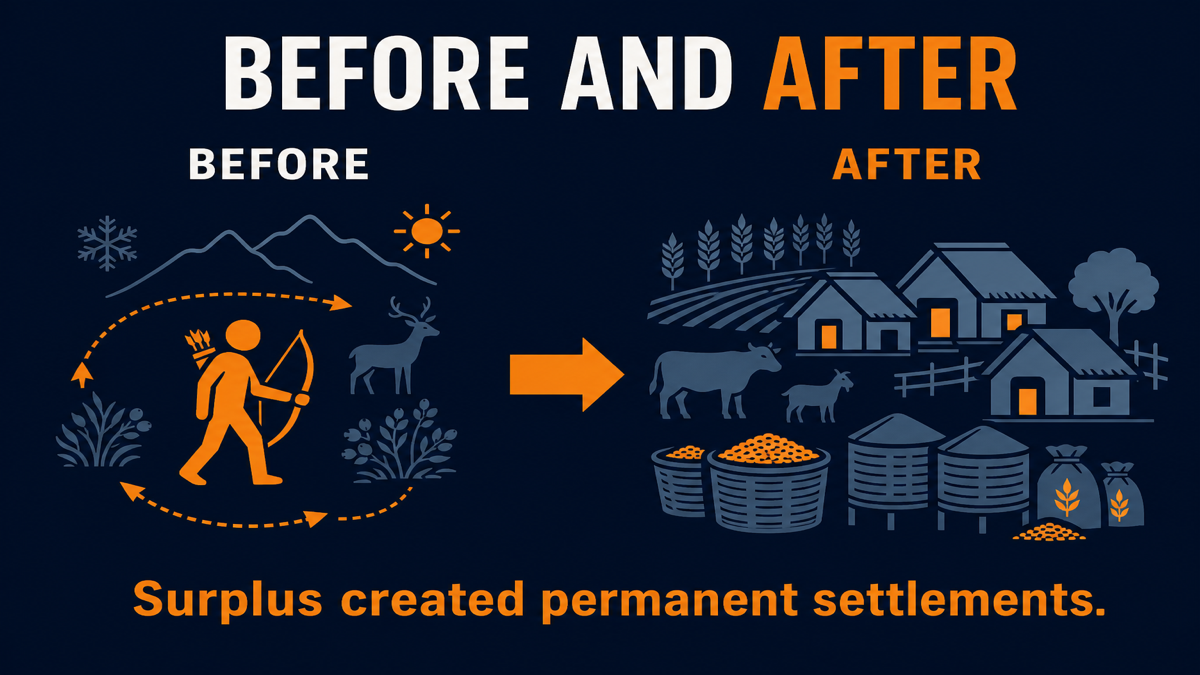
Origins of agriculture explains how farming began. The First Agricultural Revolution describes the broader transformation from foraging to farming societies.
| Concept | Meaning | AP Clue |
|---|---|---|
| Origins of agriculture | How farming began | Domestication, early cultivation, early livestock |
| Agricultural hearths | Where farming began | Early farming regions and crop origins |
| First Agricultural Revolution | Broad shift from foraging to farming | Surplus, permanent settlement, population growth |
| Domestication | Adapting plants and animals for human use | Crops, livestock, selective human control |
Review the process on origins of agriculture and the places on agricultural hearths. On AP questions, use “origins” for how farming started, “hearths” for where it started, and “First Agricultural Revolution” for the broad societal transformation.
AP Human Geography often tests the First Agricultural Revolution by comparing foraging societies with early farming societies.
| Feature | Before: Foraging Societies | After: Farming Societies |
|---|---|---|
| Food source | Wild plants and animals | Domesticated crops and animals |
| Mobility | More mobile or seasonal movement | More sedentary settlement |
| Settlement | Temporary camps | More permanent villages |
| Food supply | Seasonal and variable | More controllable and storable |
| Population | Smaller groups | Larger populations possible |
| Labor | Hunting, gathering, fishing, foraging | Farming, herding, storage, building, trade |
| Land use | Less permanent modification | Fields, pastures, roads, storage, villages |
| Social systems | Often smaller-scale organization | More specialization, inequality, and property systems possible |
AP questions often ask students to explain the First Agricultural Revolution as a cause-effect chain. Use the event, the change, and the geographic effect together.
| Cause or Change | Immediate Result | Human Geography Effect |
|---|---|---|
| Domestication | Controlled crop and animal production | More reliable food supply |
| Food surplus | Storage and extra food | Larger populations and labor specialization |
| Permanent fields | People stay near land and water | Villages and rural land-use patterns |
| Livestock raising | Animals used for food, labor, or materials | New settlement and economic systems |
| Storage | Food kept for later use | Trade, wealth differences, and social hierarchy |
| Land clearing | More land converted to fields | Environmental change and cultural landscapes |
The First Agricultural Revolution created major benefits, but it also produced environmental and social tradeoffs that AP Human Geography expects students to explain.
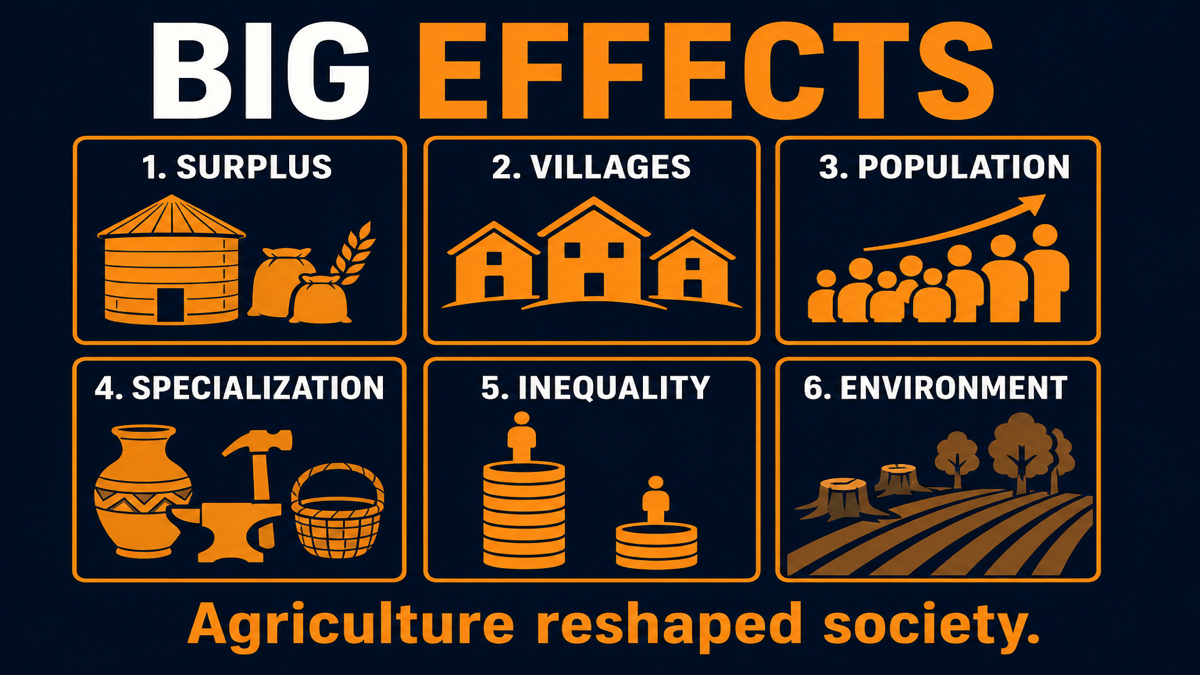
These effects show why the First Agricultural Revolution is one of the most important transitions in human geography.
Humans adapted plants and animals for controlled food production.
Farming could produce more food than immediate need.
People stayed near fields, animals, water, and stored food.
More reliable food supported larger groups.
Some people could do work beyond food production.
Land, animals, and stored food could be owned or controlled.
Surplus and land control could create differences in wealth and status.
Extra food and goods could be exchanged or saved.
Farming shaped diet, rituals, and rural identity.
Agriculture modified land, water, soil, and vegetation.
AP Human Geography often tests the First Agricultural Revolution through domestication, surplus, settlement, population, specialization, and environmental change.
| Question Clue | Likely Concept | What to Explain |
|---|---|---|
| Neolithic Revolution | First Agricultural Revolution | Shift from foraging to farming |
| Domesticated plants and animals | Domestication | Controlled food production |
| Food surplus and storage | Agricultural surplus | Settlement, population, specialization |
| Permanent villages | Sedentary settlement | People stayed near fields and food storage |
| Population growth after farming | Agricultural transition effect | More reliable food supported larger groups |
| Labor specialization | Surplus effect | Some people could do non-farming work |
| Land clearing or irrigation | Environmental change | Farming modified landscapes |
| Inequality or property systems | Social change | Surplus and land ownership changed society |
Use this four-step method whenever a prompt asks how agriculture transformed human societies.
Name the transition from hunting and gathering to agriculture.
Connect the shift to concrete farming evidence.
Link domestication, storage, water access, or useful species.
Connect farming to a geographic outcome.
The First Agricultural Revolution involved __________ because __________. This changed human geography by __________.
Example: The First Agricultural Revolution involved the domestication of plants and animals because humans began controlling food production instead of relying only on wild resources. This changed human geography by encouraging permanent settlement, food surplus, labor specialization, and population growth.
Use this sentence when an FRQ asks how agriculture first transformed human societies.
| Concept Pair | Difference | AP Clue |
|---|---|---|
| Origins of agriculture vs First Agricultural Revolution | Origins explains how farming began; First Agricultural Revolution explains the broad transformation | Process vs larger societal shift |
| Agricultural hearths vs First Agricultural Revolution | Hearths are where farming began; First Agricultural Revolution is what changed human life | Place vs transformation |
| First Agricultural Revolution vs Second Agricultural Revolution | First is domestication and farming; Second is later productivity and mechanization | Beginning farming vs improved farming |
| First Agricultural Revolution vs Green Revolution | First is ancient domestication; Green is modern high-yield input farming | Domestication vs modern technology |
| Food surplus vs population growth | Surplus is extra food; population growth is one result | Cause vs effect |
Confusing the First Agricultural Revolution with the Green Revolution
Saying farming had only positive effects
Forgetting livestock is part of domestication
Naming “farming” without explaining surplus or settlement
Confusing agricultural hearths with agricultural revolutions
Forgetting environmental change
Ignoring social inequality and property systems
Treating the revolution as one event in one place instead of a long transformation
Read each scenario, predict the revolution concept, then reveal the answer. This trains the same reasoning AP Human Geography uses on scenario prompts.
Revealed: 0 of 4 scenarios
A society begins domesticating plants and animals instead of relying only on hunting and gathering. Which concept is shown?
Answer: The First Agricultural Revolution, because the society is shifting from foraging to farming through domestication.
A farming village stores extra grain after harvest and some residents begin making tools instead of farming full-time. Which effect is shown?
Answer: Food surplus and labor specialization, because extra food allows some people to do non-farming work.
A group settles permanently near fields, animals, and water sources. Which effect of agriculture is shown?
Answer: Permanent settlement, because farming encouraged people to stay near productive land, livestock, and stored food.
A prompt describes land clearing, irrigation, and soil pressure after farming expands. Which effect is shown?
Answer: Environmental change, because farming modifies landscapes and affects soil, water, and vegetation.
Answer all eight questions. Choices shuffle each time you reload, so focus on reasoning—not letter memorization.
Open each card, draft your response, then reveal the rubric and sample when ready. Strong revolution FRQs define the shift, cite evidence, and explain a geographic effect.
Define the First Agricultural Revolution and explain one effect it had on human settlement.
The First Agricultural Revolution was the shift from hunting and gathering to farming through the domestication of plants and animals. It affected settlement because people often stayed near fields, livestock, water, and stored food. This encouraged more permanent villages and rural land-use patterns. The change mattered in human geography because agriculture reshaped where people lived, how they used land, and how populations grew.
Status: Draft your answer first—then open the rubric or sample.
Explain one benefit and one tradeoff of the First Agricultural Revolution.
One benefit of the First Agricultural Revolution was food surplus. Surplus allowed some communities to store food, support larger populations, and develop labor specialization. One tradeoff was environmental change because farming required land clearing, irrigation, and soil disturbance. This changed rural landscapes and could create pressure on soil, water, and vegetation.
Status: Draft your answer first—then open the rubric or sample.
The First Agricultural Revolution was the transition from hunting and gathering to agriculture through the domestication of plants and animals.
Yes. In AP Human Geography, the First Agricultural Revolution is often closely associated with the Neolithic Revolution, the shift from foraging to farming.
It developed through multiple interacting factors, including domestication, climate change, useful plant and animal species, food storage, population pressure, water access, and human experimentation.
Major effects included food surplus, permanent settlement, population growth, labor specialization, property systems, social inequality, trade, and environmental change.
It encouraged more permanent settlement because people often stayed near fields, livestock, water sources, and stored food.
The First Agricultural Revolution was the ancient shift to farming through domestication. The Green Revolution was a modern increase in agricultural productivity using high-yield seeds, irrigation, fertilizer, pesticides, and machinery.
Food surplus is important because it can support storage, trade, larger populations, labor specialization, and more complex settlement systems.
Define the shift from foraging to farming, mention domestication, use evidence such as surplus or permanent settlement, and explain an effect on population, labor, land use, society, or environment.