It creates rural landscapes
Fields, pastures, barns, and farm roads reshape the countryside.
AP clue: Look for visible land-use change on maps and photos.
Unit 5 Learning Journey · Agriculture and Rural Land Use
Agriculture is the deliberate growing of crops and raising of animals for food, fiber, fuel, and other human needs. In AP Human Geography, agriculture matters because it shapes rural land use, settlement patterns, labor systems, markets, technology, environmental change, and cultural landscapes.
This is the first concept page in the Unit 5 agriculture journey. It gives students the foundation for understanding agricultural origins, farming types, agricultural models, technology, agribusiness, rural settlement patterns, land survey patterns, and sustainable agriculture. After this page, students should study Origins of Agriculture and Agricultural Hearths.
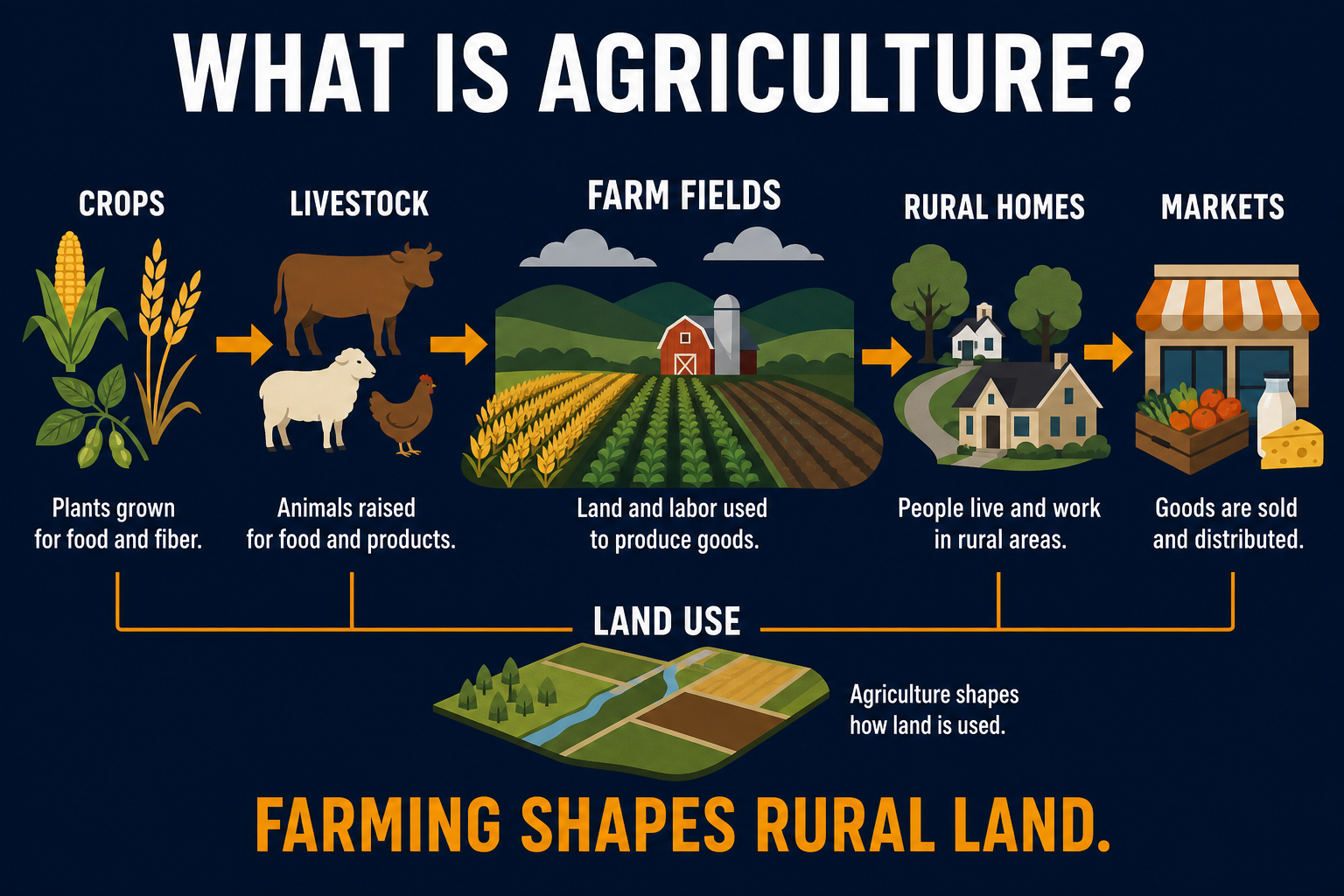
The introduction to agriculture AP Human Geography topic opens Unit 5 because every later farming concept builds on land use, labor, markets, and environmental reasoning. When a prompt mentions crops, livestock, fields, or rural settlement, start by explaining agriculture as a deliberate land-use system.
Introduction to Agriculture
Foundation for all Unit 5 farming topics.
Agriculture is the deliberate cultivation of plants and raising of animals to meet human needs. In AP Human Geography, agriculture is studied as a land-use system because farming changes landscapes, supports settlements, creates markets, shapes labor systems, affects the environment, and connects local places to regional and global food systems.
Agriculture is not just food production—it is how humans organize rural space. Farmers decide what to grow, where to pasture livestock, how to connect to markets, and how much technology to use. These decisions create the rural landscapes you analyze on AP maps and FRQs.
Farmers use land for crops, livestock, roads, storage, settlements, and processing. Land availability and land value influence what type of agriculture appears.
Some farming systems require high labor inputs, while others rely more on machinery, capital, or extensive land.
Temperature, precipitation, soil, and growing season influence where crops and livestock systems can succeed.
Distance to markets, transportation costs, demand, and prices influence agricultural location and production decisions.
Tools, machinery, irrigation, fertilizers, high-yield seeds, and storage systems can increase production and change farming patterns.
Agriculture can cause erosion, runoff, deforestation, water stress, and biodiversity loss, but sustainable methods can reduce damage.
| Agriculture Factor | What It Means | AP Exam Clue |
|---|---|---|
| Land | Space used for crops, livestock, settlements, roads, and storage | Land value and land availability shape farming |
| Labor | Human work used in planting, harvesting, herding, or processing | Labor-intensive vs mechanized farming |
| Climate | Temperature, rainfall, soil, and growing season | Crop location depends on environmental conditions |
| Markets | Demand, prices, transport, and consumers | Market distance affects farm location |
| Technology | Tools, irrigation, machinery, seeds, chemicals, storage | New inputs can increase productivity |
| Environment | Soil, water, biodiversity, and land impacts | Farming creates benefits and tradeoffs |
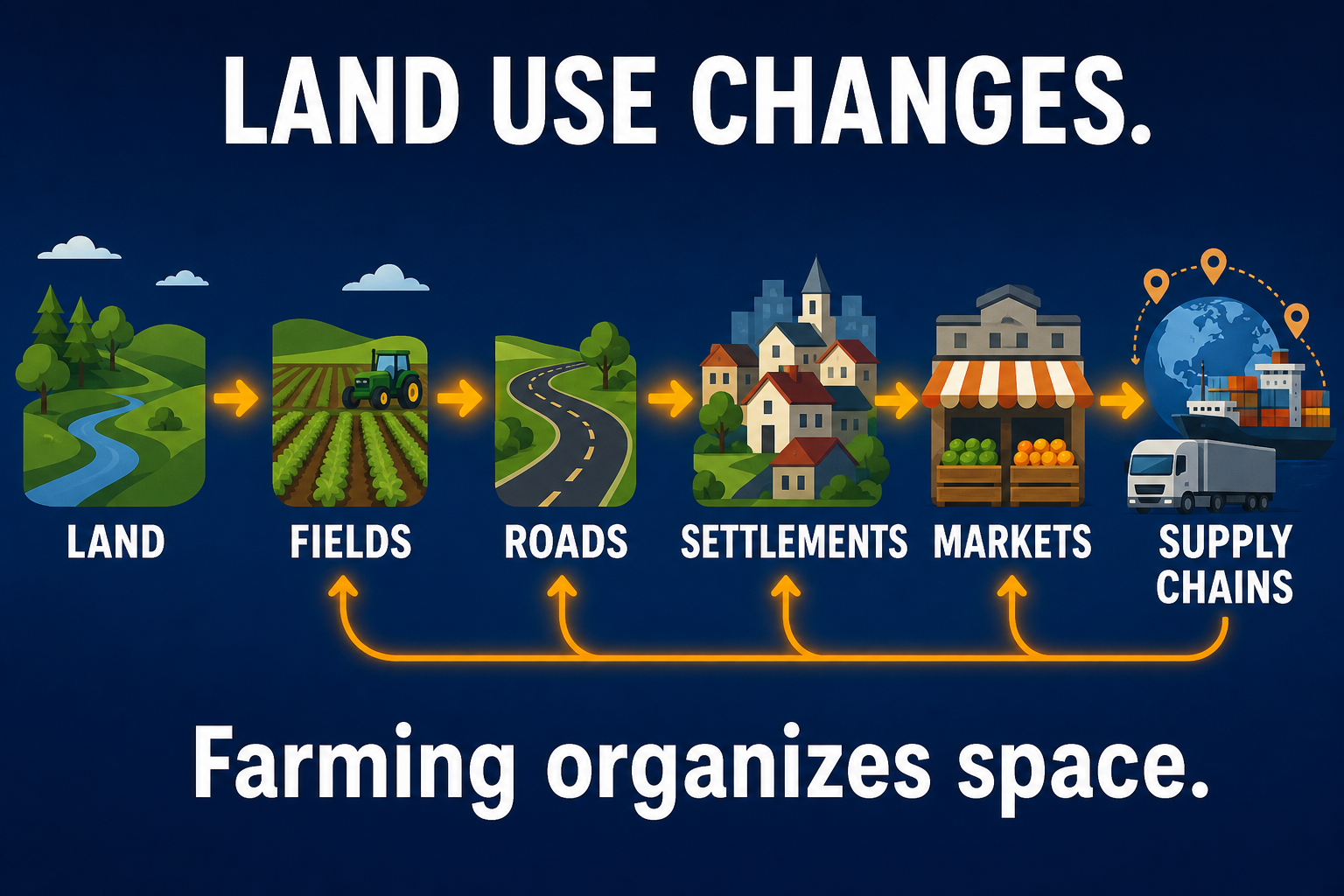
When you see rectangular fields, pasture fences, irrigation canals, or grain silos on a map, you are seeing agriculture reorganize land. Later Unit 5 pages such as the Von Thünen Model and rural settlement patterns explain specific patterns that grow from these basic land-use decisions.
Agriculture connects physical geography, economic geography, cultural geography, and political geography. AP Human Geography treats farming as a system that links people, places, and environments—not as a list of farm vocabulary.
Fields, pastures, barns, and farm roads reshape the countryside.
Food surplus allows larger, denser populations in some regions.
Farms and villages cluster near productive land and water.
Crops and livestock move from farms to regional and global markets.
Irrigation, deforestation, and chemicals alter ecosystems.
What people grow and eat varies by region and tradition.
Farm work, wages, and capital shape rural economies.
Access to land, technology, and markets is uneven.
Before agriculture, most humans relied on hunting, gathering, fishing, and foraging. Agriculture changed human geography because it allowed more permanent settlement, food surplus, population growth, labor specialization, and new land-use patterns.
| Feature | Hunting and Gathering | Agriculture |
|---|---|---|
| Food source | Wild plants and animals | Domesticated crops and animals |
| Settlement | More mobile | More permanent or sedentary |
| Population | Usually smaller groups | Larger populations possible |
| Land use | Less permanent landscape change | Fields, pastures, villages, roads |
| Surplus | Limited and seasonal | More food surplus possible |
| AP clue | Mobility and foraging | Domestication, fields, settlements |
The shift from foraging to farming is central to origins of agriculture and the First Agricultural Revolution. On AP questions, domesticated crops, permanent fields, and sedentary villages signal agriculture—not mobility and wild resource use.
One of the first major AP comparisons is subsistence agriculture vs commercial agriculture. Subsistence agriculture focuses mainly on feeding the farmer's family or local community. Commercial agriculture focuses mainly on producing for sale and profit.
| Feature | Subsistence Agriculture | Commercial Agriculture |
|---|---|---|
| Main purpose | Local or household food needs | Market sale and profit |
| Scale | Often smaller scale | Often larger scale |
| Technology | Often lower input | Often more machinery and capital |
| Market connection | Limited | Strong |
| AP clue | Family use, local consumption | Sale, profit, export, agribusiness |
Read the full comparison on subsistence vs commercial agriculture. On AP maps, look for clues about who consumes the food and whether markets drive production.
Another major AP comparison is intensive agriculture vs extensive agriculture. Intensive agriculture uses high inputs of labor or capital per unit of land. Extensive agriculture uses larger areas of land with lower inputs per unit of land.
| Feature | Intensive Agriculture | Extensive Agriculture |
|---|---|---|
| Land use | Smaller area, higher input | Larger area, lower input |
| Labor/capital | More per unit of land | Less per unit of land |
| Examples | Market gardening, wet rice, dairy in some contexts | Ranching, shifting cultivation, grain farming in some contexts |
| AP clue | High input density | Large land area |
The full guide is on intensive vs extensive agriculture. AP prompts often describe input density or land area—use those clues before naming the farming type.
This introduction page is step one in a longer journey. Each link below takes you deeper into a specific agriculture topic—all built on the land-use foundation you just learned.
how farming began
where farming began
domestication and permanent settlement
market distance and land use
mechanization and productivity
high-yield seeds and modern inputs
food supply chains
how homes and farms are arranged
how property parcels are divided
long-term resource protection
AP Human Geography rarely asks you to define agriculture in isolation. Instead, prompts give clues—crops, livestock, labor, markets, technology, or environmental change—and expect you to explain the geographic pattern.
| Question Clue | Likely Concept | What to Explain |
|---|---|---|
| Crops or livestock in a specific location | Agriculture as land use | Environmental and market reasons |
| Farms near a city | Von Thünen Model | Market distance, transport cost, perishability |
| Family farming for local consumption | Subsistence agriculture | Local needs and limited market sale |
| Farming for export or profit | Commercial agriculture | Market orientation |
| High labor or capital per land area | Intensive agriculture | Input density |
| Large land area with lower inputs | Extensive agriculture | Land abundance and lower input density |
| High-yield seeds and fertilizer | Green Revolution | Productivity gains and tradeoffs |
| Food processing and retail chains | Agribusiness | Supply chain connections |
| Soil erosion or water stress | Environmental impact | Farming creates resource pressures |
| Cover crops or drip irrigation | Sustainable agriculture | Problem-method-benefit relationship |
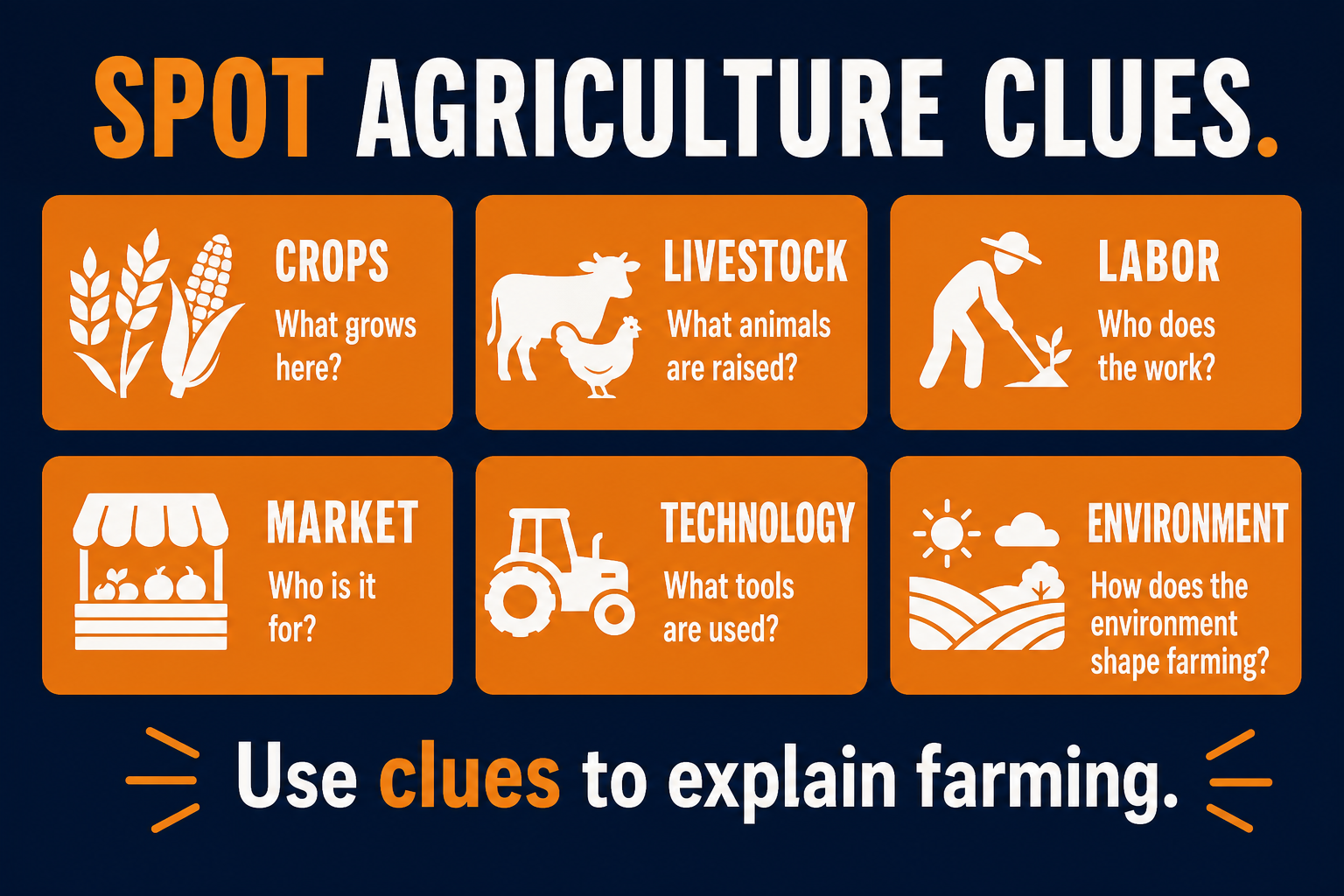
Use this four-step method whenever a prompt describes crops, livestock, farm location, or rural land use.
Name subsistence, commercial, intensive, extensive, or another Unit 5 idea.
Point to crops, fields, markets, labor, or technology in the source.
Connect climate, land, markets, or technology to why farming appears there.
Link to settlement, environment, labor, development, or inequality.
The agricultural pattern shows __________ because __________. This matters because __________ affects land use, markets, settlement, or the environment.
Example: The agricultural pattern shows commercial agriculture because the crops are grown for export markets. This matters because market demand affects land use, labor, transportation, and regional economic development.
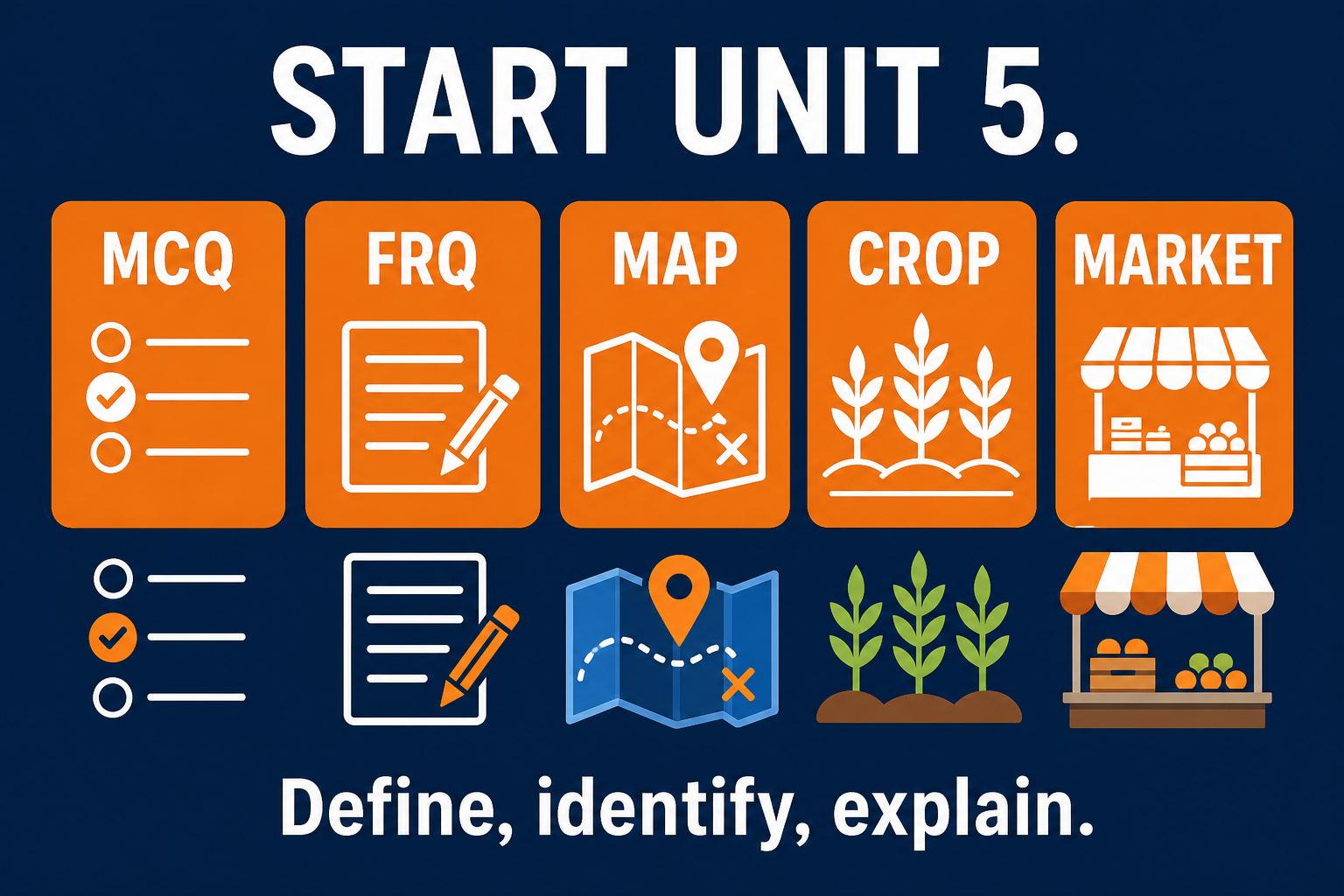
Use this sentence when an FRQ asks what agriculture is or why farming affects human geography.
| Concept Pair | Difference | AP Clue |
|---|---|---|
| Agriculture vs hunting and gathering | Agriculture uses domesticated plants or animals; hunting and gathering uses wild resources | Fields and livestock vs foraging |
| Subsistence vs commercial | Subsistence focuses on local needs; commercial focuses on sale and profit | family use vs market sale |
| Intensive vs extensive | Intensive uses higher inputs per land area; extensive uses more land with lower inputs | input density vs land area |
| Farm type vs land-use pattern | Farm type explains what is produced; land-use pattern explains where and why | dairy/ranching vs market distance |
| Agriculture vs agribusiness | Agriculture is farming; agribusiness is the business system around farming | fields vs supply chain |
Defining agriculture as only "growing crops"
Forgetting livestock is agriculture
Naming a farming type without explaining land use
Confusing subsistence and commercial agriculture
Confusing intensive and extensive agriculture
Ignoring markets and transportation
Ignoring environmental tradeoffs
Treating Unit 5 as vocabulary instead of geographic reasoning
Read each scenario, predict the agriculture concept, then reveal the answer. This trains the same reasoning AP Human Geography uses on map and scenario prompts.
Revealed: 0 of 4 scenarios
A farming household grows most of its food for family consumption and sells little to markets. Which agriculture concept is shown?
Answer: Subsistence agriculture, because production is mainly for local or household needs rather than profit.
A farm uses expensive machinery, irrigation, and fertilizer to produce crops for export. Which agriculture concept is shown?
Answer: Commercial agriculture, because the farm is producing for sale and profit in wider markets.
A crop is grown close to a city because it spoils quickly and transport costs matter. Which Unit 5 idea is shown?
Answer: Von Thünen Model logic, because perishability and transportation costs affect farm location near the market.
A region adopts cover crops to reduce soil erosion. Which Unit 5 idea is shown?
Answer: Sustainable agriculture, because the method addresses an environmental problem while supporting long-term farming.
Answer all eight questions. Choices shuffle each time you reload, so focus on reasoning—not letter memorization.
Open each card, draft your response, then reveal the rubric and sample when ready. Strong agriculture FRQs define the concept, explain land-use change, and connect farming to human geography themes.
Define agriculture and explain one way agriculture changes rural land use.
Agriculture is the deliberate growing of crops and raising of animals for human use. It changes rural land use by turning land into fields, pastures, roads, storage areas, and settlements. This matters in human geography because agricultural land use affects where people live, how they work, how goods move to markets, and how environments are changed.
Status: Draft your answer first—then open the rubric or sample.
Explain the difference between subsistence agriculture and commercial agriculture and describe one map or scenario clue that could help identify each.
Subsistence agriculture is farming mainly for the farmer's family or local community, while commercial agriculture is farming mainly for sale and profit. A subsistence clue might be a household producing food mostly for itself with limited market exchange. A commercial clue might be a large farm using machinery to produce crops for export. These clues show whether farming is organized around local needs or wider markets.
Status: Draft your answer first—then open the rubric or sample.
Agriculture is the deliberate growing of crops and raising of animals for human use. AP Human Geography studies agriculture as a land-use system that shapes rural landscapes, settlements, markets, labor, technology, and environmental change.
Agriculture is important because it affects where people live, how land is used, how food is produced, how rural economies work, and how humans change the environment.
Yes. Agriculture includes both crop cultivation and animal raising, including livestock systems such as cattle, sheep, goats, poultry, and dairy farming.
Subsistence agriculture mainly produces food for the farmer's family or local community. Commercial agriculture mainly produces goods for sale and profit.
Intensive agriculture uses higher labor or capital inputs per unit of land. Extensive agriculture uses larger areas of land with lower inputs per unit of land.
Agricultural land use is influenced by climate, soil, water, land availability, labor, technology, transportation, market demand, culture, and government policies.
Agriculture creates fields, pastures, farm roads, irrigation systems, storage areas, processing sites, rural settlements, property boundaries, and environmental changes.
Identify the agriculture concept, use map or scenario evidence, explain why the pattern occurs, and connect it to land use, markets, labor, settlement, technology, or the environment.