Market sale
Crops or livestock are produced primarily for buyers, not only for household use.
AP clue: Sale, export, or supermarket supply
Unit 5 Learning Journey · Agriculture and Rural Land Use
Subsistence agriculture and commercial agriculture describe two major ways farming is organized. Subsistence agriculture mainly produces food for the farmer's family or local community, while commercial agriculture mainly produces crops or livestock for sale, profit, and wider markets. In AP Human Geography, this comparison helps students explain land use, technology, labor, scale, market access, and development patterns.
The previous page, First Agricultural Revolution, explained how agriculture transformed human societies through domestication, food surplus, and permanent settlement. This page compares two major farming purposes: producing mainly for local survival or producing mainly for market sale. After this page, students should study Intensive vs Extensive Agriculture to compare farming by input level and land use.
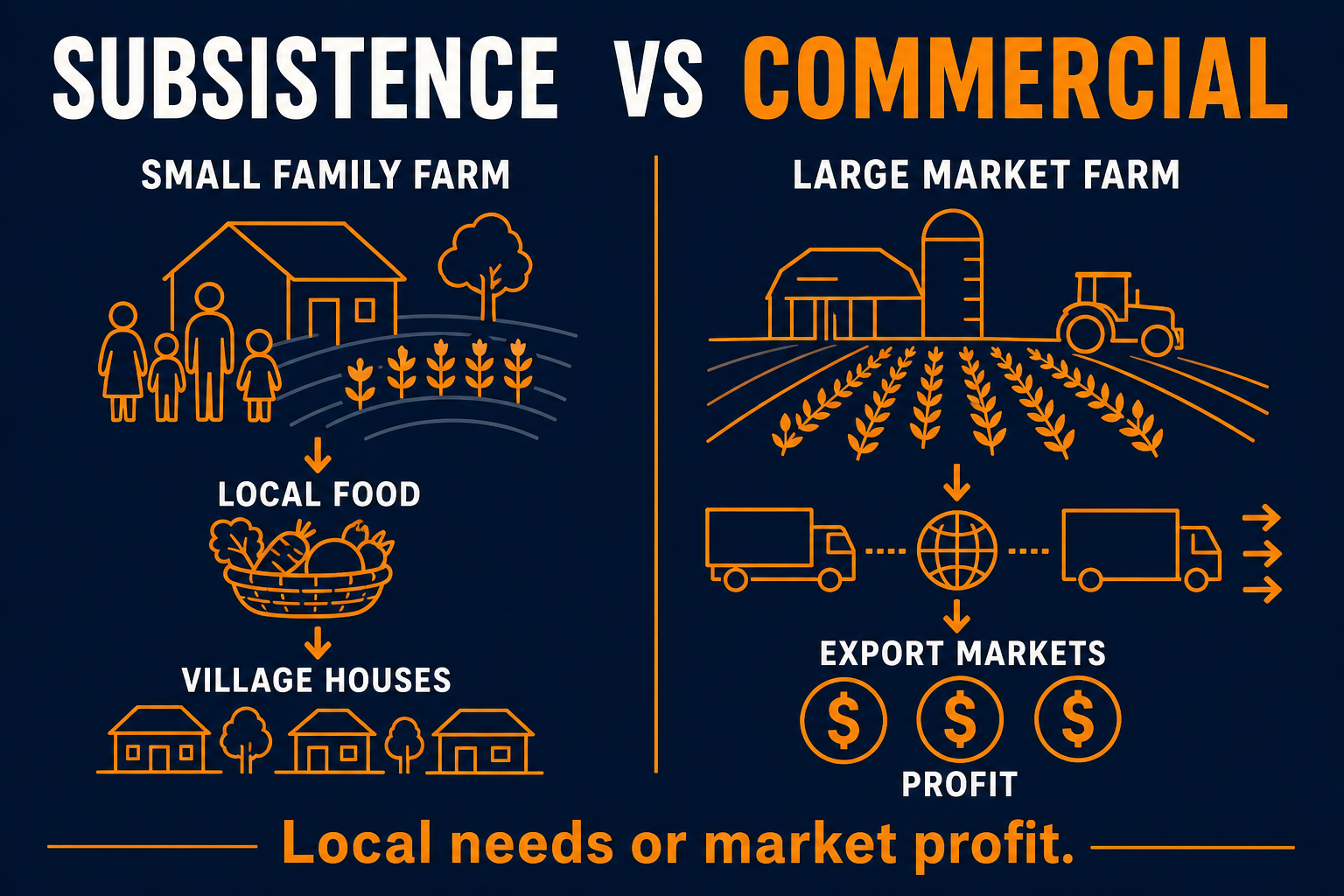
The subsistence vs commercial agriculture AP Human Geography comparison connects farming purpose to land use, labor, technology, and development—after the revolution shift, students classify how farmers meet local needs or sell to markets.
Subsistence vs Commercial Agriculture
Local needs versus market-oriented production.
Subsistence vs commercial agriculture compares farming purpose: subsistence agriculture feeds the farmer's family or local community, while commercial agriculture produces crops or livestock mainly for sale and profit. In AP Human Geography, use purpose first, then scale, technology, labor, and market access as evidence.
Subsistence and commercial agriculture differ by purpose, scale, technology, labor, market access, and development context. Use the explorer, then review the full comparison table.
Subsistence agriculture mainly meets local or household food needs. Commercial agriculture mainly produces goods for sale and profit.
Subsistence farming is often smaller scale and local, while commercial agriculture is often larger scale and connected to regional, national, or global markets.
Subsistence systems may use fewer capital inputs, while commercial systems often use machinery, irrigation, fertilizers, storage, transportation, and processing.
Subsistence agriculture may rely heavily on family labor. Commercial agriculture may use wage labor, machinery, seasonal workers, or corporate management.
Subsistence agriculture has weaker or limited market connection. Commercial agriculture depends on market demand, prices, transportation, and supply chains.
Subsistence agriculture is more common in lower-income rural regions, while commercial agriculture is more common in market-oriented economies, though both can exist in the same country.
| Feature | Subsistence Agriculture | Commercial Agriculture |
|---|---|---|
| Main purpose | Feed family or local community | Produce for sale and profit |
| Market connection | Limited or local | Strong regional, national, or global markets |
| Scale | Often smaller | Often larger |
| Technology | Often lower capital inputs | Often more machinery, capital, and technology |
| Labor | Often family or community labor | Wage labor, mechanization, or corporate systems |
| Output | Food for direct use | Crops/livestock for market sale |
| AP clue | local use, survival, household needs | profit, export, agribusiness, market sale |
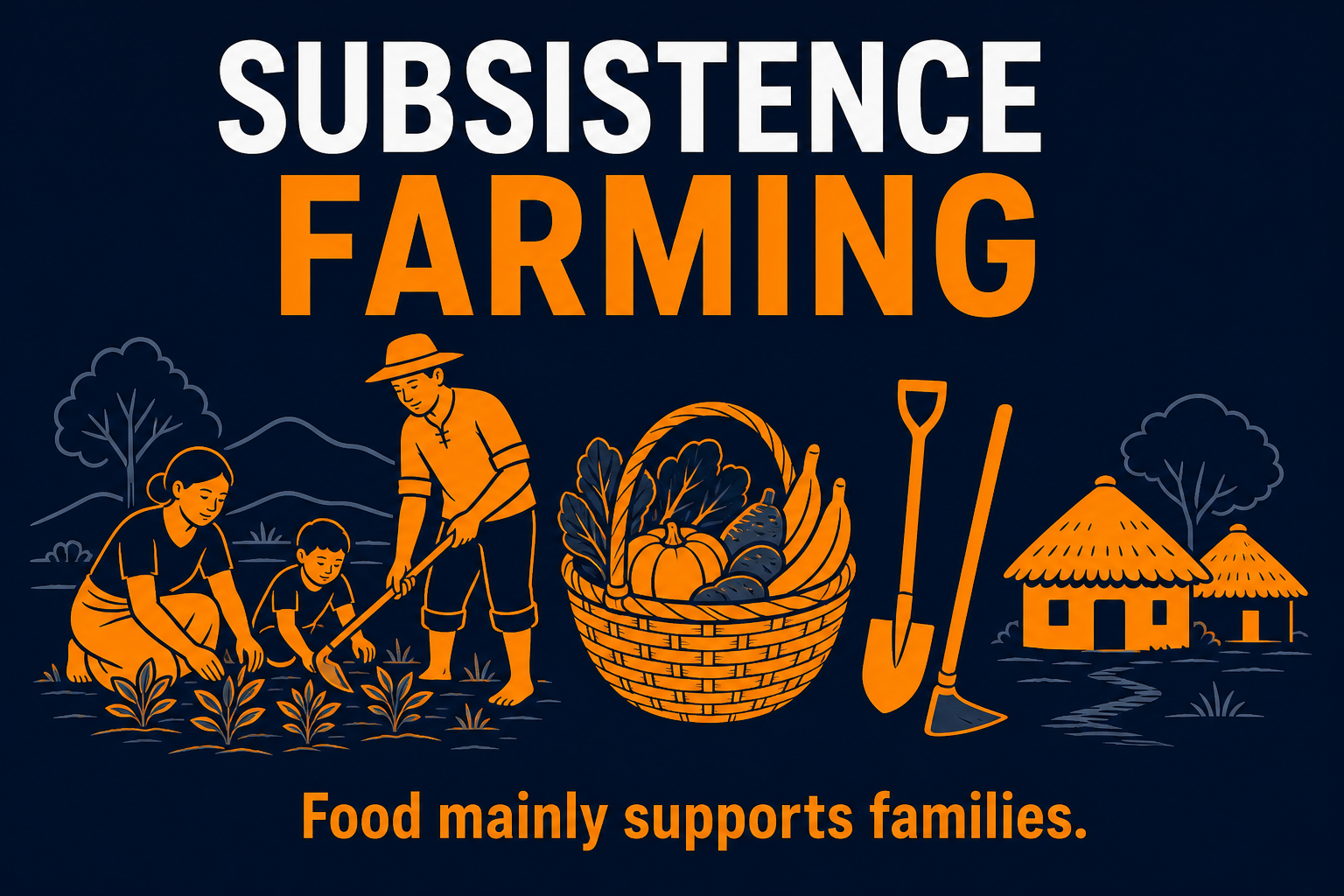
Commercial agriculture produces crops or livestock mainly for sale. It is strongly connected to markets, transportation, storage, processing, retail, profit, and sometimes larger corporate systems.
Crops or livestock are produced primarily for buyers, not only for household use.
Farmers aim to earn income from production beyond immediate family needs.
Commercial farms often cover more land or produce higher volumes for markets.
Tractors, irrigation, and machinery increase output for market sale.
Commercial systems often require loans, seeds, fertilizer, and equipment.
Roads, ports, and trucks connect farms to processors and consumers.
Grains, meat, and produce may be stored or processed before retail sale.
Commercial output often enters larger corporate supply chains through agribusiness beyond the farm gate.
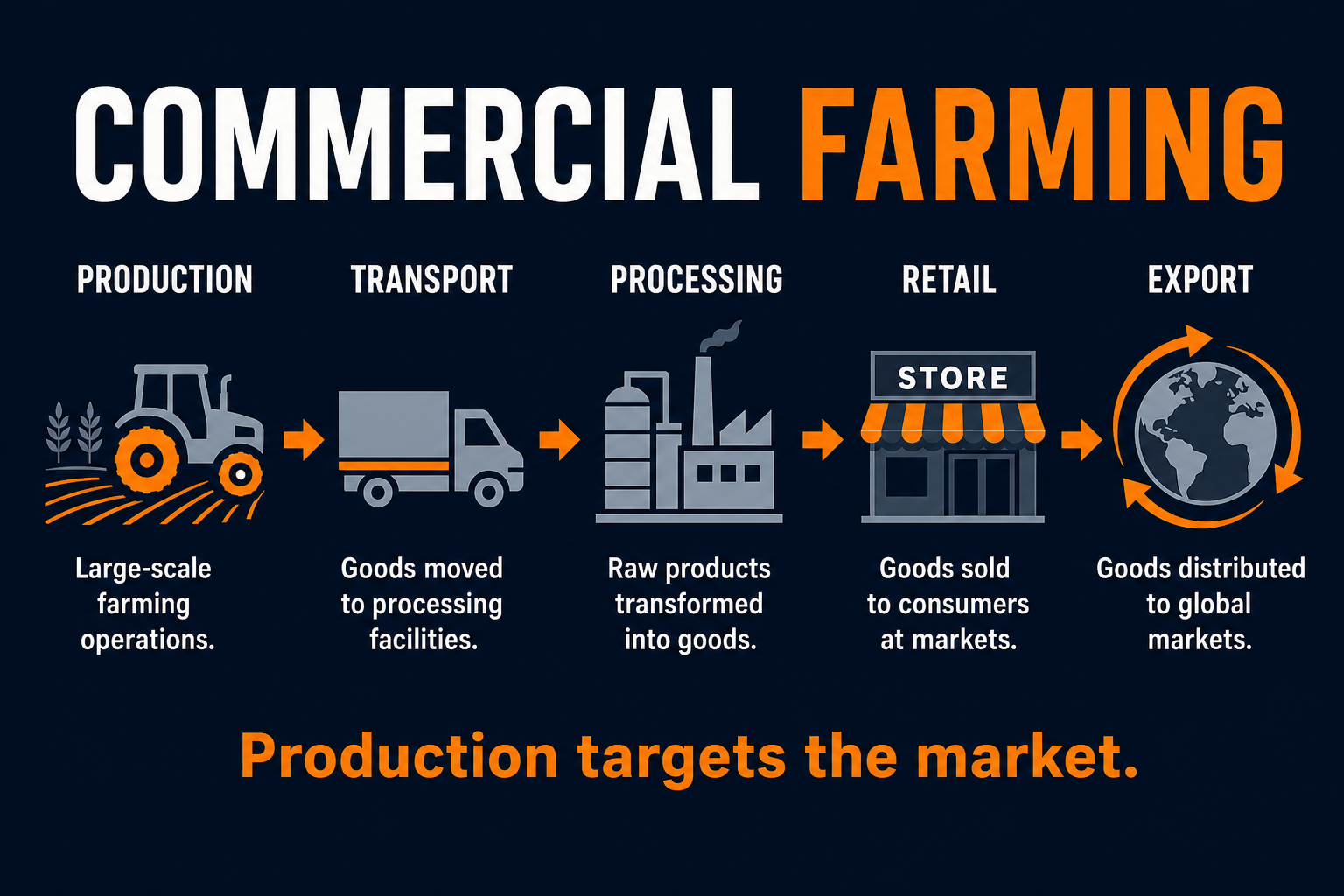
Subsistence agriculture produces food mainly for the farmer's family or local community. It may involve small farms, family labor, traditional knowledge, mixed crops, and limited surplus for sale.
Most food is eaten by the farmer's family rather than sold widely.
Villages or neighborhoods rely on nearby farms for daily food.
Relatives provide most farm work instead of large wage labor forces.
Fields and herds are often sized for local needs, not mass export.
Surplus sales may be small and local rather than tied to global markets.
Hand tools or simple technology may replace heavy machinery.
Diversity reduces risk if one crop fails.
Limited surplus can threaten food security when harvests fail.
AP questions usually test this comparison through clues. Identify the purpose first, then use scale, technology, labor, and market access as supporting evidence.
| Question Clue | Likely Type | Why |
|---|---|---|
| Family grows most food for itself | Subsistence | Main purpose is household consumption |
| Village farms mainly for local needs | Subsistence | Production stays local |
| Small farm with little machinery | Often subsistence | Lower capital input and local use |
| Large farm grows crops for export | Commercial | Production is for wider markets |
| Farm uses machinery and hired labor for profit | Commercial | Market sale and capital investment |
| Crops sent to processing and retail chains | Commercial | Connected to agribusiness and supply chains |
| Farmer sells surplus at a local market | Subsistence with some market exchange | Main purpose may still be local needs |
| Corporate farm grows one crop for supermarkets | Commercial | Profit-oriented and market connected |
Subsistence vs commercial agriculture compares purpose. Intensive vs extensive agriculture compares input level and land use. AP questions often mix these, so use the correct comparison.
| Comparison | What It Compares | AP Clue |
|---|---|---|
| Subsistence vs commercial | Farming purpose | Local needs vs sale/profit |
| Intensive vs extensive | Inputs per unit of land | High input density vs large land area |
| Subsistence agriculture | Often local and household focused | Family food, local survival |
| Commercial agriculture | Often market oriented | Profit, export, agribusiness |
| Intensive agriculture | High labor/capital per land area | More input per acre/hectare |
| Extensive agriculture | Large land area, lower input density | Ranching, large farms, lower inputs per land area |
Subsistence agriculture is often associated with rural regions where farmers have limited access to capital, technology, transportation, credit, or stable markets. Commercial agriculture is more tied to market economies, infrastructure, export systems, and global supply chains. However, both systems can exist in the same country—the distinction is about purpose, not whether a country is rich or poor.
Subsistence farmers may lack credit for machinery or inputs; commercial farms often use capital markets.
Commercial systems need roads and ports; subsistence systems may rely on local movement only.
Commercial agriculture responds to prices; subsistence responds mainly to household needs.
Commercial farms may target national or global buyers.
Subsistence households face hunger risk; commercial farms face market price risk.
Subsistence can support local food security; commercial systems feed wider populations through markets.
Commercial output links rural land to processors, retailers, and exports.
Subsistence farming supports rural household survival even without large profits.
AP Human Geography often tests farming systems through household use, market sale, exports, machinery, and supply chains.
| Question Clue | Likely Concept | What to Explain |
|---|---|---|
| Family food needs | Subsistence agriculture | Production is mainly for household use |
| Local village consumption | Subsistence agriculture | Limited market connection |
| Little surplus | Subsistence agriculture | Production mostly meets immediate needs |
| Sale and profit | Commercial agriculture | Market-oriented farming |
| Exports | Commercial agriculture | Production goes to wider markets |
| Machinery and capital | Commercial agriculture | Higher input and market connection |
| Processing, transport, retail | Commercial agriculture or agribusiness | Supply chain connection |
| Corporate farming | Commercial agriculture | Profit and large-scale production |
| Mixed local use plus some sale | Subsistence with market exchange | Main purpose still matters |
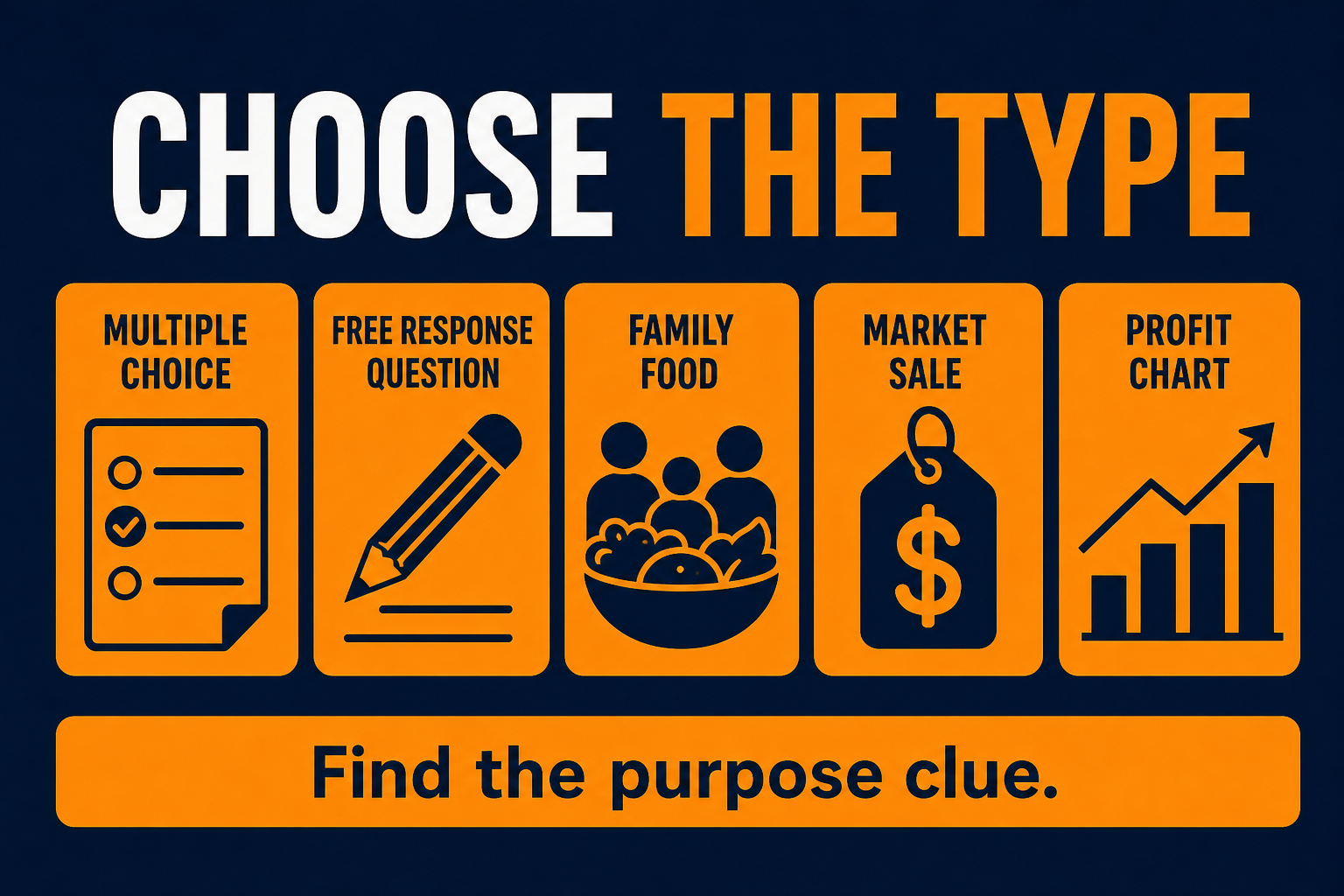
Use this four-step method whenever a prompt asks you to classify or compare farming systems.
Start with household consumption versus profit-oriented production.
Connect the purpose to concrete clues in the prompt.
Add supporting geographic evidence beyond the label.
Connect the farming system to a human geography outcome.
The farming system is __________ agriculture because __________. This affects human geography by __________.
Example: The farming system is commercial agriculture because the crops are grown for export and profit. This affects human geography by connecting rural land use to transportation networks, processing facilities, market demand, and global supply chains.
Use this sentence when an FRQ asks you to compare farming systems by purpose.
| Concept Pair | Difference | AP Clue |
|---|---|---|
| Subsistence vs commercial | Purpose of farming | Local needs vs sale/profit |
| Subsistence vs intensive | Subsistence is purpose; intensive is input density | Family use vs high input per land area |
| Commercial vs agribusiness | Commercial farming is production for sale; agribusiness is the larger business system | Farm output vs supply chain |
| Commercial vs plantation agriculture | Plantation is a specific commercial type; commercial is broader | Export crop estate vs any market farming |
| Subsistence vs sustainable agriculture | Subsistence is local-use farming; sustainable focuses on long-term resource protection | Purpose vs environmental balance |
Thinking subsistence means no farming
Thinking commercial agriculture always means one crop
Confusing subsistence vs commercial with intensive vs extensive
Saying subsistence farms never sell anything
Ignoring the purpose clue
Assuming every small farm is subsistence
Assuming every large farm is commercial without evidence
Forgetting transportation and market access
Read each scenario, predict the farming system, then reveal the answer. This trains the same reasoning AP Human Geography uses on scenario prompts.
Revealed: 0 of 4 scenarios
A household grows rice mainly to feed family members and sells only a small surplus locally. Which type is shown?
Answer: Subsistence agriculture, because the main purpose is household food needs even if a small surplus is sold.
A large farm grows soybeans for export and sells the crop through processing companies. Which type is shown?
Answer: Commercial agriculture, because the main purpose is market sale and profit.
A village grows several crops mainly for local consumption and uses family labor. Which type is shown?
Answer: Subsistence agriculture, because production is mainly local and household/community focused.
A farm uses machinery, hired labor, storage facilities, and trucks to move produce to supermarkets. Which type is shown?
Answer: Commercial agriculture, because it is connected to markets, transportation, capital, and sale.
Answer all eight questions. Choices shuffle each time you reload, so focus on reasoning—not letter memorization.
Open each card, draft your response, then reveal the rubric and sample when ready. Strong farming-system FRQs define purpose, cite evidence, and explain geographic effects.
Compare subsistence agriculture and commercial agriculture in terms of purpose and market connection.
Subsistence agriculture mainly produces food for the farmer's family or local community, while commercial agriculture mainly produces crops or livestock for sale and profit. Subsistence farming usually has limited market connection, although small surpluses may be sold locally. Commercial farming is strongly connected to markets through transportation, processing, retail, export, and price demand.
Status: Draft your answer first—then open the rubric or sample.
A rural region has small farms that mainly feed households and a nearby region has large farms producing crops for export. Explain how these two farming systems may affect land use or development differently.
The first region shows subsistence agriculture because small farms mainly feed households. This may create land use focused on local food production, family labor, and mixed crops for survival. The second region shows commercial agriculture because large farms produce crops for export. This may create land use tied to transportation networks, storage, processing, market access, capital investment, and global supply chains.
Status: Draft your answer first—then open the rubric or sample.
Subsistence agriculture is farming mainly to feed the farmer's family or local community instead of producing primarily for sale and profit.
Commercial agriculture is farming mainly to produce crops or livestock for sale, profit, export, processing, retail, or wider markets.
The main difference is purpose. Subsistence agriculture focuses on local or household food needs, while commercial agriculture focuses on sale and profit.
Yes. A subsistence farmer may sell a small surplus, but the system is still mainly subsistence if the main purpose is household or local consumption.
Commercial agriculture is often larger scale and more market connected, but the key feature is market sale and profit, not size alone.
Subsistence vs commercial compares farming purpose. Intensive vs extensive compares input level and land area.
Commercial agriculture can connect to agribusiness through inputs, machinery, processing, transportation, retail, export systems, and supply chains.
Identify the farming purpose, use scenario evidence, explain market connection, and connect the system to land use, labor, technology, development, or vulnerability.