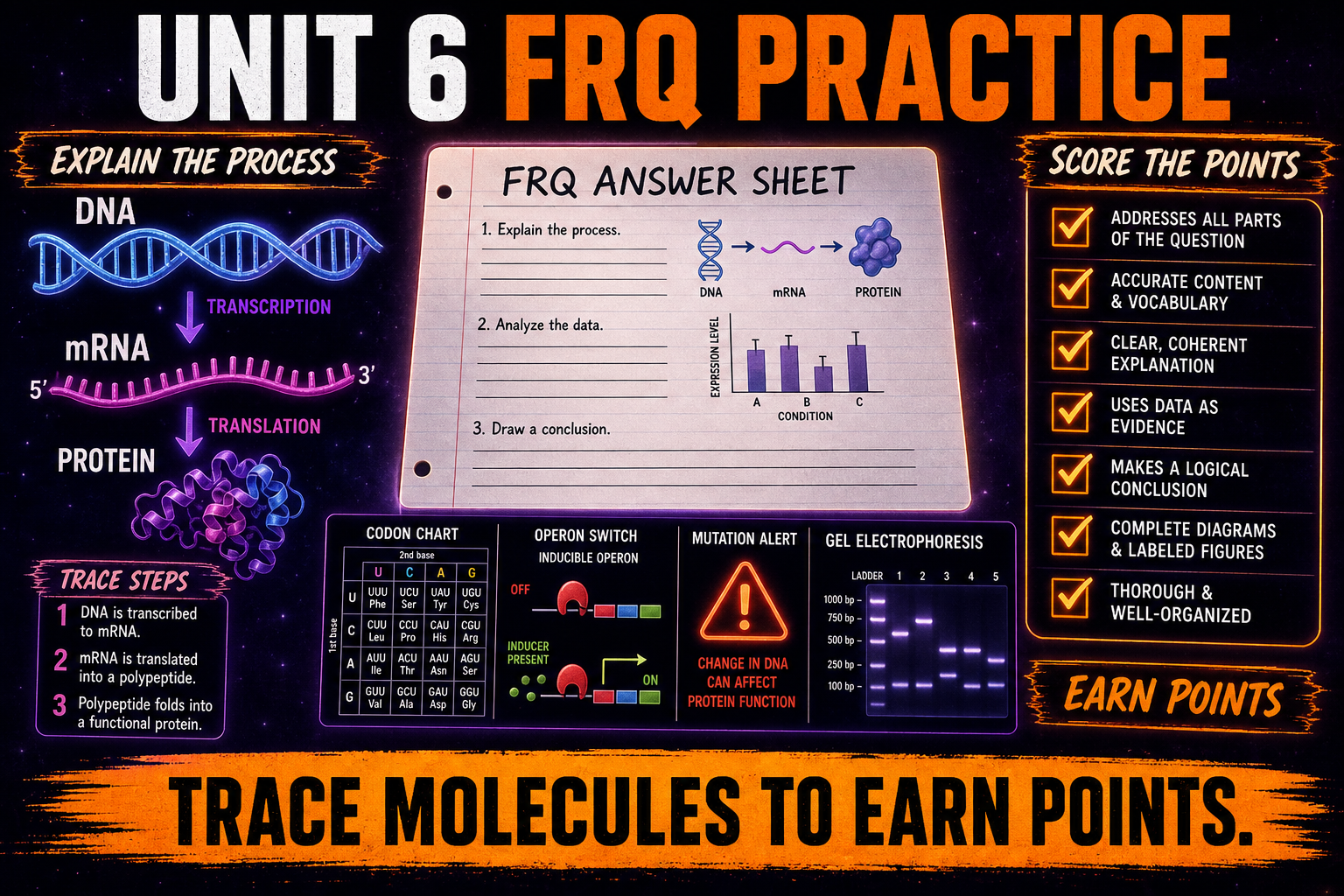
Identify the molecule: DNA, RNA, protein, plasmid, or gel band.
What is on the AP Biology Unit 6 FRQ practice page?
This AP Biology Unit 6 FRQ practice page gives free-response prompts on gene expression and regulation, including DNA replication, transcription, RNA processing, translation, central dogma, gene regulation, operons, cell specialization, mutations, and biotechnology. Each prompt includes scoring guidance, model answer bullets, and common mistakes.
Say it fast
Unit 6 FRQs test whether you can explain DNA → RNA → protein, regulation, mutations, and biotechnology using evidence.
AP Biology Unit 6 FRQs in one sentence
Unit 6 FRQs ask students to trace genetic information, interpret data, and explain how changes in gene expression can affect proteins and phenotype.
How to Answer AP Biology Unit 6 FRQs
Use this AP Bio Unit 6 FRQ strategy before you write. Strong free response questions answers trace molecules and processes instead of listing vocabulary.
Identify the process: replication, transcription, translation, regulation, mutation, or biotechnology.
Explain the immediate molecular result.
Use the data from the prompt.
Connect to protein function only when supported.
Connect to phenotype only after explaining the protein or cell function effect.
AP Biology Unit 6 FRQ Reasoning Ladder
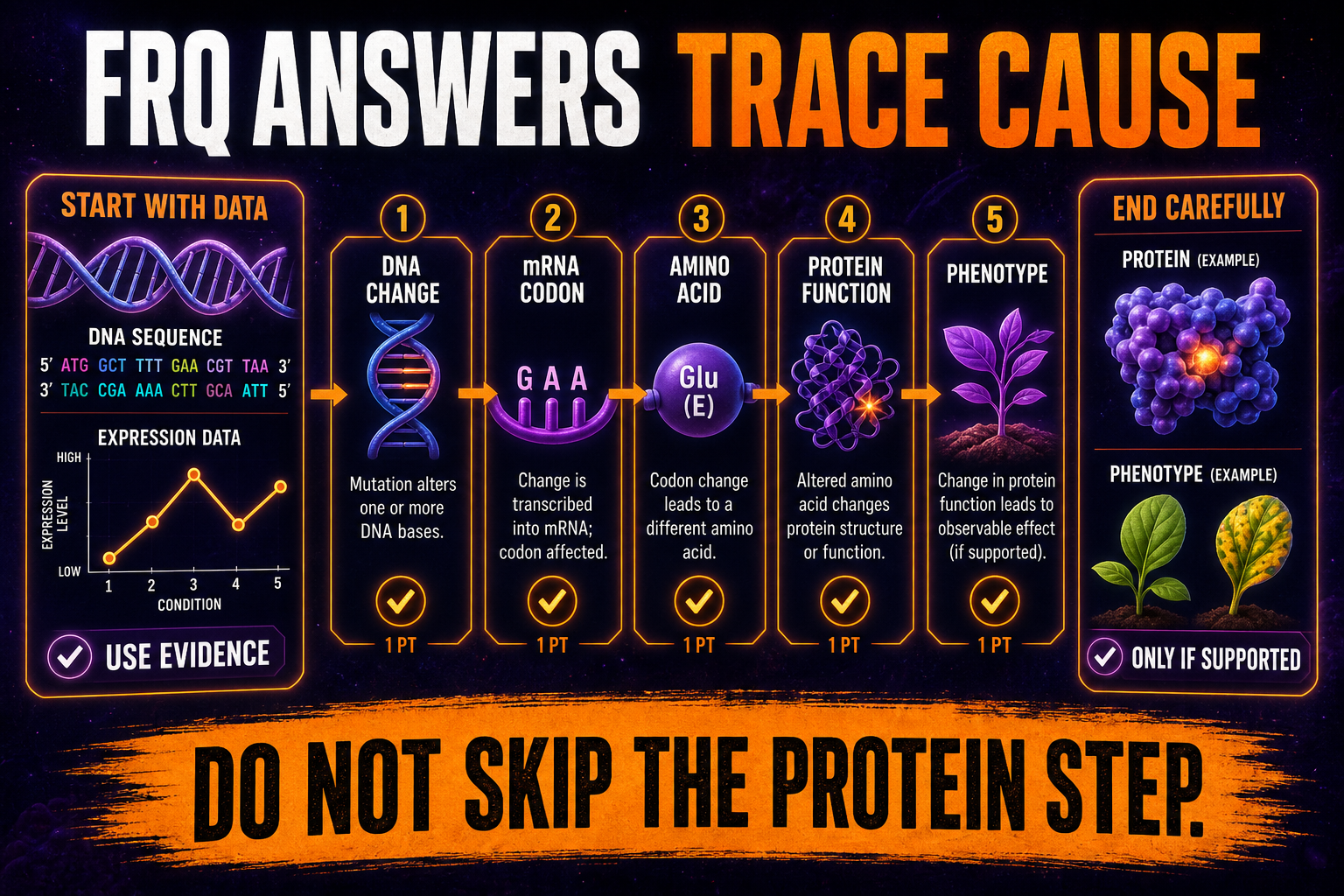
Read the prompt for the molecule
DNA, RNA, protein, plasmid, graph, gel, or operon condition.
Name the process
Replication, transcription, RNA processing, translation, regulation, mutation, or biotechnology.
Explain the immediate result
New DNA, mRNA, mature mRNA, polypeptide, changed transcription, changed codon, or separated fragments.
Use evidence
Quote or paraphrase data from the sequence, graph, table, gel, or experiment.
Connect to protein only if supported
Explain amino acid sequence, protein amount, protein shape, or protein function.
Connect to phenotype only if supported
Do not claim a trait changed unless the data or prompt supports it.
AP exam clue: Strong Unit 6 FRQ answers show the chain of cause and effect instead of listing vocabulary words.
FRQ Scoring Checklist for Unit 6
Use this checklist after each draft to see whether your answer earns scoring points on gene expression and regulation FRQs.
- I identified the correct molecule.
- I named the correct process.
- I explained the molecular result.
- I used evidence from the prompt.
- I used mRNA codons when using a codon chart.
- I explained protein effect before phenotype.
- I avoided saying every mutation is harmful.
- I avoided saying gene regulation changes DNA sequence.
- I compared experimental and control groups when needed.
- I answered every command verb.
AP Biology FRQ Command Words
| Command Word | What AP wants | Unit 6 example |
|---|---|---|
| Describe | say what happens | Describe what transcription produces. |
| Explain | give cause and effect | Explain how a mutation could affect protein function. |
| Predict | state expected outcome | Predict how mRNA levels change if a repressor cannot bind. |
| Justify | support with evidence | Justify the claim using the gel data. |
| Calculate | show math if needed | Calculate percent change in gene expression. |
| Identify | name the item | Identify the molecule produced by translation. |
AP Biology Unit 6 FRQ Topics Covered
Each topic below links to a concept review page. Return here after review to rewrite your FRQ explanation.
| Topic | FRQ skill | Review link |
|---|---|---|
| DNA and RNA structure | use base-pairing rules | DNA and RNA structure |
| DNA replication | explain semiconservative copying | DNA replication |
| Transcription and RNA processing | trace DNA to mature mRNA | Transcription and RNA processing |
| Translation | trace mRNA codons to polypeptide | Translation |
| Central dogma | explain DNA → RNA → protein | Central dogma |
| Gene regulation | explain expression changes | Gene regulation |
| Operons | predict transcription from signal and repressor | Operons |
| Lac vs trp operon | compare inducible and repressible logic | Lac vs trp operon |
| Cell specialization | same DNA, different expression | Cell specialization |
| Mutations | trace DNA change to protein effect | Mutations |
| Biotechnology | interpret PCR, gels, plasmids, CRISPR | Biotechnology |
AP Biology Unit 6 FRQ Practice Prompts
Answer each prompt in your own words before opening the scoring checklist or model answers. These cover transcription, translation, operons, mutations, and biotechnology.
Scenario
A researcher studies a gene with the DNA template sequence TAC GAA TTT. A mutation changes the second triplet to TAA.
- (a) Identify the mRNA sequence transcribed from the original DNA template. ~4 points
- (b) Explain how the mutation could affect the mRNA sequence. ~4 points
- (c) Describe how a change in mRNA codon sequence could affect the amino acid sequence. ~4 points
- (d) Explain why phenotype should only be predicted after considering protein function. ~4 points
Scoring checklist
- Correctly uses DNA template to mRNA base pairing.
- Uses U in RNA instead of T.
- Explains codon change.
- Connects codon to amino acid sequence.
- Connects protein function before phenotype.
Model answer bullets
- Original mRNA: AUG CUU AAA.
- Mutated mRNA changes because the DNA template triplet changed.
- A codon change may alter the amino acid sequence.
- A phenotype change depends on whether protein structure or function changes.
Common mistake
Using DNA triplets directly with a codon chart instead of mRNA codons.
Self-check
Review: Central Dogma · DNA and RNA Structure · Translation
Scenario
A eukaryotic gene is transcribed into pre-mRNA. A mutation disrupts normal splicing.
- (a) Identify the enzyme responsible for making RNA from a DNA template. ~4 points
- (b) Describe two RNA processing steps in eukaryotes. ~4 points
- (c) Explain how incorrect splicing could affect the mature mRNA. ~4 points
- (d) Predict how a changed mature mRNA could affect translation. ~4 points
Scoring checklist
- Names RNA polymerase.
- Describes 5′ cap, poly-A tail, or intron removal/exon joining.
- Explains mature mRNA sequence changes.
- Connects mature mRNA to codons and amino acid sequence.
Model answer bullets
- RNA polymerase synthesizes RNA from the DNA template during transcription.
- Eukaryotic RNA processing includes adding a 5′ cap, adding a poly-A tail, and splicing introns out of pre-mRNA.
- Incorrect splicing may remove needed exons or join exons incorrectly, changing the mature mRNA sequence.
- A changed mature mRNA may produce a different codon sequence, which may change the amino acid sequence during translation.
Common mistake
Saying splicing happens in the cytoplasm instead of the nucleus.
Self-check
Scenario
An mRNA sequence begins AUG GGC UAA.
- (a) Identify the start codon. ~4 points
- (b) Explain the role of tRNA anticodons. ~4 points
- (c) Predict what happens when the ribosome reaches UAA. ~4 points
- (d) Explain how changing a codon could change protein function. ~4 points
Scoring checklist
- Identifies AUG.
- Explains tRNA brings amino acids and anticodons pair with codons.
- Identifies UAA as stop codon.
- Connects amino acid sequence to protein shape/function.
Model answer bullets
- AUG is the start codon that begins translation.
- tRNA molecules carry amino acids and have anticodons that base-pair with mRNA codons during translation.
- UAA is a stop codon, so translation ends and the polypeptide is released.
- Changing a codon may change the amino acid sequence, which may change protein shape or function.
Common mistake
Using DNA triplets with a codon chart instead of mRNA codons.
Self-check
Review: Translation · Transcription vs Translation
Scenario
A graph shows Gene A mRNA levels are high in liver cells and low in muscle cells.
- (a) Describe the difference in Gene A expression between the two cell types. ~4 points
- (b) Explain how transcription factors could cause this pattern. ~4 points
- (c) Predict how Gene A protein levels may differ. ~4 points
- (d) Explain why the two cell types can have the same DNA but different function. ~4 points
Scoring checklist
- Uses graph evidence.
- Connects transcription factors to transcription.
- Connects mRNA to protein level.
- Explains differential gene expression.
Model answer bullets
- Gene A mRNA is higher in liver cells and lower in muscle cells, so Gene A is more highly expressed in liver.
- Transcription factors in liver cells may bind promoters or enhancers to increase transcription of Gene A.
- Higher mRNA in liver cells likely means more Gene A protein is produced in liver than in muscle.
- Both cell types have the same DNA, but different genes are turned on or off, creating different mRNA profiles and functions.
Common mistake
Claiming the DNA sequence differs between cell types from the same organism.
Self-check
Review: Gene Regulation · Gene Expression and Cell Specialization
Scenario
A bacterial operon is controlled by a repressor. When molecule X is absent, transcription is low. When molecule X is present, transcription is high.
- (a) Identify whether molecule X likely acts as an inducer or corepressor. ~4 points
- (b) Explain what happens to the repressor when molecule X is present. ~4 points
- (c) Predict whether RNA polymerase can transcribe the structural genes. ~4 points
- (d) Explain how mRNA levels change. ~4 points
Scoring checklist
- Identifies inducer logic.
- Explains repressor inactivation or removal.
- Connects operator access to RNA polymerase.
- Predicts increased transcription/mRNA.
Model answer bullets
- Molecule X acts as an inducer because transcription increases when X is present.
- When X is present, the inducer inactivates the repressor or prevents it from binding the operator.
- RNA polymerase can access the promoter and transcribe the structural genes when the operator is not blocked.
- mRNA levels increase because transcription of the operon increases.
Common mistake
Skipping the repressor/operator step and jumping directly to protein.
Self-check
Review: Operons · Lac Operon vs Trp Operon
Scenario
A bacterial cell has lactose present and tryptophan abundant.
- (a) Predict lac operon transcription. ~4 points
- (b) Predict trp operon transcription. ~4 points
- (c) Explain the role of lactose in lac operon regulation. ~4 points
- (d) Explain the role of tryptophan in trp operon regulation. ~4 points
Scoring checklist
- Lactose inactivates lac repressor.
- Lac transcription increases.
- Tryptophan acts as corepressor.
- Trp repressor becomes active and transcription decreases.
Model answer bullets
- Lac operon transcription increases because lactose is present.
- Trp operon transcription decreases because tryptophan is abundant.
- Lactose acts as an inducer that inactivates the lac repressor so RNA polymerase can transcribe lac genes.
- Tryptophan acts as a corepressor that activates the trp repressor, which binds the operator and blocks transcription.
Common mistake
Treating lac and trp operons as both inducible systems.
Self-check
Review: Lac Operon vs Trp Operon · Operons
Scenario
A neuron and a muscle cell from the same organism contain the same genome but show different mRNA profiles.
- (a) Explain why the two cells can have the same DNA but different mRNA profiles. ~4 points
- (b) Explain how different mRNA profiles can lead to different proteins. ~4 points
- (c) Describe how different proteins can create specialized cell functions. ~4 points
- (d) Predict how removing a transcription factor could affect specialization. ~4 points
Scoring checklist
- Explains differential gene expression.
- Connects mRNA to translation/protein.
- Connects proteins to cell function.
- Explains transcription factor role.
Model answer bullets
- Both cells have the same DNA, but different genes are transcribed, creating different mRNA profiles.
- Different mRNA molecules are translated into different proteins in each cell type.
- Different proteins perform different jobs, such as signaling in neurons or contraction in muscle cells.
- Removing a transcription factor may reduce transcription of genes needed for specialization, changing cell function.
Common mistake
Claiming neurons and muscle cells have different DNA sequences.
Self-check
Review: Gene Expression and Cell Specialization · Gene Regulation
Scenario
A one-base deletion occurs near the beginning of a coding sequence.
- (a) Identify the mutation type. ~4 points
- (b) Explain how this mutation could affect the reading frame. ~4 points
- (c) Predict how the amino acid sequence may change. ~4 points
- (d) Explain why protein function may be affected. ~4 points
Scoring checklist
- Identifies deletion.
- Explains possible frameshift.
- Describes downstream codon changes.
- Connects amino acid sequence to protein structure/function.
Model answer bullets
- This is a deletion mutation because one base was removed.
- A deletion may shift the reading frame, changing how downstream codons are read.
- Downstream amino acids may change or a premature stop codon may appear.
- Protein function may change if protein shape or active site structure is altered.
Common mistake
Saying every mutation is harmful without explaining the molecular effect.
Self-check
Review: Mutations · Translation
Scenario
Scientists amplify a DNA region using PCR and then run gel electrophoresis. Lane 1 contains a DNA ladder, lane 2 contains sample A, and lane 3 contains sample B. Sample A has a band farther from the wells than sample B.
- (a) Explain why PCR was used before gel electrophoresis. ~4 points
- (b) Describe what gel electrophoresis separates. ~4 points
- (c) Predict which sample has the smaller DNA fragment. ~4 points
- (d) Justify your prediction using gel movement. ~4 points
Scoring checklist
- PCR amplifies DNA.
- Gel separates fragments by size.
- Smaller fragments move farther.
- Sample A has smaller fragment if farther from wells.
Model answer bullets
- PCR amplifies the DNA region so there is enough material to visualize on a gel.
- Gel electrophoresis separates DNA fragments by size using an electric field.
- Sample A likely contains the smaller DNA fragment.
- Smaller DNA fragments move farther through the gel than larger fragments, so the band farther from the wells is smaller.
Common mistake
Saying larger fragments move farther on a gel.
Self-check
Review: Biotechnology
Scenario
A researcher inserts a gene into a plasmid and transforms bacteria. Only some bacteria grow on antibiotic plates and produce a fluorescent protein.
- (a) Explain the role of the plasmid. ~4 points
- (b) Explain why antibiotic plates are useful. ~4 points
- (c) Explain why only some bacteria produce fluorescence. ~4 points
- (d) Connect gene expression to protein production. ~4 points
Scoring checklist
- Plasmid carries inserted gene.
- Antibiotic marker selects transformed cells.
- Only transformed cells express the inserted gene if regulatory elements allow.
- Transcription and translation produce fluorescent protein.
Model answer bullets
- The plasmid carries the inserted gene into bacterial cells during transformation.
- Antibiotic plates select bacteria that took up the plasmid because the plasmid includes an antibiotic resistance gene.
- Only bacteria that were successfully transformed contain the fluorescent gene and can express it.
- When the inserted gene is transcribed and translated, the bacterial cell produces fluorescent protein.
Common mistake
Saying antibiotic kills all bacteria without explaining selection of transformants.
Self-check
Review: Biotechnology · Gene Regulation
Common AP Biology Unit 6 FRQ Mistakes
Mistake: “Using DNA triplets with a codon chart”
Fix: “Codon charts use mRNA codons.”
Mistake: “Jumping from DNA to phenotype”
Fix: “Trace DNA → mRNA → amino acid → protein → phenotype.”
Mistake: “Saying every mutation is harmful”
Fix: “Mutations can be harmful, beneficial, or neutral.”
Mistake: “Saying gene regulation changes DNA sequence”
Fix: “Gene regulation usually changes expression, not DNA sequence.”
Mistake: “Skipping the repressor/operator step in operons”
Fix: “Explain signal → repressor → operator → RNA polymerase → transcription.”
Mistake: “Naming a biotechnology tool without explaining its result”
Fix: “Say what the tool does to DNA or data.”
Data Interpretation Skills for Unit 6 FRQs
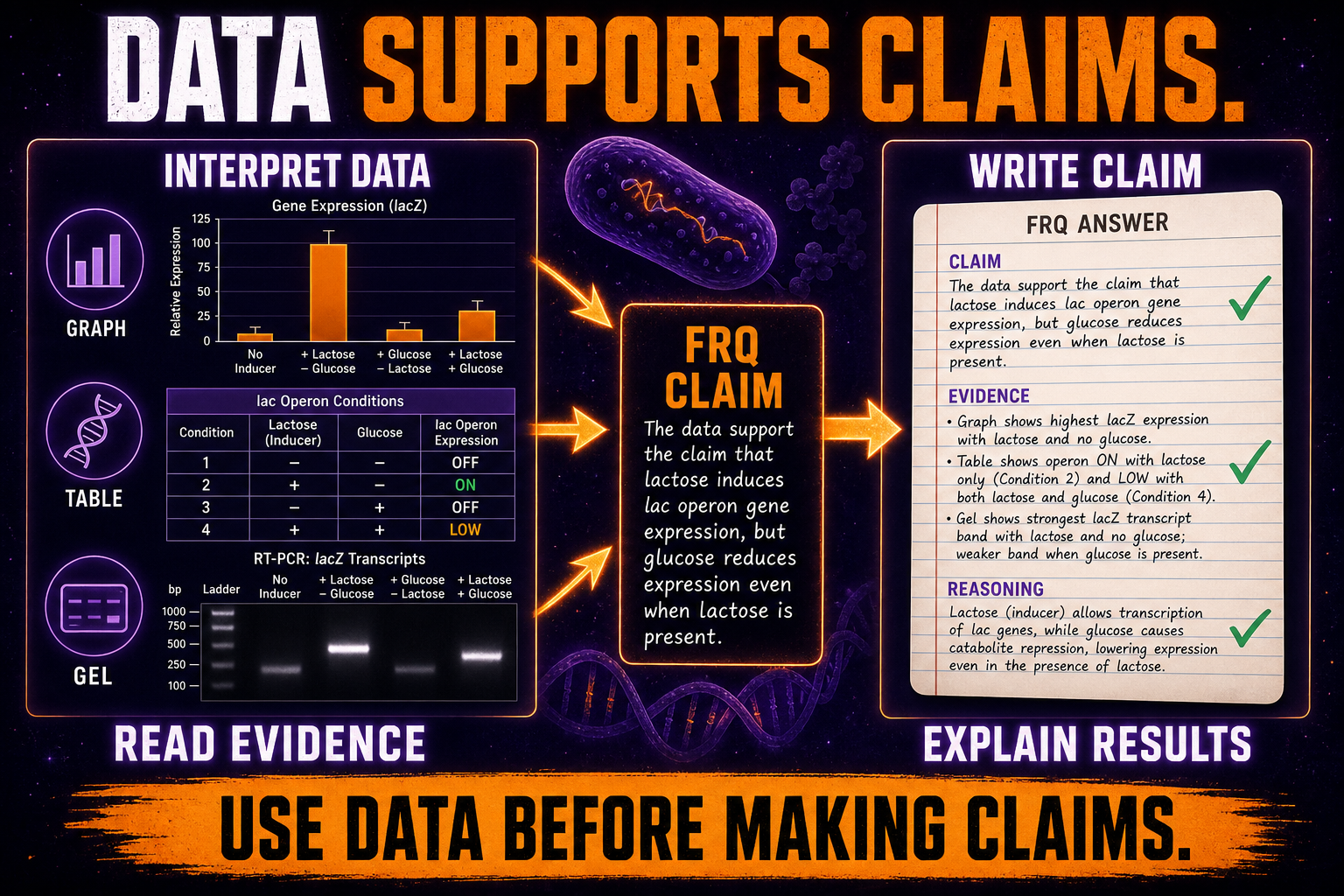
Sequence data
Use base pairing and mRNA codons.
Expression graphs
Compare mRNA levels and explain expression.
Operon tables
Trace signal, repressor, operator, and transcription.
Gel electrophoresis
Smaller DNA fragments move farther.
Experimental design
Compare controls and experimental groups.
AP Biology Unit 6 FRQ Writing Templates
Mutation template
The mutation changes ____. This may change the mRNA codon from ____ to ____. If the amino acid sequence changes, protein ____ may change. Phenotype would change only if ____.
Operon template
When ____ is present/absent, the repressor is ____. The operator is ____. RNA polymerase ____. Therefore, transcription and mRNA levels ____.
Gene regulation template
The regulatory change affects transcription of ____. This changes mRNA levels, which may change protein levels. The effect on phenotype depends on ____.
Biotechnology template
The tool used is ____. It works by ____. The data show ____. This supports the claim because ____.
AP Biology Unit 6 FRQ Practice FAQ
What topics are on AP Biology Unit 6 FRQs?
AP Biology Unit 6 FRQs cover gene expression and regulation, including DNA replication, transcription, RNA processing, translation, central dogma, gene regulation, operons, cell specialization, mutations, and biotechnology. Many prompts ask you to trace information flow and interpret data.
How do I answer AP Biology Unit 6 FRQs?
Identify the molecule and process, explain the immediate molecular result, use evidence from the prompt, and connect to protein function or phenotype only when supported. Strong answers show cause-and-effect reasoning instead of listing vocabulary.
What is the biggest mistake on Unit 6 FRQs?
The biggest mistake is jumping from DNA to phenotype without tracing mRNA, amino acids, and protein function. Another common error is using DNA triplets with a codon chart instead of mRNA codons.
How should I explain mutation effects on an FRQ?
Name the mutation type, explain how it changes the reading frame or codon, predict how the amino acid sequence may change, and connect protein structure or function before predicting phenotype.
How should I explain operons on an FRQ?
Trace the signal, repressor state, operator access, RNA polymerase activity, and resulting mRNA levels. Compare inducible and repressible logic when the prompt involves lac or trp operons.
How should I explain gene regulation on an FRQ?
Explain how regulatory molecules or transcription factors change transcription, which changes mRNA and possibly protein levels. Gene regulation usually changes expression, not DNA sequence.
How should I explain biotechnology tools on an FRQ?
State what the tool does to DNA or data, describe the experimental result, and connect the result to a claim about gene expression or fragment size. Do not name PCR or gel electrophoresis without explaining the outcome.
Do Unit 6 FRQs use data and graphs?
Yes. Unit 6 FRQs often include expression graphs, operon condition tables, gel electrophoresis results, and sequence data. Use the evidence before making claims about protein or phenotype.
How do I use codon charts on Unit 6 FRQs?
Convert DNA template sequence to mRNA first, then use mRNA codons with the chart. Codon charts read mRNA codons, not DNA triplets.
How can I practice Unit 6 FRQs effectively?
Answer one prompt without notes, compare your response to the scoring checklist and model bullets, rewrite weak sentences, review the linked concept page, and try another prompt.