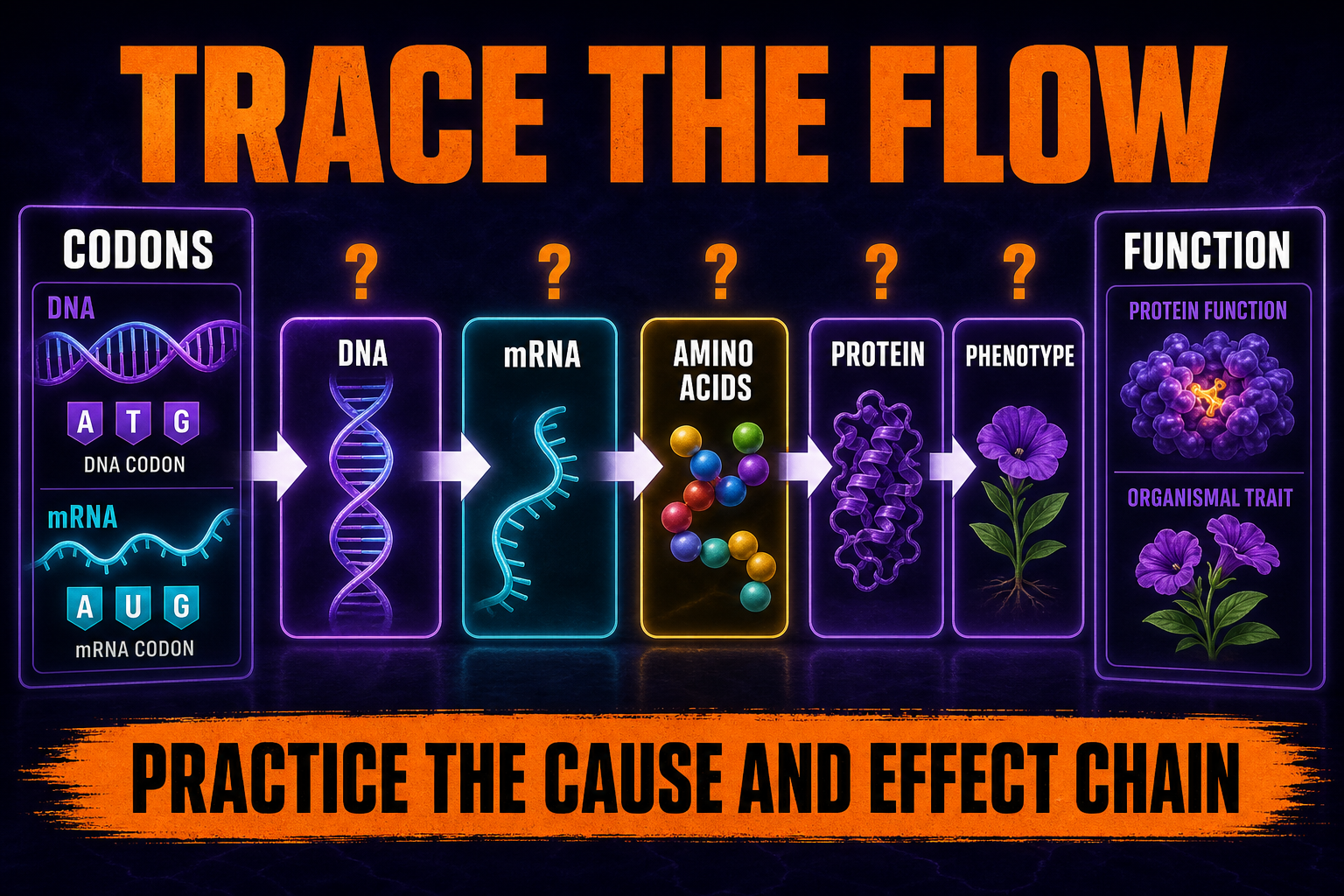
Trace DNA → RNA → protein before predicting phenotype.
Quick answer
What is on the AP Biology Unit 6 practice questions page?
This AP Biology Unit 6 practice page tests gene expression and regulation with multiple-choice questions on DNA and RNA, DNA replication, transcription, RNA processing, translation, central dogma, gene regulation, operons, lac and trp operons, cell specialization, mutations, and biotechnology.
AP Biology Unit 6 practice questions test gene expression and regulation with multiple-choice questions on DNA and RNA, DNA replication, transcription, RNA processing, translation, central dogma, gene regulation, operons, lac and trp operons, cell specialization, mutations, and biotechnology.
Unit 6 practice = DNA → RNA → protein, regulation, mutations, operons, and biotechnology.
AP Biology Unit 6 in one sentence: Unit 6 asks how genetic information is copied, expressed, regulated, changed, and analyzed.
Strategy
How to Practice AP Biology Unit 6
Use these moves on every question before you pick an answer.
Use mRNA codons with codon charts, not DNA triplets.
For operons, trace signal → repressor → operator → transcription.
For mutations, decide whether codons, amino acids, or proteins change.
For biotechnology, identify the tool and the DNA-level result.
Reasoning
Unit 6 Practice Reasoning Ladder
Trace information flow step by step instead of jumping to phenotype.
Identify the molecule
DNA, RNA, protein, plasmid, or gel band.
Identify the process
Replication, transcription, RNA processing, translation, regulation, mutation, or biotechnology.
Predict the immediate result
New DNA, mRNA, mature mRNA, polypeptide, changed transcription, changed codon, or separated DNA fragments.
Connect to protein
Ask whether amino acid sequence, protein amount, or protein function changes.
Connect to phenotype only with evidence
Do not overclaim phenotype changes.
Use data to support the answer
Use sequences, tables, graphs, gels, or experimental results.
AP exam clue: The best Unit 6 answers trace the molecule-by-molecule chain instead of jumping to the final trait.
Coverage
AP Biology Unit 6 Topics Covered
Match each practice cluster to the Unit 6 study guide you should review after a miss.
| Topic | Focus | Review |
|---|---|---|
| DNA and RNA structure | base pairing, DNA vs RNA, uracil | Study guide → |
| DNA replication | semiconservative replication, polymerase, leading/lagging | Study guide → |
| Transcription and RNA processing | RNA polymerase, pre-mRNA, splicing | Study guide → |
| Translation | codons, anticodons, ribosomes, amino acids | Study guide → |
| Central dogma | DNA → RNA → protein reasoning | Study guide → |
| Gene regulation | activators, repressors, expression levels | Study guide → |
| Operons | promoter, operator, repressor, transcription | Study guide → |
| Lac vs trp operon | inducible vs repressible logic | Study guide → |
| Cell specialization | same DNA, different expression | Study guide → |
| Mutations | silent, missense, nonsense, frameshift | Study guide → |
| Biotechnology | PCR, gels, restriction enzymes, plasmids | Study guide → |
Study path
How to Use These Practice Questions
Follow this path from coverage check to FRQ-style reasoning.
Skim the topic coverage table
Identify which Unit 6 guides you need before starting the full set.
Jump to section →Run the reasoning ladder on missed items
Name the molecule, process, immediate result, and supported protein or phenotype claim.
Jump to section →Answer all 45 MCQs
Use topic filters to drill one cluster, then return to All for mixed review.
Jump to section →Expand the question bank
Review stems and explanations without resetting your interactive progress.
Jump to section →Use the FRQ checklist
Open the dedicated FRQ page for prompts, rubrics, and model answers.
Jump to section →If you miss a question, write down the molecule, process, and result you confused.
Practice
AP Biology Unit 6 MCQ Practice Not started
Answer 45 AP-style questions across Unit 6. Filter by topic or run the full mixed set.
Question 1 of 45
Quick tip: Press A–D or 1–4 to answer · Enter for next
Review
Unit 6 Mini-Review Before You Practice
Refresh core ideas before your next practice pass.
DNA stores genetic information.
Review DNA and RNA Structure →Transcription makes RNA.
Review Transcription and RNA Processing →RNA processing prepares eukaryotic mRNA.
Review Transcription and RNA Processing →Translation builds a polypeptide.
Review Translation →Gene regulation changes expression levels.
Review Gene Regulation →Operons control prokaryotic transcription.
Review Operons →Mutations may or may not affect phenotype.
Review Mutations →Biotechnology tools copy, cut, separate, edit, or analyze DNA.
Review Biotechnology →Data
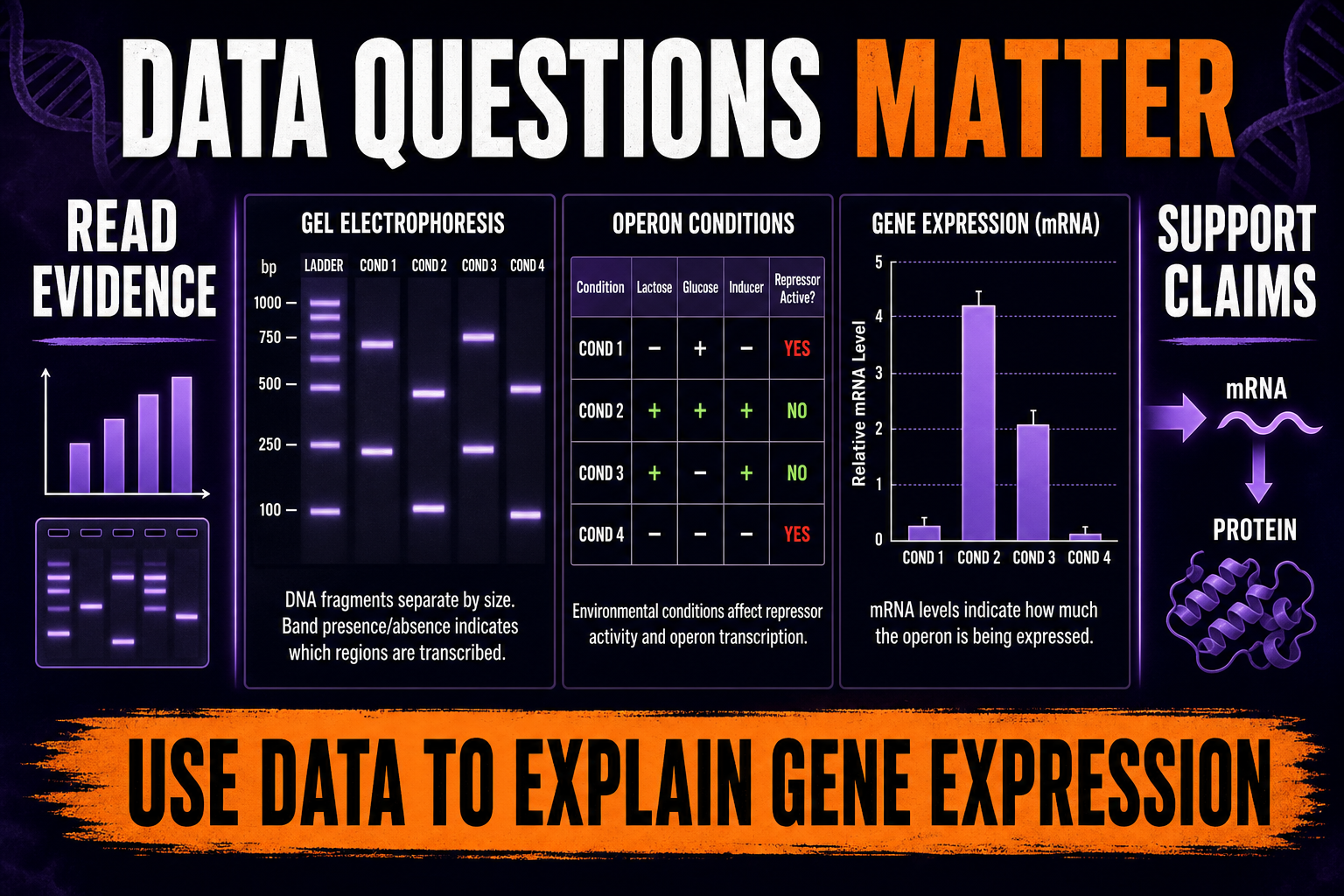
Data Skills for AP Biology Unit 6
Sequence data
Use base-pairing rules and mRNA codons.
Codon charts
Use mRNA codons, not DNA triplets.
Expression graphs
Connect mRNA level to gene expression and possible protein amount.
Operon tables
Trace signal → repressor → operator → transcription.
Gel electrophoresis
Compare band positions and remember smaller fragments move farther.
Mistakes
Common AP Biology Unit 6 Practice Mistakes
Common trap
Using DNA triplets with the codon chart
Fix: Codon charts use mRNA codons.
Common trap
Thinking transcription makes protein
Fix: Transcription makes RNA. Translation builds a polypeptide.
Common trap
Skipping RNA processing
Fix: Eukaryotic pre-mRNA is processed before translation.
Common trap
Jumping from mutation directly to phenotype
Fix: Trace DNA → mRNA → amino acid → protein → phenotype.
Common trap
Mixing up lac and trp operon logic
Fix: Lac turns on with lactose. Trp turns off with tryptophan.
Common trap
Thinking PCR separates DNA
Fix: PCR copies DNA. Gel electrophoresis separates DNA.
Shortcuts
AP Biology Unit 6 Shortcuts
DNA replication: DNA → DNA.
Transcription: DNA → RNA.
RNA processing: pre-mRNA → mature mRNA.
Translation: mRNA → polypeptide.
Gene regulation: changes RNA/protein amount.
Operons: control bacterial transcription.
Mutations: DNA changes may affect protein.
Biotechnology: tools work with DNA.
FRQ bridge
From Unit 6 MCQs to FRQs
Use this checklist when you practice short written explanations alongside MCQs.
- 1Name the molecule.
- 2Name the process.
- 3Explain the immediate result.
- 4Use data from the prompt.
- 5Connect to protein only if supported.
- 6Connect to phenotype only if supported.
Continue with AP Biology Unit 6 FRQ practice for full prompts, rubrics, and model answers.
Reference
All Unit 6 Practice Questions with Answers
Expand any row to review stems, choices, explanations, and study links without restarting the interactive quiz.
Full practice MCQs (45)
Practice Q1 — DNA and RNA Structure
Question: Which base is found in RNA but not in DNA?
Choices: A) Thymine · B) Uracil ✓ · C) Adenine · D) Guanine
Correct: B. Explanation: RNA uses uracil instead of thymine. Adenine, guanine, and cytosine appear in both nucleic acids. A common trap is picking thymine because it pairs with adenine in DNA.
Practice Q2 — DNA and RNA Structure
Question: Which molecule is double-stranded and stores genetic information in the nucleus?
Choices: A) mRNA · B) tRNA · C) DNA ✓ · D) Amino acids
Correct: C. Explanation: DNA is the double-stranded information store in eukaryotic nuclei. mRNA and tRNA are RNA molecules with different roles.
Practice Q3 — DNA and RNA Structure
Question: A DNA strand has the sequence 5′-ATG CCT-3′. Which RNA sequence could pair with this strand during transcription?
Choices: A) 5′-UAC GGA-3′ ✓ · B) 5′-ATG CCT-3′ · C) 5′-TAC GGA-3′ · D) 5′-AUG CCU-3′
Correct: A. Explanation: RNA polymerase builds RNA complementary to the template strand. A pairs with U, T pairs with A, G pairs with C, and C pairs with G. The complementary RNA is 5′-UAC GGA-3′. Trap: copying the DNA sequence without base-pairing rules.
Practice Q4 — DNA and RNA Structure
Question: Which structural feature distinguishes DNA from most RNA in cells?
Choices: A) DNA contains phosphate groups · B) DNA is usually double-stranded ✓ · C) DNA uses ribose sugar · D) DNA carries anticodons
Correct: B. Explanation: DNA is typically double-stranded with deoxyribose. RNA is usually single-stranded with ribose. Both contain phosphate groups.
Practice Q5 — DNA Replication
Question: DNA replication is described as semiconservative because each new DNA molecule has:
Choices: A) Two newly synthesized strands · B) One old strand and one new strand ✓ · C) No template strand · D) RNA instead of DNA
Correct: B. Explanation: Semiconservative replication keeps one parental strand in each daughter molecule. A common trap is thinking both strands are entirely new.
Practice Q6 — DNA Replication
Question: Which enzyme adds nucleotides to a growing DNA strand during replication?
Choices: A) RNA polymerase · B) DNA polymerase ✓ · C) Ribosome · D) Helicase only
Correct: B. Explanation: DNA polymerase adds DNA nucleotides. RNA polymerase makes RNA during transcription, not DNA replication.
Practice Q7 — DNA Replication
Question: On the lagging strand, short DNA segments called Okazaki fragments are joined by:
Choices: A) DNA ligase ✓ · B) RNA polymerase · C) Peptidyl transferase · D) Restriction enzyme
Correct: A. Explanation: DNA ligase joins Okazaki fragments on the lagging strand. Helicase opens the helix, but it does not seal fragments.
Practice Q8 — DNA Replication
Question: A student measures DNA content through the cell cycle. Which phase shows DNA content double that of G1?
Choices: A) G1 · B) S · C) G2 and M ✓ · D) Cytokinesis only
Correct: C. Explanation: After S phase, DNA is replicated. G2 and M cells hold twice the G1 DNA content until cytokinesis splits the DNA. Trap: picking S phase, which is when copying occurs, not when content is fully doubled in a completed cell.
Practice Q9 — Transcription and RNA Processing
Question: A DNA template strand has the sequence TAC GGA. Which mRNA sequence would be produced during transcription?
Choices: A) TAC GGA · B) ATG CCT · C) AUG CCU ✓ · D) UAC GGA
Correct: C. Explanation: RNA polymerase builds a complementary RNA strand from the DNA template. DNA T pairs with RNA A, DNA A pairs with RNA U, DNA C pairs with RNA G, and DNA G pairs with RNA C. The mRNA is AUG CCU. Trap: ATG CCT uses thymine in RNA or ignores template orientation.
Practice Q10 — Transcription and RNA Processing
Question: Which enzyme synthesizes RNA from a DNA template during transcription?
Choices: A) DNA polymerase · B) RNA polymerase ✓ · C) DNA ligase · D) Aminoacyl-tRNA synthetase
Correct: B. Explanation: RNA polymerase builds RNA during transcription. DNA polymerase copies DNA during replication.
Practice Q11 — Transcription and RNA Processing
Question: Which eukaryotic RNA processing step adds a protective sequence to the 5′ end of pre-mRNA?
Choices: A) Splicing · B) 5′ cap addition ✓ · C) Poly-A tail removal · D) Translation initiation
Correct: B. Explanation: The 5′ cap is added during RNA processing before export. Splicing removes introns, and the poly-A tail is added at the 3′ end.
Practice Q12 — Transcription and RNA Processing
Question: A gene contains introns and exons. Which change would most likely prevent a functional mRNA from reaching the ribosome?
Choices: A) Failure to remove an intron by splicing ✓ · B) Addition of a 5′ cap · C) Addition of a poly-A tail · D) Binding of RNA polymerase to the promoter
Correct: A. Explanation: Introns must be spliced out to produce mature mRNA. Cap and tail addition help export and stability, not block translation.
Practice Q13 — Transcription and RNA Processing
Question: A bar graph shows mRNA levels for Gene X are high in liver cells and low in muscle cells. The best conclusion is:
Choices: A) Gene X is not present in muscle cells · B) Gene X is transcribed more actively in liver cells ✓ · C) Muscle cells cannot translate any mRNA · D) Liver and muscle cells have different DNA sequences for Gene X
Correct: B. Explanation: Higher mRNA level suggests greater transcription or mRNA stability in liver cells. Same genome can show different expression. Trap: assuming different DNA sequences in specialized cells.
Practice Q14 — Translation
Question: Where does translation occur in eukaryotic cells?
Choices: A) Nucleus · B) Ribosomes in the cytoplasm ✓ · C) Golgi apparatus · D) Replication fork
Correct: B. Explanation: Translation occurs at ribosomes in the cytoplasm or on rough ER. Transcription occurs in the nucleus.
Practice Q15 — Translation
Question: Which mRNA codon signals translation to start?
Choices: A) UAA · B) UAG · C) UGA · D) AUG ✓
Correct: D. Explanation: AUG is the start codon and codes for methionine. UAA, UAG, and UGA are stop codons.
Practice Q16 — Translation
Question: An mRNA codon is 5′-CCU-3′. A tRNA anticodon that pairs correctly would be:
Choices: A) 5′-GGA-3′ · B) 5′-GGU-3′ ✓ · C) 5′-CCU-3′ · D) 5′-AGG-3′
Correct: B. Explanation: Anticodons pair antiparallel with mRNA codons. CCU pairs with GGA written 5′-GGA-3′ on the anticodon loop. Trap: writing the same sequence as the codon.
Practice Q17 — Translation
Question: Which statement best describes the role of tRNA during translation?
Choices: A) It carries DNA into the ribosome · B) It brings amino acids to the ribosome according to codons ✓ · C) It removes introns from pre-mRNA · D) It copies DNA during replication
Correct: B. Explanation: tRNA delivers amino acids matched to mRNA codons via anticodons. It does not process RNA or replicate DNA.
Practice Q18 — Translation
Question: An mRNA sequence reads 5′-AUG UUC UAA-3′. Using a codon chart, how many amino acids are incorporated before translation stops?
Choices: A) One · B) Two ✓ · C) Three · D) Zero
Correct: B. Explanation: AUG codes for the first amino acid and UAA is a stop codon. Only UUC adds a second amino acid before termination, for two total. Trap: counting the stop codon as an amino acid.
Practice Q19 — Central Dogma
Question: Which sequence correctly shows information flow in the central dogma?
Choices: A) Protein → RNA → DNA · B) DNA → RNA → protein ✓ · C) RNA → DNA → protein · D) DNA → protein → RNA
Correct: B. Explanation: The central dogma is DNA → RNA → protein. Transcription and translation carry out these steps. Trap: skipping RNA.
Practice Q20 — Central Dogma
Question: A mutation blocks RNA polymerase from binding a promoter. Which step is most directly affected?
Choices: A) DNA replication · B) Transcription ✓ · C) Translation · D) Gel electrophoresis
Correct: B. Explanation: Promoter binding is required for transcription. Without mRNA, downstream translation may also drop, but transcription is the immediate blocked step.
Practice Q21 — Central Dogma
Question: A table shows normal mRNA and protein levels in wild type but low mRNA and low protein in a mutant. The most likely primary defect is in:
Choices: A) Translation only · B) Transcription or RNA production ✓ · C) DNA replication only · D) Gel electrophoresis
Correct: B. Explanation: Low mRNA and low protein together point upstream to transcription or RNA stability. A translation-only defect would usually leave mRNA level normal.
Practice Q22 — Central Dogma
Question: Reverse transcriptase activity would produce:
Choices: A) DNA from an RNA template ✓ · B) RNA from a DNA template · C) Protein from RNA directly without ribosomes · D) mRNA from protein
Correct: A. Explanation: Reverse transcriptase makes DNA from RNA, reversing the usual transcription direction. This is an exception to the standard dogma flow.
Practice Q23 — Gene Regulation
Question: Gene regulation most directly controls:
Choices: A) Which genes are expressed and how much product is made ✓ · B) The number of chromosomes in a gamete · C) The speed of diffusion across membranes · D) The sequence of all DNA in a genome
Correct: A. Explanation: Regulation changes when and how much RNA or protein is produced. It does not change chromosome number in somatic cells.
Practice Q24 — Gene Regulation
Question: A transcription factor is removed from a cell. mRNA from its target gene drops sharply. The transcription factor most likely:
Choices: A) Activates transcription of the target gene ✓ · B) Digests mRNA in the cytoplasm · C) Replicates DNA at the origin · D) Adds amino acids to tRNA
Correct: A. Explanation: Lower mRNA after removing a factor suggests the factor helped activate transcription. Trap: assuming the factor works only in translation.
Practice Q25 — Gene Regulation
Question: Epigenetic changes such as DNA methylation can:
Choices: A) Change DNA sequence permanently · B) Reduce gene expression without changing DNA sequence ✓ · C) Replace uracil with thymine · D) Stop all translation in the cell
Correct: B. Explanation: Methylation often silences genes by blocking transcription. Epigenetic marks do not change the DNA base sequence.
Practice Q26 — Gene Regulation
Question: Two cell types express different proteins despite having the same DNA. The best explanation is:
Choices: A) Different gene regulation patterns ✓ · B) Different numbers of chromosomes in each cell type · C) Translation occurs only in one cell type · D) DNA replication is absent in one cell type
Correct: A. Explanation: Cell specialization uses differential gene expression from the same genome. Trap: assuming different DNA sequences in body cells.
Practice Q27 — Operons
Question: In a bacterial operon, the operator is:
Choices: A) Where RNA polymerase always terminates · B) A regulatory DNA site near the promoter ✓ · C) An enzyme that cuts DNA · D) The ribosome binding site on mRNA
Correct: B. Explanation: The operator is a regulatory DNA region where repressors can bind and block transcription.
Practice Q28 — Lac Operon
Question: In the lac operon, lactose is present. What is the most likely effect?
Choices: A) The repressor remains bound and transcription decreases. · B) Lactose inactivates the repressor and transcription increases. ✓ · C) Tryptophan activates the repressor and transcription decreases. · D) RNA polymerase cannot bind any bacterial promoter.
Correct: B. Explanation: Lactose or allolactose acts as an inducer that inactivates the lac repressor. The operator is open, so RNA polymerase can transcribe the structural genes. Trap: confusing lactose with tryptophan logic.
Practice Q29 — Trp Operon
Question: In the trp operon, tryptophan is abundant in the cell. What is the most likely result?
Choices: A) Repressor is inactive and transcription increases · B) Repressor binds the operator and transcription decreases ✓ · C) Lactose removes the repressor from DNA · D) RNA polymerase adds tryptophan to the growing polypeptide
Correct: B. Explanation: High tryptophan activates the trp repressor, which binds the operator and reduces transcription. This is repressible regulation. Trap: using lac operon inducible logic.
Practice Q30 — Operons
Question: An operon table shows lactose absent and repressor bound to the operator. Predict mRNA level from the lac structural genes.
Choices: A) Low ✓ · B) High · C) Unchanged regardless of repressor · D) Zero in all conditions
Correct: A. Explanation: With repressor bound, RNA polymerase cannot transcribe effectively, so lac mRNA stays low. Add lactose to inactivate the repressor and raise mRNA.
Practice Q31 — Operons
Question: Which operon is inducible?
Choices: A) Lac operon ✓ · B) Trp operon when tryptophan is high · C) Operon blocked by CAP only · D) Operon that always transcribes at maximum rate
Correct: A. Explanation: The lac operon is usually off until lactose induces expression. The trp operon is repressible when tryptophan is abundant.
Practice Q32 — Operons
Question: A graph shows enzyme activity for a trp operon product highest when tryptophan is low. This pattern supports:
Choices: A) Repressible regulation that turns off when product is abundant ✓ · B) Inducible regulation that turns on when lactose is present · C) Constitutive expression at all times · D) Translation occurring in the nucleus
Correct: A. Explanation: High enzyme when tryptophan is low fits trp repressible logic: the cell makes tryptophan enzymes when the amino acid is scarce.
Practice Q33 — Cell Specialization
Question: Cell specialization in multicellular organisms mainly results from:
Choices: A) Different DNA sequences in every cell type · B) Differential gene expression from the same genome ✓ · C) Random mutation in each cell · D) Loss of ribosomes in most cells
Correct: B. Explanation: Specialized cells express different gene sets from the same DNA. Trap: thinking each cell type has unique DNA sequence.
Practice Q34 — Cell Specialization
Question: A muscle cell and a neuron share the same genome. Which evidence best explains their different functions?
Choices: A) Different mRNA and protein profiles ✓ · B) Different numbers of chromosomes · C) Muscle cells use RNA instead of DNA · D) Neurons cannot transcribe DNA
Correct: A. Explanation: Different functions come from different expressed genes, shown by distinct mRNA and protein profiles.
Practice Q35 — Cell Specialization
Question: A data table shows high hemoglobin mRNA in red blood cell precursors and none in skin cells. This supports:
Choices: A) Tissue-specific gene expression ✓ · B) A frameshift in skin cell DNA · C) Translation without transcription in skin cells · D) Different genetic codes in each tissue
Correct: A. Explanation: Tissue-specific expression explains why only some cell types produce hemoglobin mRNA from the shared genome.
Practice Q36 — Mutations
Question: A mutation changes an mRNA codon but the amino acid remains the same. Which type of mutation is this?
Choices: A) Silent ✓ · B) Missense · C) Nonsense · D) Frameshift
Correct: A. Explanation: A silent mutation changes the codon without changing the amino acid because the genetic code is redundant. Trap: calling any base change missense.
Practice Q37 — Mutations
Question: A nonsense mutation most directly creates:
Choices: A) A premature stop codon ✓ · B) A longer protein with extra amino acids · C) A silent codon change · D) A duplicate chromosome
Correct: A. Explanation: Nonsense mutations change a codon into a stop codon, shortening the polypeptide.
Practice Q38 — Mutations
Question: A single nucleotide deletion in the middle of a coding sequence is most likely to cause:
Choices: A) Silent mutation only · B) Frameshift and altered amino acids downstream ✓ · C) No change in protein · D) Immediate chromosome loss
Correct: B. Explanation: Insertions or deletions that are not in multiples of three shift the reading frame and change downstream amino acids.
Practice Q39 — Mutations
Question: Wild-type mRNA codon 5′-CUU-3′ codes for leucine. A mutation changes it to 5′-UAA-3′. The most likely protein effect is:
Choices: A) Same amino acid at that position · B) Different amino acid at that position only · C) Premature termination of translation ✓ · D) No change because UAA is a start codon
Correct: C. Explanation: UAA is a stop codon, so translation stops early. Trap: treating UAA as a missense change.
Practice Q40 — Mutations
Question: A point mutation changes a codon from GAA to GAG. Both codons code for glutamic acid. Phenotype is unchanged. This best illustrates:
Choices: A) Silent mutation and code redundancy ✓ · B) Frameshift mutation · C) Nonsense mutation · D) Operon induction
Correct: A. Explanation: When the amino acid stays the same, the mutation is silent. Do not assume every DNA change alters phenotype.
Practice Q41 — Biotechnology
Question: After 3 PCR cycles starting from one DNA template, at most how many copies of the target region exist, assuming ideal doubling each cycle?
Choices: A) 3 · B) 6 · C) 8 ✓ · D) 9
Correct: C. Explanation: PCR doubles target DNA each cycle. Starting from 1 template, 2³ = 8 copies after 3 cycles. Trap: multiplying by 3 instead of doubling. PCR amplifies DNA; gel electrophoresis separates fragments.
Practice Q42 — Biotechnology
Question: In gel electrophoresis, which DNA fragments move farthest from the wells?
Choices: A) Largest fragments · B) Smallest fragments ✓ · C) Most circular fragments · D) Fragments with thymine only
Correct: B. Explanation: Smaller DNA fragments move more easily through the gel and travel farther from the wells. Trap: assuming larger fragments travel farther.
Practice Q43 — Biotechnology
Question: Restriction enzymes are used to:
Choices: A) Cut DNA at specific recognition sequences ✓ · B) Join Okazaki fragments during replication · C) Add caps to mRNA · D) Build polypeptides on ribosomes
Correct: A. Explanation: Restriction enzymes cut DNA at specific sites to create fragments for cloning or analysis.
Practice Q44 — Biotechnology
Question: A gel shows Lane A with one bright band near the top and Lane B with one bright band near the bottom. The best interpretation is:
Choices: A) Lane A contains larger DNA fragments than Lane B ✓ · B) Lane B contains larger DNA fragments than Lane A · C) Both lanes contain RNA only · D) Gel electrophoresis copies DNA
Correct: A. Explanation: Bands near the top moved less and represent larger fragments. Smaller fragments move farther toward the bottom.
Practice Q45 — Biotechnology
Question: A plasmid is cut with a restriction enzyme and a foreign gene is inserted. Bacteria take up the plasmid. This process is:
Choices: A) Bacterial transformation with recombinant DNA ✓ · B) Transcription of introns · C) Semiconservative replication in humans · D) RNA splicing in the nucleus
Correct: A. Explanation: Inserting a gene into a plasmid and introducing it into bacteria is recombinant DNA technology through transformation.
Benchmarks
Score Yourself
| Score | Meaning | Next step |
|---|---|---|
| Full MCQ (out of 45) | ||
| 0–18 | Needs review | Return to missed topic guides, then retry filtered sets |
| 19–29 | Developing | Mix topic filters with the reasoning ladder |
| 30–36 | Strong | Review data-style misses and operon logic |
| 37–45 | Excellent | Keep FRQ checklist sharp before the exam |
FAQ
AP Biology Unit 6 Practice Questions FAQ
What topics are on AP Biology Unit 6 practice questions?
DNA and RNA structure, DNA replication, transcription, RNA processing, translation, central dogma, gene regulation, operons, lac and trp operons, cell specialization, mutations, and biotechnology appear on this AP Biology Unit 6 practice page.
How many AP Biology Unit 6 practice questions should I do?
Complete all 45 MCQs in one or two sittings, then revisit missed topics. Add extra sets only after you can explain each answer using DNA → RNA → protein reasoning.
What is the hardest part of AP Biology Unit 6?
Many students struggle with operon logic, mutation-to-protein tracing, and data questions that combine sequences, graphs, and gels. Practice the reasoning ladder on every missed item.
How should I practice transcription and translation questions?
Write the DNA template, predict mRNA with base-pairing rules, then use mRNA codons with a codon chart for amino acids. Separate transcription from translation steps.
How should I practice operon questions?
List the signal present, repressor state, operator status, and predicted mRNA level before choosing an answer. Compare lac inducible logic with trp repressible logic.
How should I practice mutation questions?
Trace DNA change → mRNA codon → amino acid → protein effect → possible phenotype. Classify silent, missense, nonsense, and frameshift before predicting traits.
How should I practice biotechnology questions?
Name the tool first—PCR, restriction enzyme, plasmid, gel, or transformation—then state the DNA-level outcome such as copied, cut, separated, or inserted fragments.
Do AP Biology Unit 6 questions include data interpretation?
Yes. This set includes data-style items with sequences, operon tables, expression graphs, and gel electrophoresis bands. Read the evidence before selecting an answer.
What is the best way to review missed Unit 6 questions?
Use the review link under each explanation, write the molecule and process you confused, then return to the matching Unit 6 study guide before retrying the question.
Are these AP Biology Unit 6 practice questions good for FRQ preparation?
Yes. MCQs build recognition and prediction. Use the FRQ checklist to practice short written explanations that name molecules, processes, and supported protein or phenotype claims.