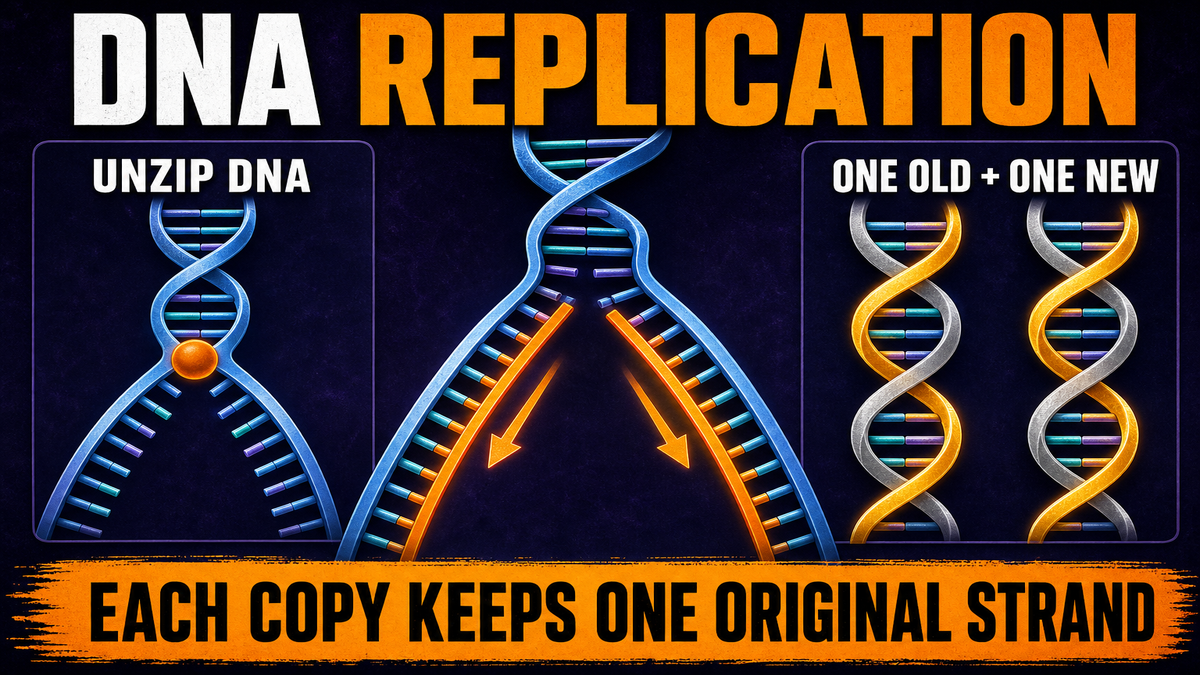
DNA unwinds.
What is DNA replication?
DNA replication is the process that copies DNA before cell division. It is semiconservative because each new DNA molecule contains one original strand and one newly built complementary strand. Accurate copying depends on complementary base pairing, replication enzymes, and 5′ to 3′ strand direction.
Say it fast
Replication is semiconservative: each new DNA molecule keeps one parental strand and one newly built strand.
DNA Replication Key Takeaways
- DNA replication happens before cell division.
- Replication is semiconservative.
- Each original DNA strand serves as a template.
- DNA polymerase builds new complementary strands.
- Leading and lagging strands form because DNA is built 5′ to 3′.
Why DNA Replication Matters in AP Biology
DNA replication allows cells to pass genetic information to daughter cells. Without accurate replication, mitosis, meiosis, heredity, gene expression, and evolution would not work correctly. AP Biology often tests the logic of how DNA structure makes copying possible.
Direct answer: DNA replication matters because cells must copy genetic information accurately before mitosis or meiosis.
Before replication logic clicks, review DNA and RNA structure for nucleotides, base pairing, and strand direction.
What Does Semiconservative Replication Mean?
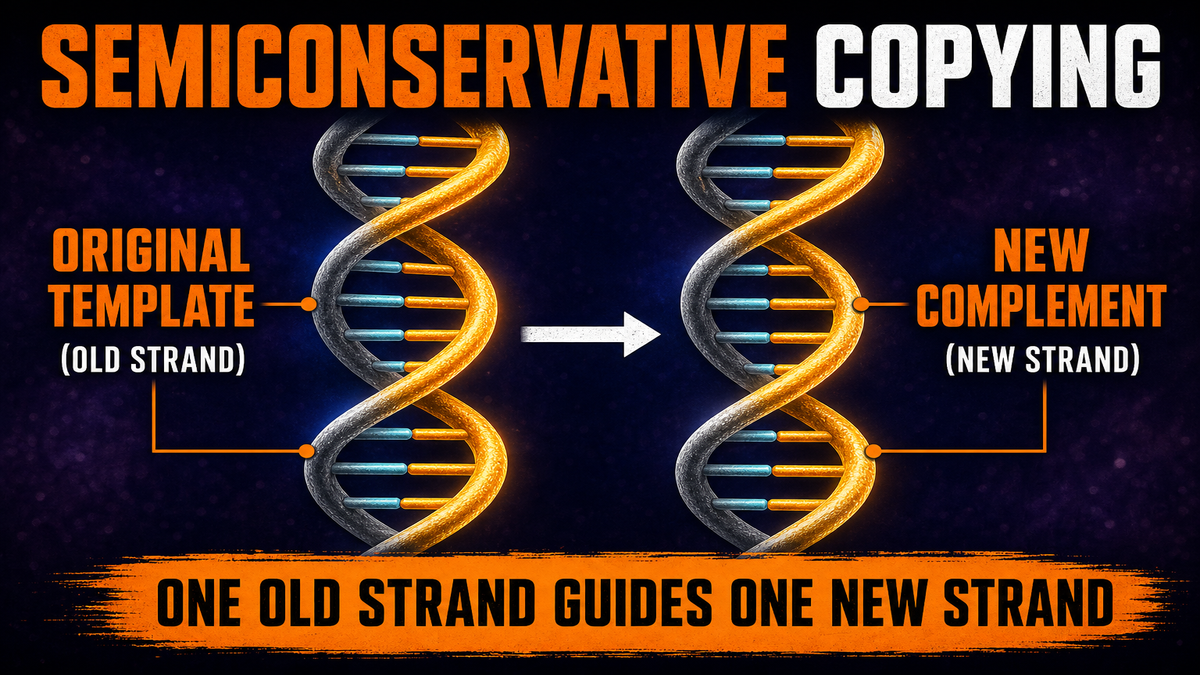
Each DNA strand can serve as a template. Original strands separate, and new complementary strands are built. Each daughter DNA molecule has one old strand and one new strand.
Direct answer: Semiconservative means each daughter DNA molecule keeps one parental strand and one newly built complementary strand.
Common mistake: Do not say replication makes two completely new DNA molecules. Each copy keeps one original strand.
DNA Replication Steps
On the AP exam, describe replication as a logical sequence—not only a list of enzyme names.
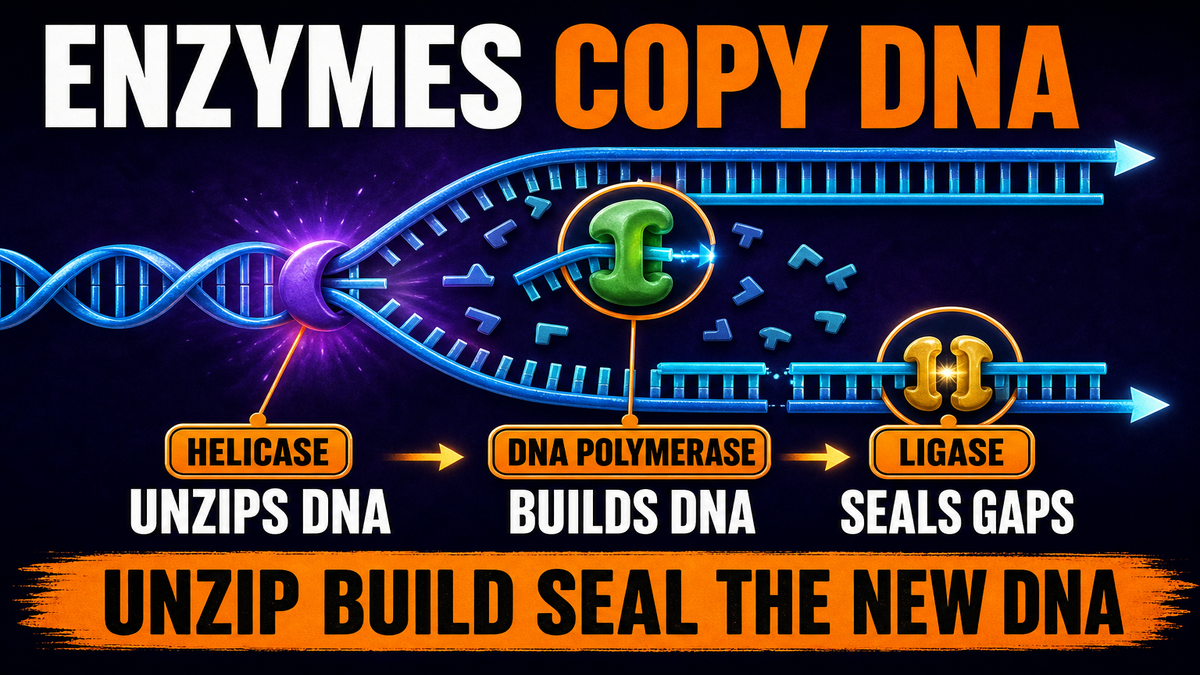
Helicase separates the strands.
Each original strand acts as a template.
DNA polymerase adds complementary nucleotides.
Leading strand is built continuously.
Lagging strand is built in fragments.
Ligase joins fragments.
Two identical DNA molecules form.
DNA Replication Enzymes
| Enzyme | Main job | AP exam clue |
|---|---|---|
| Helicase | Separates DNA strands | "Unzips" the double helix |
| DNA polymerase | Adds complementary DNA nucleotides | Builds new DNA 5′ to 3′ |
| Primase | Builds RNA primer | Gives DNA polymerase a starting point |
| Ligase | Joins fragments | Seals gaps on lagging strand |
| Topoisomerase | Relieves twisting | Reduces strain ahead of fork |
AP-scope note: AP Biology usually tests the logic of the enzymes more than every molecular detail.
Base Pairing During DNA Replication
During replication, complementary base pairing copies sequence information accurately. If base-pairing rules are shaky, revisit DNA base pairing first:
- A pairs with T
- C pairs with G
- Each template strand determines the new strand
Template: TAC GGA → New DNA: ATG CCT
Common mistake: Use T in DNA replication, not U. Uracil belongs to RNA.
Leading Strand vs Lagging Strand
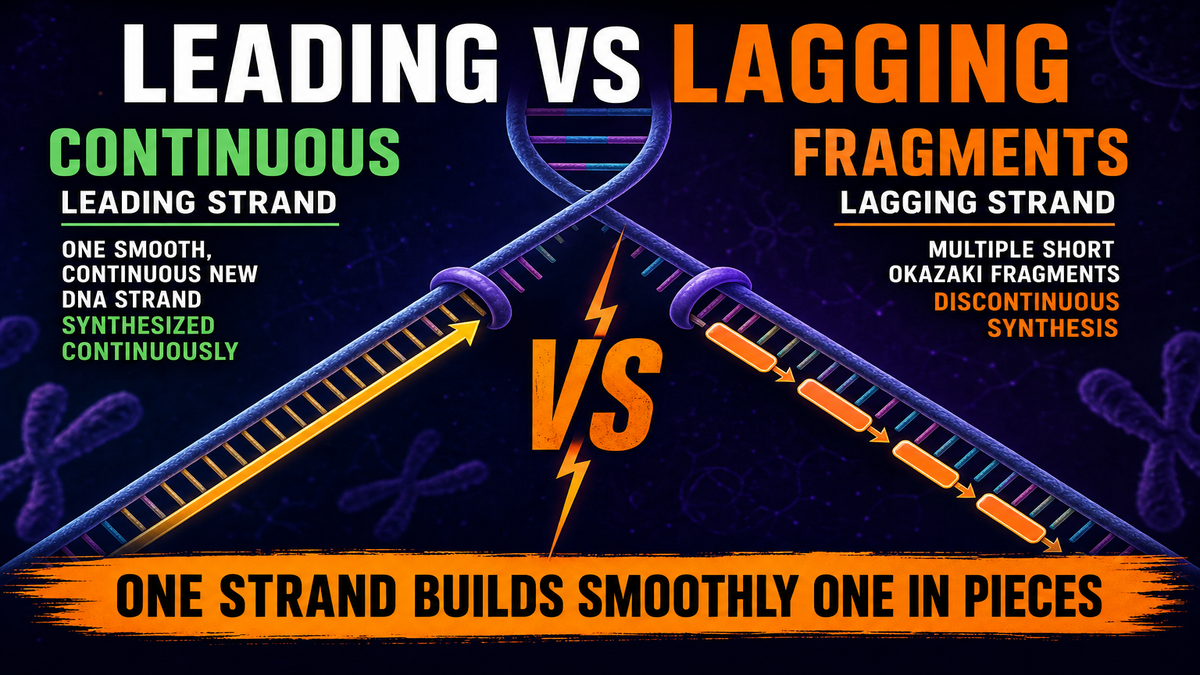
DNA polymerase builds only in the 5′ to 3′ direction. The leading strand is synthesized continuously toward the replication fork. The lagging strand is synthesized discontinuously as Okazaki fragments. Ligase joins those fragments.
| Feature | Leading strand | Lagging strand |
|---|---|---|
| Build pattern | Continuous | Discontinuous (Okazaki fragments) |
| Direction relative to fork | Synthesized toward the fork | Synthesized away from the fork on one strand |
| Fragments | No fragments | Short Okazaki fragments |
| Ligase need | Usually less critical | Joins Okazaki fragments |
| AP exam clue | Smooth continuous new strand | Short pieces + ligase |
What Are Okazaki Fragments?
Direct answer: Okazaki fragments are short DNA pieces built on the lagging strand during DNA replication. They form because DNA polymerase can only build new DNA in the 5′ to 3′ direction.
AP exam clue: If the question mentions short DNA pieces or ligase, think lagging strand.
How DNA Replication Stays Accurate
Complementary base pairing improves accuracy. DNA polymerase helps build the correct sequence, and proofreading and repair reduce errors. Replication mistakes can become mutations if not corrected, which may affect proteins and phenotype later.
When a prompt asks how a DNA change affects a protein or trait, trace the full chain on the mutations AP Biology guide.
When variation from uncorrected changes matters for populations, connect to AP Biology Unit 7 Natural Selection.
How DNA Replication Connects to Cell Division
Replication occurs before mitosis or meiosis so each daughter cell can receive genetic information.
Direct answer: Cells replicate DNA in S phase before division so each daughter cell receives a complete genome.
Connect replication timing to inheritance in AP Biology Unit 5 Heredity.
How AP Biology Tests DNA Replication
AP questions may ask you to explain semiconservative replication, predict complementary DNA strands, identify enzyme functions, interpret replication fork diagrams, compare leading and lagging strands, explain how replication errors can cause mutations, and connect DNA copying to cell division and heredity.
AP warning: Most AP mistakes happen when students memorize enzyme names but cannot explain why replication is semiconservative or why the lagging strand forms fragments.
Common DNA Replication Mistakes
Thinking both DNA strands are copied into two completely new molecules
Fix: Each daughter DNA molecule has one old strand and one new strand.
Using uracil during DNA replication
Fix: DNA replication uses thymine, not uracil.
Confusing DNA polymerase and RNA polymerase
Fix: DNA polymerase builds DNA; RNA polymerase builds RNA during transcription.
Thinking the lagging strand is wrong or incomplete
Fix: The lagging strand is normal; it is built in fragments because DNA is synthesized 5′ to 3′.
Forgetting ligase
Fix: Ligase seals Okazaki fragments on the lagging strand.
Students often confuse DNA polymerase with RNA polymerase. Replication builds DNA; transcription builds RNA from a DNA template.
Must-Know Terms
| Term | Meaning | AP exam clue |
|---|---|---|
| DNA replication | Process that copies DNA before division | Semiconservative copying |
| Semiconservative replication | Each copy keeps one original strand | One old + one new |
| Template strand | Original strand used to build a new strand | Complementary pairing |
| Daughter DNA | DNA molecules after replication | Two identical molecules |
| Complementary base pairing | A–T and C–G pairing rules | Accuracy of copying |
| Replication fork | Y-shaped region where DNA opens | Diagram clue |
| Helicase | Separates DNA strands | Unzips DNA |
| DNA polymerase | Builds new DNA strand | 5′ to 3′ synthesis |
| Primase | Makes RNA primer | Starting point |
| RNA primer | Short RNA start for DNA polymerase | Removed later in some models |
| Ligase | Joins DNA fragments | Lagging strand |
| Topoisomerase | Relieves supercoiling | Strain ahead of fork |
| Leading strand | Built continuously toward fork | Continuous synthesis |
| Lagging strand | Built in fragments | Okazaki fragments |
| Okazaki fragments | Short pieces on lagging strand | Ligase joins them |
| 5′ end | Phosphate end of a strand | Direction marker |
| 3′ end | Hydroxyl end where nucleotides add | Growth end |
| Proofreading | Corrects replication errors | Accuracy |
| Mutation | Change in DNA sequence | If uncorrected |
| Cell division | Mitosis or meiosis after replication | Passes DNA to daughters |
DNA Replication Flashcards
Tap a card to flip. Complete all 20 cards, then move to DNA replication practice questions.
Card 1 of 20Tap card to flip
DNA Replication Practice Questions
Answer all twelve AP-style questions. Choices shuffle on reload—practice semiconservative logic, base pairing, enzymes, and fork diagrams.
Need structure first? Open the transcription vs translation guide after you can explain how DNA is copied.
Question 1 of 12
Start
Correct: 0
Answered: 0
Accuracy: 0%
FRQ Strategy: Explain the Copying Logic
Direct answer: For DNA replication FRQs, earn points by explaining how original DNA strands serve as templates, how complementary base pairing builds new strands, and why each product contains one old strand and one new strand.
Scoring checklist:
- Identify replication as DNA copying
- State that replication is semiconservative
- Explain template strand logic
- Use correct base-pairing rules
- Describe enzyme roles if asked
- Explain leading/lagging strand differences if the diagram shows a fork
- Connect errors to mutations only when relevant
Prompt
Explain why DNA replication is described as semiconservative.
Scoring rubric
- State that parental DNA strands separate.
- Each original strand serves as a template.
- New strands are built by complementary base pairing.
- Each daughter DNA has one old strand and one new strand.
Sample response
During DNA replication, the two parental strands separate. Each original strand acts as a template for a new complementary strand built by DNA polymerase following A–T and C–G pairing rules. Each resulting DNA molecule therefore contains one conserved parental strand and one newly synthesized strand, which is why replication is semiconservative.
Status: Draft your answer first—then open the rubric or sample.
Prompt
A template DNA strand reads 3′-TAC GGA-5′. Predict the new DNA strand and explain the base-pairing logic.
Scoring rubric
- Correct new strand: 5′-ATG CCT-3′ (or equivalent).
- Template T pairs with A; template A pairs with T.
- Template C pairs with G; template G pairs with C.
- Use thymine in DNA, not uracil.
Sample response
The new DNA strand is 5′-ATG CCT-3′. Each nucleotide on the new strand pairs complementarily with the template: T with A, A with T, C with G, and G with C. Because this is DNA replication, thymine is used instead of uracil.
Status: Draft your answer first—then open the rubric or sample.
DNA Replication FAQ
What is DNA replication?
DNA replication is the process that copies DNA before cell division. Each new DNA molecule contains one original strand and one newly built complementary strand.
Why is DNA replication semiconservative?
Each daughter DNA molecule conserves one parental strand and gains one new strand built from complementary base pairing.
When does DNA replication happen?
Replication occurs before mitosis or meiosis, typically during S phase of the cell cycle, so daughter cells receive complete genetic information.
What does helicase do in DNA replication?
Helicase separates the two DNA strands by breaking hydrogen bonds, allowing each strand to serve as a template.
What does DNA polymerase do?
DNA polymerase adds complementary DNA nucleotides to a growing strand in the 5′ to 3′ direction.
What does ligase do?
Ligase joins Okazaki fragments on the lagging strand, sealing gaps between short DNA pieces.
What is the difference between leading and lagging strand?
The leading strand is synthesized continuously toward the replication fork. The lagging strand is synthesized discontinuously as Okazaki fragments.
What are Okazaki fragments?
Okazaki fragments are short DNA segments built on the lagging strand because DNA polymerase can only synthesize 5′ to 3′.
Why does DNA replication use thymine instead of uracil?
Thymine is used in DNA for stable long-term storage. Uracil appears in RNA, not in DNA replication.
How can DNA replication errors cause mutations?
If incorrect nucleotides are incorporated and not corrected by proofreading or repair, the DNA sequence change can become a permanent mutation that may alter gene function.