Same genome
Most cells contain the same DNA.
AP Biology · Unit 6 Gene Expression
Gene expression and cell specialization explain how cells with the same DNA can perform different jobs. A neuron, muscle cell, and pancreatic cell can contain the same genome, but they express different genes, produce different proteins, and develop different structures and functions. For AP Biology, the key is connecting differential gene expression to protein production, cell function, and phenotype.
Teacher tip: When you see a cell specialization question, do not say the cells have different DNA. Usually, they have the same DNA but express different genes.
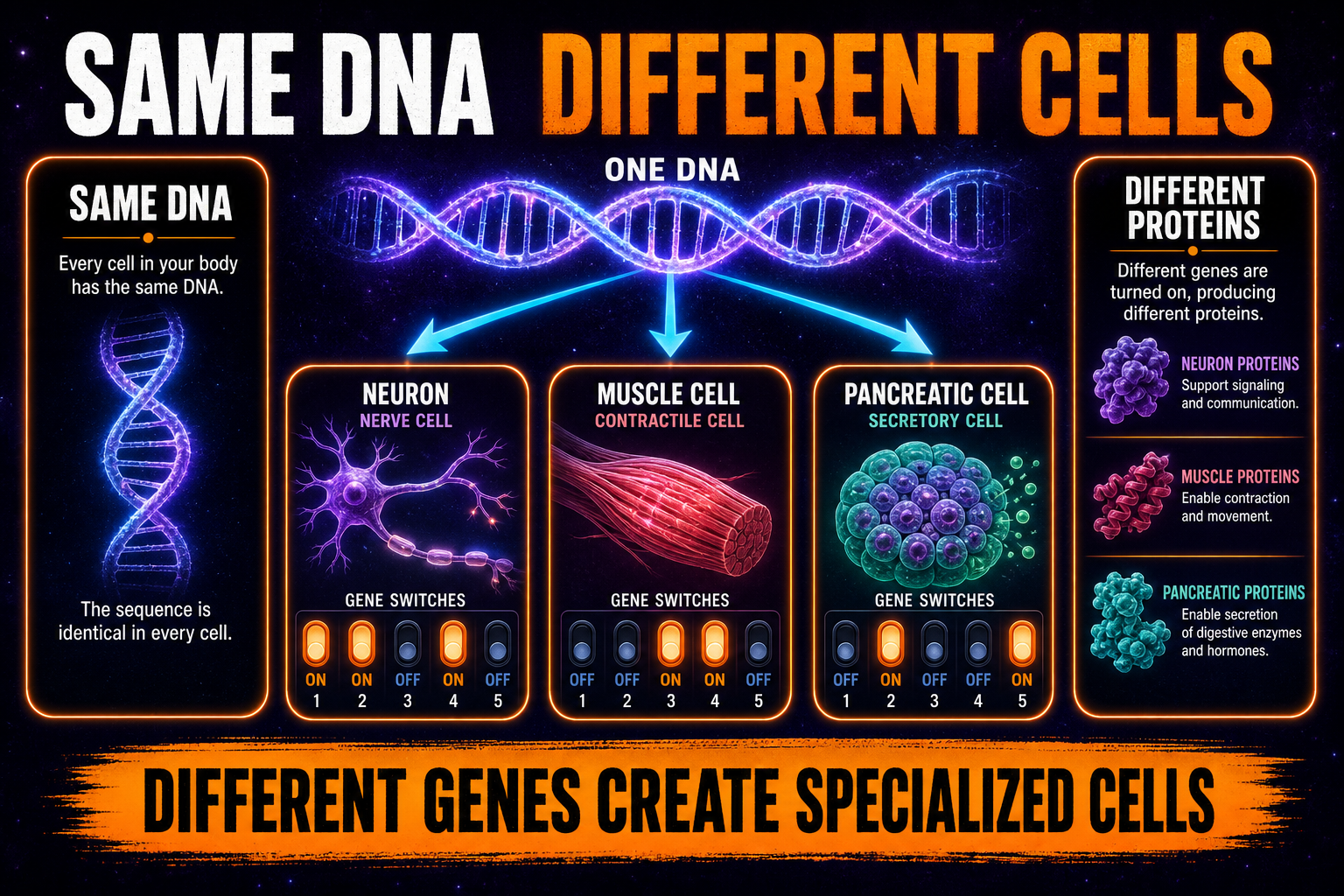
Gene expression and cell specialization explain how cells with the same DNA can become different cell types. Different cells turn on different genes, make different RNA and proteins, and develop different structures and functions. This is called differential gene expression.
Cell specialization usually comes from different gene expression, not different DNA.
Cells specialize because they express different genes from the same genome, producing different proteins and functions.
Multicellular organisms need many cell types. Neurons, muscle cells, blood cells, and pancreatic cells perform different jobs. These cells usually do not have different genomes. Instead, they use different parts of the same genome.
This page owns gene expression and cell specialization; for how genes turn on and off, see gene regulation. For DNA → RNA → protein flow, use the central dogma guide.
A skin cell and a nerve cell usually contain the same genetic information, but they express different sets of genes. A gene that is active in one cell type may be inactive in another. This changes the RNA and proteins made by each cell.
Expression → function
Gene regulation → transcription changes → mRNA changes → protein changes → cell structure/function changes → specialized cell type
Connect transcription on the transcription and RNA processing guide and protein output on translation.
Use this ladder whenever an AP question asks why two cell types from the same organism look or function differently.
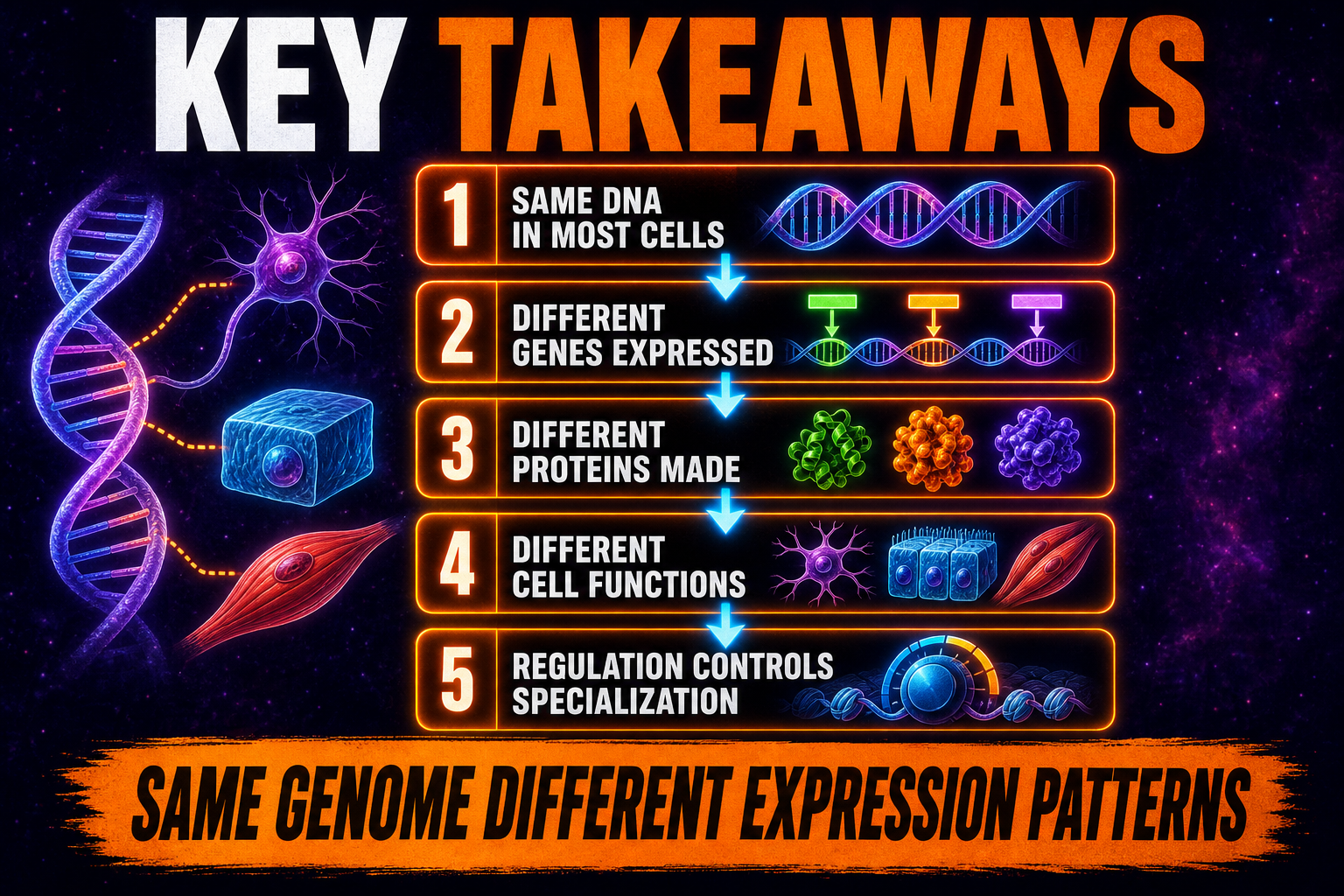
Most cells contain the same DNA.
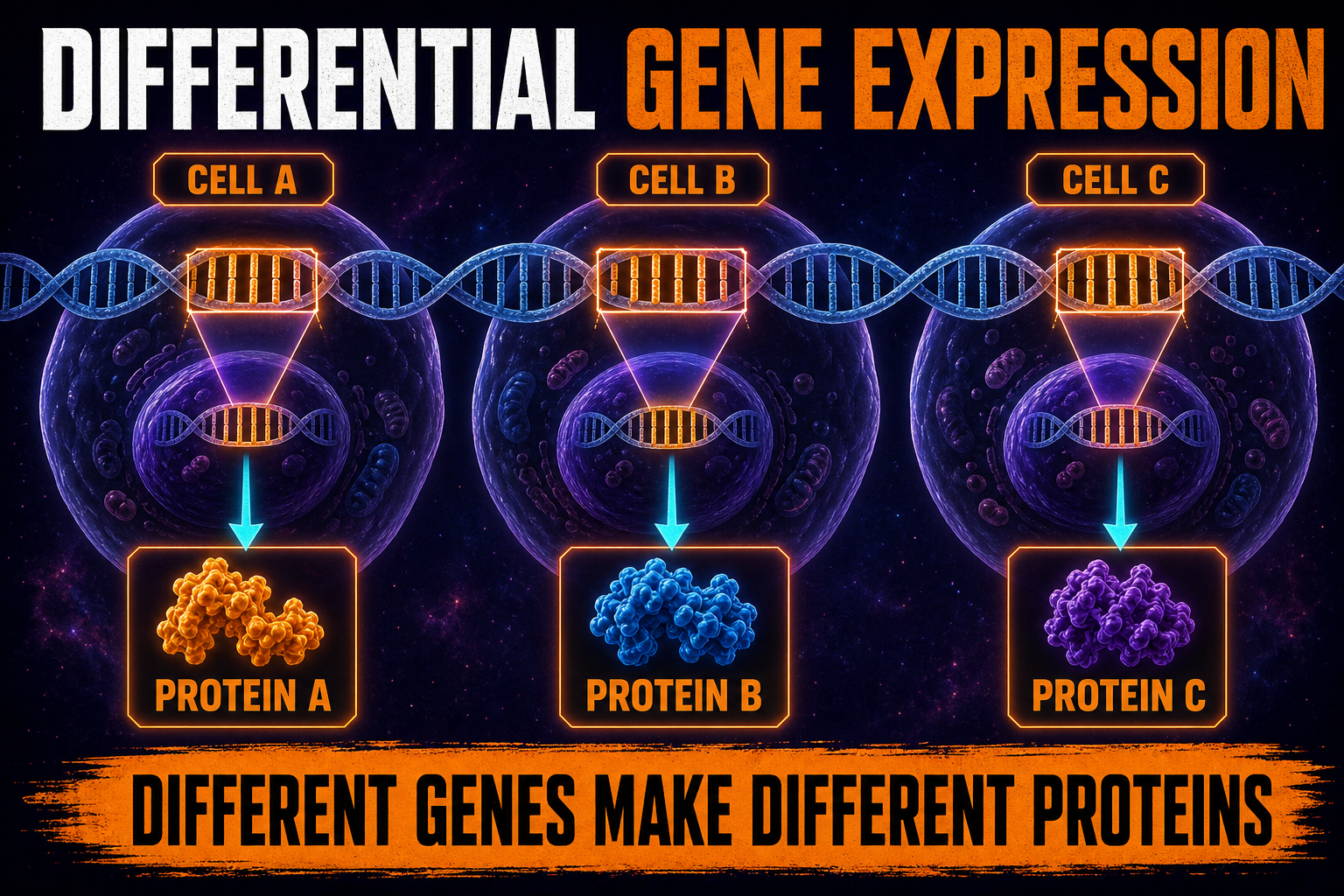
Each cell type turns on a different set of genes.
Different active genes produce different RNA messages.
Different mRNAs are translated into different proteins.
Different proteins create specialized structures and jobs.
| Term | Meaning | AP exam clue |
|---|---|---|
| Cell differentiation | Process by which cells become different types | Developmental process |
| Cell specialization | Cells having specific structures and jobs | Final function-focused result |
| Differential gene expression | Different genes active in different cells | Molecular cause |
| Gene regulation | Control of which genes are expressed | Control mechanism |
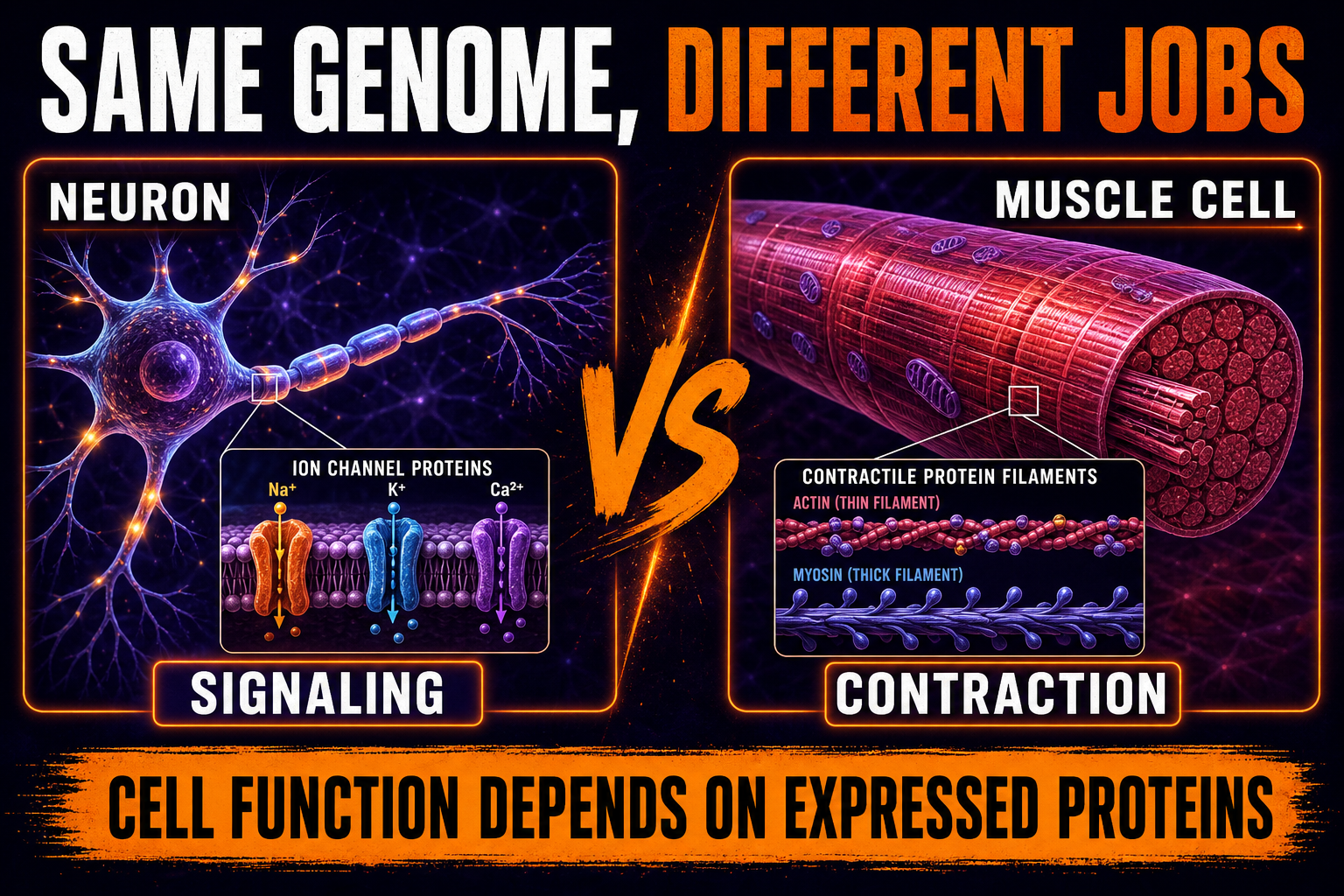
Expresses proteins for signaling and ion movement.
Function: Communication
Expresses contractile proteins.
Function: Movement
Expresses insulin-related genes.
Function: Hormone secretion
Specialized for oxygen transport.
Function: Carrying oxygen
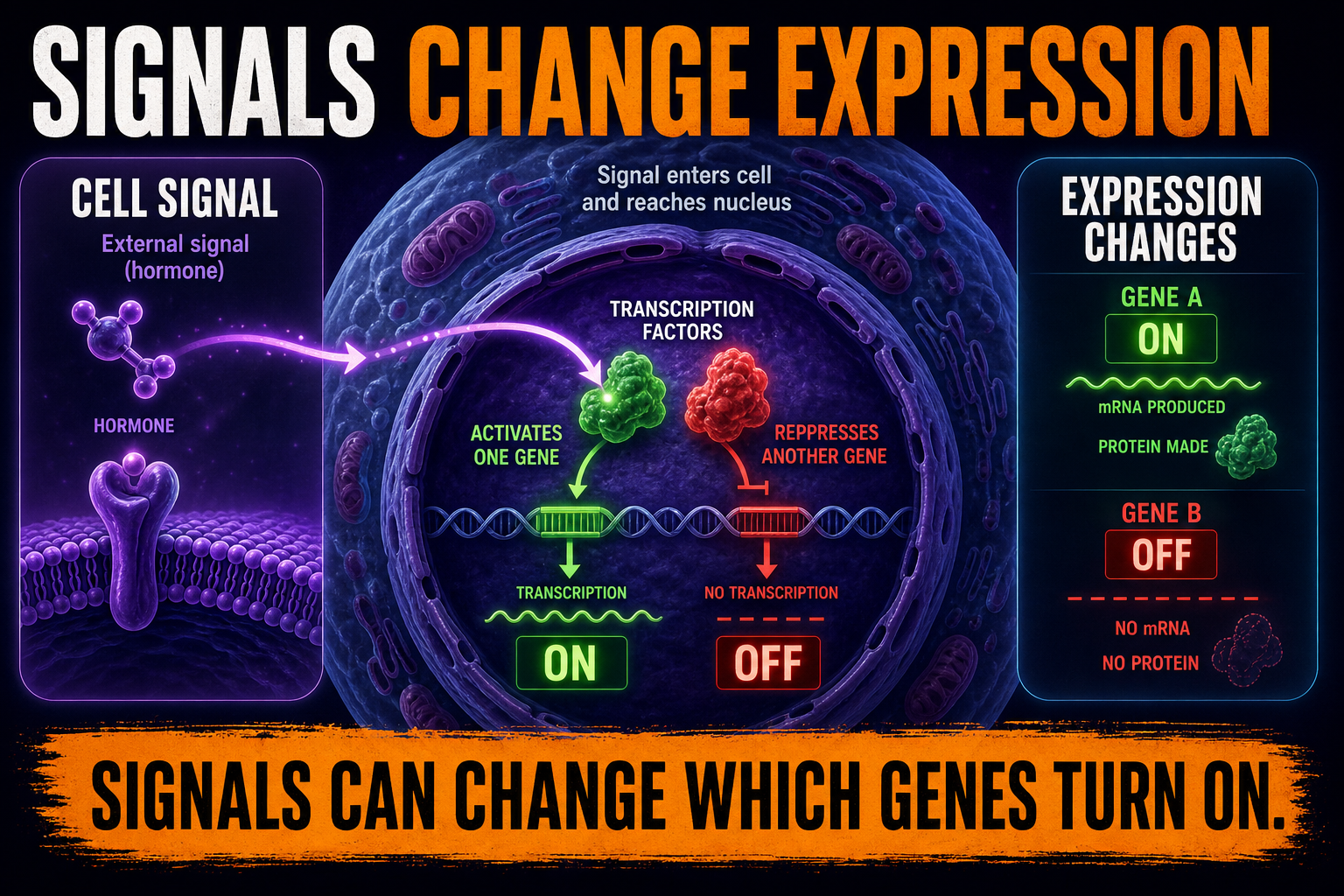
Cells can respond to internal and external signals. Signals can activate transcription factors, change which genes are transcribed, and push cells toward different specialized functions.
See gene regulation for control mechanisms that turn genes on and off.
Stem cells can become different cell types because they have the potential to activate different gene expression programs. As cells differentiate, some genes become active while others are silenced or reduced.
The central dogma shows DNA → RNA → protein. Cell specialization happens when different cells use different parts of that information flow. A gene may be transcribed in one cell type but not another.
Trace the full path on the central dogma guide and compare steps on transcription vs translation.
Gene expression affects phenotype by changing which proteins are produced and how much protein is made. Protein amount and protein function can affect cell behavior, tissue function, and visible traits.
What to do: Explain differential gene expression.
What to do: Connect expression to protein amount and cell function.
What to do: Predict changes in target gene expression.
What to do: Explain changing gene expression patterns.
A neuron and a muscle cell come from the same organism. Both contain the gene for a contractile protein, but the muscle cell expresses it at high levels while the neuron does not.
AP questions may ask you to explain why different cell types have different functions, interpret gene expression graphs, compare mRNA levels between tissues, connect transcription factors to target gene expression, explain differentiation without changing DNA sequence, connect protein production to cell function, and avoid saying cells lose genes during specialization.
Fix: Most specialized cells have the same DNA but express different genes.
Fix: Explain how gene expression changes mRNA and protein production.
Fix: Genes can be present but not expressed.
Fix: Differentiation usually changes gene expression, not DNA sequence.
Fix: Cells turn on only the genes they need.
Fix: Transcription factors help control which genes are expressed.
| Term | Meaning | AP exam clue |
|---|---|---|
| gene expression | Using a gene to make RNA and often protein | Expression level questions |
| differential gene expression | Different cells express different genes from the same genome | Same DNA, different mRNA |
| cell specialization | Cells with specific structures and functions | Not usually different DNA |
| cell differentiation | Process of becoming a specialized cell type | Development |
| stem cell | Cell that can become multiple cell types | Changes expression programs |
| genome | Complete set of DNA in an organism | Same in most body cells |
| gene regulation | Control of which genes are expressed | Turn genes on/off |
| transcription factor | Protein that helps regulate transcription | Changes expression patterns |
| mRNA | Messenger RNA from transcription | Levels reflect expression |
| protein expression | Production of functional proteins | Drives cell function |
| phenotype | Observable trait or outcome | Protein changes can affect traits |
| same DNA different cells | Shared genome, different gene use | Core specialization idea |
| cell type | Distinct specialized cell category | Neuron vs muscle, etc. |
| tissue-specific expression | Genes active mainly in one tissue | Data interpretation |
| gene silencing | Reducing or stopping expression of a gene | Gene still present |
| transcription | DNA to RNA | First step in using a gene |
| translation | mRNA to polypeptide | Builds proteins from mRNA |
| protein function | What a protein does in the cell | Links to cell job |
Flip all 20 cards until you can explain same DNA, differential expression, and the mRNA → protein → function chain without hesitating.
Answer all 12 questions. Choices shuffle on reload—trace gene expression → mRNA → protein → cell function in every explanation.
Open each card, draft your response, then reveal the rubric and sample answer.
A neuron and a muscle cell from the same organism have different mRNA profiles. Explain why.
Both cells share the same DNA, but each expresses a different set of genes. The muscle cell transcribes contractile and metabolism genes at high levels, while the neuron transcribes signaling genes more. Different mRNAs lead to different proteins, which support different specialized functions.
Status: Draft your answer first—then open the rubric or sample.
A transcription factor is removed during development. Predict how this could affect cell specialization.
Without the transcription factor, target genes may not be transcribed at the right level. mRNA and protein production for those genes can drop, so the cell may not build the structures or perform the jobs of a fully specialized cell type.
Status: Draft your answer first—then open the rubric or sample.
A stem cell differentiates into a pancreatic beta cell. Explain how changes in gene expression could produce this specialized cell type without changing the DNA sequence.
Differentiation does not require a new genome. The beta cell turns on insulin-related and secretion genes while reducing expression of genes not needed for that job. More mRNA for those genes can increase matching proteins, producing a specialized cell that secretes hormone even though the DNA sequence stayed the same.
Status: Draft your answer first—then open the rubric or sample.
Researchers confirm that liver cells and skin cells from the same person have the same DNA sequence for Gene H. Gene H mRNA is high in liver but low in skin, and Protein H is abundant in liver but scarce in skin. Explain how this supports cell specialization.
Both tissues contain Gene H in their DNA, so the difference is not gene loss. Higher mRNA in liver means the gene is expressed more there, which can produce more Protein H. More protein in liver supports liver functions, while lower expression in skin fits skin's needs. This is differential gene expression from the same genome.
Status: Draft your answer first—then open the rubric or sample.
Gene expression and cell specialization explain how cells with the same DNA become different cell types by turning on different genes, making different RNA and proteins, and developing different structures and functions.
They express different sets of genes, which produces different mRNAs and proteins that support different cell structures and jobs.
Differential gene expression means different cells express different genes from the same genome, even though the DNA sequence is usually the same.
Usually no. Cell specialization typically changes which genes are expressed, not the DNA sequence itself.
Cell differentiation is the process of becoming a specialized type; cell specialization describes cells with specific structures and functions.
Transcription factors help turn specific genes on or off, creating different gene expression patterns that lead to different proteins and cell functions.
Stem cells differentiate by activating some genes and reducing expression of others, shifting toward a specialized gene expression program.
Gene expression changes which proteins are made and how much is made; protein function can affect cell behavior and sometimes visible traits.
Saying specialized cells have different DNA instead of explaining different gene expression, mRNA, and protein levels.
State that cells usually share the same DNA, identify different gene expression, connect to mRNA and protein differences, and explain how those proteins create different cell functions.