Activator
- Increases gene expression
- Helps transcription happen
- Can help RNA polymerase bind or work
AP Biology · Unit 6 Gene Expression
Gene regulation is how cells control which genes are turned on, turned off, or expressed at different levels. Cells do not use every gene all the time. Instead, they regulate gene expression so the right proteins are made in the right cells at the right time. For AP Biology, the key is connecting gene regulation to RNA production, protein production, cell function, and phenotype.
Teacher tip: When you see a gene regulation question, ask: is the cell increasing or decreasing gene expression, and how would that change the amount of RNA or protein produced?
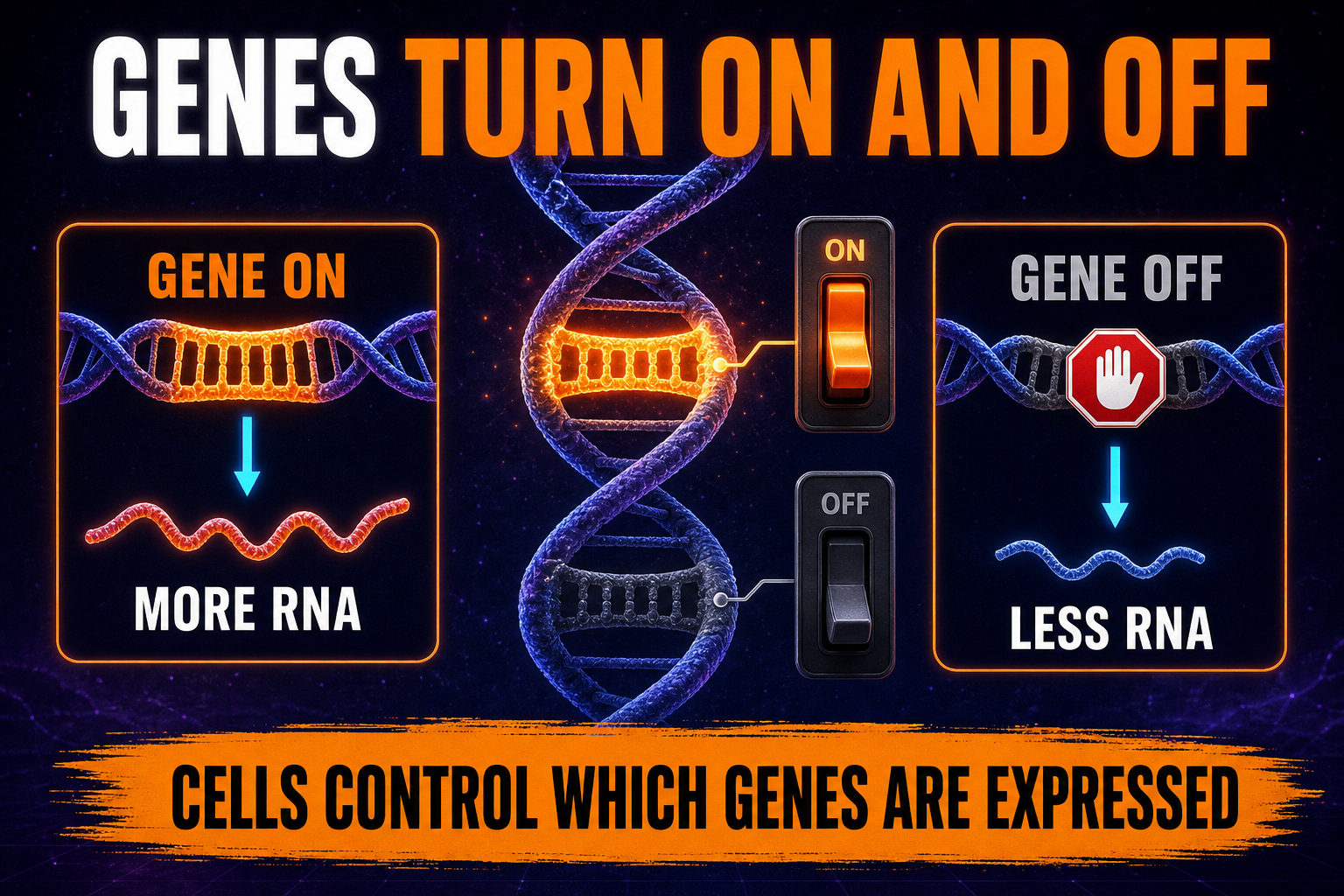
Gene regulation is the control of when, where, and how much a gene is expressed. Cells regulate gene expression so they make the right RNA and proteins at the right time. Gene regulation helps cells save energy, respond to signals, specialize, and control phenotype.
Gene regulation controls whether a gene is turned on, turned off, or expressed at a different level, which changes how much RNA or protein a cell produces.
Gene regulation controls whether genes are turned on, turned off, or expressed at different levels.
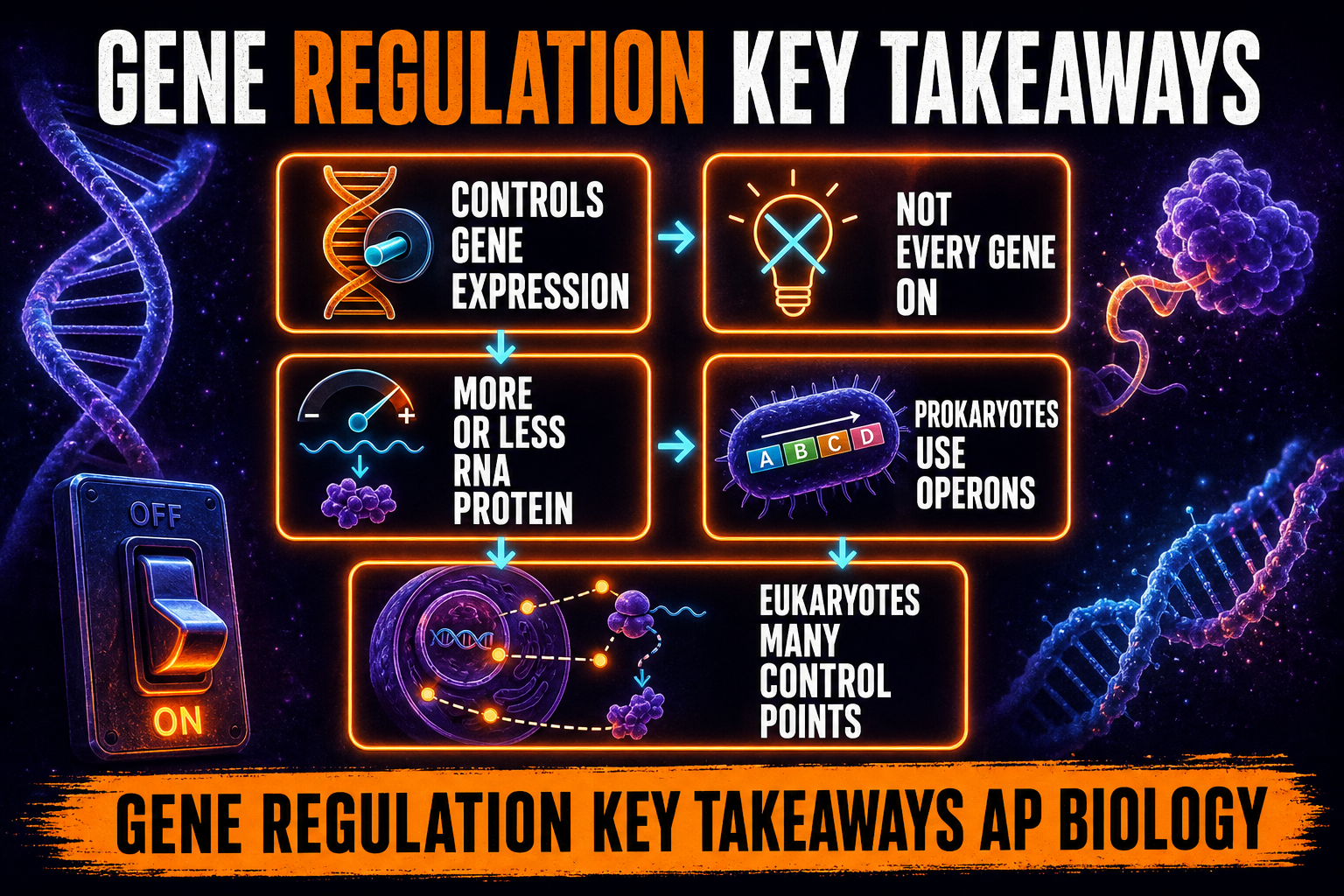
Gene regulation connects DNA information to cell behavior. A cell can have a gene but not use it all the time. By turning genes on or off, cells control which proteins are made, how much protein is made, and when proteins are made.
Review how RNA is made on the transcription and RNA processing guide, connect protein output on the translation study guide, and distinguish expression from DNA replication when a prompt compares copying DNA with using genes.
| Term | Meaning | AP Exam Clue |
|---|---|---|
| Gene expression | Using a gene to make RNA or protein | DNA information becomes a product |
| Gene regulation | Controlling gene expression | Gene is turned on, off, or adjusted |
| Transcription | DNA to RNA | RNA polymerase involved |
| Translation | mRNA to polypeptide | Ribosome and tRNA involved |
Cells regulate gene expression by controlling access to DNA, controlling transcription, processing RNA, controlling translation, or breaking down RNA or proteins. AP Biology often focuses on transcription-level control, especially whether RNA polymerase can transcribe a gene.
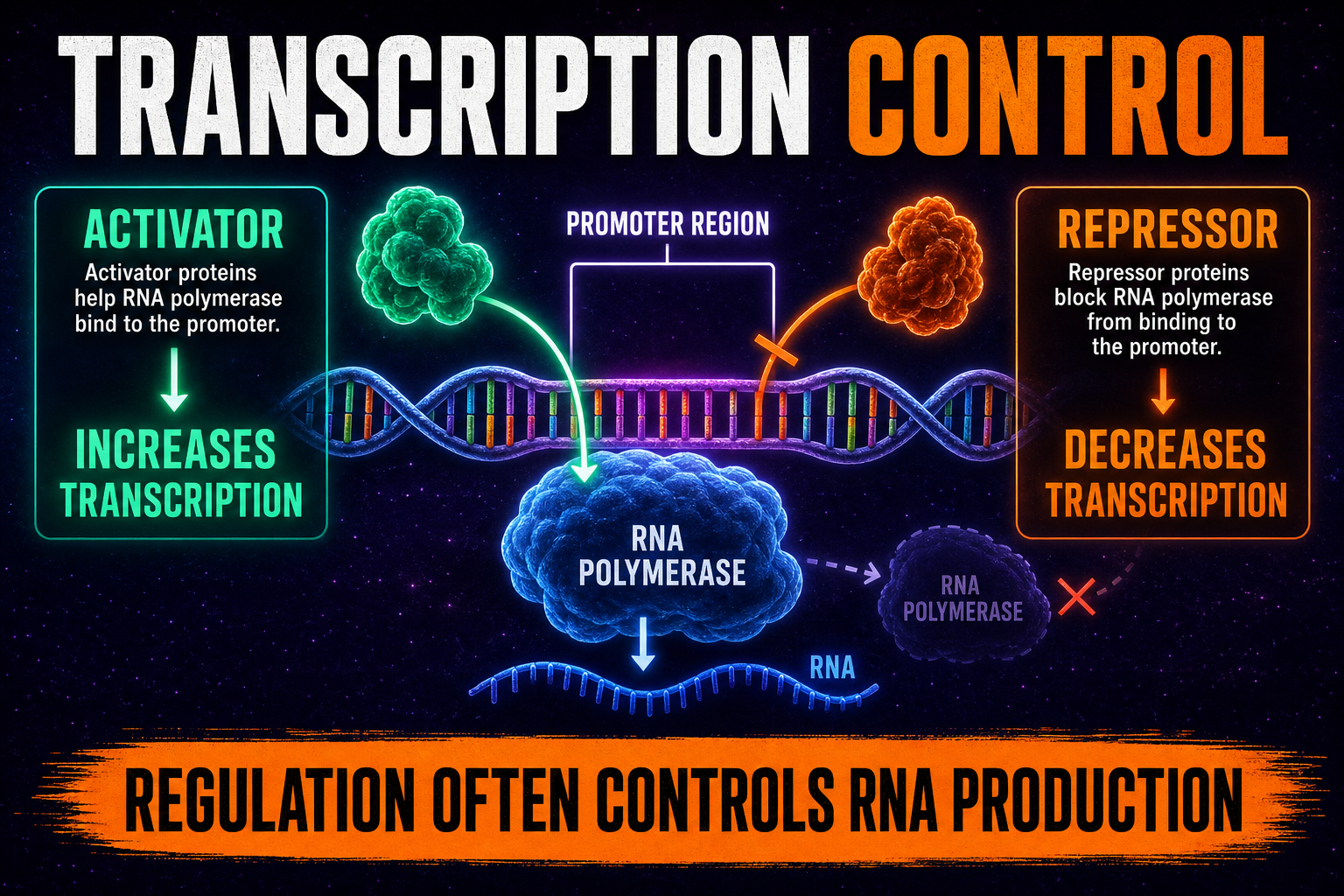
RNA polymerase must access and transcribe a gene. Activators can increase transcription; repressors can decrease transcription. Transcription factors help control whether a gene is transcribed. Changing transcription changes mRNA levels.
See transcription and RNA processing for how pre-mRNA becomes mature mRNA in eukaryotes.
Transcription factors are proteins that help regulate transcription by binding DNA or other regulatory proteins and affecting whether a gene is transcribed. They can turn genes on or off, help or block RNA polymerase, and are especially important in eukaryotic gene regulation. Different transcription factors can produce different patterns of gene expression.
Prokaryotes often regulate groups of related genes together. An operon is a group of genes controlled by the same regulatory system. This allows bacteria to respond quickly to environmental changes, such as the presence or absence of a nutrient.
For promoter, operator, repressor logic, lac and trp overviews, and practice questions, use the operons AP Biology guide. Key vocabulary includes promoter, operator, repressor, and structural genes.
Eukaryotic cells regulate gene expression at many levels because their DNA is stored in a nucleus and wrapped around proteins. Regulation can happen through chromatin structure, transcription factors, enhancers, RNA processing, mRNA stability, translation control, and protein modification or breakdown.
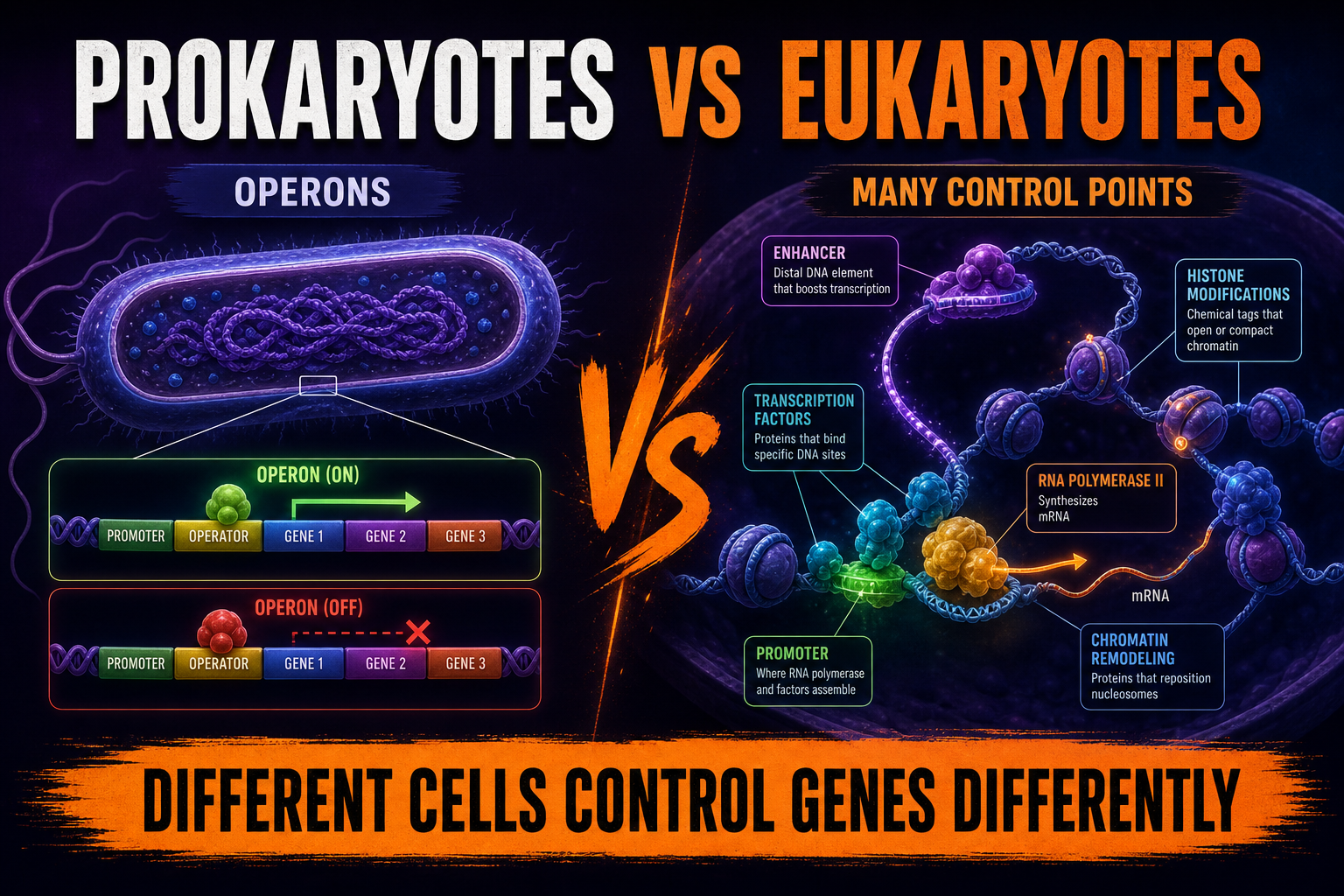
| Feature | Prokaryotes | Eukaryotes | AP exam clue |
|---|---|---|---|
| DNA location | In cytoplasm (no nucleus) | In nucleus, wrapped in chromatin | Nucleus vs cytoplasmic DNA |
| Speed of response | Often fast | Often slower, more layers | Operon on/off vs many steps |
| Common control method | Operons for related genes | Transcription factors, chromatin | Operon logic vs TF binding |
| Operons | Common | Not typical | Lac/trp operon questions |
| RNA processing | Minimal | Extensive (splicing, cap, tail) | Eukaryotic mRNA processing |
| Control points | Mainly transcription | Transcription, processing, translation, protein | Many eukaryotic checkpoints |
| AP exam clue | Predict operon on/off from signal | Differential expression, many TFs | Same DNA, different proteins |
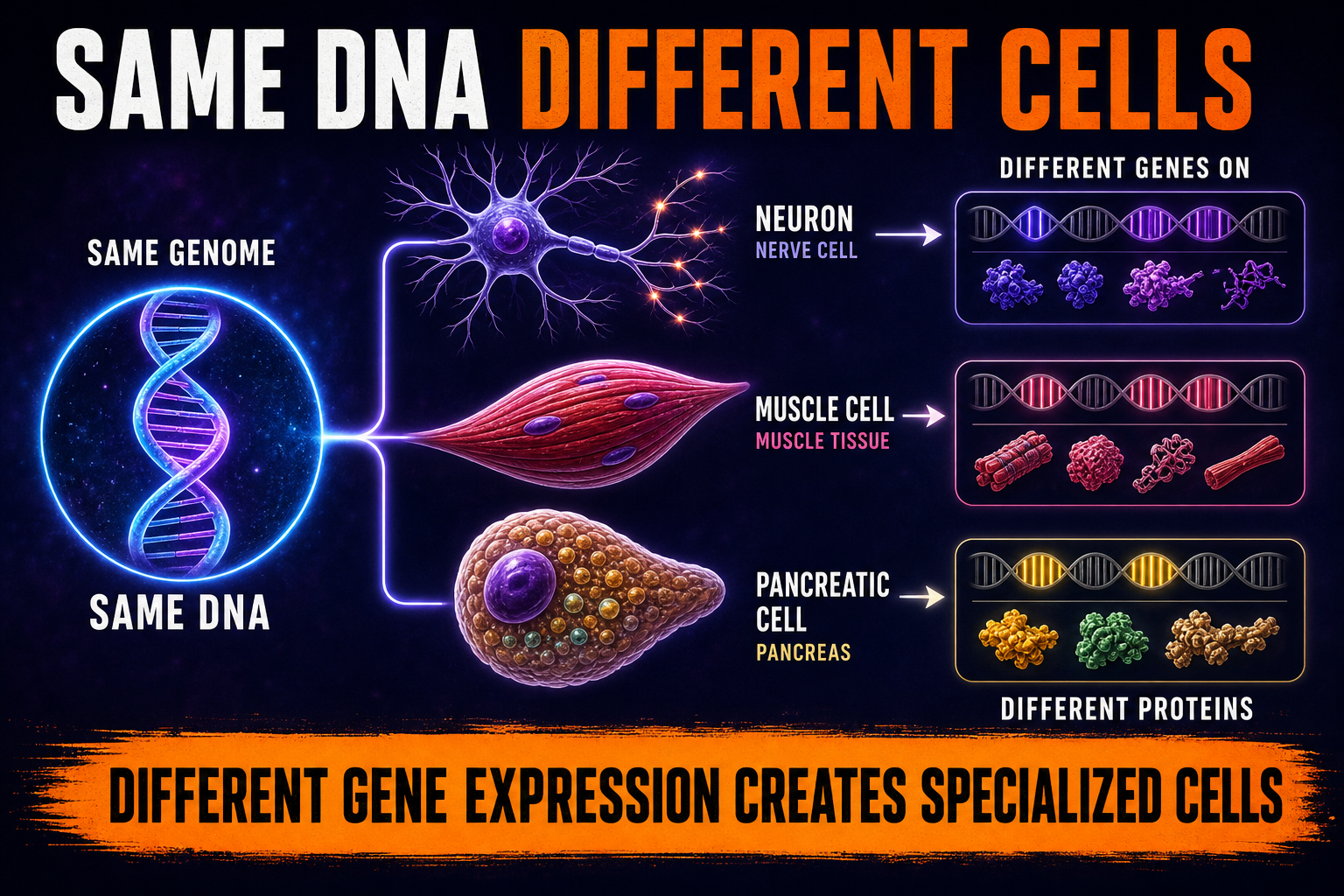
Many cells in a multicellular organism have the same DNA, but they express different genes. Different gene expression patterns lead to different proteins, and different proteins produce different cell structures and functions.
For the dedicated same DNA, different cells study path with practice and FRQs, see gene expression and cell specialization. For nucleotide structure shared by all cells, review DNA and RNA structure.
If gene regulation changes the amount or timing of protein production, it can change cell function. Changes in cell function can sometimes affect phenotype. AP Biology often asks students to connect regulation to RNA levels, protein levels, and biological outcome.
Cells can change gene expression in response to environmental signals. Bacteria may turn genes on or off depending on nutrients. Eukaryotic cells may respond to hormones, signals, or developmental cues.
The central dogma shows information flow from DNA to RNA to protein. Gene regulation controls whether that flow happens, how strongly it happens, or when it happens.
Trace the full DNA → RNA → protein path on the central dogma guide, and compare the two main expression steps on transcription vs translation.
Use this ladder when an AP question asks how a regulatory change affects cell function or phenotype.
A signal, mutation, or regulator affects whether a gene is used.
Activators, repressors, or transcription factors change RNA polymerase access.
More transcription usually means more mRNA; less transcription means less mRNA.
mRNA levels can change how much protein is made or how it works.
Protein changes can alter cell work and sometimes visible traits.
AP questions may ask you to predict whether mRNA levels increase or decrease, predict whether protein levels increase or decrease, explain activator or repressor effects, interpret gene expression graphs, compare prokaryotic and eukaryotic regulation, explain operon logic, connect gene regulation to cell specialization, and connect protein amount to phenotype.
→ Predict increased mRNA and protein
→ Predict decreased transcription
→ Differential gene expression
→ Prokaryotic regulation logic
→ Eukaryotic transcription control
→ Transcription increased then decreased
→ Connect expression to cell function
→ Regulation, not gene deletion
→ Turn genes on or off
→ Expression level changed
Fix: The gene is still in the DNA; it is just not being expressed.
Fix: Different cells express different genes.
Fix: Replication copies DNA. Gene expression uses DNA information to make RNA or protein.
Fix: Gene regulation usually changes gene expression, not the DNA sequence.
Fix: Activators increase expression; repressors decrease expression.
Fix: Changes in mRNA levels can change protein levels and cell function.
| Term | Meaning | AP exam clue |
|---|---|---|
| gene regulation | Control of when, where, and how much a gene is expressed | Turn genes on, off, or adjust levels |
| gene expression | Using a gene to make RNA and often protein | Transcription and translation products |
| transcriptional control | Regulation at the transcription step | RNA polymerase access |
| transcription factor | Protein that helps regulate transcription | Binds DNA or other regulators |
| activator | Increases gene expression | More transcription |
| repressor | Decreases gene expression | Less transcription |
| RNA polymerase | Enzyme that builds RNA from DNA | Must access promoter |
| promoter | DNA region where transcription begins | RNA polymerase binding |
| operator | Regulatory DNA near prokaryotic genes | Repressor binding site |
| operon | Group of prokaryotic genes regulated together | Lac and trp operons |
| lac operon | Inducible operon for lactose metabolism | Turns on when lactose present |
| trp operon | Repressible operon for tryptophan synthesis | Turns off when trp abundant |
| prokaryotic gene regulation | Often operon-based, fast response | Bacterial nutrient switches |
| eukaryotic gene regulation | Many levels from DNA to protein | Chromatin, TFs, processing |
| chromatin | DNA plus histone proteins | Packed DNA affects access |
| enhancer | Distant DNA region that can increase transcription | TF binding far from gene |
| differential gene expression | Different cells express different genes | Same DNA, different patterns |
| cell specialization | Different cell types from different gene use | Not usually different DNA |
| mRNA level | Amount of messenger RNA present | Rises or falls with transcription |
| protein level | Amount of functional protein present | Connects to cell function |
| phenotype | Observable trait or outcome | Protein change can affect trait |
Flip all 20 cards until you can explain activators, repressors, operons, and differential gene expression without hesitating.
Answer all 12 questions. Choices shuffle on reload—focus on expression changes, not letter memorization.
Open each card, draft your response, then reveal the rubric and sample answer.
A mutation prevents a repressor from binding near a gene. Predict how mRNA and protein levels may change.
If the repressor normally blocks RNA polymerase, the gene may be transcribed more often. mRNA levels may rise, leading to more protein. Whether phenotype changes depends on what that protein does in the cell.
Status: Draft your answer first—then open the rubric or sample.
A cell type expresses Gene A at high levels but Gene B at low levels. Explain how this supports cell specialization.
Cell specialization comes from differential gene expression. High Gene A expression can produce more of protein A, while low Gene B expression produces less of protein B. Different protein sets give different cell functions even when the genome is the same.
Status: Draft your answer first—then open the rubric or sample.
An activator protein binds near a gene's promoter and helps RNA polymerase access the gene. Predict how mRNA and protein levels may change.
The activator helps RNA polymerase transcribe the gene more often, so transcription increases. mRNA levels may rise, and more mRNA can lead to more protein. A phenotype change is possible only if that protein affects a trait-relevant cell function.
Status: Draft your answer first—then open the rubric or sample.
In a prokaryotic operon, an environmental signal causes a repressor to stop binding the operator. Explain how this could increase mRNA and protein from the operon genes.
With the repressor off the operator, RNA polymerase can transcribe the operon genes more often. mRNA levels for those genes may increase, leading to more of the proteins they code for. The gene sequences are still present; only expression changed.
Status: Draft your answer first—then open the rubric or sample.
Gene regulation is the control of when, where, and how much a gene is expressed. Cells regulate gene expression so they make the right RNA and proteins at the right time.
Regulation saves energy, allows cells to respond to signals, supports specialization, and helps control phenotype by adjusting protein production.
The gene is being expressed at a higher level, so more RNA—and often more protein—may be produced.
The gene is expressed at a low level or not at all, so little or no RNA and protein are made. The DNA sequence is usually still present.
Gene expression is using a gene to make RNA or protein. Gene regulation is controlling whether and how much that gene is used.
Activators usually increase transcription by helping RNA polymerase bind or work more effectively.
Repressors usually decrease transcription by blocking or reducing RNA polymerase access.
Transcription factors are proteins that help regulate transcription by binding DNA or other regulatory proteins and affecting whether a gene is transcribed.
Prokaryotes often use operons for fast, coordinated control. Eukaryotes regulate at many levels, including chromatin, transcription factors, RNA processing, and translation.
Cells with the same DNA can express different genes, producing different proteins and therefore different structures and functions.
If regulation changes the amount or timing of a protein, cell function can change, which can sometimes affect observable traits.
Usually no. Gene regulation typically changes expression levels, not the DNA sequence itself. Sequence changes are mutations.