DNA sequence changes
A mutation or edit changes the stored genetic code.
AP Biology · Unit 6 Gene Expression
The central dogma explains how genetic information flows from DNA to RNA to protein. DNA stores the instructions, transcription copies part of the DNA into RNA, RNA processing prepares the message, and translation uses mRNA to build a polypeptide. For AP Biology, the key is tracing how information moves from molecule to molecule and how that flow can affect phenotype.
Teacher tip: When you see a Unit 6 question, ask: where is the information now, what molecule is made next, and how could the final protein affect phenotype?
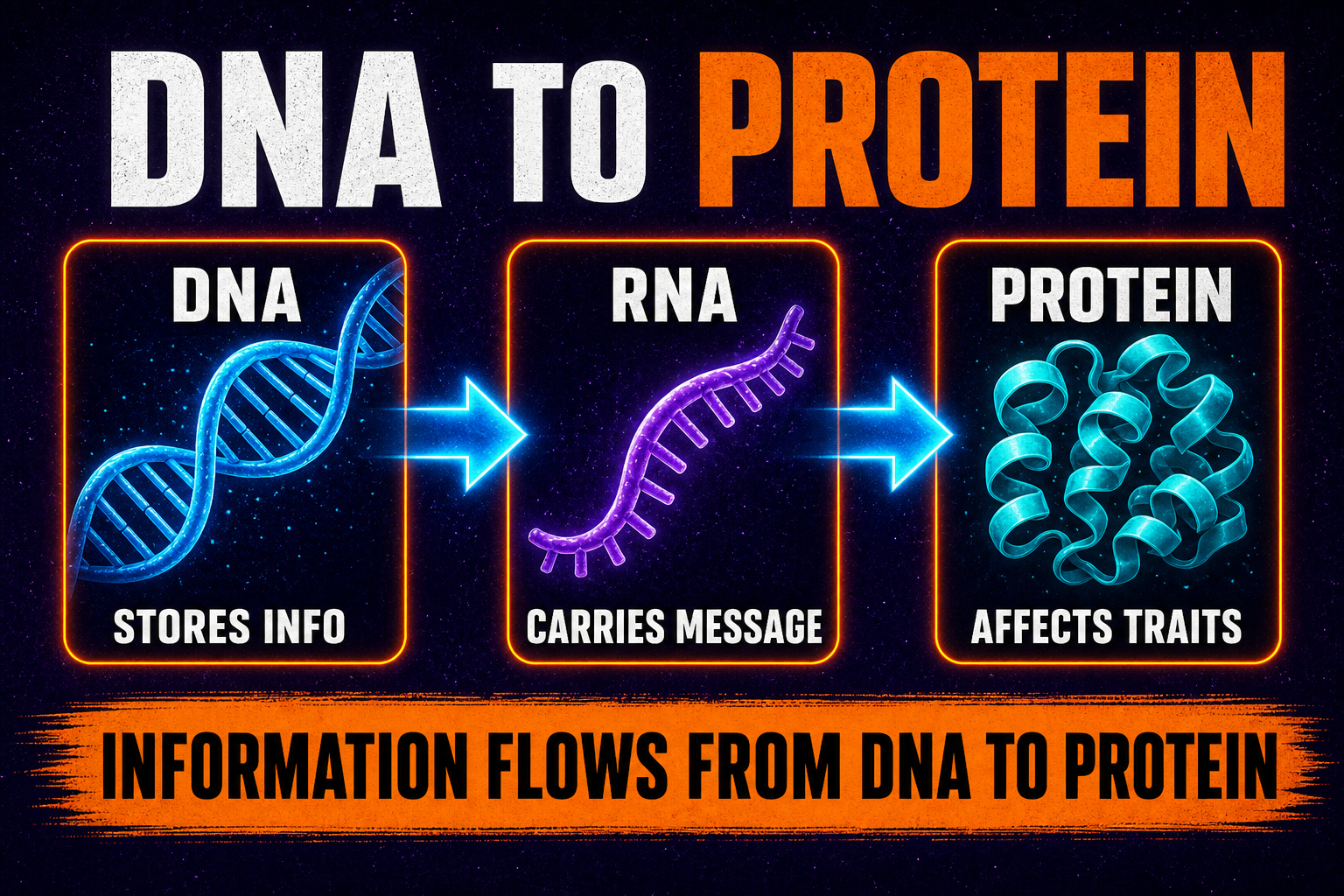
The central dogma is the flow of genetic information from DNA to RNA to protein. DNA stores genetic information, transcription copies DNA information into RNA, and translation uses mRNA codons to build a polypeptide that can become a functional protein.
DNA stores genetic information, transcription copies that information into RNA, and translation uses mRNA to build a polypeptide that can affect protein function and phenotype.
Central dogma = DNA → RNA → protein.
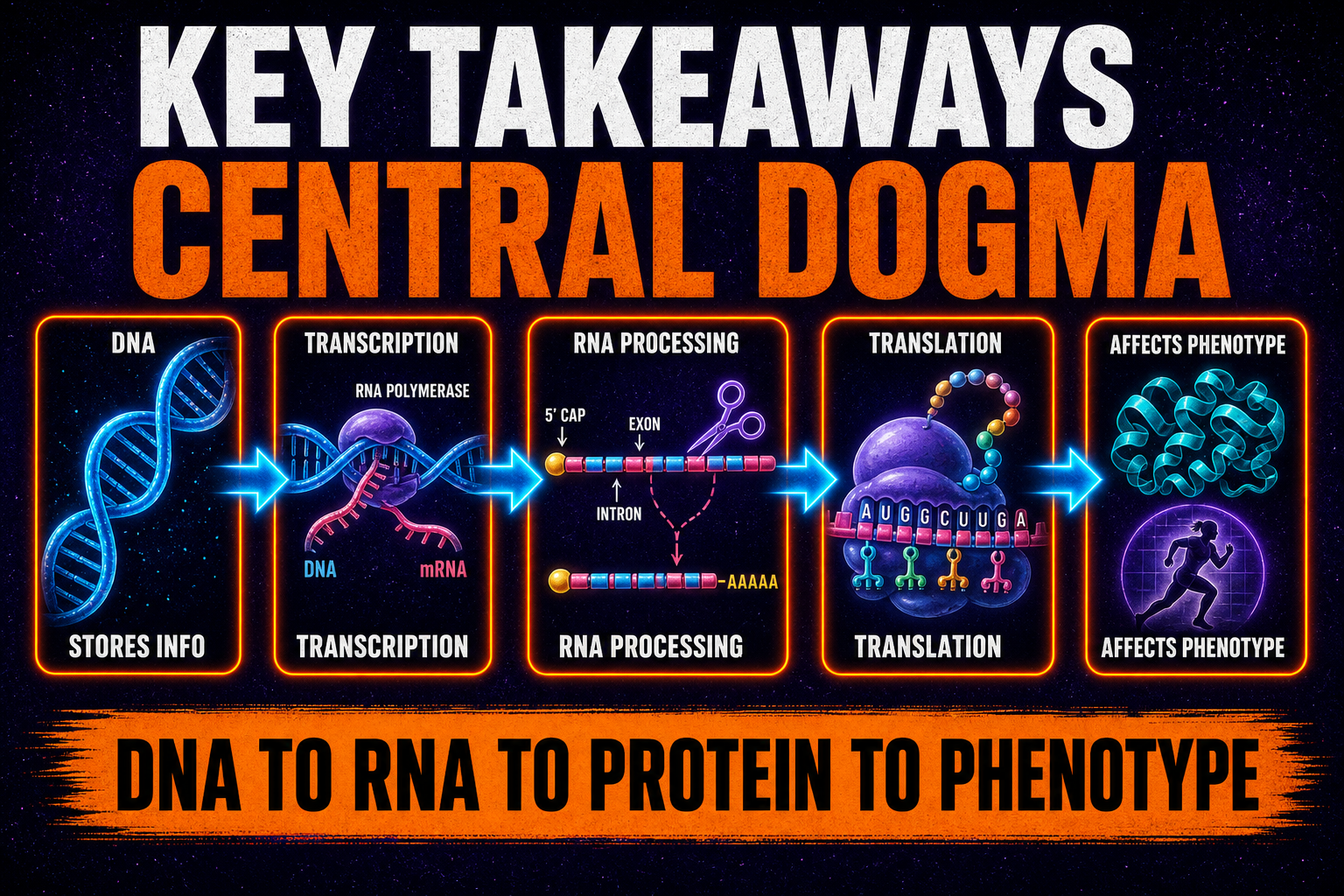
The central dogma connects molecular biology to traits. It explains how a DNA sequence can influence RNA sequence, amino acid sequence, protein shape, protein function, and phenotype. AP Biology often tests this chain of reasoning in MCQs, data questions, and FRQs.
Understanding the big flow helps you navigate Unit 6 without mixing up individual processes. For DNA base-pairing and nucleotide structure, review DNA and RNA structure. For how transcription builds RNA, see transcription and RNA processing.
Cells also control how much of that flow occurs at each step. For activators, repressors, and turning genes on or off, see the gene regulation AP Biology guide.
DNA is the stored information. RNA is the copied message. Protein is often the functional product. Transcription creates RNA. Translation creates a polypeptide. Phenotype can change when protein function changes.
Information flow:
DNA → RNA → protein — then trace transcription, RNA processing (in eukaryotes), translation, and how protein function can connect to phenotype.
Students often mix up replication, transcription, RNA processing, and translation. Use this table before every Unit 6 data question.
| Process | Information flow | Main product | AP exam clue |
|---|---|---|---|
| DNA replication | DNA → DNA | copied DNA | happens before cell division |
| Transcription | DNA → RNA | RNA transcript | RNA polymerase is involved |
| RNA processing | pre-mRNA → mature mRNA | mature mRNA | cap, tail, introns removed |
| Translation | mRNA → polypeptide | amino acid chain | ribosome, codons, tRNA |
DNA contains genes. A gene is a DNA sequence that can be used to make an RNA product. DNA base order matters because it influences the RNA sequence made during transcription.
Review nucleotide structure and base-pairing rules on the DNA and RNA structure guide before predicting mRNA from a template strand.
DNA replication is not the same as gene expression. Replication copies the entire DNA molecule before cell division. The central dogma usually focuses on how information in a gene is expressed as RNA and protein, but replication matters because copied DNA must be passed to new cells.
DNA replication is DNA → DNA, while the central dogma focuses on DNA → RNA → protein.
For enzyme names, semiconservative copying, and leading/lagging strand logic, use the DNA replication study guide.
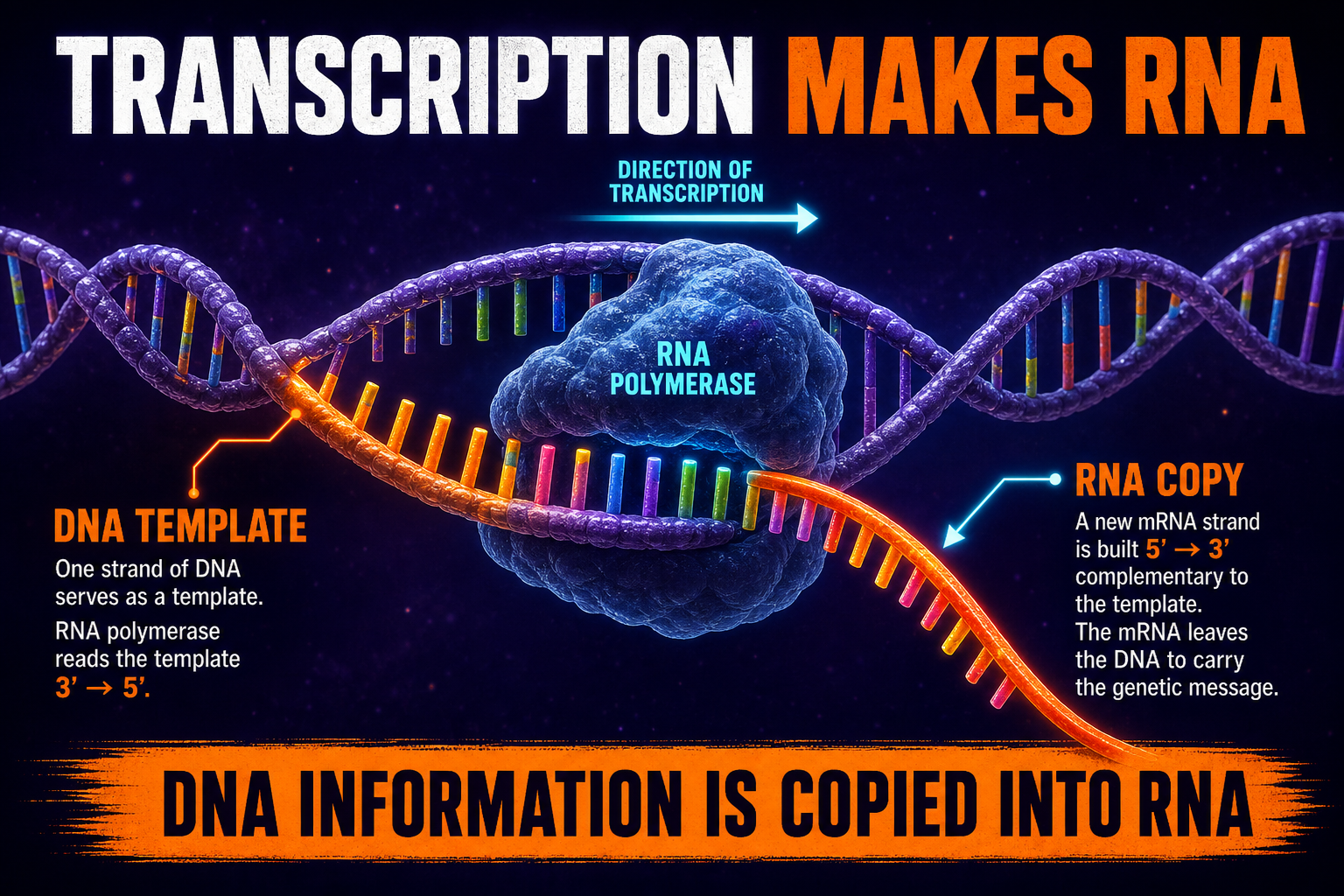
Transcription uses a DNA template to build a complementary RNA molecule. In eukaryotic cells, the first RNA copy is often processed before translation.
See the full step-by-step guide on transcription and RNA processing.
In eukaryotes, pre-mRNA is processed before translation. A 5′ cap is added, a poly-A tail is added, and introns are removed while exons are joined.
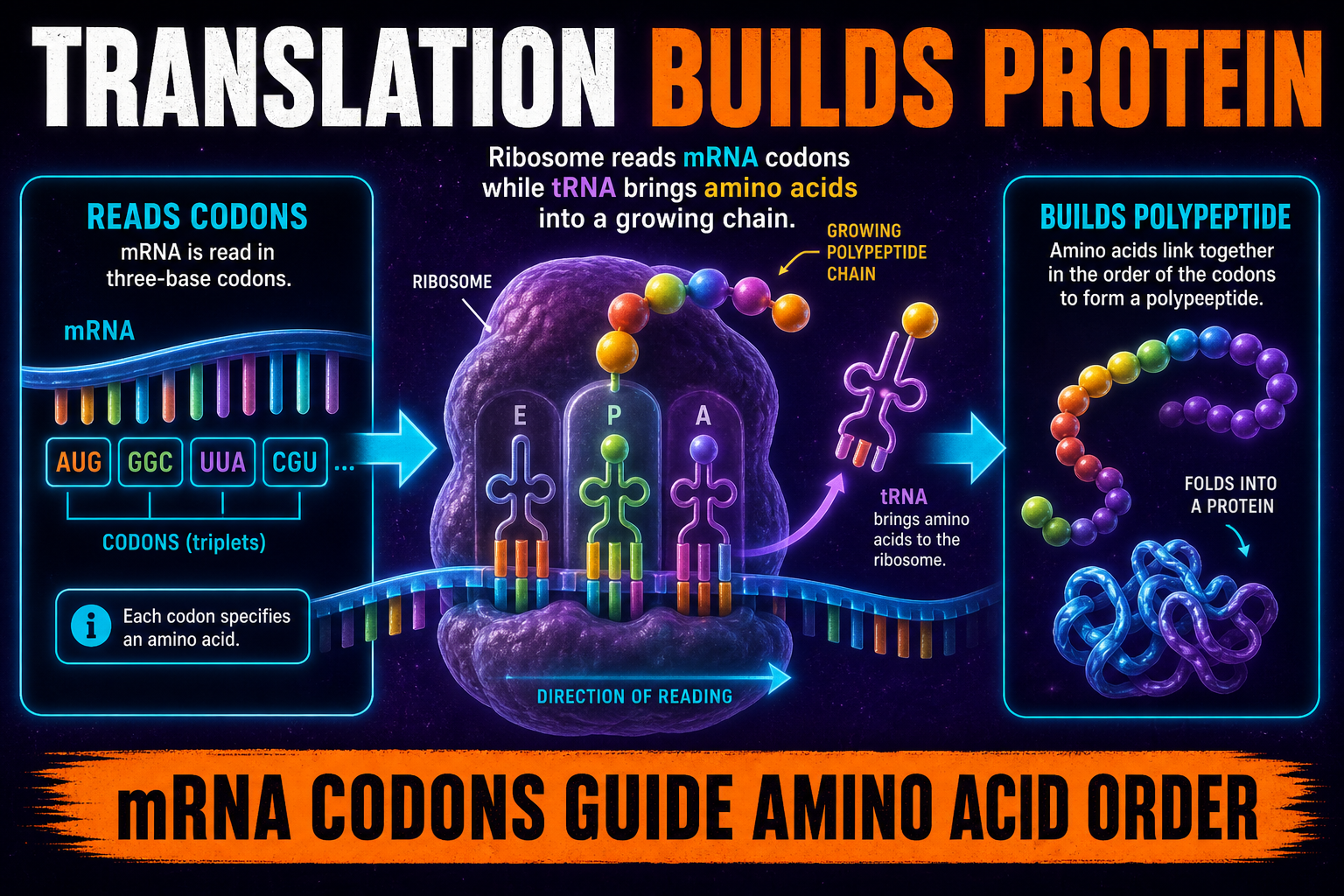
Translation happens at ribosomes. Ribosomes read mRNA codons. tRNA molecules bring amino acids. Amino acids are joined into a polypeptide.
For codon charts, start/stop codons, and ribosome mechanics, review the translation guide.
A protein’s amino acid sequence affects how it folds. Protein shape affects protein function. Protein function can affect enzymes, receptors, transport proteins, structural proteins, and visible traits.
When a prompt links molecular change to population patterns, connect back to AP Biology Unit 7 Natural Selection.
Most cells in a multicellular organism contain the same DNA, but they do not express all genes at the same time. Different patterns of gene expression allow cells to make different proteins and perform different functions.
For how cells control which genes are expressed, see the gene regulation AP Biology guide. For same DNA, different cell types, see gene expression and cell specialization.
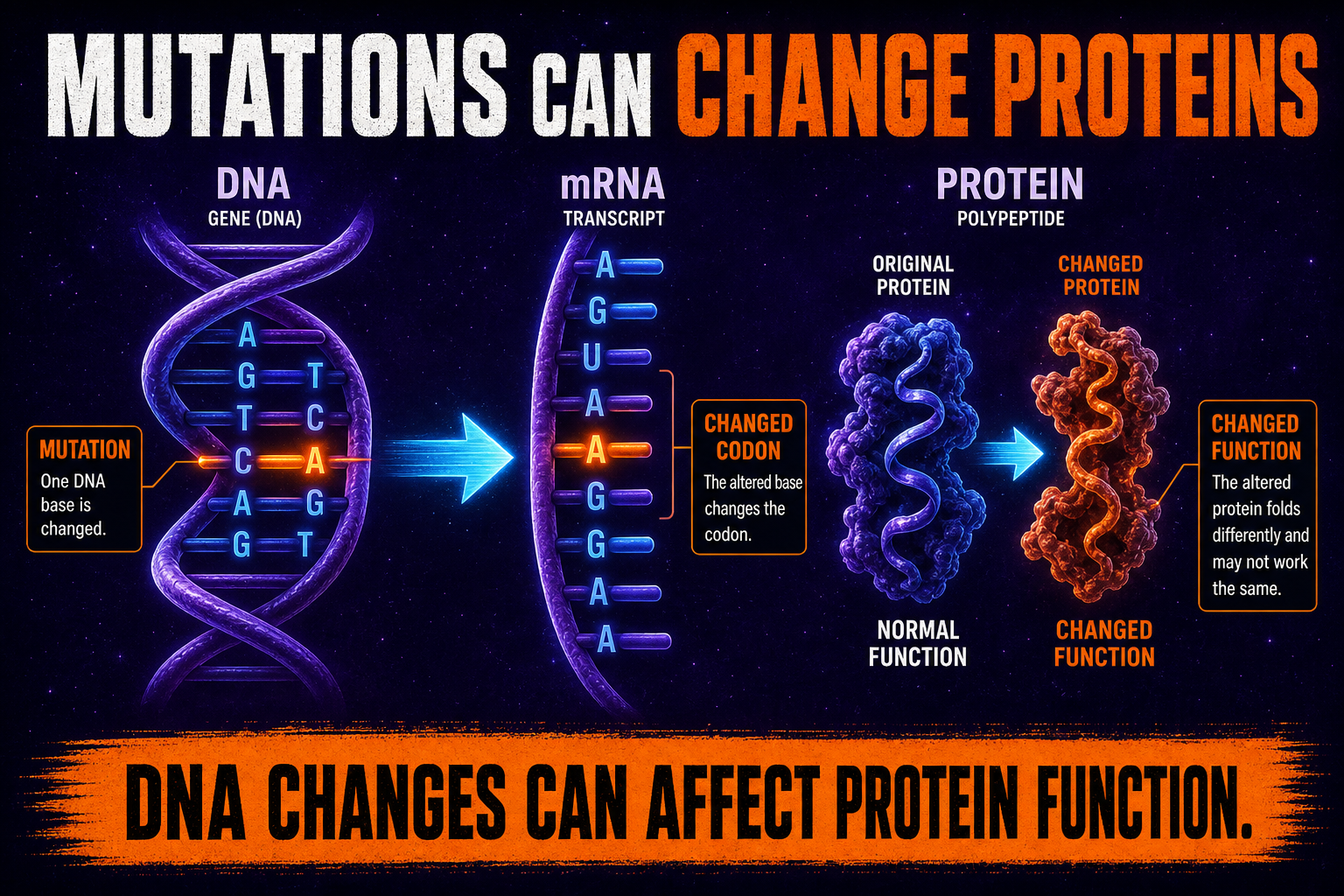
Mutations can change DNA sequence. That change may alter mRNA codons, amino acid sequence, protein shape, protein function, or phenotype. Not all mutations affect phenotype; some are silent or neutral.
For substitution, frameshift, silent, missense, and nonsense logic with practice questions, see the mutations AP Biology guide.
A DNA base change can change an mRNA codon. If the codon changes, the amino acid sequence may change. If the amino acid sequence changes, protein shape or function may change. Whether phenotype changes depends on the role of the protein.
| Term | What it means | Main product | AP exam clue |
|---|---|---|---|
| Central dogma | The overall flow of genetic information | RNA and protein (via multiple steps) | Trace DNA → RNA → protein → phenotype |
| Transcription | Copy DNA gene information into RNA | RNA (usually pre-mRNA / mRNA) | RNA polymerase, nucleus, U replaces T |
| RNA processing | Prepare eukaryotic pre-mRNA for translation | Mature mRNA | 5′ cap, poly-A tail, splicing introns |
| Translation | Read mRNA codons to build a polypeptide | Polypeptide (protein) | Ribosome, codon chart, tRNA, anticodons |
| Protein function | How a folded protein affects cell work | Functional protein activity | Connect amino acid sequence to phenotype |
For a side-by-side comparison of the two main expression steps, see transcription vs translation.
Use this ladder whenever an AP question asks how a DNA change affects a trait.
A mutation or edit changes the stored genetic code.
Transcription copies the new DNA sequence into RNA codons.
Translation may incorporate a different amino acid.
A different polypeptide can fold or work differently.
Observable traits can shift when protein activity changes.
What to do: Build the complementary mRNA using RNA base-pairing rules.
What to do: Use the codon chart to identify amino acids or stop signals.
What to do: Check whether the codon and amino acid changed.
What to do: Connect amino acid sequence or protein shape to phenotype only when supported by evidence.
AP questions may ask you to trace DNA → RNA → protein, predict mRNA from a DNA template, use a codon chart, explain how a mutation affects protein function, distinguish replication from transcription and translation, connect protein changes to phenotype, and interpret gene expression data.
→ Central dogma reasoning chain
→ Transcription step
→ RNA processing after transcription
→ Translation step
→ Predict amino acids from mRNA
→ Predict mRNA, then protein effect
→ DNA → DNA, not gene expression
→ Connect to phenotype
→ May not change amino acid or phenotype
→ Which step is blocked or increased?
Fix: DNA information is transcribed into RNA, then RNA is translated into a polypeptide.
Fix: Replication is DNA to DNA. Transcription is DNA to RNA.
Fix: Transcription makes RNA. Translation builds a polypeptide.
Fix: Eukaryotic pre-mRNA is processed before translation.
Fix: Some mutations are silent or have no major effect.
Fix: Phenotype often changes because protein function changes.
| Term | Meaning | AP exam clue |
|---|---|---|
| central dogma | Flow of genetic information from DNA to RNA to protein | Big-picture information flow |
| DNA | Double-stranded molecule that stores genetic information | Template for transcription |
| RNA | Single-stranded nucleic acid message | Product of transcription |
| gene | DNA sequence used to make an RNA product | Unit of expression |
| gene expression | Using a gene to make RNA and often protein | Transcription + processing + translation |
| transcription | DNA → RNA copying process | RNA polymerase in nucleus (eukaryotes) |
| RNA polymerase | Enzyme that builds RNA from a DNA template | Transcription enzyme |
| mRNA | Mature messenger RNA carrying codons | Leaves nucleus for translation |
| pre-mRNA | Initial RNA transcript before processing | Needs cap, tail, splicing |
| mature mRNA | Processed mRNA ready for translation | Exons joined, introns removed |
| RNA processing | Modifications that prepare eukaryotic pre-mRNA | Cap, tail, splicing |
| intron | Non-coding region removed from pre-mRNA | Spliced out in eukaryotes |
| exon | Coding region kept in mature mRNA | Joined after splicing |
| translation | mRNA → polypeptide at ribosomes | Uses codon chart |
| ribosome | Site where codons are read and peptide bonds form | Cytoplasm or rough ER |
| codon | Three RNA bases on mRNA | Codes for amino acid or stop |
| anticodon | Three bases on tRNA complementary to a codon | On tRNA, not mRNA |
| tRNA | Carries a specific amino acid to the ribosome | Anticodon matches codon |
| amino acid | Building block of polypeptides | Joined by peptide bonds |
| polypeptide | Chain of amino acids from translation | Can fold into a protein |
| protein | Folded functional molecule (often from a polypeptide) | Enzymes, receptors, structure |
| phenotype | Observable trait or function | Protein change can alter phenotype |
| mutation | Change in DNA sequence | Trace effect through dogma chain |
| reading frame | Grouping of mRNA bases into consecutive codons | Frameshift mutations shift it |
Flip all 20 cards until you can trace DNA → RNA → protein → phenotype without hesitating.
Answer all 15 questions. Choices shuffle on reload—focus on information flow, not letter memorization. For full Unit 6 coverage with 45 MCQs and topic filters, try the AP Biology Unit 6 practice questions page.
Open each card, draft your response, then reveal the rubric and sample answer.
A DNA template sequence changes from TAC to TAT. Predict the mRNA codon and explain how this could affect translation.
Transcription copies the DNA template into mRNA. TAC produces AUG; TAT produces AUA. If this is the start codon, the first amino acid could change from methionine to isoleucine, potentially altering protein structure, function, and phenotype.
Status: Draft your answer first—then open the rubric or sample.
A mutation creates an early stop codon in mRNA. Explain how this could affect the polypeptide and phenotype.
During translation, ribosomes read mRNA until a stop codon. An early stop codon terminates translation prematurely, producing a shorter polypeptide missing downstream amino acids. The protein is likely nonfunctional, which can change cell function and phenotype.
Status: Draft your answer first—then open the rubric or sample.
The central dogma is the flow of genetic information from DNA to RNA to protein. DNA stores instructions, transcription copies DNA into RNA, and translation uses mRNA codons to build a polypeptide.
For most protein-coding genes, the order is DNA → RNA → protein. In eukaryotes, RNA processing happens between transcription and translation to convert pre-mRNA into mature mRNA.
No. DNA does not become protein directly. DNA information is copied into RNA during transcription, and mRNA is read during translation to build a polypeptide.
Replication copies DNA into DNA before cell division. Transcription copies a gene from DNA into RNA as part of gene expression.
Transcription copies DNA information into RNA. Translation reads mRNA codons at ribosomes to build a polypeptide.
In eukaryotes, RNA processing happens after transcription and before translation. It converts pre-mRNA into mature mRNA by adding a 5′ cap, adding a poly-A tail, and removing introns while joining exons.
A mutation can change a DNA sequence, which may change mRNA codons, amino acid sequence, protein shape, protein function, and sometimes phenotype.
For most protein-coding genes, the central dogma is DNA → RNA → protein. Some biological systems, such as retroviruses, use reverse transcriptase to copy RNA into DNA, but AP Biology usually tests the main information-flow model first.
The central dogma is important because many AP Biology questions ask students to trace how changes in DNA or RNA can affect amino acid sequence, protein function, and phenotype.