Identify the goal
Copy, cut, separate, move, edit, or read DNA.
AP Biology · Unit 6 Gene Expression
Biotechnology uses molecular tools to study and manipulate DNA. AP Biology often tests what each tool does: PCR copies DNA, restriction enzymes cut DNA, gel electrophoresis separates DNA fragments, plasmids move genes into bacteria, and sequencing reads DNA base order. The key is choosing the right tool and interpreting the data it produces.
Teacher tip: Do not memorize biotechnology tools as a list. Ask what the scientist is trying to do: copy DNA, cut DNA, separate fragments, move a gene, edit a gene, or read a sequence.
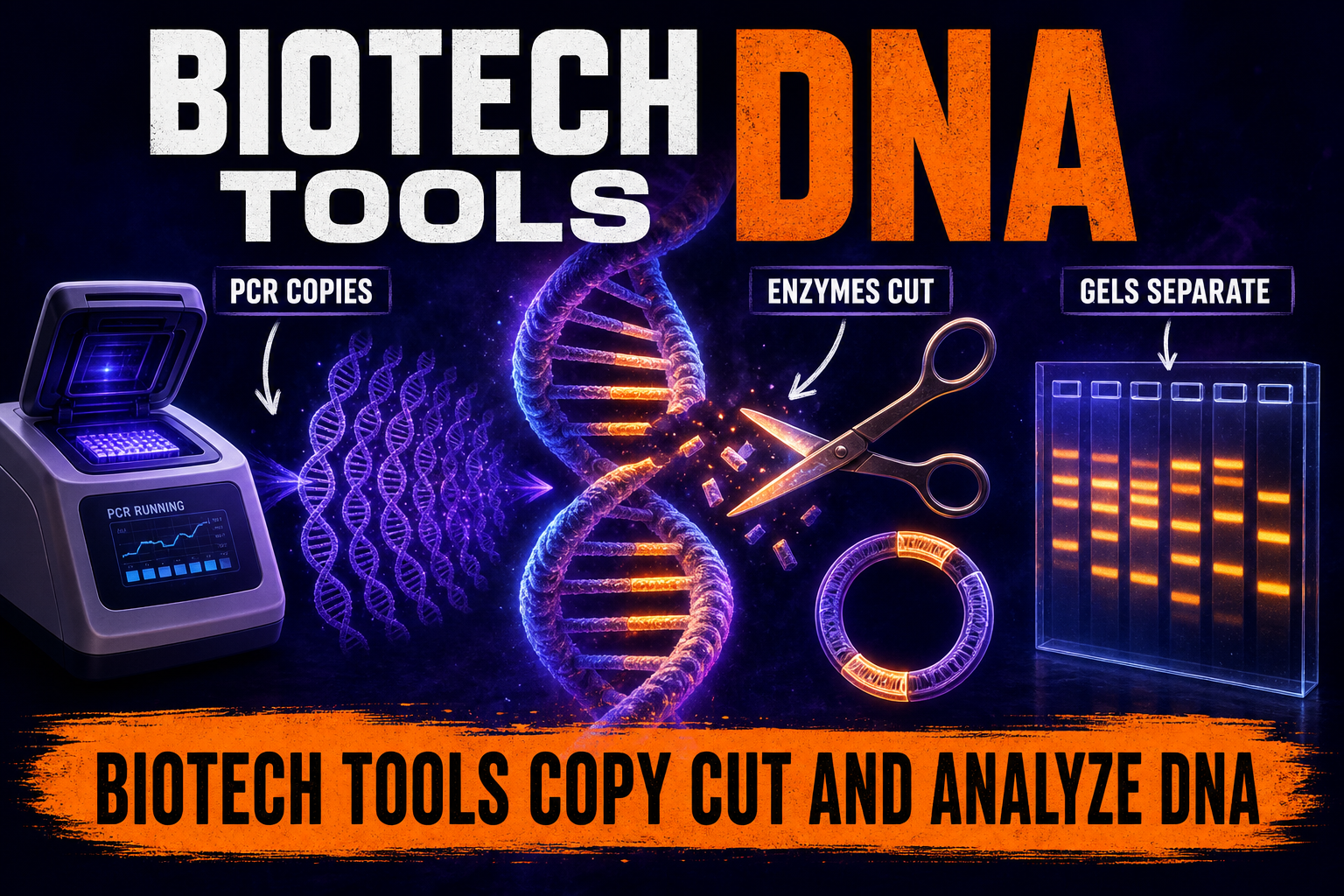
Biotechnology is the use of molecular tools to study, copy, cut, separate, move, edit, or analyze DNA. In AP Biology, the most important biotechnology tools include PCR, gel electrophoresis, restriction enzymes, plasmids, bacterial transformation, DNA sequencing, and CRISPR. For biotechnology AP Biology, match each tool to the scientist's goal and interpret the data it produces.
Biotechnology = tools that let scientists work with DNA.
Biotechnology tools let scientists copy DNA, cut DNA, separate DNA fragments, move genes into cells, edit genes, and analyze DNA sequences.
Biotechnology connects molecular biology to real experiments. AP Biology questions often ask students to choose a tool, interpret a gel, explain why DNA was amplified, predict transformation results, or connect genetic engineering to gene expression.
For DNA structure rules that underpin these tools, see DNA and RNA structure. For copying DNA before analysis, connect PCR logic to DNA replication.
| Tool | Main job | AP exam clue |
|---|---|---|
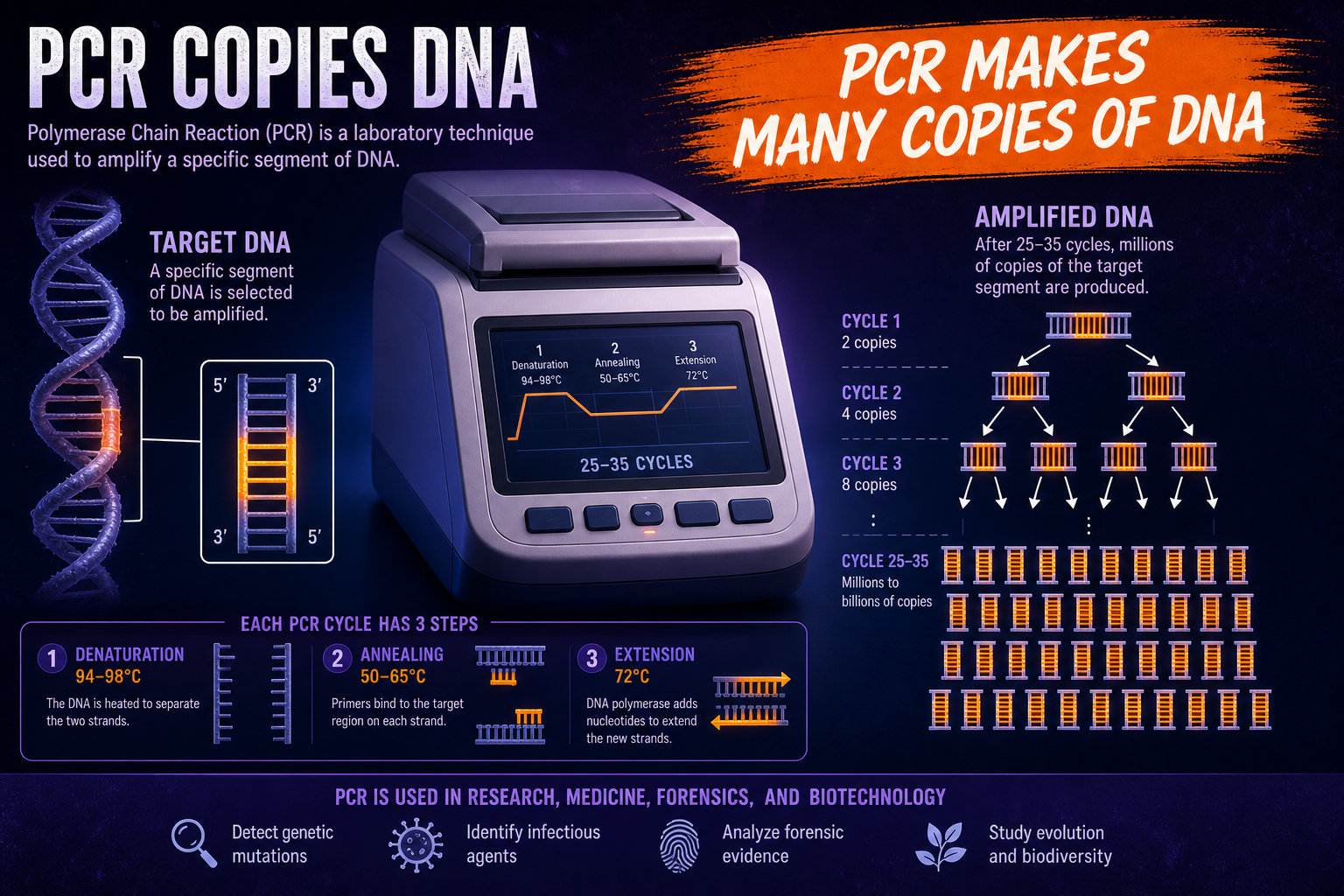
| PCR | copies DNA | amplifies a target DNA sequence |
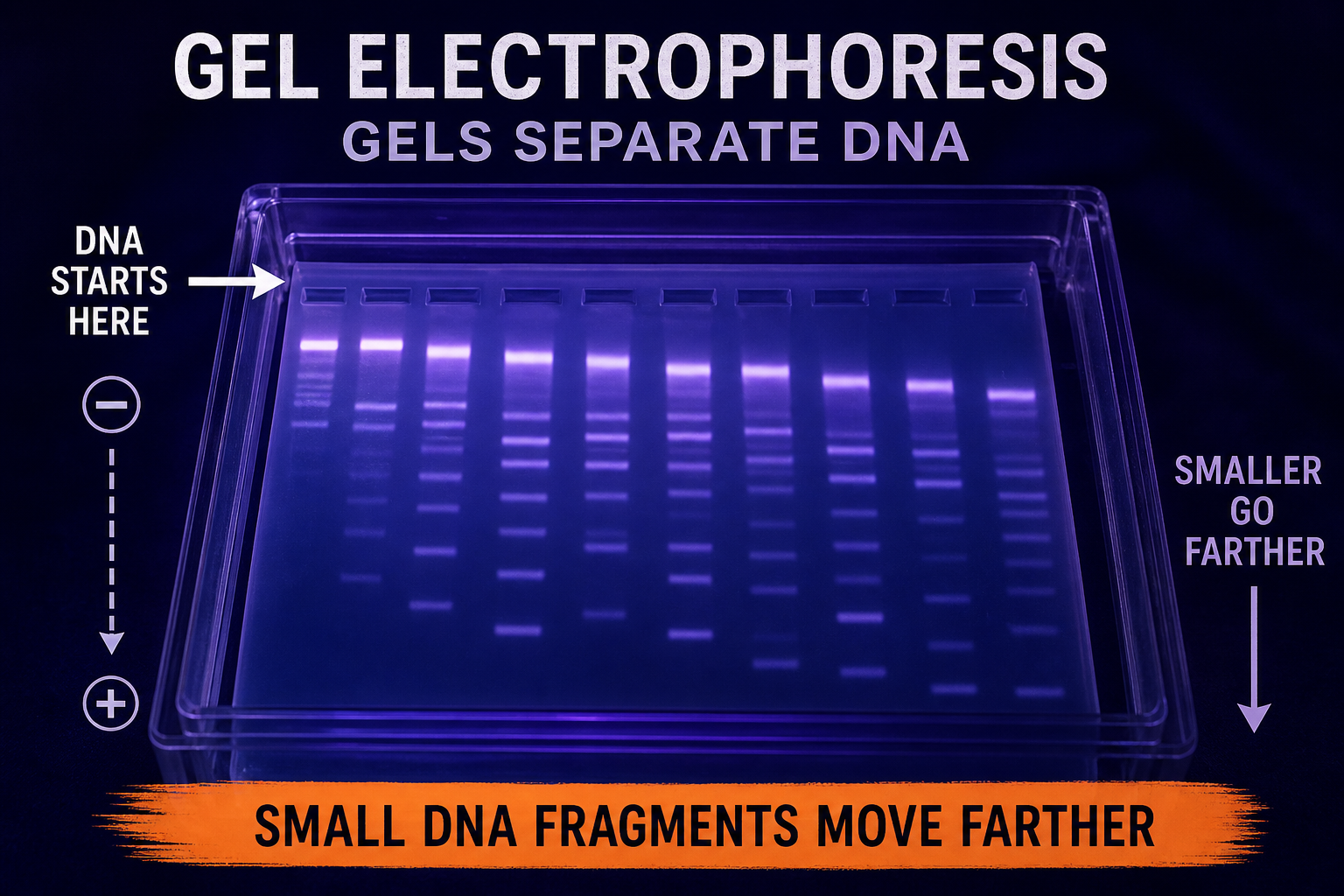
| Gel electrophoresis | separates DNA fragments by size | smaller fragments travel farther |
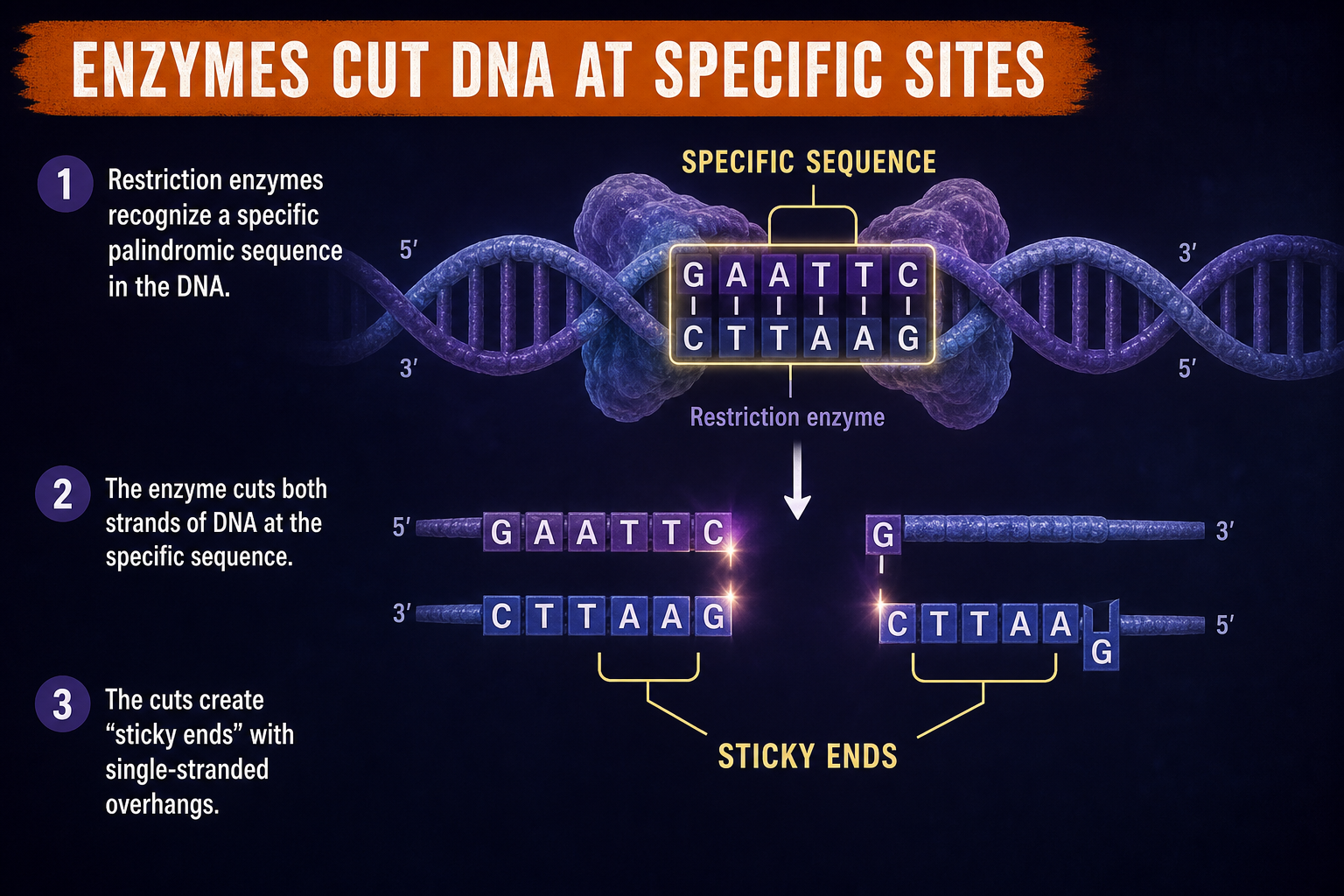
| Restriction enzymes | cut DNA | cut at specific recognition sites |
| DNA ligase | joins DNA fragments | seals sugar-phosphate backbone |
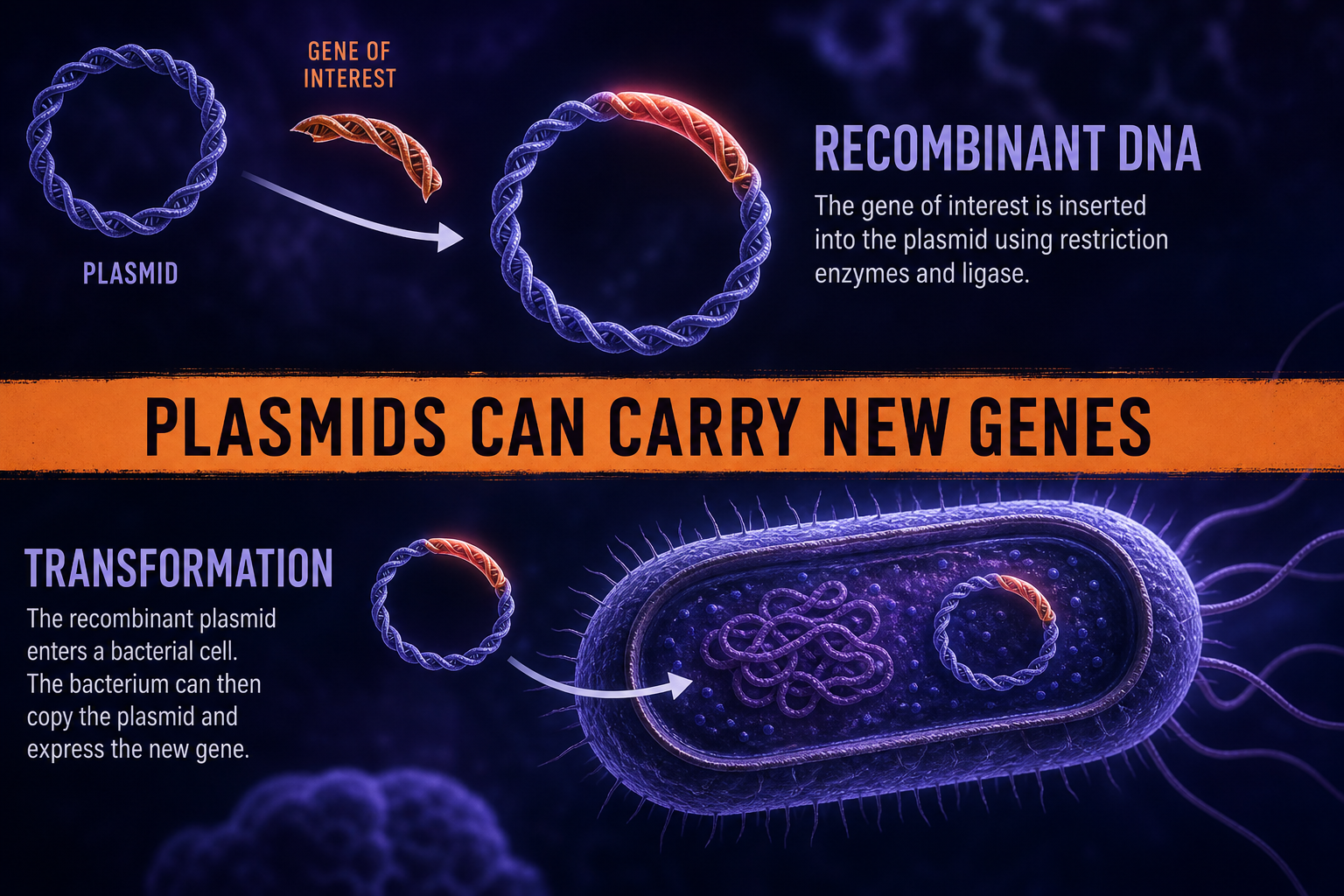
| Plasmids | carry genes into bacteria | circular bacterial DNA |
| Transformation | cells take up DNA | bacteria receive plasmids |
| DNA sequencing | reads base order | determines nucleotide sequence |
| CRISPR | edits DNA | targets and changes specific DNA sequences |
| Recombinant DNA | DNA from different sources | inserted gene plus vector |
Use this ladder whenever an AP question asks which biotechnology tool is being used or what result to expect.
Copy, cut, separate, move, edit, or read DNA.
PCR copies, restriction enzymes cut, gels separate, plasmids move, CRISPR edits, sequencing reads.
More DNA, cut DNA fragments, separated bands, transformed cells, edited DNA, or a base sequence.
Read bands, compare fragment sizes, check transformed colonies, or analyze sequence changes.
Ask whether the DNA change or inserted gene affects RNA or protein production.
Use the experimental result, not just the tool name.
| Question | Best tool | Why |
|---|---|---|
| Need many copies of DNA? | PCR | PCR amplifies a target region when the sample is too small to test. |
| Need to separate DNA fragments by size? | Gel electrophoresis | Fragments move through a gel; smaller pieces travel farther from the wells. |
| Need to cut DNA at a specific sequence? | Restriction enzymes | Each enzyme recognizes a specific sequence and creates predictable fragments. |
| Need to join DNA fragments? | DNA ligase | Ligase seals compatible ends after restriction enzyme cuts. |
| Need to move a gene into bacteria? | Plasmid + transformation | A vector carries the gene; bacteria that take up the plasmid may express it. |
| Need to read base order? | DNA sequencing | Sequencing reveals the nucleotide order in a DNA molecule. |
| Need to edit a target gene? | CRISPR | Guide RNA targets a sequence; Cas cuts DNA so repair can change the gene. |
Biotechnology tools act on DNA, RNA, or gene expression. A changed DNA sequence can affect mRNA, protein sequence, protein function, or phenotype. Inserted genes may be transcribed and translated if the correct regulatory sequences are present.
Review the central dogma study guide for the full flow, then use transcription vs translation when you need process labels.
Biotechnology can detect mutations, analyze mutation effects, or intentionally edit genes. PCR can amplify a region, sequencing can identify the base change, gel electrophoresis can compare fragment patterns, and CRISPR can target DNA for editing.
For mutation types and tracing DNA → protein effects, see the mutations study guide—this page focuses on tools, not full mutation taxonomy.
Biotechnology can change gene expression by inserting a gene, editing a gene, altering regulatory DNA, or transforming cells with plasmids. AP questions may ask whether an inserted gene will be transcribed, translated, or expressed as a protein.
Connect expression outcomes to gene regulation and translation when the prompt asks about protein production.
What to do: Choose PCR.
What to do: Interpret gel electrophoresis by size.
What to do: Use restriction enzyme logic.
What to do: Infer which cells were transformed.
What to do: Think gene editing or CRISPR.
Scenario: A scientist wants to compare whether two students have the same DNA fragment pattern for a specific gene region. The DNA sample is very small.
Conclusion: PCR copies the DNA first; gel electrophoresis separates the fragments so the samples can be compared.
AP questions may ask you to choose the correct tool for a goal, explain what PCR does, interpret gel electrophoresis band patterns, explain restriction enzyme cuts, explain plasmid transformation, identify recombinant DNA, interpret sequencing or mutation data, connect gene editing to protein function or phenotype, and evaluate experimental controls.
Fix: PCR copies DNA. Gel electrophoresis separates DNA.
Fix: Smaller DNA fragments move farther through the gel.
Fix: Restriction enzymes cut DNA. DNA ligase joins DNA.
Fix: Plasmids are small circular DNA molecules.
Fix: AP biotechnology questions often require comparing experimental and control groups.
Fix: Gene editing changes DNA, but phenotype depends on gene expression and protein function.
| Term | Meaning | AP exam clue |
|---|---|---|
| biotechnology | Use of molecular tools to study or manipulate DNA | Match tool to goal |
| PCR | Amplifies a specific DNA sequence | Need many copies |
| primer | Short DNA that starts PCR | Defines target region |
| DNA polymerase | Builds new DNA strands in PCR | Adds nucleotides |
| gel electrophoresis | Separates DNA fragments by size | Band pattern data |
| DNA fragment | Piece of DNA after cutting or PCR | Compare sizes on a gel |
| restriction enzyme | Cuts DNA at a recognition sequence | Predictable fragments |
| recognition sequence | Specific DNA site an enzyme cuts | Named for each enzyme |
| sticky ends | Single-stranded overhangs after a cut | Can pair for ligation |
| DNA ligase | Joins DNA fragments | Seals backbone after cut |
| recombinant DNA | DNA combined from different sources | Inserted gene + vector |
| plasmid | Small circular DNA in bacteria | Common cloning vector |
| vector | DNA molecule that carries a gene into a cell | Often a plasmid |
| bacterial transformation | Bacteria take up foreign DNA | Plasmid uptake |
| selectable marker | Gene that helps identify transformed cells | Antibiotic resistance common |
| DNA sequencing | Determines nucleotide order | Reads base sequence |
| CRISPR | Gene-editing system targeting specific DNA | Guide RNA + Cas |
| guide RNA | RNA that targets a DNA sequence in CRISPR | Directs the cut |
| Cas enzyme | Enzyme that cuts DNA in CRISPR | Creates a double-strand break |
| genetic engineering | Deliberate change of an organism's DNA | Recombinant DNA, CRISPR |
| GMO | Organism with engineered DNA | Inserted or edited genes |
| gene expression | Using a gene to make RNA and often protein | After transformation or edit |
| control group | Baseline for comparison in an experiment | Supports causal claims |
Flip all 20 cards until you can match each tool to its DNA-level result.
Answer all 12 questions. Choices shuffle on reload—use goal → tool → DNA result → data in each explanation. For 45 Unit 6 MCQs with score tracking, open the AP Biology Unit 6 practice questions page.
Open each card, draft your response, then reveal the rubric and sample answer.
A researcher has a tiny DNA sample and wants to compare DNA fragment sizes between two individuals. Explain which tools should be used.
Goal: compare fragment patterns with little starting DNA. PCR amplifies the target region so there is enough DNA to analyze. Restriction enzymes may cut the region into fragments. Gel electrophoresis separates fragments by size; smaller fragments travel farther. Band patterns in each lane can be compared between individuals.
Status: Draft your answer first—then open the rubric or sample.
A plasmid with an inserted gene is added to bacteria. Some bacteria grow on antibiotic media and produce a new protein. Explain what likely happened.
Bacteria took up the recombinant plasmid (transformation). The plasmid included a selectable marker, so only transformed cells grew on antibiotic media. The inserted gene was transcribed and translated, producing the new protein in those cells.
Status: Draft your answer first—then open the rubric or sample.
Biotechnology is the use of molecular tools to study, copy, cut, separate, move, edit, or analyze DNA. Common AP tools include PCR, gel electrophoresis, restriction enzymes, plasmids, transformation, sequencing, and CRISPR.
PCR copies DNA, gel electrophoresis separates fragments by size, restriction enzymes cut DNA, DNA ligase joins fragments, plasmids carry genes, transformation moves DNA into cells, sequencing reads base order, and CRISPR can edit targeted sequences.
PCR amplifies a specific DNA sequence, producing many copies from a small starting sample using primers, DNA polymerase, and repeated heating and cooling cycles.
Gel electrophoresis separates DNA fragments by size. Negatively charged DNA moves through a gel toward the positive electrode, and smaller fragments usually travel farther.
Smaller fragments move more easily through the pores in the gel matrix, so they travel farther from the wells than larger fragments.
Restriction enzymes cut DNA at specific recognition sequences, creating DNA fragments that can be analyzed on a gel or used in recombinant DNA work.
DNA ligase joins DNA fragments by sealing the sugar-phosphate backbone, often after restriction enzyme cuts create compatible ends.
Recombinant DNA combines DNA from different sources, such as a human gene inserted into a bacterial plasmid.
Plasmids are small circular DNA molecules used as vectors to carry genes into bacteria or other host cells during genetic engineering.
Bacterial transformation is the uptake of foreign DNA, such as a plasmid, by bacterial cells. Transformed cells may express genes on the plasmid.
DNA sequencing determines the order of nucleotides in a DNA molecule, which can identify mutations, alleles, or inserted genes.
CRISPR is a gene-editing tool in which guide RNA targets a specific DNA sequence and a Cas enzyme cuts the DNA so repair can change the gene.
Name the correct tool, explain what it does at the DNA level, interpret the experimental data, compare controls when present, and connect to RNA, protein, or phenotype only when the prompt provides evidence.