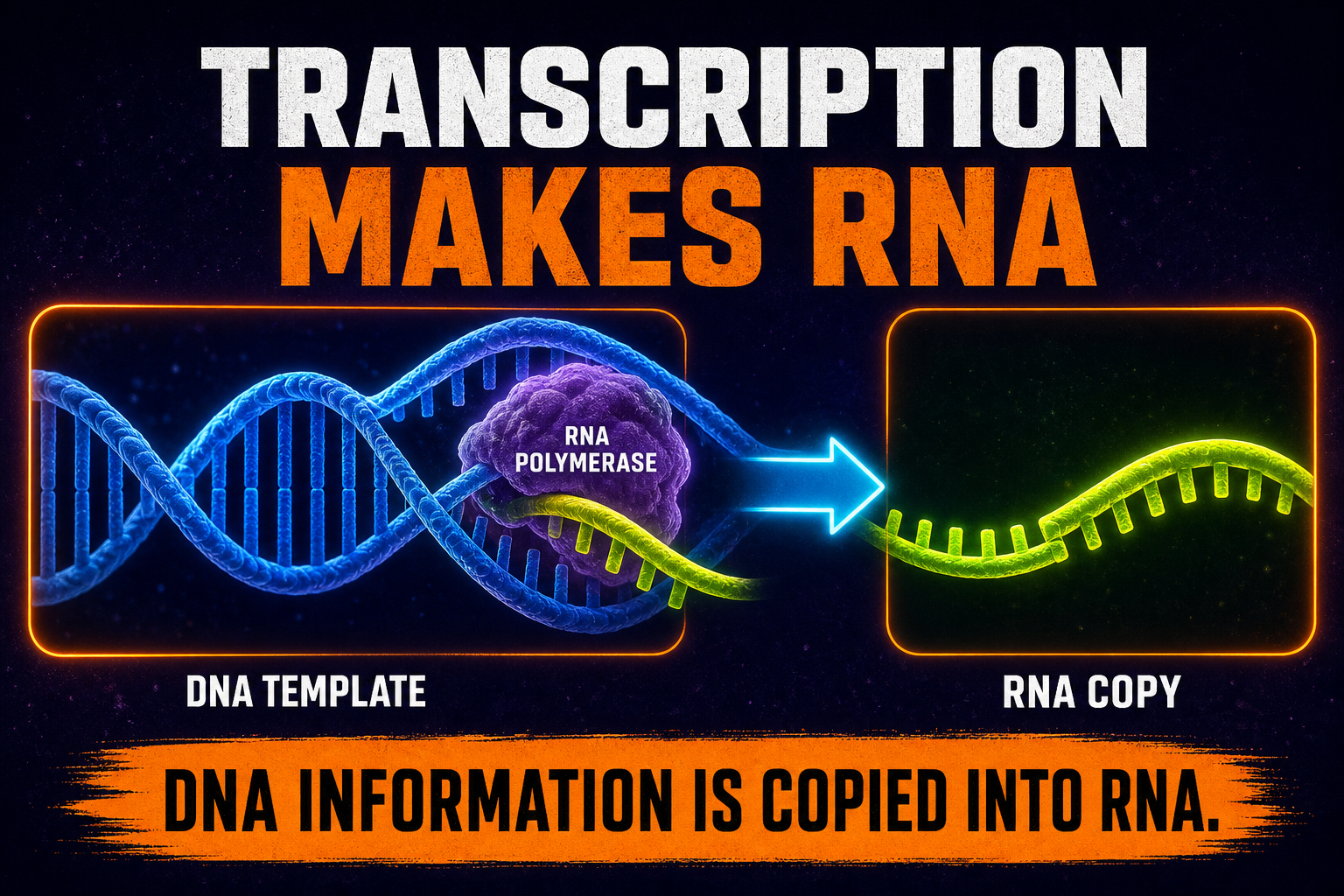
RNA polymerase binds near a gene.
What is transcription and RNA processing?
Transcription and RNA processing AP Biology covers how a gene’s DNA message becomes usable RNA. Transcription makes RNA from a DNA template, while RNA processing modifies eukaryotic pre-mRNA into mature mRNA by adding a 5′ cap, adding a poly-A tail, and removing introns while joining exons.
Say it fast
Transcription makes RNA. RNA processing prepares eukaryotic mRNA.
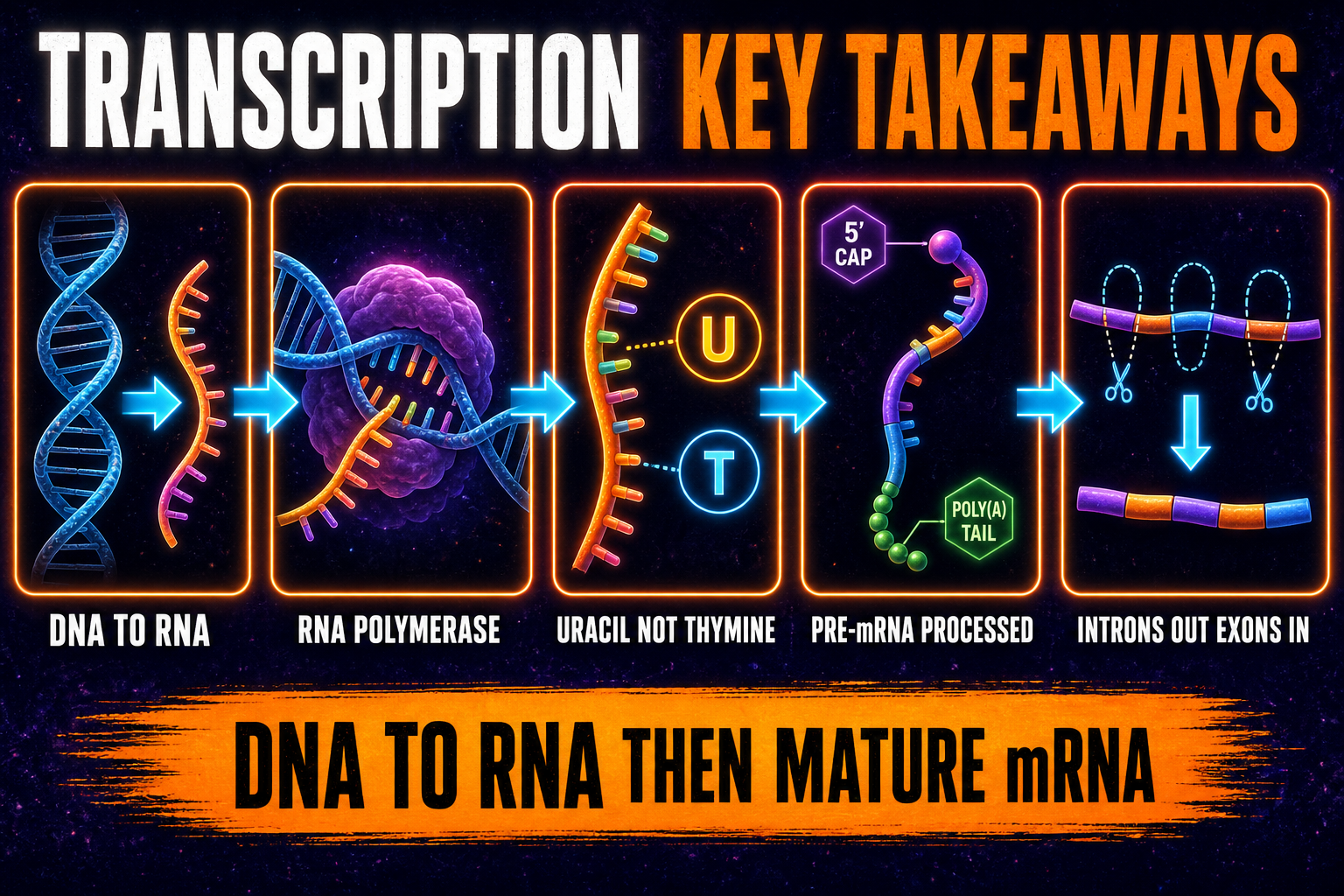
Transcription and RNA Processing Key Takeaways
- Transcription copies DNA information into RNA.
- RNA polymerase builds RNA from a DNA template.
- RNA uses uracil instead of thymine.
- Eukaryotic pre-mRNA is processed before translation.
- Introns are removed and exons are joined during splicing.
Why Transcription Matters in AP Biology
Transcription is the first major step in gene expression. A gene in DNA cannot directly become a protein. First, the cell makes an RNA copy of the gene. That RNA message can then be processed and later used to build a polypeptide.
Direct answer: Transcription matters because it turns stored DNA information into an RNA message the cell can use.
Review DNA and RNA structure for nucleotides and base pairing, then DNA replication to see how the DNA template is maintained before transcription. When a prompt asks whether transcription increases or decreases, connect to the gene regulation AP Biology guide.
What Happens During Transcription?
On the AP exam, describe transcription as a clear sequence from DNA template to RNA transcript.
DNA strands separate locally.
One DNA strand acts as the template.
RNA polymerase adds complementary RNA nucleotides.
RNA uses U instead of T.
The RNA transcript is released.
What Does RNA Polymerase Do?
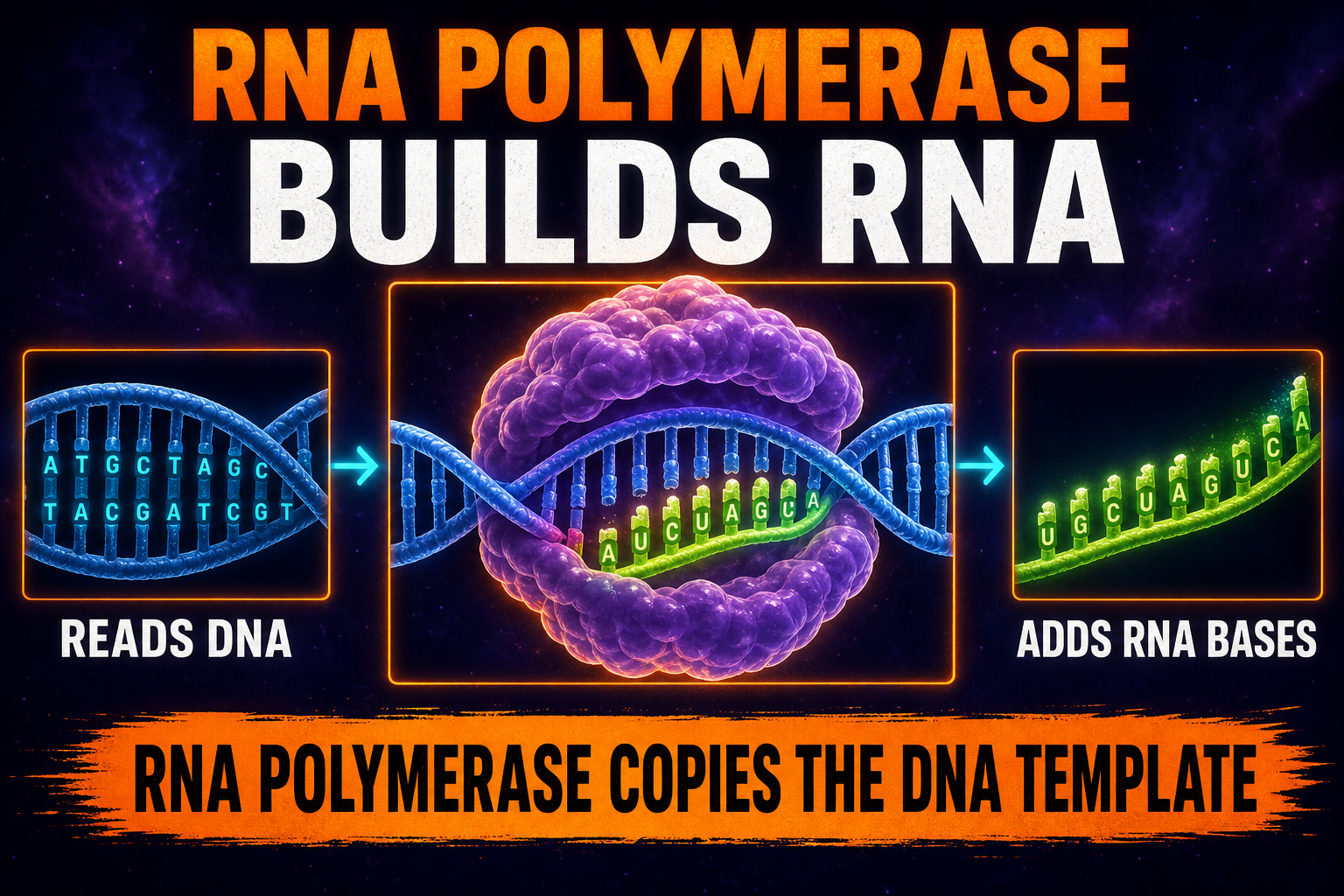
Direct answer: RNA polymerase is the enzyme that builds RNA during transcription by reading a DNA template strand and adding complementary RNA nucleotides.
- RNA polymerase binds near the start of a gene
- It reads the DNA template strand
- It builds RNA 5′ to 3′
- It does not build protein
- It is different from DNA polymerase
Common mistake: DNA polymerase builds DNA during replication. RNA polymerase builds RNA during transcription.
DNA Template Strand vs RNA Transcript
The template strand is read by RNA polymerase. The RNA transcript is complementary to that template strand.
- DNA A pairs with RNA U
- DNA T pairs with RNA A
- DNA C pairs with RNA G
- DNA G pairs with RNA C
DNA template: TAC GGA → mRNA: AUG CCU
Common mistake: Use U in RNA, not T.
Where Does Transcription Happen?
Direct answer: In eukaryotes, transcription occurs in the nucleus. In prokaryotes, transcription occurs in the cytoplasm.
- In eukaryotes, transcription happens in the nucleus
- In prokaryotes, transcription happens in the cytoplasm
- Eukaryotic RNA often needs processing before translation
- Prokaryotic mRNA usually does not need the same processing before translation
What Is RNA Processing?
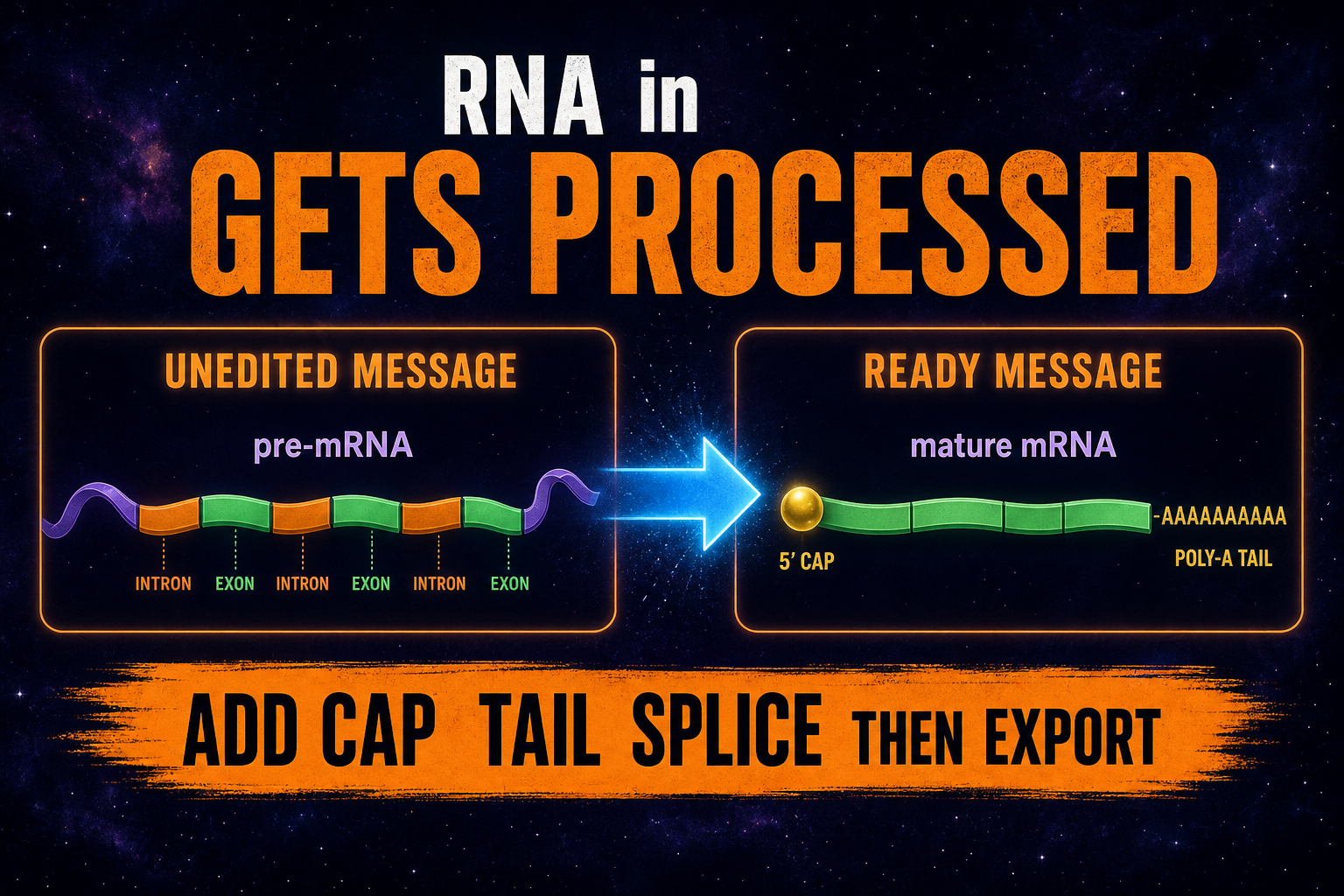
Direct answer: RNA processing modifies eukaryotic pre-mRNA before translation. The main steps are adding a 5′ cap, adding a poly-A tail, and removing introns while joining exons.
- pre-mRNA is the unprocessed RNA copy
- Mature mRNA is ready to leave the nucleus
- Processing protects and edits the message
- Processing helps mRNA be translated correctly
What Does the 5′ Cap Do?
The 5′ cap is added to the front end of eukaryotic mRNA. It helps protect the mRNA and helps ribosomes recognize the mRNA later during translation.
Direct answer: The 5′ cap helps protect mRNA and supports ribosome recognition during translation.
What Does the Poly-A Tail Do?
The poly-A tail is added to the 3′ end of eukaryotic mRNA. It helps protect mRNA from breakdown and supports export and stability. It does not code for amino acids directly.
Direct answer: The poly-A tail helps stabilize eukaryotic mRNA and protect it from rapid breakdown.
Introns vs Exons
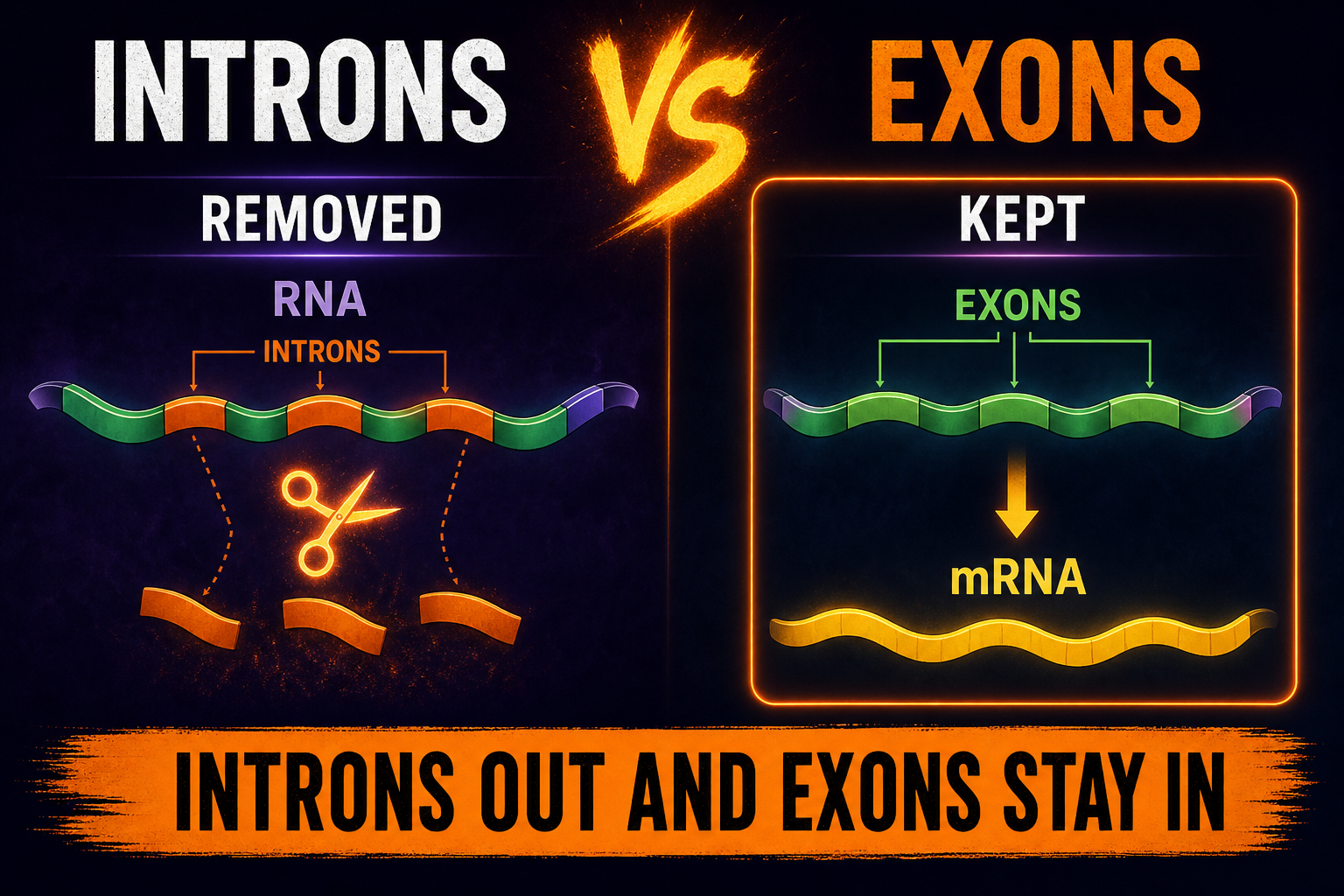
| Feature | Introns | Exons |
|---|---|---|
| Meaning | Noncoding segments removed from pre-mRNA | Coding segments kept in mature mRNA |
| What happens during splicing | Cut out of the RNA transcript | Joined together in final mRNA |
| Role in mature mRNA | Not present in mature mRNA | Remain and are expressed |
| AP exam clue | Removed before translation | Exons stay in the message |
| Common mistake | Thinking introns code for protein | Forgetting exons are the expressed parts |
Direct answer: Introns are removed. Exons are expressed because they remain in mature mRNA.
What Happens During RNA Splicing?
- Introns are removed
- Exons are joined
- The mature mRNA sequence changes compared with pre-mRNA
- Splicing allows the cell to prepare a usable mRNA message
AP exam clue: If introns are not removed correctly, the mature mRNA sequence can change, which may affect the amino acid sequence and protein function later.
Pre-mRNA vs Mature mRNA
| Feature | Pre-mRNA | Mature mRNA |
|---|---|---|
| Stage | First RNA copy from transcription | Processed RNA ready for use |
| Contains introns? | Usually yes in eukaryotes | No—introns removed |
| Has cap and tail? | Not yet fully processed | 5′ cap and poly-A tail added |
| Can leave nucleus? | Generally not as final message | Yes—mature mRNA can export |
| Used for translation? | Not directly | Yes—ribosomes read mature mRNA |
| AP exam clue | Unedited RNA message | Ready message after processing |
Direct answer: Pre-mRNA is the first RNA copy. Mature mRNA has been processed and can be used for translation.
How RNA Processing Affects Gene Expression
RNA processing changes whether an RNA message is stable, exportable, and usable for translation. If splicing is incorrect, the mRNA sequence can change, which may affect the amino acid sequence and protein function.
How This Connects to Transcription vs Translation
This page focuses on transcription and RNA processing. Translation is the next step, when ribosomes read the mature mRNA message to build a polypeptide. For the full translation guide, see translation AP Biology. For a direct comparison of both processes, see the transcription vs translation guide.
How AP Biology Tests Transcription and RNA Processing
AP questions may ask you to predict mRNA from a DNA template, identify what RNA polymerase does, distinguish transcription from replication, explain why RNA uses U instead of T, describe the 5′ cap, poly-A tail, and splicing, identify introns and exons, explain how incorrect splicing can affect protein function, and connect RNA processing to gene expression.
AP warning: Most AP mistakes happen when students say transcription makes protein or forget that eukaryotic pre-mRNA is processed before translation.
Common Transcription and RNA Processing Mistakes
Thinking transcription makes protein
Fix: Transcription makes RNA. Translation makes a polypeptide.
Using thymine in mRNA
Fix: RNA uses uracil instead of thymine.
Confusing DNA polymerase and RNA polymerase
Fix: DNA polymerase copies DNA. RNA polymerase builds RNA.
Thinking introns stay in mature mRNA
Fix: Introns are removed. Exons are joined.
Forgetting RNA processing in eukaryotes
Fix: Eukaryotic pre-mRNA gets a 5′ cap, poly-A tail, and splicing.
Thinking mRNA is the same as pre-mRNA
Fix: Mature mRNA has been processed and is ready for translation.
Must-Know Terms
| Term | Meaning | AP exam clue |
|---|---|---|
| transcription | DNA information copied into RNA | DNA → RNA, not protein |
| RNA polymerase | Enzyme that builds RNA from DNA template | Not DNA polymerase |
| DNA template strand | Strand read by RNA polymerase | Complementary to RNA |
| RNA transcript | RNA molecule made during transcription | Uses U, not T |
| mRNA | Messenger RNA carrying genetic code | Processed in eukaryotes |
| pre-mRNA | Unprocessed eukaryotic RNA transcript | Has introns |
| mature mRNA | Processed mRNA ready for translation | Cap, tail, spliced exons |
| 5′ cap | Modified nucleotide at 5′ end of mRNA | Protection and ribosome recognition |
| poly-A tail | Chain of adenines at 3′ end | Stability and export |
| intron | Noncoding segment removed by splicing | Cut out |
| exon | Segment kept in mature mRNA | Expressed sequence |
| RNA splicing | Removal of introns and joining of exons | Changes pre-mRNA sequence |
| gene expression | Using genetic information to make products | Transcription is first step |
| nucleus | Site of eukaryotic transcription | Processing also here |
| cytoplasm | Site of prokaryotic transcription; translation location | mRNA export in eukaryotes |
| uracil | RNA base paired with adenine | Replaces thymine in RNA |
| complementary base pairing | A–U and C–G rules for RNA copying | Predict mRNA from DNA |
| coding strand | DNA strand with same sequence as RNA (with T→U) | Not the template strand |
| template strand | DNA strand read by RNA polymerase | RNA is complementary |
| translation | Building polypeptide from mRNA | Next step after mature mRNA |
Transcription and RNA Processing Flashcards
Tap a card to flip. Complete all 20 cards, then move to transcription and RNA processing practice questions.
Card 1 of 20Tap card to flip
Transcription and RNA Processing Practice Questions
Answer all twelve AP-style questions. Choices shuffle on reload—practice RNA polymerase, template-to-mRNA pairing, processing steps, and splicing logic.
Ready to compare processes? Open the transcription vs translation guide after you can trace DNA to processed mRNA.
Question 1 of 12
Start
Correct: 0
Answered: 0
Accuracy: 0%
FRQ Strategy: Trace DNA to RNA
Direct answer: For transcription and RNA processing FRQs, earn points by naming the molecule being made, using correct base-pairing rules, and explaining how RNA processing changes pre-mRNA into mature mRNA.
Scoring checklist:
- Identify transcription as DNA to RNA
- Name RNA polymerase if asked
- Use U in RNA instead of T
- Explain template strand logic
- Describe 5′ cap, poly-A tail, or splicing when relevant
- State that introns are removed and exons are joined
- Connect processing errors to changed mRNA or protein only when the prompt supports it
Prompt
A DNA template strand reads 3′-TAC GGA-5′. Predict the mRNA sequence and explain the base-pairing logic.
Scoring rubric
- Correct mRNA: 5′-AUG CCU-3′ (or equivalent).
- Template T pairs with A in RNA; template A pairs with U.
- Template C pairs with G; template G pairs with C.
- State that transcription makes RNA, not protein.
Sample response
The mRNA is 5′-AUG CCU-3′. RNA polymerase builds RNA complementary to the template: T with A, A with U, C with G, and G with C. Because this is RNA, uracil replaces thymine. Transcription produces an RNA message that can later be processed in eukaryotes before translation.
Status: Draft your answer first—then open the rubric or sample.
Prompt
A mutation prevents an intron from being removed during RNA processing. Explain how this could affect mature mRNA and protein function.
Scoring rubric
- State that introns are normally removed during splicing.
- Explain that mature mRNA may retain extra sequence.
- Connect an altered mRNA sequence to a possible change in amino acid sequence.
- Link to possible change in protein structure or function when supported.
Sample response
Normally, introns are removed and exons are joined to make mature mRNA. If an intron remains, the mRNA sequence is longer and may be read incorrectly during translation. This can change codons and insert extra amino acids or a stop signal, potentially altering protein structure and function.
Status: Draft your answer first—then open the rubric or sample.
Transcription and RNA Processing FAQ
What is transcription in AP Biology?
Transcription is the process that copies genetic information from a DNA template into RNA.
What does RNA polymerase do?
RNA polymerase builds RNA during transcription by reading a DNA template strand and adding complementary RNA nucleotides in the 5′ to 3′ direction.
What is RNA processing?
RNA processing modifies eukaryotic pre-mRNA into mature mRNA by adding a 5′ cap, adding a poly-A tail, and removing introns while joining exons.
What is the difference between pre-mRNA and mature mRNA?
pre-mRNA is the first RNA copy and often contains introns. Mature mRNA has been processed with a cap, tail, and splicing and is ready for translation.
What does the 5′ cap do?
The 5′ cap helps protect mRNA and supports ribosome recognition during translation.
What does the poly-A tail do?
The poly-A tail helps stabilize eukaryotic mRNA and protect it from rapid breakdown.
What is the difference between introns and exons?
Introns are removed from pre-mRNA during RNA splicing. Exons are joined together and remain in mature mRNA, where they can help code for the final gene product.
What happens during RNA splicing?
Introns are removed and exons are joined together to form mature mRNA.
Where does transcription happen?
In eukaryotes, transcription occurs in the nucleus. In prokaryotes, transcription occurs in the cytoplasm.
Does transcription make protein?
No. Transcription makes RNA. Translation makes a polypeptide from mature mRNA.