Identify the signal
Example: lactose present, lactose absent, tryptophan high, tryptophan low.
AP Biology · Unit 6 Gene Expression
Operons are gene regulation systems in prokaryotes that let bacteria control groups of related genes together. Instead of turning one gene on or off at a time, an operon can regulate several genes using one promoter, one operator, and regulatory proteins such as repressors. For AP Biology, the key is predicting whether transcription increases or decreases when an inducer, corepressor, or repressor changes.
Teacher tip: When you see an operon question, ask: Is RNA polymerase blocked or allowed to transcribe the structural genes?
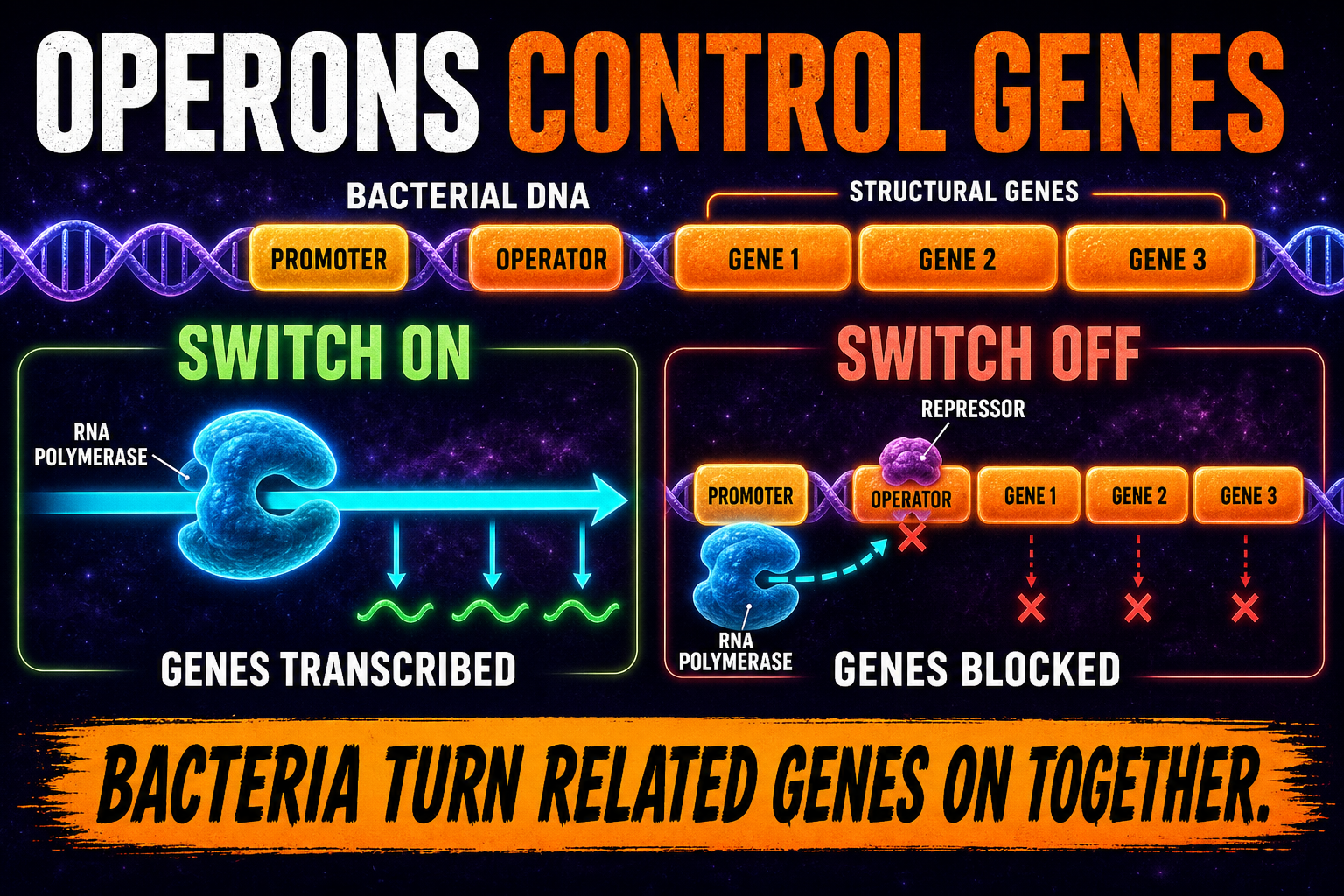
An operon is a group of related prokaryotic genes controlled together by the same regulatory system. Operons usually include a promoter, an operator, structural genes, and regulatory proteins such as repressors. Operons help bacteria quickly turn related genes on or off depending on environmental conditions.
Operon = prokaryotic gene switch that controls related genes together.
Operons let bacteria control transcription of several related genes at once by regulating whether RNA polymerase can transcribe them.
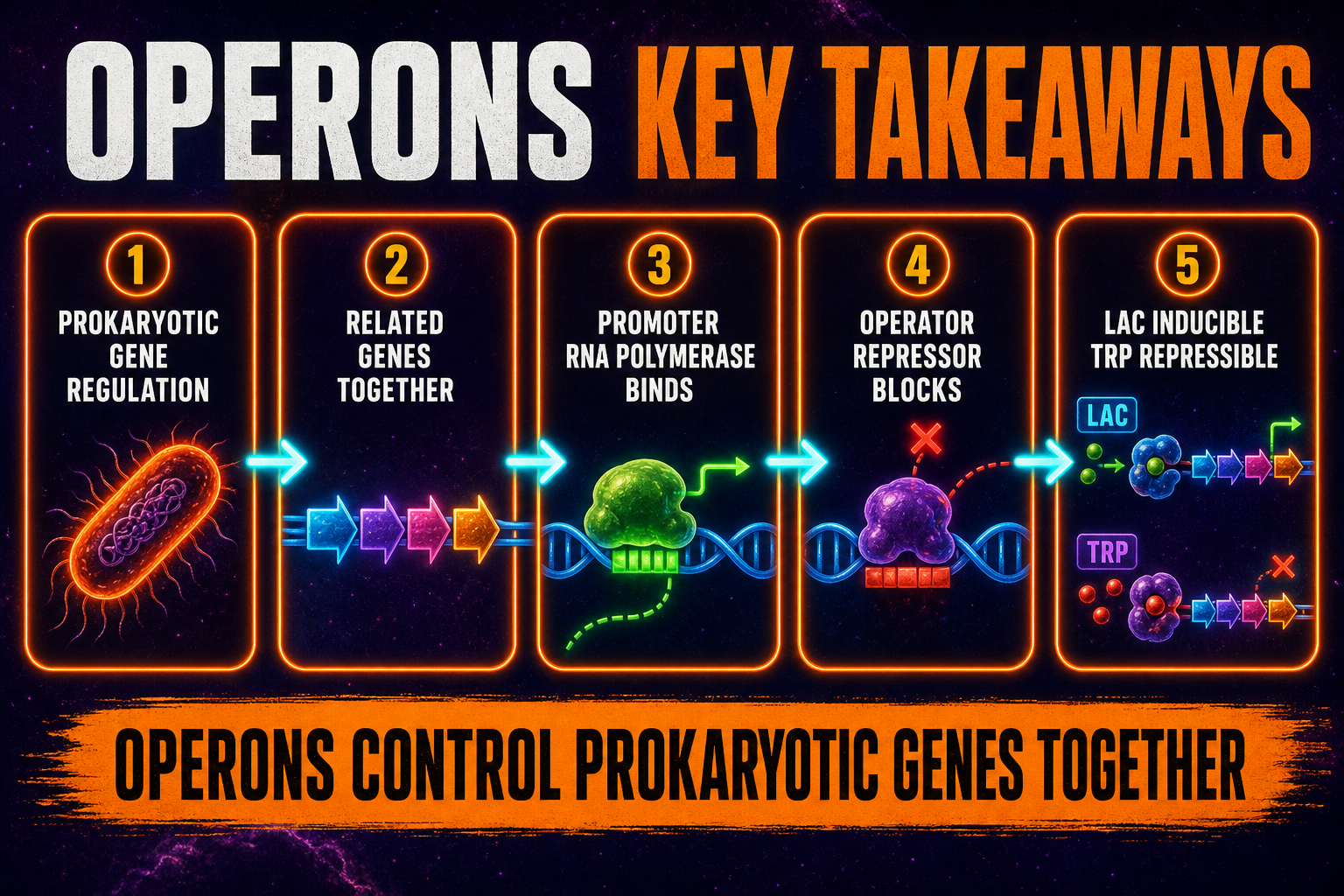
Operons show how cells regulate gene expression without changing DNA sequence. Bacteria can save energy by turning genes on only when their products are needed. AP Biology often tests operons with condition tables, repressor logic, and predictions about mRNA or enzyme production.
Operons are a major example of prokaryotic gene regulation within the broader Unit 6 topic of how cells control expression. Review how RNA is built on the transcription and RNA processing guide before predicting operon mRNA output.
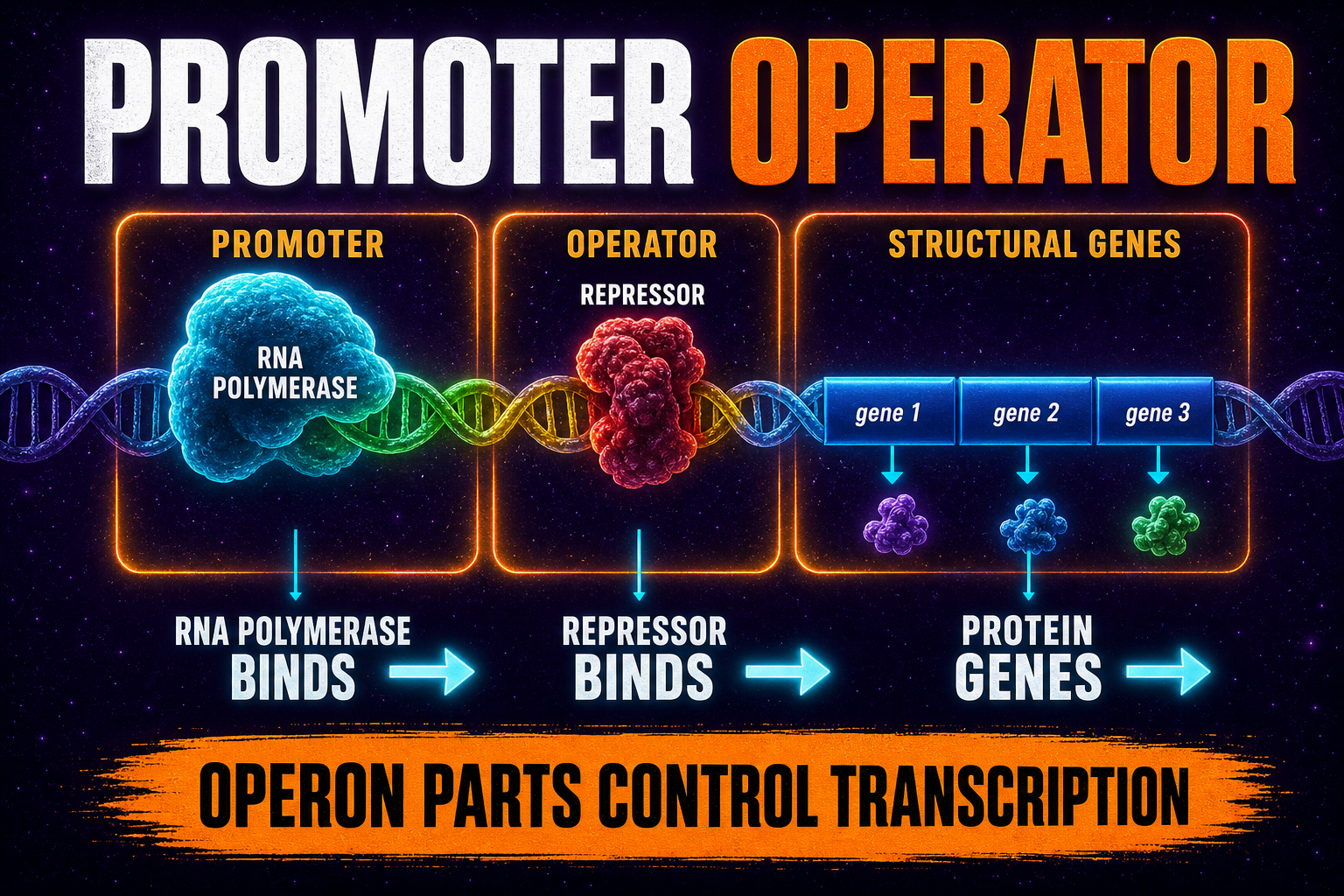
| Part | What it does | AP exam clue |
|---|---|---|
| Promoter | RNA polymerase binds here | Transcription can begin |
| Operator | Repressor can bind here | Blocks or allows transcription |
| Structural genes | Code for proteins | Transcribed together |
| Regulatory gene | Codes for regulatory protein | Often makes repressor |
| Repressor | Blocks transcription when active | Prevents RNA polymerase movement |
| Inducer | Turns some operons on | Inactivates repressor in lac operon |
| Corepressor | Helps turn some operons off | Activates repressor in trp operon |
For nucleotide structure shared by all genes, review DNA and RNA structure.
Operons usually control whether RNA polymerase can transcribe structural genes. If a repressor blocks the operator, transcription decreases. If RNA polymerase can pass through, the structural genes are transcribed into mRNA.
Use this ladder whenever an AP question asks whether an operon is on or off.
Example: lactose present, lactose absent, tryptophan high, tryptophan low.
Is the repressor active, inactive, bound, or removed?
Is the operator blocked or open?
Can RNA polymerase transcribe the structural genes?
Will mRNA and protein/enzyme levels increase or decrease?
| Feature | Promoter | Operator |
|---|---|---|
| Main role | Starts transcription | Controls access to transcription |
| What binds there | RNA polymerase | Repressor protein |
| Effect on transcription | Transcription begins at promoter | Repressor bound → transcription blocked or reduced |
| Common AP clue | Where RNA polymerase attaches | Where repressor blocks RNA polymerase |
| Student trap | Confusing with operator | Confusing with promoter |
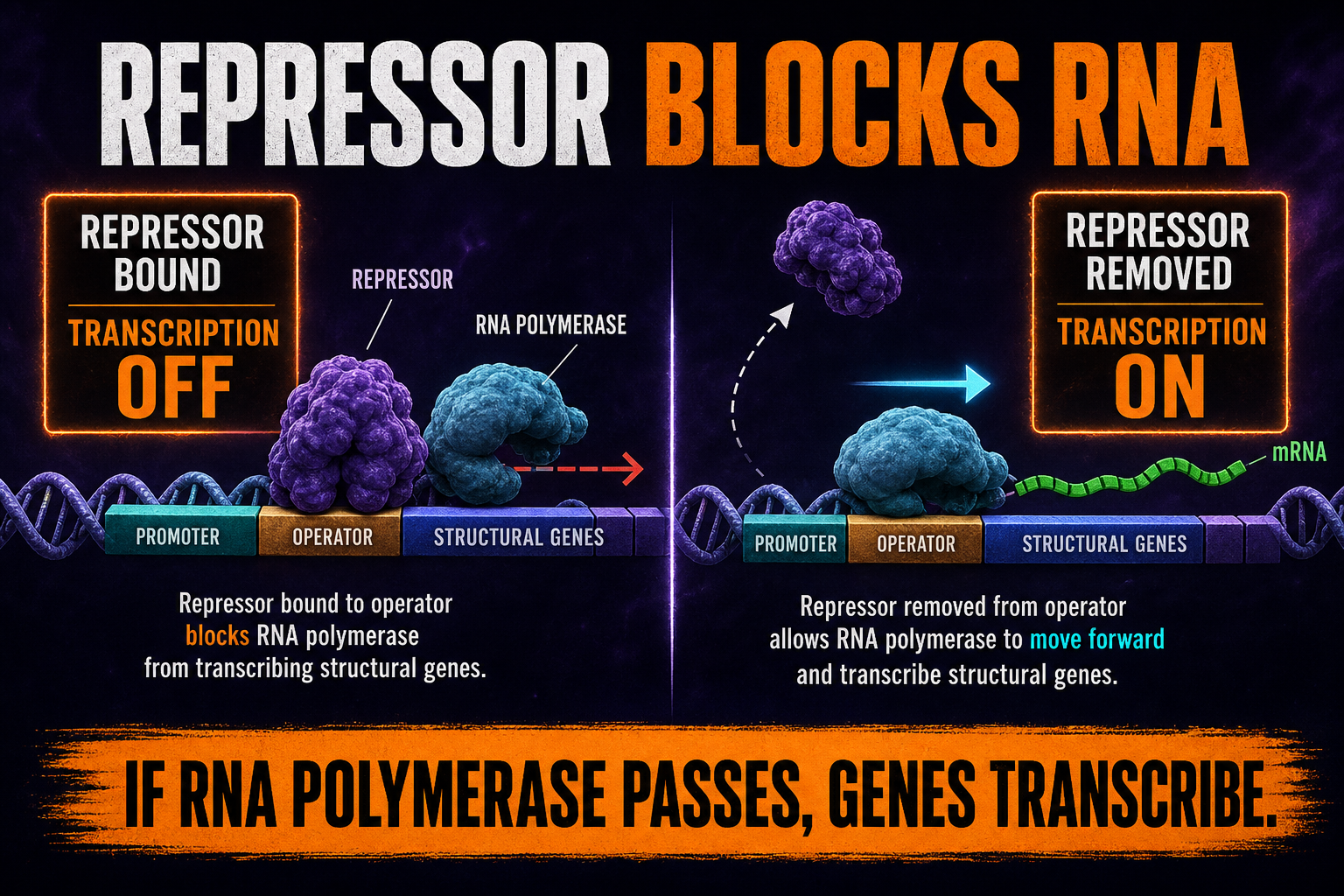
Example: If lactose is present, the lac operon can turn on so bacteria can produce enzymes to use lactose.
Example: If tryptophan is abundant, the trp operon turns off so bacteria stop making tryptophan-building enzymes.
The lac operon helps bacteria use lactose. When lactose is absent, the repressor blocks transcription. When lactose is present, the inducer inactivates the repressor, allowing transcription of genes needed for lactose metabolism.
The trp operon helps bacteria make tryptophan. When tryptophan is low, the operon stays on. When tryptophan is high, tryptophan activates the repressor, which blocks transcription.
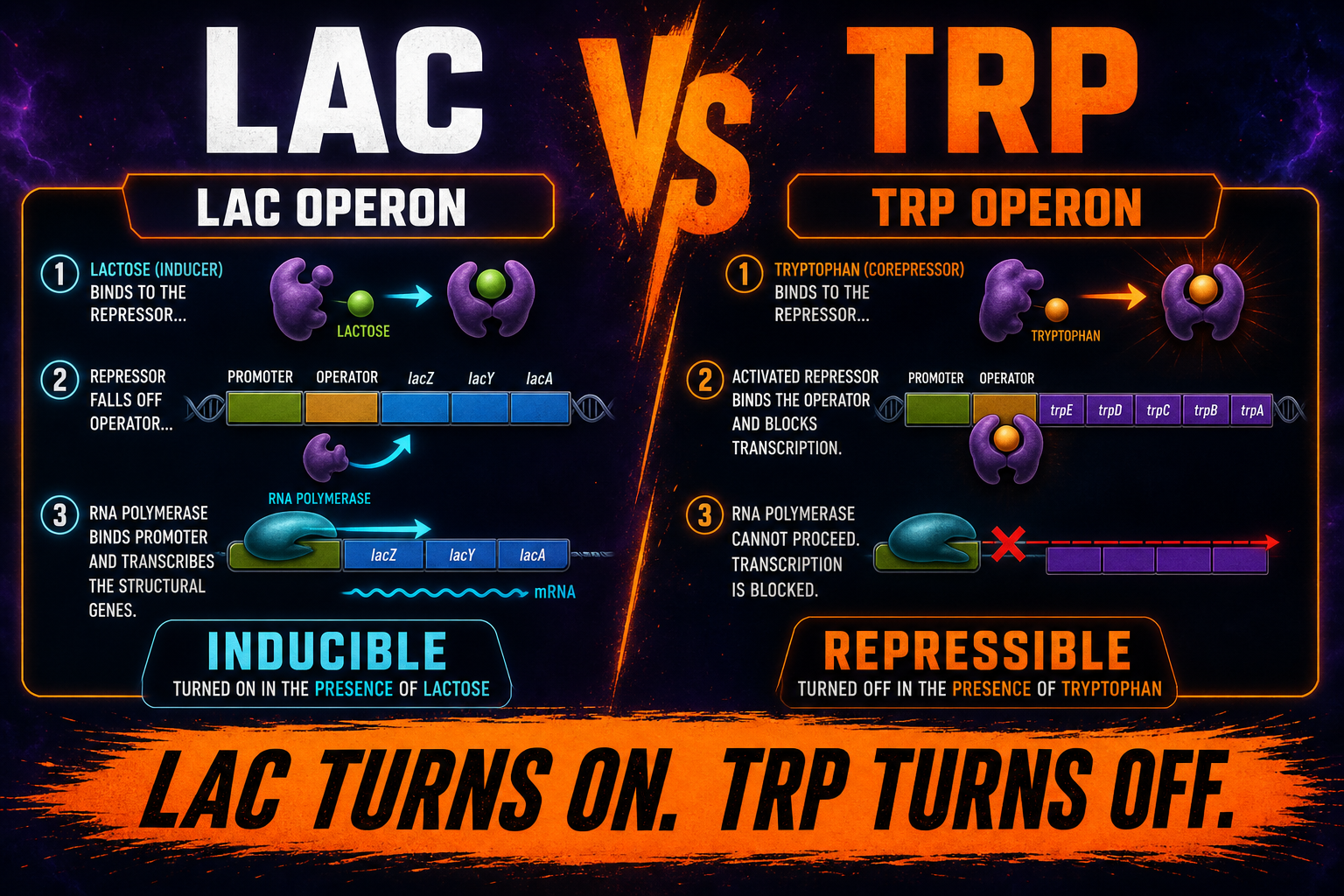
| Feature | Inducible Operon | Repressible Operon |
|---|---|---|
| Default state | Usually off | Usually on |
| What turns it on/off | Inducer turns it on | Corepressor turns it off |
| Classic example | Lac operon | Trp operon |
| Signal molecule | Lactose (inducer) | Tryptophan (corepressor) |
| Logic | Substrate present → genes on | Product abundant → genes off |
| AP exam clue | Lactose present → repressor off operator | High tryptophan → repressor on operator |
For a full side-by-side comparison with reasoning ladders, AP data patterns, and practice questions, see the lac operon vs trp operon AP Biology guide.
Gene regulation controls when and how much genes are expressed. Operons are a major prokaryotic example of gene regulation because they control transcription of related genes together.
See the full gene regulation guide for activators, repressors, and eukaryotic control points beyond operons.
The central dogma shows DNA → RNA → protein. Operons regulate whether the DNA-to-RNA step happens. If transcription is blocked, less mRNA is made, so less protein may be produced.
Trace the full path on the central dogma guide, then follow mRNA to protein on the translation study guide. Compare both expression steps on transcription vs translation.
What to do: Decide whether the lac repressor blocks the operator.
What to do: Decide whether the trp repressor is active.
What to do: Infer that transcription of structural genes increased.
What to do: Predict increased transcription if the repressor normally blocks the operon.
Reasoning:
Conclusion: When lactose is present, the lac operon is usually on.
AP questions may ask you to identify promoter, operator, structural genes, and repressor; predict whether transcription increases or decreases; interpret lactose or tryptophan conditions; compare inducible and repressible logic; predict mRNA and enzyme levels; explain what happens if a repressor cannot bind; and connect operons to prokaryotic gene regulation.
Fix: Operons are mainly a prokaryotic gene regulation model in AP Biology.
Fix: RNA polymerase binds the promoter; repressors bind the operator.
Fix: The repressor must be active and bound to the operator to block transcription.
Fix: Lac is inducible and turns on with lactose. Trp is repressible and turns off with high tryptophan.
Fix: First predict transcription and mRNA levels.
Fix: Operons usually change gene expression, not DNA sequence.
| Term | Meaning | AP exam clue |
|---|---|---|
| operon | Group of related prokaryotic genes regulated together | Lac and trp operons |
| prokaryotic gene regulation | Often operon-based control of transcription | Bacterial switches |
| promoter | DNA where RNA polymerase binds | Transcription starts here |
| operator | DNA where repressor can bind | Blocks RNA polymerase when occupied |
| structural genes | Genes transcribed together in an operon | Code for proteins |
| regulatory gene | Codes for a regulatory protein | Often produces repressor |
| RNA polymerase | Enzyme that builds RNA from DNA | Must pass operator to transcribe genes |
| repressor | Protein that decreases transcription | Binds operator when active |
| active repressor | Repressor that can bind operator | Usually blocks transcription |
| inactive repressor | Repressor that cannot block operator | Transcription can proceed |
| inducer | Molecule that turns some operons on | Inactivates lac repressor |
| corepressor | Molecule that helps turn some operons off | Activates trp repressor |
| lac operon | Inducible operon for lactose metabolism | On when lactose present |
| trp operon | Repressible operon for tryptophan synthesis | Off when tryptophan abundant |
| inducible operon | Usually off; turned on by signal | Lac operon classic example |
| repressible operon | Usually on; turned off by signal | Trp operon classic example |
| transcription | DNA to RNA synthesis | Controlled at promoter/operator |
| mRNA level | Amount of messenger RNA | Rises or falls with transcription |
| enzyme production | Protein output from operon genes | Follows mRNA levels |
| gene expression | Using genes to make RNA and protein | Operons regulate expression |
Flip all 20 cards until you can trace signal → repressor → operator → transcription without hesitating.
Answer all 12 questions. Choices shuffle on reload—focus on repressor and operator logic, not letter memorization.
0 of 3 FRQs opened
A bacterium has lactose present. Predict lac operon transcription and explain the mechanism.
Lactose acts as an inducer that inactivates the lac repressor. With the repressor off the operator, RNA polymerase can transcribe the structural genes. mRNA levels rise, leading to more enzymes for lactose metabolism.
Status: Draft your answer first—then open the rubric or sample.
Tryptophan levels are high. Predict trp operon transcription and explain the mechanism.
High tryptophan acts as a corepressor that activates the trp repressor. The active repressor binds the operator and blocks RNA polymerase. Transcription of structural genes decreases, so mRNA and tryptophan-synthesis enzymes decline.
Status: Draft your answer first—then open the rubric or sample.
A mutation prevents the lac operon repressor from binding the operator. Lactose is absent. Predict whether transcription of the structural genes increases or decreases compared with a normal lac operon without lactose, and explain your reasoning.
Without lactose, a normal lac operon keeps the repressor on the operator, so transcription stays low. If a mutation stops repressor binding, the operator stays open even without lactose. RNA polymerase can transcribe the structural genes more often, so mRNA and lactose-metabolism enzymes may be higher than in the normal lactose-absent condition.
Status: Draft your answer first—then open the rubric or sample.
An operon is a group of related prokaryotic genes controlled together by the same regulatory system, usually including a promoter, operator, structural genes, and regulatory proteins such as repressors.
Operons are mainly a prokaryotic gene regulation model in AP Biology. Eukaryotes typically regulate genes differently.
The promoter is the DNA region where RNA polymerase binds to begin transcription of the operon genes.
The operator is a DNA region where a repressor can bind to block or reduce transcription of the structural genes.
A repressor decreases transcription by binding the operator and blocking RNA polymerase from transcribing the structural genes when active.
The lac operon is inducible and usually turns on when lactose is present. The trp operon is repressible and usually turns off when tryptophan is abundant.
It is usually off when lactose is absent, but lactose (or allolactose) acts as an inducer that inactivates the repressor so transcription can increase when lactose is available.
It is usually on when tryptophan is low, but tryptophan acts as a corepressor that activates the repressor to block transcription when enough tryptophan is already present.
Transcription of the structural genes is usually blocked or reduced because RNA polymerase cannot move through the operator region effectively.
Operons control whether RNA polymerase can transcribe a group of related genes, which changes mRNA levels and often enzyme or protein production.
Operons regulate the DNA-to-RNA step. If transcription is blocked, less mRNA is made and less protein may be produced.
Memorizing lac and trp labels without predicting whether the repressor blocks the operator and whether RNA polymerase can transcribe the structural genes.