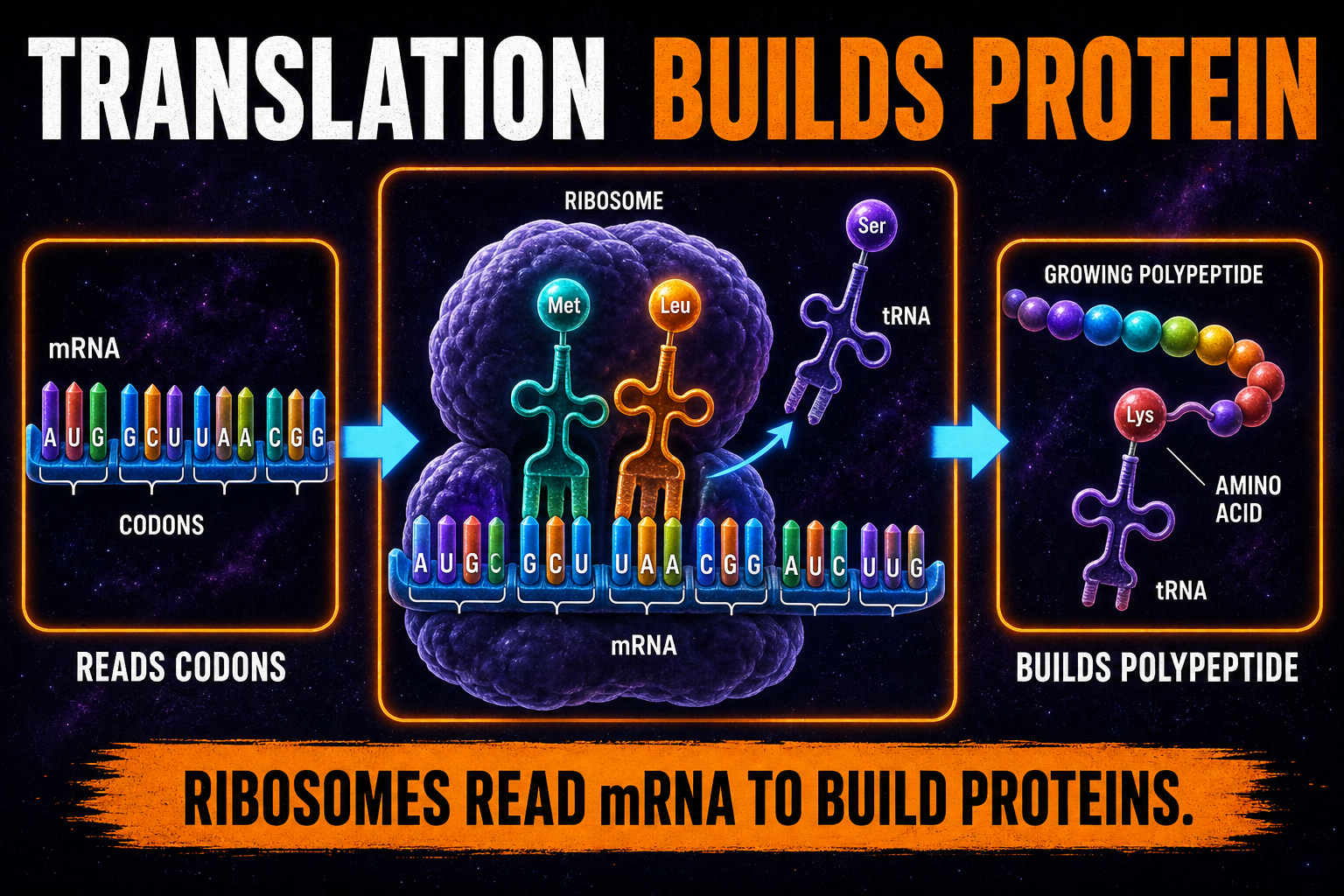
Mature mRNA attaches to a ribosome.
What is translation in AP Biology?
Translation AP Biology is the process that reads an mRNA message to build a polypeptide. Ribosomes move along mRNA codons, tRNA molecules bring amino acids using complementary anticodons, and amino acids join to form a polypeptide that can fold into a protein.
Say it fast
Translation reads mRNA and builds a polypeptide.
Translation Key Takeaways
- Translation uses mRNA to build a polypeptide.
- Ribosomes read mRNA codons.
- tRNA anticodons pair with mRNA codons.
- Amino acids are joined into a growing chain.
- The amino acid sequence affects protein shape and function.
Why Translation Matters in AP Biology
Translation AP Biology connects genetic information to cell function. DNA stores information, transcription and RNA processing copy and prepare the message into mature mRNA, and translation uses that mRNA to build a polypeptide. Proteins then affect traits, cell structure, enzymes, transport, signaling, and phenotype.
Direct answer: Translation matters because it turns an mRNA message into a polypeptide that can become a functional protein.
Review DNA and RNA structure for nucleotides, then DNA replication for how the template is maintained.
What Happens During Translation?
On the AP exam, describe translation as a clear sequence from mature mRNA to released polypeptide.
The ribosome reads mRNA codons.
tRNA molecules bring amino acids.
tRNA anticodons pair with mRNA codons.
Amino acids join by peptide bonds.
The ribosome moves codon by codon.
A stop codon ends translation.
The polypeptide is released.
What Does the Ribosome Do?
Direct answer: The ribosome is the structure that reads mRNA codons and helps join amino acids into a polypeptide during translation.
- Ribosomes are made of rRNA and proteins
- Ribosomes read mRNA codons
- Ribosomes help position tRNA
- Ribosomes catalyze peptide bond formation
- Translation occurs at ribosomes in the cytoplasm or on rough ER
Common mistake: Do not say ribosomes make mRNA. Ribosomes read mRNA.
What Are mRNA Codons?
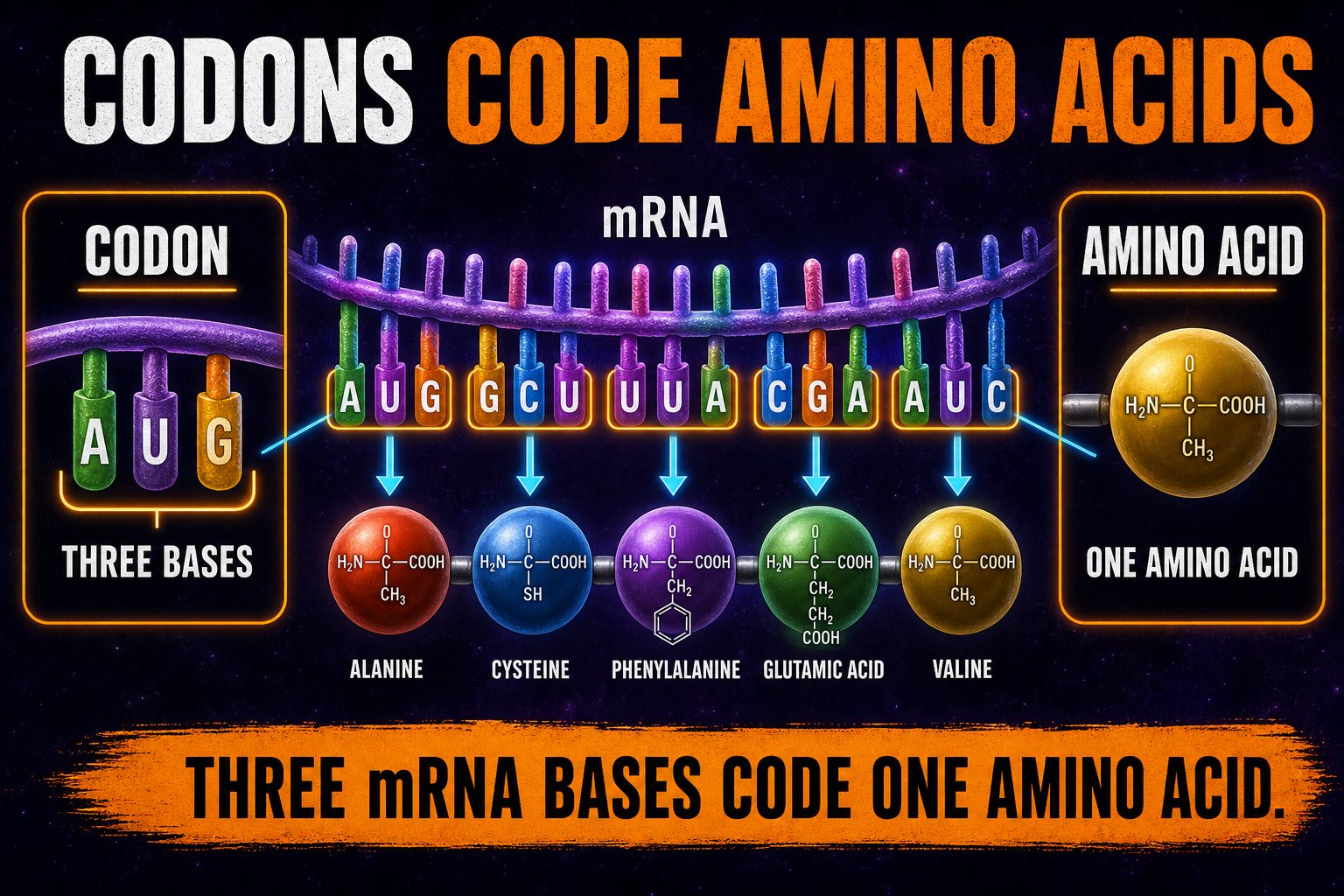
Direct answer: A codon is a three-base sequence on mRNA that specifies an amino acid or a stop signal.
- Codons are read in groups of three
- Each codon corresponds to an amino acid or stop signal
- AUG is usually the start codon
- Stop codons end translation
- Changing a codon can change the amino acid sequence
mRNA codon: AUG → start / methionine
What Does tRNA Do?
Direct answer: tRNA brings amino acids to the ribosome and uses an anticodon to pair with a complementary mRNA codon.
- tRNA carries a specific amino acid
- tRNA has an anticodon
- Anticodons pair with codons
- Correct pairing helps add the correct amino acid
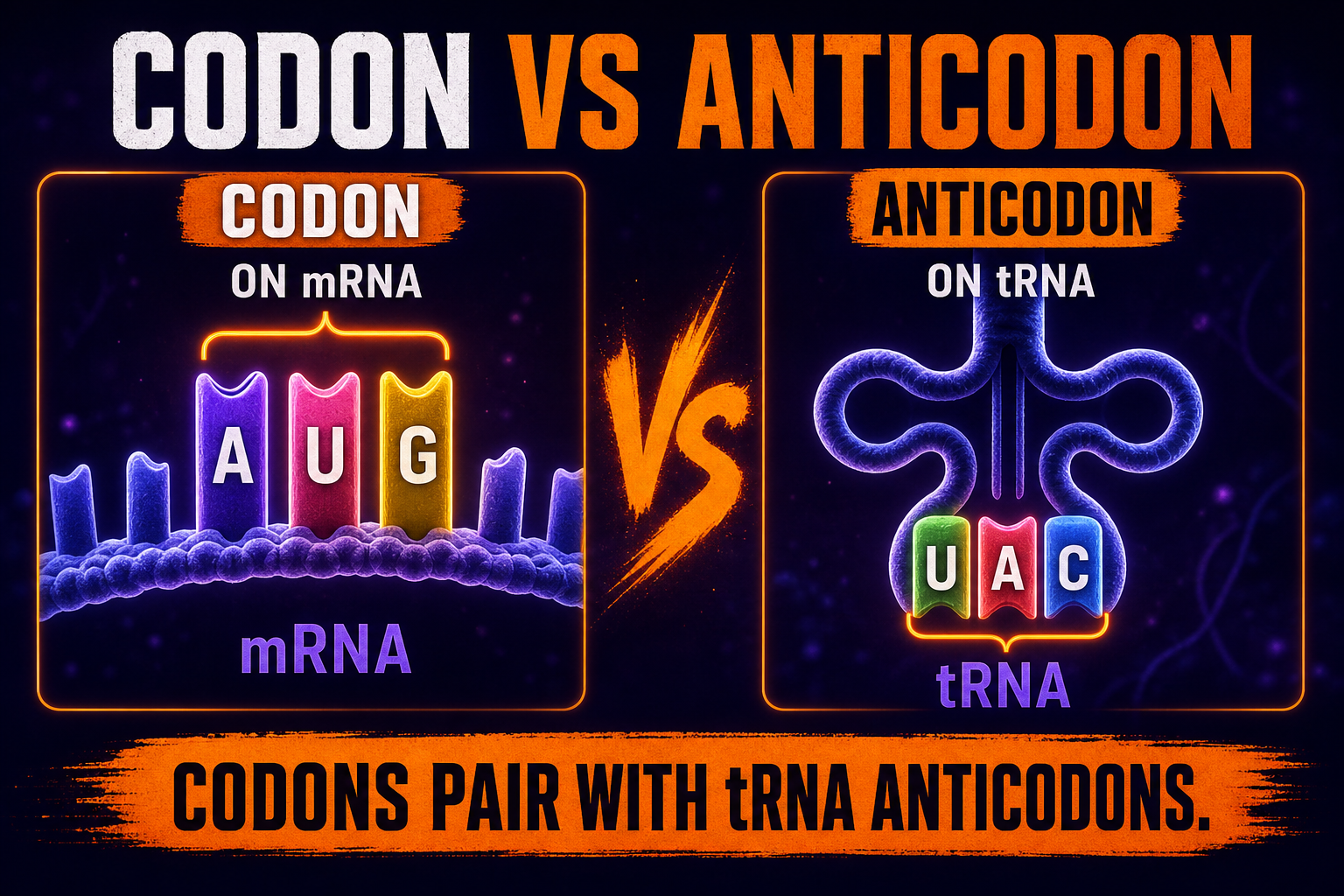
Common mistake: Codons are on mRNA. Anticodons are on tRNA.
Codon vs Anticodon
| Feature | Codon | Anticodon |
|---|---|---|
| Location | On mRNA | On tRNA |
| Number of bases | Three bases per codon | Three bases per anticodon |
| Main role | Specifies amino acid or stop | Pairs with codon to deliver amino acid |
| Pairs with | tRNA anticodon | mRNA codon |
| AP exam clue | Read by the ribosome on mRNA | Carries the matching amino acid |
| Common mistake | Thinking anticodons are on mRNA | Thinking codons are on tRNA |
Direct answer: A codon is on mRNA. An anticodon is on tRNA.
How Amino Acids Become a Polypeptide
Amino acids are the monomers of proteins. The ribosome links them with peptide bonds to form a polypeptide that can fold into a functional protein.
Direct answer: Translation builds a polypeptide by joining amino acids in the order specified by mRNA codons.
- Amino acids are the monomers of proteins
- The ribosome links amino acids together
- Peptide bonds form between amino acids
- The chain is called a polypeptide
- The polypeptide can fold into a protein
Start Codons and Stop Codons
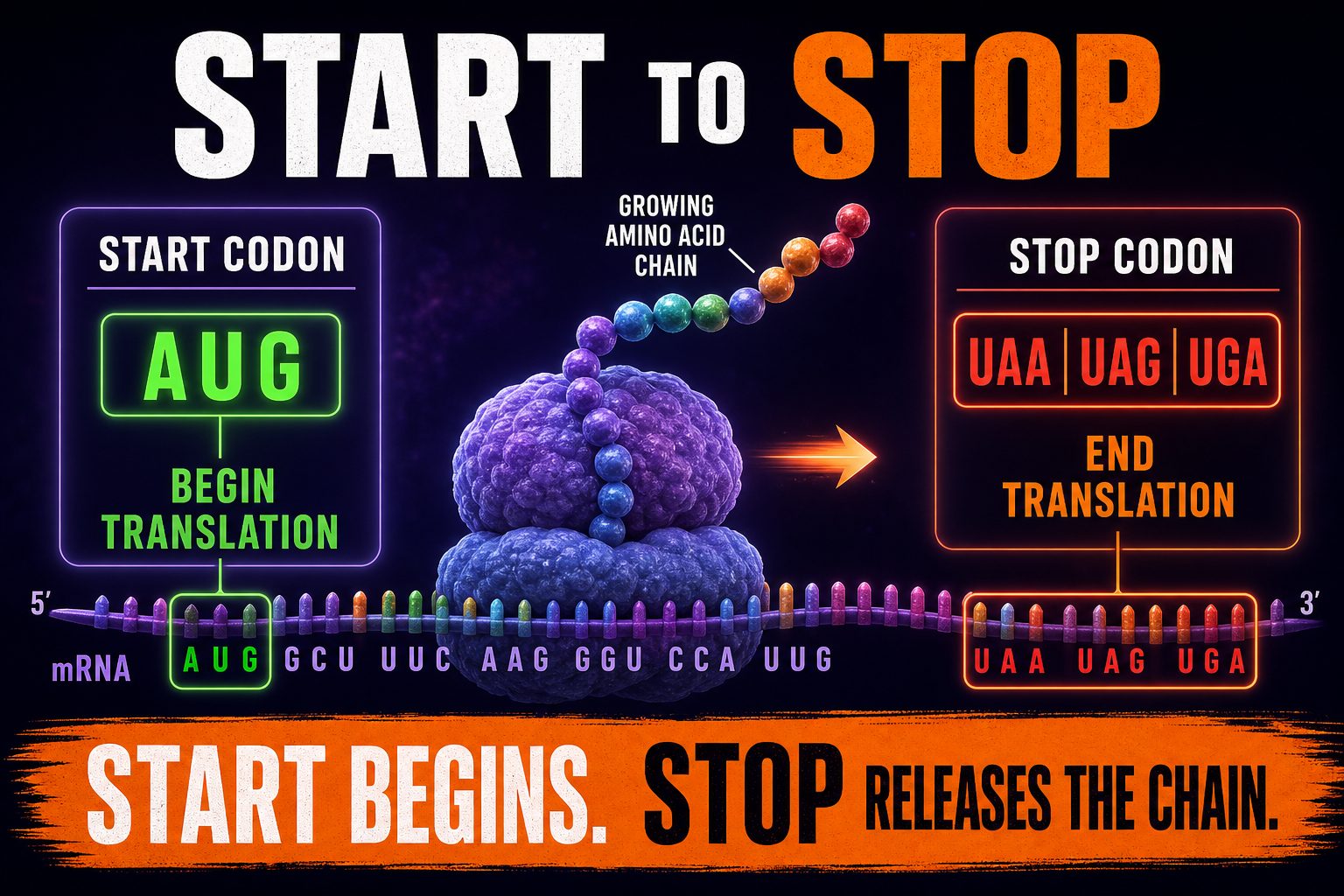
- AUG usually starts translation
- AUG codes for methionine
- Stop codons (UAA, UAG, UGA) do not code for amino acids
- Stop codons signal release of the polypeptide
- Reading frame matters
Direct answer: The start codon begins translation, while stop codons end translation and release the polypeptide.
Why Reading Frame Matters
Codons are read in groups of three. Inserting or deleting bases can shift the reading frame so many codons—and amino acids—change after the mutation.
For frameshift, silent, missense, and nonsense tracing from DNA to phenotype, use the mutations AP Biology guide.
AP exam clue: If a mutation shifts the reading frame, many codons after the mutation may change.
Where Does Translation Happen?
Direct answer: Translation happens at ribosomes. In eukaryotes, ribosomes are in the cytoplasm or attached to rough ER. In prokaryotes, ribosomes are in the cytoplasm.
- Eukaryotic mRNA is usually processed before translation
- Prokaryotes can begin translation quickly because they lack a nucleus
- AP Biology mostly tests location and logic, not every molecular detail
How Translation Is Different from Transcription
Transcription makes RNA from DNA. Translation uses mRNA to build a polypeptide. This page focuses on translation. For a full comparison, use the transcription vs translation guide.
How Translation Connects mRNA to Phenotype
The mRNA sequence affects amino acid order. Amino acid order affects polypeptide shape. Protein shape affects protein function. Protein function can affect cell function and phenotype.
mRNA codons → amino acid sequence → polypeptide shape → protein function → phenotype
Direct answer: Translation connects gene expression to phenotype because the amino acid sequence can affect protein shape and function.
Gene regulation controls how much mRNA reaches ribosomes, which can change protein output. Review the gene regulation AP Biology guide for the full on/off control picture.
How AP Biology Tests Translation
AP questions may ask you to identify codons and anticodons, use a codon chart, predict amino acid sequence from mRNA, explain what tRNA does, identify start and stop codons, explain how a mutation affects translation, connect amino acid changes to protein function, and distinguish transcription from translation.
AP warning: Most AP mistakes happen when students mix up codons and anticodons or say translation makes RNA instead of a polypeptide.
Common Translation Mistakes
Thinking translation makes RNA
Fix: Translation uses mRNA to build a polypeptide.
Mixing up codons and anticodons
Fix: Codons are on mRNA. Anticodons are on tRNA.
Thinking tRNA is the protein
Fix: tRNA carries amino acids; amino acids build the polypeptide.
Forgetting the ribosome
Fix: The ribosome reads mRNA and helps join amino acids.
Thinking stop codons code for amino acids
Fix: Stop codons signal the end of translation.
Using DNA bases in mRNA
Fix: mRNA uses U, not T.
Must-Know Terms
| Term | Meaning | AP exam clue |
|---|---|---|
| translation | Process that builds a polypeptide from mRNA | mRNA → polypeptide |
| mRNA | Messenger RNA read by ribosomes | Uses U, not T |
| codon | Three-base mRNA sequence | Codes for amino acid or stop |
| anticodon | Three-base tRNA sequence | Pairs with codon |
| tRNA | Transfers amino acids to ribosome | Not the final protein |
| ribosome | Reads mRNA and joins amino acids | rRNA + proteins |
| rRNA | Ribosomal RNA in ribosome structure | Part of ribosome |
| amino acid | Monomer of proteins | Brought by tRNA |
| polypeptide | Chain of amino acids | Can fold into protein |
| protein | Functional folded polypeptide | Shape affects function |
| peptide bond | Bond linking amino acids | Formed at ribosome |
| start codon | Usually AUG; begins translation | Also codes for methionine |
| AUG | Common start codon | Methionine in eukaryotes |
| stop codon | UAA, UAG, or UGA; ends translation | No amino acid added |
| reading frame | Groups of three bases read as codons | Frameshift changes many codons |
| cytoplasm | Main site of translation in eukaryotes | Ribosomes here or on rough ER |
| rough ER | ER with ribosomes for secreted proteins | Translation on membrane |
| gene expression | Using genetic information | Translation is final protein step |
| mutation | DNA change that may alter mRNA/protein | Can shift reading frame |
| phenotype | Observable trait | Protein function can affect it |
Translation Flashcards
Tap a card to flip. Complete all 20 cards, then move to translation practice questions.
Card 1 of 20Tap card to flip
Translation Practice Questions
Answer all twelve AP-style questions. Choices shuffle on reload—practice ribosomes, codons, anticodons, start/stop signals, and reading frame logic.
Ready to compare processes? Open the transcription vs translation guide after you can trace mRNA to polypeptide.
Question 1 of 12
Start
Correct: 0
Answered: 0
Accuracy: 0%
FRQ Strategy: Trace mRNA to Protein
Direct answer: For translation FRQs, earn points by tracing how mRNA codons determine amino acid order, how amino acid order affects protein shape or function, and how protein function can affect phenotype.
Scoring checklist:
- Identify translation as mRNA to polypeptide
- Name the ribosome if asked
- Use codons on mRNA
- Use anticodons on tRNA
- Explain amino acid sequence changes
- Connect amino acid sequence to protein function when asked
- Connect protein function to phenotype when supported by the prompt
Prompt
An mRNA sequence begins 5′-AUG GAA UUU-3′. Explain how the ribosome uses this sequence during translation.
Scoring rubric
- State that translation begins at the start codon (AUG).
- Describe ribosome reading codons in groups of three.
- Explain tRNA anticodon pairing and delivery of amino acids.
- Note peptide bond formation and movement codon by codon.
- Mention stop codon ends translation if sequence continues.
Sample response
The ribosome binds mature mRNA and begins at AUG, the start codon. tRNA with anticodon UAC brings methionine. For GAA, tRNA with anticodon CUU brings glutamic acid; for UUU, tRNA with anticodon AAA brings phenylalanine. The ribosome catalyzes peptide bonds, moving 5′ to 3′ along mRNA until a stop codon releases the polypeptide.
Status: Draft your answer first—then open the rubric or sample.
Prompt
A mutation changes a codon into a stop codon. Predict how this could affect the polypeptide and protein function.
Scoring rubric
- Identify that stop codons end translation.
- Predict a shorter polypeptide.
- Explain possible loss of functional domains.
- Connect altered protein function to phenotype when supported.
Sample response
A stop codon signals the ribosome to release the chain early. The polypeptide is shorter than normal, which may remove key regions needed for folding or activity. If the protein is an enzyme or structural protein, cell function and phenotype may change depending on the gene affected.
Status: Draft your answer first—then open the rubric or sample.
Translation FAQ
What is translation in AP Biology?
Translation is the process in which ribosomes read mRNA codons and use tRNA molecules to build a polypeptide from amino acids.
What does translation produce?
Translation produces a polypeptide, which can fold and be modified into a functional protein.
Where does translation happen?
Translation occurs at ribosomes in the cytoplasm or on rough ER in eukaryotes; prokaryotes translate in the cytoplasm.
What does the ribosome do during translation?
The ribosome reads mRNA codons, positions tRNA, and catalyzes peptide bonds between amino acids.
What is a codon?
A codon is a three-base sequence on mRNA that specifies an amino acid or a stop signal.
What is an anticodon?
An anticodon is a three-base sequence on tRNA that pairs complementarily with an mRNA codon.
What is the difference between a codon and an anticodon?
Codons are on mRNA and specify amino acids or stop signals; anticodons are on tRNA and pair with codons to deliver amino acids.
What does tRNA do?
tRNA brings a specific amino acid to the ribosome and uses its anticodon to match the correct mRNA codon.
What is the start codon?
The start codon is usually AUG, which begins translation and codes for methionine in eukaryotes.
What do stop codons do?
Stop codons (UAA, UAG, UGA) end translation and signal release of the polypeptide; they do not code for amino acids.
How can mutations affect translation?
Mutations can change codons, introduce premature stop codons, or shift the reading frame, altering the amino acid sequence and protein function.
Does translation make RNA?
No. Translation uses mRNA to build a polypeptide. Transcription makes RNA.