Thinking a nucleotide is just a nitrogenous base
Fix: A nucleotide includes sugar, phosphate, and base.
AP Biology · Unit 6 · Gene Expression
DNA and RNA structure explains how cells store, copy, and use genetic information. DNA stores the instructions, while RNA helps carry and use those instructions during gene expression. For AP Biology, the key is understanding nucleotides, base-pairing rules, strand direction, and why DNA and RNA have different jobs.
Teacher tip: When you study DNA and RNA, do not just memorize letters. Ask how the structure helps the molecule do its job.
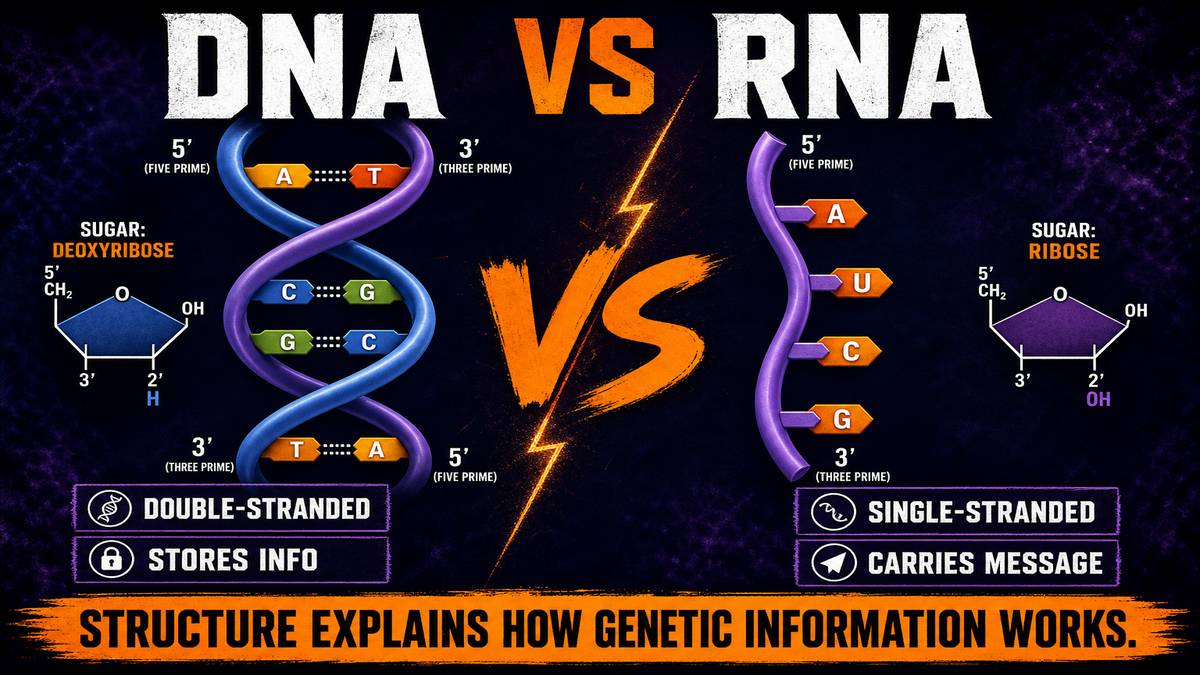
DNA and RNA are nucleic acids made of nucleotides. Each nucleotide has a sugar, phosphate group, and nitrogenous base. DNA usually stores genetic information in a double-stranded helix, while RNA is usually single-stranded and helps carry or use genetic information during gene expression.
DNA stores genetic information. RNA helps use genetic information.
DNA and RNA are not just vocabulary terms. Their structures explain how genetic information is copied, transcribed, translated, regulated, and inherited. Base pairing explains replication and transcription. RNA structure explains how mRNA, tRNA, and rRNA help build proteins.
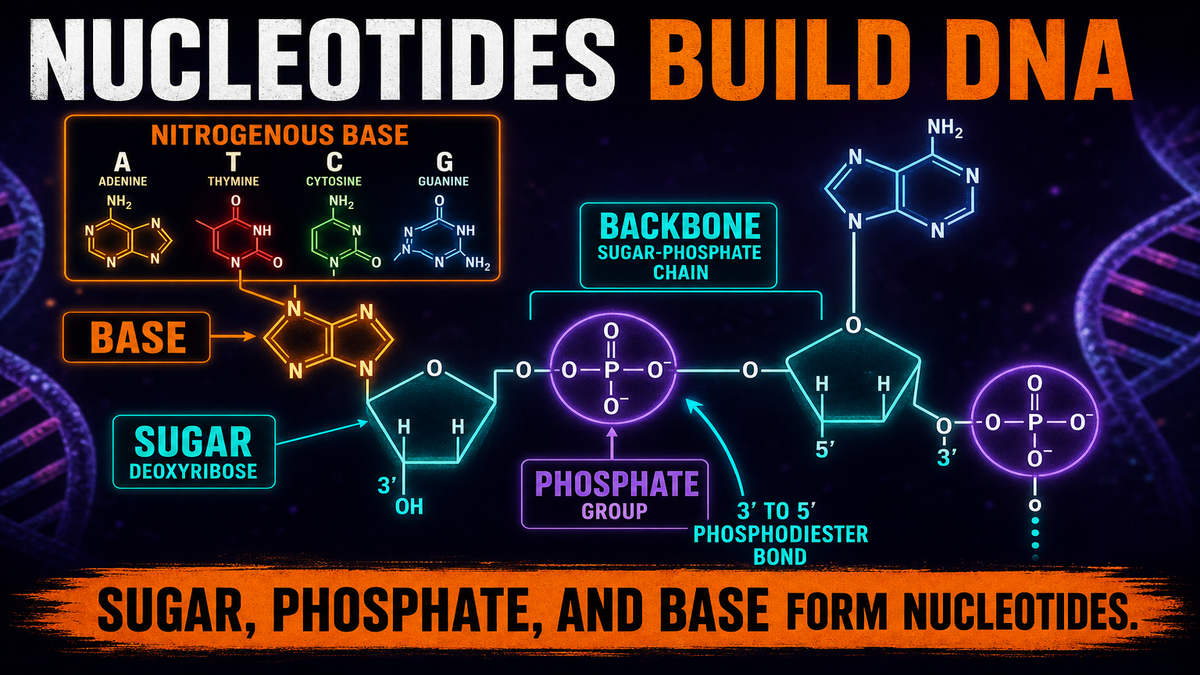
Nucleotides are the monomers of nucleic acids. Each nucleotide has a sugar, a phosphate group, and a nitrogenous base. DNA nucleotides contain deoxyribose; RNA nucleotides contain ribose. Nucleotides link together through sugar-phosphate bonds to form strands.
DNA is usually double-stranded and forms a double helix. A sugar-phosphate backbone runs along each strand, with nitrogenous bases pointing inward. Complementary base pairing holds the strands together: adenine (A) pairs with thymine (T), and cytosine (C) pairs with guanine (G). DNA stores the genetic instructions a cell needs.
After structure makes sense, study how cells copy DNA in the DNA replication guide.
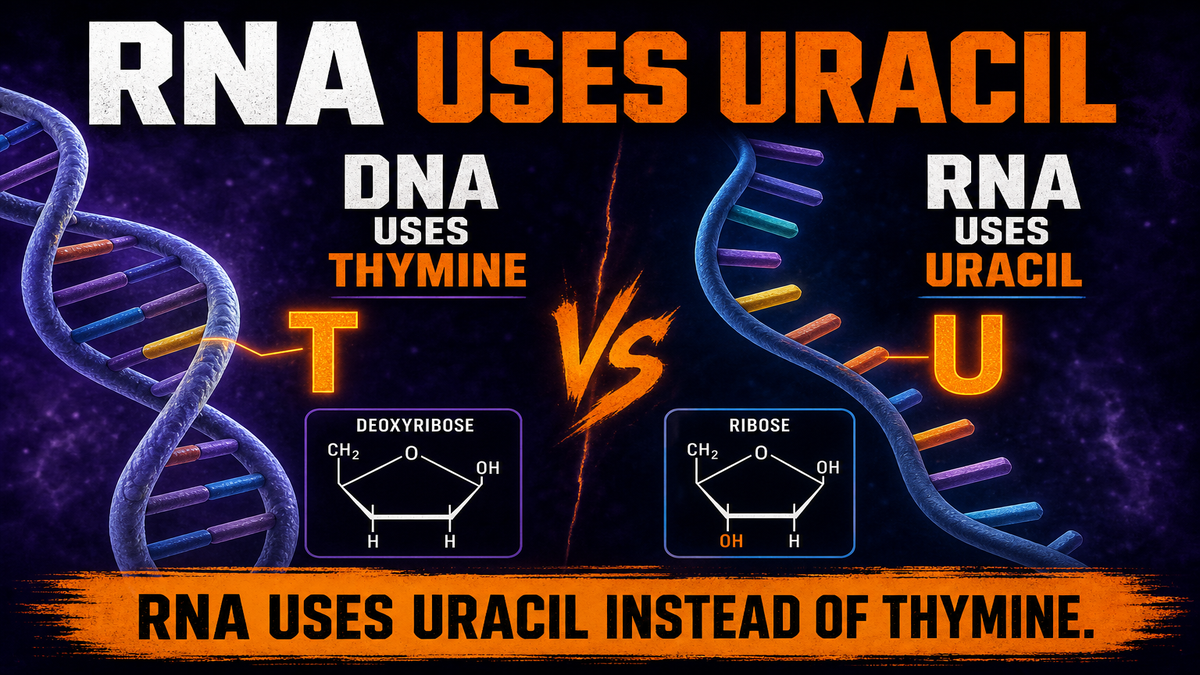
RNA is usually single-stranded and contains ribose sugar. It uses uracil instead of thymine. RNA can fold into functional shapes. mRNA carries messages from DNA, tRNA helps bring amino acids to ribosomes, and rRNA helps form ribosomes.
| Feature | DNA | RNA | AP exam clue |
|---|---|---|---|
| Full name | Deoxyribonucleic acid | Ribonucleic acid | DNA vs RNA names |
| Main job | Stores genetic information | Carries or helps use genetic information | Storage vs message |
| Strands | Usually double-stranded | Usually single-stranded | Helix vs single strand |
| Sugar | Deoxyribose | Ribose | Extra oxygen on ribose |
| Bases | A, T, C, G | A, U, C, G | U replaces T in RNA |
| Uses thymine or uracil | Thymine (T) | Uracil (U) | T vs U is a classic clue |
| Typical location in eukaryotes | Nucleus (and mitochondria/chloroplasts) | Nucleus and cytoplasm | mRNA exits nucleus for translation |
| Stability | More stable long-term storage | Usually shorter-lived | Why DNA keeps T |
| Role in gene expression | Template for RNA synthesis | mRNA, tRNA, and rRNA help express genes | DNA stores; RNA acts |
| AP exam clue | Double helix, T, deoxyribose | Single strand, U, ribose, mRNA/tRNA/rRNA | Match structure to function |
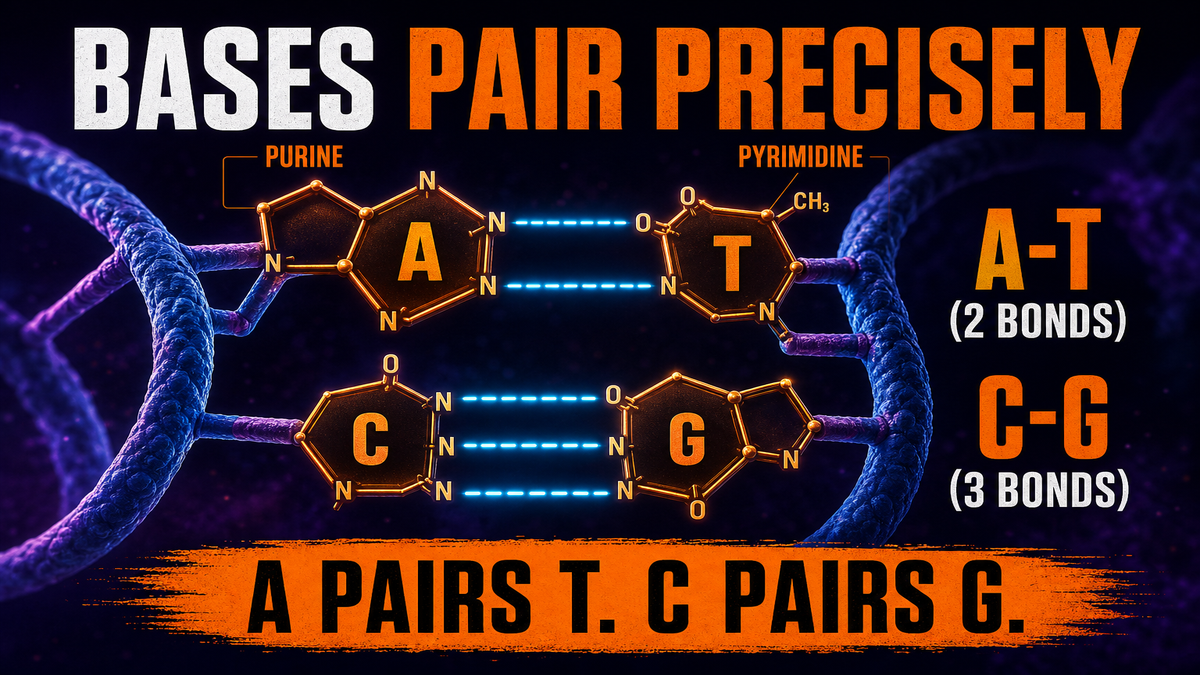
In DNA: A pairs with T; C pairs with G.
In RNA pairing with DNA during transcription: DNA A pairs with RNA U; DNA T pairs with RNA A; DNA C pairs with RNA G; DNA G pairs with RNA C.
Example: DNA template TAC → mRNA AUG.
Purines have two rings; adenine and guanine are purines. Pyrimidines have one ring; cytosine, thymine, and uracil are pyrimidines. A purine always pairs with a pyrimidine, which keeps the width of the DNA double helix consistent.
Pure As Gold = purines are A and G.
DNA and RNA strands have direction. One end is the 5′ end; the other is the 3′ end. Nucleic acids are built in the 5′ to 3′ direction. Directionality matters during replication and transcription because enzymes add nucleotides only to the 3′ end of a growing strand.
DNA stores the gene. Transcription copies a gene into RNA. RNA processing prepares mRNA in eukaryotes. Translation reads mRNA to build a polypeptide. Protein function affects phenotype.
For a full comparison of the two main expression steps, see the transcription vs translation guide.
AP questions may ask you to identify nucleotide parts, compare DNA and RNA, apply base-pairing rules, predict an RNA sequence from a DNA template, explain how structure supports function, or connect DNA/RNA structure to replication, transcription, or translation.
Fix: A nucleotide includes sugar, phosphate, and base.
Fix: RNA uses uracil instead of thymine.
Fix: RNA is usually single-stranded.
Fix: mRNA is complementary to the DNA template strand.
Fix: Base pairing allows copying and information transfer.
| Term | Meaning | AP exam clue |
|---|---|---|
| DNA | Stores genetic information in a double helix | Double-stranded; uses T |
| RNA | Helps carry or use genetic information | Usually single-stranded; uses U |
| Nucleic acid | Polymer of nucleotides (DNA or RNA) | Information molecules |
| Nucleotide | Monomer: sugar + phosphate + base | Not just the base alone |
| Monomer | Single building block of a polymer | Nucleotide is the monomer |
| Polymer | Chain of repeating monomers | DNA/RNA strands are polymers |
| Sugar-phosphate backbone | Alternating sugar and phosphate along a strand | Bases point inward |
| Deoxyribose | Sugar in DNA nucleotides | Missing one oxygen vs ribose |
| Ribose | Sugar in RNA nucleotides | Has extra hydroxyl group |
| Nitrogenous base | A, T, C, G, or U | Pairs across strands |
| Adenine (A) | Purine base | Pairs with T in DNA, U in RNA |
| Thymine (T) | Pyrimidine in DNA only | Replaced by U in RNA |
| Cytosine (C) | Pyrimidine base | Pairs with G |
| Guanine (G) | Purine base | Pairs with C |
| Uracil (U) | Pyrimidine in RNA only | Pairs with A during transcription |
| Purine | Two-ring base (A or G) | Pure As Gold |
| Pyrimidine | One-ring base (C, T, or U) | Pairs with a purine |
| Complementary base pairing | A with T/U; C with G | Explains copying and transcription |
| Double helix | Two complementary DNA strands twisted together | Watson-Crick model |
| Template strand | DNA strand copied during transcription | mRNA is complementary to it |
| mRNA | Messenger RNA; carries gene message | Read at ribosomes |
| tRNA | Transfer RNA; brings amino acids | Anticodon matches codon |
| rRNA | Ribosomal RNA; part of ribosome | Catalyzes peptide bonds |
| 5′ end | End with free phosphate group | Strand direction marker |
| 3′ end | End with free hydroxyl group | Strands grow 5′ to 3′ |
| Gene | Segment of DNA that codes for RNA/protein | Unit of expression |
| Genome | Complete set of genetic information | All genes in a cell |
Tap a card to flip. Use all 20 cards before practice questions.
Answer all twelve questions. Choices shuffle on reload—focus on base-pairing logic, not letter memorization.
Scoring checklist:
Explain how complementary base pairing supports accurate DNA replication.
DNA is double-stranded, and complementary base pairing holds the strands together: adenine pairs with thymine and cytosine pairs with guanine. During replication, each parent strand acts as a template. Free nucleotides pair with exposed bases on each template, so two new complementary strands form. Because pairing rules are specific, the sequence is copied accurately before cell division.
Status: Draft your answer first—then open the rubric or sample.
A DNA template strand reads 3′-TAC GGA-5′. Predict the mRNA sequence and explain the base-pairing logic.
The mRNA sequence is 5′-AUG CCU-3′. mRNA is complementary to the DNA template: template T pairs with RNA A, template A pairs with RNA U, template C pairs with RNA G, and template G pairs with RNA C. RNA uses uracil instead of thymine, so adenine on the template is copied as uracil in mRNA.
Status: Draft your answer first—then open the rubric or sample.
DNA and RNA are nucleic acids made of nucleotides. DNA usually stores genetic information in a double helix, while RNA is usually single-stranded and helps carry or use that information during gene expression.
Each nucleotide has a sugar, a phosphate group, and a nitrogenous base.
DNA usually stores genetic information in a double helix with deoxyribose and thymine. RNA is usually single-stranded, contains ribose, uses uracil instead of thymine, and helps express genes as mRNA, tRNA, or rRNA.
Uracil is less costly to make and RNA is usually short-lived. DNA uses the more stable thymine for long-term storage of genetic information.
In DNA, adenine pairs with thymine and cytosine pairs with guanine.
When RNA pairs with a DNA template, DNA A pairs with RNA U, DNA T pairs with RNA A, DNA C pairs with RNA G, and DNA G pairs with RNA C.
Purines have two rings (adenine and guanine). Pyrimidines have one ring (cytosine, thymine, and uracil). A purine pairs with a pyrimidine to keep DNA width consistent.
Two complementary strands held by base pairing stabilize genetic information and allow each strand to serve as a template during replication.
Single-stranded RNA can fold into functional shapes for carrying messages (mRNA), matching codons (tRNA), or forming ribosomes (rRNA).
DNA structure stores genes. Complementary base pairing allows transcription to copy DNA into RNA. RNA structure lets mRNA, tRNA, and rRNA carry and translate that information into proteins that affect phenotype.