Cell Organelles and Their Functions: AP Biology Guide
AP Bio organelles and their functions are essential for understanding how cells organize work. Organelles are specialized structures inside cells that help with jobs like storing DNA, building proteins, processing energy, transporting materials, recycling waste, and maintaining homeostasis.
This guide helps you learn the major organelles AP Biology students need to know, connect each organelle to its function, compare plant and animal cell structures, and practice AP-style questions about how organelles work together.
Updated May 28, 2026 · Reviewed by APScore5 Editorial Team
The previous page, cell structure and function, introduced the broad AP Biology idea that structure supports function. This page zooms in on the actual cell structures students need to recognize and explain. After this page, you will compare prokaryotic and eukaryotic cells, study cell size, and move into membrane structure and transport.
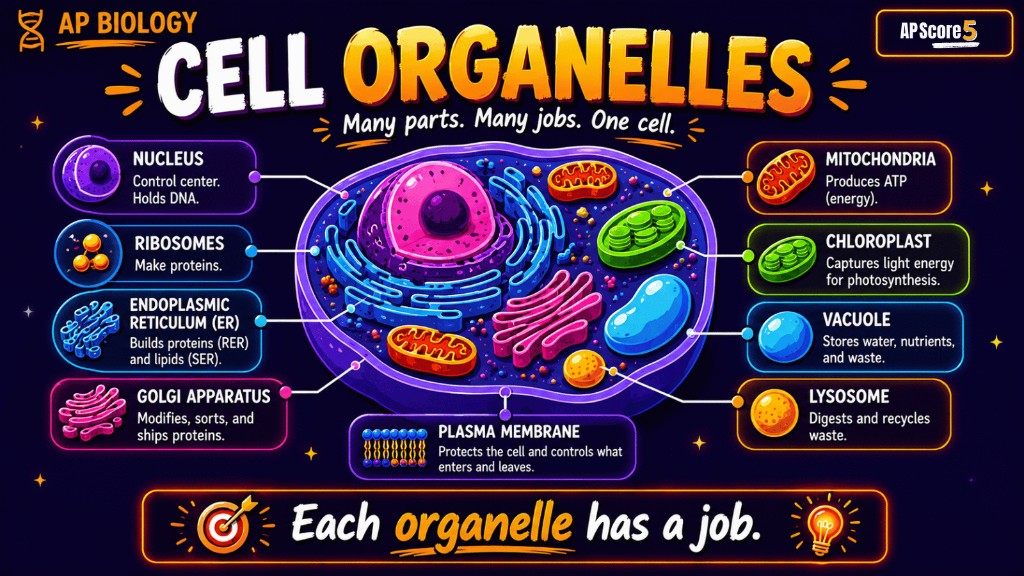
Organelles are specialized cell structures that perform specific jobs.
Think of this guide as your organelle job map. When an AP question names a cell type or process—protein secretion, photosynthesis, turgor loss, or high ATP demand—your first step is to match the need to the organelle that performs that job.
Cell organization differs between simple and complex cells.
Learning Journey Checkpoint: This page teaches the main organelle jobs. Later pages explain how cell type, cell size, membranes, and compartmentalization affect cell function.
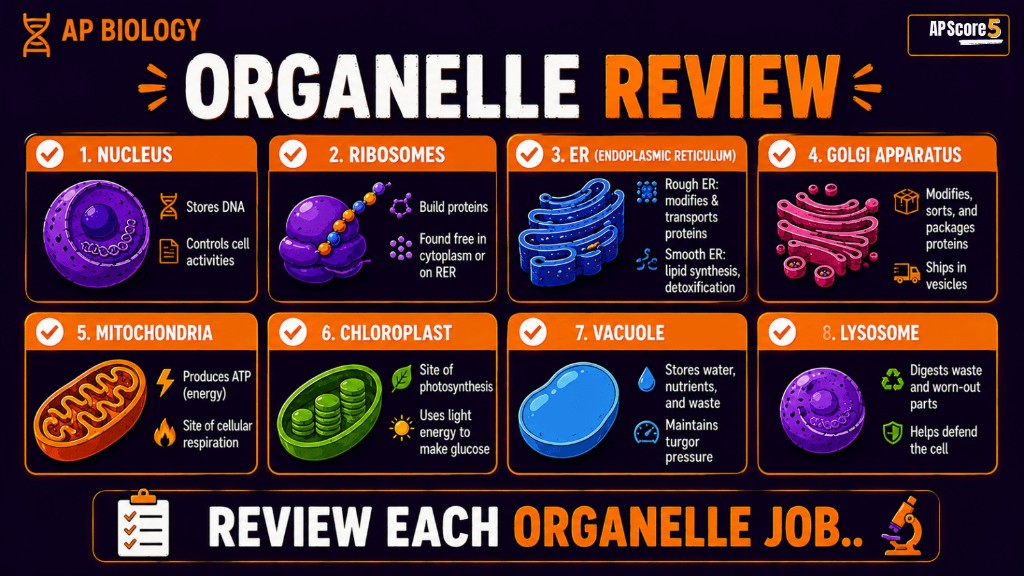
Cell organelles are specialized structures inside cells that perform specific functions. In AP Biology, students should know how organelles such as the nucleus, ribosomes, endoplasmic reticulum, Golgi apparatus, mitochondria, chloroplasts, vacuoles, lysosomes, cytoskeleton, cell wall, and plasma membrane help cells carry out life processes.
Say It Fast
Organelles = cell structures with jobs
Nucleus stores DNA
Ribosomes build proteins
ER and Golgi process and ship materials
Mitochondria help produce ATP
Chloroplasts carry out photosynthesis
Vacuoles store materials
Lysosomes recycle waste
AP Exam Clue: If a question asks why an organelle matters, name the organelle, describe its function, and explain how that function helps the cell.
Organelle map
AP Bio Organelles and Their Functions Chart
Use this chart as the main AP Biology organelle map. The goal is not just to memorize names. The goal is to connect each organelle to the job it performs and the clue that usually appears in AP-style questions.
Organelle or Structure
Main Function
AP Biology Clue
Nucleus
Stores DNA and controls gene expression in eukaryotic cells
Present in eukaryotes, absent in prokaryotes
Ribosomes
Build proteins
Found in both prokaryotic and eukaryotic cells
Rough ER
Folds and processes proteins made by attached ribosomes
Protein production and secretion
Smooth ER
Makes lipids and helps detoxify substances
Lipid synthesis and detoxification
Golgi apparatus
Modifies, sorts, and ships proteins and lipids
Packaging and secretion
Mitochondria
Help produce ATP through cellular respiration
High-energy cells often have many mitochondria
Chloroplasts
Carry out photosynthesis in plants and algae
Capture light energy and produce sugars
Vacuoles
Store water, ions, nutrients, or waste
Central vacuole supports plant cell turgor
Lysosomes
Break down macromolecules and damaged cell parts
Digestion and recycling
Cytoskeleton
Maintains shape, support, and intracellular movement
Microtubules, microfilaments, transport
Plasma membrane
Controls movement in and out of the cell
Selective permeability and homeostasis
Cell wall
Provides support and protection
Found in plants, fungi, bacteria, and some protists
AP Exam Clue: A table helps you review, but strong AP answers explain mechanisms. Do not just say "Golgi ships proteins." Say the Golgi modifies, sorts, and packages proteins for delivery.
Major organelles
Major Cell Organelles AP Biology Students Need to Know
Each card below answers four AP-ready questions: what the structure is, what it does, where it is found, and the mistake students make most often. Link back to the cell structure and function overview when you need the big-picture structure-to-function reasoning.
Nucleus
What it is: A membrane-bound structure that stores DNA in eukaryotic cells.
Function: Stores genetic information and helps control gene expression.
Found in: Eukaryotic cells.
AP exam clue: If a cell has a nucleus, it is eukaryotic.
Common mistake: Do not say all cells have a nucleus. Prokaryotes do not.
Ribosomes
What it is: Small structures made of RNA and protein.
Function: Build proteins.
Found in: Prokaryotic and eukaryotic cells.
AP exam clue: Ribosomes are not membrane-bound and are found in all cells.
Common mistake: Do not say prokaryotes lack organelles if you mean ribosomes.
Rough ER
What it is: Membrane network with ribosomes attached.
Function: Helps fold and process proteins.
Found in: Eukaryotic cells.
AP exam clue: Rough ER is associated with protein production and secretion.
Common mistake: Do not confuse rough ER with smooth ER.
Smooth ER
What it is: Membrane network without ribosomes.
Function: Makes lipids and helps detoxify substances.
Found in: Eukaryotic cells.
AP exam clue: Smooth ER is associated with lipid synthesis and detoxification.
Common mistake: Do not say smooth ER makes proteins.
Golgi Apparatus
What it is: Stacked membrane sacs.
Function: Modifies, sorts, and ships proteins and lipids.
Found in: Eukaryotic cells.
AP exam clue: Golgi often appears in secretion or protein packaging questions.
Common mistake: Do not say Golgi creates proteins from scratch.
Mitochondria
What it is: Double-membrane organelle involved in cellular respiration.
Function: Helps produce ATP.
Found in: Most eukaryotic cells.
AP exam clue: Cells with high energy demands often contain many mitochondria.
Common mistake: Do not simply say mitochondria make energy. Say they help produce ATP.
Chloroplasts
What it is: Double-membrane organelle that contains chlorophyll.
Function: Carries out photosynthesis.
Found in: Plants and algae.
AP exam clue: Connect chloroplasts to light energy, glucose production, and photosynthesis.
Common mistake: Do not say animal cells have chloroplasts.
Vacuoles
What it is: Storage structures inside cells.
Function: Store water, ions, nutrients, or waste.
Found in: Plant, fungal, protist, and some animal cells.
AP exam clue: Central vacuole helps plant cells maintain turgor pressure.
Common mistake: Do not ignore vacuoles in osmosis questions.
Lysosomes
What it is: Membrane-bound sacs containing digestive enzymes.
Function: Break down macromolecules, waste, and damaged cell parts.
Found in: Mostly animal cells; related digestive compartments can appear in other eukaryotes.
AP exam clue: Connect lysosomes to recycling and digestion.
Common mistake: Do not confuse lysosomes with ribosomes.
Cytoskeleton
What it is: Protein fiber network inside the cell.
Function: Supports shape, movement, organization, and intracellular transport.
Found in: Eukaryotic cells and simpler structural proteins in prokaryotes.
AP exam clue: Connect cytoskeleton to cell shape, movement, and transport.
Common mistake: Do not treat cytoskeleton as only a skeleton. It is dynamic.
Plasma Membrane
What it is: Phospholipid bilayer with proteins.
Function: Controls what enters and exits the cell.
Common mistake: Do not confuse plasma membrane with cell wall.
Cell Wall
What it is: Rigid support layer outside the plasma membrane.
Function: Provides support and protection.
Found in: Plants, fungi, bacteria, and some protists.
AP exam clue: Plant cell walls contain cellulose.
Common mistake: Do not say animal cells have cell walls.
Teamwork
How Organelles Work Together
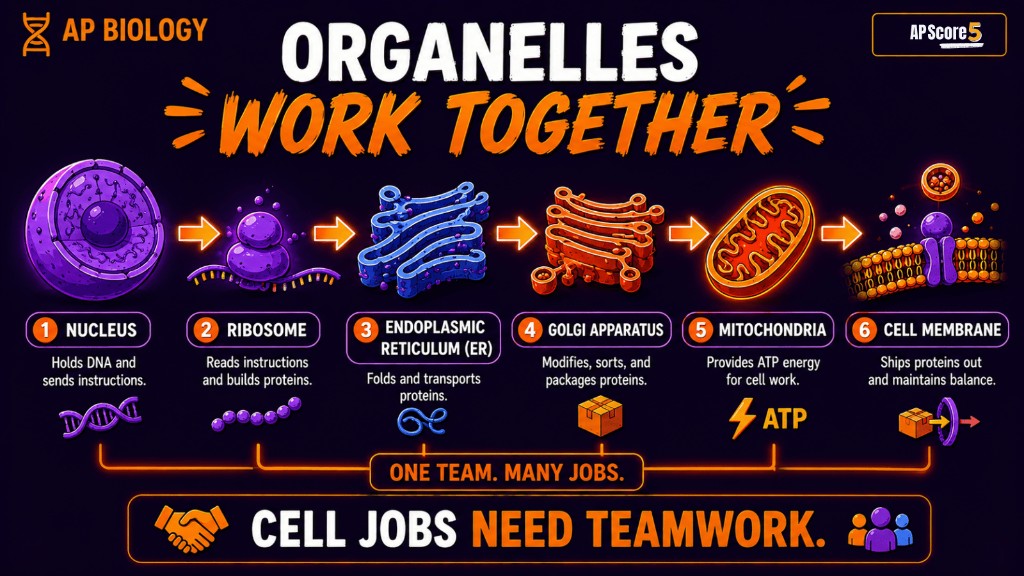
Cells do not use organelles one at a time. Many cell processes require organelles to work as a system. AP Biology often asks students to connect multiple structures in one explanation.
Protein secretion pathway: DNA in nucleus → ribosome builds protein → rough ER folds protein → Golgi modifies and sorts protein → vesicle transports protein → plasma membrane releases protein
Energy support: Mitochondria produce ATP that supports active transport, protein synthesis, movement, and other cellular work.
Plant cell water support: Cell wall and central vacuole help plant cells maintain shape and turgor.
Waste recycling: Lysosomes break down damaged materials so useful components can be reused.
Organelles often work together to build proteins, process energy, and maintain homeostasis.
AP Exam Clue: When a prompt asks how a cell performs a process, include all relevant structures in order.
Protein pathway
The Protein Pathway: Ribosomes, Rough ER, Golgi, and Vesicles
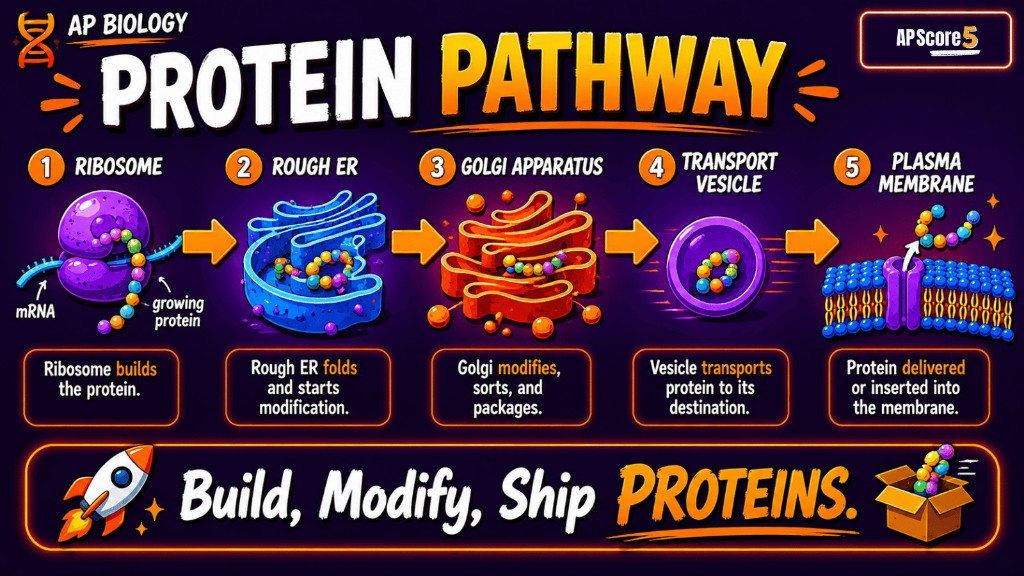
One of the most important organelle teamwork examples is the path of a protein that will be secreted or sent to a membrane. This pathway helps students understand why eukaryotic compartmentalization matters without repeating the full compartmentalization page.
1
Nucleus
DNA contains instructions for protein production.
2
Ribosome
Protein is built from amino acids.
3
Rough ER
Protein begins folding and processing.
4
Vesicle
Protein moves through the cell.
5
Golgi apparatus
Protein is modified, sorted, and packaged.
6
Plasma membrane
Protein may be secreted or inserted into the membrane.
Ribosomes, rough ER, Golgi apparatus, and vesicles work together to produce and ship proteins.
AP Exam Clue: If a question describes a cell secreting large amounts of protein, expect ribosomes, rough ER, Golgi apparatus, vesicles, and ATP demand.
Energy organelles
Mitochondria vs Chloroplasts
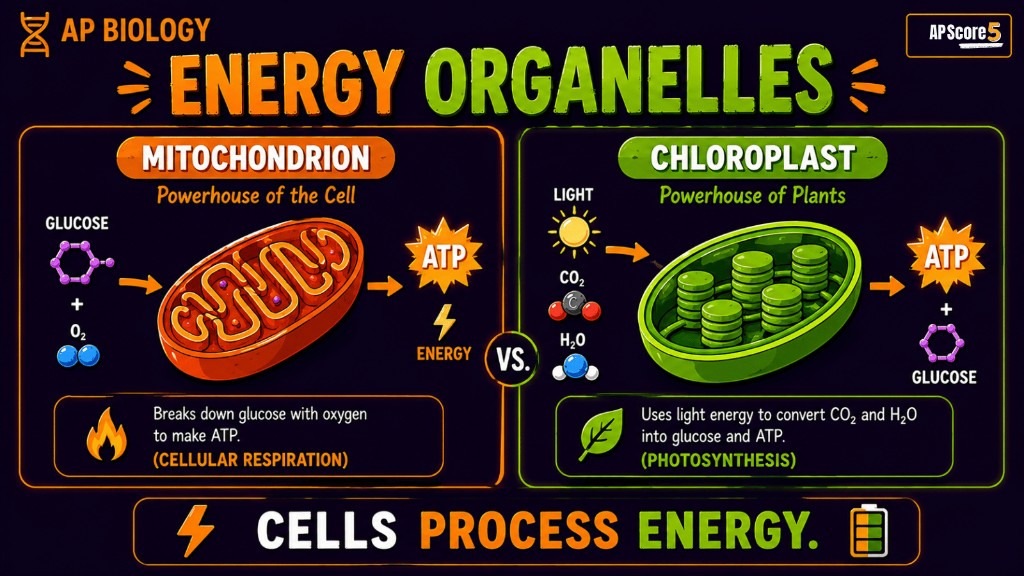
Mitochondria and chloroplasts are both energy-related organelles, but they do different jobs. Mitochondria help cells produce ATP through cellular respiration. Chloroplasts capture light energy and use it to make sugars during photosynthesis.
Feature
Mitochondria
Chloroplasts
Main role
Help produce ATP
Carry out photosynthesis
Found in
Most eukaryotic cells
Plants and algae
Energy connection
Cellular respiration
Photosynthesis
Input clue
Organic molecules and oxygen
Light, carbon dioxide, water
Output clue
ATP
Sugars and oxygen
AP trap
"Makes energy" is too vague
Animal cells do not have chloroplasts
Mitochondria and chloroplasts are energy-related organelles with different roles.
AP Exam Clue: Do not turn this section into a full Unit 3 energy page. Focus on organelle roles and AP clues here.
Cell types
Plant vs Animal Cell Organelles
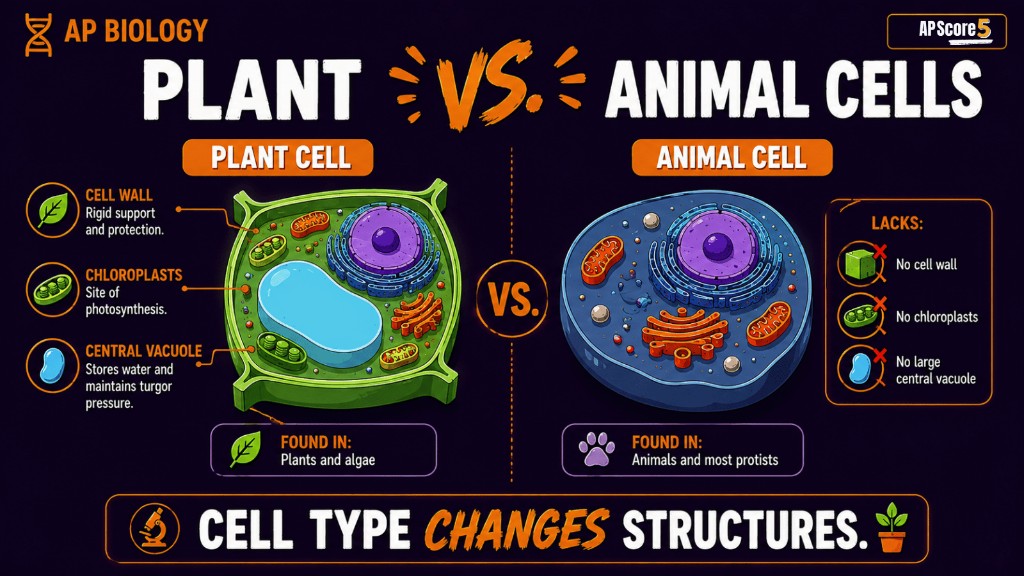
Plant and animal cells are both eukaryotic, so they share a nucleus, ribosomes, ER, Golgi apparatus, mitochondria, cytoskeleton, plasma membrane, and other structures. Plant cells also have structures that help with photosynthesis and support.
Structure
Plant Cells
Animal Cells
Nucleus
Yes
Yes
Ribosomes
Yes
Yes
Mitochondria
Yes
Yes
ER and Golgi
Yes
Yes
Plasma membrane
Yes
Yes
Cell wall
Yes
No
Chloroplasts
Usually yes in photosynthetic cells
No
Large central vacuole
Yes
No large central vacuole
Lysosomes
Less emphasized; other lytic compartments can function similarly
Commonly emphasized
Plant and animal cells share many organelles, but plant cells have structures that support photosynthesis and water balance.
AP Exam Clue: If a question mentions chloroplasts, cellulose cell walls, or a large central vacuole, the cell is likely a plant cell or photosynthetic eukaryote.
Homeostasis
How Organelles Help Maintain Homeostasis
Homeostasis means maintaining stable internal conditions. Organelles help maintain homeostasis by controlling materials, producing ATP, storing water, processing proteins, and recycling damaged components.
Organelle or Structure
Homeostasis Role
Plasma membrane
Regulates entry and exit
Mitochondria
Supplies ATP for active transport and cell work
Vacuole
Stores water and solutes
Lysosome
Breaks down waste and damaged structures
Ribosomes
Build proteins needed for cell function
Golgi apparatus
Sorts materials for proper delivery
Cytoskeleton
Maintains cell organization and movement
AP Exam Tip: When answering homeostasis questions, explain the mechanism. Do not just name the organelle.
Organelle Diagnosis Lab: Which Cell Part Is Needed?
Read each scenario, predict the organelle or structure, then reveal the answer. This trains the same reasoning AP Biology uses in data questions and short free response.
Organelle Diagnosis Lab · Scenario 1
A pancreatic cell is secreting large amounts of protein hormones.
Answer: Ribosomes, rough ER, Golgi apparatus, vesicles, and mitochondria.
Organelle Diagnosis Lab · Scenario 2
A plant cell is losing turgor pressure in a salty environment.
Answer: Central vacuole, plasma membrane, and osmosis are involved.
Organelle Diagnosis Lab · Scenario 3
A muscle cell needs large amounts of ATP.
Answer: Mitochondria.
Organelle Diagnosis Lab · Scenario 4
A photosynthetic cell is capturing light energy.
Answer: Chloroplasts.
Organelle Diagnosis Lab · Scenario 5
A cell is breaking down damaged organelles.
Answer: Lysosomes.
Organelle Diagnosis Lab · Scenario 6
A cell is sorting proteins before secretion.
Answer: Golgi apparatus.
Organelle Diagnosis Lab · Scenario 7
A cell is making lipids for membranes.
Answer: Smooth ER.
Organelle Diagnosis Lab · Scenario 8
A cell is maintaining shape and moving materials internally.
Answer: Cytoskeleton.
Organelle Diagnosis Lab · Scenario 9
A bacterial cell is producing proteins but has no nucleus.
Answer: Ribosomes in a prokaryotic cell.
Organelle Diagnosis Lab · Scenario 10
A plant cell needs rigid support outside the plasma membrane.
Answer: Cell wall.
Common mistakes
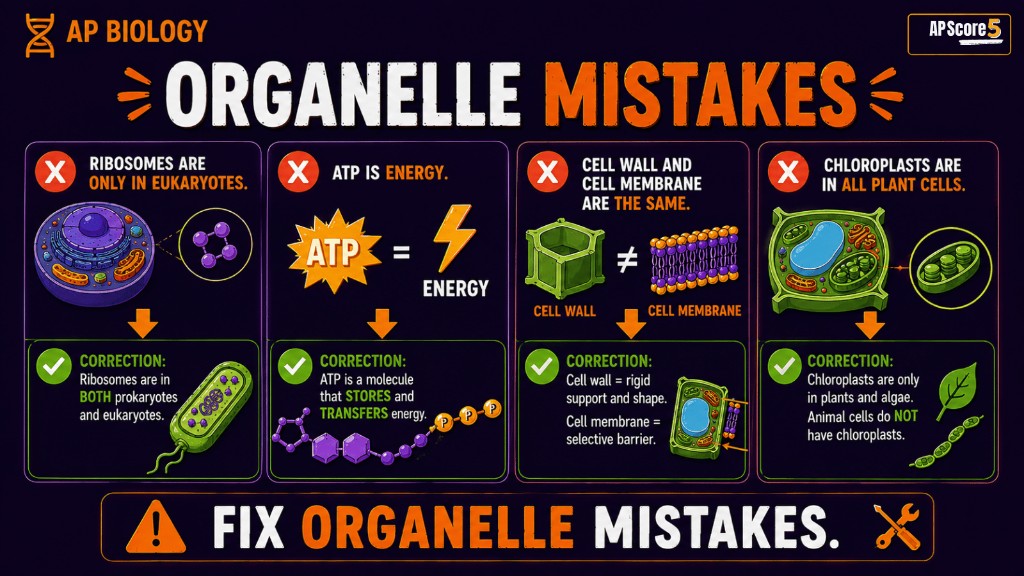
Common Mistakes About Cell Organelles
Many organelle missed points come from swapped roles or vague energy language. Use this table to upgrade weak phrases into AP-ready explanations.
Mistake
Better AP Biology Understanding
"Mitochondria make energy"
Mitochondria help produce ATP, the usable energy currency
"All cells have a nucleus"
Eukaryotic cells have nuclei; prokaryotic cells do not
"Prokaryotes have no organelles at all"
Prokaryotes lack membrane-bound organelles but have ribosomes
"Golgi makes proteins"
Ribosomes make proteins; Golgi modifies, sorts, and ships them
"Smooth ER makes proteins"
Smooth ER makes lipids and helps detoxify substances
"Animal cells have cell walls"
Animal cells do not have cell walls
"All eukaryotes have chloroplasts"
Chloroplasts are found in plants and algae, not animals or fungi
"Cell wall controls entry and exit"
Plasma membrane controls movement; cell wall provides support
Many organelle mistakes come from memorizing names without understanding functions.MCQ practice
AP Bio Organelles and Their Functions Practice Questions
Answer all ten questions. Choices shuffle each time you reload, so focus on reasoning—not letter memorization.
Question 1 of 10Start
Correct: 0Answered: 0Streak: 0Accuracy: 0%
FRQ practice
AP-Style FRQ Practice: Cell Organelles
Open each card, draft your response, then reveal the rubric and sample when ready. In organelle FRQs, name the organelle, describe its function, and connect that function to the cell's need.
0 of 2 FRQs opened
Prompt
Identify the organelle where proteins are built.
Describe the role of the rough ER in protein processing.
Explain how the Golgi apparatus supports protein secretion.
Explain why a cell that secretes many proteins may need many mitochondria.
Tip: Name the structure, describe the function, and explain how that function helps the cell.
Scoring rubric (4 points)
1 pt — Ribosomes build proteins.
1 pt — Rough ER helps fold and process proteins, especially proteins associated with secretion or membranes.
1 pt — The Golgi apparatus modifies, sorts, and packages proteins into vesicles.
1 pt — Mitochondria help produce ATP needed for protein synthesis, vesicle transport, and secretion.
Sample response
Sample response: Proteins are built at ribosomes. The rough ER helps fold and process proteins that will be secreted or inserted into membranes. The Golgi apparatus modifies, sorts, and packages those proteins into vesicles for delivery. A cell that secretes many proteins needs many mitochondria because ATP supports protein synthesis, vesicle movement, and export across the plasma membrane.
Self-check before you reveal
Status: Draft your answer first—then open the rubric or sample.
Prompt
Identify one structure found in plant cells but not animal cells.
Describe the function of that structure.
Explain how vacuoles can help plant cells maintain homeostasis.
Explain why prokaryotic cells can build proteins even though they lack membrane-bound organelles.
Tip: Name the structure, describe the function, and explain how that function helps the cell.
Scoring rubric (4 points)
1 pt — Accept cell wall, chloroplast, or large central vacuole.
1 pt — Cell wall provides support; chloroplast carries out photosynthesis; central vacuole stores water and helps maintain turgor.
1 pt — Vacuoles store water and solutes, helping regulate water balance and pressure.
1 pt — Prokaryotes have ribosomes, which build proteins, even though they lack membrane-bound organelles.
Sample response
Sample response: Plant cells have a cell wall outside the plasma membrane, which provides support and protection. Vacuoles store water and solutes, helping plant cells maintain turgor and internal balance during osmotic changes. Prokaryotic cells lack membrane-bound organelles but still contain ribosomes that build proteins in the cytoplasm.
Self-check before you reveal
Status: Draft your answer first—then open the rubric or sample.
FRQ Tip
In organelle FRQs, name the organelle, describe its function, and connect that function to the cell's need.
Keep learning
Continue the Unit 2 Learning Journey
You now have the organelle job map. Use these links to compare cell types, study membranes, and practice Unit 2 questions.
Organelles are specialized cell structures that perform specific jobs, such as storing DNA, building proteins, producing ATP, carrying out photosynthesis, storing materials, or recycling waste.
What organelles do AP Biology students need to know?
AP Biology students should know the nucleus, ribosomes, rough ER, smooth ER, Golgi apparatus, mitochondria, chloroplasts, vacuoles, lysosomes, cytoskeleton, plasma membrane, and cell wall.
What organelle builds proteins?
Ribosomes build proteins. In eukaryotic cells, ribosomes may be free in the cytoplasm or attached to the rough endoplasmic reticulum.
What is the function of the Golgi apparatus?
The Golgi apparatus modifies, sorts, and packages proteins and lipids for delivery inside or outside the cell.
What is the difference between mitochondria and chloroplasts?
Mitochondria help produce ATP through cellular respiration, while chloroplasts carry out photosynthesis in plants and algae.
Do prokaryotic cells have organelles?
Prokaryotic cells lack membrane-bound organelles, but they do have ribosomes, DNA, cytoplasm, and a plasma membrane.
What organelles are found in plant cells but not animal cells?
Plant cells have cell walls, chloroplasts in photosynthetic cells, and large central vacuoles. Animal cells do not have cell walls or chloroplasts.
How do organelles help maintain homeostasis?
Organelles help maintain homeostasis by regulating transport, producing ATP, storing water and solutes, recycling waste, and processing proteins.
Why are organelles important in AP Biology?
Organelles are important because AP Biology questions often ask students to explain how cell structures support cellular functions.
Final review
AP Bio Organelles and Their Functions: Final Review
A strong organelle review connects each structure to its function and AP exam clue.
Organelles are specialized cell structures with specific jobs
Nucleus stores DNA in eukaryotic cells
Ribosomes build proteins
Rough ER helps process proteins
Smooth ER makes lipids and helps detoxify substances
Golgi apparatus modifies, sorts, and ships materials
Mitochondria help produce ATP
Chloroplasts carry out photosynthesis in plants and algae
Vacuoles store water and materials
Lysosomes digest and recycle materials
Cytoskeleton supports shape, movement, and internal transport
Plasma membrane controls movement in and out
Cell wall provides support and protection
Strong AP answers connect organelle structure, function, and cellular need