Monomers and Polymers AP Biology: Building Blocks of Macromolecules
Learn how monomers link into polymers—and why that logic drives every macromolecule class.
AP Bio monomers and polymers questions test whether you can name building blocks, describe dehydration synthesis and hydrolysis, and connect polymer structure to cell function. This page explains monomer versus polymer, the four major macromolecule pairs, the lipids exception, and gives you AP-style flashcards, MCQs, and mini FRQs.
Updated May 24, 2026Reviewed by APScore5 Editorial Team
Must knowMonomer → polymer pairs for carbs, proteins, nucleic acids, and lipids
Big ideaDehydration synthesis builds; hydrolysis breaks
AP skillConnect subunit → bond → structure → function
What Is the Relationship Between Monomers and Polymers?
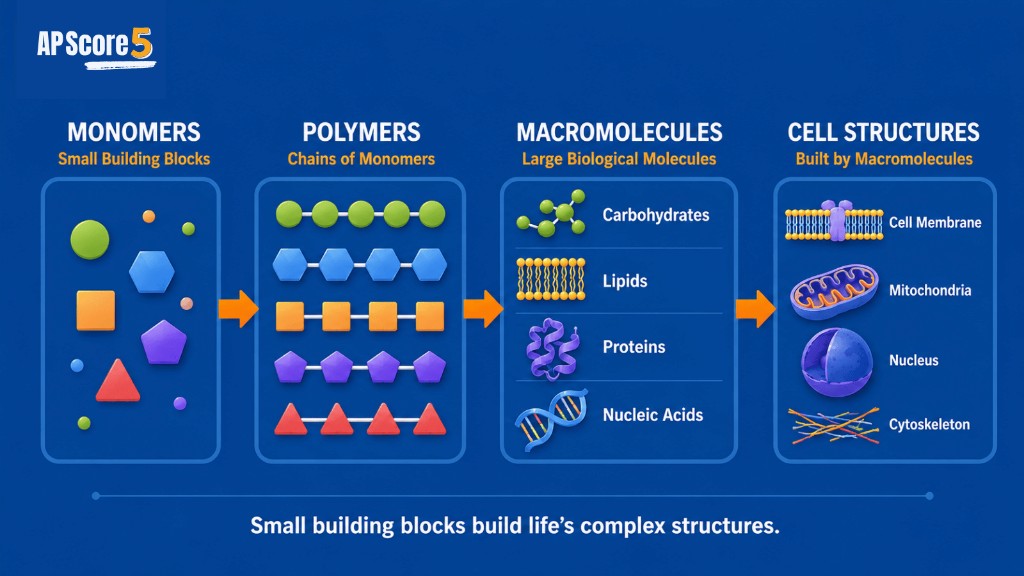
Monomers are small molecular building blocks. Polymers are larger molecules made when many monomers are joined together. In AP Biology, this relationship helps explain how carbohydrates, proteins, and nucleic acids form the larger macromolecules cells use for energy, structure, enzymes, and genetic information.
Figure - Monomers Build Polymers And Macromolecules
AP tip: Do not assume every biological macromolecule is a true polymer. Lipids are usually grouped with macromolecules because they are large and hydrophobic, but they are not always made of repeating monomers like proteins or nucleic acids.
Monomers and polymers AP Biology content sits between atomic chemistry and macromolecule function. After you learn that CHNOPS elements build living matter, the next question is how those atoms assemble into usable structures. Monomers are the reusable parts—glucose, amino acids, nucleotides. Polymers are the assembled products—starch, polypeptides, DNA. The College Board expects you to name monomers, describe how they link, and explain why polymer length and sequence matter for function.
This guide covers monomer versus polymer definitions, the four major macromolecule pairs, dehydration synthesis and hydrolysis, the lipids exception, structure-function reasoning, and AP-style practice. If you have not reviewed atomic foundations yet, start with elements of life and water properties first.
Foundation
Why Do Monomers and Polymers Matter in AP Biology?
Cells do not work with isolated atoms. They work with molecules that can store energy, catalyze reactions, form membranes, and carry genetic instructions. Polymers make that possible because repeating subunits can be assembled in different lengths and sequences, creating enormous chemical diversity from a small set of monomer types.
Monomers and polymers matter on AP exams because questions rarely stop at vocabulary. A typical item might describe a digestive enzyme breaking a large molecule into smaller pieces and ask which process is occurring. Another might compare starch and cellulose—same glucose monomer, different polymer linkages, different biological roles. Strong answers connect monomer identity, bond formation or breakage, and the resulting structure or function.
Unit 1 treats monomers and polymers as the bridge from chemistry to macromolecules. Once you understand how subunits join and split, the dedicated guides for carbohydrates, proteins, nucleic acids, and lipids become easier because you already know the assembly logic.
On free-response questions, partial credit often goes to students who explain mechanism, not just labels. Saying “starch is a polymer” earns less than explaining that glucose monomers joined by dehydration synthesis form glycosidic bonds in a polysaccharide used for energy storage. That is the reasoning pattern AP Biology rewards throughout the course.
Polymers also explain regulation. Cells control which monomers are available, which enzymes catalyze bond formation, and when hydrolysis releases subunits for recycling. A mutation that changes one amino acid in a polypeptide can alter folding and function—evidence that polymer sequence is not cosmetic detail but functional information.
Compare
What Is the Difference Between a Monomer and a Polymer?
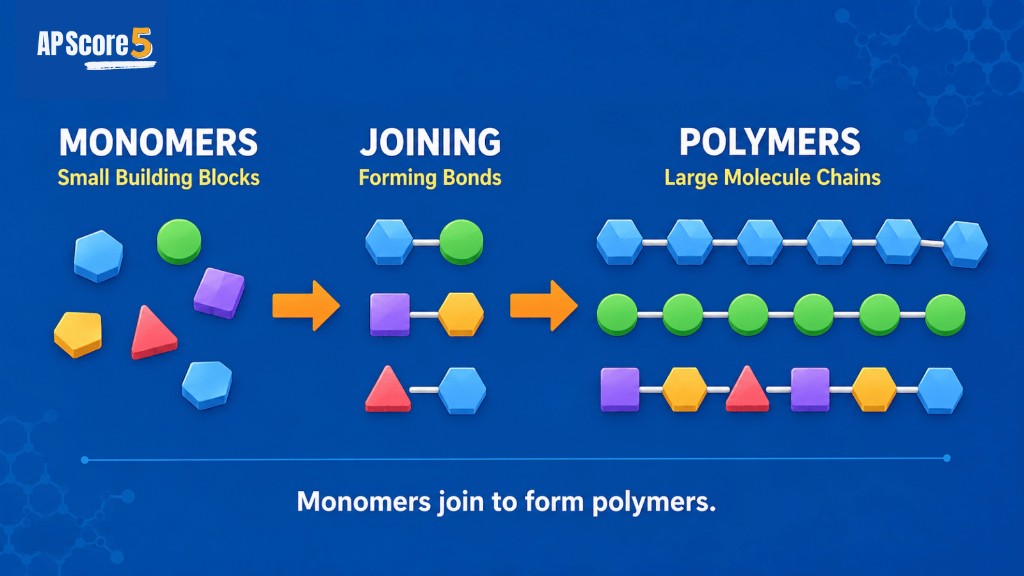
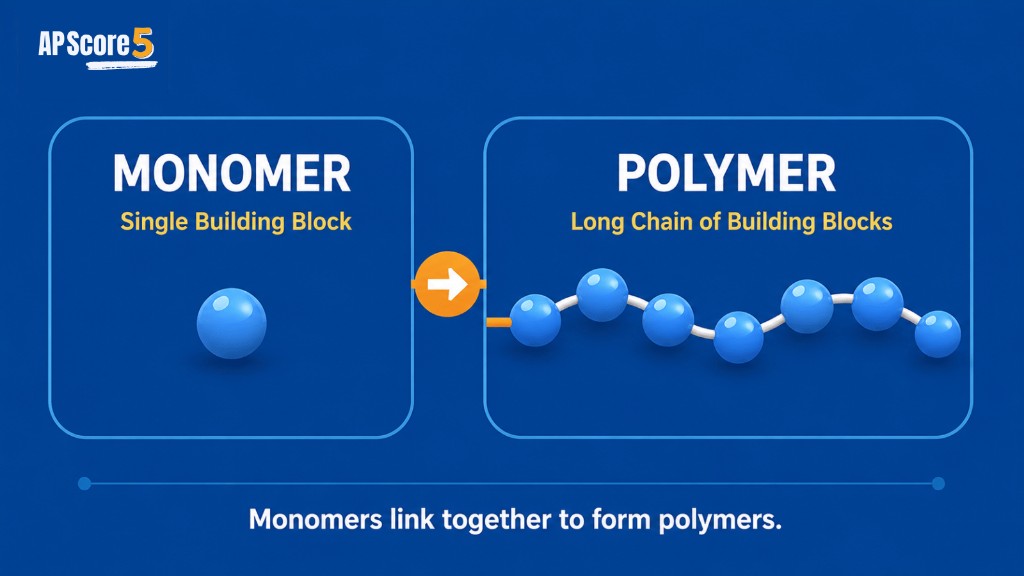
A monomer is one building block. A polymer is many building blocks connected in a chain (or branched network). Think of monomers as individual beads and polymers as the necklace. The same bead type can make different products depending on how many beads you link and in what pattern.
Figure - Small Monomers Join To Form Polymers
Feature
Monomer
Polymer
Size
Small subunit
Large molecule of repeating subunits
Example (carbohydrates)
Glucose
Starch, glycogen, cellulose
Example (proteins)
Amino acid
Polypeptide / protein
Example (nucleic acids)
Nucleotide
DNA, RNA
Formation
Used as input to build polymers
Built by linking monomers
Key process to build
—
Dehydration synthesis
Key process to break
Released when polymers split
Hydrolysis
On MCQs, read carefully whether the question asks for the monomer name or the polymer name. “Which molecule is the monomer of proteins?” expects amino acid, not hemoglobin. “Which is a polymer of nucleotides?” expects DNA or RNA, not adenine alone.
Polymers are not automatically huge in every context. A disaccharide such as maltose is two monosaccharides linked—technically a small polymer. AP Biology usually focuses on the four macromolecule classes and their typical monomer-polymer relationships, but the underlying idea is the same at every scale: subunits link, properties emerge.
Figure - Monomer Vs Polymer Building Block ChainMechanism
How Do Monomers Become Polymers?
Monomers become polymers through dehydration synthesis, also called a condensation reaction. Two monomers align so that a hydroxyl group from one and a hydrogen from another can be removed as water. The remaining atoms form a new covalent bond between subunits. Repeat the process and the chain grows.
The reverse process is hydrolysis. Water is added to break a bond between monomers, splitting a polymer back into subunits. Digestive enzymes often use hydrolysis so cells can absorb monomers from food and rebuild polymers inside the cell.
Enzymes control both directions. Anabolic pathways use dehydration synthesis to build storage molecules and structural polymers. Catabolic pathways use hydrolysis to release usable monomers during digestion or recycling. AP Biology frequently pairs these terms with a specific bond type: peptide bonds in proteins, glycosidic bonds in carbohydrates, phosphodiester bonds in nucleic acids.
For a dedicated walkthrough of bond breaking and building with diagrams, see the dedicated dehydration synthesis and hydrolysis guide for diagrams and practice. You should be able to state that dehydration synthesis removes water to join monomers and hydrolysis adds water to split polymers.
Energy coupling appears here too. Building polymers often requires input energy and enzyme catalysis. Breaking polymers can release energy when cells need fuel. Connecting polymer chemistry to metabolism preview is exactly what Unit 3 energetics builds on later.
Interactive reference
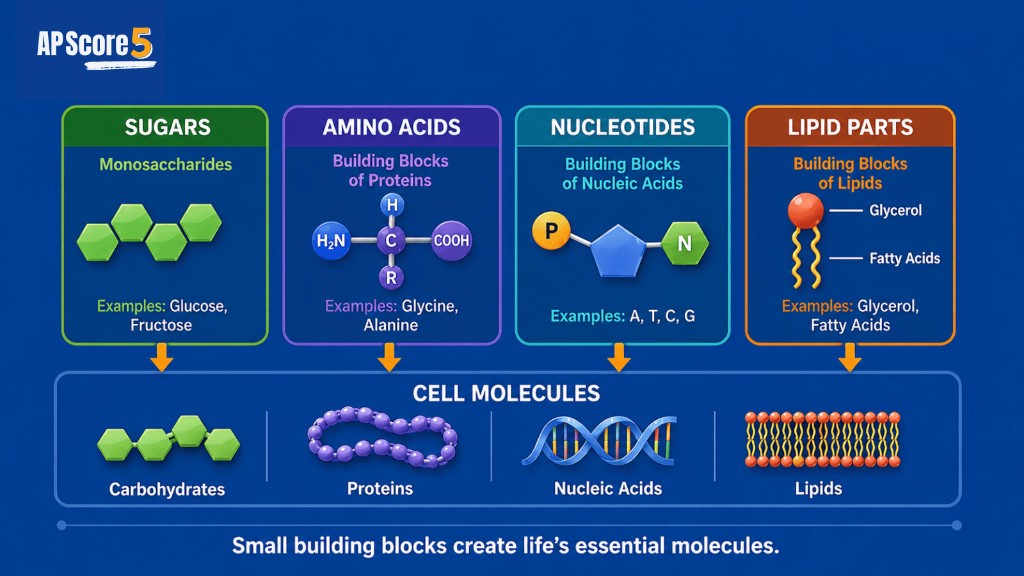
What Are the Biological Monomer-Polymer Pairs?
Tap each macromolecule class or strip button to explore monomer, polymer, bond type, and AP test clues. Explore all four pairs to unlock the finish button faster.
Note: Lipids are macromolecules grouped by hydrophobic behavior; triglycerides are not classic polymers.
AP examples: Triglycerides, phospholipids, steroids.
Test clue: “hydrophobic,” “fatty acid,” “not a true polymer.”
0 of 4 macromolecule pairs explored · tap each card once
Macromolecule
Monomer
Polymer / product
Bond type
Main function
Carbohydrates
Monosaccharide
Polysaccharide
Glycosidic
Energy storage, structure
Proteins
Amino acid
Polypeptide
Peptide
Enzymes, structure, transport
Nucleic acids
Nucleotide
DNA, RNA
Phosphodiester
Genetic information
Lipids
Fatty acids, glycerol
Triglycerides, phospholipids
Ester (not repeating chain for all)
Energy storage, membranes
Three classes—carbohydrates, proteins, and nucleic acids—form classic polymers with repeating monomers. Lipids are still essential macromolecules but do not always fit the simple monomer-polymer template. That distinction is one of the most tested exceptions in Unit 1.
Exception
Why Are Lipids the Common AP Biology Exception?
Lipids are grouped as macromolecules because they are large biological molecules central to membranes and energy storage. However, a triglyceride is built from one glycerol and three fatty acids—it is not a long repeating chain of identical monomers like a polypeptide or DNA strand.
Phospholipids have a glycerol backbone, two fatty acid tails, and a phosphate-containing head group. They assemble into bilayers, but again, the structure is not a simple polymer of one monomer type repeated hundreds of times. AP items often ask whether lipids are true polymers; the safe answer is that lipids are macromolecules defined largely by hydrophobic regions, and many are not classic polymers.
Do not overcorrect and say lipids are unrelated to monomer chemistry. Fatty acids are still subunits. Ester linkages still form through dehydration-type reactions. The exam tests whether you know the category rules and the exception, not whether you can force lipids into the same template as proteins.
When a question lists “polymer of amino acids,” “polymer of nucleotides,” and “polymer of glucose,” the outlier lipid choice might be “polymer of fatty acids only” without glycerol context—that is a trap. Read whether the option describes a true repeating chain or a composite molecule.
Big idea
How Does Polymer Structure Connect to Function?
Structure-function reasoning is the payoff of learning monomers and polymers. The monomer type sets the chemistry. The sequence and length of the polymer set the shape. The shape sets what the molecule can do in the cell.
Consider proteins: twenty amino acid monomers can be arranged in countless sequences. Each sequence folds into a specific three-dimensional shape. Enzyme active sites depend on that shape. Change one monomer and you may change folding, binding, and activity—as in sickle cell hemoglobin.
Carbohydrates show the same logic with simpler diversity. Starch and cellulose both use glucose monomers, but different glycosidic linkages produce different shapes—branching for storage versus linear chains for plant cell wall strength. Same monomer, different polymer architecture, different function.
Nucleic acids store information in the order of nucleotide monomers. The sequence is the code. Polymer length and complementary base pairing between strands enable replication and transcription. Without polymer thinking, DNA looks like a list of letters; with polymer thinking, you see a functional information molecule.
On AP exams, whenever a stem mentions a change in subunit order, bond type, or chain length, ask: how would that change shape or function? That habit carries into Unit 2 enzymes, Unit 6 gene expression, and many FRQ scenarios.
Avoid traps
What Are Common AP Biology Mistakes on Monomers and Polymers?
Fix: Many lipids are macromolecules but not true repeating monomer chains.
Mistake: Ignoring bond type
Fix: Link peptide, glycosidic, and phosphodiester bonds to the correct class.
Mistake: Vague FRQ answers
Fix: Name the monomer, state the process, and connect polymer structure to a specific function.
Another frequent error is treating polymer length as irrelevant. Longer polysaccharides store more glucose units. Longer DNA molecules carry more base pairs. Polymer size matters even when the monomer type stays the same.
Students also forget that digestion is hydrolysis. If a question describes an enzyme breaking starch in the mouth, the answer is not dehydration synthesis. Follow the direction of the arrow: monomers joining versus polymer splitting.
Quick review
Monomer-Polymer Review Grid for AP Biology Unit 1
Carbohydrates
Glucose monomers → polysaccharides for energy or structure.
Finish this guide, then open dehydration synthesis and hydrolysis for the next step in Unit 1.
Vocabulary
What Vocabulary Should You Know for Monomers and Polymers?
MonomerA small molecular building block that can link into a polymer.
PolymerA large molecule made of repeating monomer units.
Dehydration synthesisJoins monomers by removing water and forming a covalent bond.
HydrolysisBreaks polymers into monomers by adding water.
MonosaccharideA single sugar monomer such as glucose.
PolysaccharideA carbohydrate polymer of monosaccharides.
Amino acidThe monomer of proteins.
PolypeptideA polymer chain of amino acids.
NucleotideThe monomer of nucleic acids.
Peptide bondCovalent bond linking amino acids in proteins.
Glycosidic bondCovalent bond linking monosaccharides in carbohydrates.
Phosphodiester bondBond linking nucleotides in DNA and RNA backbones.
MacromoleculeA large biological molecule such as a carbohydrate, lipid, protein, or nucleic acid.
Condensation reactionReaction that joins molecules while releasing a small byproduct, often water.
Structure-functionA molecule’s shape and chemistry determine what it does in the cell.
Flashcards
18 Monomers and Polymers Flashcards
Every 5th card shows an ad placeholder with a short countdown. Flip the card to read the definition, then use the arrow for the next card.
Card 1 of 18Tap card to flip
Practice
14 AP-Style MCQs on Monomers and Polymers
Choices shuffle at display time. Tap an answer, read the explanation, then use Next question. An ad appears after every 5th question with a short countdown.
1 pt — Water removed as product; glycosidic bond forms; glucose monomers → polysaccharide polymer.
Sample answer
The plant cell is performing dehydration synthesis (a condensation reaction). Each glucose monomer donates –OH from one carbon and –H from the partner’s hydroxyl, and those fragments combine as H₂O that leaves the reaction.
The remaining oxygen bridges form a glycosidic bond, so many glucose units become a polysaccharide polymer (starch). Water is a product, not a reactant used to stitch sugars together—that distinction is a common partial-credit trap on macromolecule FRQs.
Before you submit
Picture monomers joining and H₂O leaving—not water entering.
FRQ 2 · 3 points
Are all four macromolecules true polymers?
Open ↓
Prompt
A review sheet lists carbohydrates, lipids, proteins, and nucleic acids as the four major biological macromolecules in AP Biology Unit 1.
A student writes that each class is a “true polymer of repeating identical monomers.”
Evaluate this claim using at least one valid example for the macromolecule class that does not fit the pattern.
Scoring rubric (3 points)
1 pt — Carbohydrates, proteins, and/or nucleic acids described as polymers of repeating monomers with named subunits.
1 pt — Lipid exception: not a single repeating monomer chain (triglyceride or phospholipid example).
1 pt — Clear comparison: why lipids are grouped as macromolecules but differ from polypeptide/polynucleotide logic.
Sample answer
The claim is partly true. Carbohydrates such as starch are polymers of glucose monomers; proteins are polypeptides of amino acids; nucleic acids are polynucleotides of nucleotides. In each case, repeating subunits join by covalent bonds in a defined sequence or pattern.
Lipids break the “repeating monomer chain” rule. A triglyceride is one glycerol plus three fatty acids—large and hydrophobic, but not a long chain of identical repeating units like a protein strand. Phospholipids have two fatty acid tails and a polar head; membranes depend on them, yet AP Bio still teaches lipids separately from classic polymer chemistry.
So all four are macromolecules by size and biology, but only three are true polymers in the monomer-repeat sense. FRQ readers want you to name the lipid outlier, not argue that fats are “polymers of fatty acids.”
Before you submit
The lipids exception is the point—do not call every class a polymer.
FRQ 3 · 3 points
Protein digestion in the small intestine
Open ↓
Prompt
Pepsin in the stomach begins denaturing dietary protein, and proteases in the small intestine finish breaking peptide bonds.
Epithelial cells absorb single amino acids into the bloodstream for transport to other tissues.
Name the chemical process that splits the polymer and explain how water participates in the reaction.
Scoring rubric (3 points)
1 pt — Hydrolysis (not dehydration synthesis).
1 pt — Water added/used as reactant to break peptide (covalent) bonds.
1 pt — Products are amino acid monomers suitable for absorption/reuse.
Sample answer
Intestinal proteases catalyze hydrolysis of the dietary polypeptide. A water molecule is added to the peptide bond, supplying –H and –OH that insert into the linkage so the chain splits.
Water is a reactant here—the opposite role from building a protein at the ribosome, where dehydration synthesis releases water. Repeated hydrolysis steps yield free amino acid monomers the small intestine can absorb and cells can use to build new proteins or burn for energy.
Linking digestion to hydrolysis plus “water in, monomers out” usually earns more credit than naming the enzyme alone without the bond-breaking chemistry.
Before you submit
Tie the answer to absorption of amino acids in the small intestine.
FAQ
Frequently Asked Questions About Monomers and Polymers
What is a monomer in AP Biology?
A monomer is one small subunit that can bond to identical or compatible partners to build a polymer—one glucose ring, one amino acid, or one nucleotide. On the exam, monomer language comes first; the follow-up is usually which bond forms next (glycosidic, peptide, or phosphodiester) during dehydration synthesis.
What is a polymer in AP Biology?
A polymer is a long molecule made of many monomers linked by covalent bonds, such as glycogen (many glucoses), a polypeptide (many amino acids), or DNA (many nucleotides). Length and sequence both matter: two proteins built from the same amino acids in different order fold differently and do different jobs in the cell.
What is the difference between a monomer and a polymer?
Scale is the difference: a monomer is a single LEGO brick, a polymer is the finished structure built from many bricks. Function follows size—one glucose can fuel respiration quickly, while starch stores thousands of glucoses for later use in a plant cell.
What is dehydration synthesis?
Dehydration synthesis removes –OH from one monomer and –H from another, releases H₂O, and forms a new covalent bond between subunits. Ribosomes use this same logic when they stitch amino acids during translation; digestion later reverses it with hydrolysis when you need monomers again.
What is hydrolysis?
Hydrolysis adds water to break a bond between monomers, splitting polymers into subunits your body can absorb or recycle. Salivary amylase starts hydrolyzing starch in the mouth—that real-world example is the same bond-breaking chemistry AP Bio describes on FRQs about macromolecule breakdown.
What are the monomers of carbohydrates?
Monosaccharides—simple sugars like glucose, fructose, and galactose—are the carbohydrate monomers. Two glucoses make maltose; thousands make starch or glycogen, so questions may jump from “name the monomer” straight to “name the glycosidic linkage that joins them.”
What are the monomers of proteins?
Amino acids are the monomers; the twenty common types differ by R-group side chains that control folding and chemistry. A dipeptide is only two amino acids linked by one peptide bond, while hemoglobin is a polymer with hundreds—sequence, not just count, encodes function.
What are the monomers of nucleic acids?
Nucleotides are monomers with three parts: phosphate, pentose sugar (ribose or deoxyribose), and a nitrogenous base. ATP is related (adenine, ribose, phosphates) but when a prompt asks for DNA or RNA building blocks, answer nucleotide and mention phosphodiester bonds in the backbone.
Are lipids true polymers?
Many lipids are not classic polymers because the course groups them by hydrophobic behavior, not long repeating monomer chains. Triglycerides are three fatty acids on glycerol; phospholipids have two fatty acid tails and a polar head—great for membranes, but not built like a protein strand of identical repeating units.
How do monomers and polymers connect to macromolecules?
Cells build four macromolecule families by linking the right monomer with the right bond: glucose to starch, amino acids to enzymes, nucleotides to RNA, fatty acids plus glycerol to fats. Unit 1 moves from “what is the subunit?” to “what reaction joins or splits them?”—most MCQs test that pair together.
Why is the lipids exception important on AP exams?
Four-class comparison questions often ask which three form true polymers; lipids are the usual outlier. Knowing fats assemble differently stops you from claiming a “polymer of fatty acids” when the prompt is really testing membrane structure or why fats store more energy per gram than starch.
What should I know for AP Biology FRQs about monomers and polymers?
A strong FRQ paragraph names the monomer, names the polymer, states dehydration synthesis or hydrolysis, and ties to a real process such as translation, digestion, or DNA replication. Sketch +H₂O versus −H₂O on scrap paper—readers reward correct bond breaking and forming language, not vocabulary alone.
Checklist
Final Review Checklist for Monomers and Polymers
Check each skill when you can explain it without looking at the page.
0 of 8 skills ready
You finished Monomers and Polymers
Nice work — you explored all four macromolecule pairs and checked off the review skills. Continue to dehydration synthesis and hydrolysis, then the macromolecules overview.
You just learned how monomers assemble into polymers and why that logic matters for every macromolecule class. Next, study bond-level mechanisms, then compare all four classes on the macromolecules overview.