What is photosynthesis in AP Biology?
Photosynthesis is the process plants, algae, and cyanobacteria use to convert light energy into chemical energy stored in glucose. In AP Biology, the two major stages are the light-dependent reactions on the thylakoid membrane and the Calvin cycle in the stroma; the overall equation is 6 CO2 + 6 H2O + light → C6H12O6 + 6 O2.
In one sentence
In one sentence: Photosynthesis uses light energy to convert carbon dioxide and water into glucose and oxygen through light-dependent reactions and the Calvin cycle.
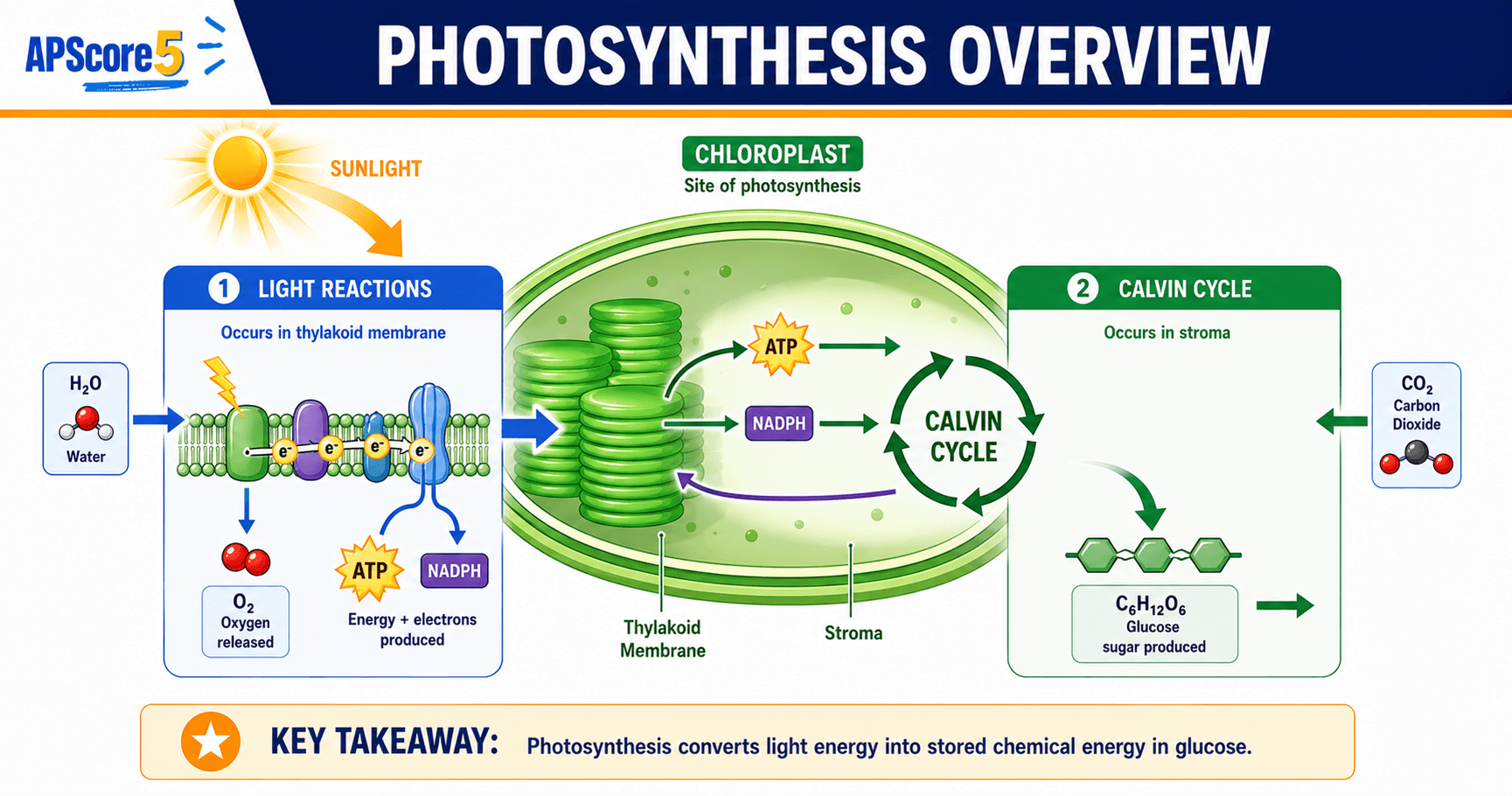
Plain-language snapshot
AP Must Know
- Light-dependent reactions happen on the thylakoid membrane.
- The Calvin cycle happens in the stroma.
- Water is split during photolysis, releasing O2.
- CO2 provides the carbon used to build glucose.
- ATP and NADPH from the light reactions power the Calvin cycle.
- RuBisCO fixes CO2 during the Calvin cycle.
- Photosynthesis stores energy; cellular respiration releases energy.
Photosynthesis at a glance
Most O2 in Earth's atmosphere comes from this reaction
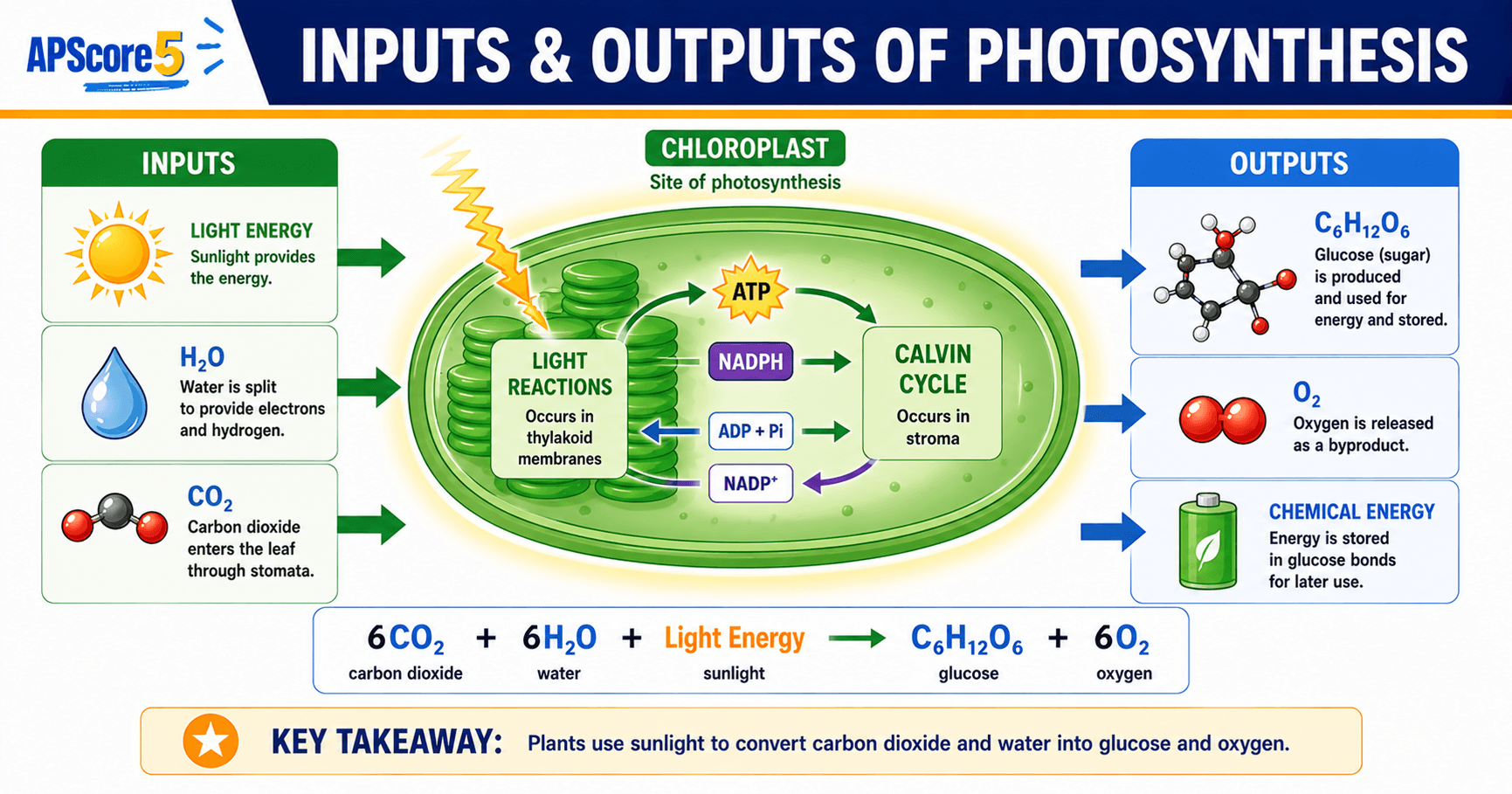
Key idea: Use this photosynthesis AP Biology table to compare the two stages of photosynthesis by location, inputs, and outputs.
| Stage | Where it happens | Inputs | Outputs |
|---|---|---|---|
| 1. Light-dependent reactions | Thylakoid membrane | Light, H2O, NADP+, ADP | ATP, NADPH, O2 |
| 2. Calvin cycle (light-independent) | Stroma | CO2, ATP, NADPH | Glucose (G3P), ADP, NADP+ |
The two stages are connected: light reactions make the ATP and NADPH that the Calvin cycle uses to build glucose. Both happen in the chloroplast, just in different compartments.
Chemiosmosis (H+ through ATP synthase) links light-dependent reactions AP Biology output to ATP and NADPH photosynthesis carriers that feed the stroma Calvin cycle.
Why does photosynthesis matter?
Photosynthesis is the foundation of almost every food chain on Earth. Plants use it to make their own glucose. Animals eat plants (or other animals that ate plants) to get that glucose. Even fungi and bacteria depend, indirectly, on the carbon plants pull from the atmosphere.
Photosynthesis also produces nearly all the O2 in Earth's atmosphere. Every breath you take contains oxygen released by a plant, algae, or cyanobacterium during photosynthesis. About 2.4 billion years ago, ancient cyanobacteria evolved photosynthesis and released enough O2 to permanently change the planet's atmosphere — an event called the Great Oxygenation Event.
In modern ecology, photosynthesis is the primary way carbon moves from the atmosphere into living things. Forests, grasslands, and ocean phytoplankton act as massive carbon sinks, pulling CO2 out of the air. This makes photosynthesis a central topic in climate biology too.
This connects directly to cellular respiration, which does the reverse — breaks down glucose to release CO2 and produce ATP. Together, the two processes form a continuous cycle that powers ecosystems.
Where does photosynthesis happen? The chloroplast explained
Photosynthesis happens inside an organelle called the chloroplast, found in plant cells and algae. Chloroplasts have a layered structure designed to support both stages of photosynthesis simultaneously.
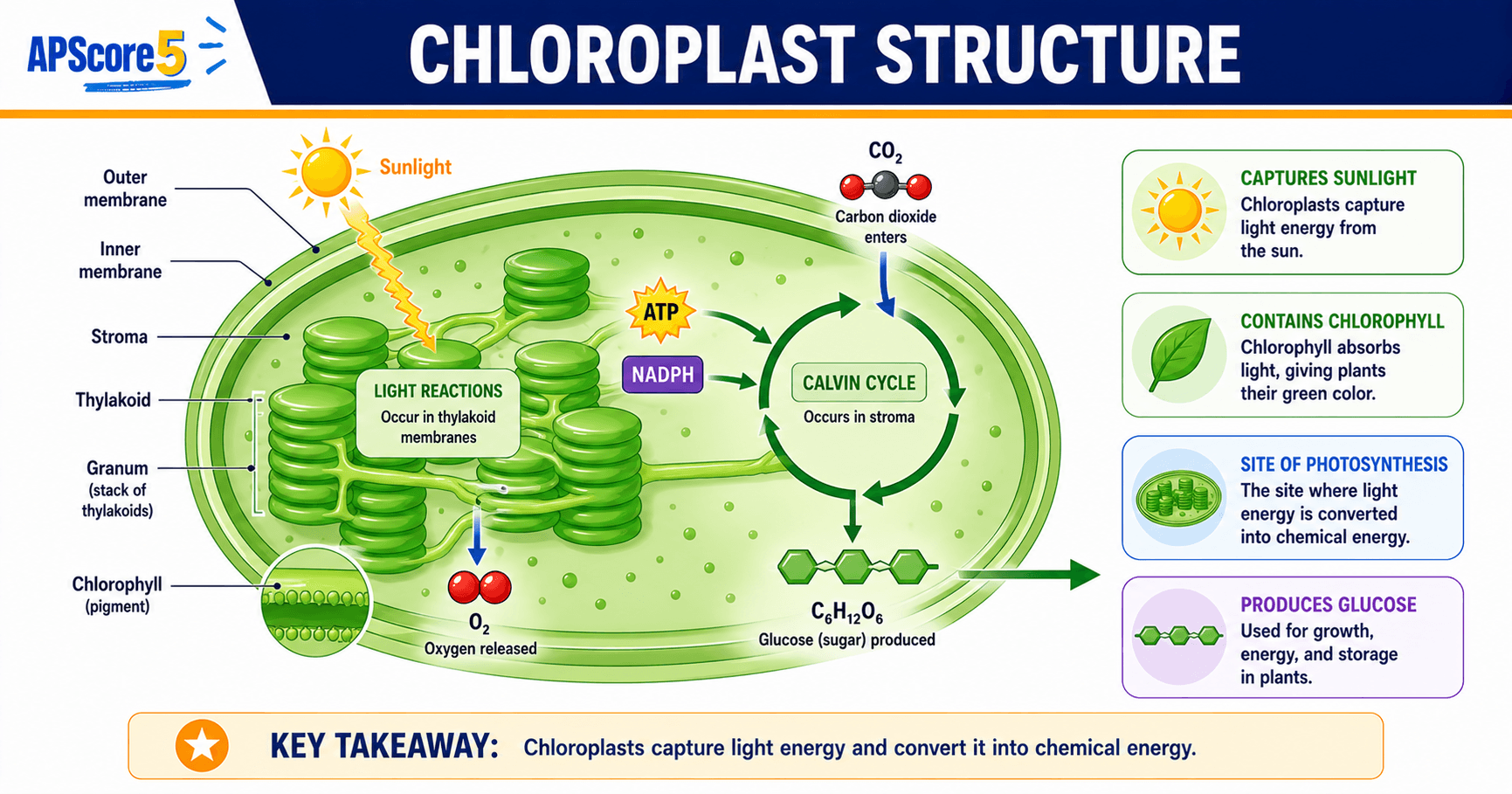
This chloroplast structure AP Biology table maps each part to its role in photosynthesis overview flow.
| Chloroplast part | Description | What happens there |
|---|---|---|
| Outer membrane | Smooth, permeable | Boundary |
| Inner membrane | Selectively permeable | Controls what enters the stroma |
| Stroma | Fluid-filled space | Calvin cycle occurs here |
| Thylakoid | Flat disc-like sacs | Light reactions occur on the membrane |
| Granum (grana) | Stack of thylakoids | Increases surface area for light reactions |
| Thylakoid lumen | Inside of thylakoid | H+ accumulates here during light reactions |
The structure is similar to a mitochondrion — both have an inner membrane folded for surface area, and both use that membrane for an electron transport chain plus chemiosmosis. This is no coincidence. Both organelles likely evolved from ancient bacteria through endosymbiosis.
What are the two stages of photosynthesis?
Photosynthesis has two main stages that happen in different parts of the chloroplast and serve different purposes.
2 Stages in Order
- Light-dependent reactions: light + H2O + ADP + NADP+ → ATP + NADPH + O2
- Calvin cycle: CO2 + ATP + NADPH → G3P/glucose + ADP + NADP+
The light reactions make ATP and NADPH; the Calvin cycle uses ATP and NADPH to fix carbon.
Stage 1: Light-dependent reactions — capture light energy and convert it into chemical energy carriers (ATP and NADPH). They happen on the thylakoid membrane and require light.
Stage 2: Calvin cycle (light-independent reactions) — use the ATP and NADPH from stage 1 to fix carbon dioxide into glucose. This happens in the stroma. It doesn't require light directly, but it does need the products of the light reactions.
Common mistake: The Calvin cycle is light-independent, but it usually runs during the day because it needs ATP and NADPH from the light reactions.
The two stages depend on each other. The light reactions produce ATP and NADPH, which the Calvin cycle consumes. The Calvin cycle produces ADP and NADP+, which the light reactions reuse. The cycle keeps running as long as there is light, water, and CO2.
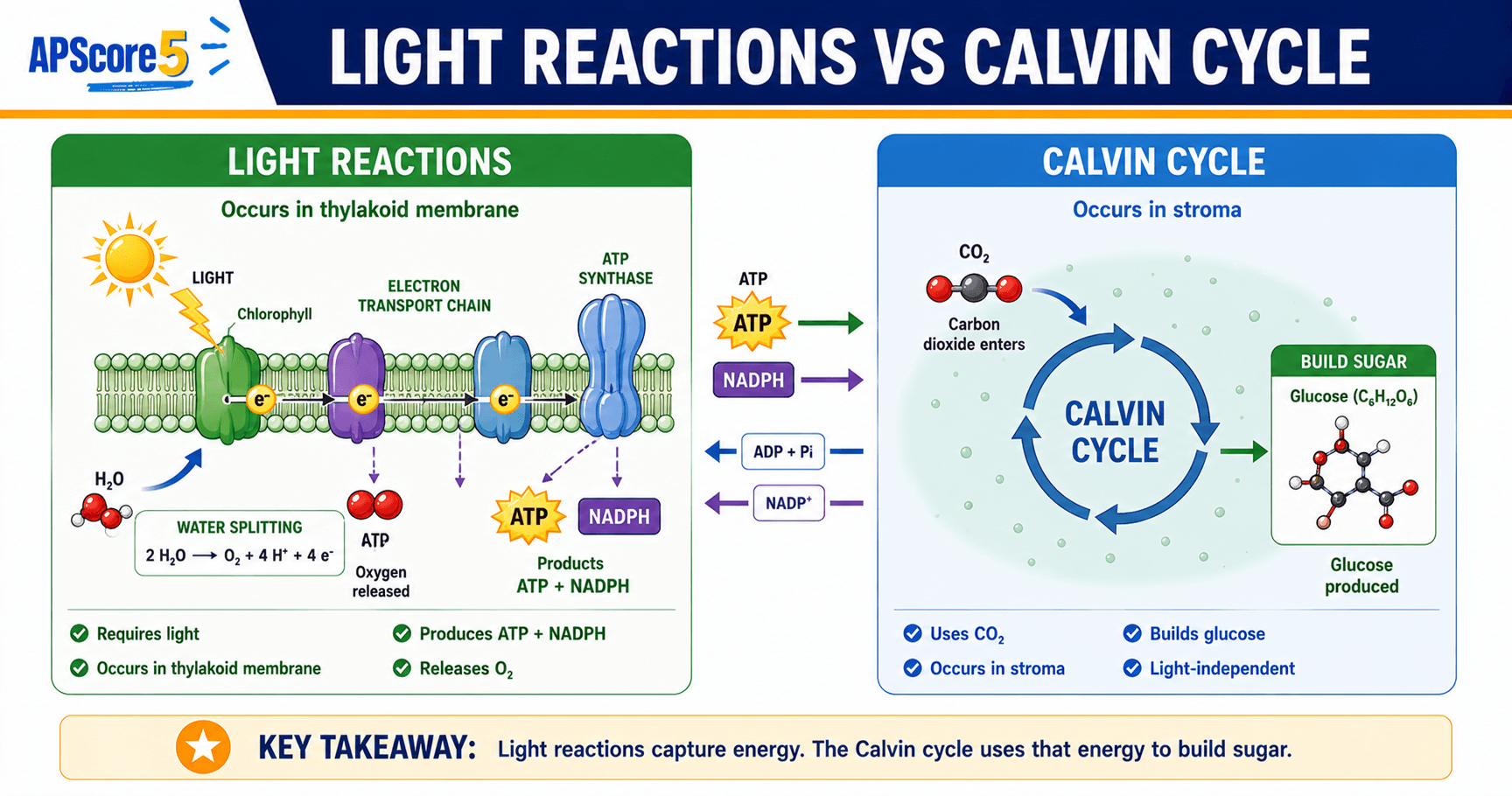
Stage 1: Light-dependent reactions explained
The light-dependent reactions happen on the thylakoid membrane. They capture light, split water, make ATP and NADPH, and release O2.
AP trap: The O2 released by photosynthesis comes from H2O (photolysis water oxygen), not from CO2—oxygen comes from water photosynthesis is a classic MCQ.
The five key steps:
- Light hits Photosystem II (PSII). Chlorophyll absorbs light, exciting electrons to a higher energy level.
- Water is split (photolysis). The reaction 2 H2O → 4 H+ + 4 e− + O2 replaces the lost electrons in PSII. This is where the O2 in our atmosphere comes from — directly from water molecules being split.
- Electrons travel through an electron transport chain. Energy is used to pump H+ from the stroma into the thylakoid lumen, creating a proton gradient.
- Electrons reach Photosystem I (PSI), absorb more light energy, and reduce NADP+ to NADPH. NADPH carries electrons to the Calvin cycle.
- H+ flows back through ATP synthase, making ATP (called photophosphorylation).
Outputs: ATP, NADPH, O2.
Critical AP point: O2 does NOT come from CO2. It comes from water via photolysis. This is one of the most-tested AP Bio facts. Tracing oxygen through the equation: 6 H2O has 6 oxygen atoms, all of which end up in 6 O2.
The light reactions use the same chemiosmosis principle as cellular respiration — an H+ gradient drives ATP synthase. The mechanism is identical, even though the organelle and the energy source (light vs glucose) are different.
AP trap: NADPH is the photosynthesis electron carrier; NADH is mainly used in cellular respiration—don't swap them on FRQs.
Stage 2: The Calvin cycle explained
The Calvin cycle (also called light-independent reactions) happens in the stroma of the chloroplast. It uses the ATP and NADPH from the light reactions to build glucose from CO2; on FRQs, expect to name RuBisCO when they ask where carbon fixation begins.
The three phases:
- Carbon fixation. The enzyme RuBisCO attaches CO2 to a 5-carbon molecule called RuBP, creating an unstable 6-carbon molecule that immediately splits into two 3-carbon molecules called 3-PGA. RuBisCO is the most abundant protein on Earth — it's that important.
- Reduction. Each 3-PGA is reduced using ATP and NADPH (both from the light reactions). The product is G3P (glyceraldehyde-3-phosphate), a 3-carbon sugar.
- Regeneration. Most of the G3P is recycled to regenerate RuBP, keeping the cycle running. About 1 in 6 G3P molecules exits the cycle to become glucose or other sugars.
To make one glucose (6 carbons), the Calvin cycle must run 6 times, fixing 6 CO2 molecules and using 18 ATP plus 12 NADPH.
Why "light-independent" doesn't mean "happens only at night": the Calvin cycle doesn't directly need light, but it needs ATP and NADPH from the light reactions. Without light, those carriers run out within minutes. So in practice, the Calvin cycle runs during the day, alongside the light reactions — just in a different part of the chloroplast.
This is one of the biggest AP Bio confusions. "Dark reactions" was a misleading old name. Modern textbooks now use "light-independent reactions" or "Calvin cycle" exclusively.
What is chlorophyll and how does it work?
Chlorophyll is the green pigment that captures light energy in the light reactions. It sits inside two protein complexes — Photosystem I and Photosystem II — embedded in the thylakoid membrane.
Chlorophyll absorbs red and blue wavelengths of light strongly and reflects green — which is why plants look green. The reflected light is the part that's NOT being absorbed.
Common mistake: Chlorophyll reflects green light; it absorbs red and blue light most strongly.
There are two main types in plants:
- Chlorophyll a — primary pigment, directly involved in the light reactions
- Chlorophyll b — accessory pigment, helps capture additional wavelengths and passes energy to chlorophyll a
Plants also have carotenoids (yellow, orange, red pigments) that absorb wavelengths chlorophyll misses and protect the plant from damage by excess light. In autumn, when chlorophyll breaks down, carotenoids become visible — that's why leaves turn yellow and orange.
How does photosynthesis make glucose?
Glucose is built one carbon at a time during the Calvin cycle. Here's the math:
- Key idea: 6 CO2 are fixed to build one glucose.
- Key idea: The Calvin cycle must turn 6 times for one glucose.
- Key idea: 18 ATP and 12 NADPH are used per glucose (from light reactions).
- Key idea: 2 G3P combine to form one glucose.
- Key idea: 10 G3P regenerate RuBP.
AP Bio note: Questions often ask where atoms go. CO2 supplies carbon for glucose; H2O supplies electrons and the O2 released by photosynthesis.
So making one glucose takes 6 turns of the Calvin cycle, 18 ATP, and 12 NADPH. Those carriers in turn require light reactions running on water and sunlight.
This connects elegantly back to cellular respiration: the glucose photosynthesis builds is exactly the same molecule that respiration breaks down. The 30–32 ATP a cell gets from respiring one glucose is the energy "withdrawal" from the deposit photosynthesis made.
How photosynthesis appears on the AP Biology exam
Photosynthesis is heavily tested on the AP Bio exam — both directly in Unit 3 and indirectly when comparing to cellular respiration.
In multiple-choice questions
- "Where does the Calvin cycle occur?" → stroma (NOT thylakoid membrane)
- "Where does O2 in photosynthesis come from?" → water, via photolysis (NOT CO2)
- "What does the Calvin cycle need from the light reactions?" → ATP and NADPH
- "What pigment absorbs red and blue light?" → chlorophyll
- "What enzyme fixes CO2?" → RuBisCO
In free-response questions
- Tracing electron flow through Photosystem II → ETC → Photosystem I → NADPH
- Predicting effects of changing light intensity, CO2 concentration, or temperature
- Comparing photosynthesis to cellular respiration (mechanism, location, direction)
- Analyzing experimental data on photosynthesis rate
Common stimuli
- Chloroplast diagrams with stages labeled
- Energy graphs showing where ATP and NADPH are produced and consumed
- Absorption spectra showing which wavelengths chlorophyll uses
AP Exam Answer Template
Photosynthesis captures light energy in the thylakoid membrane, where water is split and electrons move through photosystems to make ATP and NADPH. The Calvin cycle in the stroma uses ATP and NADPH to fix CO2 into G3P, which can be used to build glucose.
Score booster: Always name both the stage and the chloroplast location: thylakoid membrane or stroma.
Strong AP answer formula: Identify the stage → Explain location and inputs/outputs → Explain how ATP or NADPH is involved → Connect to the broader process (carbon cycle, energy flow, or comparison with respiration).
Test yourself in 5 seconds
Where does the oxygen released during photosynthesis come from?
Photosynthesis vs cellular respiration comparison
Why it matters: Photosynthesis vs cellular respiration questions reward precise wording—similar equations, but different pathways and locations.
These two processes recycle gases and sugars ecologically and are constantly compared on the AP Bio exam.
Common mistake: Photosynthesis and cellular respiration are chemically related, but they are not exact mechanical opposites step-for-step.
This photosynthesis vs cellular respiration table separates energy storage (glucose built) from energy release (ATP made).
| Feature | Photosynthesis | Cellular respiration |
|---|---|---|
| Overall reaction | 6 CO2 + 6 H2O + light → C6H12O6 + 6 O2 | C6H12O6 + 6 O2 → 6 CO2 + 6 H2O + ATP |
| Purpose | Build glucose using light energy | Break down glucose to make ATP |
| Direction | Anabolic (builds) | Catabolic (breaks down) |
| Location | Chloroplasts (stroma + thylakoid) | Mitochondria + cytoplasm |
| Inputs | CO2 + H2O + light | Glucose + O2 |
| Outputs | Glucose + O2 | CO2 + H2O + ATP |
| Energy carrier | NADPH | NADH and FADH2 |
| Has electron transport chain? | Yes (thylakoid membrane) | Yes (inner mitochondrial membrane) |
| Uses chemiosmosis? | Yes — H+ gradient drives ATP synthase | Yes — H+ gradient drives ATP synthase |
| Performed by | Plants, algae, cyanobacteria | Almost all organisms |
The two processes form an ecological cycle. Plants do photosynthesis, taking in CO2 from the atmosphere and releasing O2. Animals (and plants at night) do cellular respiration, taking in O2 and releasing CO2. The CO2 goes back to plants. The cycle continues indefinitely as long as energy keeps flowing in from the sun.
C3, C4, and CAM plants: photosynthesis variations
Not all plants do photosynthesis identically. Three strategies exist, each adapted to different climates.
Use this C3 C4 CAM plants AP Biology summary to explain carbon fixation trade-offs and hot, dry stress.
| Strategy | How CO2 is fixed | Best for | Examples |
|---|---|---|---|
| C3 | RuBisCO fixes CO2 directly into a 3-carbon molecule (3-PGA) | Cool, moist climates | Wheat, rice, soybeans |
| C4 | CO2 first fixed into a 4-carbon molecule, then transferred to RuBisCO in specialized cells | Hot, sunny climates | Corn, sugarcane, sorghum |
| CAM | Stomata open at night to take in CO2; Calvin cycle runs during the day | Arid (desert) climates | Cacti, pineapples, jade plants |
Why these variations exist: RuBisCO has a problem. When O2 levels are high (hot, dry days), RuBisCO sometimes grabs O2 instead of CO2, wasting energy in photorespiration AP Biology contexts. C4 and CAM plants evolved workarounds to keep RuBisCO away from high O2 concentrations.
This is a useful AP example of natural selection — plants in different climates evolved different photosynthesis strategies because the same enzyme works less well under different conditions.
Common AP Bio mistakes about photosynthesis
- Saying O2 comes from CO2. It comes from water, via photolysis in Photosystem II.
- Calling the Calvin cycle "dark reactions." It happens during the day too — it just doesn't directly need light.
- Confusing the locations. Light reactions = thylakoid membrane. Calvin cycle = stroma.
- Mixing up NADH and NADPH. NADPH is the photosynthesis carrier (note the P). NADH is the cellular respiration carrier.
- Saying chlorophyll absorbs green light. It reflects green and absorbs red and blue.
- Forgetting that photosynthesis uses chemiosmosis. ATP is made the same way as in cellular respiration — through H+ gradients and ATP synthase.
- Treating photosynthesis as the opposite of respiration mechanically. They're chemically reversed in terms of inputs/outputs, but they use similar mechanisms (electron transport, chemiosmosis). Compare them carefully on FRQs.
Extended practice: narrate photosynthesis like an FRQ
When a prompt shows a chloroplast cartoon, start by naming compartments: thylakoids versus stroma. Then trace energy: photons excite electrons in photosystems, water splitting replaces electrons and vents oxygen, the thylakoid ETC pumps protons, ATP synthase returns protons while phosphorylating ADP, and NADPH carries reducing power outward into the stroma where RuBisCO fixes carbon.
If the question manipulates light alone, explain ATP and NADPH availability before discussing Calvin-cycle rate. If it manipulates CO2, explain carbon fixation first, then mention that unused light-reaction products can accumulate briefly. If it manipulates temperature, separate thylakoid enzyme kinetics from Rubisco oxygenase competition that fuels photorespiration.
Pair every claim with location words AP readers reward: thylakoid membrane, stroma, lumen, photosystem, ATP synthase, NADPH. Avoid vague “it happens in the chloroplast” sentences unless you immediately narrow to membrane versus fluid.
Three-minute drill: sketch labels for PSII, PSI, ETC arrows, ATP synthase, and Calvin-cycle inputs on paper, then teach the diagram aloud without peeking—same cadence you want on test day.
Photosynthesis flashcards
Every fifth card advance triggers an ad placeholder with a three-second countdown before the next card appears.
Photosynthesis AP Biology practice questions
Photosynthesis FRQ practice
Prompt: A scientist studies a plant exposed to two experimental conditions: (1) bright light but no CO2, and (2) normal CO2 but total darkness. The scientist measures glucose production and ATP/NADPH levels in the chloroplasts.
- (A) Define photosynthesis and identify the two main stages.
- (B) Predict and explain what will happen to the rate of glucose production in condition (1) — bright light but no CO2.
- (C) Predict and explain what will happen to the rate of glucose production in condition (2) — normal CO2 but total darkness.
- (D) Use the results of conditions (1) and (2) to explain why the two stages of photosynthesis depend on each other.
Sample 4-point response
(A) Photosynthesis is the process plants and other photosynthetic organisms use to convert light energy into chemical energy stored in glucose. The two main stages are the light-dependent reactions (on the thylakoid membrane) and the Calvin cycle / light-independent reactions (in the stroma).
(B) Glucose production will stop almost immediately. The light reactions will continue and produce ATP and NADPH at first. But the Calvin cycle requires CO2 as an input — RuBisCO needs CO2 to combine with RuBP. Without CO2, the Calvin cycle halts. ATP and NADPH will accumulate in the stroma but no glucose will form.
(C) Glucose production will also stop, but for a different reason. Without light, the light reactions cannot proceed. ATP and NADPH won't be regenerated. Within minutes, existing ATP and NADPH will be consumed by the Calvin cycle, and then the Calvin cycle will halt because it has no energy carriers. Glucose production drops to zero.
(D) Together, these results show the two stages are interdependent. The light reactions can run without the Calvin cycle (briefly), but the products will accumulate uselessly. The Calvin cycle cannot run without the light reactions (more than briefly), because it depends entirely on the ATP and NADPH the light reactions produce. Photosynthesis as a whole only works when both stages run simultaneously, with the light reactions feeding ATP and NADPH to the Calvin cycle in real time.
Rubric (4 pts): A — defines photosynthesis AND names both stages with locations. B — predicts glucose stops AND explains CO2 is the missing input for the Calvin cycle. C — predicts glucose stops AND explains lack of ATP/NADPH halts the Calvin cycle. D — explains the interdependence using both experimental results.
Photosynthesis FAQ
What is photosynthesis?
Photosynthesis converts light energy into chemical energy stored in sugars. Photoautotrophs run light-dependent reactions on thylakoids and the Calvin cycle in the stroma inside chloroplasts.
What is the photosynthesis equation?
6 CO2 + 6 H2O + light energy → C6H12O6 + 6 O2 (balanced overview for AP Biology).
What are the two stages of photosynthesis?
Light-dependent reactions (thylakoid membrane) and the Calvin cycle (stroma). Light reactions output ATP and NADPH; the Calvin cycle consumes them to fix carbon.
Where do light-dependent reactions happen?
On the thylakoid membrane inside chloroplasts—often stacked as grana.
Where does the Calvin cycle happen?
In the stroma—the fluid surrounding thylakoids.
Where does the oxygen released during photosynthesis come from?
From water via photolysis in Photosystem II—not from CO2.
What is the role of chlorophyll?
Absorbs photons for photosystems; strongest absorption in blue and red, so green wavelengths are reflected.
What is the role of RuBisCO?
Catalyzes carbon fixation by attaching CO2 to RuBP—starting the Calvin cycle.
What do ATP and NADPH do in photosynthesis?
They store energy and reducing power from light reactions and are consumed in the Calvin cycle to reduce 3-PGA to G3P and regenerate RuBP.
How is photosynthesis different from cellular respiration?
Photosynthesis builds glucose using light and releases O2; respiration oxidizes glucose to make ATP and releases CO2. They recycle reactants ecologically but are not simple mechanical reversals of every step.
What is the difference between C3, C4, and CAM plants?
C3 fixes CO2 directly with RuBisCO; C4 concentrates CO2 before RuBisCO; CAM temporally separates CO2 uptake and Calvin cycling to save water.
What is photorespiration?
RuBisCO oxygenase activity when O2 competes with CO2—wastes energy; C4/CAM partly mitigate it.
Why is the Calvin cycle called "light-independent"?
No photons required directly—it uses ATP and NADPH—but it usually runs in daylight when those carriers are supplied.