Carbon
Forms the backbone of organic molecules — chains, rings, and branches.
AP examples: Glucose, amino acids, fatty acids, DNA bases.
Test clue: “organic molecule,” “carbon skeleton,” “chains/rings.”
AP Biology · Unit 1 · Chemistry of Life
Learn how CHNOPS and carbon make life’s molecules possible.
AP Biology elements of life questions usually test whether you understand how a few key elements—especially carbon, hydrogen, oxygen, nitrogen, phosphorus, and sulfur—build the molecules that make cells work. This page explains CHNOPS in plain English, connects each element to biological molecules, and gives you AP-style practice so you can recognize the concept in MCQs and FRQs.
Unit 1 progress
AP Biology · Unit 1
Part of Unit 1: Chemistry of Life
Pair this guide with water properties before you study macromolecules.
The main elements of life in AP Biology are carbon, hydrogen, oxygen, nitrogen, phosphorus, and sulfur, often remembered as CHNOPS. These elements form the major biological molecules: carbohydrates, lipids, proteins, nucleic acids, water, and many cell structures.
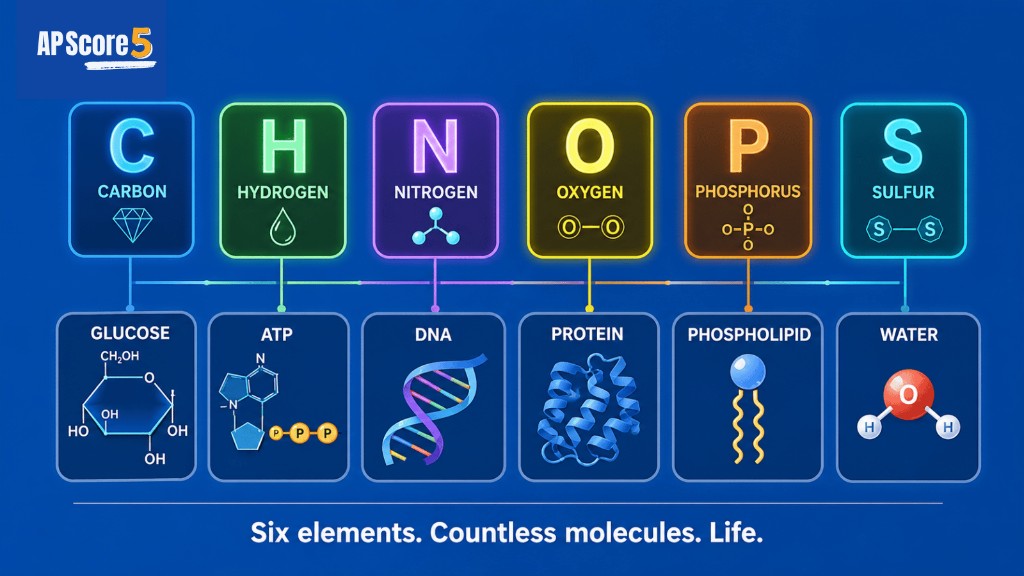
Elements of life AP Biology content is really about one big idea: living systems are built from matter, and a small group of elements appears again and again in the molecules cells need. The most important shortcut is CHNOPS—carbon, hydrogen, nitrogen, oxygen, phosphorus, and sulfur—but memorizing those letters is only the first step. For AP Biology, you need to connect each element to biological structures and functions. Carbon helps build diverse organic molecules. Nitrogen appears in proteins and nucleic acids. Phosphorus appears in ATP, DNA, RNA, and phospholipids. Sulfur helps stabilize some proteins. When you can connect elements to molecules and molecules to cell function, Unit 1 becomes much easier.
AP Biology Unit 1 starts with chemistry because cells are physical systems made of matter. Every membrane, enzyme, strand of DNA, and molecule of ATP is built from atoms. The reason this matters for AP Biology is simple: if you understand what elements can do chemically, you can better explain why biological molecules have certain shapes and functions.
Elements of life AP Biology content is not about memorizing every element on the periodic table. Instead, it focuses on a smaller set of elements that appear again and again in living systems. The most useful shortcut is CHNOPS: carbon, hydrogen, nitrogen, oxygen, phosphorus, and sulfur. These elements are especially important because they form water, organic molecules, proteins, nucleic acids, ATP, membranes, and many structures inside cells.
In AP Biology, the elements of life matter because they explain how simple atoms become water, carbohydrates, lipids, proteins, nucleic acids, membranes, enzymes, and DNA.
The strongest AP Biology answers usually connect chemistry to function. Instead of saying, “Carbon is found in living things,” a better answer says, “Carbon can form four covalent bonds, allowing it to create stable chains, rings, and branched molecules with different structures and functions.” That is the kind of structure-function explanation that helps on MCQs and FRQs.
AP questions often ask you to connect element → molecule → structure → function → cell process. When a stem mentions a phosphate group, think ATP, nucleotides, and membranes—not a random mineral. When it mentions amino groups, think proteins. When it mentions hydrocarbon chains, think lipids. Those links are how AP Biology writers test whether you understand chemistry of life, not just vocabulary.
Start with water properties if polarity and hydrogen bonding still feel fuzzy. Water is where oxygen and hydrogen show up first; CHNOPS builds on that foundation when you move into organic molecules.
Tap each letter or card to explore role, AP examples, and test clues. Explore all six to unlock the finish button faster.
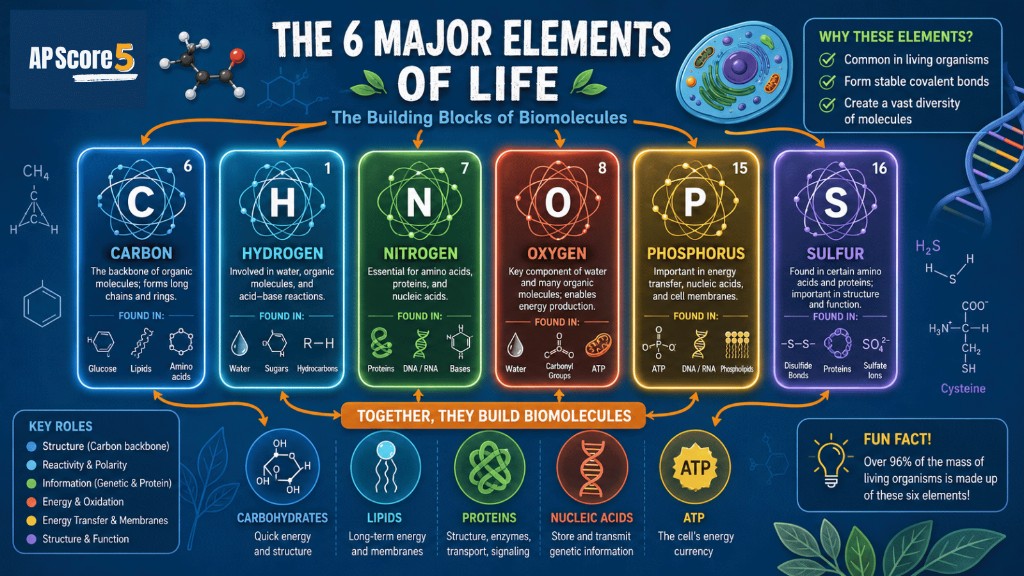
Forms the backbone of organic molecules — chains, rings, and branches.
AP examples: Glucose, amino acids, fatty acids, DNA bases.
Test clue: “organic molecule,” “carbon skeleton,” “chains/rings.”
Builds water and hydrocarbon regions in lipids and many organic groups.
AP examples: Water, carbohydrates, lipid hydrocarbon chains.
Test clue: “hydrogen bonding,” “pH,” “hydrocarbon.”
Found in water, functional groups, and molecules tied to energy transfer.
AP examples: Water, glucose, phosphate-linked groups.
Test clue: “polar,” “oxygen-containing group,” “cellular respiration.”
Builds amino acids, proteins, and nitrogenous bases in nucleic acids.
AP examples: Proteins, DNA, RNA, ATP bases.
Test clue: “amino group,” “nucleotide,” “protein.”
Central to phosphate groups in ATP, nucleic acids, and phospholipids.
AP examples: ATP, DNA/RNA backbone, phospholipid bilayer.
Test clue: “phosphate,” “energy transfer,” “nucleotide backbone.”
Stabilizes some protein shapes through disulfide bonds.
AP examples: Cysteine, disulfide bridges in folded proteins.
Test clue: “protein folding,” “tertiary structure,” “disulfide bridge.”
0 of 6 elements explored · tap each card once
Carbon, hydrogen, and oxygen appear in many biological molecules, especially carbohydrates and lipids. Nitrogen becomes especially important when you study amino acids, proteins, and nucleic acids. Phosphorus shows up in ATP, DNA, RNA, and phospholipids. Sulfur appears in some amino acids and can help stabilize protein structure.
Trace elements such as iron or zinc matter in smaller amounts, but CHNOPS covers the bulk of what Unit 1 expects you to explain on exams.
| Element | Symbol | Main biological role | AP Biology example | Common test clue |
|---|---|---|---|---|
| Carbon | C | Forms the backbone of organic molecules | Glucose, amino acids, fatty acids, DNA bases | “organic molecule,” “carbon skeleton,” “chains/rings” |
| Hydrogen | H | Helps form water and many organic molecules | Water, carbohydrates, lipids | “hydrogen bonding,” “pH,” “hydrocarbon” |
| Oxygen | O | Found in water and many functional groups; important in energy transfer | Water, glucose, phosphate groups | “polar,” “oxygen-containing group,” “cellular respiration” |
| Nitrogen | N | Builds amino acids and nucleic acids | Proteins, DNA, RNA, ATP nitrogenous bases | “amino group,” “nucleotide,” “protein” |
| Phosphorus | P | Builds phosphate groups, ATP, DNA/RNA backbones, phospholipids | ATP, DNA, RNA, phospholipid bilayer | “phosphate,” “energy transfer,” “nucleotide backbone” |
| Sulfur | S | Stabilizes some protein structures | Cysteine, disulfide bonds | “protein folding,” “tertiary structure,” “disulfide bridge” |
Carbon is the most important element to understand deeply in this topic. Carbon has four valence electrons, which means it can form four covalent bonds. This gives carbon unusual flexibility compared with many other elements. It can bond to hydrogen, oxygen, nitrogen, sulfur, phosphorus, and other carbon atoms.
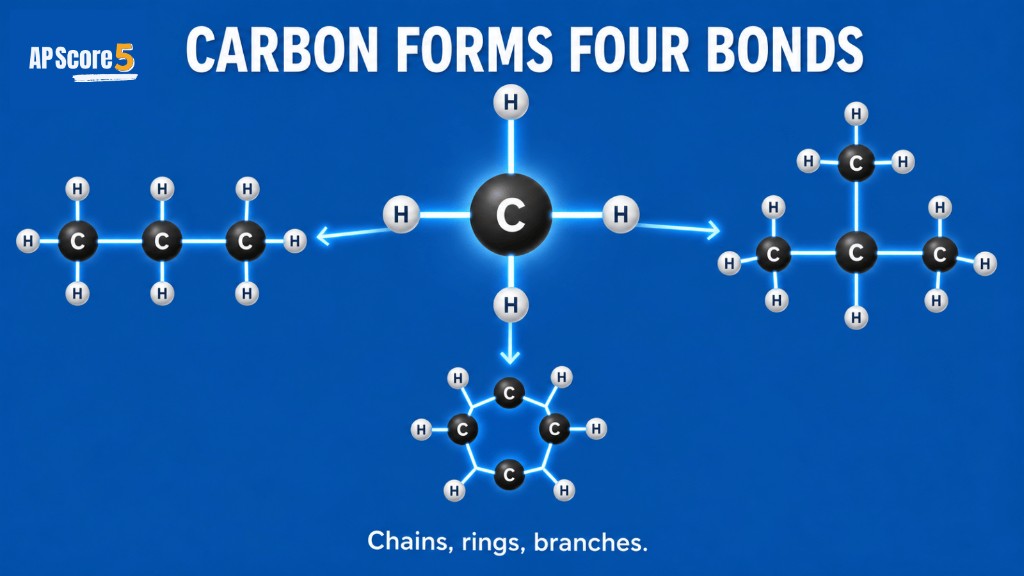
That last part is especially important: carbon can bond with itself. This allows carbon to form long chains, branched chains, and rings. Those structures become the skeletons of many organic molecules.
Glucose has a carbon skeleton. Fatty acids contain long hydrocarbon chains. Amino acids contain a central carbon attached to important functional groups. DNA and RNA contain carbon-based sugars and nitrogenous bases. Without carbon’s bonding ability, cells would not be able to build the diverse molecules needed for metabolism, heredity, membranes, enzymes, and structure.
Compare carbon with silicon on a released-style logic item: both can bond to four atoms, but carbon–carbon bonds are especially stable in aqueous cell chemistry, which helps explain why life’s polymers are carbon-based. You rarely need silicon details—just know why carbon’s bonding supports molecular diversity.
Elements become useful to living systems when atoms bond together to form molecules. A single carbon atom is not a carbohydrate by itself. A single nitrogen atom is not a protein by itself. But when atoms combine in specific arrangements, they form molecules with specific properties.
A helpful learning chain is:
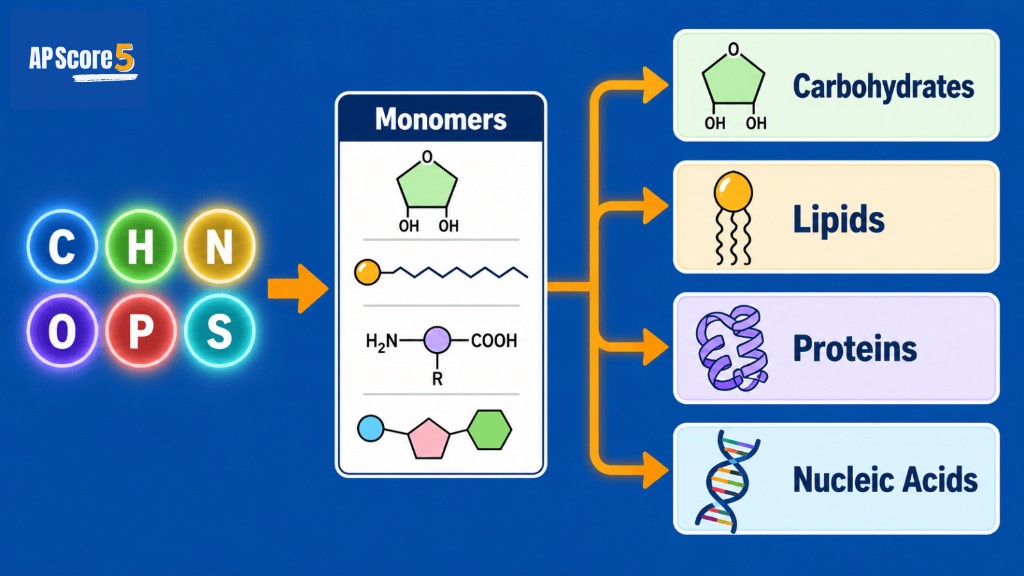
Atoms combine through chemical bonds. Molecules form when atoms are bonded together. Some small molecules act as monomers, or building blocks. Monomers can join to form polymers. Large biological polymers and other large molecules are called macromolecules. For a full guide on how building blocks combine, see monomers and polymers AP Biology.
For example, carbon, hydrogen, and oxygen can form carbohydrates such as glucose. Carbon and hydrogen form hydrocarbon chains common in lipids. Carbon, hydrogen, oxygen, nitrogen, and sometimes sulfur form amino acids and proteins. Carbon, hydrogen, oxygen, nitrogen, and phosphorus form nucleotides and nucleic acids.
This is why AP Biology often asks you to think across levels. A question might start with an element, but the real point may be a molecule’s function. Phosphorus matters because phosphate groups are part of ATP, DNA, RNA, and phospholipids. Nitrogen matters because it appears in amino acids and nitrogenous bases. Carbon matters because it forms the backbone of organic molecules.
When you move from elements to polymers, you will use macromolecules guides for side-by-side comparison. Elements of life is the vocabulary layer; macromolecule pages show how those atoms arrange into functional classes.
Once students learn CHNOPS, the next step is connecting those elements to macromolecules. This is where Unit 1 becomes more useful. You are not just memorizing letters. You are learning the chemical ingredients of the molecules that cells use.
Quick energy and structural support from sugar monomers.
Examples: glucose, starch, cellulose
Long-term energy storage and membrane structure.
Examples: phospholipids, triglycerides
Enzymes, transport, structure, and signaling.
Examples: amylase, hemoglobin
Store and transmit genetic information.
Examples: DNA, RNA
| Macromolecule | Main elements | Building blocks | Main function | AP example |
|---|---|---|---|---|
| Carbohydrates | C, H, O | Monosaccharides | Quick energy and structure | Glucose, starch, cellulose |
| Lipids | C, H, O, sometimes P | Fatty acids and glycerol | Long-term energy, membranes, signaling | Phospholipids, triglycerides, steroids |
| Proteins | C, H, O, N, sometimes S | Amino acids | Enzymes, transport, structure, signaling | Amylase, hemoglobin, membrane proteins |
| Nucleic acids | C, H, O, N, P | Nucleotides | Store and transmit genetic information | DNA, RNA |
Notice that carbon, hydrogen, and oxygen appear in all four major macromolecule groups. Nitrogen is especially important in proteins and nucleic acids. Phosphorus is especially important in nucleic acids, ATP, and phospholipids. Sulfur appears in some amino acids and helps stabilize some protein shapes.
Carbohydrates are mostly carbon, hydrogen, and oxygen. They are often used for quick energy or structural support. Lipids are also rich in carbon and hydrogen, which helps explain why many lipids are hydrophobic and store a lot of energy. Proteins include nitrogen because amino acids contain amino groups. Some proteins also include sulfur, which can help stabilize folded structures. Nucleic acids include nitrogen in their bases and phosphorus in their sugar-phosphate backbones.
AP Biology often uses these details to test structure and function. If a question mentions a phosphate group, think about ATP, nucleotides, DNA, RNA, and phospholipids. If a question mentions amino groups, think about amino acids and proteins. If a question mentions long nonpolar hydrocarbon chains, think about lipids.
Drill each class on its own spoke when you are ready: carbohydrates, lipids, proteins, and nucleic acids.
Fix: Know what each element helps build—phosphate groups need phosphorus; amino groups need nitrogen.
Fix: Lipids are grouped by hydrophobic behavior; they are not always repeating monomer chains like proteins.
Fix: Phosphorus is central to ATP, nucleic acids, and phospholipid membranes.
Fix: Nitrogen → amino acids and nitrogenous bases; phosphorus → phosphate groups.
Fix: Use structure-function language: four covalent bonds → diverse carbon skeletons → specific biological roles.
The most common mistake is treating CHNOPS like a vocabulary-only topic. Students memorize the letters but cannot explain what the elements do. AP Biology questions usually expect more than recall. They want you to connect chemical structure to biological function.
Another common mistake is confusing nitrogen and phosphorus. Nitrogen is found in amino groups and nitrogenous bases. Phosphorus is found in phosphate groups. That difference matters because phosphate groups are central to ATP, DNA/RNA backbones, and phospholipid membranes.
A third mistake is writing vague FRQ answers. For example, “carbon is important because organisms need it” is true but weak. A stronger answer explains that carbon forms four covalent bonds, allowing stable and diverse molecular structures. AP Biology rewards precise reasoning.
Follow these steps in order or jump to the topic you miss most on practice sets. You are on step 2.
Finish this guide, then open macromolecules for the next step in Unit 1.
Every 5th card shows an ad placeholder with a short countdown. Flip the card to read the definition, then use the arrow for the next card.
Choices shuffle at display time. Tap an answer, read the explanation, then use Next question. An ad appears after every 5th question with a short countdown.
Want more Unit 1 drills? Try daily AP Biology practice or practice by topic.
Click a question to open the full prompt. Write your answer on paper first, then reveal the rubric and a strong sample response.
Carbon has four valence electrons, so each carbon atom can form four covalent bonds with other carbons and with atoms such as hydrogen, oxygen, and nitrogen.
That tetravalence lets cells assemble linear chains, branched skeletons, and rings that stay stable at body temperature. A glucose ring, a fatty acid tail, and an amino acid side chain all rely on the same carbon bonding rules—different arrangements, not a different element.
On the exam, partial credit often requires both “four bonds” and a sentence linking that property to shape diversity in real macromolecules.
Name the bonding property first, then give a macromolecule example.
In proteins, nitrogen sits in the amino group (–NH₂) of each amino acid and remains part of the backbone once peptide bonds form. That chemistry supports enzyme active sites, hemoglobin’s oxygen binding, and the many R-group chemistries that determine folding.
In nucleic acids, nitrogen is in the nitrogenous bases of nucleotides—the rings that pair A–T and G–C (or A–U in RNA). Base pairing depends on those nitrogen atoms, so nitrogen here is about information storage and replication, not catalysis.
Same element, different jobs: nitrogen in proteins mainly supports structure and function of polypeptides; nitrogen in DNA/RNA supports complementary base pairing and the genetic code. A strong FRQ names both locations and states the functional consequence.
Do not stop at “both have nitrogen”—locate it in each polymer.
In ATP, phosphorus is part of phosphate groups. Hydrolyzing the terminal phosphate to ADP + Pᵢ releases free energy the cell couples to work such as muscle contraction or active transport—phosphorus here is tied to immediate energy transfer, not long-term storage like glycogen.
In RNA (and DNA), phosphorus forms the phosphodiester backbone that links nucleotides. Those covalent links create a stable polymer strand whose sequence of bases encodes information; phosphorus is structural and informational in nucleic acids, not primarily an energy “coin.”
CHNOPS lists phosphorus because it recurs in ATP, nucleic acids, and phospholipid membranes—three different macromolecule jobs. Unit 1 rewards you for matching the element to the molecule (ATP vs backbone) instead of treating P as interchangeable with nitrogen.
Use the muscle-cell ATP story from the prompt in your answer.
Living organisms are mostly built from six elements your course groups as CHNOPS: carbon, hydrogen, nitrogen, oxygen, phosphorus, and sulfur. Trace elements like iron and magnesium matter too, but Unit 1 MCQs usually ask you to match CHNOPS to macromolecules—glucose for CHO, hemoglobin’s iron is a separate story from the core CHNOPS list.
CHNOPS is a memory cue for carbon, hydrogen, nitrogen, oxygen, phosphorus, and sulfur—the atoms that show up again and again in carbs, lipids, proteins, and nucleic acids. Treat it like a checklist: if a molecule is clearly biological, you can usually point to several of these elements in its formula or structure diagram.
Carbon forms four covalent bonds, so it can bond to itself and many other atoms in chains, branches, and rings that stay stable at body temperature. That flexible backbone is why a simple sugar, a fatty acid tail, and an amino acid side chain all orbit carbon—without it, cells could not build the varied macromolecule shapes AP Bio tests.
Carbohydrates are built from carbon, hydrogen, and oxygen; many simple sugars follow a rough 1:2:1 ratio, as in glucose (C₆H₁₂O₆). Starch and cellulose are huge CHO polymers, but the element lineup stays the same—exam traps often sneak in nitrogen or phosphorus from proteins or DNA instead.
Proteins add nitrogen (and sometimes sulfur) to the CHO backbone because every amino acid has an amino group. Enzymes like catalase and structural proteins like keratin both depend on nitrogen for peptide bonds; disulfide bridges between cysteines bring in sulfur that helps lock tertiary shape.
DNA and RNA contain C, H, O, and N in their nitrogenous bases and sugars, plus phosphorus in the phosphate backbone. ATP is another phosphorus hotspot: when hydrolysis breaks ATP to ADP and inorganic phosphate, your cell releases energy it can use within seconds of a signal.
Phosphorus appears in phosphate groups (–PO₄) that link nucleotides and charge the polar heads of many membrane phospholipids. When the College Board asks about “energy coupling,” they often mean ATP’s phosphate transfer—not just memorizing the symbol P on a flashcard.
Nitrogen sits in amino groups of amino acids and in the rings of adenine, guanine, cytosine, thymine, and uracil. Farmers talk about nitrogen fixation for crops because plants need it for proteins and chlorophyll—the same idea explains why nitrogen-poor soil can limit growth even when water and light look fine.
Nitrogen supports the “information and enzyme” side of cells—protein structure and base pairing in DNA and RNA. Phosphorus supports energy and linkage chemistry—ATP, phosphodiester bonds, and phospholipid heads—so MCQs that show only N or only P are testing which job each element plays, not whether you can spell CHNOPS.
No—carbon provides the skeleton, but hydrogen and oxygen fill bonds and form water, while nitrogen, phosphorus, and sulfur specialize proteins and nucleic acids. A strong FRQ habit is to name the element, name a real molecule (ATP, phospholipid, enzyme), then state what that molecule does in the cell.
The same six elements rearrange into monomers that polymerize into carbohydrates, lipids, proteins, and nucleic acids. Once CHNOPS clicks, the next Unit 1 move is linking each element pattern to monomer-versus-polymer logic—glucose chains versus amino acid chains versus nucleotide strands.
FRQs rarely ask for a bare symbol list; they ask structure-to-function links, such as why carbon’s bonding supports diverse molecules or why removing phosphorus disrupts ATP cycling. Practice writing one sentence that names the element, one that names a concrete example (DNA backbone, enzyme active site), and one that states the cellular outcome.
Check each skill when you can explain it without looking at the page.
0 of 8 skills ready
Nice work — you explored CHNOPS and checked off the review skills. Continue to monomers and polymers to see how small building blocks form larger biological molecules.
You just learned the elements that make biological molecules possible. Next, learn how monomers join into polymers, then continue to dehydration synthesis and macromolecules.