Carbohydrates
Sugars and sugar polymers used for quick energy, energy storage, and structural support.
Examples: Glucose, starch, glycogen, cellulose
Main clue: Monosaccharides, polysaccharides, or glucose
AP Biology · Unit 1 · Chemistry of Life
Compare carbohydrates, lipids, proteins, and nucleic acids in one clear AP Biology guide.
AP Biology macromolecules questions usually test whether you can connect molecule structure to molecule function. The four major biological macromolecule groups are carbohydrates, lipids, proteins, and nucleic acids. This page gives you a clear comparison chart, explains monomers and polymers, shows how to identify each molecule type, and gives you AP-style practice so you can avoid common Unit 1 mistakes.
Unit 1 progress
AP Biology · Unit 1
Part of Unit 1: Chemistry of Life · Page 5 of 11
Pair with dehydration synthesis and hydrolysis (previous) and carbohydrates (next).
The four major biological macromolecules in AP Biology are carbohydrates, lipids, proteins, and nucleic acids. Carbohydrates provide energy and structure, lipids support membranes and long-term energy storage, proteins perform jobs such as enzymes and transport, and nucleic acids store and transmit genetic information.
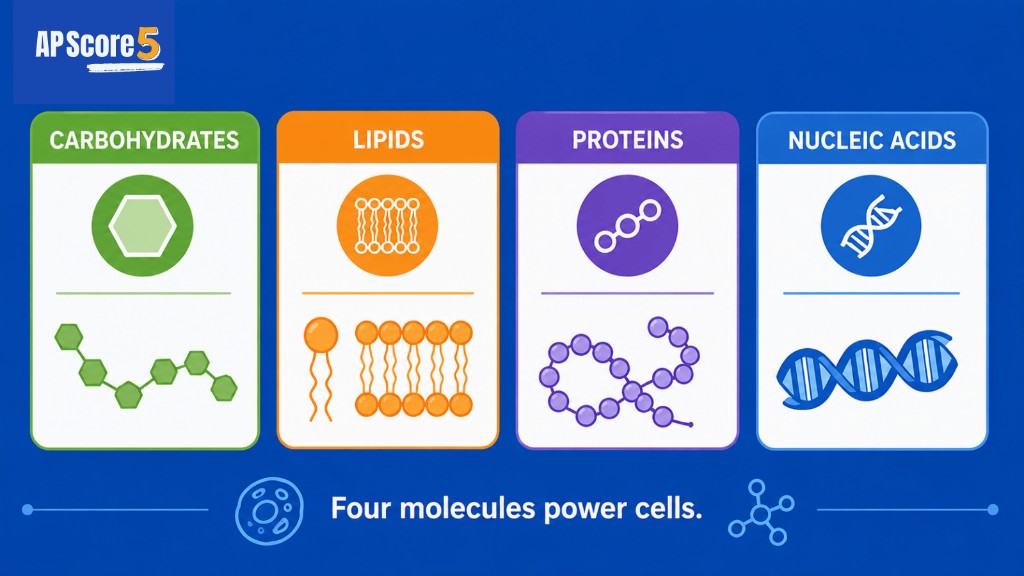
AP Biology macromolecules are the large biological molecules cells use to do life's work. The four major groups are carbohydrates, lipids, proteins, and nucleic acids. Carbohydrates often support energy and structure. Lipids support membranes, long-term energy storage, and signaling. Proteins fold into shapes that allow enzymes, transport proteins, receptors, and structural molecules to work. Nucleic acids store and transmit genetic information. For AP Biology, the goal is not just to memorize the four names. The goal is to connect each macromolecule's structure, building blocks, and chemical properties to its biological function.
If you have not reviewed subunits yet, start with monomers and polymers and dehydration synthesis and hydrolysis, then return here to compare all four classes before the deep dives on carbohydrates, lipids, proteins, and nucleic acids.
AP Biology Unit 1 connects chemistry to living systems. Macromolecules are large biological molecules cells use for energy, structure, enzymes, membranes, and genetic information. Students should not just memorize names—the AP exam tests structure-function relationships. Macromolecules connect earlier pages: elements of life, monomers and polymers, and dehydration synthesis and hydrolysis.
AP Biology Unit 1 is called Chemistry of Life because cells are built from molecules. Macromolecules are the large biological molecules that help cells store energy, build structures, speed up reactions, form membranes, and store genetic information.
In AP Biology, macromolecules matter because they connect chemistry to cell function.
The four major macromolecule groups are carbohydrates, lipids, proteins, and nucleic acids. Each group has a different chemical structure and a different biological role. Carbohydrates are often connected to energy and structure. Lipids are connected to membranes, long-term energy storage, and signaling. Proteins are connected to enzymes, transport, movement, structure, and communication. Nucleic acids are connected to DNA, RNA, and genetic information.
The key is not just memorizing the four names. AP Biology questions often ask why a molecule's structure helps it do its job. That means you should know the elements, building blocks, bonds, examples, and functions of each macromolecule group. Exam questions often trace: elements → monomers → polymer or molecule → structure → function → cell process.
Strong students also connect this topic back to water properties. Water participates in building and breaking polymers, which is one reason aqueous chemistry is central to life.
Use these four cards as a quick mental map before you open the full comparison chart. Each card lists examples and the vocabulary AP stems love to reuse.
Sugars and sugar polymers used for quick energy, energy storage, and structural support.
Examples: Glucose, starch, glycogen, cellulose
Main clue: Monosaccharides, polysaccharides, or glucose
Mostly hydrophobic molecules used for long-term energy storage, membranes, and signaling.
Examples: Triglycerides, phospholipids, steroids
Main clue: Hydrocarbon chains, nonpolar regions, membranes
Amino acid-based molecules that fold into shapes and perform many cell jobs.
Examples: Enzymes, hemoglobin, membrane proteins, collagen
Main clue: Amino acids, polypeptides, folding, enzymes
Nucleotide-based molecules that store and transmit genetic information.
Examples: DNA and RNA
Main clue: Nucleotides, nitrogenous bases, sugar-phosphate backbone
When a question gives you a molecule, ask: What elements are present? What building blocks are involved? What structure is described? What function is being tested?
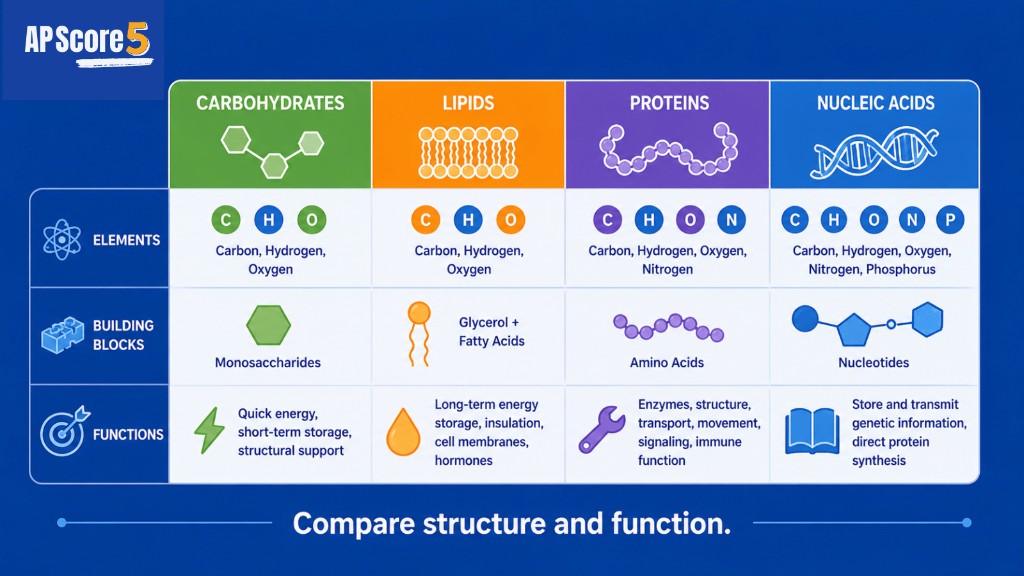
| Macromolecule | Main Elements | Building Blocks | Polymer / Larger Form | Main Functions | AP Examples | Test Clues |
|---|---|---|---|---|---|---|
| Carbohydrates | C, H, O | Monosaccharides | Disaccharides and polysaccharides | Quick energy, energy storage, structure | Glucose, starch, glycogen, cellulose | Sugar, glucose, polysaccharide, starch, cellulose, glycogen |
| Lipids | C, H, O; sometimes P | Fatty acids and glycerol for many lipids; not true repeating monomers | Triglycerides, phospholipids, steroids | Long-term energy storage, membranes, insulation, signaling | Fats, oils, phospholipids, steroid hormones | Hydrophobic, nonpolar, hydrocarbon chain, membrane, bilayer, hormone |
| Proteins | C, H, O, N; sometimes S | Amino acids | Polypeptides and folded proteins | Enzymes, transport, structure, movement, signaling, receptors | Amylase, hemoglobin, collagen, membrane channels | Amino acid, peptide bond, folding, enzyme, active site, denaturation |
| Nucleic Acids | C, H, O, N, P | Nucleotides | DNA and RNA | Store and transmit genetic information | DNA, RNA | Nucleotide, nitrogenous base, sugar-phosphate backbone, genetic code |
This chart is one of the most important AP Biology Unit 1 study tools. When a question gives you a molecule, ask: What elements are present? What building blocks are involved? What structure is described? What function is being tested?
Carbohydrates are made mainly of carbon, hydrogen, and oxygen. Many carbohydrates are built from monosaccharides. Monosaccharides include glucose. Larger carbohydrates include disaccharides and polysaccharides. Carbohydrates are used for quick energy, storage, and structure. Starch and glycogen store energy. Cellulose provides structural support in plant cell walls.
Carbohydrates are often the easiest macromolecule group to recognize because they are built around sugars. A monosaccharide is a simple sugar. Glucose is one of the most important examples. Cells can use glucose for energy, and glucose units can be joined into larger carbohydrates through dehydration synthesis.
Polysaccharides are carbohydrate polymers made of many monosaccharides. Starch stores energy in plants. Glycogen stores energy in animals. Cellulose provides structural support in plant cell walls. A common AP Biology theme is that structure affects function. Starch, glycogen, and cellulose can all involve glucose, but they do not all do the same job. Their bonding and arrangement affect how cells use them.
Continue to the carbohydrates deep dive for glycosidic bonds, branching patterns, and more AP-style examples.
Lipids are mostly hydrophobic. They are rich in carbon and hydrogen. Lipids are not usually true polymers. Common examples include triglycerides, phospholipids, and steroids. Triglycerides store long-term energy. Phospholipids form cell membranes. Steroids can act as hormones. Phospholipids are amphipathic: hydrophilic head and hydrophobic tails.
Lipids are the macromolecule group that causes the most confusion because they do not follow the monomer-polymer pattern as neatly as carbohydrates, proteins, and nucleic acids. Lipids are grouped mainly because they are mostly hydrophobic. They tend to contain many carbon-hydrogen bonds and do not mix well with water.
The most important AP Biology lipid example is the phospholipid. A phospholipid has a hydrophilic head and hydrophobic tails. This structure helps explain why phospholipids form bilayers in water—a perfect structure-function example that connects Unit 1 to Unit 2 membranes.
Open the lipids guide for triglyceride formation, saturation, and membrane diagrams.
Proteins are built from amino acids. Amino acids form polypeptides. Polypeptides fold into functional proteins. Protein shape determines function. Proteins can be enzymes, transport proteins, receptors, structural proteins, and signaling molecules. Denaturation can disrupt protein function. Primary, secondary, tertiary, and quaternary structure matter for folding. Sulfur can help stabilize some protein structures through disulfide bonds.
Proteins are among the most important macromolecules in AP Biology because they do so many cell jobs. Amino acids join to form polypeptides, and polypeptides fold into specific shapes. An enzyme's shape allows it to bind a substrate. A transport protein's shape affects what can cross a membrane. When a protein loses its shape, it can lose its function—this is called denaturation.
AP Biology often tests proteins through structure-function reasoning. Do not just say proteins are important. Explain that amino acid sequence affects folding, folding affects shape, and shape affects function.
Study sequence and folding in the proteins deep dive.
Nucleic acids are built from nucleotides. Nucleotides contain a sugar, phosphate group, and nitrogenous base. DNA and RNA are nucleic acids. DNA stores genetic information. RNA helps use genetic information to make proteins. Nucleic acids contain C, H, O, N, and P. Phosphodiester bonds connect nucleotides in the sugar-phosphate backbone.
Nucleic acids store and transmit genetic information. Both DNA and RNA are made from nucleotide monomers. DNA stores genetic information. RNA helps use that information, especially when cells build proteins. This topic becomes much deeper in AP Biology Unit 6, but Unit 1 introduces the chemical structure.
Nucleic acids are strong examples of structure-function. The sequence of bases stores information. The sugar-phosphate backbone provides structure. The molecule's organization allows genetic information to be copied, stored, and used.
Continue to the nucleic acids guide for base pairing and replication previews.
Carbohydrates, proteins, and nucleic acids clearly follow monomer-polymer logic. Carbohydrates: monosaccharides → polysaccharides. Proteins: amino acids → polypeptides/proteins. Nucleic acids: nucleotides → DNA/RNA. Lipids are the major exception—large biological molecules but not always true repeating polymers. This is a frequent AP Biology trap.
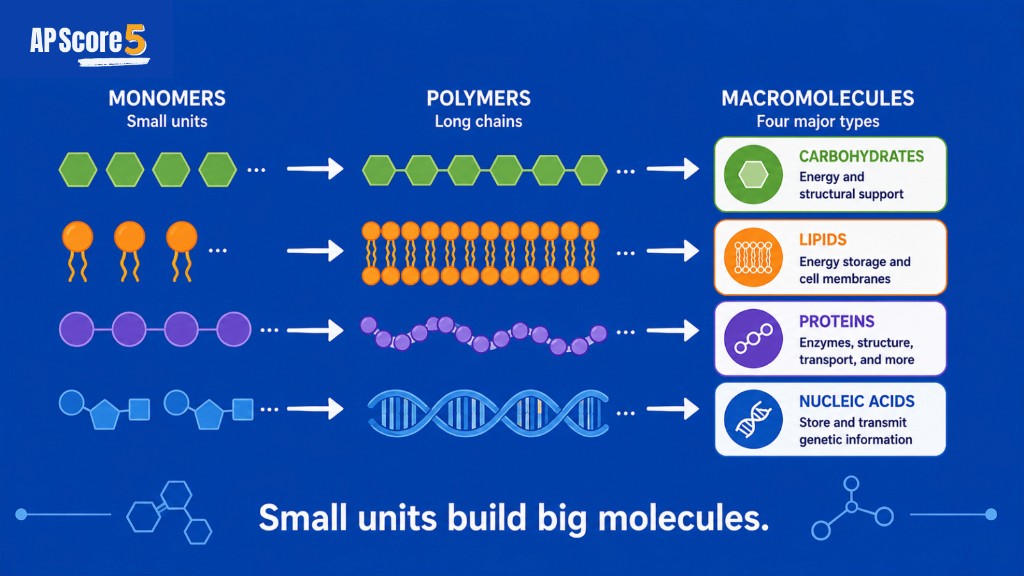
| Macromolecule | Monomer or Building Block | True Polymer? | Why It Matters |
|---|---|---|---|
| Carbohydrates | Monosaccharides | Often yes | Polysaccharides are sugar polymers. |
| Proteins | Amino acids | Yes | Amino acid sequence affects folding and function. |
| Nucleic Acids | Nucleotides | Yes | Nucleotide sequence stores genetic information. |
| Lipids | Fatty acids, glycerol, other components | Not usually | Lipids are grouped by hydrophobic properties, not a repeating monomer chain. |
Review monomers and polymers if you need the subunit vocabulary before exam day.
AP Biology rewards answers that connect molecular structure to biological role. Use these patterns when you write FRQs or eliminate MCQ distractors.
| Pattern | Molecule Type | Structure | Function |
|---|---|---|---|
| Glucose polymer branching | Carbohydrate | Branched chains | Energy storage |
| Hydrocarbon chains | Lipid | Nonpolar C-H rich tails | Hydrophobic behavior and energy storage |
| Phospholipid head and tails | Lipid | Hydrophilic head, hydrophobic tails | Membrane bilayer formation |
| Amino acid sequence | Protein | Specific order of amino acids | Folding and function |
| Active site shape | Protein | Specific 3D shape | Enzyme-substrate binding |
| Nucleotide sequence | Nucleic acid | Order of bases | Genetic information |
When you see denaturation, bilayer formation, or base sequence in a prompt, name the macromolecule class first, then explain how structure enables the function.
Look for molecule names, elements, building blocks, function clues, and structural terms. Watch out for the lipid exception. If the question says enzyme, think protein. If it says DNA/RNA, think nucleic acid. If it says bilayer or hydrophobic, think lipid. If it says glucose, starch, glycogen, or cellulose, think carbohydrate.
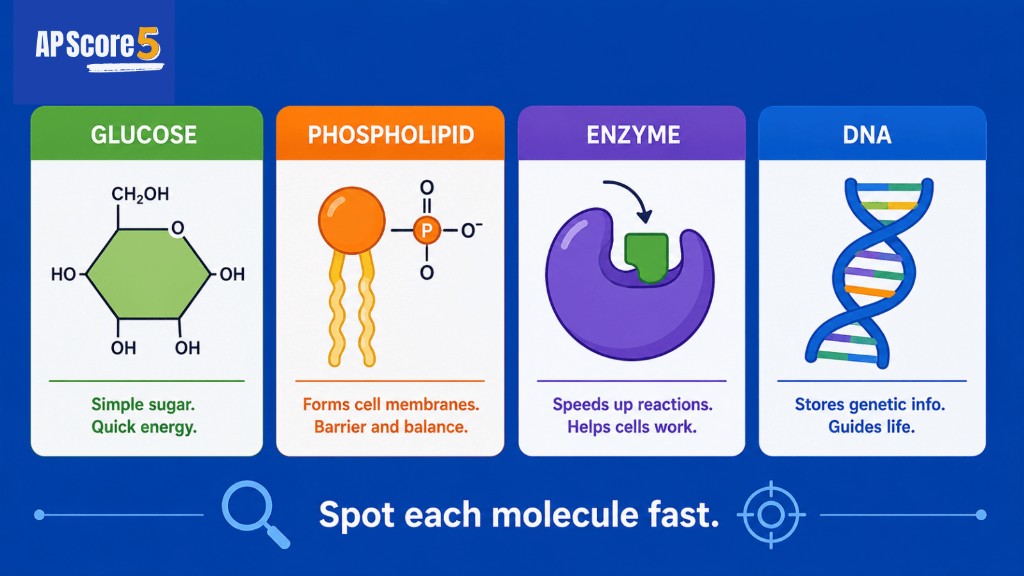
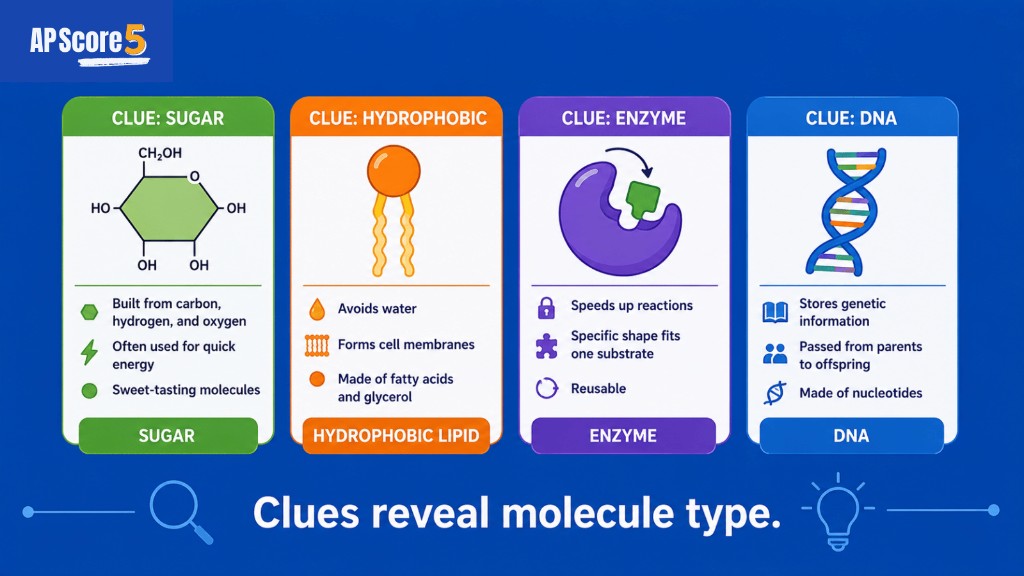
Practice this checklist with the MCQs below—choices shuffle so you cannot memorize letter positions.
Fix: Know how structure helps each molecule do its job—not just the four labels.
Fix: Lipids are large biological molecules but not usually true polymers.
Fix: Amino acids build proteins; nucleotides build DNA and RNA.
Fix: Phosphate groups are key in DNA, RNA, ATP, and phospholipids.
Fix: Some carbohydrates store energy; others provide structure (cellulose).
Fix: Protein function depends heavily on folding and 3D shape.
Fix: Phospholipids are lipids with hydrophilic heads and hydrophobic tails.
Fix: Terms like active site, bilayer, nucleotide, and polysaccharide are strong clues.
Open each card to reveal the answer and why the clue fits. Use these before the macro explorer below.
Answer: Carbohydrate
These are sugars or sugar polymers.
Answer: Lipid
Lipids are mostly nonpolar and help build membranes.
Answer: Protein
Proteins are built from amino acids and fold into functional shapes.
Answer: Nucleic Acid
Nucleic acids store and transmit genetic information.
Answer: Protein
Enzymes are proteins with specific active sites.
Answer: Lipid
Fats store long-term energy.
Answer: Carbohydrate
Cellulose is a structural polysaccharide.
Answer: Nucleic Acid
DNA and RNA have sugar-phosphate backbones.
Tap each type once to open details. Explore all four to enable the finish button sooner.
Monosaccharides · polysaccharides · quick energy and structure
Monomer: Monosaccharides (glucose)
Examples: Starch, glycogen, cellulose
AP clue: Sugar, glucose, polysaccharide
Hydrophobic · membranes · long-term energy
Building blocks: Fatty acids, glycerol (not true repeating polymers)
Examples: Triglycerides, phospholipids, steroids
AP clue: Bilayer, hydrophobic tails
Amino acids · folding · enzymes and structure
Monomer: Amino acids → polypeptides
Examples: Amylase, hemoglobin, collagen
AP clue: Peptide bond, active site, denaturation
Nucleotides · DNA/RNA · genetic information
Monomer: Nucleotides
Examples: DNA, RNA
AP clue: Sugar-phosphate backbone, bases
0 of 4 macromolecule types explored · tap each card once
Follow these steps in order. You are on step 5.
Continue to the carbohydrates deep dive.
Review lipids for bilayers and energy storage.
Study proteins for sequence and shape.
Open the nucleic acids guide.
Review monomer-polymer pairs.
Review dehydration synthesis and hydrolysis.
Review elements of life.
Review water properties.
Every 5th card shows an ad placeholder with a short countdown. Flip the card to read the definition, then use the arrow for the next card.
Choices shuffle at display time. Tap an answer, read the explanation, then use Next question.
Want more Unit 1 drills? Try daily AP Biology practice or practice by topic.
Click a question to open the full prompt. Write your answer on paper first, then reveal the rubric and a strong sample response.
Carbohydrates are often built from sugar units such as glucose and can be used for quick energy or storage in polysaccharides like starch. Lipids contain many nonpolar hydrocarbon regions in fatty acid tails, which do not mix well with water.
The nonpolar C-H rich structure of lipids allows them to store a large amount of energy per gram and to form hydrophobic regions in membranes. Carbohydrates are more water-friendly and easier to break down quickly for immediate ATP production—different structures, different energy strategies.
Compare sugar polymers to hydrocarbon-rich lipids—not just 'both store energy.'
Proteins are built from amino acids, and the amino acid sequence affects how the chain folds into a specific three-dimensional shape. That folded shape determines how the protein functions.
An enzyme works because its active site has a complementary shape for its substrate. Heat can cause denaturation, changing the shape without changing the sequence. Once shape is lost, binding and catalysis stop—so AP Biology rewards structure-function reasoning, not sequence alone.
Heat denatures shape—sequence unchanged but function lost.
The molecule is a nucleic acid, most likely DNA. It is built from nucleotide monomers linked by phosphodiester bonds in a sugar-phosphate backbone.
Nucleic acids such as DNA and RNA store or transmit genetic information. The sequence of nitrogenous bases encodes instructions cells use to build proteins and regulate metabolism—structure stores information, function follows sequence.
Sugar-phosphate backbone + bases → nucleic acid, not protein.
Many macromolecules are polymers: proteins from amino acids, nucleic acids from nucleotides, and many carbohydrates from monosaccharides. These classes form long chains of linked subunits with covalent bonds.
Lipids are the major exception. A triglyceride is glycerol plus three fatty acids—not a long repeating chain of identical monomers. Lipids are grouped as macromolecules because they are large and biologically important, but they are classified mainly by hydrophobic properties, not classic polymer chemistry.
Lipids are macromolecules—but not usually true polymers.
The four major macromolecules in AP Biology are carbohydrates, lipids, proteins, and nucleic acids. Each group has different building blocks, structures, and biological roles that AP questions expect you to compare.
Carbohydrates are used for quick energy, energy storage, and structural support. Glucose fuels respiration, starch and glycogen store energy, and cellulose strengthens plant cell walls.
Lipids are used for long-term energy storage, membranes, insulation, and signaling. Triglycerides store energy, phospholipids form membranes, and steroids can act as hormones.
Proteins perform many cell functions, including enzymes, transport, structure, movement, signaling, and receptors. Their amino acid sequence and folded shape determine which job each protein can do.
Nucleic acids store and transmit genetic information. DNA and RNA are the major examples, and their nucleotide sequences encode instructions cells use to build and regulate proteins.
The monomers of carbohydrates are monosaccharides, such as glucose. Monosaccharides can join into disaccharides and polysaccharides through dehydration synthesis.
The monomers of proteins are amino acids. Amino acids link by peptide bonds to form polypeptides that fold into functional proteins.
The monomers of nucleic acids are nucleotides. Each nucleotide has a sugar, phosphate group, and nitrogenous base.
Lipids are not usually true polymers because they are not made of long repeating monomer chains like proteins or nucleic acids. They are grouped as macromolecules mainly because they are large and mostly hydrophobic.
Look for clues such as glucose or starch for carbohydrates, hydrophobic tails or bilayers for lipids, amino acids or enzymes for proteins, and nucleotides or DNA/RNA for nucleic acids. Match the clue to building blocks and function before you pick an answer.
Enzymes are usually proteins. An enzyme's active site shape allows it to bind a specific substrate and speed up a chemical reaction.
Phospholipids, a type of lipid, form the main structure of cell membranes. Their hydrophilic heads and hydrophobic tails explain bilayer formation in water.
Nucleic acids store genetic information, especially DNA. RNA helps cells use that information during processes such as protein synthesis.
Be ready to connect each macromolecule's structure, building blocks, and chemical properties to its biological function. Strong FRQ paragraphs name the macromolecule, describe relevant structure, and explain why that structure supports a specific cell process.
Check each skill when you can explain it without looking at the page.
0 of 14 skills ready
Nice work—you explored all four macromolecule types and checked off the review skills. Continue to carbohydrates for your first deep dive, or open lipids, proteins, and nucleic acids from the links below.
You just compared the four major macromolecule groups. Next, go deeper into each molecule type, starting with carbohydrates.