Weber connects to industrial location theory when prompts list raw materials, markets, energy, or policy beyond the three-factor triangle.
What is Weber's Least Cost Theory in AP Human Geography?
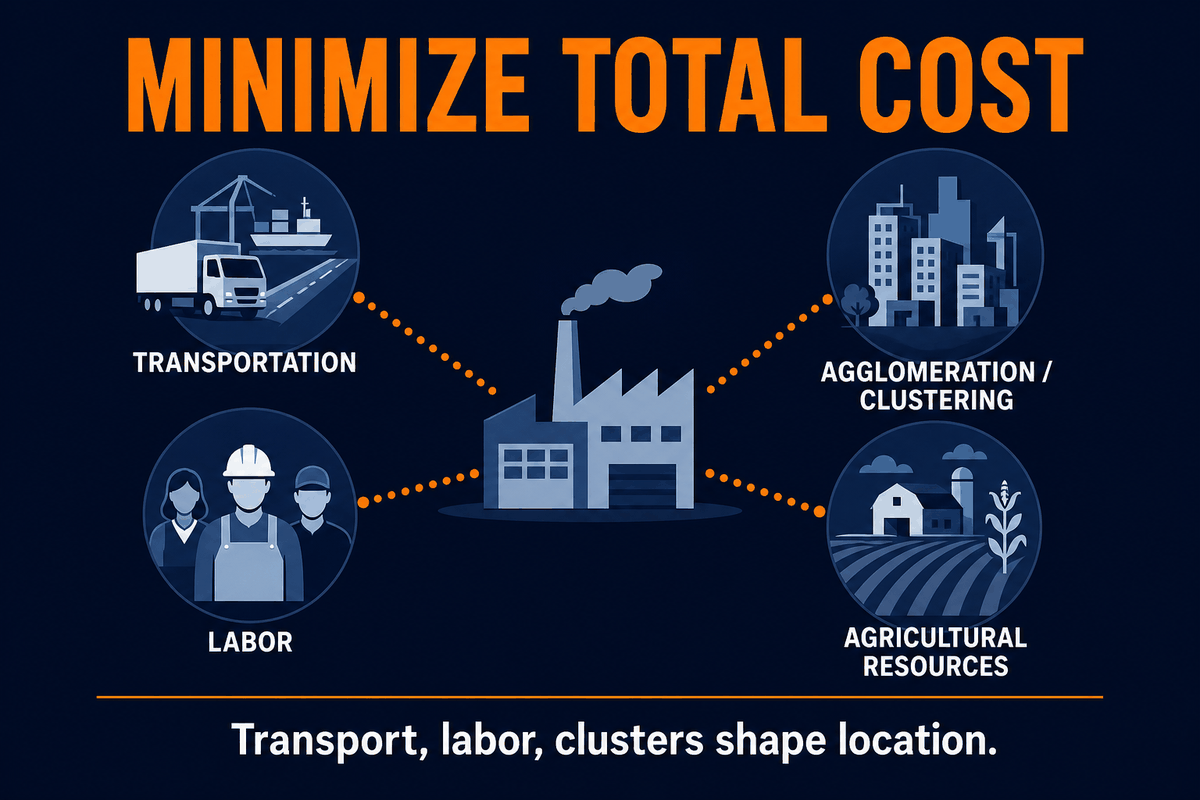
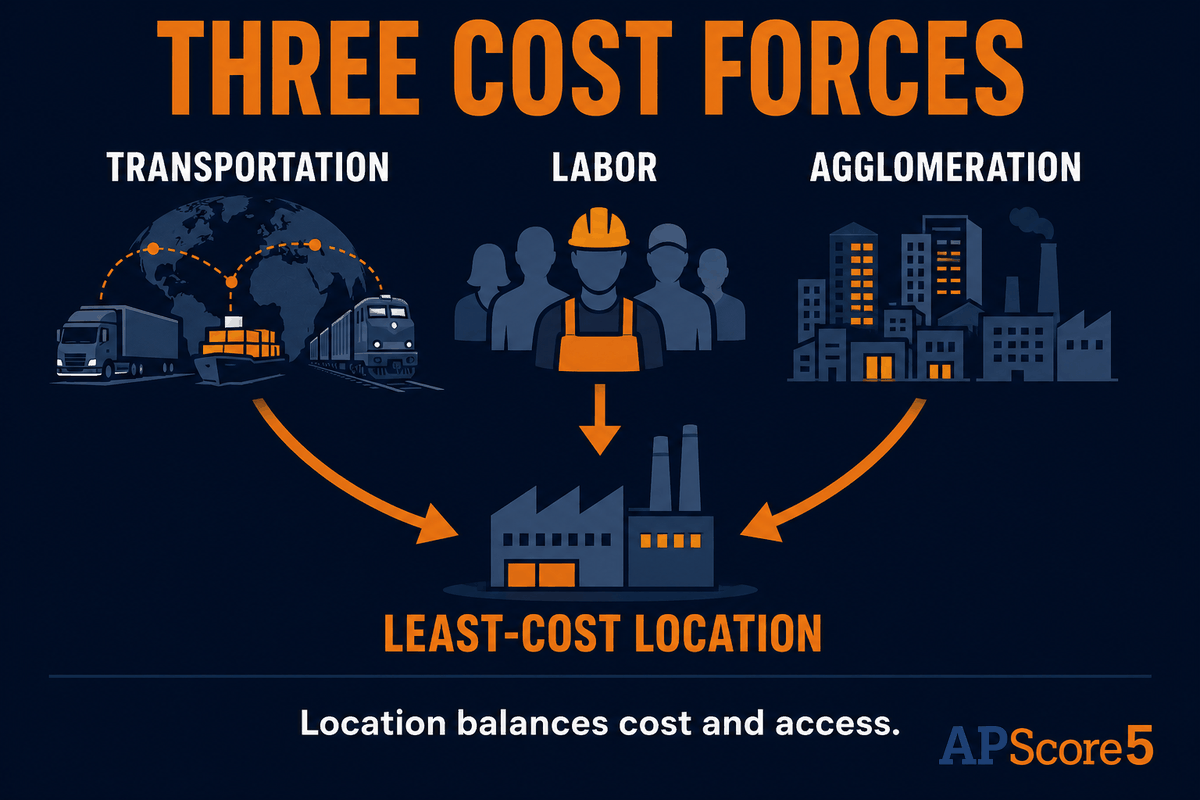
Weber's Least Cost Theory explains industrial location by arguing that factories choose locations that minimize total cost. In Weber's Least Cost Theory AP Human Geography, the three major cost factors are transportation costs, labor costs, and agglomeration. A factory may locate near raw materials, markets, cheaper labor, or other firms depending on which factor reduces cost the most.
Say it fast: Weber = factory location based on the lowest total cost.
AP clue: If the question mentions Alfred Weber, least cost, transportation, labor, agglomeration, raw materials, markets, or a location triangle, think Weber's Least Cost Theory.
Unit 7 hub → Industrial Location Theory → Weber's Least Cost Theory
Why Weber's Least Cost Theory Matters in AP Human Geography
Weber's Least Cost Theory AP Human Geography gives a formal way to explain why factories sit near ports, mines, labor pools, or industrial clusters — not randomly on the map.
Factory jobs link to economic sectors — especially secondary manufacturing — and to agglomeration when firms cluster for shared suppliers and labor.
Strong AP answers name the dominant Weber factor, explain why it lowers total cost, and add bulk-reducing or bulk-gaining logic when weight clues appear.
- Weber is a core Unit 7 model for maps, plant examples, and FRQs about factory sites.
- Transportation, labor, and agglomeration must be weighed together — not one alone.
- Bulk-reducing and bulk-gaining patterns explain which triangle vertex often wins.
- The location triangle organizes material, market, and labor clues on AP stimuli.
AP clue: Transport costs, labor costs, agglomeration, location triangle, bulk-reducing, bulk-gaining → Weber's Least Cost Theory.
What is Weber's Least Cost Theory?
Weber's Least Cost Theory is Alfred Weber's industrial location model that explains where a factory should locate to minimize total cost. Firms compare transportation costs for moving inputs and outputs, labor costs across regions, and agglomeration savings from clustering near suppliers and workers. AP Human Geography uses it with bulk-reducing, bulk-gaining, and location-triangle clues on maps and FRQs.
Weber's Least Cost Theory Explained
Weber's Least Cost Theory asks where a factory should locate to minimize total cost. Alfred Weber formalized industrial location as a balance among moving goods, paying workers, and gaining savings from clustering — not transport alone.
- Firms compare how far they must move heavy inputs, finished goods, and workers.
- Cheaper labor or agglomeration savings can pull a plant away from the lowest-freight point.
- Bulk-reducing industries often hug raw materials; bulk-gaining industries often chase markets.
- Weber is a model — real firms also weigh energy, policy, and footloose talent beyond the triangle.
For the wider factor list — markets, energy, footloose industries — see industrial location theory after you master the three Weber costs.
What are the three factors in Weber's Least Cost Theory?
Weber's three cost factors are transportation, labor, and agglomeration. Transportation covers moving inputs and outputs; labor compares wage rates and worker availability; agglomeration captures savings when firms cluster to share suppliers, infrastructure, and skilled labor. No single factor always wins — the least-cost site balances all three for that product and supply chain.
The Three Weber Cost Factors
Use this table before you pick an answer — Weber always weighs all three cost families, even when one dominates on the exam.
| Factor | What It Measures | AP Clue | Example |
|---|---|---|---|
| Transportation cost | Freight for moving inputs, parts, and finished goods | Port, highway, rail hub, heavy bulk to ship | Export warehouse at a break-of-bulk port |
| Labor cost | Wages, skill level, and worker availability | Lower wages, skilled technicians, large labor pool | Textile assembly in a lower-wage region |
| Agglomeration | Savings from clustering near suppliers and workers | Industrial district, supplier network, tech corridor | Automotive corridor with shared parts makers |
Transportation Costs in Weber's Model
Transportation costs include moving raw materials, parts, and finished goods by truck, rail, ship, or air. Distance, weight, and mode matter — heavy items cost more per mile, so location logic often follows the most expensive item to move.
- Break-of-bulk points attract warehouses where loads switch between ship, rail, and truck.
- Port cities reduce ocean shipping costs for global supply chains.
- When both input and output are heavy, compare which direction dominates total freight.
- Weber starts with transport minimization, then adjusts for labor and agglomeration.
Labor Costs in Weber's Model
Labor costs compare wage rates, skill levels, and worker availability across regions. Labor-intensive production is sensitive to wage differences — a pull that can offset higher transport on Weber-style map questions.
- Assembly plants may seek lower wages when labor is a large share of total cost.
- High-skill industries may seek universities, technicians, and specialized workers instead.
- Do not assume cheap labor alone explains every offshore move — also check transport and clustering.
- Name the wage or skill clue in FRQs; do not only say "cheap labor."
Agglomeration Benefits in Weber's Model
Agglomeration occurs when firms cluster to share suppliers, specialized labor, infrastructure, and knowledge spillovers. Weber treats clustering savings as a formal third cost factor that can pull a factory toward an industrial district.
- Shared parts suppliers and skilled labor pools reduce search and coordination costs.
- Tech corridors and automotive districts show agglomeration in action.
- Congestion, high rents, or pollution can limit agglomeration benefits.
- Weber includes agglomeration alongside transport and labor — not as an afterthought.
Go deeper on clustering benefits and deglomeration in the agglomeration study guide.
How does agglomeration affect Weber's model?
Agglomeration in Weber's model means clustering near other firms to cut costs through shared suppliers, specialized labor pools, infrastructure, and knowledge spillovers. Agglomeration savings can offset higher rent or longer transport for some industries. AP answers should explain the shared benefit — not only say firms cluster — and note congestion or high land costs as possible limits.
Bulk-Reducing, Bulk-Gaining, and Weber
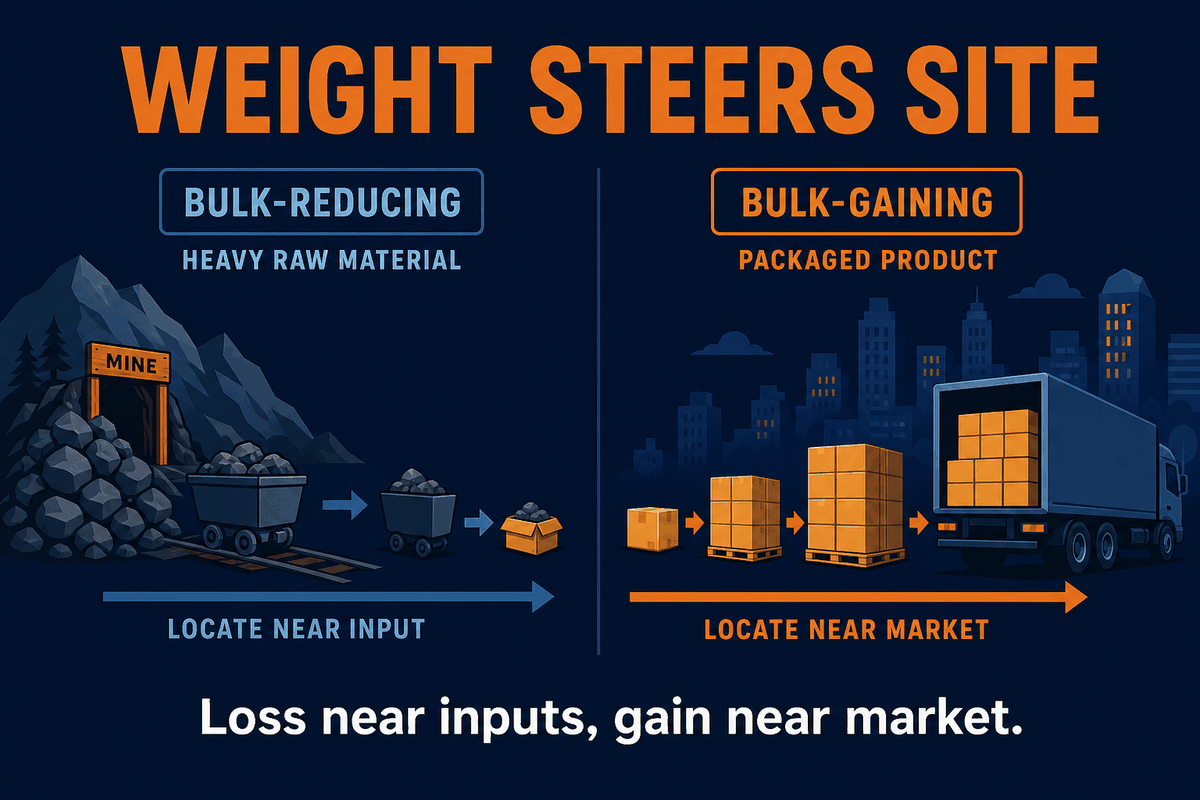
Weber's triangle works with bulk-reducing and bulk-gaining logic from industrial location theory. Ask which item is costlier to move long distance — the input or the output.
- Bulk-reducing industries lose weight during processing — often locate near raw material sources.
- Bulk-gaining industries gain weight or bulk — often locate near markets when finished goods dominate freight.
- Steel smelting and beverage bottling are classic AP contrasts within Weber analysis.
- Mixed cases exist; use the stimulus to identify which weight change matters most.
Weber's Location Triangle
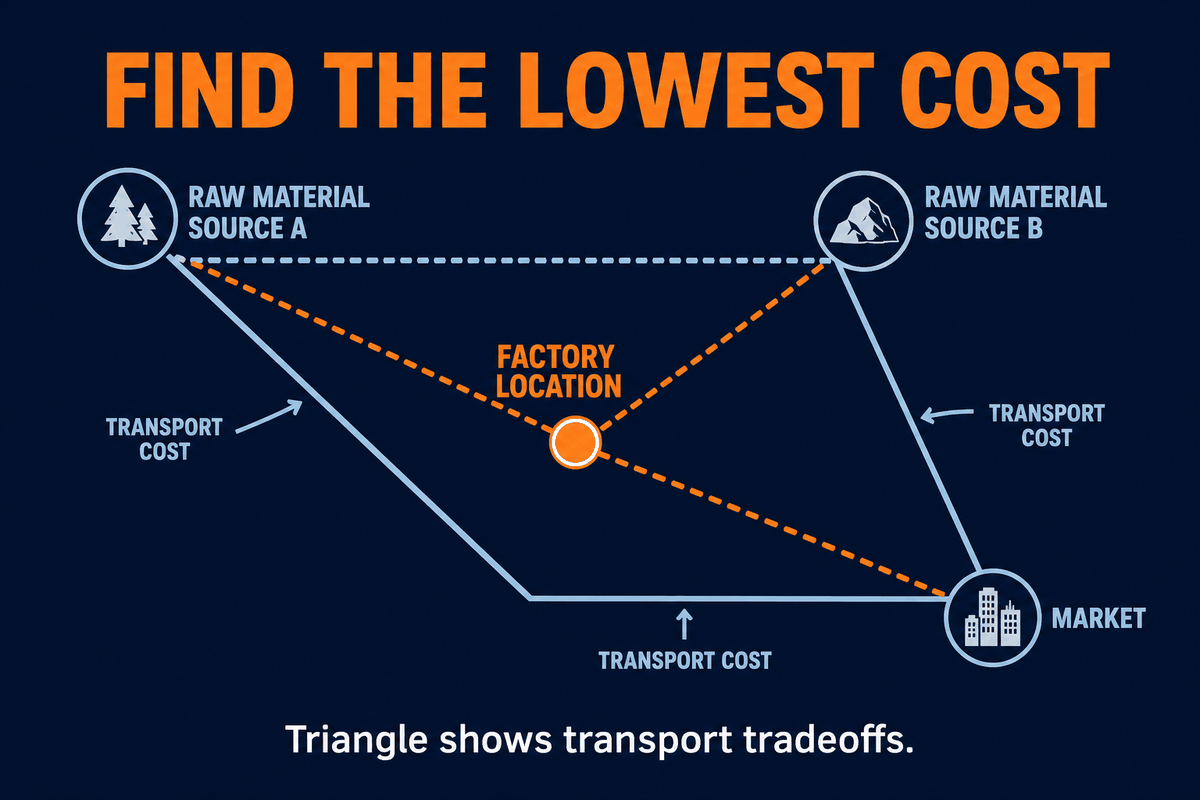
The location triangle places key points — raw material, market, labor — around a possible factory site. The least-cost location minimizes total transport among those points, then shifts when labor or agglomeration savings outweigh pure freight.
A map shows Point M at an iron ore deposit, Point K at a major consumer market, and Point L in a lower-wage labor region. A steel firm notes that processing greatly reduces ore weight.
- Which point is most likely to pull a bulk-reducing steel operation?
- When might Point L override pure transport minimization?
- What is one agglomeration clue that could shift the site again?
Reveal model explanation
1. Bulk-reducing pull: Point M — heavy ore is costly to ship before weight is lost during processing.
2. Labor override: If assembly or maintenance is labor-intensive and wage savings at L exceed extra freight, the firm may shift toward L.
3. Agglomeration clue: An existing supplier network or skilled metalworking cluster near a highway could pull the plant for shared infrastructure.
Why this earns credit: Names triangle vertices, connects bulk type to orientation, and shows labor or agglomeration can adjust the least-cost point.
What is the location triangle?
Weber's location triangle places raw material sources and a market around a possible factory site. The optimal location minimizes total transport cost for moving inputs and outputs, then adjusts when cheaper labor or agglomeration savings pull the plant elsewhere. AP items often show ore, market, and labor clues — name which vertex dominates before picking a site.
Weber vs Industrial Location Theory
Weber is the formal three-factor cost model; industrial location theory is the broader AP framework for all site factors.
| Feature | Weber's Least Cost Theory | Industrial Location Theory |
|---|---|---|
| Main focus | Minimize transport + labor + agglomeration | Compare all major site factors for a plant |
| Key tools | Location triangle, three cost factors | Bulk-reducing, bulk-gaining, orientation labels |
| Best AP clue | Port, wages, supplier cluster on one map | Mine, market, footloose talent, SEZ policy |
| Typical weakness | Can oversimplify to transport only | Can list factors without naming the dominant one |
| FRQ move | Name dominant Weber factor with evidence | Name dominant factor plus bulk or footloose label |
Weber Trap Fixer
Replace weak assumptions with stronger AP moves when Weber location clues appear on the exam.
| Trap | Why it is wrong | Stronger AP move |
|---|---|---|
| Weber only means transportation | Labor and agglomeration are formal Weber factors too | Weigh all three costs; name which one the stimulus emphasizes |
| Bulk-reducing and bulk-gaining are interchangeable | Weight change direction pulls location differently | State whether processing loses or gains bulk, then pick material or market orientation |
| Cheapest labor always wins | Heavy freight on bulky goods can exceed wage savings | Compare transport cost for the heaviest item moved |
| Agglomeration always wins | Congestion and rent can push firms outward | Explain shared suppliers or labor, but note limits if asked |
| Location triangle is only geometry | Triangle organizes material, market, and labor cost pulls | Label each vertex and explain which dominates for that product |
| Weber replaces industrial location theory | Broader factors include energy, policy, and footloose talent | Use Weber for three-factor clues; widen to industrial location when needed |
| Market orientation means any city factory | Need bulky, fragile, or perishable finished goods logic | Cite weight gained, spoilage, or delivery cost to consumers |
| One factor explains every global shift | Policy, trade, technology, and deindustrialization also reshape sites | Pair Weber factor with broader change when the stem includes it |
Map Cost Clue Practice
Practice reading a location stimulus like an AP map or data question. Draft your answer, then open the model explanation.
A map shows Site X near an iron ore deposit and coal field, Site Y near a major port and interstate highway interchange, and Site Z in a large metropolitan consumer market with a lower-wage satellite town nearby. A beverage company notes that finished bottles gain bulk after water and packaging are added.
- Which site best fits a bulk-reducing steel operation using Weber logic?
- Which site best fits a bulk-gaining beverage bottler?
- What is one transportation clue for Site Y?
- What is one labor-cost clue that could affect Site Z?
Reveal model explanation
1. Steel (bulk-reducing): Site X — ore and coal proximity minimize transport of heavy inputs before weight is lost.
2. Beverage bottler (bulk-gaining): Site Z — finished bottles are bulky near consumers; market orientation cuts delivery cost.
3. Site Y transport clue: Port plus interstate interchange lowers import/export and domestic freight costs.
4. Site Z labor clue: Lower-wage satellite town near the metro market can reduce assembly or delivery labor cost while staying near consumers.
Why this earns credit: Matches bulk type to Weber orientation, cites specific spatial evidence, and separates transport from labor logic.
Least-Cost Location Builder
Read each clue and classify it as Transportation Cost, Labor Cost, Agglomeration, Raw-Material Orientation, or Market Orientation. Score 12 clues with instant feedback.
How to Use Weber's Least Cost Theory in FRQs
Name the dominant Weber factor → cite spatial evidence → explain why it lowers total cost.
Weak answer
The factory is near the highway because of Weber.
Better answer
The bottling plant uses market orientation because finished beverages gain bulk after water and packaging are added. Locating near a large urban market reduces transportation costs for heavy finished goods and allows faster delivery to retailers — a Weber least-cost choice when bulk-gaining dominates freight.
Sentence starters
- The dominant Weber factor is…
- Transportation cost is shown when…
- Labor cost pulls the site because…
- Agglomeration explains clustering because…
- This industry is bulk-reducing because…
- This industry is bulk-gaining because…
A strong answer names the factor, connects it to product weight or access, and uses location-triangle language when the map supports it.
How do you use Weber's Least Cost Theory on an AP Human Geography FRQ?
Name the dominant Weber factor — transport, labor, or agglomeration — cite specific stimulus evidence (port, highway, wage gap, supplier cluster), and explain why that factor lowers total cost. Add bulk-reducing or bulk-gaining logic when weight changes, and contrast with broader industrial location factors if the prompt includes energy, policy, or footloose talent instead of bulky freight alone.
FRQ Practice and Location Sprints
Full FRQ
A soft-drink bottling company must choose between Site A in a large metropolitan consumer market and Site B near a major port and sugar-supplier rail line. The company adds water and packaging at the plant, making finished bottles bulky and costly to ship long distances. Most customers remain in domestic markets.
- A. Identify the bulk type shown.
- B. Explain which site better fits Weber's least-cost theory for this bottler.
- C. Explain one transportation or agglomeration clue that could still make Site B attractive.
- D. Explain one limitation of using only bulk-gaining logic to predict every factory location.
Planning hint
A: bulk-gaining. B: Site A near metro market. C: port/rail at B or supplier cluster. D: labor, agglomeration, policy, or footloose factors also matter.
Reveal rubric, model answer, and weak vs better samples
Rubric (4 points typical)
- 1 pt — Bulk-gaining (weight or bulk added during bottling)
- 1 pt — Site A: market orientation minimizes shipping bulky finished goods to consumers
- 1 pt — Valid Site B clue: port/rail access or agglomeration with suppliers
- 1 pt — Valid limitation: labor, agglomeration, energy, policy, or footloose logic also shape sites
Model A: Bulk-gaining — water and packaging increase product bulk at the plant.
Model B: Site A fits better because market orientation places bottling near large consumer demand, reducing transportation cost for heavy finished beverages.
Model C: Site B offers port and rail access for imported syrup or sugar and possible supplier clustering along the transport corridor.
Model D: Bulk-gaining logic alone ignores labor cost differences, agglomeration with distributors, government incentives, and footloose management talent.
Common weak answer: Site A is near people so it is the answer.
Better answer: The operation is bulk-gaining because water and packaging increase product bulk, so Site A's market orientation near a large metropolitan consumer market minimizes shipping heavy finished bottles to retailers. Site B could still compete through port and rail access for inputs or supplier agglomeration, but the dominant Weber clue is bulk gained toward the market — though real firms also weigh labor, clustering, and policy beyond one bulk rule.
Why this earns credit: Names bulk type, picks a site with evidence, acknowledges a competing factor, and states a limitation.
Location sprint 1
A copper smelter locates at the mine because the ore is heavy and loses weight during refining.
- A. Identify the Weber orientation and bulk type.
- B. Explain why the location lowers total cost.
Reveal sprint rubric and model
Sprint rubric (2 points)
- 1 pt — Raw-material orientation and bulk-reducing (both or equivalent)
- 1 pt — Heavy ore transported shorter distance before weight is lost, cutting transportation cost
Model A: Raw-material orientation; bulk-reducing industry.
Model B: Locating at the mine minimizes shipping heavy ore long distances before refining reduces its weight and transportation cost — a Weber least-cost pull toward the material vertex.
Location sprint 2
A labor-intensive apparel factory moves from an expensive labor market to a lower-wage region even though transport costs to port increase slightly.
- A. Identify the dominant Weber factor.
- B. Explain why the move can still minimize total cost.
Reveal sprint rubric and model
Sprint rubric (2 points)
- 1 pt — Labor cost (dominant Weber factor)
- 1 pt — Wage savings on labor-intensive production outweigh the modest rise in transport cost to port
Model A: Labor cost.
Model B: When assembly is labor-intensive, lower wages can reduce total cost more than the extra freight to reach export ports — Weber weighs labor alongside transportation.
Common Mistakes
Saying Weber only means transportation
Wrong: Pick the cheapest shipping route and ignore everything else.
Better: Weber includes transportation, labor, and agglomeration.
Confusing raw-material orientation and market orientation
Wrong: Both orientations always locate at the same triangle point.
Better: Weight-losing/bulk-reducing industries often locate near raw materials; bulk-gaining industries often locate near markets.
Treating agglomeration as unrelated
Wrong: Clustering is separate from Weber's model entirely.
Better: Agglomeration is one of Weber's three major cost factors.
Saying least cost means cheapest land
Wrong: The factory always picks the lowest rent site.
Better: Least cost means lowest total cost, not just land price.
Ignoring model limitations
Wrong: Weber explains every modern location decision perfectly.
Better: Real-world location decisions also include policy, taxes, trade rules, technology, risk, and global supply chains.
AP Exam Clues
Weber vocabulary
- Weber's Least Cost Theory
- Alfred Weber
- transportation cost
- labor cost
- agglomeration
- location triangle
- least-cost site
- bulk-reducing
- bulk-gaining
Spatial clues
- near mine or ore deposit
- near major city or market
- port city or break-of-bulk
- highway or rail interchange
- lower-wage labor region
- skilled worker pool
- industrial district cluster
- supplier network nearby
Contrast clues
- not transport alone
- weight lost → materials
- weight gained → markets
- labor savings override freight
- cluster vs isolated plant
- Weber vs industrial location
- footloose beyond triangle
- policy or energy also matter
AP clue: Decision rule: If the prompt asks where a factory should locate, identify the dominant Weber factor and whether the product is bulk-reducing or bulk-gaining.
Practice MCQs
9 AP-style questions on weber's least cost theory ap human geography. Choices shuffle at display time.
Definition
Question 1
Which statement best defines Weber's Least Cost Theory?
Explanation: Weber's Least Cost Theory minimizes transport, labor, and agglomeration — the three formal cost factors in Alfred Weber's industrial location model.
Why the tempting wrong answer fails: Five stages are Rostow; unequal trade is dependency theory; HDI is a composite index.
AP clue: Transport, labor, agglomeration, least cost, location triangle → Weber.
Alfred Weber
Question 2
Alfred Weber's least-cost model is most closely associated with which geographic question?
Explanation: Alfred Weber formalized industrial location as a least-cost problem balancing freight, wages, and agglomeration savings.
Why the tempting wrong answer fails: Five stages are Rostow; core-periphery is Wallerstein; sector shifts are economic sectors.
AP clue: Alfred Weber, factory site, minimize cost → least-cost industrial location.
Transportation
Question 3
A manufacturer builds near a port to reduce shipping costs for imported parts and exported finished goods. Which Weber factor is most directly shown?
Explanation: Port access cuts transportation cost for global inputs and outputs — a core Weber transportation factor.
Why the tempting wrong answer fails: Dependence is a development theory; mass consumption is Rostow; GII measures inequality, not factory sites.
AP clue: Port, import, export, shipping, freight → transportation cost in Weber.
Labor
Question 4
A labor-intensive textile firm relocates to a region with lower wages even though transport costs rise slightly. Which Weber factor best explains the move?
Explanation: Weber includes labor cost; when assembly is labor-intensive, lower wages can pull production away from the lowest-freight site alone.
Why the tempting wrong answer fails: Clustering is agglomeration; bulk-gaining pulls toward markets; traditional society is Rostow stage 1.
AP clue: Lower wages, labor-intensive assembly, wage savings → Weber labor cost.
Agglomeration
Question 5
Several suppliers, factories, and skilled workers cluster in one industrial district. Which Weber factor best explains the pattern?
Explanation: Weber treats agglomeration as a formal cost factor — clustering lowers coordination and shared-service costs.
Why the tempting wrong answer fails: Commodity dependence is export concentration; suburbanization is residential; DTM is population change.
AP clue: Suppliers cluster, shared labor pool, industrial district → agglomeration.
Location triangle
Question 6
A map shows an iron ore deposit, a major consumer market, and a cheaper labor pool. A steel firm must minimize total cost. Which Weber concept best organizes the decision?
Explanation: Weber's location triangle weighs transport among key points — ore, market, labor — before labor or clustering shifts the site.
Why the tempting wrong answer fails: Core-periphery is uneven development; takeoff is one Rostow stage; GII is a social indicator.
AP clue: Ore, market, labor on a map, minimize cost → location triangle.
Bulk-reducing / raw material
Question 7
A copper smelter locates at the mine because ore is heavy and loses weight during refining. Which orientation fits Weber analysis best?
Explanation: Smelting near ore cuts transport of heavy raw inputs before refining reduces weight — bulk-reducing raw-material orientation in Weber terms.
Why the tempting wrong answer fails: Urban consumers fit market orientation; talent-driven sites are footloose; quinary is a sector label.
AP clue: Mine, heavy ore, weight lost in processing → bulk-reducing near raw materials.
Bulk-gaining / market
Question 8
A beverage bottling company builds plants in major metropolitan areas. Which Weber pattern fits best?
Explanation: Bottling adds water and packaging, making finished goods bulkier — market orientation lowers delivery cost near consumers.
Why the tempting wrong answer fails: Water is widely available; bottling gains bulk; dependency is a development theory, not a site-cost model.
AP clue: Bottling plant, major city, bulky finished good → market orientation / bulk-gaining.
FRQ application
Question 9
A company must choose between Site A near a highway interchange with skilled workers and Site B near iron ore deposits. Processing greatly reduces ore weight. Which FRQ answer best applies Weber's Least Cost Theory?
Explanation: When processing reduces bulk, locating near ore cuts input transport — name bulk-reducing logic, cite weight loss, and acknowledge labor or agglomeration at Site A.
Why the tempting wrong answer fails: Highways help but weight-loss processing favors inputs; core-periphery is a different framework; takeoff is Rostow.
AP clue: Weight lost, ore nearby, smelting or refining → bulk-reducing Weber site choice on FRQs.
FAQ
What is Weber's Least Cost Theory in AP Human Geography?
Weber's Least Cost Theory explains industrial location by arguing that factories choose locations that minimize total cost. The three major cost factors are transportation costs, labor costs, and agglomeration. A factory may locate near raw materials, markets, cheaper labor, or other firms depending on which factor reduces cost the most. AP Human Geography uses Weber to interpret maps, location triangles, and factory scenarios.
Who was Alfred Weber?
Alfred Weber was an economic geographer who developed a formal least-cost model of industrial location. His model explains how manufacturers weigh transportation, labor, and agglomeration when choosing factory sites. AP Human Geography associates Weber with the location triangle and the three-factor cost framework used to analyze industrial location decisions.
What are the three factors in Weber's Least Cost Theory?
The three factors are transportation cost, labor cost, and agglomeration. Transportation covers moving inputs and outputs; labor compares wage rates and worker availability; agglomeration captures savings when firms cluster to share suppliers, infrastructure, and skilled labor. Weber assumes firms seek the site where these three forces together produce the lowest total cost.
Why do transportation costs matter in Weber's model?
Moving raw materials and finished goods costs money. Heavy, bulky, perishable, or weight-changing goods make transport more important. Industries may locate near raw materials or markets depending on which direction of movement is costlier. Transportation is often the starting point of Weber's model before labor or agglomeration pull the factory away from the transport-minimizing point.
How do labor costs affect Weber's model?
Cheaper labor can attract labor-intensive industries, while skilled labor can attract advanced or technology-related production. A factory may accept higher transportation costs if labor savings are large enough. Weber includes labor as a formal pull factor — not only low wages, but also skill and availability when the stimulus highlights them.
What is agglomeration in Weber's Least Cost Theory?
Agglomeration means firms cluster to share suppliers, specialized labor, infrastructure, services, and knowledge. Clustering can reduce costs and increase efficiency even when rent is higher inside the district. Weber treats agglomeration as a third major factor that can pull a factory toward an industrial cluster when shared benefits outweigh extra transport or land expense.
What is the location triangle?
Weber's location triangle shows a factory point relative to key locations such as raw material sources and a market. The firm compares transport costs among those points to find a least-cost location, then may shift when cheaper labor or agglomeration savings outweigh pure freight minimization. AP map clues often label materials, market, and labor — identify which pull dominates.
What is the difference between bulk-reducing and bulk-gaining industries?
Bulk-reducing industries lose weight or bulk during processing, so they often locate near raw material sources to cut transport of heavy inputs. Bulk-gaining industries gain weight or bulk — often by adding water or packaging — so they often locate near markets when finished goods are costlier to ship. Both patterns connect to Weber's transportation cost logic.
What are the limitations of Weber's Least Cost Theory?
Weber's model is simplified. Real firms also consider government policy, taxes, trade rules, technology, risk, energy, global supply chains, and non-cost factors such as quality of life. The model assumes rational cost minimization and may not explain every modern location decision, especially footloose or policy-driven industrial districts.
How do you write about Weber's Least Cost Theory on an AP Human Geography FRQ?
Name Weber's Least Cost Theory, identify the dominant cost factor with specific evidence (port, highway, wage gap, supplier cluster), and explain why that factor lowers total cost. Use location-triangle language when the map shows material, market, and labor points. Add bulk-reducing or bulk-gaining labels when weight changes, and state a limitation if the prompt asks for critique.