Location theory connects to economic sectors when industrialization and deindustrialization shift jobs between extraction, manufacturing, and services.
What is industrial location theory in AP Human Geography?
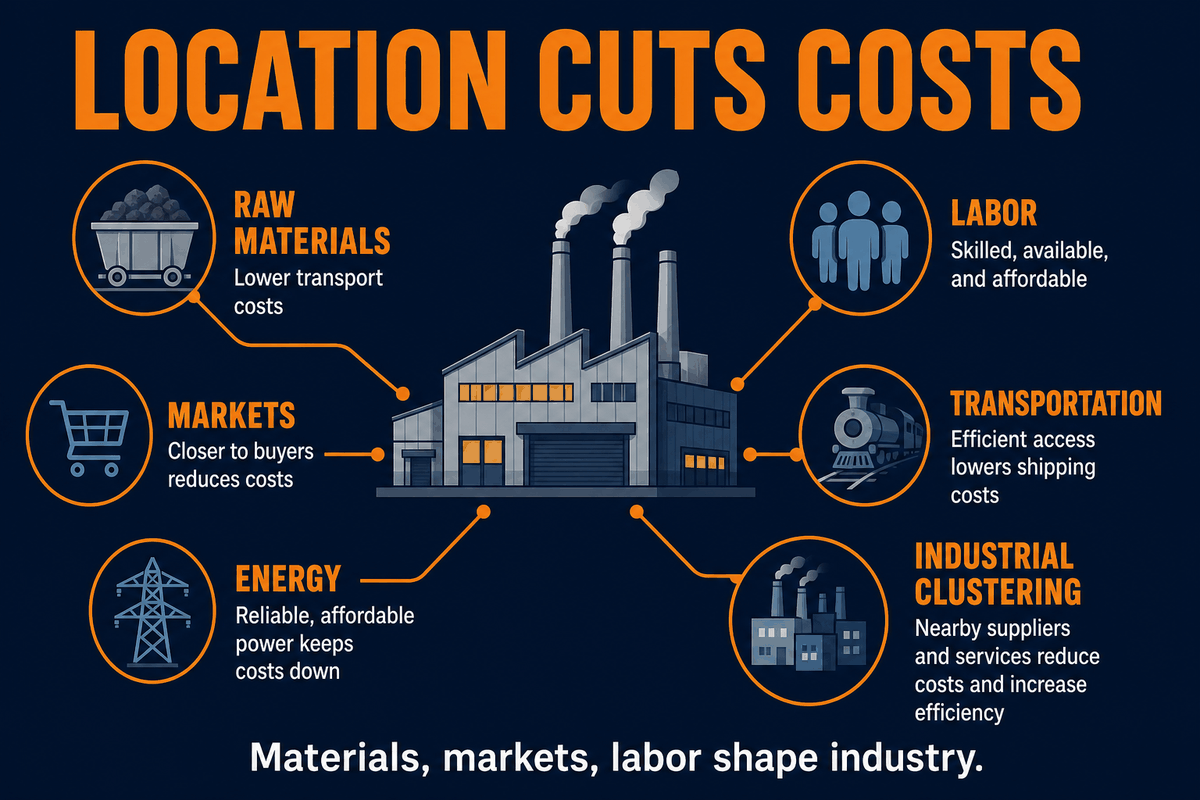
Industrial location theory explains why factories and industries locate in specific places. In industrial location theory AP Human Geography, firms choose locations based on transportation costs, raw materials, markets, labor, energy, infrastructure, agglomeration, government policies, and supply-chain connections. The goal is usually to reduce costs, increase access, or improve efficiency.
Say it fast: Industrial location theory = industries locate where costs are lower and access is better.
AP clue: If the question mentions factory location, transportation costs, raw materials, markets, labor, bulk-reducing, bulk-gaining, agglomeration, or footloose industry, think industrial location theory.
Unit 7 hub → Dependency Theory → Industrial Location Theory
Why Industrial Location Theory Matters in AP Human Geography
Industrial location theory AP Human Geography explains why factories, warehouses, and processing plants sit near mines, ports, highways, labor pools, or consumer markets — not randomly on the map.
AP prompts often pair plant examples with Weber's least-cost theory or agglomeration. Global supply chains also link to dependency theory when foreign firms control where value is captured.
Strong AP answers name the dominant factor, explain why it lowers cost or improves access, and label bulk-reducing, bulk-gaining, raw-material, or market orientation when weight clues appear.
- Industrial location is a core Unit 7 topic for maps, plant examples, and FRQs.
- Firms compare multiple factors — not just one — when choosing sites.
- Bulk-reducing and bulk-gaining logic appears often on multiple-choice and free-response items.
- Transportation, labor, and clustering can outweigh raw material proximity for some industries.
AP clue: Raw materials, markets, transport routes, bulk-reducing, bulk-gaining, labor costs, agglomeration → industrial location theory.
What is industrial location theory?
Industrial location theory explains why factories and industrial activities locate where they do. Firms weigh site factors — raw materials, markets, labor, transportation, energy, land, and agglomeration — to minimize costs or maximize access. AP Human Geography uses it to interpret maps, plant examples, and FRQ stimuli about where industry clusters and why location choices change over time.
Industrial Location Theory Explained
Industrial location theory asks which site minimizes costs or maximizes access for a given industry. Firms weigh how far they must move heavy inputs, finished goods, and workers — and whether clustering with other firms saves money.
- Location is rarely random: products, transport technology, and labor markets shape site choice.
- Different industries prioritize different factors — ore processing differs from bottling or software design.
- Changes in transport, trade policy, or technology can shift optimal locations over time.
- Weber's model adds formal least-cost logic; this guide builds the factor vocabulary AP items expect first.
When a prompt names transport, labor, and agglomeration together, open Weber's least-cost theory for the triangle framework.
What are the main industrial location factors?
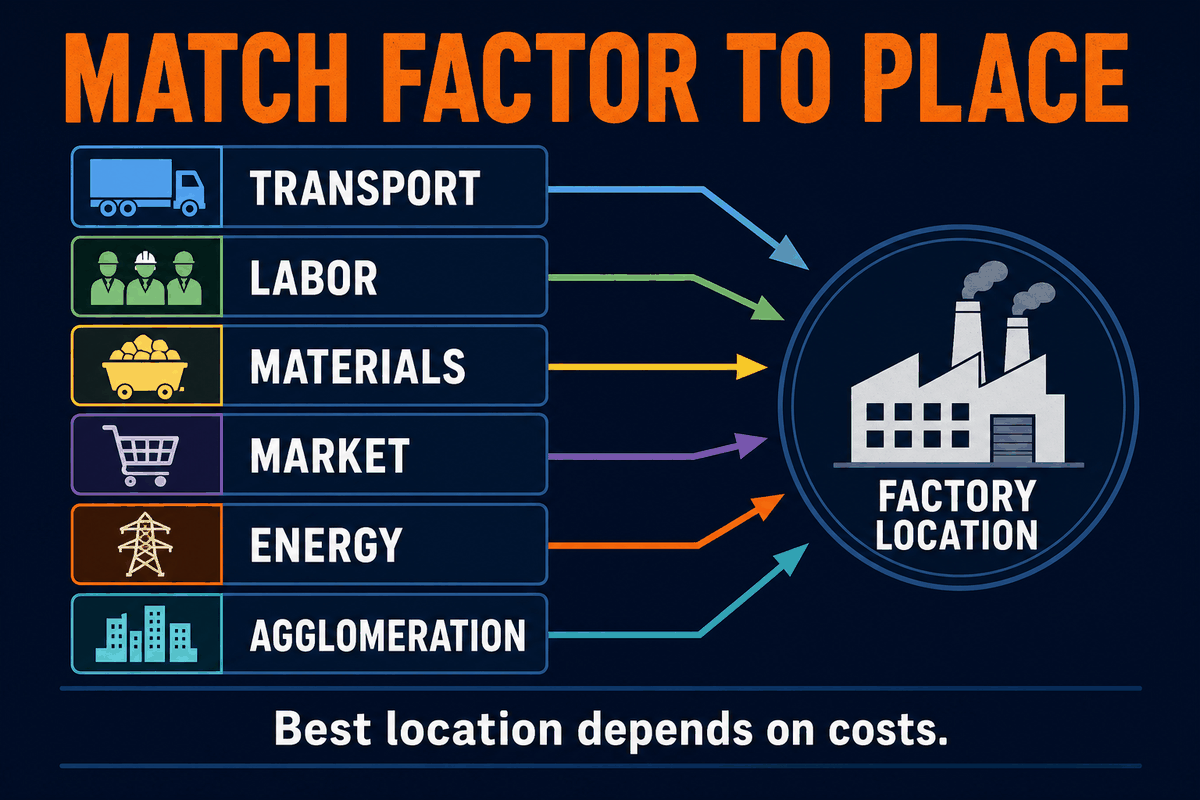
Key factors include raw materials, markets, transportation, labor, energy, land or capital, agglomeration, government policy, and global supply-chain connections. No single factor always wins — firms compare which cost or access issue matters most for that product. AP clues often pair a heavy input, bulky output, cheap labor pool, or transport hub with the dominant factor.
Main Industrial Location Factors
Use this table to match each factor to AP clues and common traps before you pick an answer on the exam.
| Factor | Why It Matters | AP Clue | Example Type | Common Mistake |
|---|---|---|---|---|
| Raw materials | Heavy or bulky inputs are costly to ship long distances | Mine, forest, quarry, farm, ore deposit | Copper smelter, lumber mill, cement plant | Assuming every factory must sit on a mine |
| Markets | Consumer proximity cuts delivery cost for bulky or perishable finished goods | Major city, dense population, retail demand | Bottling plant, bakery, fresh food processor | Calling every urban factory market-oriented without citing bulk or spoilage |
| Transportation | Ports, highways, and rail lower freight and logistics costs | Port city, interstate interchange, break-of-bulk point | Export warehouse, global assembly plant | Ignoring freight when only labor is mentioned in the stem |
| Labor | Wage rates and skill levels affect production cost | Cheap assembly wages, university talent, skilled technicians | Textile assembly, chip design, auto parts | Assuming cheap labor alone explains every offshore move |
| Energy | Power-intensive industry needs reliable, affordable energy | Coal field, hydro dam, electricity grid | Aluminum smelting, glass manufacturing | Forgetting energy when a stimulus mentions smelting or furnaces |
| Land / capital | Large sites, capital access, and infrastructure support big plants | Industrial park, cheap land, utilities ready | Automotive assembly, mega-factory campus | Treating land cost as irrelevant in every case |
| Agglomeration | Clustering shares suppliers, labor pools, and infrastructure | Industrial district, supplier network, tech corridor | Automotive corridor, electronics cluster | Assuming clusters always grow and never face congestion |
| Government policy | Tax breaks, SEZs, and regulations attract or repel investment | Tax incentive, special economic zone, tariff policy | Maquiladora zone, export processing zone | Naming policy without explaining the mechanism |
| Global connections | Supply chains link sites across borders through trade and FDI | Offshore assembly, TNC supplier map, global export | Border assembly plant, multinational supplier network | Confusing outsourcing with automatic raw-material orientation |
Transportation Costs
Transportation costs include moving raw materials, parts, and finished goods by truck, rail, ship, or air. Distance, weight, and mode matter — heavy items cost more per mile, so location logic often follows the most expensive item to move.
- Break-of-bulk points attract warehouses where loads switch between ship, rail, and truck.
- Port cities reduce ocean shipping costs for global supply chains.
- Highway and rail access lowers domestic distribution costs.
- When both input and output are heavy, compare which direction dominates total freight.
Weber formalizes transport as one vertex of the least-cost triangle — see Weber's least-cost theory when prompts weigh freight against labor and clustering.
Raw-Material Orientation
Raw-material orientation pulls industry toward the source of bulky or heavy inputs. If transporting ore, logs, or limestone costs more than moving the finished product, the plant usually sits near the resource.
- Mining, smelting, milling, and quarry-based industry often use raw-material orientation.
- Perishable farm inputs — such as milk or fruit — may also locate near agricultural sources.
- AP credit requires naming the heavy or bulky input, not only saying "near resources."
- Pair with bulk-reducing logic when processing removes weight before shipment.
Market Orientation
Market orientation pulls industry toward consumers when finished products are bulky, fragile, perishable, or costly to ship. Urban markets offer large demand and shorter delivery routes.
- Bulk-gaining products — beverages, packaged foods — often locate near cities.
- Fresh bakery or dairy processing may serve nearby urban consumers quickly.
- Time-sensitive delivery and spoilage risk strengthen market orientation clues.
- Do not assume every city factory is market-oriented — check whether the product gained bulk or serves local demand.
Why do some industries locate near markets?
Market-oriented firms sit near consumers when finished products are bulky, fragile, perishable, or expensive to ship long distances. Bulk-gaining logic, fresh bakery goods, and time-sensitive delivery all pull industry toward urban markets. AP answers should name the product characteristic — weight gained, spoilage risk, or consumer proximity — not only say "near people."
Bulk-Reducing and Bulk-Gaining Industries
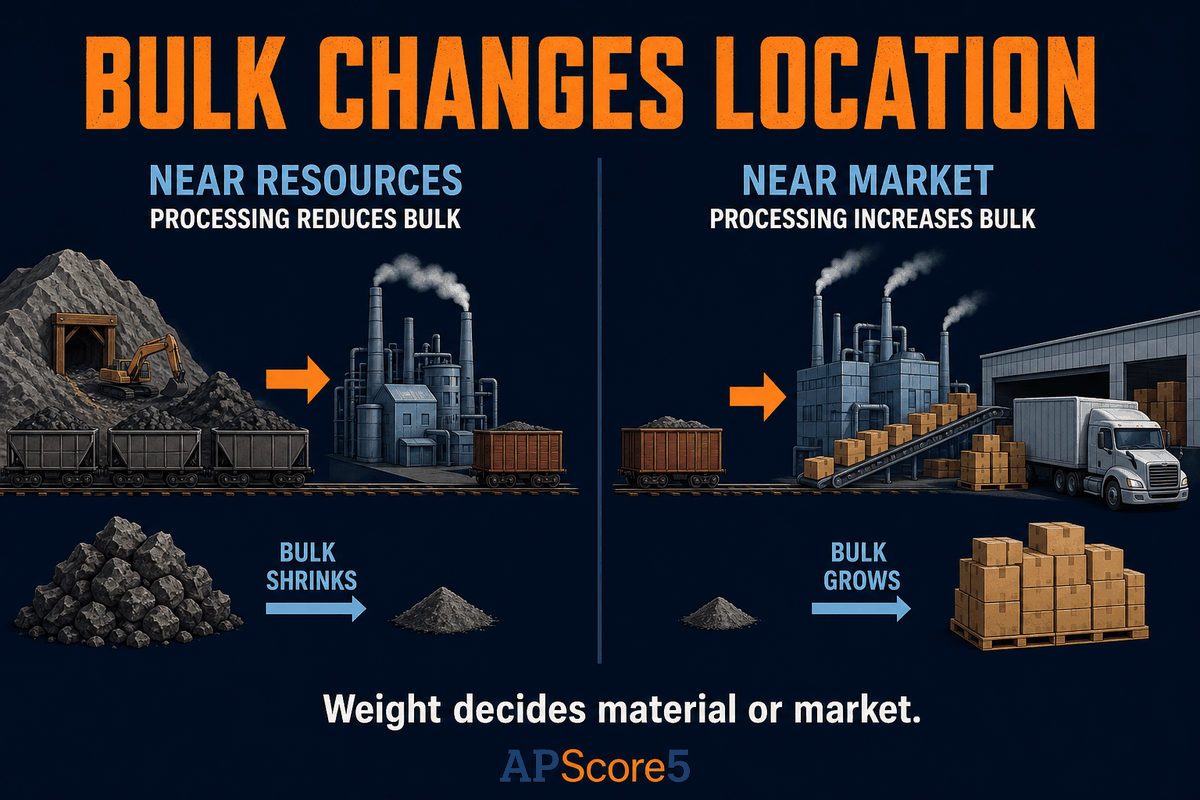
Bulk-reducing industries lose weight or bulk during processing; bulk-gaining industries gain weight or bulk — often by adding water, ingredients, or packaging.
- Steel and copper smelting reduce bulk — locate near mines or energy when inputs dominate freight.
- Beverage bottling and many food processors gain bulk — locate near markets when finished goods dominate freight.
- Ask: which is more expensive to move long distance — the input or the output?
- Mixed cases exist; use the stimulus to identify which weight change matters most.
What is the difference between bulk-reducing and bulk-gaining industries?
Bulk-reducing industries lose weight or bulk during processing, so they often locate near raw material sources to cut transport of heavy inputs. Bulk-gaining industries gain weight or bulk — often by adding water or packaging — so they often locate near markets to reduce shipping of finished bulky products. Steel smelting and beverage bottling are classic AP contrasts.
Labor, Energy, and Infrastructure
Not every plant follows bulky inputs or outputs. Labor, energy, and infrastructure can become the dominant pull when products are light but production is skill- or power-intensive.
- Labor-intensive assembly may seek lower wages or large worker pools.
- High-skill industries may seek universities, research labs, and venture capital.
- Smelting and glassmaking need reliable, cheap energy near power sources.
- Ready utilities, highways, and industrial parks reduce setup cost for large factories.
Deindustrialization can remove plants when labor, energy, or transport advantages shift — see industrialization and deindustrialization for regional job loss patterns.
Agglomeration and Industrial Clustering
Agglomeration occurs when firms cluster to share suppliers, specialized labor, infrastructure, and knowledge spillovers. Clustering can lower costs even when rent is higher inside the district.
- Automotive corridors, electronics districts, and tech regions show agglomeration economies.
- Shared parts suppliers and skilled labor pools reduce search and coordination costs.
- Congestion, high rents, or pollution can trigger deglomeration — firms moving outward.
- Weber treats agglomeration savings as a formal pull factor in least-cost analysis.
Go deeper on clustering benefits and limits in the agglomeration study guide.
Footloose Industries
Footloose industries are not tightly bound to heavy raw materials or bulky consumer markets because inputs and outputs are light, valuable, or digital. Location follows talent, capital, quality of life, and connectivity.
- Software design, chip research, and advanced business services can locate in tech corridors.
- Air freight and digital delivery reduce dependence on local ore or water sources.
- AP clues stress universities, skilled workers, venture capital, or innovation ecosystems.
- Footloose does not mean location is random — skill and cluster advantages still matter.
Industrial Location Factor Matrix
Match each industry type to its dominant orientation and best AP clue before you write an FRQ paragraph.
| Industry | Dominant orientation | Bulk type | Key factor | Best AP clue |
|---|---|---|---|---|
| Steel smelting | Raw-material | Bulk-reducing | Ore and energy access | Weight lost near mine or coal |
| Copper refining | Raw-material | Bulk-reducing | Heavy ore transport | Smelter at ore deposit |
| Beverage bottling | Market | Bulk-gaining | Urban consumer market | Water added near city |
| Lumber mill | Raw-material | Bulk-reducing | Forest proximity | Logs bulky before processing |
| Fresh bakery | Market | Bulk-gaining / perishable | Consumer proximity | Serves nearby urban market |
| Software design | Footloose / labor | Neither bulk type | Skilled talent pool | Universities and tech capital |
| Automotive assembly | Market + agglomeration | Mixed | Supplier network | Industrial corridor cluster |
| Port warehouse | Transport | Mixed | Break-of-bulk access | Imports and exports at port |
Industrial Location Trap Fixer
Replace weak assumptions with stronger AP moves when factory location clues appear on the exam.
| Trap | Why it is wrong | Stronger AP move |
|---|---|---|
| Bulk-reducing and bulk-gaining are the same | Weight change direction differs and pulls location differently | State whether processing loses or gains bulk, then pick input or market orientation |
| All factories locate near raw materials | Market, labor, transport, and footloose logic also matter | Identify the dominant factor named in the stimulus |
| Transportation never matters if labor is cheap | Freight on heavy goods can exceed labor savings | Compare transport cost for the heaviest item moved |
| Market orientation means any city factory | Need bulky, fragile, or perishable finished goods logic | Cite weight gained, spoilage, or delivery cost to consumers |
| Agglomeration always wins | Congestion and rent can push firms out | Explain shared suppliers or labor, but note limits if asked |
| Weber is only about transport | Weber includes labor and agglomeration in least-cost analysis | Link to Weber when three forces appear together |
| Footloose means location is random | Talent, capital, and clusters still matter | Cite skilled labor, universities, or tech ecosystem clues |
| One factor explains every global shift | Policy, trade, technology, and deindustrialization also reshape sites | Pair location factor with broader industrial change when the stem includes it |
Map Clue Practice
Practice reading a location stimulus like an AP map or data question. Draft your answer, then open the model explanation.
A map shows Site X near an iron ore deposit and coal field, Site Y near a major port and interstate highway interchange, and Site Z in a large metropolitan consumer market. A steel company notes that processing greatly reduces the weight of the ore.
- Which site best fits a bulk-reducing steel operation?
- Which site best fits a bulk-gaining beverage bottler?
- What is one transportation clue for Site Y?
- What is one market-orientation clue for Site Z?
Reveal model explanation
1. Steel (bulk-reducing): Site X — ore and coal proximity minimize transport of heavy inputs before weight is lost.
2. Beverage bottler (bulk-gaining): Site Z — finished bottles are bulky near consumers; market orientation cuts delivery cost.
3. Site Y transport clue: Port plus interstate interchange lowers import/export and domestic freight costs.
4. Site Z market clue: Large metropolitan consumer market provides demand and short delivery routes.
Why this earns credit: Matches bulk type to orientation, cites specific spatial evidence, and separates transport from market logic.
Factory Location Decision Sorter
Read each clue and classify it as Raw Material Orientation, Market Orientation, Transportation Access, Labor / Skill Factor, or Agglomeration / Clustering. Score 12 clues with instant feedback.
How to Use Industrial Location Theory in FRQs
Name the dominant factor → cite spatial evidence → explain why it lowers cost or improves access.
Weak answer
The factory is near the highway because of location theory.
Better answer
The bottling plant uses market orientation because finished beverages gain bulk after water and packaging are added. Locating near a large urban market reduces the cost of shipping heavy finished goods to consumers and allows faster delivery to retailers.
Sentence starters
- The dominant location factor is…
- This industry is bulk-reducing because…
- This industry is bulk-gaining because…
- Raw-material orientation is shown when…
- Market orientation is shown when…
- Agglomeration explains clustering because…
A strong answer names the factor, connects it to product weight or access, and uses orientation labels when the stimulus supports them.
How do you use industrial location theory on an AP Human Geography FRQ?
Name the dominant location factor, cite specific stimulus evidence (mine, port, highway, labor pool, market), explain why that factor lowers cost or improves access, and connect to bulk-reducing, bulk-gaining, or orientation labels when relevant. Contrast with agglomeration or footloose logic if the prompt includes clustering or high-skill talent instead of raw materials.
FRQ Practice and Location Sprints
Full FRQ
A steel company must choose between Site A near iron ore and coal deposits and Site B near a major port and skilled labor pool. Processing greatly reduces the weight of the ore. Most customers remain in domestic markets served by rail from either site.
- A. Identify the bulk type shown.
- B. Explain which site better fits industrial location theory for this steel operation.
- C. Explain one transportation or labor clue that could still make Site B attractive.
- D. Explain one limitation of using only bulk-reducing logic to predict every factory location.
Planning hint
A: bulk-reducing. B: Site A near ore/coal. C: port/skilled labor at B. D: labor, agglomeration, policy, or footloose factors also matter.
Reveal rubric, model answer, and weak vs better samples
Rubric (4 points typical)
- 1 pt — Bulk-reducing (weight lost during processing)
- 1 pt — Site A: raw-material orientation near ore/coal minimizes heavy input transport
- 1 pt — Valid Site B clue: port export access or skilled labor pool
- 1 pt — Valid limitation: other factors (labor, agglomeration, policy, market) can override simple bulk logic
Model A: Bulk-reducing — processing greatly reduces ore weight.
Model B: Site A fits better because raw-material orientation places smelting near heavy iron ore and coal, minimizing freight on inputs before weight is lost.
Model C: Site B offers port access for imported ore or exported steel and a skilled labor pool that can lower production or maintenance costs.
Model D: Bulk-reducing logic alone ignores labor quality, agglomeration with suppliers, energy cost, government incentives, and changing transport technology.
Common weak answer: Site A is near materials so it is the answer.
Better answer: The operation is bulk-reducing because processing removes weight from heavy ore, so Site A's raw-material orientation near iron ore and coal minimizes transport of the costliest inputs. Site B could still compete through port access and skilled labor, but the dominant AP clue is weight loss toward inputs — though real firms also weigh energy, agglomeration, and policy beyond one bulk rule.
Why this earns credit: Names bulk type, picks a site with evidence, acknowledges a competing factor, and states a limitation.
Location sprint 1
A copper smelter locates at the mine because the ore is heavy and loses weight during refining.
- A. Identify the orientation and bulk type.
- B. Explain why the location lowers cost.
Reveal sprint rubric and model
Sprint rubric (2 points)
- 1 pt — Raw-material orientation and bulk-reducing (both or equivalent)
- 1 pt — Heavy ore transported shorter distance before weight is lost, cutting freight cost
Model A: Raw-material orientation; bulk-reducing industry.
Model B: Locating at the mine minimizes shipping heavy ore long distances before refining reduces its weight and transport cost.
Location sprint 2
A beverage company builds bottling plants in several large metropolitan areas even though sugar and flavor inputs could ship from distant suppliers.
- A. Identify the orientation and bulk type.
- B. Explain why metropolitan location lowers cost or improves access.
Reveal sprint rubric and model
Sprint rubric (2 points)
- 1 pt — Market orientation and bulk-gaining (both or equivalent)
- 1 pt — Finished bottles are bulky near consumers; urban sites cut delivery cost and reach large demand
Model A: Market orientation; bulk-gaining industry.
Model B: Adding water and packaging increases product bulk, so locating in large metros reduces shipping heavy finished beverages to retailers and consumers.
Common Mistakes
Saying all industries locate near raw materials
Wrong: Every factory must sit next to mines, forests, or farms.
Better: Some are raw-material oriented, but others are market oriented, labor oriented, transport oriented, or footloose.
Confusing bulk-reducing and bulk-gaining
Wrong: Both types always follow the same location rule.
Better: Bulk-reducing often locates near raw materials; bulk-gaining often locates near markets.
Ignoring transportation
Wrong: Labor or markets alone explain every factory site.
Better: Highways, railroads, ports, airports, and pipelines can strongly shape location.
Saying footloose means random
Wrong: Footloose industries locate anywhere with no logic.
Better: Footloose industries are less tied to transport costs but still consider labor, infrastructure, taxes, and business environment.
Saying agglomeration is always positive
Wrong: Clusters always lower every cost with no downside.
Better: Clustering can help firms, but congestion, high land costs, and competition can create diseconomies.
AP Exam Clues
Location vocabulary
- industrial location theory
- location factors
- raw-material orientation
- market orientation
- bulk-reducing
- bulk-gaining
- footloose industry
- agglomeration
Spatial clues
- near mine or forest
- near major city
- port city
- highway interchange
- break-of-bulk point
- cheap labor pool
- skilled workers
- industrial district
Contrast clues
- weight lost → inputs
- weight gained → markets
- not all near mines
- not only labor cost
- cluster vs isolated plant
- Weber transport triangle
- deindustrialization shift
- global supply chain
AP clue: Decision rule: If the prompt asks why a factory sits where it does, identify the dominant factor and whether the product is bulk-reducing or bulk-gaining.
Practice MCQs
8 AP-style questions on industrial location theory ap human geography. Choices shuffle at display time.
Definition
Question 1
Which statement best defines industrial location theory?
Explanation: Industrial location theory focuses on why plants sit where they do — weighing materials, markets, labor, transport, energy, and clustering.
Why the tempting wrong answer fails: Five stages are Rostow; unequal trade is dependency theory; HDI is a composite index.
AP clue: Raw materials, markets, transport, bulk-reducing, bulk-gaining → industrial location theory.
Raw material orientation
Question 2
A copper smelter locates near ore deposits to reduce shipping heavy raw inputs. Which orientation fits best?
Explanation: Smelting near ore cuts transport of heavy raw materials — a classic raw-material orientation clue.
Why the tempting wrong answer fails: Urban consumers fit market orientation; talent-driven sites are footloose; quinary is a sector label, not a location orientation.
AP clue: Mine, ore, heavy input, smelter → raw-material orientation.
Market orientation
Question 3
A beverage bottling company builds plants in major metropolitan areas. Which factor best explains the pattern?
Explanation: Bottling adds weight and volume, so firms often locate near large markets to reduce delivery costs — market orientation.
Why the tempting wrong answer fails: Water is widely available; bottling gains bulk; traditional society is Rostow stage 1.
AP clue: Bottling plant, major city, bulky finished good → market orientation.
Bulk-reducing
Question 4
Which industry is the best example of a bulk-reducing activity?
Explanation: Steel processing reduces bulk of heavy inputs, pulling smelting toward mines and energy sources — bulk-reducing.
Why the tempting wrong answer fails: Bottling and baking gain bulk or serve markets; software is footloose and skill-driven.
AP clue: Ore, smelting, weight lost in processing → bulk-reducing.
Bulk-gaining
Question 5
Which industry is the best example of a bulk-gaining activity?
Explanation: Bottling adds water and containers, making finished goods bulkier — classic bulk-gaining market orientation.
Why the tempting wrong answer fails: Smelting, lumber, and cement processing typically lose bulk or follow heavy inputs — bulk-reducing patterns.
AP clue: Water added, packaging, heavier finished product → bulk-gaining.
Transportation
Question 6
A manufacturer chooses a port city to import parts and export finished goods globally. Which factor is most directly shown?
Explanation: Port cities reduce shipping and logistics costs for global supply chains — a transportation location factor.
Why the tempting wrong answer fails: Dependence is a development theory; mass consumption is Rostow; GII measures inequality, not factory sites.
AP clue: Port, import, export, shipping, intermodal hub → transportation access.
Agglomeration
Question 7
Several suppliers, factories, and specialized workers cluster in one industrial district. Which concept best explains the pattern?
Explanation: Firms cluster to share suppliers, skilled labor, and infrastructure — agglomeration economies lower coordination costs.
Why the tempting wrong answer fails: Commodity dependence is export concentration; suburbanization is residential; DTM is population change.
AP clue: Suppliers cluster, shared labor pool, industrial district → agglomeration.
FRQ application
Question 8
A company must choose between Site A near a highway interchange with skilled workers and Site B near iron ore deposits. The product loses weight during processing. Which FRQ answer best applies industrial location theory?
Explanation: When processing reduces bulk, locating near ore cuts input transport — name bulk-reducing logic and cite the weight-loss clue.
Why the tempting wrong answer fails: Highways help distribution but weight-loss processing favors inputs; core-periphery is a different framework; takeoff is Rostow.
AP clue: Weight lost, ore nearby, smelting or refining → bulk-reducing site choice on FRQs.
FAQ
What is industrial location theory in AP Human Geography?
Industrial location theory explains why factories and other industrial activities locate where they do. Firms compare factors such as raw materials, markets, labor, transportation, energy, land, and agglomeration when choosing sites. In AP Human Geography, the theory helps explain bulk-reducing and bulk-gaining patterns, market versus raw-material orientation, and why industry clusters near ports, highways, labor pools, or consumers.
What factors affect industrial location?
Factors include raw materials, markets, transportation, labor, energy, infrastructure, agglomeration, government policy, land costs, and supply-chain connections. Firms compare which factor most affects cost or access for their product. AP stimuli often highlight one dominant factor — such as a port, mine, cheap labor pool, or large consumer market — rather than listing every factor equally.
What is raw-material orientation?
Raw-material orientation means locating near the source of bulky or heavy inputs to reduce transport costs. Industries that process heavy raw materials — such as mining, smelting, lumber milling, or cement production — often sit close to forests, quarries, or ore deposits. Bulk-reducing logic is closely tied to raw-material orientation because weight is lost during processing.
What is market orientation?
Market orientation means locating near consumers or large urban markets when finished products are bulky, fragile, perishable, or expensive to ship long distances. Bulk-gaining industries — such as beverage bottling or fresh food processing — often use market orientation because adding water, packaging, or assembly near the customer cuts delivery costs.
What is a bulk-reducing industry?
A bulk-reducing industry loses weight or bulk during processing, so transporting the finished product is cheaper than transporting the raw input. Steel smelting, copper refining, and lumber milling are common examples. These industries often locate near raw material sources to minimize freight on heavy inputs before processing reduces their weight.
What is a bulk-gaining industry?
A bulk-gaining industry increases in weight or bulk during production — often by adding water, ingredients, or packaging. Beverage bottling and many fresh food processors are classic examples. Because the finished product is bulky, firms often locate near markets so they do not ship heavy finished goods long distances.
Why do transportation costs matter for industrial location?
Moving inputs and outputs costs money. Heavy, bulky, fragile, or perishable goods increase transportation importance. Ports, railroads, highways, airports, and pipelines can shape where firms locate to reduce freight costs. Transportation is central to Weber's Least Cost Theory and to bulk-reducing and bulk-gaining location decisions on AP exams.
What is a footloose industry?
A footloose industry is less tied to raw materials or transportation costs because inputs and outputs are light, valuable, or information-based. High-tech design, electronics research, and some advanced services can locate where skilled labor, capital, and business environment are favorable — but location factors still matter.
How is industrial location theory related to Weber's Least Cost Theory?
Weber's Least Cost Theory is a formal industrial location model that minimizes transport, labor, and agglomeration costs. Industrial location theory uses the same core ideas — raw materials, markets, labor, transport, and clustering — in a broader AP framework that also includes bulk-reducing, bulk-gaining, and footloose patterns beyond Weber's triangle alone.
How do you write about industrial location theory on an AP Human Geography FRQ?
Name the dominant location factor, cite specific stimulus evidence (port, highway, mine, labor pool, market), and explain why that factor lowers cost or improves access. Add bulk-reducing, bulk-gaining, raw-material, or market orientation labels when the product's weight changes. Mention agglomeration or footloose logic if the prompt stresses clustering or skilled talent instead of bulky inputs.