AP Human Geography · Unit 7 · Industrial and Economic Development
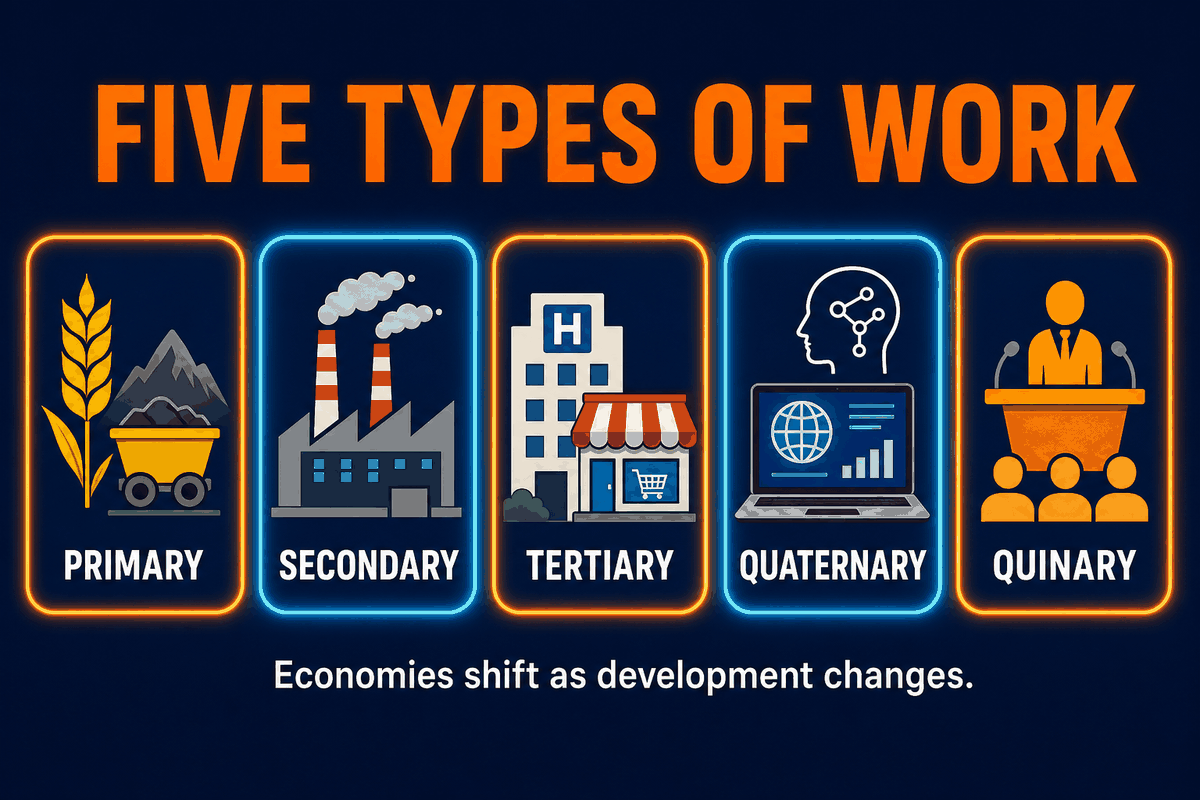
PrimarySecondaryTertiaryQuaternaryQuinary
Economic Sectors AP Human Geography: Primary to Quinary Explained
Understand how economies are organized into primary, secondary, tertiary, quaternary, and quinary sectors, and how employment shifts reveal patterns of development.
Updated June 1, 2026 · Reviewed by APScore5 Editorial Team
Economic sectors are categories of work used to describe what people do in an economy. The five sectors are primary, secondary, tertiary, quaternary, and quinary. In economic sectors AP Human Geography, sector structure helps explain development patterns, employment change, industrialization, deindustrialization, and the shift from resource extraction toward services and information-based work.
Say it fast: Economic sectors classify jobs by what kind of work is being done.
AP clue: If the question mentions farming, mining, manufacturing, services, research, information, executives, sectoral shifts, or postindustrial economies, think economic sectors.
The five economic sectors help students classify types of work and explain how employment patterns change as economies develop.Start here
Economic sectors AP Human Geography answers a basic but powerful question: what kinds of work dominate an economy, and what does that pattern suggest about development?
📊
Sector data from pie charts, employment tables, and development graphs show whether an economy still depends on extraction, manufacturing, or services and knowledge work.
Strong AP answers classify jobs by activity, explain what the employment pattern suggests, and pair sector evidence with development indicators or HDI when the prompt asks about overall development.
Sector structure helps compare countries at different stages of development.
A rising tertiary or quaternary share often signals postindustrial change.
A large informal economy means official statistics may understate precarity.
Sector data alone is not enough — connect it to income, inequality, and health or education indicators.
AP clue: Sector pie chart or employment table → classify the dominant sector, explain the development pattern, and name a limitation or second indicator.
What are economic sectors?
Economic sectors are categories that describe what kind of work people do in an economy. They help geographers compare employment structure, explain industrial change, and interpret development data on maps, tables, and FRQs. On the exam, sector labels turn job examples into evidence about whether an economy still depends on extraction, manufacturing, or services.
Overview
📊
Economic Sectors Explained
Economic sectors group jobs by the type of work performed. The five-sector model is a core tool for interpreting development, industrial change, and employment structure on the AP exam.
Primary = extraction of raw materials
Secondary = manufacturing and processing
Tertiary = services
Quaternary = information, research, data, and technology
Quinary = high-level decision-making and leadership
Sector
Main activity
Examples
AP clue
Common mistake
Primary
Extract raw materials
Farming, fishing, forestry, mining
Resource, farm, mine language
Calling every rural job primary
Secondary
Make goods
Factories, mills, construction, processing
Plant, factory, assembly
Labeling a cafeteria worker secondary
Tertiary
Provide services
Retail, transport, health care, education, tourism
Service, sell, care for
Assuming all office jobs are quaternary
Quaternary
Information and knowledge
R&D, data analysis, software, scientific research
Research, data, tech design
Confusing routine banking with quaternary
Quinary
Top decision-making
CEOs, cabinet ministers, university presidents
Executive, policy, leadership
Thinking quinary means "fifth on a list"
What are the five economic sectors?
The five sectors are primary (extraction), secondary (manufacturing), tertiary (services), quaternary (information and knowledge work), and quinary (high-level decision-making). AP prompts often ask you to classify a job or interpret how sector shares change over time. Memorize the activity type each sector represents before you compare countries on a chart.
Primary
🌾
Primary Sector
The primary sector extracts raw materials directly from the earth or natural environment. Agriculture, fishing, forestry, and mining are classic examples. Primary employment often represents a larger share in less industrialized economies, but a high primary share does not automatically mean a country is poor — some advanced economies still have productive, mechanized primary sectors.
On FRQs, primary work appears in prompts about rural labor, resource dependence, or early-stage development. Pair primary-sector evidence with measures of development when asked whether a country is fully developed.
Secondary
🏭
Secondary Sector
The secondary sector transforms raw materials into finished or semi-finished goods through manufacturing, processing, and construction. Factories, mills, shipyards, and assembly plants are secondary workplaces. Industrialization expands secondary employment; deindustrialization can shrink it as jobs move abroad or toward services.
Factory location connects to bulk-reducing and bulk-gaining patterns and to Weber's least-cost theory when prompts ask why industry clusters near inputs, markets, or cheap labor.
Tertiary
🛒
Tertiary Sector
The tertiary sector provides services rather than goods: retail, transportation, health care, education, tourism, finance, and government services at the routine delivery level. Tertiary employment often grows as economies develop and urbanize because cities concentrate consumers, workers, and service firms.
A large tertiary share can signal a more service-based economy, but many service jobs are modest-wage work — sector labels describe activity, not individual income.
Quaternary
💻
Quaternary Sector
The quaternary sector focuses on information, research, data, software, and advanced technology. Scientific research, university R&D, data analytics, and technology design are quaternary activities common in postindustrial economies.
Do not label every office job quaternary — routine clerical or sales work usually remains tertiary unless it produces or manages specialized knowledge.
What is the difference between tertiary and quaternary sectors?
Tertiary work provides services such as retail, transport, health care, and education. Quaternary work produces or manages information, research, data, software, and advanced technology. A bank teller is tertiary; a data scientist designing algorithms is quaternary. If the prompt stresses R&D or data, think quaternary rather than generic services.
Quinary
🏛️
Quinary Sector
The quinary sector captures top-level decision-making and leadership: national executives, cabinet ministers, CEOs of major firms, university presidents, and leaders of large nonprofits. Quinary work sets policy and strategy rather than delivering everyday services.
A government minister shaping economic policy is quinary; a clerk processing forms in the same ministry is more likely tertiary. Classify by the role, not the building.
Change over time
📈
Sectoral Change and Development
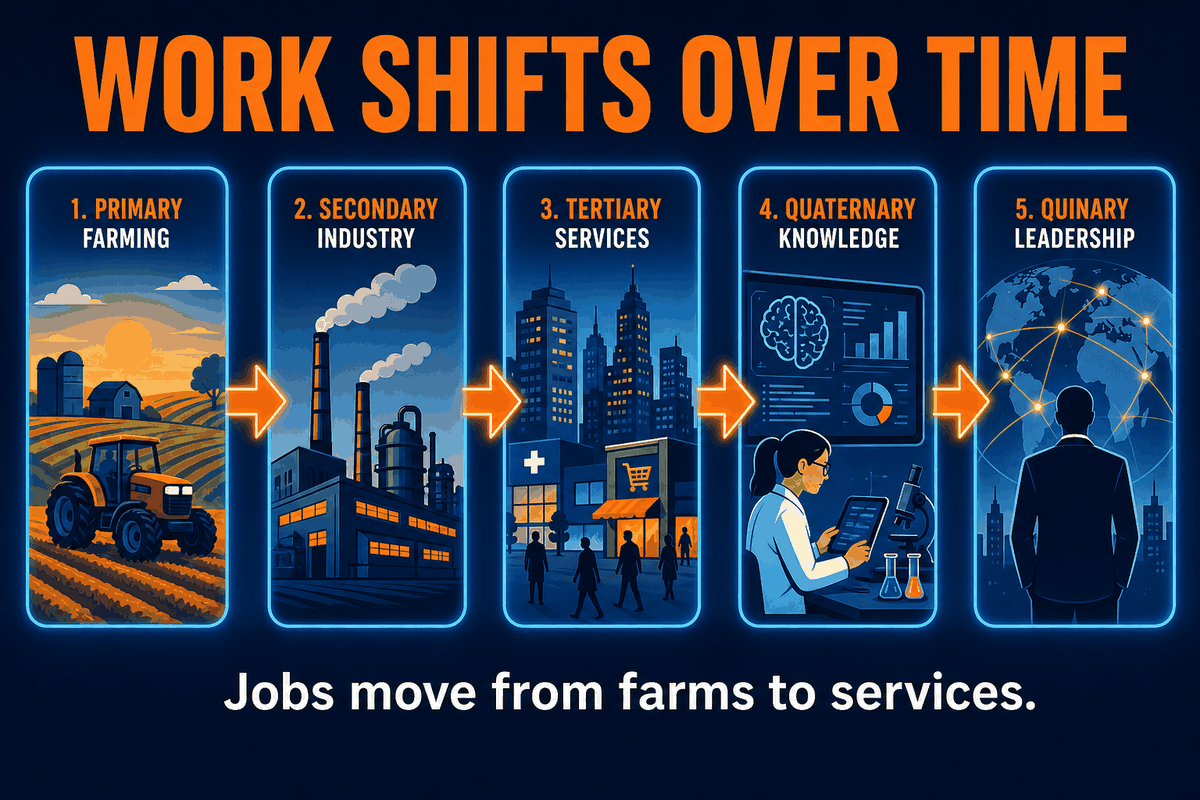
Sectoral change describes how the mix of jobs shifts as economies develop. Employment often moves from primary toward secondary work during industrialization, then toward tertiary and quaternary jobs in postindustrial economies. Deindustrialization can reduce manufacturing employment even while services and knowledge work grow.
Compare sector pies with development indicators and watch for a large informal sector that official tables undercount. A country can show rising tertiary employment while many workers still depend on unregulated street vending or cash day labor.
How do economic sectors show development?
As economies develop, employment often shifts from primary toward secondary, then toward tertiary and quaternary work. A large service or knowledge share can signal postindustrial change, but sector data should be paired with income, HDI, inequality, and informal employment before you claim a country is fully developed or wealthy.
Sectoral change often shows employment shifting away from primary work toward manufacturing, services, information, and high-level decision-making as development changes.Formal vs informal
📋
Formal vs Informal Economy
The formal economy includes regulated, taxed, and officially recorded work. The informal economy includes unregulated or unofficial activity — street vending, informal day labor, unregistered repair work, and cash-paid services that may never enter national employment statistics.
Informal work is often tertiary in activity (selling food or providing services) but invisible in formal sector data. That matters when you interpret development: a high tertiary share in official data does not capture everyone working informally at low pay.
Why can sector data be misleading?
Official sector statistics may undercount informal work, seasonal labor, or unpaid family production. A high tertiary share does not prove everyone is wealthy, and a high primary share does not always mean a country is poor if that sector is productive and mechanized. Always ask what the table leaves out.
Confusions
🧩
Common Sector Confusions
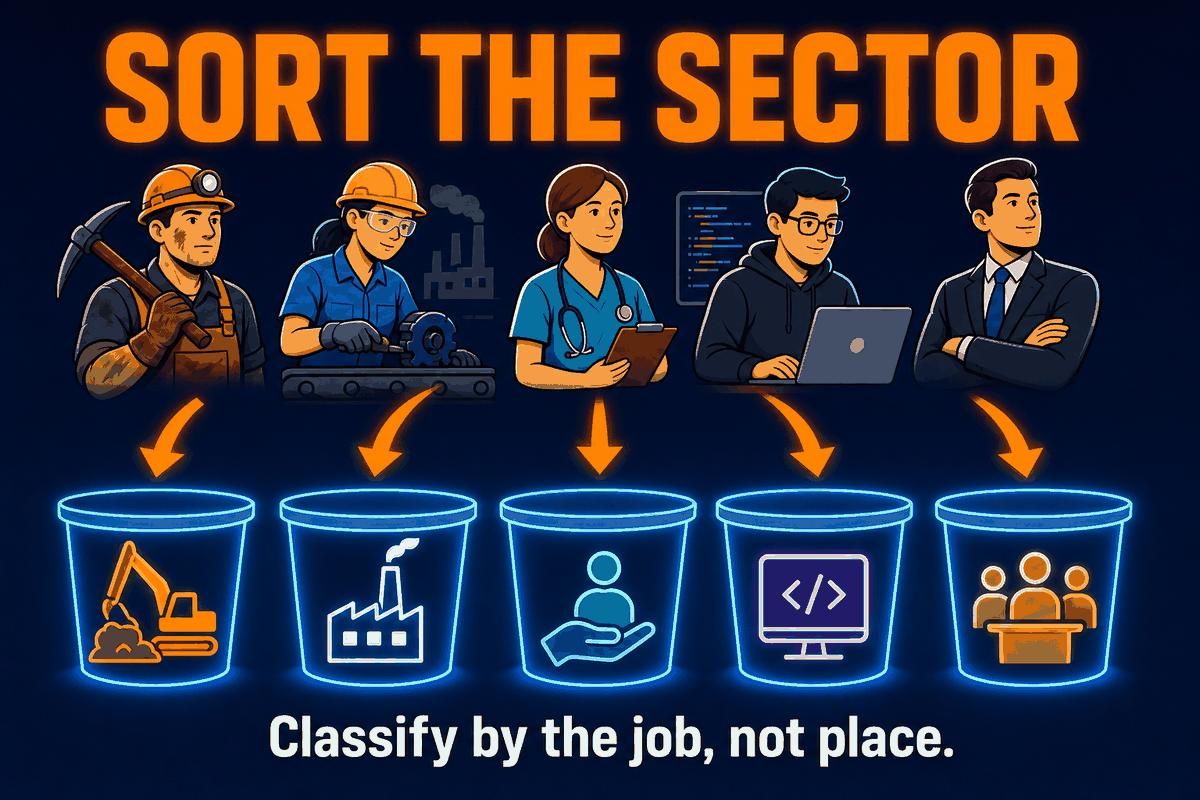
Classify sectors by activity, not by location, country income, or building type.
A farm accountant keeping books is tertiary (or quaternary if doing advanced analytics) — not primary just because the office sits near fields.
A factory cafeteria worker serves food → tertiary, not secondary.
Software design for a manufacturer → quaternary, not secondary.
A cabinet minister setting economic policy → quinary, not simply tertiary.
Street vending → often informal tertiary, even when it happens in a global city.
AP clue: Ask: What is the worker actually doing — extracting, making, serving, researching, or leading?
Economic sectors are classified by the activity being performed, not simply by whether the work occurs in a city, rural area, rich country, or poor country.Data reader
📖
Development Pattern Reader
Practice reading sector employment like an AP stimulus. Use the data below, draft your answer, then open the model explanation.
Country B: 5% primary employment, 18% secondary employment, 60% tertiary employment, and 17% quaternary/quinary employment.
Which country likely has a more postindustrial economy?
What evidence supports your answer?
What additional indicator would you request before claiming overall development?
Reveal model explanation
1. More postindustrial: Country B — low primary share and much larger tertiary plus quaternary/quinary employment.
2. Evidence: Country B has only 5% primary workers compared with 55% in Country A, and 77% of Country B workers are in tertiary or knowledge/leadership sectors versus 25% tertiary in Country A.
3. Additional indicator: Request HDI, GNI per capita, Gini coefficient, literacy, life expectancy, or informal-sector data before claiming the whole population is developed or wealthy.
Why this earns credit: Names the pattern, cites specific shares, and limits the claim — a hallmark of strong sector FRQs.
Clue practice
🔍
Sector Clue Practice
Read each clue, predict the sector, then reveal the answer. Say the sector out loud before you click — that builds speed for MCQs and FRQs.
Clue 1: Copper mining
Answer: Primary
Clue 2: Steel manufacturing
Answer: Secondary
Clue 3: Retail banking
Answer: Tertiary
Clue 4: Software research
Answer: Quaternary
Clue 5: Cabinet-level economic policy
Answer: Quinary
Clue 6: Street vending
Answer: Informal tertiary
Clue 7: Coffee farming
Answer: Primary
Clue 8: Coffee roasting plant
Answer: Secondary
Clue 9: Café service
Answer: Tertiary
Clue 10: Consumer behavior analytics for a café chain
Answer: Quaternary
Interactive
🎯
Sector Shift Sorter
Classify each clue into Primary, Secondary, Tertiary, Quaternary/Quinary, or Informal Economy. Score 12 clues with instant feedback.
FRQ strategy
✍️
How to Use Economic Sectors in FRQs
Read the sector data → identify the economic pattern → explain what it suggests about development.
Weak answer
Country B is better because it has more services.
Better answer
Country B appears more postindustrial because a larger share of employment is in tertiary and quaternary sectors, while a smaller share is in primary work. However, sector data alone does not prove broad development, so an AP answer should also consider HDI, income distribution, literacy, life expectancy, or informal employment.
Sentence starters
The dominant sector is…
This suggests the economy is…
A high primary share may indicate…
A high tertiary or quaternary share may indicate…
One limitation of this data is…
Another indicator needed is…
A strong answer uses sector evidence, explains the development pattern, and names a limitation or additional indicator when asked.
FRQ practice
📝
FRQ Practice and Data Sprint
Full FRQ
A table shows that Country X has 48% of workers in the primary sector, 22% in the secondary sector, and 30% in the tertiary sector. Country Y has 4% in the primary sector, 16% in the secondary sector, 62% in the tertiary sector, and 18% in the quaternary/quinary sectors.
A. Define primary sector.
B. Identify which country is more likely postindustrial.
C. Explain one piece of evidence that supports your answer.
D. Explain one limitation of using sector data alone to measure development.
Planning hint
Label A as definition, B as Country Y (or justify with shares), C as numeric evidence, D as limitation plus another indicator (HDI, Gini, informal work).
Reveal rubric, model answer, and weak vs better samples
Rubric (4 points typical)
1 pt — Accurate definition of primary sector (extraction of raw materials)
1 pt — Identifies Country Y as more likely postindustrial
1 pt — Evidence uses specific sector shares from the table
1 pt — Limitation names missing income, inequality, health, education, or informal data
Model A: The primary sector includes work that extracts raw materials from nature, such as farming, fishing, forestry, and mining.
Why this earns the point: Names extraction, not manufacturing or services.
Model B: Country Y is more likely postindustrial.
Model C: Country Y has only 4% primary employment and 80% combined tertiary plus quaternary/quinary employment, while Country X still has 48% primary workers.
Model D: Sector data alone does not show income distribution, informal employment, or human development, so HDI or Gini would be needed before claiming full development.
Common weak answer: Country Y is richer because services are better.
Better answer: Country Y's low primary share and large tertiary/quaternary employment suggest a postindustrial structure, but sector percentages do not prove low inequality or high living standards without HDI, GNI per capita, or informal-sector data.
Data interpretation sprint
A country's secondary-sector employment falls while tertiary and quaternary employment rise.
1 pt — Plausible cause (automation, outsourcing) or consequence (job loss in factories, growth in services)
Model A: The economy is shifting from manufacturing toward services and knowledge work — a postindustrial or deindustrializing transition.
Model B (consequence): Factory workers may face unemployment or need retraining while service and tech jobs grow in metropolitan areas.
Avoid errors
🚫
Common Mistakes
Classifying by place instead of activity
Wrong: A job is primary because it happens in a rural area.
Better: Classify the job by what the worker does — extraction, manufacturing, service, information, or leadership.
Treating all service jobs as quaternary
Wrong: Any office or shop job must be quaternary.
Better: Most services are tertiary; quaternary involves information, research, data, or knowledge production.
Thinking quinary means "fifth job"
Wrong: Quinary is any job listed fifth on a chart.
Better: Quinary usually refers to high-level decision-making or leadership, not routine office work.
Assuming high tertiary employment means everyone is wealthy
Wrong: Many services means the whole country is developed.
Better: Pair sector structure with HDI, Gini, income, and informal-sector data before claiming broad development.
Ignoring informal work
Wrong: Official employment tables tell the whole story.
Better: Informal and unrecorded work can be large but missing from formal sector statistics.
Exam clues
🔎
AP Exam Clues
Sector vocabulary
primary sector
secondary sector
tertiary sector
quaternary sector
quinary sector
Activity clues
extraction
manufacturing
services
research
information
decision-making
Pattern clues
informal economy
postindustrial
sectoral shift
employment structure
deindustrialization
AP clue:Decision rule: Classify the sector by the activity performed, then explain what the employment pattern suggests about development.
Practice
✅
Practice MCQs
8 AP-style questions on economic sectors ap human geography. Choices shuffle at display time.
Primary definition
Question 1
Which activity best fits the primary sector?
Explanation: Primary work extracts raw materials directly from nature, such as mining.
Why the tempting wrong answer fails: Assembly, retail, and software design belong to secondary, tertiary, or quaternary work.
AP clue: Mining, farming, fishing, forestry → primary.
Secondary definition
Question 2
Which statement best describes the secondary sector?
Explanation: Secondary work transforms inputs into goods through manufacturing, processing, or construction.
Why the tempting wrong answer fails: Services, research, and top leadership fit tertiary, quaternary, or quinary roles.
AP clue: Factory, mill, plant, construction → secondary.
Tertiary example
Question 3
Which job is the best example of tertiary-sector work?
Explanation: Health care is a service — a classic tertiary-sector activity.
Why the tempting wrong answer fails: Fishing and smelting are primary/secondary; R&D is quaternary.
AP clue: Retail, transport, tourism, health, education → tertiary.
Quaternary example
Question 4
Which job is the best example of quaternary-sector work?
Explanation: Research and technology development are information- and knowledge-based quaternary work.
Why the tempting wrong answer fails: Harvesting, building, and hotel service are primary, secondary, or tertiary.
AP clue: R&D, data, software, scientific research → quaternary.
Quinary clue
Question 5
A prompt describes executives making global investment decisions for a multinational firm. Which sector clue fits best?
Explanation: Top-level strategic decision-making by executives is quinary-sector work.
Why the tempting wrong answer fails: Investment leadership is not resource extraction, manufacturing, or routine informal vending.
AP clue: Cabinet ministers, CEOs, major policy leaders → quinary.
Sectoral change
Question 6
As a country industrializes, employment often shifts in which general direction?
Explanation: Sectoral change typically moves from extraction toward manufacturing, then services and knowledge work.
Why the tempting wrong answer fails: Development patterns rarely freeze sector shares or move only toward primary work.
AP clue: Industrialization + postindustrial → sector shift language.
Informal economy
Question 7
Which description best fits informal-sector work?
Explanation: Informal work is unofficial or unregulated and may not appear fully in formal employment statistics.
Why the tempting wrong answer fails: Policy leadership, formal research, and recorded factory jobs are usually formal-sector activities.
AP clue: Street vending, cash day labor, unregistered services → informal.
FRQ data interpretation
Question 8
Country X has 48% primary, 22% secondary, and 30% tertiary employment. Country Y has 4% primary, 16% secondary, 62% tertiary, and 18% quaternary/quinary employment. Which FRQ conclusion is strongest?
Explanation: Low primary share and high service/knowledge employment suggest postindustrial structure, with limits on sector data alone.
Why the tempting wrong answer fails: High primary share usually signals less industrial/postindustrial structure, not higher development.
AP clue: Compare sector shares → pattern → limitation + another indicator.
Balance growth with environmental and social goals.
FAQ
❓
FAQ
What are economic sectors in AP Human Geography?
Economic sectors are categories of work used to describe what people do in an economy. In AP Human Geography, they help explain development patterns, employment structure, industrial change, and shifts from resource extraction toward services and information-based work.
What are the five economic sectors?
The five economic sectors are primary (extraction), secondary (manufacturing), tertiary (services), quaternary (information and knowledge work), and quinary (high-level decision-making). Together they describe how an economy organizes labor.
What is the primary sector?
The primary sector includes work that extracts raw materials from nature, such as agriculture, fishing, forestry, and mining. It often represents a larger share of employment in less industrialized economies, though some wealthy countries still have productive mechanized primary sectors.
What is the secondary sector?
The secondary sector transforms raw materials into finished or semi-finished goods through manufacturing, processing, and construction. Industrialization expands secondary employment, and factory location ties to industrial geography topics such as Weber's least-cost theory.
What is the tertiary sector?
The tertiary sector provides services rather than goods, including retail, transportation, health care, education, tourism, and finance. Tertiary employment often grows as economies urbanize and develop.
What is the quaternary sector?
The quaternary sector involves information, research, data, software, and advanced technology design. It is common in postindustrial economies where knowledge work becomes a larger share of employment.
What is the quinary sector?
The quinary sector refers to high-level decision-making and leadership, such as top executives, senior government officials, university presidents, and major nonprofit leaders. It is not simply any office job.
How do economic sectors show development?
Sector shares show how employment is organized. Development often shifts jobs from primary toward secondary, then toward tertiary and quaternary work. Sector data should be paired with indicators such as HDI, income, Gini, literacy, life expectancy, and informal employment.
What is the informal economy?
The informal economy includes unregulated or unofficial work, such as street vending, informal day labor, or unregistered services. It may be undercounted in official statistics, which can distort how development and employment structure appear on maps and tables.
How do you write about economic sectors on an AP Human Geography FRQ?
Read the sector data, identify the dominant pattern, explain what it suggests about development, and note a limitation or additional indicator when asked. Strong answers classify jobs by activity, use evidence from the stimulus, and connect sector shifts to industrialization, postindustrial change, or informal work.