World-systems theory explains development through global relationships — not only internal national stages. It links to core-periphery maps and dependency theory on trade and power.
What is Wallerstein World Systems Theory in AP Human Geography?
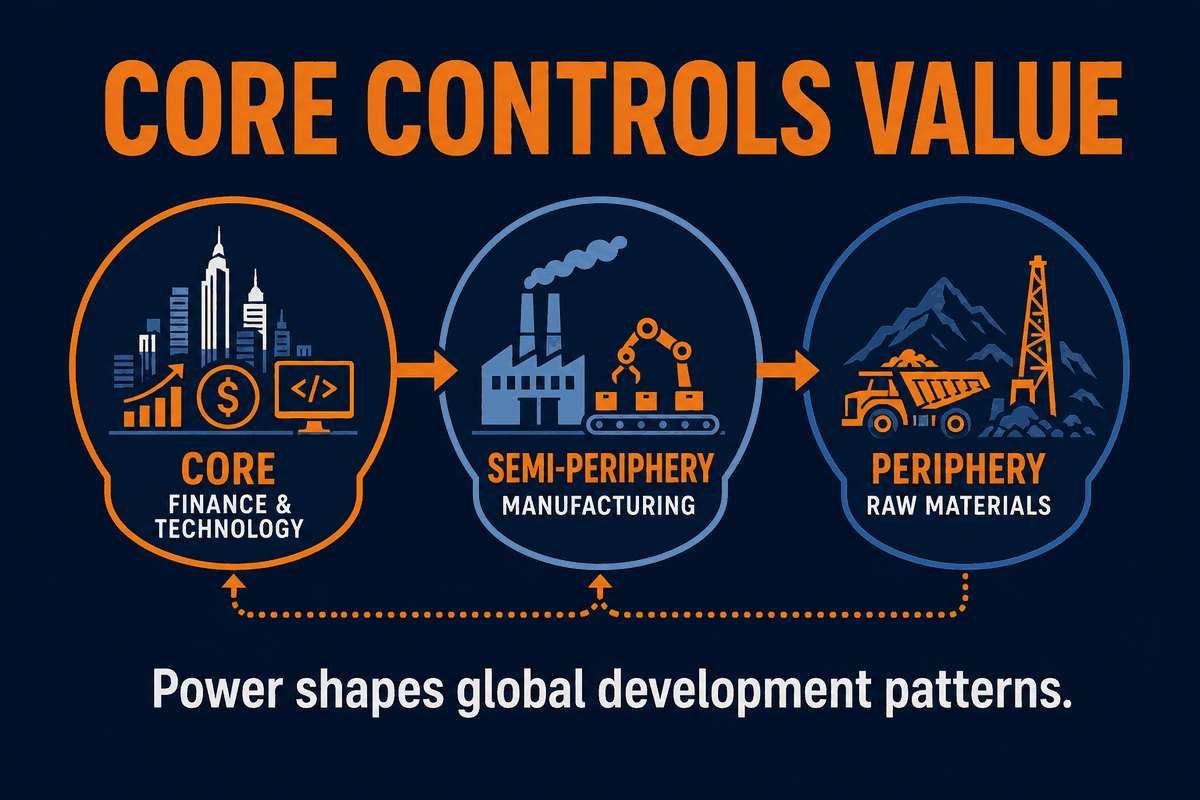
Wallerstein World Systems Theory explains uneven development by dividing the global economy into core, semi-periphery, and periphery roles. Core areas control high-value activities like finance, technology, and management; periphery areas often provide raw materials and low-wage labor; and semi-periphery areas have mixed roles. In Wallerstein World Systems Theory AP Human Geography, the theory is used to explain global inequality and economic dependency.
Say it fast: Wallerstein = development as a global core-periphery network.
AP clue: If the question mentions core, semi-periphery, periphery, global inequality, unequal trade, commodity flows, or dependency in the world economy, think Wallerstein.
Unit 7 hub → Rostow's Stages → Wallerstein
Why World Systems Theory Matters in AP Human Geography
Wallerstein World Systems Theory AP Human Geography answers a core Unit 7 question: why does development stay uneven when trade, investment, and production connect every region?
AP stimuli often compare Wallerstein with Rostow's stages. Pair role evidence with HDI or sector data when tables mix global roles with quality-of-life indicators.
Strong AP answers name the role, cite trade or value-capture clues, and explain uneven development — contrast Rostow when the prompt describes takeoff or five stages instead of core-periphery networks.
- Wallerstein is a major structural development theory in Unit 7.
- It explains global inequality through core, semi-periphery, and periphery roles.
- Commodity chains and value capture appear often on exams.
- The model is useful but simplified — roles can change and countries are internally diverse.
AP clue: Core, semi-periphery, periphery, commodity flows, unequal exchange → name Wallerstein and identify the role.
What is Wallerstein World Systems Theory?
Wallerstein World Systems Theory explains development through unequal roles in the global economy: core, semi-periphery, and periphery. Core areas dominate finance, technology, and high-value decisions; periphery areas often supply raw materials and low-wage labor. Geographers use it for global inequality and dependency prompts — name Wallerstein when trade and power relationships shape development.
Wallerstein World Systems Theory Explained
Wallerstein World Systems Theory (associated with Immanuel Wallerstein) treats the modern world economy as a single system in which places occupy different economic roles. Development is shaped by relationships between core, semi-periphery, and periphery — not only by what happens inside one country's borders.
- Core areas dominate high-value production, finance, technology, and decision-making.
- Periphery areas often provide raw materials, agricultural exports, and low-wage labor.
- Semi-periphery areas combine features of both — manufacturing growth with continued ties to core markets.
- Trade, colonial history, investment flows, and labor patterns help explain who captures surplus value.
When a stimulus lists factories or income without trade roles, check whether Rostow's ladder fits better than a world-systems reading.
What are core, semi-periphery, and periphery countries?
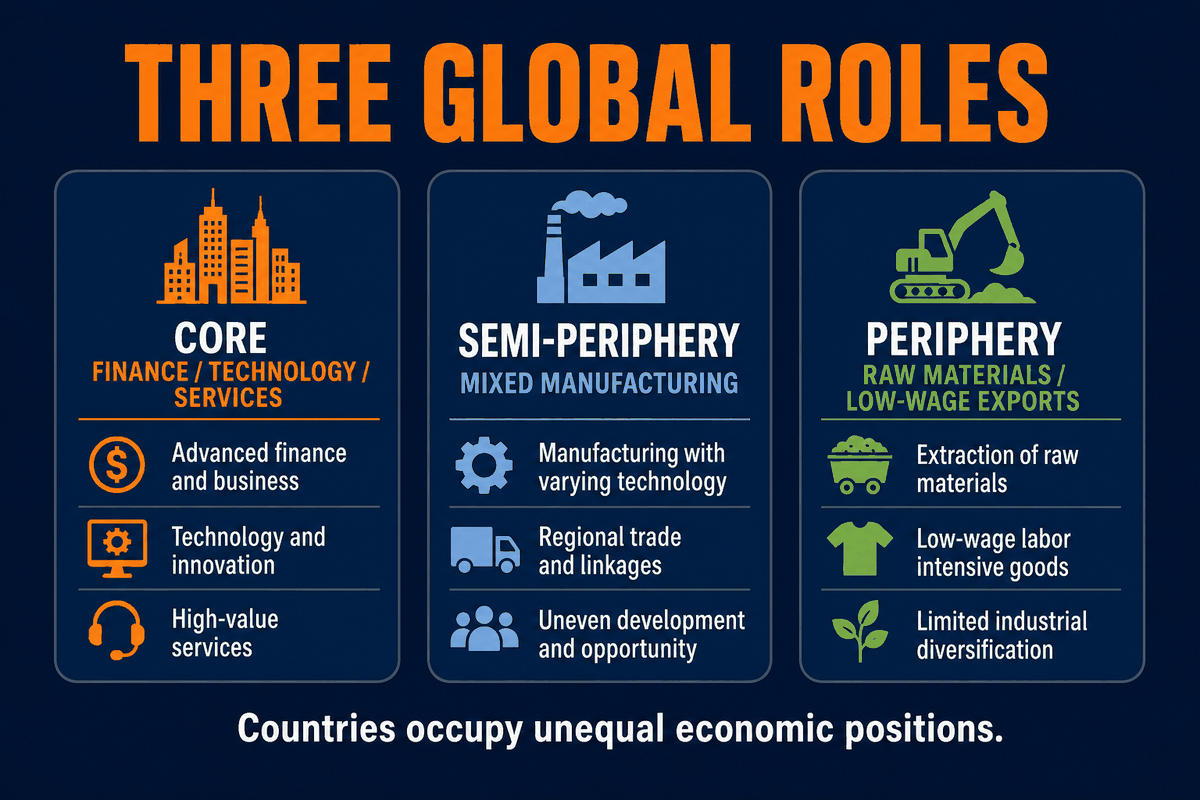
Core countries concentrate high-value finance, technology, headquarters, and skilled decision-making. Semi-periphery countries mix manufacturing, some high-value sectors, and lower-wage production — often linking core and periphery. Periphery countries often export raw materials or agricultural goods with less control over global value chains. AP answers match stimulus clues to the role, not wealth alone.
Core, Semi-Periphery, and Periphery
Use this table as a quick map, then read each role section below for AP-level detail.
| Role | Main function | AP clue | Economic pattern | Common mistake |
|---|---|---|---|---|
| Core | High-value finance, technology, decision-making | Headquarters, patents, branding, advanced services | Captures more profit from global chains | Thinking every resident in a core country is wealthy |
| Semi-periphery | Mixed manufacturing and dependent growth | Industrial production plus core market ties | Buffer between core and periphery | Ignoring semi-periphery as a real category |
| Periphery | Raw materials and low-wage exports | Commodity dependence, low-value exports | Less control over high-value decisions | Calling periphery the same as no development |
Core Countries
Core positions concentrate high-value industries, finance, technology, headquarters, skilled labor, and political-economic influence in the world system.
- Core firms often control branding, design, patents, and global marketing.
- Advanced services and decision-making capture more profit from commodity chains.
- Core regions influence markets, investment rules, and technology diffusion.
- Core does not mean zero poverty — structural power differs from every household's income.
Semi-Periphery Countries
Semi-periphery countries hold mixed roles: manufacturing and industrial growth alongside some lower-wage production and dependence on core investment.
- They may process raw materials or assemble goods for core markets.
- They can exploit periphery links while remaining influenced by core finance and technology.
- They often act as a buffer between core and periphery in the world system.
- Positions can shift upward or downward over time — semi-periphery is not a permanent label for every industry.
Periphery Countries
Periphery positions often feature resource extraction, agricultural exports, low-wage labor, and dependence on core markets or multinational firms.
- Exports may be dominated by a few raw commodities — oil, minerals, cocoa, coffee.
- Less control over finance, technology, branding, and high-value decisions in global chains.
- Industrial growth can occur, but structural ties to core demand may persist.
- Avoid simplistic language like "undeveloped" — describe the role in global exchange.
Uneven Development and Global Power
Development stays uneven because value and power are distributed unequally across the world system — not because every place lacks resources or labor.
- Core regions control finance, technology, markets, and high-value production.
- Periphery regions may export low-value inputs and import higher-value manufactured goods.
- Semi-periphery regions can dominate some production links while remaining tied to core capital.
- Dependency theory and neocolonial patterns often appear in the same FRQ cluster as Wallerstein.
How does world systems theory explain uneven development?
Uneven development persists because value and power are distributed unequally across the world system. Core regions control finance, technology, branding, and markets; periphery regions may export low-value inputs and depend on core demand. Semi-periphery regions can dominate some links while remaining tied to core investment — inequality is structural, not only internal to one country.
Commodity Flows and Value Capture
Follow the commodity chain: where materials move, where value is added, and who controls decisions.
- Raw materials often flow from periphery toward core or semi-periphery processing.
- Manufacturing and assembly may occur in semi-periphery locations.
- Branding, finance, technology, and management often capture the highest profit in core regions.
- AP credit requires explaining who controls the chain, not only what is exported.
Rostow vs Wallerstein
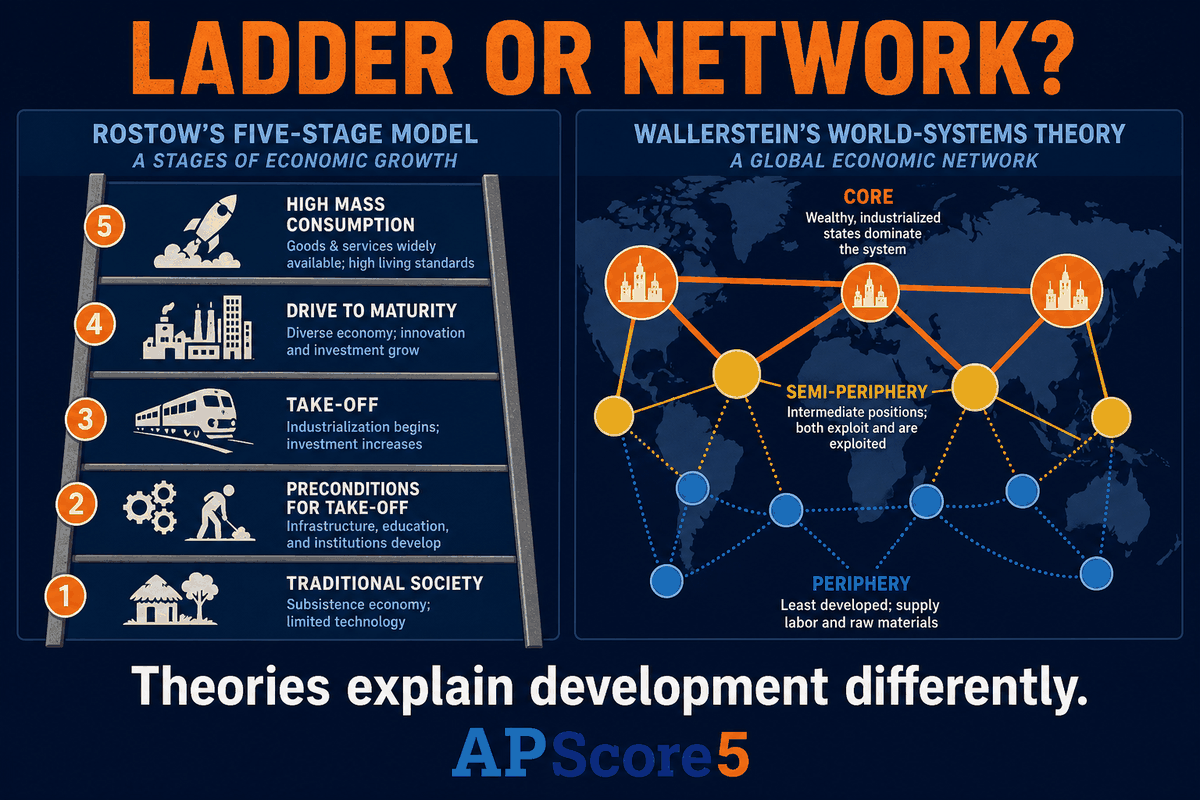
Pick the theory that matches the prompt stem — stages and takeoff point to Rostow; core-periphery and value capture point to Wallerstein.
| Feature | Rostow | Wallerstein |
|---|---|---|
| Main metaphor | Five-stage modernization ladder | Core–semi-periphery–periphery network |
| Main cause of development | Internal investment and industrial stages | Unequal global economic relationships |
| View of countries | Similar path through stages over time | Structural roles in the world economy |
| Best AP clue | Takeoff, preconditions, mass consumption | Core, periphery, commodity chains, unequal exchange |
| Weakness | Linear, Western-centered modernization | Broad categories; roles can shift |
| FRQ move | Name stage + investment/manufacturing clue | Name role + trade/value relationship + uneven development |
How is Wallerstein different from Rostow?
Rostow explains development as national stages on a modernization ladder driven by internal investment and industry. Wallerstein explains development through global structural relationships among core, semi-periphery, and periphery. Rostow stresses sequential national growth; Wallerstein stresses unequal exchange, commodity flows, and who captures profit in the world economy.
World Systems Trap Fixer
AP world-systems questions reward careful reading. Use this table to replace weak assumptions with stronger moves.
| Trap | Why it is wrong | Stronger AP move |
|---|---|---|
| Core means everyone is rich | Structural role is not the same as every household's income | Describe control of finance, technology, and value |
| Periphery means no development exists | Periphery describes global role, not zero economy | Cite exports, dependence, and low-value chain position |
| Countries can never change roles | Positions can shift over decades | Note role while acknowledging change is possible |
| Wallerstein and Rostow say the same thing | Ladder vs network are different frameworks | Match stages to Rostow and roles to Wallerstein |
| World systems theory only describes trade | Power, labor, technology, and finance matter too | Explain value capture and decision-making |
| Semi-periphery is unimportant | Semi-periphery links core and periphery | Use mixed manufacturing + core dependence clues |
| Core-periphery is only about location | Roles are economic, not just map distance from a core city | Use production, trade, and power evidence |
| The theory explains every detail perfectly | Countries have internal inequality and politics | State one limitation on full FRQs |
Commodity Flow Practice
Practice matching countries to world-system roles like an AP stimulus. Draft your answer, then open the model explanation.
A country exports raw minerals at low prices. A second country processes the minerals into electronics parts. A third country controls brand, design, finance, and global marketing, capturing the largest share of profit.
- Which role best fits each country?
- Which country likely captures the most value?
- How does this show uneven development?
- How would Rostow explain development differently?
Reveal model explanation
1. Roles: Raw-material exporter → periphery; processor → semi-periphery; branding/finance/marketing controller → core.
2. Value capture: The core country likely captures the most profit because it controls high-value decisions and advanced services.
3. Uneven development: Value and power concentrate in the core while periphery supplies low-price inputs — structural inequality in the chain.
4. Rostow contrast: Rostow would focus more on internal stages of modernization (infrastructure, takeoff, industry) rather than unequal global roles and value capture.
Why this earns credit: Names roles with trade evidence, explains uneven development, and contrasts theories when asked.
Strengths and Limitations
Strengths
- Explains global inequality and uneven development structurally.
- Highlights trade relationships, dependency, and commodity chains.
- Shows why cores can capture more surplus from global production.
- Useful for FRQs with raw exports, assembly, and core-controlled marketing.
Limitations
- Can oversimplify countries into broad categories.
- Roles change over time; labels are not permanent.
- National scores hide internal regional and group inequality.
- Does not explain every local political or cultural factor.
- May understate agency in semi-periphery and periphery countries.
What are the limitations of world systems theory?
World systems theory can oversimplify countries into broad categories, hide internal regional inequality, and understate how roles shift over time. It does not explain every local political or cultural factor. Pair Wallerstein with HDI, Gini, or regional data when prompts ask about development quality inside a country, not only its global trade role.
World Systems Role Sorter
Read each clue and classify it as Core, Semi-Periphery, Periphery, Rostow / Modernization Clue, or Not Enough Evidence. Score 12 clues with instant feedback.
How to Use Wallerstein in FRQs
Name the theory → identify the role → explain the global relationship → connect to uneven development.
Weak answer
The core is rich and the periphery is poor.
Better answer
Wallerstein's world-systems theory explains development through unequal global economic roles. Core countries often control high-value finance, technology, branding, and decision-making, while periphery countries may provide raw materials or low-wage labor. This creates uneven development because the core captures more profit and power from global production networks.
Sentence starters
- The theory shown is Wallerstein's world-systems theory because…
- The country is acting as the core because…
- The periphery role is shown by…
- This creates uneven development because…
- This differs from Rostow because…
- One limitation of the theory is…
A strong answer identifies the economic role, explains the relationship between roles, and connects that relationship to uneven development.
FRQ Practice and Core-Periphery Sprint
Full FRQ
A global production network shows Country A exporting raw materials, Country B assembling manufactured goods, and Country C controlling finance, design, patents, branding, and global marketing.
- A. Identify the development theory best shown.
- B. Identify which country best fits the core role.
- C. Explain one reason Country A may fit the periphery role.
- D. Explain how this pattern can produce uneven development.
Planning hint
Label A as Wallerstein, B as Country C (core), C as raw exports/dependence, D as unequal value capture and structural inequality.
Reveal rubric, model answer, and weak vs better samples
Rubric (4 points typical)
- 1 pt — Identifies Wallerstein's world-systems theory (structural global inequality)
- 1 pt — Country C as core (finance, design, patents, branding, marketing)
- 1 pt — Country A periphery: raw material exports and/or dependence on higher-value imports
- 1 pt — Uneven development: core captures more value and power from the chain
Model A: Wallerstein's world-systems theory.
Why this earns the point: Names a structural global framework, not Rostow stages or HDI alone.
Model B: Country C.
Model C: Country A exports raw materials and depends on core markets for higher-value goods and decisions.
Model D: Core control of finance and branding captures more surplus, leaving periphery exporters with less value — structural uneven development.
Common weak answer: Country C is rich so it is the core.
Better answer: Country C acts as core because it controls finance, design, and global marketing in the production network, capturing high-value profit, while Country A's raw exports fit a periphery role — showing uneven development through unequal global relationships rather than income alone.
Core-periphery sprint
A student says Wallerstein is the same as Rostow because both explain development.
- A. Explain one difference between Rostow and Wallerstein.
- B. Identify one AP clue that points to Wallerstein rather than Rostow.
Reveal sprint rubric and model
Sprint rubric (2 points)
- 1 pt — Rostow = national stages/ladder; Wallerstein = global core-periphery network and unequal exchange
- 1 pt — Wallerstein clue: core/semi-periphery/periphery, commodity chain, value capture, dependency
Model A: Rostow describes internal modernization stages; Wallerstein describes unequal global roles and who controls value in trade networks.
Model B: A prompt mentioning periphery raw exports and core control of finance or branding points to Wallerstein, not Rostow's takeoff stage.
Common Mistakes
Saying core simply means rich and periphery simply means poor
Wrong: Core countries are wealthy; periphery countries have no economy.
Better: Roles are based on control of value, production, trade, labor, technology, and decision-making.
Confusing Wallerstein with Rostow
Wrong: Both models describe the same staged national development path.
Better: Rostow is a stage ladder; Wallerstein is a global relationship network.
Ignoring semi-periphery
Wrong: Every country is either core or periphery with no middle category.
Better: Semi-periphery countries have mixed roles and often connect core and periphery.
Thinking roles never change
Wrong: A country's world-system role is fixed forever.
Better: Countries and regions can shift roles over time, though the system remains unequal.
Treating the model as perfect
Wrong: World systems theory explains every local detail without limits.
Better: The theory is useful but simplifies complex countries and regions.
AP Exam Clues
Wallerstein vocabulary
- Wallerstein
- world systems theory
- core
- semi-periphery
- periphery
- global inequality
- commodity chain
- unequal exchange
Process clues
- value capture
- dependency
- neocolonialism
- raw materials
- low-wage labor
- high-value services
- finance
- technology
Contrast clues
- headquarters
- global production
- branding
- not takeoff alone
- not five stages
- structural inequality
- trade relationships
AP clue: Decision rule: If the prompt describes unequal global economic roles, value capture, raw material flows, and core-periphery relationships, think Wallerstein.
Practice MCQs
9 AP-style questions on wallerstein world systems theory ap human geography. Choices shuffle at display time.
Wallerstein definition
Question 1
Which statement best defines Wallerstein's world-systems theory?
Explanation: Wallerstein maps the world economy into structural roles shaped by trade, power, and value capture.
Why the tempting wrong answer fails: Five stages are Rostow; HDI is a composite index; least-cost theory is Weber.
AP clue: Core, semi-periphery, periphery, global inequality → Wallerstein.
Core role
Question 2
Which description best fits a core country in world-systems theory?
Explanation: Core roles dominate high-value finance, technology, branding, and strategic control of commodity chains.
Why the tempting wrong answer fails: Raw-material dependence is periphery; takeoff is Rostow; life expectancy/schooling are HDI components.
AP clue: Finance, technology, headquarters, high-value services → core.
Semi-periphery role
Question 3
Which description best fits a semi-periphery country?
Explanation: Semi-periphery combines industrial growth with dependence on core finance and markets — a buffer role.
Why the tempting wrong answer fails: Subsistence-only is not semi-periphery; poverty alone does not define the role; mass consumption is Rostow.
AP clue: Mixed manufacturing, rising industry, core dependence → semi-periphery.
Periphery role
Question 4
Which clue best matches a periphery role in the world system?
Explanation: Periphery roles often supply low-value exports and have less control over high-profit decisions.
Why the tempting wrong answer fails: Patents and branding signal core; high HDI is not the definition of periphery; maturity is Rostow.
AP clue: Raw materials, low-wage labor, commodity dependence → periphery.
Global inequality
Question 5
How does world-systems theory best explain global inequality?
Explanation: Wallerstein stresses that cores capture more surplus while peripheries remain tied to lower-value exports.
Why the tempting wrong answer fails: Identical ladders are Rostow; mass consumption does not end inequality; trade patterns are central to Wallerstein.
AP clue: Unequal exchange, value capture, structural inequality → Wallerstein.
Commodity flow
Question 6
In a global commodity chain, raw minerals are exported cheaply, parts are assembled abroad, and a core firm captures profit through design and marketing. What does this best illustrate?
Explanation: Commodity chains show where value is added and who controls finance, technology, and marketing — usually core roles.
Why the tempting wrong answer fails: Traditional society is Rostow stage 1; semi-periphery often processes goods; HDI is a separate indicator.
AP clue: Raw exports, assembly, core profit from branding → commodity flow and value capture.
Rostow vs Wallerstein
Question 7
A student says Rostow and Wallerstein describe development the same way. Which correction is strongest?
Explanation: Rostow is a linear national ladder; Wallerstein is a structural global network of economic roles.
Why the tempting wrong answer fails: Both address economic change; HDI is not Wallerstein; commodity chains fit Wallerstein better than Rostow alone.
AP clue: Stages vs core-periphery network → contrast Rostow and Wallerstein.
Limitation
Question 8
Which statement is a valid limitation of world-systems theory?
Explanation: Roles can change over time and national averages hide variation — the model is structural, not a complete local portrait.
Why the tempting wrong answer fails: Periphery countries can industrialize; indicators still matter; semi-periphery is a central Wallerstein category.
AP clue: Oversimplifies, roles shift, internal gaps → state a limitation on FRQs.
FRQ application
Question 9
Country A exports raw materials, Country B assembles goods, and Country C controls finance, patents, and global marketing. Which answer best applies Wallerstein on an FRQ?
Explanation: Name Wallerstein, assign roles from trade and value control, and explain uneven development from unequal global relationships.
Why the tempting wrong answer fails: Raw exports suggest periphery, not takeoff; roles differ by function; HDI does not replace world-systems analysis.
AP clue: Raw exporter, assembler, finance/branding controller → core-periphery FRQ evidence.
FAQ
What is Wallerstein World Systems Theory in AP Human Geography?
Wallerstein World Systems Theory explains uneven development by dividing the global economy into core, semi-periphery, and periphery roles. Core areas control high-value activities like finance, technology, and management; periphery areas often provide raw materials and low-wage labor; and semi-periphery areas have mixed roles. In AP Human Geography, the theory is used to explain global inequality and economic dependency.
Who created world systems theory?
World-systems theory is associated with sociologist Immanuel Wallerstein, who described the modern world economy as a system in which countries and regions occupy different economic roles. AP Human Geography uses Wallerstein alongside Rostow, dependency theory, and the core-periphery model in Unit 7 development studies.
What are core countries?
Core countries concentrate high-value industries, finance, technology, headquarters, skilled labor, and political-economic influence. They often capture more profit from global commodity chains through branding, design, and decision-making. Core does not mean every resident is wealthy — it describes structural control in the world economy.
What are semi-periphery countries?
Semi-periphery countries have mixed economic roles: manufacturing and industrial growth alongside some lower-wage production and dependence on core markets. They can act as a buffer between core and periphery, sometimes exploiting periphery links while influenced by core investment. Their position can shift over time.
What are periphery countries?
Periphery countries often focus on resource extraction, agricultural exports, and low-wage labor with less control over high-value decisions. They may depend on core markets or firms and face commodity dependence. Periphery does not mean no development — it describes a structural role in unequal global exchange.
How does world systems theory explain uneven development?
Development is uneven because value and power are distributed unequally. Core regions control finance, technology, and high-value production; periphery regions may export low-value raw materials and import manufactured goods; semi-periphery regions hold mixed dependent and dominant relationships. Unequal exchange and value capture keep structural gaps in the world system.
What is the difference between Rostow and Wallerstein?
Rostow explains development as national stages of modernization — traditional society through takeoff to high mass consumption — driven by internal investment and industry. Wallerstein explains development through global relationships among core, semi-periphery, and periphery. Rostow uses a ladder metaphor; Wallerstein uses a network of unequal economic roles.
What is an example of a world systems theory clue?
A country exports raw minerals at low prices while a core country controls finance, patents, branding, and global marketing, capturing the largest share of profit. AP stimuli may also mention core, semi-periphery, periphery, commodity chains, unequal exchange, dependency, or low-wage resource exports.
What are the limitations of world systems theory?
World systems theory can oversimplify countries into broad categories, hide internal regional differences, and understate how roles change over time. It does not explain every local political or cultural factor and may understate agency in semi-periphery and periphery countries. Pair it with other indicators when needed.
How do you write about Wallerstein on an AP Human Geography FRQ?
Name the theory, identify the economic role (core, semi-periphery, or periphery), explain the global relationship with specific trade or production evidence, and connect the pattern to uneven development. State a limitation when asked. Contrast Rostow when the prompt describes stages rather than global value capture and core-periphery relationships.