Global supply chains split design, finance, assembly, and logistics across countries. Wallerstein's world-systems theory and the core-periphery model help explain why high-value tasks often remain in core areas while lower-cost work moves elsewhere.
What is the difference between outsourcing and offshoring in AP Human Geography?
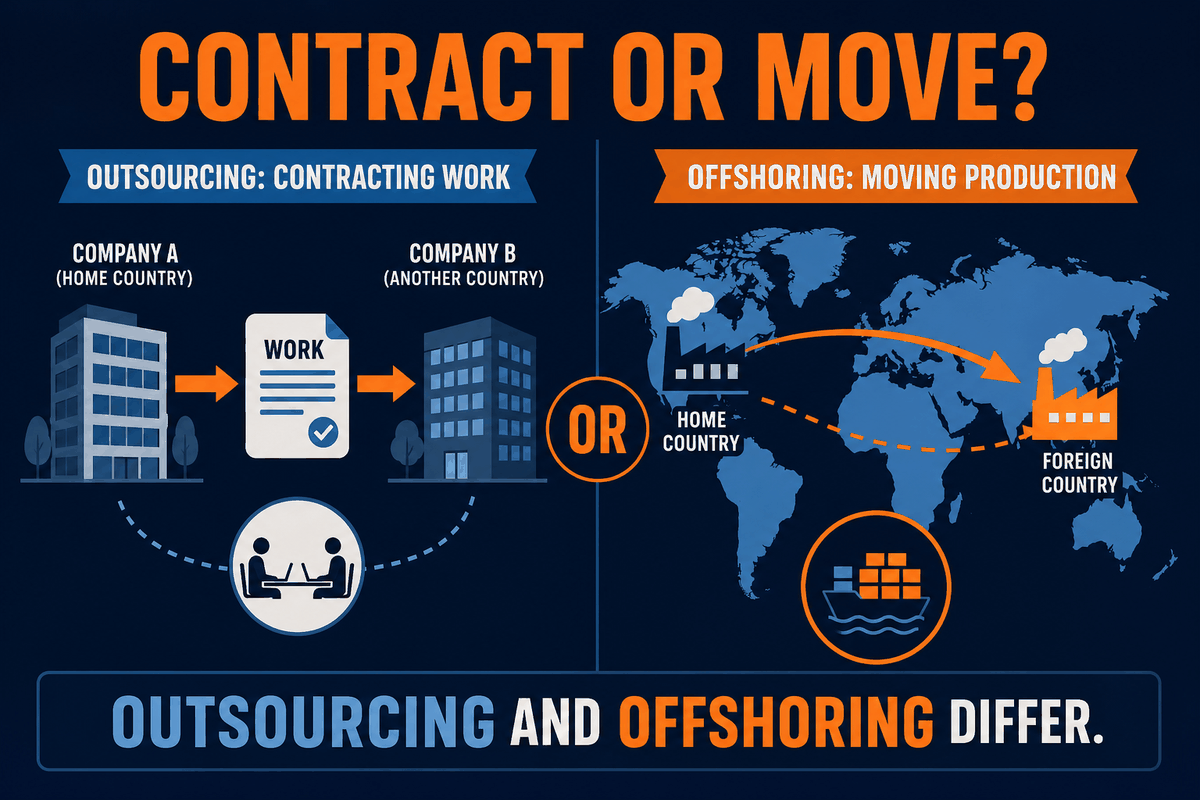
Outsourcing means contracting work to another company, while offshoring means moving work or production to another country. A company can outsource without offshoring, offshore without outsourcing, or do both at the same time. In outsourcing and offshoring AP Human Geography, these concepts help explain global supply chains, labor-cost differences, deindustrialization, and the new international division of labor.
Say it fast: Outsourcing = who does the work. Offshoring = where the work is done.
AP clue: If the question mentions contracting work, moving production abroad, lower labor costs, global supply chains, job relocation, or multinational firms, think outsourcing and offshoring.
Unit 7 hub → Industrialization and Deindustrialization → Outsourcing and Offshoring
Why Outsourcing and Offshoring Matter in AP Human Geography
Outsourcing and offshoring AP Human Geography explains how firms organize work across space — who performs a task, where it happens, and how jobs and profits move between regions.
Origin regions may lose manufacturing jobs through deindustrialization, while destination regions may gain assembly plants, call centers, or logistics hubs — sometimes inside special economic zones.
Strong AP answers separate outsourcing (who) from offshoring (where), explain firm motivations, and describe effects on both origin and destination regions with tradeoffs — not one-sided winners-only stories.
Multinational corporations reorganize production constantly. A smartphone designed in California may be assembled in Vietnam, with customer support contracted in another country and components sourced from several suppliers. Geographers study these patterns because they reshape wages, migration, urban growth, pollution, and national development strategies. The AP exam rarely asks for dictionary definitions alone; it shows narratives about contracted call centers, company-owned maquiladora plants, or falling factory employment in older industrial regions.
When you read a stimulus, ask two questions before you label anything: Did another company take over the task? Did the work cross a national border? Those questions prevent the most common mistake — treating outsourcing and offshoring as interchangeable buzzwords. Pair your process labels with sector vocabulary when employment shifts from manufacturing to services, and with dependency theory when prompts emphasize unequal exchange or foreign control.
- Outsourcing explains contracting work to another firm — domestic or foreign.
- Offshoring explains moving work to another country — with or without another company.
- Both connect to labor-cost differences, multinational corporations, and global supply chains.
- Origin regions may face job loss or wage pressure; destination regions may gain jobs with new risks.
- Lower production costs for firms do not automatically mean higher welfare for every worker.
AP clue: Contracted work → outsourcing. Work moved abroad → offshoring. Contract abroad → both.
What is outsourcing?
Outsourcing means contracting work to another company or external provider instead of performing it in-house. The work may stay in the same country or move abroad. On the AP exam, outsourcing answers who performs the work — another firm takes over tasks such as assembly, customer service, logistics, or payroll.
Outsourcing Explained
Outsourcing means contracting work to another company or external provider instead of performing it in-house. The defining question is who performs the work — your employees or another firm's.
Outsourcing can stay entirely within one country. A retailer may hire a domestic logistics company to run warehouses, or a hospital may contract payroll processing to a specialist firm nearby. It can also cross borders when a U.S. bank contracts software testing to a company in India — that example combines outsourcing with offshoring because another firm performs the work in another country.
- Manufacturing components — auto firms contract seat assembly or electronics installation to suppliers.
- Customer service and call centers — voice or chat support handled by a third-party provider.
- Logistics and warehousing — shipping, inventory, and fulfillment contracted out.
- Payroll and back-office tasks — administrative work performed by external specialists.
- Software support and IT maintenance — technology tasks managed by another company.
- Assembly stages — final product branding may stay in-house while assembly is contracted.
Firms outsource to cut costs, access expertise they lack, increase flexibility, or focus on core business functions such as design and marketing. Outsourcing does not automatically mean job loss — sometimes it shifts work to efficient specialists while the firm grows. When domestic factory jobs disappear because contracted production moves abroad, outsourcing overlaps with offshoring and may contribute to deindustrialization in the origin region.
On FRQs, cite the stimulus: if the prompt says "contracts," "hires another firm," or "third-party provider," outsourcing is likely involved even before you decide whether a border was crossed.
What is outsourcing?
Outsourcing means contracting work to another company or external provider instead of performing it in-house. The work may stay in the same country or move abroad. On the AP exam, outsourcing answers who performs the work — another firm takes over tasks such as assembly, customer service, logistics, or payroll.
Offshoring Explained
Offshoring means moving work or production to another country. The defining question is where the work is performed — domestic sites versus foreign sites.
A company may offshore while still owning the operation. Opening a company-owned assembly plant in Mexico is offshoring even if no other corporation runs the factory. Alternatively, offshoring can overlap with outsourcing when a firm contracts a foreign company to perform the work. Maquiladora zones, export processing, and foreign-owned branch plants are common AP geography settings for offshoring discussions.
- Labor-cost differences — wages, benefits, and regulations vary across borders.
- Trade access and market entry — producing inside a country can reduce tariffs or reach local buyers.
- Supply-chain links — locating near suppliers, ports, or regional hubs lowers total cost.
- Tax incentives and SEZ benefits — special economic zones may offer breaks that attract foreign plants.
- Flexibility and scale — large foreign campuses can ramp production up or down quickly.
Offshoring can contribute to deindustrialization when manufacturing employment falls in the origin country while output continues abroad. It can also support industrialization in destination regions if new factories, ports, and worker training expand. The direction of change depends on scale, sector, and policy — always read whether the prompt focuses on Country A losing jobs or Country B gaining them.
Offshoring is not limited to factories. Data entry, medical transcription, animation, and financial analysis can move abroad when digital networks make remote work possible. Service offshoring follows the same geographic logic as manufacturing offshoring even when no smokestacks appear in the stimulus.
What is offshoring?
Offshoring means moving work or production to another country. The firm may keep ownership of a foreign plant or rely on another company. Offshoring answers where the work is done. It often connects to lower labor costs, trade access, supply chains, and tax incentives in destination regions.
Outsourcing vs Offshoring
Use this table before you answer — the AP exam tests whether you can separate who performs work from where it happens.
| Feature | Outsourcing | Offshoring |
|---|---|---|
| Main question | Who performs the work? | Where is the work performed? |
| Definition | Contracting work to another company or external provider | Moving work or production to another country |
| Can occur domestically? | Yes — same-country contractors count | No — requires crossing a national border |
| Can involve another country? | Yes, if the contractor is abroad | Yes, by definition |
| Can be done by same company? | No — another firm usually performs the task | Yes — a company-owned foreign plant still offshores |
| AP clue | Contract, third-party provider, external firm | Moved abroad, overseas plant, foreign production |
| Common mistake | Assuming outsourcing always crosses borders | Assuming offshoring always means another company runs the plant |
Combine the rows when both change: contracting software support to a firm in another country is both outsourcing and offshoring. Domestic warehouse logistics contracted to a local third party is outsourcing only. A company-owned factory abroad is offshoring only unless another firm operates it.
Practice with everyday examples. Your school might outsource cafeteria operations to a food service company on campus — outsourcing without offshoring. A shoe brand might offshore stitching to its own plant overseas — offshoring without outsourcing. A brand that hires a foreign factory it does not own uses both concepts at once.
What is the difference between outsourcing and offshoring?
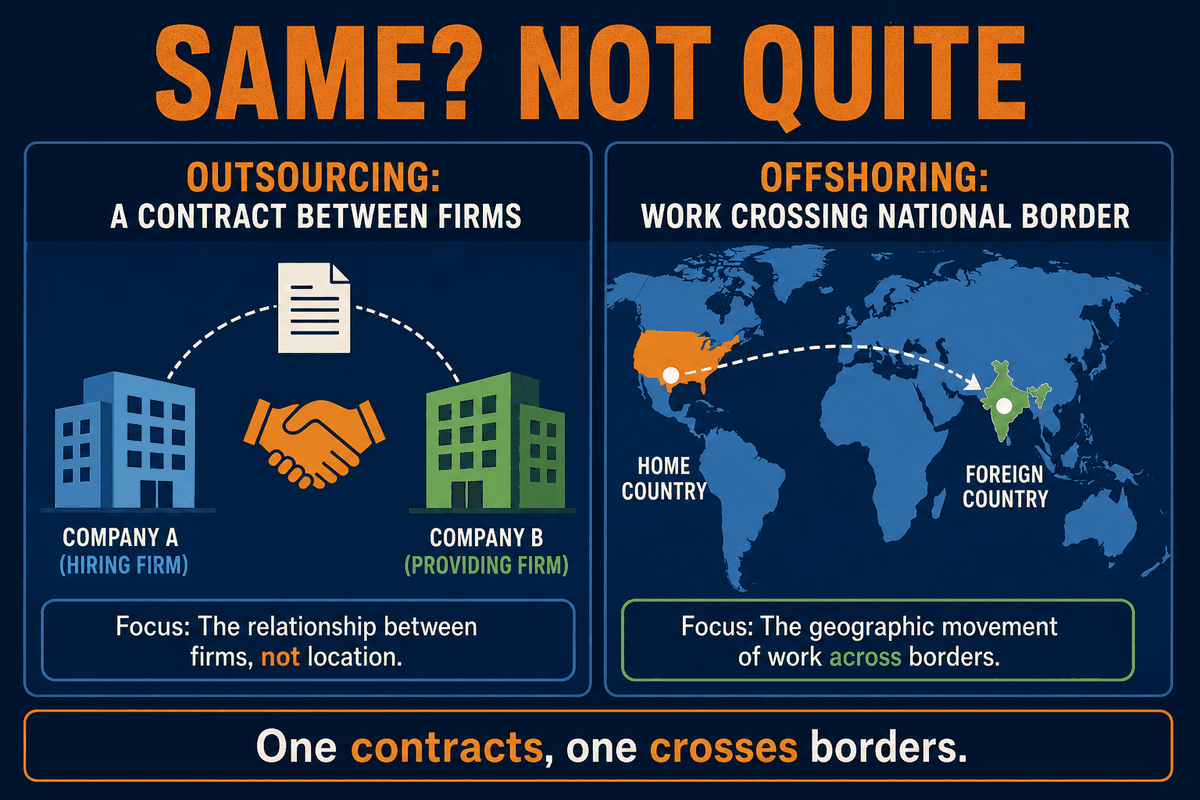
Outsourcing focuses on who does the work — contracting to another company. Offshoring focuses on where the work is done — crossing a national border. A firm can outsource domestically without offshoring, offshore while still owning the foreign operation, or combine both when it contracts work abroad.
Why Companies Outsource or Offshore
Firms make location and contracting decisions to reduce total cost, access capabilities, and compete in global markets. Weber's least-cost theory and industrial location theory provide vocabulary for transport, labor, and clustering — outsourcing and offshoring are practical applications of those pulls.
Lower labor costs
Wage and benefit differences between countries encourage firms to move labor-intensive stages abroad or contract them to lower-cost providers.
Access to specialized skills
Engineering, software, or precision manufacturing expertise may be cheaper or more available in specific regions.
Access to suppliers
Locating near component makers reduces delays — common in electronics and apparel supply chains.
Lower production costs
Land, energy, or regulation costs may favor foreign sites even after shipping is included.
Market access
Producing inside a country can satisfy local demand or avoid trade barriers.
Tax incentives or SEZ benefits
Special economic zones and export zones attract plants with tax breaks and streamlined rules.
Flexibility
Contracting allows firms to scale orders up or down without owning every facility.
Focus on core business
Brands may keep design, marketing, and finance while contracting routine production or support.
Global supply-chain efficiency
Splitting stages across locations can minimize total time and cost across the network.
Government policy also shapes decisions. Trade agreements, tariffs, and investment rules can push firms toward nearby countries or toward offshore suppliers. Agglomeration may keep some high-tech design clusters in core cities even when assembly leaves — a pattern dependency theory critiques when peripheries remain tied to low-wage roles.
Why do companies outsource or offshore?
Firms seek lower labor or production costs, specialized skills, supplier access, market entry, tax incentives, flexibility, and supply-chain efficiency. Decisions reshape jobs in origin and destination regions and connect to multinational corporations, special economic zones, and global inequality patterns.
Global Supply Chain Connection
A global supply chain splits production across many places. Raw materials, parts, assembly, marketing, and retail may each occur in different countries linked by shipping, air freight, digital networks, and corporate management.
Design, finance, branding, and strategic decisions often remain in core regions with advanced services and multinational headquarters. Manufacturing, assembly, or routine services may move to lower-cost regions with younger labor forces or export-oriented policies. Logistics hubs connect the chain — ports, airports, rail corridors, and warehouses matter as much as factory walls.
- Stage splitting — each step locates where cost, time, or skill advantages are strongest.
- Just-in-time networks — delays in one country can disrupt factories worldwide.
- Supplier tiers — large brands depend on many subcontractors invisible on the final label.
- Risk concentration — pandemics, conflicts, or storms reveal fragile single-source nodes.
- Power in the chain — buyers in core markets may capture more profit than assembly workers abroad.
Outsourcing and offshoring are tools firms use to build and adjust these chains. When an AP map shows multiple countries along one product's path, describe how contracting and border crossings organize the network — not only the final destination of one shipment.
Link supply-chain geography to development debates. Development indicators may rise in a destination country when exports grow, but HDI and inequality data show whether gains reach most residents. Sustainable development questions ask whether long supply chains externalize pollution or weak labor standards to places with fewer protections.
Time geography matters too. Faster shipping and digital communication let firms reconfigure chains quickly — a coastal city may gain a logistics campus one decade and lose apparel orders the next when wages rise elsewhere. Students should describe movement and reorganization, not frozen maps that imply one country always wins or always loses.
New International Division of Labor
The new international division of labor (NIDL) describes how work is organized globally by cost, skill, regulation, and role. Rather than every country performing the same mix of jobs, the world economy splits tasks across regions.
High-value decision-making — research, finance, branding, and corporate strategy — often concentrates in core regions. Lower-cost assembly, routine services, or resource processing may locate in semi-periphery or periphery areas. Digital communication allows some service tasks to join manufacturing in this global split.
- Spatial specialization — regions develop reputations for textiles, electronics, or call centers.
- Uneven upgrading — some destinations move up the chain; others remain in low-wage roles.
- Gender and labor norms — export factories may employ young women with specific social effects.
- Policy competition — countries compete for foreign investment with wages, zones, and infrastructure.
NIDL connects outsourcing and offshoring to Wallerstein and core-periphery language without assuming every periphery stays static forever. Semi-periphery countries may host both rising industry and continued dependence on foreign buyers.
On FRQs, use NIDL when prompts describe worldwide task splitting — design in one region, chips in another, assembly in a third, and marketing in a fourth. The term summarizes the geographic pattern your evidence already shows.
Compare NIDL to older international divisions of labor that emphasized colonial raw-material exports. Today's chains still show uneven power, but semi-periphery countries such as Mexico, China, or Vietnam may host complex industrial districts rather than only one resource specialty — read the stimulus date and sector before you label a country permanently peripheral.
Effects on Origin and Destination Regions
Outsourcing and offshoring redistribute jobs, investment, and risk. AP prompts often ask for one origin effect or one destination effect — prepare both and choose the scale shown in the stimulus.
| Region / actor | Possible benefit | Possible cost | AP explanation |
|---|---|---|---|
| Origin region losing jobs | Firms may lower prices or refocus on higher-skill work | Manufacturing job loss, wage pressure, deindustrialization, out-migration | Name job loss with evidence; link to industrial decline if factories closed |
| Destination region receiving jobs | Employment, wages, FDI, infrastructure, industrialization | Weak labor rules, pollution, dependency on foreign orders | Balance gains with labor or environmental concerns when shown |
| Firm / multinational corporation | Lower costs, larger markets, flexible production | Supply-chain disruption, reputation risk from labor scandals | Explain profit and efficiency motives with stimulus details |
| Workers in origin region | Some workers retrain into services or tech | Unemployment, underemployment, union decline | Distinguish average regional trend from individual outcomes |
| Workers in destination region | Paid employment and skill training | Low wages, long hours, unsafe conditions | Avoid assuming all foreign workers benefit equally |
| Consumers | Lower prices or more product variety | Ethical concerns, quality risk, hidden social costs | Consumers may gain while workers face tradeoffs elsewhere |
Scale matters. A whole country may gain export revenue while a specific neighborhood hosts polluting plants. An origin metropolis may lose factories while its financial sector grows — sector data from economic sectors helps describe that mix.
Winners, Losers, and Tradeoffs
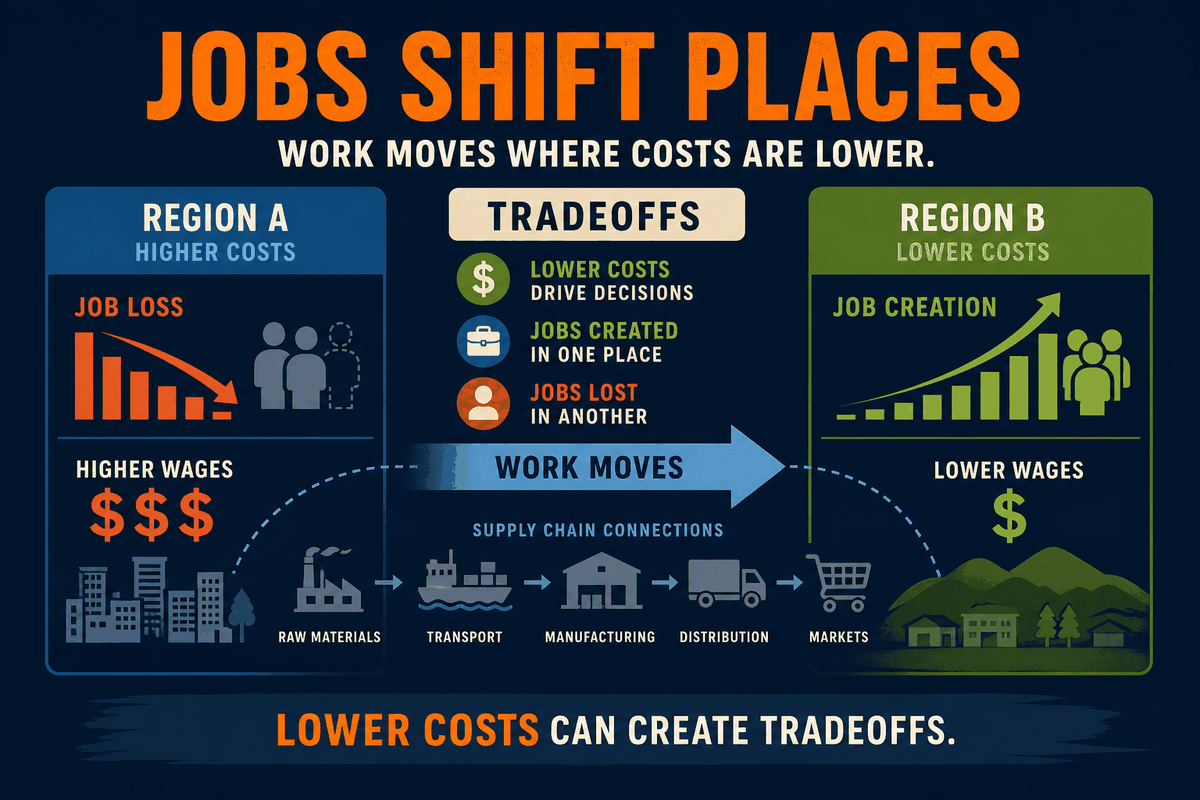
Lower production costs rarely produce only winners. Firms may increase profit and consumers may see cheaper goods, but workers and communities can face losses that do not appear on a corporate balance sheet.
- Firms — gain cost savings, flexibility, and market reach; risk supply disruptions or public criticism over labor practices.
- Consumers — may enjoy lower prices; ethical debates question hidden social and environmental costs.
- Destination regions — may industrialize and upgrade skills; may also host sweatshop conditions or toxic runoff.
- Origin regions — may shed polluting plants and shift toward services; may also lose stable middle-class factory wages.
- Workers — face wage competition, job insecurity, or new opportunities depending on skill and location.
- Governments — collect taxes from new investment or lose revenue when payrolls shrink.
Balanced AP paragraphs acknowledge tradeoffs when the prompt allows. A destination country that gains jobs may still face weak enforcement of labor law. An origin country that loses factories may eventually attract logistics or research offices on old industrial land — but transition can take decades.
Rostow's stages might frame destination growth as industrial takeoff, while dependency theory warns that foreign-owned assembly may not equal autonomous development. Use the theory the stimulus invites — evidence first, theory second.
Outsourcing, Offshoring, and Deindustrialization
Deindustrialization is the decline of manufacturing employment or industrial importance in a region. Offshoring can contribute when firms move assembly abroad and close domestic plants. Outsourcing may also reduce local jobs when contracted work leaves the region even if brand headquarters remain.
Automation and global trade competition are related but distinct causes — robotics can cut jobs without crossing borders, while offshoring moves work geographically. AP stimuli sometimes list multiple causes; name the one your evidence best supports.
Origin regions such as older manufacturing belts may experience unemployment, tax-base loss, brownfields, and out-migration. Service-sector growth can continue nationally while specific cities lose mill jobs. Read the full industrialization and deindustrialization study guide for Rust Belt clues, brownfields, and redevelopment responses.
- Offshoring abroad can reduce domestic factory employment.
- Outsourcing can shift work to contractors in lower-cost locations.
- Destination regions may gain industry while origins decline — a paired geographic story.
- Postindustrial restructuring may follow job loss in high-income countries.
- Pair decline language with the correct cause named in the stimulus — do not blame offshoring if only automation is shown.
Outsourcing and Offshoring Trap Fixer
Replace weak assumptions with stronger AP moves when global labor clues appear.
| Trap | Why it is wrong | Stronger AP move |
|---|---|---|
| Outsourcing and offshoring are the same | They highlight different dimensions — contractor versus country | Ask who performs the work and where it occurs before labeling |
| Outsourcing always means international | Domestic contractors count as outsourcing | Use outsourcing for any external contract; add offshoring only if a border is crossed |
| Offshoring always means another company | A firm can own the foreign plant | Company-owned factories abroad are offshoring without outsourcing |
| Only factories can be outsourced or offshored | Services and digital work move too | Include call centers, IT, payroll, and logistics examples |
| Only rich countries benefit | Destination regions may gain jobs; origin firms save costs | Identify winners and losers with regional scale |
| Destination regions always benefit equally | Labor and environmental problems may persist | Note job gains alongside possible weak protections or pollution |
| Job loss only comes from offshoring | Automation and domestic outsourcing also matter | Match the cause named in the stimulus |
| Lower costs mean no tradeoffs | Workers and communities may lose even when prices fall | Explain at least one cost alongside firm or consumer benefit |
Scenario Practice
Practice classifying a multi-part corporate stimulus like an AP data or narrative question.
A U.S.-based company contracts customer support to another company in the same country. Another division moves electronics assembly to a company-owned plant abroad. A third division contracts software testing to a foreign firm.
- Which example is outsourcing only?
- Which example is offshoring only?
- Which example is both outsourcing and offshoring?
- What is one possible effect on the origin region?
Reveal model explanation
1. Outsourcing only: Customer support contracted to another company in the same country — another firm performs the work without crossing a border.
2. Offshoring only: Electronics assembly moved to a company-owned plant abroad — location changes while the same company owns the facility.
3. Both: Software testing contracted to a foreign firm — another company performs work in another country.
4. Origin effect: Possible manufacturing or service job loss, wage pressure, deindustrialization in the U.S. base, or a shift toward higher-skill domestic roles — choose one and explain with evidence.
Why this earns credit: Separates who from where, labels both concepts correctly, and states a plausible spatial effect.
Outsourcing vs Offshoring Sorter
Read each clue and classify it as Outsourcing Only, Offshoring Only, Both Outsourcing and Offshoring, Neither / Not Enough Evidence, or Effect or Tradeoff. Score 12 clues with instant feedback.
How to Use Outsourcing and Offshoring in FRQs
Identify the process → explain who or where changed → connect to cost, labor, or regional effects.
Weak answer
The company sent jobs away.
Better answer
The example shows offshoring because production moved to another country. If the work is also contracted to a different company, it is outsourcing too. Firms may do this to reduce labor costs or access supply chains, but the origin region may experience job loss, wage pressure, or deindustrialization, while the destination region may gain jobs and investment.
Sentence starters
- This is outsourcing because…
- This is offshoring because…
- This is both because…
- The firm benefits by…
- The origin region may experience…
- The destination region may experience…
A strong answer clearly separates outsourcing from offshoring and explains at least one spatial effect. Use sector vocabulary when employment shifts from manufacturing to services after plants leave.
How do you use outsourcing and offshoring on an AP Human Geography FRQ?
Name the process with evidence, separate who changed from where changed, explain a firm motivation (cost, skills, supply chain), and describe at least one spatial effect on the origin or destination region. Note tradeoffs — job loss, wage pressure, new investment, or labor and environmental concerns — when the stimulus supports balanced analysis.
FRQ Practice and Global Labor Sprints
Full FRQ
A company headquartered in Country A contracts software support to a firm in Country B and moves some manufacturing to a company-owned factory in Country C. Country A loses some manufacturing jobs, while Country C gains assembly jobs but faces concerns about wages and environmental regulation.
- A. Define outsourcing.
- B. Define offshoring.
- C. Identify which part of the scenario shows both outsourcing and offshoring.
- D. Explain one effect on either the origin region or destination region.
Planning hint
A: contract to another company. B: move work to another country. C: software support contracted in Country B. D: Country A job loss or Country C jobs with labor/environment tradeoffs.
Reveal rubric, model answer, and weak vs better samples
Rubric (4 points typical)
- 1 pt — Outsourcing defined as contracting work to another company
- 1 pt — Offshoring defined as moving work or production to another country
- 1 pt — Identifies contracted software support abroad as both outsourcing and offshoring
- 1 pt — Valid origin or destination effect with explanation (job loss, investment, wages, environment)
Model A: Outsourcing is contracting work to another company instead of doing it in-house.
Model B: Offshoring is moving production or services to another country.
Model C: Software support contracted to a firm in Country B is both outsourcing and offshoring because another company performs the work across a border.
Model D: Country A may lose manufacturing jobs and face deindustrialization, while Country C gains assembly employment but may face low wages or weaker environmental enforcement.
Common weak answer: The company went global and jobs changed.
Better answer: Outsourcing means Country A's headquarters hires another firm to perform a task. Offshoring means work crosses into Country B or Country C. Contracted software support in Country B is both outsourcing and offshoring. Country A loses manufacturing jobs, showing a deindustrialization effect in the origin region, while Country C gains assembly jobs but may face labor and environmental tradeoffs in the destination region.
Why this earns credit: Defines both terms, identifies the combined example, and explains a regional effect with balanced detail.
Global labor sprint 1
A company moves production to its own factory abroad.
- A. Identify the process.
- B. Explain one reason a firm might do this.
Reveal sprint rubric and model
Sprint rubric (2 points)
- 1 pt — Offshoring (work moved to another country)
- 1 pt — Valid reason: lower labor costs, market access, suppliers, or tax incentives
Model A: Offshoring — the company relocated production across a national border.
Model B: The firm may seek lower labor costs or proximity to suppliers and export markets, reducing total production cost.
Global labor sprint 2
A company contracts warehouse logistics to another firm in the same country.
- A. Identify the process.
- B. Explain why this is not offshoring.
Reveal sprint rubric and model
Sprint rubric (2 points)
- 1 pt — Outsourcing (contracting to another company)
- 1 pt — Work stays in the same country, so no border is crossed
Model A: Outsourcing — another firm performs logistics under contract.
Model B: Offshoring requires work to move to another country; a domestic contractor keeps production and services inside the same national economy.
Common Mistakes
Saying outsourcing and offshoring are identical
Wrong: Outsourcing and offshoring always mean the same thing on every AP prompt.
Better: Outsourcing is about who does the work; offshoring is about where the work is done.
Saying outsourcing must be international
Wrong: Outsourcing only counts when work moves to another country.
Better: Outsourcing can happen domestically or internationally — contracting is the key idea.
Saying offshoring must involve another company
Wrong: Offshoring always means hiring a foreign contractor.
Better: Offshoring can happen inside the same company if work moves to a company-owned plant abroad.
Ignoring destination-region effects
Wrong: AP answers only need to describe job loss in the origin country.
Better: Strong answers consider both origin and destination regions — jobs, wages, investment, and labor conditions.
Saying lower cost means only benefits
Wrong: Cheaper production always helps every worker and region equally.
Better: Lower costs can create tradeoffs such as job loss, wage pressure, weak labor protections, or environmental harm.
AP Exam Clues
Process vocabulary
- outsourcing
- offshoring
- contracted work
- third-party provider
- moved abroad
- production overseas
- multinational corporation
- global supply chain
- new international division of labor
Regional clues
- labor cost
- job relocation
- deindustrialization
- origin region
- destination region
- foreign investment
- export processing
- maquiladora-style zones
- wage pressure
Balanced analysis
- tradeoff
- lower prices
- job creation abroad
- job loss at home
- labor protections
- environmental regulation
- not identical terms
- not always international
- not only factories
AP clue: Decision rule: If work is contracted to another company, use outsourcing. If work moves to another country, use offshoring. If both happen, say both.
Practice MCQs
8 AP-style questions on outsourcing and offshoring ap human geography. Choices shuffle at display time.
Outsourcing definition
Question 1
Which statement best defines outsourcing?
Explanation: Outsourcing means hiring another firm to perform work your company used to do in-house.
Why the tempting wrong answer fails: Moving abroad is offshoring; robotics is automation; closing plants describes decline, not contracting.
AP clue: Third-party provider, contracted work, external firm → outsourcing.
Offshoring definition
Question 2
Which statement best defines offshoring?
Explanation: Offshoring relocates work or production across a national border.
Why the tempting wrong answer fails: Domestic payroll contracting is outsourcing without offshoring; clustering is agglomeration; indicators are development measurement.
AP clue: Production overseas, moved abroad, foreign plant → offshoring.
Outsourcing vs offshoring
Question 3
A firm contracts IT support to a company in the same country. Another firm moves assembly to its own plant abroad. Which comparison is correct?
Explanation: Domestic contracting is outsourcing without offshoring; a company-owned foreign plant is offshoring.
Why the tempting wrong answer fails: Domestic contracts do not cross borders; the foreign plant clearly changes where work occurs.
AP clue: Who vs where — contract at home = outsourcing; plant abroad = offshoring.
Both concepts
Question 4
A apparel brand hires a factory in Vietnam to sew clothing while keeping design in the United States. Which pair of concepts best fits?
Explanation: Contracting production abroad combines outsourcing (another company) and offshoring (another country).
Why the tempting wrong answer fails: Foreign contracted production is not domestic-only; design ownership does not erase contracted sewing abroad.
AP clue: Contract + foreign location → both outsourcing and offshoring.
Firm motivation
Question 5
Which reason best explains why a multinational corporation moves assembly to a lower-wage country?
Explanation: Firms offshore or outsource to cut costs, access skills, suppliers, or markets — not to end transport or return to subsistence farming.
Why the tempting wrong answer fails: Global production still uses transport; Rostow stage 1 is unrelated; assembly relocation does not expand origin mining jobs.
AP clue: Labor cost, cheaper production, supplier access → firm motivation.
Deindustrialization connection
Question 6
Manufacturing employment falls in a high-income region while assembly jobs grow abroad. Which related process fits best?
Explanation: Lost manufacturing jobs at home while production shifts abroad fits deindustrialization tied to offshoring and trade.
Why the tempting wrong answer fails: Job loss is decline, not growth; clustering does not explain relocation; exports alone do not guarantee sustainability.
AP clue: Domestic manufacturing job loss + production abroad → deindustrialization link.
Origin/destination effect
Question 7
A destination country gains factory jobs but reports weak labor protections and pollution near new plants. Which AP conclusion is strongest?
Explanation: Destination regions may gain employment and investment but can also face low wages, weak rules, or environmental harm.
Why the tempting wrong answer fails: Benefits are uneven; origin effects still matter; foreign jobs can coincide with origin job loss.
AP clue: Jobs + weak protections or pollution → balanced destination-region analysis.
FRQ scenario
Question 8
Country A contracts software support to a firm in Country B and operates a company-owned factory in Country C. Country A loses manufacturing jobs while Country C gains assembly work. Which FRQ answer best applies outsourcing and offshoring?
Explanation: Contract abroad = both concepts; owned foreign plant = offshoring; spatial effects differ by region with plausible tradeoffs.
Why the tempting wrong answer fails: Origin job loss matters; contracting abroad includes outsourcing; job loss contradicts industrialization growth.
AP clue: Name processes separately, then explain origin and destination effects with evidence.
FAQ
What is outsourcing in AP Human Geography?
Outsourcing is contracting work to another company or external provider instead of performing it in-house. The work may stay in the same country or move abroad. AP Human Geography uses outsourcing to explain who performs tasks such as manufacturing components, customer service, logistics, payroll, software support, or assembly when firms reorganize production.
What is offshoring in AP Human Geography?
Offshoring is moving work or production to another country. The company may keep ownership of a foreign facility or rely on another firm. Offshoring explains where work is performed and often connects to labor costs, trade access, supply chains, tax incentives, and market access in destination regions.
What is the difference between outsourcing and offshoring?
Outsourcing focuses on who does the work — another company performs the task. Offshoring focuses on where the work is done — production or services cross a national border. A firm can outsource domestically without offshoring, offshore with its own foreign plant without outsourcing, or combine both when it contracts work abroad.
Can outsourcing happen without offshoring?
Yes. A company can contract work to another firm in the same country — domestic payroll services, logistics, or customer support are outsourcing without crossing a border. Offshoring requires work to move to another country.
Can offshoring happen without outsourcing?
Yes. A company can move production to a company-owned plant abroad. That is offshoring because the location changes, even though the same corporation still owns the operation. Outsourcing requires another company to perform the work.
Why do companies outsource or offshore?
Firms seek lower labor or production costs, specialized skills, supplier networks, market access, tax incentives, flexibility, focus on core business, and global supply-chain efficiency. These decisions reshape employment in origin and destination regions and connect to multinational corporations and development theory.
How do outsourcing and offshoring affect deindustrialization?
When manufacturing or service jobs leave an origin region because work is contracted elsewhere or moved abroad, the origin region can experience deindustrialization — falling manufacturing employment, plant closures, and economic restructuring. Automation and trade competition are separate but related causes that may appear in the same prompt.
What are effects of outsourcing and offshoring on destination regions?
Destination regions may gain jobs, wages, foreign investment, infrastructure, and industrialization opportunities. They may also face weak labor protections, environmental harm, dependency on foreign firms, or uneven benefits within the country. AP answers should note both opportunities and costs when the stimulus allows.
What are common AP exam clues for outsourcing and offshoring?
Look for contracted work, third-party providers, production moved abroad, multinational corporations, global supply chains, labor-cost differences, job relocation, deindustrialization, new international division of labor, origin region, destination region, and tradeoff language. Separate who performs work from where it occurs.
How do you write about outsourcing and offshoring on an AP Human Geography FRQ?
Identify outsourcing, offshoring, or both with stimulus evidence. Explain a firm motivation such as cost, skills, or supply-chain access. Describe at least one effect on the origin or destination region — job loss, investment, wage pressure, or labor and environmental concerns. Avoid treating the terms as identical.