Development can raise income, health, education, and infrastructure. Development indicators and HDI track many of those gains — but averages can hide pollution, displacement, or weak labor protections.
What is sustainable development in AP Human Geography?
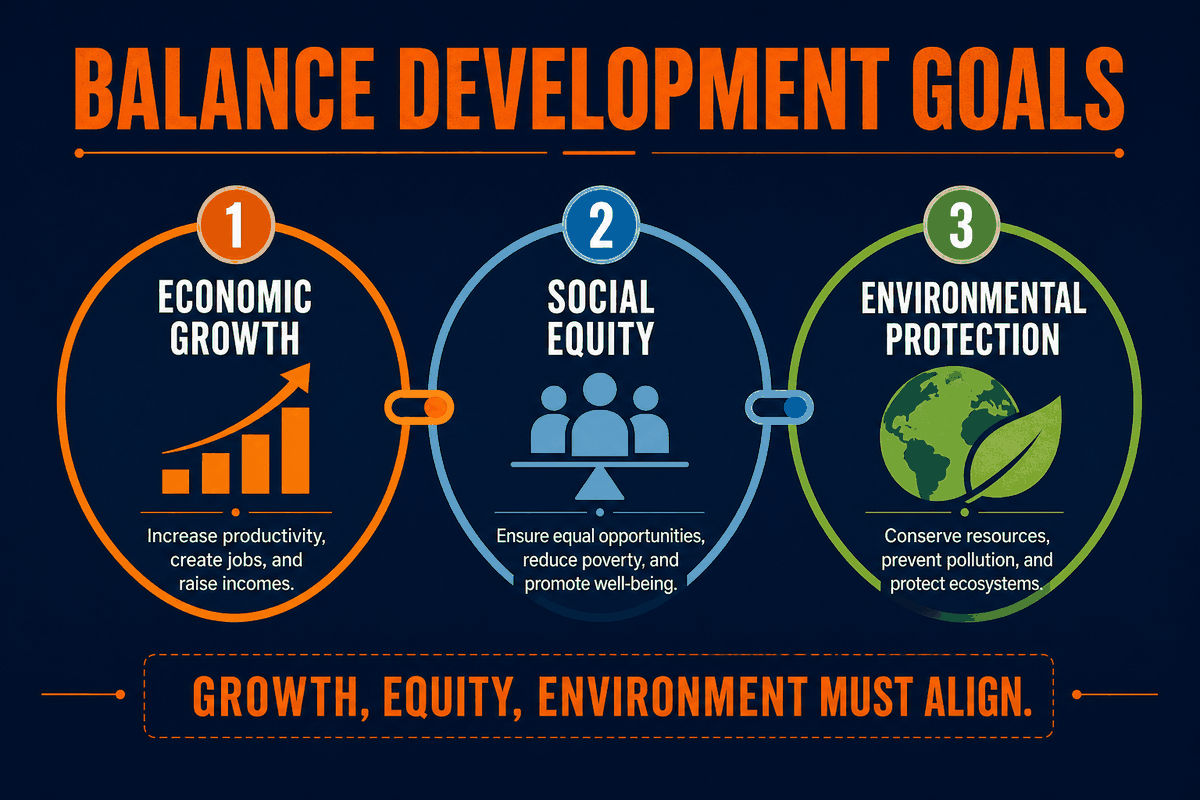
Sustainable development is development that meets present needs while protecting the ability of future generations to meet their needs. In sustainable development AP Human Geography, it means balancing economic growth, social equity, and environmental protection. Strong AP answers explain both the benefits and tradeoffs of policies such as clean energy, conservation, ecotourism, urban redevelopment, pollution controls, or export-oriented growth.
Say it fast: Sustainable development = growth today without harming tomorrow.
AP clue: If the question mentions balancing economic growth, equity, environment, resource use, SDGs, conservation, pollution, future generations, or development tradeoffs, think sustainable development.
Unit 7 hub → Special Economic Zones → Sustainable Development
Why Sustainable Development Matters in AP Human Geography
Sustainable development AP Human Geography is the capstone idea that connects everything you studied in Unit 7 — development indicators, industrial location, globalization, and policy — to one question: can growth last, and can it be fair?
Development can also create inequality, resource depletion, and industrial pollution. Industrial change, global supply chains, and special economic zones often appear in prompts that ask you to evaluate tradeoffs, not only celebrate growth.
Strong AP answers name the policy, identify which pillar it supports, explain a benefit, and note a tradeoff when the stimulus allows balanced analysis.
Unit 7 teaches how economies industrialize, how wealth stays uneven, and how firms relocate production across borders. Sustainable development is where those threads meet policy evaluation. A country may report rising GDP while rivers downstream from export factories run brown. A city may plant trees along a new transit line while rents push longtime residents farther from jobs. Geographic thinking asks who benefits, who pays, and whether the pattern can continue — not whether one headline number proves success.
College Board materials increasingly use scenario language: brownfield cleanup, ecotourism revenue, renewable energy investment, affordable housing mandates, pollution controls on assembly plants, and community protests over displacement. Your job is not to memorize every UN sustainability report. It is to recognize when a prompt expects balanced analysis across economic, social, and environmental goals — and to avoid one-sided answers that treat every green label as automatic victory.
Sustainable development also connects back to models you already know. Rostow's stages describe industrial takeoff; sustainability asks about the environmental and social price of that path. Wallerstein and the core-periphery model describe uneven global roles; sustainability asks whether periphery production carries pollution or low-wage risk for core consumers. Dependency theory warns about shallow linkages; sustainability asks whether growth reinvests locally and protects future resources.
Because this is the final Phase 1 spoke, treat sustainable development as your Unit 7 evaluation habit. When an FRQ ends with "evaluate," "assess tradeoffs," or "explain limitations," you are often being pushed toward sustainability logic even if the phrase never appears in the prompt.
Think about time scales. A policy can be economically successful this fiscal year yet environmentally destructive over decades. A housing program may solve today's shortage while building on floodplains that fail tomorrow's climate tests. Sustainable development pushes you to mention duration, not only direction — growth versus decline. That is why future generations appear in the formal definition: geography is intergenerational even when exam prompts focus on a single country at one moment.
Also think about scale. A national renewable energy target may coexist with local air pollution hotspots near legacy factories. A global apparel brand may advertise sustainability while suppliers in another region discharge untreated wastewater. Core-periphery and world-systems vocabulary helps you explain those uneven geographies without assuming every place experiences development the same way.
- Sustainable development balances economic growth, social equity, and environmental protection.
- Future generations matter — present gains should not destroy long-term opportunity.
- AP prompts frequently test tradeoffs, not pure success stories.
- Environmental protection alone is not the full definition.
- Unit 7 models explain patterns; sustainability evaluates whether they are responsible.
AP clue: Balancing jobs, equity, environment, and future generations → think sustainable development.
What is sustainable development?
Sustainable development meets present needs without reducing future generations' ability to meet theirs. On the AP exam, it balances economic growth, social equity, and environmental protection — not one pillar alone. Strong answers name who benefits, who pays, and whether gains can last over time.
Sustainable Development Explained
Sustainable development meets present needs without reducing future generations' ability to meet theirs. That sentence appears in textbooks and on AP-style prompts because it forces you beyond short-term growth. A mine that exhausts ore in ten years, a factory that poisons groundwater, or a tourism boom that prices out residents may raise statistics today while shrinking opportunity tomorrow.
On the AP exam, sustainable development is both a definition and an analytical framework. Definition questions ask you to choose the balanced phrase among distractors that mention only environment or only GDP. Analytical questions give you a policy narrative and expect you to sort benefits and costs across pillars.
- Present needs — jobs, income, health, education, housing, infrastructure.
- Future opportunity — resources, ecosystems, stable economies, social cohesion.
- Three-pillar test — economic, social, environmental goals considered together.
- Policy evaluation — who benefits, who pays, what long-term effects appear.
- Tradeoff language — benefits and costs when stimuli support balanced answers.
Sustainable development is not the same as "no development." Countries with high poverty still need investment, jobs, and services. Sustainability asks how to pursue those goals without creating permanent harm. It also differs from purely environmental conservation that ignores unemployment or housing shortages. A protected forest next to a community without clean water or stable work fails the social and economic tests even if biodiversity thrives.
When stimuli mention clean energy, ecotourism, brownfield reuse, pollution controls, mixed-income housing, or export zones with labor standards, ask which pillars appear and which are missing. That habit prevents the most common AP mistake: calling any green-sounding project fully sustainable without checking equity and economics.
How sustainable development appears on AP-style stimuli
Prompts rarely print the full definition. Instead you read about a city converting an old steel site into housing and parks, a province requiring scrubbers on factory smokestacks, or a coastal country promoting ecotourism to fund reef protection. Stack clues: cleanup or conservation (environment), jobs or housing (economic and social), and sometimes rising rents or weak enforcement (tradeoff). If two pillars improve while one worsens, you have sustainable development analysis — not a one-word label.
Contrast two headlines. Headline A: "National GDP rises 6 percent." That alone is not sustainability evidence. Headline B: "GDP rises while the city invests in transit, cleans a brownfield, and residents protest rent increases." That is sustainability territory — growth plus environmental action plus social tension. Train yourself to hunt for multi-pillar stories.
Link definitions to sector change when prompts describe moving from heavy industry toward services or tech. Higher-value work can support economic sustainability, but only if jobs are stable and environmental damage from old industry is addressed. Link to industrial location when firms choose cleaner technology or when dirty industry relocates rather than improves.
Students sometimes confuse sustainable development with a single technology fix — solar panels on a roof, one new park, or a recycling program. Technology and green space can support sustainability, but AP credit usually requires you to explain who gains economically and socially, not only what was built. A photo of panels without wages, housing, or pollution data is incomplete evidence — the same logic the Sustainability Tradeoff Sorter trains with "Not Enough Evidence" clues.
Why is sustainable development not only environmental?
Environmental protection is one pillar, not the whole definition. Sustainable development also asks whether growth creates fair jobs, reduces poverty, and improves health and education. A clean park built by displacing low-income residents fails the social test even if trees thrive.
Three Pillars of Sustainable Development
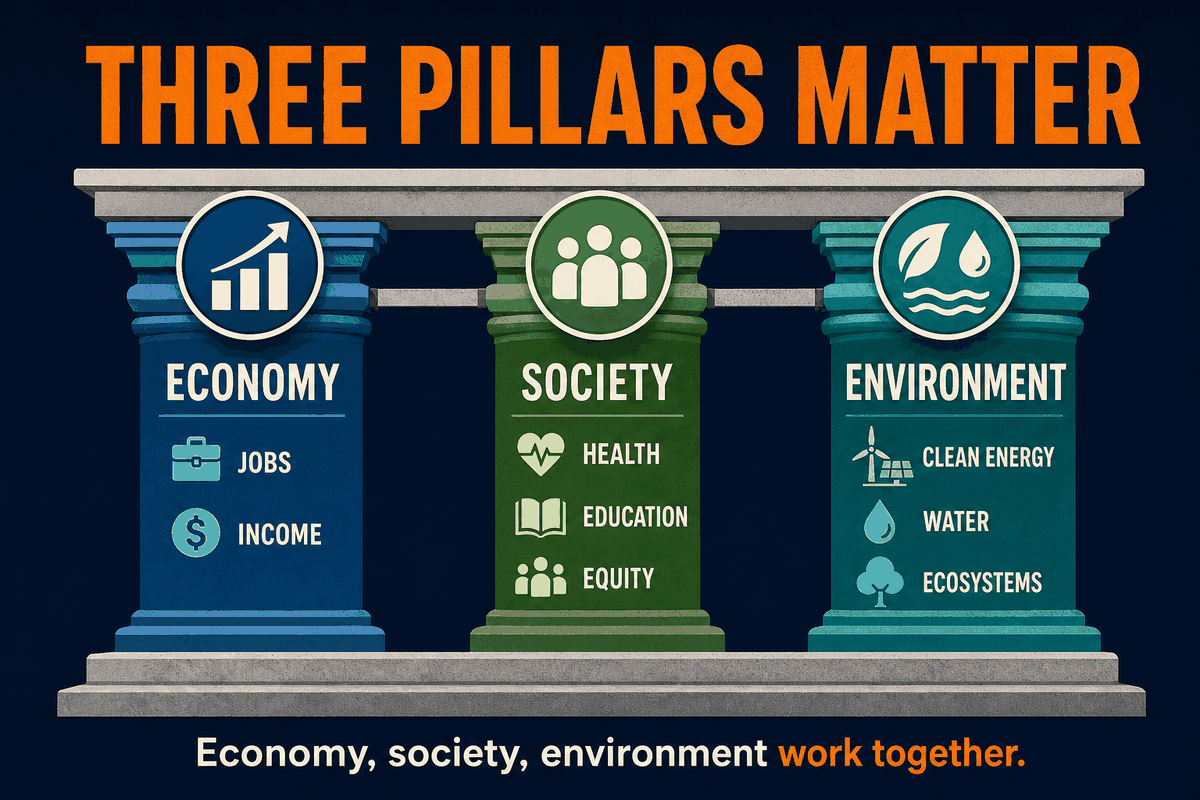
AP Human Geography organizes sustainable development around three pillars: economic, social, and environmental sustainability. Exam questions may ask you to identify one pillar, compare them, or explain why a policy fails if it ignores a pillar.
| Pillar | Main goal | AP clue | Example | Common mistake |
|---|---|---|---|---|
| Economic sustainability | Long-term jobs, income, infrastructure, and diversified growth | Stable employment, investment, diversified economy, not one fragile export | Worker retraining after factory closure; local suppliers gain contracts | Assuming any GDP increase is automatically sustainable |
| Social sustainability | Equity, health, education, housing, safety, labor rights, inclusion | Affordable housing, health access, gender equity, community input, fair wages | Mixed-income housing near transit; program expanding girls' education | Treating social sustainability as only charity, not structural equity |
| Environmental sustainability | Clean air and water, ecosystems, pollution control, resource stewardship | Emissions reduction, wetland protection, renewable energy, conservation | Brownfield cleanup; factory installs cleaner technology | Thinking environmental sustainability is the entire definition |
The pillars interact. Economic growth without social equity can widen inequality. Environmental rules without economic planning can eliminate jobs without transition support. Social programs without environmental care can improve housing while leaving toxic soil untouched. Strong FRQs name the pillar that improves and the pillar at risk.
Memory device for MCQs: Economic = employment and endurance; Social = services and equity; Environmental = ecosystems and emissions. When a clue fits more than one pillar, pick the best-supported primary pillar and mention overlap in FRQ prose if time allows.
What are the three pillars of sustainable development?
The three pillars are economic sustainability (jobs, income, long-term growth), social sustainability (equity, health, education, housing, labor rights), and environmental sustainability (clean air and water, ecosystems, pollution control, resource stewardship). AP answers should connect all three when a policy affects development.
Economic Sustainability
Economic sustainability means growth and employment that can last — not a one-year export boom followed by empty factories. AP clues include stable jobs, diversified industries, infrastructure investment, worker retraining, and local value capture rather than dependence on a single commodity or foreign buyer.
Economic sustainability connects directly to Unit 7 content you already studied. Sector shifts from primary extraction toward manufacturing or services can raise productivity, but only if new jobs match worker skills and pay living wages. GDP and GNI may rise while vulnerability remains if the economy relies on one crop, one factory owner, or one global buyer.
- Job stability — employment that survives demand shocks and technology change.
- Diversification — multiple industries rather than one export or resource.
- Infrastructure — roads, power, ports, and digital links that support long-term production.
- Investment and retraining — capital and skills that help workers adapt after industrial change.
- Local linkages — suppliers and services that keep income circulating regionally.
Export-oriented growth can be economically sustainable when countries move up value chains — from raw exports toward processing, design, or branded goods. It is less sustainable when profits leave, components are imported entirely, and wages stay at the bottom of global labor markets. That is why economic sustainability often appears alongside SEZ and offshoring debates on the exam.
When writing FRQs, tie economic sustainability to specific stimulus evidence: new businesses after brownfield cleanup, diversified tourism and manufacturing, or retraining centers that reduce long-term unemployment after deindustrialization. Avoid vague claims that "the economy improved" without naming how.
Economic sustainability vs short-term growth
A short-term growth spike from stripping forests or pumping groundwater may boost GDP now and weaken the economy later when resources disappear. AP readers reward answers that distinguish volume of growth from durability. Ask: will these jobs exist in fifteen years? Can the region survive if global demand shifts? Does income depend on one firm or one crop?
Deindustrialization makes economic sustainability visible when old factory towns seek new employers, logistics hubs, or tech offices on cleaned industrial land. Transition policy — retraining, small-business loans, broadband — is economic sustainability in action.
Environmental Sustainability
Environmental sustainability protects air, water, soil, biodiversity, and climate stability so resources exist for future use. AP clues include pollution control, conservation, renewable energy, wetland restoration, emissions standards, and reducing resource depletion.
Industrial Unit 7 topics make environmental sustainability concrete. Industrialization historically raised smokestack emissions; sustainable policy adds scrubbers, cleaner technology, and monitoring. Agglomeration concentrates economic activity — and sometimes concentrates pollution unless regulation keeps pace.
- Pollution reduction — cleaner factories, waste treatment, lower emissions.
- Resource stewardship — managing forests, fisheries, groundwater, and minerals responsibly.
- Ecosystem protection — habitats, biodiversity, watersheds, and green space.
- Energy transition — renewable or efficient energy where stimuli mention it.
- Long-term carrying capacity — avoiding growth that depletes resources permanently.
Environmental sustainability is not anti-growth. It asks what kind of growth. A logistics hub on cleaned brownfield land may improve environmental outcomes compared with sprawl into farmland. A solar or wind project may cut emissions but require land, minerals, and upfront capital — which returns you to tradeoff analysis.
Watch for pollution leakage — when strict rules in one country push dirty production to another with weaker enforcement. That pattern links environmental sustainability to offshoring and world-systems geography: consumers in core markets may benefit from cheap goods while periphery communities bear emissions.
Brownfields and environmental justice
Contaminated former industrial sites — brownfields — are environmental hazards and social equity issues when they sit near low-income neighborhoods. Cleanup plus safe reuse is a textbook sustainable development story because it addresses pollution, land efficiency, and potentially housing or jobs. If cleanup never happens, children play near toxins while developers build on cleaner suburban land — an uneven geographic pattern AP maps may hint at.
What are examples of sustainable development in AP Human Geography?
Examples include brownfield cleanup with affordable housing, pollution controls on factories, ecotourism that funds conservation, transit-oriented redevelopment, renewable energy with community benefits, and export zones with labor and environmental standards. Each example should show economic, social, and environmental dimensions when the stimulus allows.
Sustainable Development Goals
The Sustainable Development Goals (SDGs) are United Nations targets for reducing poverty, improving health and education, advancing gender equity, and protecting the environment. You do not need to memorize all seventeen goals for AP Human Geography, but recognize that they express the same multidimensional logic as the three pillars.
Examples especially relevant to Unit 7 include:
- No poverty / zero hunger — economic and social baseline goals.
- Good health and quality education — social sustainability and HDI-related outcomes.
- Gender equality and reduced inequalities — equity across groups and regions.
- Clean water and sanitation — environmental and public health links.
- Affordable and clean energy — environmental transition with economic costs and benefits.
- Decent work and economic growth — jobs that are productive and fair.
- Sustainable cities and communities — housing, transit, and urban environmental quality.
- Climate action and life on land or water — conservation and emissions reduction.
On MCQs, SDG distractors may confuse goals with Rostow stages, Weber factors, or purely economic indicators. Correct answers emphasize global, multidimensional targets — not a single factory location rule.
Use SDGs as vocabulary reinforcement, not as a separate test. When a stimulus mentions clean water access for low-income districts, you are inside SDG logic even if the acronym never appears. When a prompt references "global goals for equity and environment," connect that language to sustainable development pillars.
SDGs also show that sustainability is negotiated politically. Countries prioritize differently based on income, resource endowment, and governance. Dependency critics might ask whether global goal timelines pressure periphery states while core consumers maintain high resource use. You do not need that debate on every question, but it shows why sustainability is geographic — scales and power matter.
For exam prep, pick five SDG examples you can explain in one sentence each — clean water access, gender equity in schooling, affordable clean energy, sustainable cities, and climate action pair naturally with Unit 7 industrial and urban themes. If a multiple-choice option lists only "climate" while the stimulus mentions jobs and housing, reconsider whether a broader multidimensional answer fits better.
Tradeoffs and Unintended Consequences
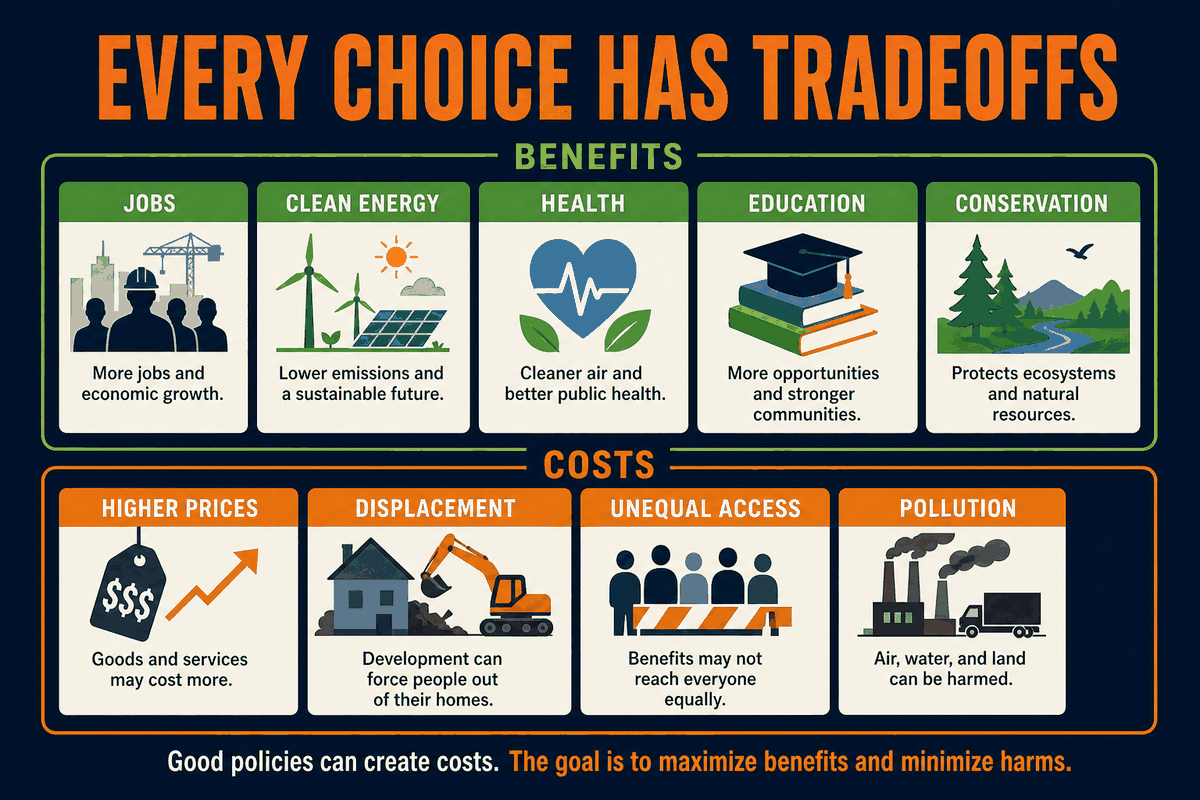
Sustainable development analysis lives in tradeoffs. Policies that help one pillar may strain another. AP Human Geography rewards students who explain benefits and costs when stimuli include both — not students who treat sustainability as a synonym for "good."
| Policy example | Likely benefit | Possible tradeoff | Stronger AP move |
|---|---|---|---|
| Clean energy project | Lower emissions; long-term energy security | Land use, mineral mining, upfront cost, uneven access | Credit emissions gains; note cost or access concerns if shown |
| Ecotourism | Conservation funding; local jobs | Higher living costs; cultural disruption; habitat stress from visitors | Balance habitat protection with community equity |
| Export manufacturing zone | Jobs, exports, infrastructure | Pollution, low wages, weak local linkages | Pair economic gains with social or environmental evidence |
| Green urban redevelopment | Cleaner land, transit, green space | Displacement; rising rents; benefits skewed to newcomers | Propose affordable housing or anti-displacement tools |
| Pollution controls on factories | Cleaner air and water for residents | Higher production costs; possible job loss if firms relocate | Name health benefit and economic transition challenge |
Unintended consequences appear when planners optimize one goal. Bus rapid transit may cut emissions but raise property values along the corridor. A conservation zone may protect wildlife while limiting local farming income. Renewable energy may reduce coal jobs before new positions scale up. Geography tracks those spatial and social ripples.
When SEZs raise exports, ask about enforcement of labor and environmental rules. When Weber's least-cost logic pushes firms toward cheap labor abroad, ask who breathes the factory air and who drinks the river water downstream.
Tradeoff writing template for FRQs: "The policy improves [pillar] by [evidence], but it may weaken [pillar] because [evidence]." That structure earns balanced credit without requiring a long essay.
Sustainable Development in Industry and Cities
Industry and cities are where sustainable development becomes visible on maps and in data. Pollution, housing, transit, energy use, and job access concentrate in urban-industrial landscapes — exactly the settings AP Human Geography loves.
Industrial sustainability includes cleaner technology, emissions monitoring, waste treatment, and closing dirty plants that cannot meet standards. It also includes retraining workers when deindustrialization removes old factory jobs. A sustainable path plans transition rather than abandoning communities.
Urban sustainability includes brownfield cleanup, transit-oriented development, green infrastructure, efficient water and energy systems, mixed-income housing, and infill development that reduces sprawl into farmland or habitat. Each tool can score on multiple pillars: economic (jobs, tax base), social (housing, mobility), environmental (lower emissions, cleaned land).
- Brownfield redevelopment — reuse contaminated industrial land instead of greenfield sprawl.
- Transit-oriented development — housing and jobs near public transportation.
- Affordable housing policy — prevents green upgrades from displacing residents.
- Green infrastructure — parks, permeable surfaces, urban trees, flood management.
- Industrial symbiosis — firms share waste heat or materials to reduce overall pollution.
Connect urban industry to agglomeration: clustering reduces transport but can increase congestion and emissions unless planning manages density. Connect to industrial location when cleaner firms choose sites with access to skilled labor, regulation, and markets — not only cheapest land.
City-scale FRQs often describe one neighborhood gaining parks and rail while another still hosts polluting warehouses. Scale matters. National sustainability averages can hide local environmental injustice — a core theme when you evaluate who lives near highways, ports, or legacy factories.
Practice linking industry and city examples to pillars quickly: a transit line near cleaned industrial land can score economic (jobs, tax base), social (mobility, housing access), and environmental (lower car emissions, brownfield reuse) points in one paragraph. That integrated writing style mirrors how real urban planners defend projects — and how AP readers expect you to connect concepts rather than list isolated facts. Use that habit on every sustainability FRQ you write.
Rust Belt transition as sustainability story
Former industrial regions in North America and Europe show deindustrialization, brownfields, and attempted renewal through tech, medical, education, or logistics economies. Sustainable outcomes depend on whether cleanup, jobs, and housing reach former manufacturing communities or only waterfront districts attractive to investors. AP narratives may describe both new employers and persistent unemployment — credit both when present.
Sustainable Development, SEZs, and Globalization
Globalization moves capital, jobs, pollution, and standards across borders. Sustainable development asks whether that movement produces inclusive, durable, and environmentally responsible growth — or whether it externalizes costs to weaker regions and weaker enforcement.
Special economic zones illustrate the debate. Zones may attract foreign investment, create assembly jobs, and build port infrastructure — economic sustainability clues. They may also report low wages, weak unions, pollution near host communities, and shallow linkages to local suppliers — social and environmental tradeoffs. Export growth alone does not prove sustainability.
Outsourcing and offshoring split production across countries. A brand headquartered in a core city may design products while assembly occurs where labor is cheaper and rules differ. Consumers may see lower prices while workers and residents near foreign factories experience different conditions. Sustainable development analysis names both geographies.
- Global supply chains can raise income in destination countries.
- They can also shift pollution and low-wage risk to places with weaker protections.
- Labor and environmental standards become part of sustainability policy.
- Footloose firms may relocate again if costs rise — challenging long-term economic sustainability.
- Fair trade, monitoring, and local content rules attempt to reduce harmful tradeoffs.
Link to Wallerstein and core-periphery: high-value tasks often stay in core regions while periphery areas host riskier or dirtier stages. Sustainable development questions whether that division is acceptable and what policies might spread benefits more evenly.
When a prompt describes export zones with new pollution controls and worker housing, sustainability improves on paper — verify enforcement in your answer. When a prompt describes rising exports with contaminated rivers, name the gap between economic statistics and environmental reality.
Compare two supply-chain stories. Story one: a firm offshores assembly to cut labor costs with no monitoring — economic gain for the firm, possible social and environmental risk abroad. Story two: the same firm requires supplier audits, limits hazardous chemicals, and funds worker housing near the plant — still globalized, but closer to sustainable development because standards travel with investment. The geography of responsibility matters as much as the geography of production.
On mixed review, pair this section with the SEZ study guide and outsourcing guide before attempting the Unit 7 review bridge below the MCQs. Sustainable development is the lens; those topics supply many of the scenarios you will evaluate.
Sustainable Development Trap Fixer
Replace weak assumptions with stronger AP moves when sustainability clues appear.
| Trap | Why it is wrong | Stronger AP move |
|---|---|---|
| Sustainable development only means environment | Protecting nature alone ignores jobs, equity, and future economic stability | Name all three pillars; environment is one part of the framework |
| Economic growth is always sustainable | GDP can rise while pollution, inequality, or resource depletion worsen | Ask whether growth is long-term, inclusive, and environmentally responsible |
| Green policies have no costs | Redevelopment and energy transitions can raise prices or displace residents | Credit environmental benefits; note social or economic tradeoffs when shown |
| All ecotourism is good | Tourism can fund conservation but also stress habitat and raise living costs | Balance conservation benefits with community equity and access |
| Sustainable development ignores jobs | Economic pillar includes stable employment and diversified income | Explain job creation or retraining as part of sustainability |
| Sustainability means stopping all development | Low-income regions still need investment, services, and infrastructure | Support responsible development that meets present needs fairly |
| One policy benefits everyone equally | Gains often concentrate geographically or socially | Name who benefits and who pays using stimulus evidence |
| SDGs are only about climate | SDGs include poverty, health, education, gender equity, and work | Treat SDGs as multidimensional goals aligned with three pillars |
Scenario Practice
Practice reading a brownfield redevelopment stimulus the way an AP narrative question might present it.
A city redevelops a polluted brownfield into mixed-income housing, a job-training center, transit access, and green space. The project reduces pollution and creates jobs, but some residents worry about rising rents and displacement.
- Which concept is shown?
- What is one economic benefit?
- What is one environmental benefit?
- What is one social tradeoff?
- How could the policy become more sustainable?
Reveal model explanation
Concept: Sustainable development — the project balances economic growth, environmental cleanup, and social needs across pillars.
Economic benefit: Jobs, businesses, or worker training that raise long-term employability and local economic activity.
Environmental benefit: Brownfield cleanup, reduced contamination, and green space that improve environmental quality.
Social tradeoff: Rising rents and possible displacement of existing residents despite mixed-income goals.
More sustainable policy: Stronger affordable housing protections, community input, anti-displacement funds, and long-term pollution monitoring.
Why this earns credit: Names sustainable development, cites pillar-specific evidence, and proposes a tradeoff fix.
Sustainability Tradeoff Sorter
Read each clue and classify it as Economic Sustainability, Social Sustainability, Environmental Sustainability, Tradeoff / Unintended Consequence, or Not Enough Evidence. Score 12 clues with instant feedback.
How to Use Sustainable Development in FRQs
Name the policy → identify economic, social, or environmental goal → explain one tradeoff or long-term effect.
Weak answer
The project is sustainable because it helps the environment.
Better answer
The project supports sustainable development because it cleans polluted land and creates jobs, but a complete answer must also consider social equity. If redevelopment raises rents and displaces residents, the policy may improve the environment while worsening inequality. A stronger sustainable policy would include affordable housing, community participation, and long-term pollution controls.
Sentence starters
- The policy supports sustainable development because…
- The economic benefit is…
- The social equity issue is…
- The environmental benefit is…
- One tradeoff is…
- The policy would be more sustainable if…
A strong answer names the pillar, explains the benefit, and evaluates a tradeoff. Use development indicators when prompts include statistics, but interpret whether those numbers reflect durable, equitable, and clean growth.
How do you use sustainable development on an AP Human Geography FRQ?
Name the policy and pillar it supports, explain one benefit with evidence, and note a tradeoff or long-term effect when the prompt allows balanced analysis. Connect jobs, equity, and environment — avoid calling every green project fully sustainable without checking social and economic impacts.
FRQ Practice and Sustainability Sprints
Full FRQ
A city cleans up a polluted former industrial site and builds affordable housing, public transit, green space, and a job-training center. New businesses move in, but rents begin rising in nearby neighborhoods.
- A. Identify the development concept shown.
- B. Explain one environmental benefit.
- C. Explain one economic or social benefit.
- D. Explain one possible tradeoff or unintended consequence.
Planning hint
A: Sustainable development. B: Brownfield cleanup, less contamination, green space. C: Jobs, affordable housing, transit access, or training. D: Rising rents, displacement, or uneven benefits.
Reveal rubric, model answer, and weak vs better samples
Rubric (4 points typical)
- 1 pt — Identifies sustainable development or balanced three-pillar development
- 1 pt — Valid environmental benefit: cleanup, green space, reduced pollution
- 1 pt — Valid economic or social benefit: jobs, housing, transit, training
- 1 pt — Valid tradeoff: displacement, rising rents, or uneven neighborhood gains
Model A: The concept is sustainable development — balancing economic, social, and environmental goals rather than maximizing one alone.
Model B: Environmental benefits include cleaning contaminated industrial land and adding green space that improves air quality and recreation.
Model C: Economic and social benefits include affordable housing, job-training programs, transit access, and new businesses that employ residents.
Model D: A tradeoff is rising rents in nearby neighborhoods, which may displace longtime residents despite affordable units on the redeveloped site.
Common weak answer: The project is good because it is green.
Better answer: The city pursues sustainable development by cleaning a brownfield and adding housing, transit, and training, but rising nearby rents show a social tradeoff. Stronger policy would add displacement protections and monitor affordability beyond the project boundary.
Why this earns credit: Names the concept, cites pillar-specific benefits with evidence, and states a specific tradeoff tied to the stimulus.
Sustainability sprint 1
An ecotourism project funds habitat conservation but raises local housing prices.
- A. Identify one environmental benefit.
- B. Explain one social or economic tradeoff.
Reveal sprint rubric and model
Sprint rubric (2 points)
- 1 pt — Valid environmental benefit: habitat or conservation funding
- 1 pt — Valid tradeoff: higher housing costs, displacement, or unequal access to tourism profits
Model A: Ecotourism can fund habitat conservation and protect species or landscapes from more destructive land uses.
Model B: Rising housing prices may displace local residents or make the area less affordable for existing communities — a social and economic tradeoff.
Sustainability sprint 2
A government promotes export manufacturing with pollution controls and worker protections.
- A. Explain one economic benefit.
- B. Explain why labor or environmental standards matter for sustainability.
Reveal sprint rubric and model
Sprint rubric (2 points)
- 1 pt — Valid economic benefit: jobs, exports, investment, or infrastructure
- 1 pt — Standards support social and environmental pillars so growth is not only short-term output
Model A: Export manufacturing can create jobs, attract investment, and increase foreign exchange from sold goods.
Model B: Pollution controls and worker protections help ensure growth does not harm health, ecosystems, or fair labor conditions — making development more sustainable over time.
Common Mistakes
Saying sustainable development only means protecting nature
Wrong: Sustainable development is only about saving forests and wildlife.
Better: It balances economy, society, and environment — environmental protection is one pillar, not the whole idea.
Ignoring tradeoffs
Wrong: Sustainable policies always help everyone with no costs.
Better: AP answers should explain both benefits and costs when the stimulus supports balanced analysis.
Saying economic growth is automatically sustainable
Wrong: Any rise in GDP proves sustainable development.
Better: Growth must be long-term, inclusive, and environmentally responsible — not only a short-term statistic.
Saying green policies have no social cost
Wrong: Green redevelopment never displaces residents or raises prices.
Better: Policies can create displacement, price increases, or unequal access — name those tradeoffs when shown.
Forgetting future generations
Wrong: Sustainability only asks whether a project succeeds this year.
Better: Sustainability asks whether present development protects future opportunities and resources.
AP Exam Clues
Core vocabulary
- sustainable development
- sustainability
- three pillars
- economic growth
- social equity
- environmental protection
- future generations
- SDGs
- inclusive growth
Policy clues
- pollution control
- conservation
- renewable energy
- clean water
- affordable housing
- brownfield redevelopment
- ecotourism
- green infrastructure
- worker protections
Balanced analysis
- tradeoffs
- unintended consequences
- displacement
- rising rents
- pollution leakage
- not environment only
- not GDP only
- evaluate over time
- who benefits / who pays
AP clue: Decision rule: If the prompt asks whether development balances jobs, equity, and environment over time, use sustainable development.
Practice MCQs
10 AP-style questions on sustainable development ap human geography. Choices shuffle at display time.
Sustainable development definition
Question 1
Which statement best defines sustainable development?
Explanation: Sustainable development balances present needs with future opportunity — the classic Brundtland-style AP definition.
Why the tempting wrong answer fails: GDP alone ignores equity and environment; stopping all growth is not the AP definition; forests alone omit economic and social pillars.
AP clue: Present needs + future generations + balance → sustainable development.
Three pillars
Question 2
Which set best represents the three pillars of sustainable development?
Explanation: The three pillars are economic, social, and environmental sustainability — the framework AP Human Geography uses for balanced development.
Why the tempting wrong answer fails: Sectors classify work; Wallerstein roles describe global inequality; macro indicators alone are not the pillar framework.
AP clue: Economy, society, environment together → three pillars.
Economic sustainability
Question 3
A region diversifies its economy, invests in infrastructure, and creates stable jobs that are not tied to one declining export. Which pillar is emphasized?
Explanation: Stable jobs, diversified income, and long-term economic resilience match economic sustainability.
Why the tempting wrong answer fails: The stimulus emphasizes jobs and diversification, not ecosystems or housing alone; diversification supports sustainability.
AP clue: Stable jobs, diversified economy, long-term growth → economic pillar.
Social sustainability
Question 4
A program expands access to health care, affordable housing, and girls' education in low-income neighborhoods. Which pillar fits best?
Explanation: Health care, housing, and education access are classic social sustainability and equity outcomes.
Why the tempting wrong answer fails: No environmental or export clues appear; quinary sector is unrelated to community equity programs.
AP clue: Health, housing, education access → social sustainability.
Environmental sustainability
Question 5
A city installs cleaner factory technology, reduces river pollution, and protects wetland habitat. Which pillar is shown?
Explanation: Pollution reduction and habitat protection are environmental sustainability goals.
Why the tempting wrong answer fails: Political participation and stock markets are not the clues given; dependency theory is a separate development model.
AP clue: Pollution control, clean water, habitat protection → environmental pillar.
SDGs
Question 6
Which statement best describes the Sustainable Development Goals (SDGs) for AP Human Geography?
Explanation: SDGs are multidimensional global goals — poverty, health, education, gender equity, clean water, clean energy, and more.
Why the tempting wrong answer fails: Weber and Rostow are separate models; SDGs complement rather than replace standard development indicators.
AP clue: Global goals, poverty, health, education, environment → SDGs.
Tradeoff identification
Question 7
Ecotourism funds habitat conservation but raises local housing costs for residents. Which AP conclusion is strongest?
Explanation: Conservation is an environmental benefit; rising housing costs are a social or economic tradeoff — balanced AP analysis.
Why the tempting wrong answer fails: No policy is automatically perfect; environmental gains do not erase equity concerns; tradeoffs appear frequently on AP prompts.
AP clue: Conservation plus rising local costs → benefit and tradeoff.
Brownfield redevelopment
Question 8
A city cleans contaminated industrial land and redevelops it for housing, parks, and businesses. Which term fits best?
Explanation: Cleaning and reusing former industrial sites is brownfield redevelopment — a common sustainable urban development example.
Why the tempting wrong answer fails: Maquiladoras are border factories; primate city is urban hierarchy; subsistence farming is primary-sector agriculture.
AP clue: Polluted former industrial site cleaned and reused → brownfield redevelopment.
Globalization / SEZ sustainability
Question 9
An export zone creates jobs and rising exports but reports weak pollution enforcement and low wages. Which sustainable development conclusion fits best?
Explanation: Jobs and exports support economic goals, but low wages and pollution show social and environmental tradeoffs typical of SEZ debates.
Why the tempting wrong answer fails: Export growth alone does not prove full sustainability; SEZs connect to globalization; labor and environment matter on AP prompts.
AP clue: Exports plus low wages or pollution → balanced SEZ sustainability analysis.
FRQ application
Question 10
A city redevelops a brownfield with affordable housing, transit, green space, and job training, but nearby rents begin rising. Which FRQ answer best applies sustainable development?
Explanation: Name environmental and economic benefits, acknowledge the social tradeoff, and suggest protections — full sustainable development FRQ logic.
Why the tempting wrong answer fails: One benefit does not end analysis; economic growth still matters; benefits and tradeoffs can coexist.
AP clue: Cleanup + jobs + housing + rising rents → balanced sustainable development FRQ.
How Sustainable Development Connects All of Unit 7
You have worked through development indicators, industrial location, globalization, and policy tools. Sustainable development is the evaluation lens that asks whether those patterns improve lives fairly and last over time — not only whether output or exports rise this year.
Use this grid before a cumulative Unit 7 FRQ or before returning to the Unit 7 hub for mixed practice.
| Unit 7 concept | Sustainable development connection | AP exam move |
|---|---|---|
| Economic sectors | Sector shifts show whether jobs move toward services and higher value — or trap workers in low-wage extraction | Link sector change to income stability and long-term economic resilience |
| Measures of development | GDP and GNI can rise while pollution or inequality worsen — sustainability asks who gains | Pair averages with Gini, health, or environmental clues before calling development success |
| HDI | Health and education gains matter, but HDI does not show environmental damage or future risk | Use HDI with tradeoff language when stimulus shows uneven or short-term gains |
| Rostow | Staged growth models emphasize industrial takeoff — sustainability asks about costs of that path | Contrast Rostow's optimism with pollution, inequality, or resource limits in the stimulus |
| Wallerstein | Core regions may capture high-value tasks while peripheries host polluting or low-wage production | Name who benefits and who bears environmental or social costs in the chain |
| Core-periphery | Value and hazard often shift spatially — clean cores and dirty peripheries are common AP patterns | Explain uneven benefits across scales: global, national, local |
| Dependency theory | Export dependence can limit local control and reinvestment — sustainability asks about long-term autonomy | Pair dependence clues with whether growth is inclusive and environmentally safe |
| Industrial location theory | Firms minimize cost — sustainability asks who pays external costs like pollution or weak labor rules | Connect location factors to community and environmental impacts |
| Weber's Least Cost Theory | Cheapest location is not always fairest or cleanest — transport and labor savings may hide tradeoffs | Explain benefit plus cost when cheap production creates pollution or low wages |
| Agglomeration | Clustering boosts efficiency but can concentrate congestion, housing pressure, and emissions | Balance agglomeration benefits with urban social and environmental strain |
| Industrialization and deindustrialization | Factory growth and decline reshape land, jobs, and pollution — brownfields need sustainable reuse | Link industrial change to cleanup, job retraining, and community transition |
| Outsourcing and offshoring | Global labor shifts can create jobs abroad and loss at home — standards may differ by place | Evaluate whether supply chains protect workers and environment across borders |
| Special economic zones | Zones can boost exports and FDI while raising labor and environmental concerns | Name economic gains and social or environmental tradeoffs with evidence |
Closing move: Sustainable development is often the "evaluate the tradeoff" concept at the end of a Unit 7 FRQ.
Ready for mixed review? Return to the Unit 7 hub, try AP Human Geography daily practice, or open any Phase 1 guide above for a targeted refresh.
FAQ
What is sustainable development in AP Human Geography?
Sustainable development is development that meets present needs while protecting the ability of future generations to meet their needs. In AP Human Geography, it means balancing economic growth, social equity, and environmental protection. Strong answers explain benefits and tradeoffs of policies such as clean energy, conservation, ecotourism, urban redevelopment, pollution controls, or export-oriented growth.
What are the three pillars of sustainable development?
The three pillars are economic sustainability (jobs, income, infrastructure, long-term growth), social sustainability (equity, health, education, housing, labor rights, community access), and environmental sustainability (clean air and water, ecosystems, pollution control, resource stewardship). AP Human Geography uses this framework to evaluate whether development improves lives without creating lasting harm.
Why is sustainable development not only environmental?
Environmental protection is essential but not sufficient. Sustainable development also asks whether growth creates fair jobs, reduces poverty, improves health and education, and protects communities. A project that cleans a river but displaces low-income residents may score well on environment yet fail social equity — which is why AP answers should address more than one pillar.
What are the Sustainable Development Goals?
The Sustainable Development Goals (SDGs) are global targets adopted by the United Nations to reduce poverty, improve health and education, increase equity, and protect the environment. You do not need to memorize all seventeen on the AP exam, but recognize examples relevant to Human Geography: poverty reduction, gender equality, clean water, clean energy, decent work, sustainable cities, and climate action.
What is an example of sustainable development?
Examples include brownfield cleanup with affordable housing and transit, factory pollution controls that protect nearby communities, ecotourism that funds habitat conservation, renewable energy projects with local job benefits, and export zones with labor and environmental standards. Strong AP examples name at least one benefit and, when appropriate, one tradeoff.
What are tradeoffs of sustainable development?
Tradeoffs occur when a policy helps one pillar while straining another. Green redevelopment may reduce pollution but raise rents and displace residents. Clean energy may cut emissions but require land, minerals, or high upfront investment. Export manufacturing may create jobs but worsen pollution if enforcement is weak. AP answers should explain both sides when evidence allows.
How does sustainable development connect to industrialization?
Industrialization can raise income and employment but also produce pollution, resource depletion, and uneven benefits. Sustainable development asks whether industrial growth uses cleaner technology, protects workers and communities, and avoids long-term environmental damage. It connects to deindustrialization when old factory districts become brownfields needing cleanup and redevelopment.
How does sustainable development connect to globalization?
Globalization moves production, investment, and pollution across borders. Special economic zones and offshoring may create jobs and exports in one place while raising labor or environmental concerns. Sustainable development evaluates whether global growth is inclusive, environmentally responsible, and durable — not only whether trade statistics rise.
What are common AP exam clues for sustainable development?
Clues include balancing economic growth, equity, and environment; future generations; SDGs; pollution control; conservation; renewable energy; clean water; affordable housing; brownfield redevelopment; ecotourism; tradeoffs; unintended consequences; and inclusive growth. If a prompt asks whether development balances jobs, equity, and environment over time, use sustainable development vocabulary.
How do you write about sustainable development on an AP Human Geography FRQ?
Name the policy and the pillar it supports, explain one benefit with stimulus evidence, and note a tradeoff or long-term effect when the prompt allows balanced analysis. Connect economic, social, and environmental dimensions. Avoid one-sided claims such as calling every green project fully sustainable without checking who benefits and who pays.
Social Sustainability and Equity
Social sustainability asks whether development improves quality of life fairly — health, education, housing, safety, labor protections, political participation, and freedom from discrimination. A project that cleans a river but evicts low-income tenants fails social sustainability even if water quality improves.
Social clues appear constantly in urban and industrial scenarios: affordable housing mandates, community meetings about redevelopment, women's access to education and jobs, labor union demands near export zones, and protests over gentrification after green infrastructure investment.
Link social sustainability to HDI when health and education improve, but remember HDI averages can hide neighborhood gaps. A rising national HDI with soaring local inequality still raises social sustainability questions. Link to core-periphery patterns when core districts gain services while periphery communities host polluting industry without equal benefits.
Globalization scenarios often test social sustainability through labor standards. Export zones may create jobs while reports cite long shifts, low pay, or weak enforcement. Balanced answers credit employment gains and name equity concerns when evidence supports them.
Gentrification and green redevelopment
Green infrastructure — parks, transit, energy-efficient buildings — can raise property values. Longtime residents may face rising rents or taxes. AP prompts use that tension to test whether you see social tradeoffs inside environmentally friendly projects. Strong answers propose affordable housing set-asides, community land trusts, or anti-displacement policies when the question asks how to make a project more sustainable.
Social sustainability also means development respects cultural identity and local decision-making. Ecotourism that ignores indigenous land rights or urban renewal that excludes neighborhood input weakens the social pillar even when investors profit.