Rostow's ladder links agriculture, infrastructure, manufacturing, diversification, and mass consumption — the same broad shifts you see in sectoral change data.
What is Rostow's Stages of Economic Growth in AP Human Geography?
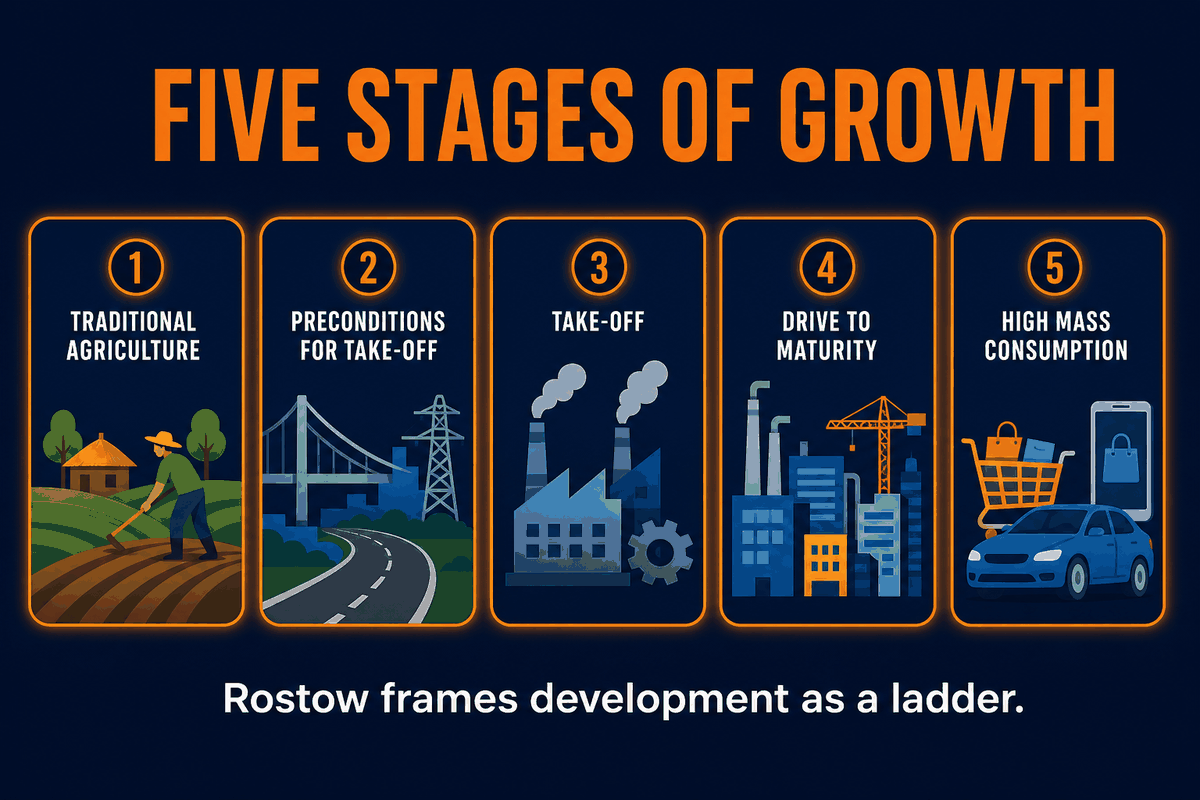
Rostow's Stages of Economic Growth is a modernization model that explains development as a linear path through five stages: traditional society, preconditions for takeoff, takeoff, drive to maturity, and age of high mass consumption. In Rostow's Stages of Economic Growth AP Human Geography, the model is useful for explaining industrialization and economic growth, but students must also know its limitations.
Say it fast: Rostow = development as a five-stage ladder.
AP clue: If the question mentions stages, modernization, takeoff, traditional society, industrial growth, or mass consumption, think Rostow.
Unit 7 hub → HDI → Rostow's Stages
Why Rostow's Model Matters in AP Human Geography
Rostow's Stages of Economic Growth AP Human Geography answers a core Unit 7 question: how do geographers explain industrialization as a staged process rather than a single jump to wealth?
AP stimuli often test takeoff and model limitations. Pair stage evidence with development indicators or HDI when tables mix stages with health or income data.
Strong AP answers name the stage, cite investment or manufacturing clues, and note that Rostow is linear and Western-centered — contrast Wallerstein or dependency theory when the prompt asks about global inequality.
- Rostow is a major modernization theory in Unit 7.
- Takeoff is the most tested stage clue on many exams.
- The model explains internal investment and industrial growth.
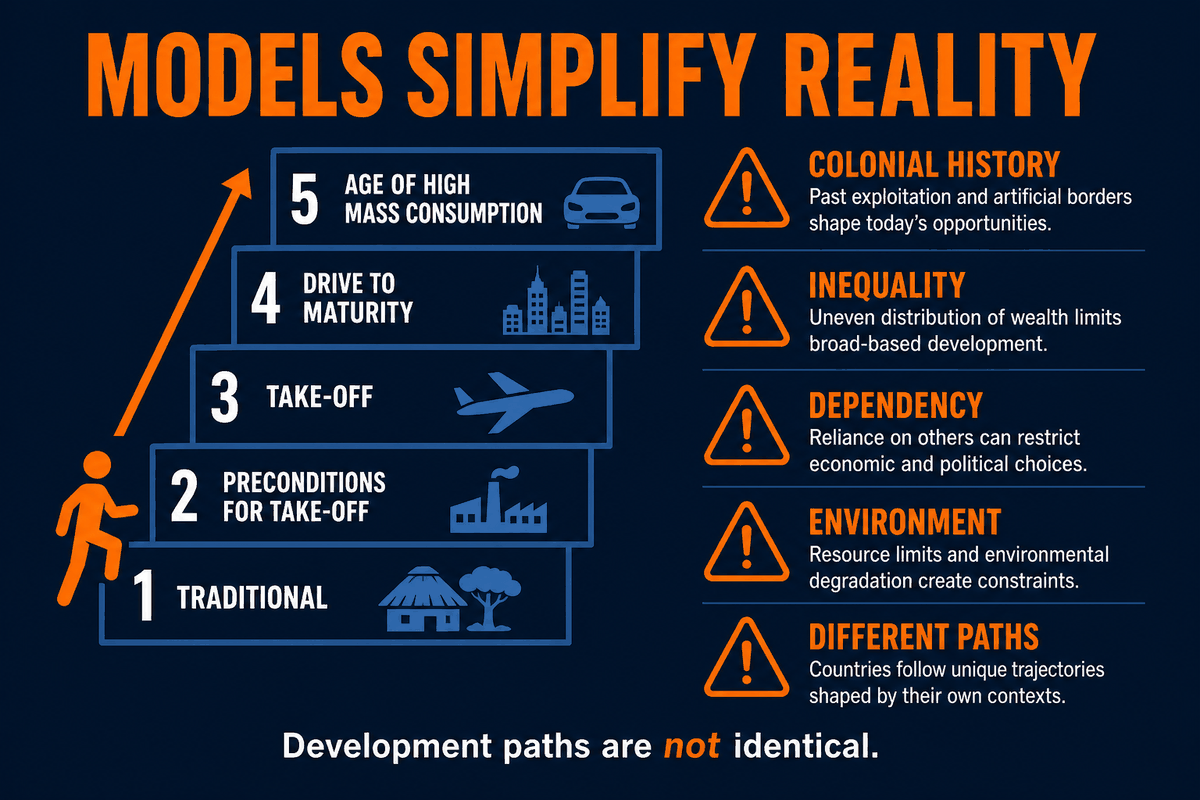
- Limitations matter: colonial history, dependency, and inequality are not fully explained by a five-stage ladder alone.
AP clue: Stages, modernization, takeoff, traditional society, mass consumption → name Rostow and identify the stage.
What is Rostow's Stages of Economic Growth?
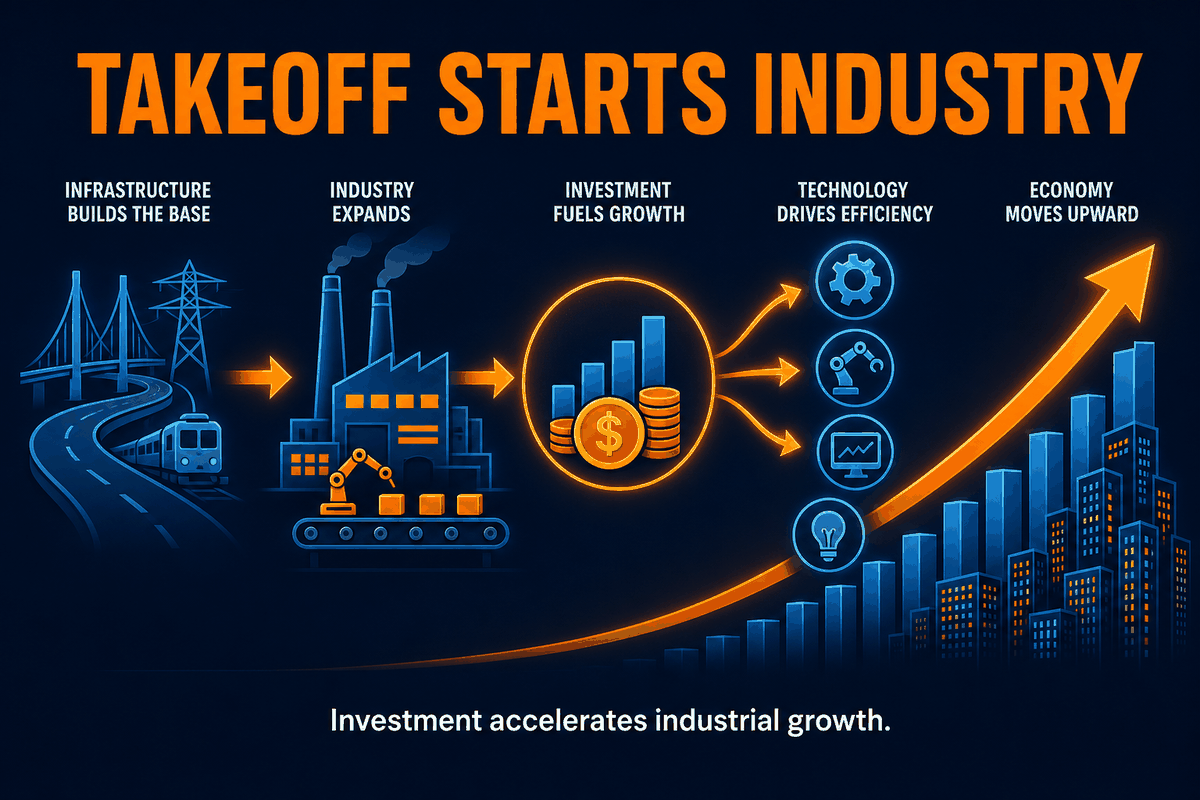
Rostow's Stages of Economic Growth is a modernization model that describes development as a linear sequence from traditional agriculture toward industrial takeoff, diversified industry, and high mass consumption. Geographers use it to explain how investment, technology, and manufacturing can accelerate growth. On the exam, name Rostow when a prompt tracks stages of industrialization.
Rostow's Model Explained
Rostow's Stages of Economic Growth (associated with W. W. Rostow) is a modernization theory that treats development as a sequence of stages. Economies are assumed to move from traditional agriculture toward industrial takeoff, diversified industry, and high mass consumption through internal investment, technology, and institutions.
- Development is described as a linear ladder, not a single indicator score.
- The model stresses manufacturing, infrastructure, and rising investment.
- It is useful for explaining industrialization timelines on AP stimuli.
- It is often contrasted with structural theories that emphasize global power and extraction.
Before you label a country "developed," check whether HDI or inequality data support the same story — stage labels describe process, not full quality of life.
What are the five stages in Rostow's model?
The five stages are traditional society, preconditions for takeoff, takeoff, drive to maturity, and age of high mass consumption. Each stage describes a different mix of agriculture, infrastructure, investment, manufacturing, diversification, and consumer spending. Strong AP answers match stimulus clues to the correct stage before explaining the economic process.
The Five Stages of Rostow's Model
Use this table as a quick map, then read each stage section below for AP-level detail.
| Stage | Main idea | AP clue | Economic pattern | Common mistake |
|---|---|---|---|---|
| Traditional society | Subsistence agriculture and limited technology | Farming, local production, low industry | Most output from agriculture | Thinking traditional means no economy |
| Preconditions for takeoff | Infrastructure and investment prepare industry | Roads, ports, schools, commercial agriculture | Growth without rapid factory boom yet | Calling any small factory boom takeoff |
| Takeoff | Rapid industrial acceleration begins | Rising investment, factories, technology | Self-sustaining industrial growth starts | Labeling any income gain as takeoff |
| Drive to maturity | Economy diversifies and technology spreads | Advanced industry across many sectors | Less dependence on one leading sector | Confusing maturity with mass consumption |
| High mass consumption | Consumer goods and services dominate | High spending, services, consumer economy | Widespread consumption, not zero poverty | Assuming everyone is wealthy |
Stage 1: Traditional Society
Traditional society features subsistence agriculture, limited technology, low productivity, and local production tied to traditional social structures.
- Most labor remains in farming or resource extraction with little factory employment.
- Trade and transport may exist, but industrial technology is limited.
- This stage is "less industrialized," not "without an economy."
- High primary-sector shares in employment data often signal this stage.
Stage 2: Preconditions for Takeoff
Preconditions for takeoff build the foundation for industrialization: infrastructure improves, investment rises, commercial agriculture expands, and education or technology may spread.
- Roads, ports, rail, schools, and utilities support future factory growth.
- Institutions and elites may channel savings into productive investment.
- The economy prepares for industry but has not yet entered rapid takeoff.
- AP clues: "building ports and schools" without yet "factory boom."
Stage 3: Takeoff
Takeoff begins when manufacturing expands rapidly, investment accelerates, and infrastructure plus technology support sustained industrial growth. This is the breakthrough stage — not merely "getting richer."
- Leading sectors (often textiles, rail, or heavy industry in textbook examples) grow quickly.
- Factory employment and industrial output rise sharply.
- Growth becomes self-sustaining enough to continue without only one external push.
- See the next section for weak vs better FRQ language on takeoff.
What is the takeoff stage?
Takeoff is the turning point when industrial production and investment accelerate rapidly enough to create self-sustaining growth. Clues include rising factory employment, expanding infrastructure, and spreading technology — not simply higher income. AP questions often test takeoff because it marks the shift from preparation to rapid industrialization.
Takeoff Stage Focus
Takeoff is the turning point where industrialization accelerates. AP credit usually requires more than "the economy improved."
Weak answer
The country takes off because it gets richer.
Better answer
The country enters takeoff when investment and industrial production accelerate, allowing manufacturing and infrastructure to expand rapidly enough to create self-sustaining economic growth.
- Name investment, manufacturing, technology, and infrastructure in your evidence.
- Contrast preconditions (preparation) with takeoff (rapid industrial breakthrough).
- If the prompt mentions global cores controlling factories, consider Wallerstein — not Rostow alone.
Stage 4: Drive to Maturity
Drive to maturity occurs when the economy diversifies, technology spreads across industries, and production becomes more advanced. The country becomes less dependent on a single leading sector.
- Skilled labor and complex industry expand.
- Manufacturing and services grow beyond one export niche.
- Innovation and diffusion of technology characterize this stage.
- Employment may shift further toward tertiary and quaternary work.
Stage 5: Age of High Mass Consumption
The age of high mass consumption features expanding consumer goods, widespread services, and high household spending. Advanced sectors and consumer culture dominate — but inequality can remain.
- High incomes support durable goods, automobiles, electronics, and leisure spending.
- Service employment often grows alongside advanced industry.
- Mass consumption does not mean every group shares equally in wealth.
- Pair with Gini or regional data if the prompt asks about inequality inside a wealthy country.
Rostow as Modernization Theory
Rostow belongs to modernization theory, which assumes countries can follow a similar development path through internal changes — technology, investment, industry, and institutions.
- Focus is on national growth processes rather than global trade structure alone.
- Western industrial countries are often treated as the model endpoint.
- Critics argue the theory underplays colonialism, extraction, and unequal global relationships.
- Dependency theory and world-systems views stress how periphery economies can remain tied to core demand even during industrial growth.
Rostow Trap Fixer
AP Rostow questions reward careful reading. Use this table to replace weak assumptions with stronger moves.
| Trap | Why it is wrong | Stronger AP move |
|---|---|---|
| All countries follow the same path | History, politics, and global trade vary widely | Name the stage clue, then note the model is linear |
| Takeoff means instant development | Takeoff is a process, not a finished outcome | Describe investment and manufacturing acceleration |
| High mass consumption means no inequality | Consumption averages hide poverty gaps | Pair with Gini or regional evidence |
| Rostow explains colonialism well | Colonial extraction is not the model's focus | Use dependency or Wallerstein for imperial history |
| Rostow and Wallerstein say the same thing | Ladder vs world-system are different frameworks | Contrast national stages with core-periphery structure |
| Rostow proves GDP equals development | Stages describe process, not every social outcome | Add HDI, literacy, or inequality indicators |
| The model has no bias | Modernization theory is often Western-centered | Acknowledge bias when asked about limitations |
| Every country must become Western-style consumer society | Development paths and cultures differ | Explain limitation + alternative theory |
Model Timeline Practice
Practice matching country sketches to Rostow stages like an AP stimulus. Draft your answer, then open the model explanation.
Country A has mostly subsistence agriculture and limited infrastructure.
Country B is building ports, roads, schools, and commercial agriculture.
Country C has rapid manufacturing growth and rising investment.
Country D has diversified industry and advanced technology.
Country E has high consumer spending and a large service economy.
- Which country best represents takeoff?
- Which country best represents drive to maturity?
- What clue supports each answer?
- What is one limitation of using this model?
Reveal model explanation
1. Takeoff: Country C — rapid manufacturing growth and rising investment.
2. Drive to maturity: Country D — diversified industry and advanced technology across sectors.
3. Supporting clues: Country B shows preconditions (infrastructure and commercial agriculture without factory boom); Country E fits high mass consumption (consumer spending and services).
4. Limitation: Rostow assumes a linear path and does not fully explain colonial history, dependency, inequality, or different political and cultural development routes.
Why this earns credit: Names stages with specific economic evidence and limits the claim — the same habit needed on full FRQs.
Rostow vs Wallerstein Preview
Rostow uses a national modernization ladder: traditional society → takeoff → maturity → mass consumption, driven by internal investment and industry.
Wallerstein uses a global network: core, semi-periphery, and periphery positions shaped by trade, imperial history, and surplus flows.
- Rostow: stages, linear growth, modernization, takeoff language.
- Wallerstein: core-periphery, unequal exchange, structural global inequality.
- Many FRQs want you to pick the theory that matches the prompt stem.
Continue with the full Wallerstein World Systems Theory guide for network diagrams and FRQ contrasts.
How is Rostow different from Wallerstein?
Rostow explains development as internal stages on a modernization ladder — investment, industry, and consumption moving upward over time. Wallerstein explains development through world-system relationships among core, semi-periphery, and periphery countries. Rostow stresses national growth processes; Wallerstein stresses global inequality and structural trade patterns.
Strengths and Limitations
Strengths
- Simple framework for comparing development stages on timelines and narratives.
- Useful for explaining industrialization, investment, and takeoff language.
- Helps students recognize maturity and mass consumption patterns.
- Easy to apply to AP stimuli that describe staged economic change.
Limitations
- Assumes a similar linear path for all countries.
- Often criticized as Western-centered modernization theory.
- Underplays colonialism, dependency, and global power relationships.
- Underplays inequality, environment, and political variation.
- Not every country follows the same sequence or endpoint.
What are the limitations of Rostow's model?
Rostow assumes a similar linear path for all countries, which can hide colonial history, dependency, global power relationships, inequality, and environmental costs. It is often criticized as Western-centered modernization theory. Pair Rostow with limitations or contrast Wallerstein and dependency theory when the prompt asks about uneven development.
Rostow Stage Builder
Read each clue and classify it as Traditional Society, Preconditions for Takeoff, Takeoff, Drive to Maturity, or High Mass Consumption. Score 12 clues with instant feedback.
How to Use Rostow's Model in FRQs
Name the model → identify the stage clue → explain the growth process → mention limitation if asked.
Weak answer
The country is in takeoff because it is growing.
Better answer
The country is in Rostow's takeoff stage because industrial production and investment are rapidly increasing. This suggests the economy is moving from preparation toward self-sustaining industrial growth, but the model is limited because it assumes a linear path and underplays colonial history, dependency, inequality, and global power relationships.
Sentence starters
- The model shown is Rostow's model because…
- The stage is likely…
- One clue is…
- This stage matters because…
- One limitation of Rostow's model is…
- This differs from Wallerstein because…
A strong answer names the stage, gives specific economic evidence, and explains either the process or the model's limitation.
FRQ Practice and Model Sprints
Full FRQ
A country is expanding roads, ports, schools, and commercial agriculture. Ten years later, manufacturing investment rises sharply, factory employment grows, and industrial production accelerates.
- A. Identify the development model.
- B. Identify the stage shown after manufacturing investment rises.
- C. Explain one clue that supports your answer.
- D. Explain one limitation of using this model to explain development.
Planning hint
Label A as Rostow, B as takeoff, C as factory/investment acceleration, D as linear path/colonial/dependency/inequality limit.
Reveal rubric, model answer, and weak vs better samples
Rubric (4 points typical)
- 1 pt — Identifies Rostow's Stages of Economic Growth (modernization model)
- 1 pt — Identifies takeoff after manufacturing investment rises
- 1 pt — Clue: sharp rise in manufacturing investment, factory employment, or industrial production
- 1 pt — One limitation (linear path, colonialism, dependency, inequality, global power, bias)
Model A: Rostow's Stages of Economic Growth (a modernization model describing staged development).
Why this earns the point: Names Rostow as the framework, not Wallerstein or HDI alone.
Model B: Takeoff.
Model C: Manufacturing investment rises sharply, factory employment grows, and industrial production accelerates — evidence of rapid industrial breakthrough.
Model D: Rostow assumes a linear ladder and underplays colonial history, dependency, inequality, and different global power relationships.
Common weak answer: The country is developing because it built schools.
Better answer: Early ports and schools suggest preconditions, but the later factory and investment surge matches Rostow's takeoff stage because industrial growth accelerates toward self-sustaining expansion — while the model still oversimplifies global inequality and historical extraction.
Model sprint 1
A country has diversified industry, advanced technology, and less dependence on one manufacturing sector.
- A. Identify the Rostow stage.
- B. Explain one clue that supports your answer.
Reveal sprint rubric and model
Sprint rubric (2 points)
- 1 pt — Drive to maturity
- 1 pt — Diversified industry and technology spread across sectors
Model A: Drive to maturity.
Model B: The economy is diversified with advanced technology and is no longer dependent on only one industrial sector.
Model sprint 2
A student says Rostow explains all countries because every country follows the same path.
- A. Explain why this claim is too simplistic.
- B. Identify one theory that challenges Rostow's assumptions.
Reveal sprint rubric and model
Sprint rubric (2 points)
- 1 pt — Rostow is linear/Western-centered and ignores colonialism, dependency, inequality, or different paths
- 1 pt — Names Wallerstein, dependency theory, or similar structural critique
Model A: Rostow oversimplifies development by assuming a similar sequence for every country and underplaying historical and global structural barriers.
Model B: Wallerstein's world-systems theory (or dependency theory) emphasizes unequal global relationships rather than an identical national ladder.
Common Mistakes
Forgetting that Rostow is a linear model
Wrong: Rostow describes random economic change with no sequence.
Better: Rostow explains development as a sequence of stages.
Treating takeoff as any growth
Wrong: Any GDP increase means the country is in takeoff.
Better: Takeoff means rapid industrial growth, investment, and self-sustaining expansion.
Saying Rostow explains global inequality well
Wrong: Rostow is the best model for core-periphery trade networks.
Better: Wallerstein and dependency theory focus more directly on global inequality.
Ignoring the model's bias
Wrong: Rostow is a neutral model with no cultural assumptions.
Better: Rostow is often criticized as Western-centered and modernization-focused.
Thinking high mass consumption means no poverty
Wrong: High mass consumption proves everyone is wealthy.
Better: A country can have high consumption and still have inequality.
AP Exam Clues
Rostow vocabulary
- Rostow
- stages
- modernization
- traditional society
- preconditions for takeoff
- takeoff
- drive to maturity
- high mass consumption
Process clues
- industrialization
- investment
- infrastructure
- self-sustaining growth
- development ladder
- linear model
- factory expansion
Limitation clues
- Western-centered
- colonial history
- dependency
- core-periphery contrast
- inequality
- different paths
AP clue: Decision rule: If the prompt describes countries moving through stages from agriculture to industrialization to mass consumption, think Rostow.
Practice MCQs
8 AP-style questions on rostow's stages of economic growth ap human geography. Choices shuffle at display time.
Rostow definition
Question 1
Which statement best defines Rostow's Stages of Economic Growth?
Explanation: Rostow's model is a staged modernization theory from traditional society to high mass consumption.
Why the tempting wrong answer fails: World-systems theory is Wallerstein; Gini measures inequality; sectors classify work types.
AP clue: Five stages, modernization ladder, linear development → Rostow.
Five stages
Question 2
Which set correctly lists Rostow's five stages in order?
Explanation: Rostow's ladder moves from traditional agriculture through takeoff to diversified industry and mass consumption.
Why the tempting wrong answer fails: Core-periphery is Wallerstein; economic sectors are a different framework.
AP clue: Traditional → preconditions → takeoff → maturity → mass consumption.
Traditional society
Question 3
Which description best fits the traditional society stage?
Explanation: Traditional society relies on local agricultural production with little industrial technology.
Why the tempting wrong answer fails: Factory acceleration is takeoff; diversification is maturity; consumer dominance is mass consumption.
AP clue: Subsistence farming, limited technology → traditional society.
Preconditions for takeoff
Question 4
Which clue best matches the preconditions for takeoff stage?
Explanation: Preconditions build infrastructure, institutions, and investment that prepare an economy for industrial takeoff.
Why the tempting wrong answer fails: Mass consumption is the final stage; extraction alone is not Rostow's preconditions pattern.
AP clue: Infrastructure, schools, commercial agriculture, early investment → preconditions.
Takeoff stage
Question 5
Which description best defines Rostow's takeoff stage?
Explanation: Takeoff marks the breakthrough when industrial production and investment rise sharply enough to sustain growth.
Why the tempting wrong answer fails: Takeoff is a process, not instant full development; Wallerstein focuses on global structure, not national stages alone.
AP clue: Rapid manufacturing, investment, infrastructure, self-sustaining growth → takeoff.
Drive to maturity
Question 6
Which description best fits the drive to maturity stage?
Explanation: Drive to maturity features diversified, technologically advanced industry beyond a single leading sector.
Why the tempting wrong answer fails: Subsistence agriculture is traditional society; mass consumption still includes industry and services.
AP clue: Diversified industry, technology spread, advanced production → drive to maturity.
High mass consumption
Question 7
Which description best fits the age of high mass consumption?
Explanation: High mass consumption emphasizes consumer goods, services, and high household spending — not the end of inequality.
Why the tempting wrong answer fails: Raw-material extraction alone is earlier-stage; inequality can persist despite high consumption.
AP clue: Consumer goods, services, high spending → high mass consumption.
Limitation / Wallerstein
Question 8
A student claims Rostow and Wallerstein describe development the same way. Which correction is strongest?
Explanation: Rostow is a linear national modernization ladder; Wallerstein maps global structural inequality.
Why the tempting wrong answer fails: Both address industrial change; Rostow is not a Gini measure; Wallerstein does not use Rostow's five stages.
AP clue: Stages vs core-periphery, ladder vs world system → contrast Rostow and Wallerstein.
FAQ
What is Rostow's Stages of Economic Growth in AP Human Geography?
Rostow's Stages of Economic Growth is a modernization model that explains development as a linear path through five stages: traditional society, preconditions for takeoff, takeoff, drive to maturity, and age of high mass consumption. In AP Human Geography, the model is useful for explaining industrialization and economic growth, but students must also know its limitations.
Who created Rostow's Stages of Economic Growth?
The model is associated with economist W. W. Rostow, who described modernization as a staged ladder from traditional agriculture toward industrial takeoff, diversified industry, and high mass consumption. AP Human Geography uses Rostow as a development theory to compare with Wallerstein, dependency theory, and other Unit 7 frameworks.
What are the five stages of Rostow's model?
The five stages are traditional society, preconditions for takeoff, takeoff, drive to maturity, and age of high mass consumption. Together they describe how economies may shift from subsistence agriculture through industrial acceleration toward diversified production and widespread consumer spending.
What is the takeoff stage?
The takeoff stage is the turning point when industrial production and investment accelerate rapidly, allowing manufacturing, infrastructure, and technology to expand enough to create self-sustaining economic growth. It is one of the most tested Rostow clues on the AP exam.
What is the traditional society stage?
Traditional society is characterized by subsistence agriculture, limited technology, low productivity, and local production with traditional social structures. It is not the absence of an economy, but a stage with little industrialization compared with later stages.
What is the drive to maturity stage?
Drive to maturity occurs when the economy diversifies, technology spreads across industries, production becomes more advanced, and the country reduces dependence on a single industrial sector. Skilled labor and complex industry grow during this stage.
What is the age of high mass consumption?
The age of high mass consumption features expanding consumer goods and services, higher incomes, and widespread consumption as advanced and service sectors grow. It does not mean every person is wealthy or that inequality has disappeared.
What are the limitations of Rostow's model?
Rostow's model assumes a similar linear path for all countries, which can oversimplify colonial history, dependency, global power relationships, inequality, and environmental costs. Critics argue it is Western-centered modernization theory and does not explain why some countries remain in periphery roles.
How is Rostow different from Wallerstein?
Rostow explains development as national stages of modernization driven by internal investment and industrial growth. Wallerstein explains development through world-system relationships among core, semi-periphery, and periphery countries. Rostow uses a ladder metaphor; Wallerstein uses a global network.
How do you write about Rostow's model on an AP Human Geography FRQ?
Name the model, identify the stage using specific economic clues, explain the growth process, and state a limitation when asked. Avoid claiming Rostow alone proves full development or explains global inequality. Strong answers contrast Rostow with Wallerstein or dependency theory when the prompt asks about structural inequality.