SEZs connect to export-oriented industrialization, secondary-sector manufacturing, and industrial growth or decline depending on whether a region gains plants or loses them to cheaper zones elsewhere.
What are special economic zones in AP Human Geography?
Special economic zones, or SEZs, are designated areas within a country that use special rules, tax incentives, infrastructure, or trade advantages to attract investment and increase exports. In special economic zones AP Human Geography, SEZs help explain export-oriented industrialization, foreign direct investment, global supply chains, maquiladoras, export processing zones, and the tradeoffs of development policy.
Say it fast: SEZs = special zones designed to attract investment, factories, and exports.
AP clue: If the question mentions tax incentives, export processing zones, free trade zones, maquiladoras, foreign investment, relaxed regulations, or export-oriented manufacturing, think special economic zones.
Unit 7 hub → Outsourcing and Offshoring → Special Economic Zones
Why Special Economic Zones Matter in AP Human Geography
Special economic zones AP Human Geography explains how governments reshape space with policy — designating places where different tax, trade, and regulatory rules attract factories, ports, and foreign investment.
Zones often sit inside global supply chains linked to outsourcing and offshoring, Wallerstein's world-systems theory, and the core-periphery model — assembly in one place, design and finance in another.
Strong AP answers name the policy tool (incentives, customs rules, infrastructure) and the development outcome (jobs, exports, FDI) — then note tradeoffs when wages, pollution, or uneven benefits appear in the stimulus.
Countries do not create SEZs by accident. Leaders choose coastal ports, border corridors, or industrial districts where tax breaks, tariff reductions, and upgraded infrastructure can pull multinational firms away from competing locations. Shenzhen in China, maquiladora corridors in northern Mexico, and export zones across Southeast Asia appear in textbooks because they show how policy reshapes economic geography — not only where factories sit on a map, but who profits, who works, and who bears environmental costs.
On the AP exam, SEZ prompts rarely ask you to memorize one country's zone law. They show narratives about simplified customs, foreign-owned assembly plants, rising exports, and protests over low wages or pollution. Your job is to identify the zone type when clues allow, explain why firms and governments use the policy, and balance benefits against costs. Pair zone vocabulary with dependency theory when prompts emphasize foreign control, and with development indicators when export revenue rises but inequality persists.
Think about scale. A national government may report double-digit export growth from zone firms while a fishing village downstream from the industrial park records contaminated runoff. A migrant worker may earn more than on a family farm yet still face long shifts without strong union protection. Geographic analysis asks who gains, who pays, and where effects concentrate — not whether one headline statistic proves success. That mindset separates AP Human Geography from a simple pro-business or anti-business opinion essay.
Unit 7 connects SEZs to the wider development toolkit you have already studied. Weber's least-cost theory explains transport and labor pulls; agglomeration explains supplier clustering; industrial location theory explains why ports and borders win investment. SEZs are how governments try to tilt those forces deliberately rather than wait for markets alone.
- SEZs are designated areas with special economic rules or incentives.
- EPZs, free trade zones, and maquiladoras are related zone types with different AP clues.
- Governments use zones to attract FDI, exports, jobs, and infrastructure.
- Benefits can include industrialization; costs can include labor and environmental tradeoffs.
- Zones connect to global supply chains, outsourcing, offshoring, and uneven development.
AP clue: Tax incentives, export processing, maquiladoras, foreign investment → think SEZ or related zone policy.
What is a special economic zone?
A special economic zone (SEZ) is a designated area within a country that follows different economic rules than the rest of the nation. Governments use tax breaks, infrastructure, customs advantages, or relaxed regulations to attract firms, foreign investment, and export-oriented manufacturing inside the zone.
Special Economic Zones Explained
A special economic zone (SEZ) is a geographically defined area where national economic rules differ from the rest of the country. Inside the zone, firms may face lower taxes, faster customs processing, reduced tariffs, cheaper land, or lighter regulations — incentives designed to attract investment and production that might otherwise locate elsewhere.
SEZs are a policy, not a natural landscape feature. A coastal city with many factories is not automatically an SEZ. The AP clue is government action: tax breaks for export firms, fenced or designated districts, port upgrades tied to zone policy, or legal text describing special rules. Countries create SEZs to jump-start industrialization, test market reforms, develop border regions, or compete for mobile global capital.
- Designated geography — a port district, border strip, industrial park, or coastal corridor set apart by law.
- Different rules — taxes, customs, tariffs, or regulations that do not apply the same way outside the zone.
- Investment target — foreign and domestic firms that build factories, warehouses, or logistics hubs.
- Export orientation — many zones emphasize goods sold abroad, not only local markets.
- Global connection — zones often serve as nodes in multinational supply chains.
Firms use SEZs for manufacturing, assembly, processing, logistics, and re-export. A smartphone brand might assemble devices in a zone where components arrive from several countries, workers stitch or solder parts, and finished units ship worldwide. Finance, research, and branding may remain in core cities while the zone handles labor-intensive stages — a pattern core-periphery analysis describes without assuming every periphery stays poor forever.
SEZs also appear in development debates. Rostow's stages might frame zone-led exports as industrial takeoff, while critics using dependency theory ask whether foreign-owned assembly creates shallow linkages or long-term dependence on outside buyers. Read the stimulus before you pick a theory — evidence first, model second.
When a prompt mentions "special rules," "tax holiday," "export processing," or "designated industrial park," start your answer with SEZ vocabulary and immediately name the incentive shown. That single move separates strong answers from vague comments about "factories near the coast."
How SEZs appear on AP-style stimuli
College Board materials and practice prompts often describe zones indirectly. You might read about a government that "streamlines customs for export firms," "builds a container terminal beside a fenced industrial park," or "offers ten-year tax holidays to foreign manufacturers." Each phrase is a breadcrumb. Stack them: designated area plus incentive plus export orientation equals SEZ or EPZ language.
Contrast two coastlines. City A has old fishing ports and informal workshops with no special legal status — interesting economically, but not an SEZ without policy evidence. City B passes a law creating a coastal district with duty exemptions, foreign-ownership rules, and public spending on a deep-water terminal — that is SEZ logic even if the paragraph never prints the acronym. Train yourself to hunt for policy verbs: exempt, streamline, designate, incentivize, attract foreign investment.
Historical context helps too. China's early special economic zones helped model export-led growth for other developing countries. Mexico's maquiladora program grew with trade agreements and border integration. Southeast Asian EPZs attracted apparel and electronics assembly. You do not need dates on the exam, but recognizing that SEZs spread as a development fashion since the late twentieth century explains why so many prompts feel similar.
What is a special economic zone?
A special economic zone (SEZ) is a designated area within a country that follows different economic rules than the rest of the nation. Governments use tax breaks, infrastructure, customs advantages, or relaxed regulations to attract firms, foreign investment, and export-oriented manufacturing inside the zone.
SEZ vs EPZ vs Free Trade Zone vs Maquiladora
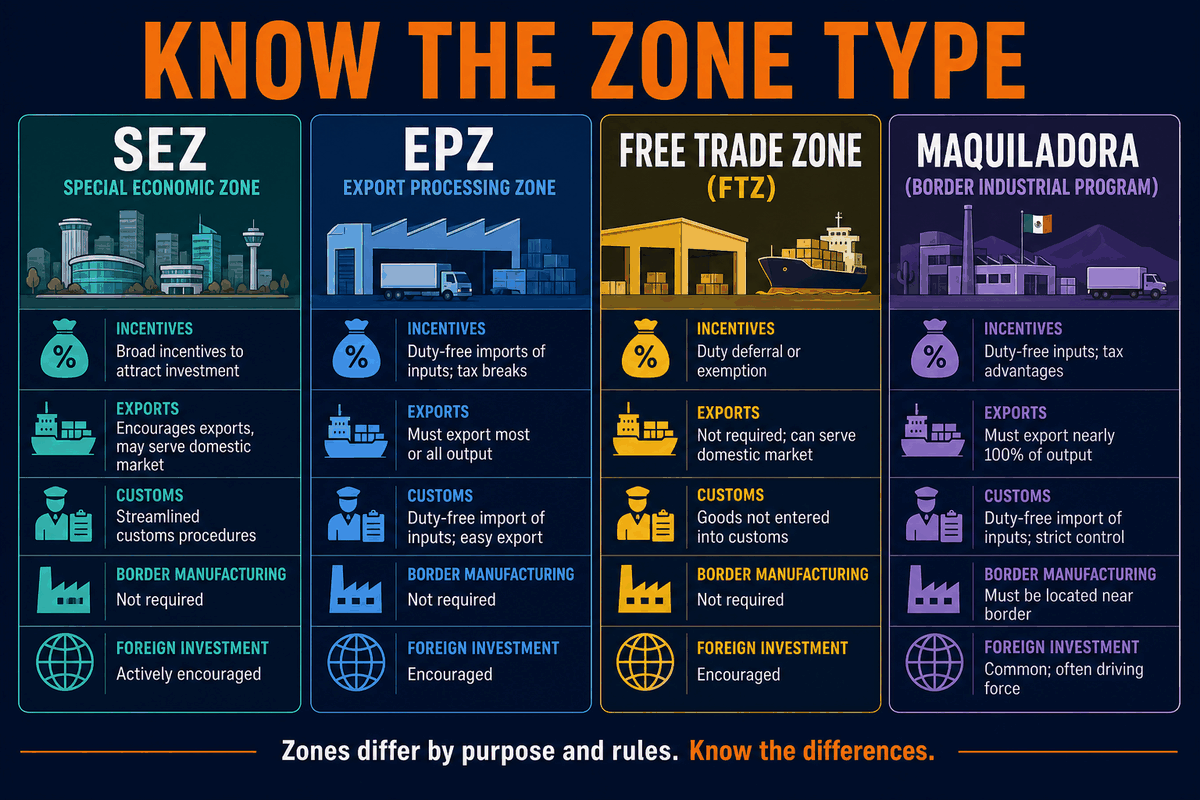
AP Human Geography treats these terms as related but not identical. All involve special trade or investment rules; each emphasizes different clues. Use the table before you label a stimulus.
| Zone type | Main purpose | AP clue | Example logic | Common mistake |
|---|---|---|---|---|
| Special Economic Zone (SEZ) | Broad development district with special rules to attract investment and industry | Tax incentives, infrastructure, relaxed regulations, designated park | Government builds port roads and offers tax breaks to pull foreign factories | Calling any factory cluster an SEZ without policy evidence |
| Export Processing Zone (EPZ) | Export-oriented production with trade and customs advantages | Export factories, tariff reductions, simplified customs, outbound goods | Assembly plants ship nearly all output abroad with duty benefits | Assuming EPZs sell mainly to domestic consumers |
| Free Trade Zone (FTZ) | Duty-free storage, processing, or re-export with minimal barriers | Duty-free warehousing, re-export, port storage, minimal processing | Goods enter a port zone, stay exempt from some duties, then ship out | Confusing storage-only FTZs with full border assembly plants |
| Maquiladora | Border manufacturing importing components for assembly and export | U.S.–Mexico border, imported parts, exported finished goods | Electronics parts cross the border, workers assemble, products export north | Using maquiladora for every SEZ worldwide regardless of location |
Overlap is common. A maquiladora may operate inside a broader SEZ. An EPZ may share features with a free trade zone near a port. On FRQs, pick the term best supported by the stimulus — or explain that multiple labels apply when export assembly sits in a government-incentivized district.
Free trade zones emphasize trade friction reduction — moving and storing goods. Maquiladoras emphasize cross-border assembly. EPZs emphasize export production. SEZs are the umbrella policy category many countries use for any incentivized district, whether coastal, border, or inland.
Quick classification drills
Scenario 1: Goods arrive at a port, sit in bonded warehouses, and leave without assembly — lean toward free trade zone. Scenario 2: Imported chips and screens enter a border city, workers assemble phones, products ship north — lean toward maquiladora (often inside a broader SEZ). Scenario 3: A government builds an industrial park with tax holidays for factories that export 90 percent of output — lean toward EPZ or export-oriented SEZ. Scenario 4: A province experiments with relaxed business law but no clear export focus — SEZ as general policy district.
If two labels fit, say so briefly: "This is an export processing zone within a special economic zone." Examiners reward precision, not forced single-word answers when the stimulus supports multiple accurate terms.
What is an export processing zone?
An export processing zone (EPZ) is a type of trade zone focused on producing goods for export, often with tariff reductions, simplified customs, and incentives for foreign firms. On the AP exam, EPZ clues include export-oriented factories, assembly for global markets, and trade rules that favor outbound shipments.
What is a maquiladora?
A maquiladora is a factory, often near the U.S.–Mexico border, that imports components, assembles products, and exports finished goods. AP Human Geography uses maquiladoras as a border manufacturing example linked to offshoring, export processing, labor costs, and global supply chains.
Why Countries Create SEZs
Governments treat SEZs as deliberate development tools — a way to reshape economic geography faster than waiting for organic industrial growth. Motives mix economic, political, and geographic goals.
Attract foreign direct investment
Tax and regulatory incentives pull multinational firms to build factories, warehouses, and supplier networks inside the zone.
Increase exports
Export-oriented rules help firms sell abroad, earn foreign currency, and integrate into global markets.
Create manufacturing jobs
Assembly and processing plants employ local workers — often young migrants from rural areas seeking wages.
Build infrastructure
Ports, roads, power, and utilities upgraded for the zone can later support wider regional growth.
Connect to global supply chains
Zones become assembly nodes linking imported components to exported finished goods.
Encourage industrialization
Policymakers hope zones spark secondary-sector growth and move the economy up sector ladders.
Test economic reforms
Special rules inside a zone let governments experiment before applying changes nationwide.
Develop ports or border regions
Coastal and border districts gain investment that might not arrive without targeted incentives.
Increase technology transfer
Foreign firms may train workers and introduce production methods — though depth of transfer varies.
Competition matters. If neighboring countries offer lower wages or better ports, governments may escalate incentives to avoid losing mobile investment. Weber's least-cost theory and industrial location theory help explain why firms compare total cost across places — SEZs tilt that calculation.
Politicians also advertise zones as quick wins: visible factories, rising export statistics, and construction jobs. HDI and inequality data show whether those wins reach health, education, and income beyond the zone fence.
Regional equity debates shape zone location. Coastal elites may capture the first wave of investment while inland provinces demand their own SEZs to avoid being left behind — a spatial politics story AP narratives sometimes hint at when multiple zones appear on a national map. International lenders and trade partners may also push export-oriented reforms as conditions for aid or market access, linking zone policy to global economic pressure beyond purely domestic choice.
Why do countries create special economic zones?
Countries create SEZs to attract foreign direct investment, increase exports, create manufacturing jobs, build ports and infrastructure, test economic reforms, and connect to global supply chains. SEZs are a deliberate development strategy — not automatic growth for every worker or region.
Incentives and Location Advantages
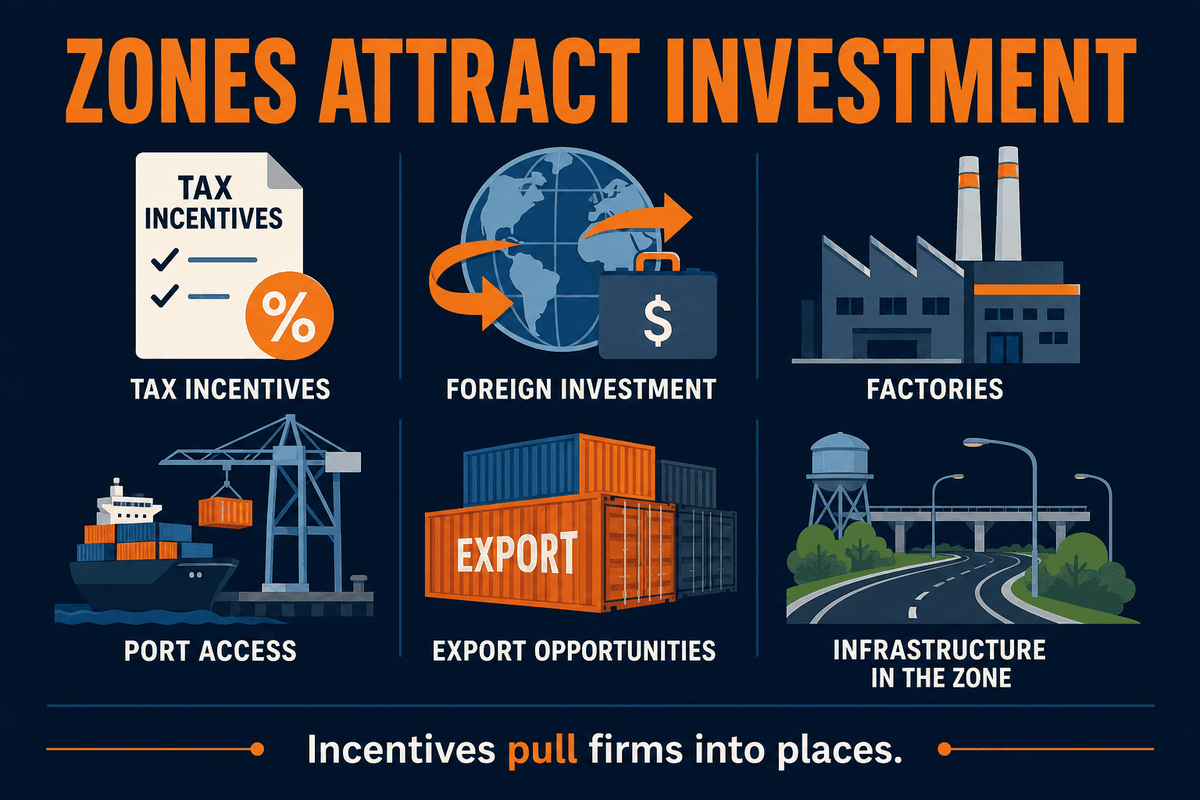
SEZs work when incentives change firm behavior. Multinational corporations compare labor cost, transport, taxes, and risk across countries — zone policy tries to win that comparison.
- Tax breaks — reduced corporate tax, tax holidays, or exemptions for export firms.
- Tariff reductions — lower duties on imported components used in export production.
- Simplified customs — faster clearance, fewer inspections, streamlined paperwork.
- Infrastructure — new ports, roads, power grids, water, and telecommunications.
- Ports and logistics — deep-water access, container terminals, and freight corridors.
- Lower land or labor costs — cheaper sites and wages relative to core production regions.
- Regulatory flexibility — faster permits or lighter rules inside the zone boundary.
- Access to export markets — location near shipping lanes or major consumer regions.
Industrial location theory explains why the same incentive package fails in a landlocked remote area but succeeds near a major port. Agglomeration may grow as suppliers cluster near anchor factories inside the zone — or remain weak if firms import every component and repatriate profits.
Location advantages interact. A tax break alone may not attract a firm if port congestion is severe. Simplified customs matter most when components cross borders repeatedly — exactly the maquiladora and EPZ pattern. When writing FRQs, tie each incentive to a firm decision: lower cost, faster export, or easier import of parts.
Students sometimes list incentives without explaining why they matter. Stronger answers say tax breaks reduce production cost, tariff reductions make imported components cheaper for export assembly, or port upgrades cut shipping time to global markets. That causal link earns credit.
Site factors that pair with zone policy
Even generous incentives fail on poor sites. Firms still need reliable power, water, labor supply, and access to shipping lanes. A landlocked province may struggle to compete with a coastal EPZ unless transport corridors are excellent. Weber's least-cost analysis reminds you that weight-losing or weight-gaining processes interact with distance — zone policy modifies cost but does not erase geography.
Labor matters intensely. Young migrants often supply zone factories with flexible workforces. Gender patterns appear in many export industries where firms prefer hiring young women for assembly lines — a social dimension AP prompts occasionally mention. Wage levels must stay competitive globally or firms relocate again to the next cheapest district.
Foreign Direct Investment and Export Growth
Foreign direct investment (FDI) occurs when foreign firms invest in production facilities, infrastructure, or ownership in another country. SEZs target FDI because new plants, jobs, and exports can appear faster than domestic capital alone might allow.
When FDI enters a zone, host countries may gain manufacturing employment, export revenue, tax income (after holidays end), worker training, and technology spillovers. But outcomes vary. Wages may stay low if labor supply is large. Local supplier linkages may stay weak if firms import nearly every component. Profits may flow to foreign headquarters rather than reinvest locally.
- Factory and warehouse construction — physical capital built by foreign firms.
- Export revenue — goods sold abroad raise trade statistics and foreign exchange.
- Employment — assembly-line and logistics jobs for local workers.
- Training — workers learn production skills transferable to other firms.
- Technology transfer — management methods and equipment — when linkages are deep enough.
Do not assume FDI automatically creates broad development. Dependency theory warns that export enclaves may remain tied to foreign buyers. Sustainable development asks whether growth respects labor rights and environmental limits. A zone can raise GDP while HDI moves slowly if health and education gains lag behind factory output.
Export growth is a common SEZ success metric — containers leaving port, trade balance improving, politicians citing national income. AP prompts often pair rising exports with protests about pollution or wages. Credit both trends when the stimulus includes them.
Reading FDI and export data carefully
Statistics can mislead. Export value may rise because global demand for electronics grew, not because the zone transformed domestic capabilities. FDI figures may reflect construction of one large plant rather than broad industrial upgrading. Always tie numbers to the stimulus narrative — who built the factory, what it produces, and where goods ship.
Ask whether profits stay local. Foreign firms may repatriate earnings, import components from home-country suppliers, and limit technology sharing. Dependency theorists argue such enclave investment reinforces periphery status unless governments force local content rules or supplier development — policies some zones attempt with mixed results.
Compare short-run and long-run effects. Tax holidays expire. Wages may rise as labor markets tighten. Competitors in neighboring countries may copy incentive packages. A zone that succeeds in the 1990s may face empty factories by the 2020s if firms chase lower costs elsewhere — linking SEZ study to industrial change over time.
Global Supply Chain Connection
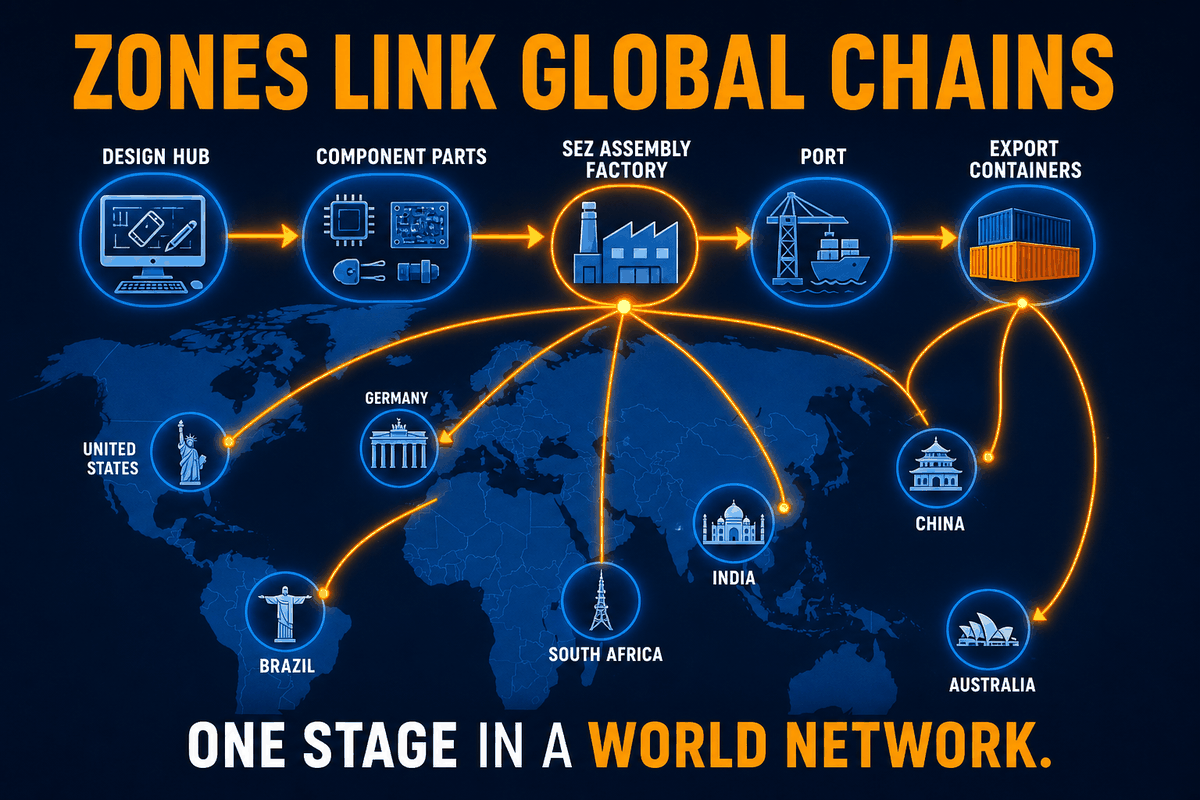
SEZs rarely exist in isolation. They function as nodes in global production networks — places where one stage of a multi-country chain concentrates because incentives and location reduce total cost.
Design, finance, marketing, and research may stay in core regions. Component manufacturing may occur in several countries. Final assembly may land in an SEZ or maquiladora where labor is abundant and export rules are favorable. Shipping connects each stage through ports often upgraded precisely for zone traffic.
- Import-assemble-export — parts arrive, workers assemble, finished goods depart.
- Stage splitting — each step locates where policy and cost favor it.
- Buyer power — brands in core markets may capture more profit than assembly workers.
- Just-in-time pressure — delays in one zone disrupt downstream factories worldwide.
- Policy competition — countries adjust incentives when firms threaten to relocate.
Link zones to outsourcing and offshoring when contracted foreign firms perform assembly, or when company-owned plants move abroad into incentivized districts. Wallerstein helps describe how semi-periphery zones host industry while core regions retain high-value tasks — though some zones upgrade over time.
On map or narrative stimuli showing multiple countries in one product's path, explain where the SEZ fits in the chain. The zone is not the whole supply network — it is one spatial fix firms and governments use to organize global production.
From zone to network
Picture a laptop's journey. Design and marketing occur in a core city. Memory chips fab in East Asia. Plastic casing molds in another country. Final assembly lands in an SEZ where labor costs and export rules favor bulk shipment. Retail distribution reaches consumers worldwide. Removing the zone stage would require reorganizing the entire cost structure — which is exactly why governments defend incentive packages even when critics protest local conditions.
Digital services join physical goods. Customer support, software testing, and data processing can occur in office zones with fiber-optic links rather than assembly lines. The geographic logic matches manufacturing SEZs: special rules plus connectivity attract footloose work. Offshoring vocabulary still applies when the work crosses borders into an incentivized district.
Benefits, Costs, and Tradeoffs
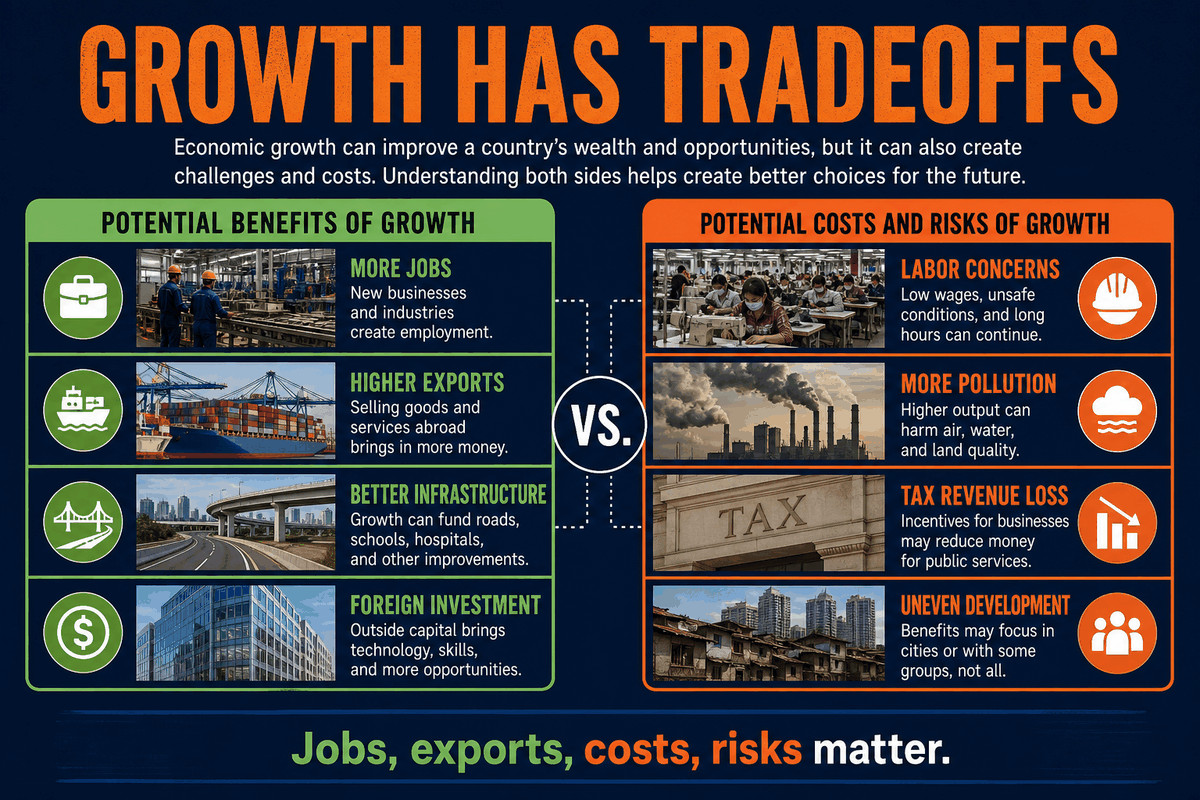
SEZ success stories appear in headlines — jobs, exports, new ports. AP Human Geography also tests whether you see costs hidden behind those numbers.
| Potential benefit | Possible cost | Strong AP explanation |
|---|---|---|
| Job creation | Low wages, weak labor protections, unsafe conditions | Name employment gains but note wage or protection concerns when shown |
| Export growth | Dependence on foreign buyers and global demand shocks | Exports help trade balances but may not diversify the economy |
| Foreign investment | Profit outflow and shallow local linkages | FDI builds plants but may not reinvest deeply in local suppliers |
| Infrastructure improvement | Public spending diverted from schools or hospitals | Port roads help trade but opportunity costs exist |
| Technology transfer | Limited training beyond repetitive assembly tasks | Workers gain skills but may not reach engineering or design roles |
| Tax incentives | Lost tax revenue for public services | Holidays attract firms but reduce near-term government income |
| Labor flexibility | Union weakness and worker bargaining limits | Flexible rules attract firms but may reduce worker power |
| Environmental regulation | Pollution near zone factories and ports | Weak enforcement may externalize environmental costs to local communities |
| Regional inequality | Zone enclave grows while inland areas lag | Benefits concentrate geographically unless policy spreads gains |
Balanced FRQs acknowledge both sides when evidence allows. A country may celebrate export records while communities near the zone report contaminated water or long shifts at low pay. Sustainable development frames these tensions explicitly — growth today versus social and environmental costs tomorrow.
Scale matters. National export totals may rise while individual workers see little improvement in development indicators. A zone may glow on satellite night lights while villages inland lack clinics. Geographic thinking requires asking where benefits land and who pays costs.
Who wins and who faces costs?
Governments may gain export revenue, employment statistics, and political credit for "modernization" — but sacrifice tax income during holidays and risk dependence on footloose firms. Foreign firms may lower production costs and reach global markets — but face reputational risk if labor scandals erupt. Workers may earn steady wages yet lack bargaining power. Local suppliers may win contracts if linkages deepen — or lose if everything is imported. Residents near the zone may breathe polluted air or face traffic congestion without sharing job benefits. Consumers abroad may enjoy cheaper electronics while ethical debates question hidden social costs.
Sustainable development asks whether growth can continue without destroying environmental support systems or social cohesion. An SEZ that treats rivers as waste channels may boost GDP this decade and harm fishing livelihoods the next. Balanced AP paragraphs name at least two actors when the prompt allows — not only "the country benefits."
SEZs, Deindustrialization, and Offshoring
SEZs do not only affect the host country. They interact with job loss and industrial change elsewhere. When firms offshore assembly to an incentivized zone, origin regions may lose manufacturing employment even as the destination zone gains factories.
Read the full outsourcing and offshoring study guide for who-versus-where vocabulary. A company may close a domestic plant and open a maquiladora or EPZ facility abroad — pairing destination-zone growth with origin-region deindustrialization.
- SEZs can attract production relocated from higher-cost countries.
- Tax and labor advantages make zones destinations in firm location decisions.
- One region's industrialization may connect to another region's factory closures.
- Global competition pushes governments to offer ever-stronger incentives.
- Automation in origin countries may combine with offshoring to zones abroad.
AP stimuli sometimes describe both sides — rising exports in Country B and shuttered plants in Country A. Name both geographies. Avoid treating the zone as an isolated success story with no spatial tradeoffs elsewhere.
Maquiladoras illustrate the paired story clearly: U.S. brands seek lower assembly costs south of the border while some U.S. manufacturing communities face decline. The zone is the policy tool; offshoring is the firm strategy; deindustrialization is the possible origin outcome.
Policy competition can trigger a race to the bottom. If Country A offers a ten-year tax holiday and Country B responds with fifteen years plus free land, firms gain bargaining power while governments reduce revenue. Geographers study whether the spatial fix truly develops host regions or merely reallocates assembly among competing zones with similar low-wage profiles.
When writing about paired geographies, use clear directional language: "Production shifted from Country X to an SEZ in Country Y, reducing manufacturing employment in X while creating assembly jobs in Y." That sentence structure mirrors how AP readers expect you to connect zone policy to global labor redistribution.
SEZ Trap Fixer
Replace weak assumptions with stronger AP moves when zone and development clues appear.
Each row below fixes a common multiple-choice or FRQ trap. Read the "Stronger AP move" column as a template you can adapt — not a script to paste without stimulus evidence. Apply the fix only when the prompt actually supports that stronger move on the exam.
| Trap | Why it is wrong | Stronger AP move |
|---|---|---|
| SEZs always create development | Every worker and region gains equally from any zone policy | Note jobs and exports plus possible uneven benefits or tradeoffs |
| SEZs and EPZs are always identical | Any export factory proves the same zone type | Compare purpose and clues — SEZ is broader; EPZ emphasizes exports |
| Tax breaks have no cost | Incentives are free and never affect public budgets | Mention lost tax revenue or spending tradeoffs when relevant |
| FDI always benefits workers | Foreign plants guarantee high wages and strong rights | Check wages, linkages, reinvestment, and working conditions in the stimulus |
| Export growth means equal development | Rising exports prove HDI and inequality improved everywhere | Pair exports with inequality, labor, or environmental evidence |
| Maquiladoras only matter as factories | Border plants have no supply-chain or policy context | Explain import-assemble-export and border location logic |
| SEZs are unrelated to globalization | Zones are purely local with no cross-border flows | Connect components, exports, and foreign firms to global networks |
| SEZs have no environmental tradeoffs | Industrial growth never produces pollution concerns | Note pollution or weak regulation when the stimulus includes them |
Zone Scenario Practice
Practice reading a coastal zone stimulus the way an AP narrative or data question might present it.
Before you reveal the model, try writing four short sentences — one for policy label, one for benefit, one for tradeoff, one for supply-chain link. Timed practice builds the muscle memory FRQs demand. Many students lose points because they describe "a zone with factories" without naming tax breaks or customs rules that define SEZ policy.
A coastal region creates a zone with tax breaks, simplified customs, port access, and export-focused factories. Foreign firms assemble electronics there. Exports rise, but local groups raise concerns about wages, tax revenue, pollution, and weak links to local suppliers.
- What development policy is shown?
- What is one benefit?
- What is one tradeoff?
- How does this connect to global supply chains?
Reveal model explanation
Policy: A special economic zone or export-processing strategy — designated area with tax breaks, customs advantages, and export-oriented factories.
Benefit: Jobs, rising exports, foreign investment, or improved port infrastructure — choose one and explain with evidence.
Tradeoff: Low wages, lost tax revenue from incentives, pollution, or weak local supplier linkages — match the concern listed in the stimulus.
Supply chain: Foreign firms use the zone as an assembly stage — components may arrive from abroad, finished electronics export to global markets.
Why this earns credit: Names the policy, cites incentives, balances benefit and cost, and connects to global production.
SEZ Benefit and Tradeoff Sorter
Read each clue and classify it as SEZ Incentive, SEZ Benefit, SEZ Tradeoff, Global Supply Chain Link, or Not Enough Evidence. Score 12 clues with instant feedback.
How to Use Special Economic Zones in FRQs
Identify the SEZ policy → explain the incentive → connect to investment, exports, jobs, or tradeoffs.
Weak answer
The country makes a zone to get money.
Better answer
The country creates a special economic zone by offering tax incentives, infrastructure, and simplified trade rules to attract foreign firms. This can increase exports and manufacturing jobs, but it may also create tradeoffs such as low wages, environmental costs, lost tax revenue, or uneven development if benefits do not spread beyond the zone.
Sentence starters
- The policy shown is a special economic zone because…
- One incentive is…
- This attracts firms by…
- One development benefit is…
- One tradeoff is…
- This connects to global supply chains because…
A strong answer explains both the incentive and the development tradeoff. Use sector vocabulary when zone jobs shift employment toward manufacturing or services in the host region.
Point-by-point FRQ checklist
Step 1: Underline policy clues — tax break, customs, designated park, export percentage. Step 2: Label SEZ, EPZ, maquiladora, or free trade zone with the best-fitting term. Step 3: Explain one firm or government motivation using incentive vocabulary. Step 4: State one measurable benefit (jobs, exports, FDI, infrastructure). Step 5: Add one tradeoff if the stimulus mentions wages, pollution, tax revenue, or weak linkages. Step 6: Optional — connect to core-periphery or supply chains when components cross borders. This sequence prevents the one-sentence "they made a zone" answers that earn partial credit at best.
How do you use SEZs on an AP Human Geography FRQ?
Identify the SEZ policy with stimulus evidence, name at least one incentive (tax break, customs rule, infrastructure), explain a development outcome (jobs, exports, FDI), and note a tradeoff such as low wages, pollution, lost tax revenue, or uneven benefits when the prompt allows balanced analysis.
FRQ Practice and SEZ Decision Sprints
Full FRQ
A country creates a coastal zone with tax breaks, simplified customs rules, upgraded port infrastructure, and export-focused factories. Foreign firms assemble electronics there for global markets. Exports and factory jobs increase, but concerns grow about low wages, pollution, and limited local supplier connections.
- A. Identify the development policy shown.
- B. Explain one reason firms are attracted to the zone.
- C. Explain one economic benefit for the host country.
- D. Explain one possible social, environmental, or economic tradeoff.
Planning hint
A: SEZ or export-processing zone policy. B: tax breaks, customs, port access, or lower costs. C: jobs, exports, or FDI. D: low wages, pollution, lost tax revenue, or weak local linkages.
Reveal rubric, model answer, and weak vs better samples
Rubric (4 points typical)
- 1 pt — Identifies SEZ, EPZ, or export-oriented zone policy
- 1 pt — Valid firm attraction reason: tax break, customs, port, or cost advantage
- 1 pt — Valid host-country benefit: jobs, exports, FDI, or infrastructure
- 1 pt — Valid tradeoff: wages, pollution, tax revenue, or weak linkages
Model A: The policy is a special economic zone or export processing zone — a designated coastal area with special trade and tax rules.
Model B: Firms are attracted by tax breaks, simplified customs, and upgraded port infrastructure that lower production and export costs.
Model C: The host country gains manufacturing jobs and rising electronics exports, bringing foreign investment into the zone.
Model D: Tradeoffs include low wages, pollution near factories, lost tax revenue from incentives, or weak connections to local suppliers outside the zone.
Common weak answer: The zone helps the economy grow.
Better answer: The country uses an SEZ strategy with tax breaks and simplified customs to attract foreign electronics assembly for export. Jobs and exports rise, but low wages, pollution, and limited local supplier linkages show uneven development tradeoffs typical of export-oriented zones.
Why this earns credit: Names the policy, explains incentives and benefits with evidence, and states a specific tradeoff tied to the stimulus.
SEZ decision sprint 1
A zone offers tariff reductions and simplified customs to firms that assemble goods for export.
- A. Identify the type of zone logic shown.
- B. Explain how this can increase exports.
Reveal sprint rubric and model
Sprint rubric (2 points)
- 1 pt — Export processing zone or export-oriented SEZ logic
- 1 pt — Lower trade barriers and faster customs reduce export costs and speed shipments
Model A: Export processing zone or export-oriented SEZ — rules favor assembly for outbound trade.
Model B: Tariff reductions and simplified customs lower the cost and time of importing components and exporting finished goods, encouraging firms to produce for global markets from the zone.
SEZ decision sprint 2
A student says SEZs always create equal development.
- A. Explain why this claim is too simple.
- B. Identify one possible SEZ tradeoff.
Reveal sprint rubric and model
Sprint rubric (2 points)
- 1 pt — Benefits may be uneven; not all workers or regions gain equally
- 1 pt — Valid tradeoff: low wages, pollution, lost tax revenue, weak linkages, or inequality
Model A: SEZs may create jobs and exports but benefits can concentrate inside the zone while other areas lag — development is not automatically equal.
Model B: Possible tradeoffs include low wages, environmental pollution, lost tax revenue from incentives, or weak local supplier connections.
Common Mistakes
Saying SEZs always help everyone
Wrong: Special economic zones always create equal development for every worker and region.
Better: SEZs can create jobs and exports, but benefits may be uneven and tradeoffs may occur.
Treating all zone types as identical
Wrong: SEZs, EPZs, free trade zones, and maquiladoras always mean exactly the same thing.
Better: They are related but have different purposes and AP exam clues — compare before you label.
Ignoring incentives
Wrong: SEZ answers only need to say factories exist in a coastal area.
Better: AP answers should mention tax breaks, customs rules, infrastructure, tariffs, or regulatory advantages.
Saying foreign investment always creates broad development
Wrong: Foreign direct investment in a zone automatically raises wages and HDI everywhere.
Better: FDI depends on wages, local linkages, technology transfer, working conditions, and reinvestment.
Ignoring environmental and labor concerns
Wrong: SEZ FRQs only require listing export growth with no costs.
Better: SEZ answers often need benefits and costs — labor protections, pollution, or uneven development.
AP Exam Clues
Zone vocabulary
- special economic zone
- SEZ
- export processing zone
- EPZ
- free trade zone
- maquiladora
- tax incentives
- tariff reduction
- simplified customs
Development clues
- export-oriented manufacturing
- foreign direct investment
- foreign firms
- port access
- assembly
- global supply chain
- manufacturing jobs
- infrastructure upgrade
- export growth
Balanced analysis
- labor concerns
- environmental tradeoffs
- low wages
- uneven development
- lost tax revenue
- weak local linkages
- not identical zone types
- not automatic development
- policy plus outcome
AP clue: Decision rule: If a government creates a special area with incentives to attract firms, exports, or foreign investment, think SEZ or EPZ.
Practice MCQs
9 AP-style questions on special economic zones ap human geography. Choices shuffle at display time.
SEZ definition
Question 1
Which statement best defines a special economic zone (SEZ)?
Explanation: An SEZ is a planned area with different economic rules — tax breaks, customs advantages, or infrastructure — to attract firms.
Why the tempting wrong answer fails: Factories alone do not prove an SEZ; closed manufacturing is decline; a financial district is not necessarily a trade zone.
AP clue: Designated zone, tax incentives, special rules → SEZ.
EPZ definition
Question 2
Which statement best defines an export processing zone (EPZ)?
Explanation: EPZs emphasize export-oriented production with incentives such as tariff reductions and simplified customs.
Why the tempting wrong answer fails: Retail-only districts are not EPZs; subsistence farming is unrelated; primate city is urban hierarchy vocabulary.
AP clue: Export factories, outbound shipments, customs incentives → EPZ.
Free trade zone
Question 3
A port district allows duty-free storage and re-export of goods with minimal processing. Which zone type fits best?
Explanation: Duty-free storage and re-export with minimal processing matches free trade zone logic.
Why the tempting wrong answer fails: Maquiladoras emphasize assembly; brownfields are land reuse; quinary is a sector type, not a trade zone.
AP clue: Duty-free storage, re-export, minimal processing → free trade zone.
Maquiladora
Question 4
A factory near the U.S.–Mexico border imports parts, assembles electronics, and exports finished products. Which term fits best?
Explanation: Import-assemble-export near the border is the classic maquiladora pattern on AP Human Geography exams.
Why the tempting wrong answer fails: Storage-only zones differ; subsistence farming is primary sector; active assembly contradicts total factory loss.
AP clue: Border assembly, imported parts, exported goods → maquiladora.
Why governments create SEZs
Question 5
Which reason best explains why a government creates a special economic zone?
Explanation: Governments use SEZs to pull in FDI, boost exports, build infrastructure, and test industrial development policies.
Why the tempting wrong answer fails: SEZs expand trade connections; traditional society is pre-industrial; no policy guarantees equal income for all.
AP clue: Attract firms, exports, investment, jobs → government SEZ motivation.
Foreign direct investment
Question 6
Foreign firms build assembly plants inside a coastal SEZ after the government offers tax breaks and port upgrades. Which concept is shown?
Explanation: Foreign-owned plants built after tax and infrastructure incentives show FDI responding to SEZ policy.
Why the tempting wrong answer fails: Domestic outsourcing lacks foreign investment; mining is primary sector; agglomeration is clustering without SEZ rules.
AP clue: Foreign firms, new plants, tax breaks, port investment → FDI in an SEZ.
SEZ benefits
Question 7
Which outcome is a common benefit of a successful special economic zone?
Explanation: SEZs may generate employment, rising exports, FDI, and infrastructure — common AP benefit language.
Why the tempting wrong answer fails: Inequality may persist; factories outside zones may continue; sustainability requires more than exports alone.
AP clue: Jobs, exports, infrastructure, investment → SEZ benefits.
SEZ tradeoffs
Question 8
A zone raises exports but reports low wages, weak labor protections, and pollution near factories. Which AP conclusion is strongest?
Explanation: Balanced answers note jobs and exports alongside low wages, weak protections, or pollution.
Why the tempting wrong answer fails: Benefits are often uneven; FDI can bring costs; environmental and labor issues appear frequently on AP prompts.
AP clue: Exports plus low wages or pollution → balanced SEZ tradeoff analysis.
FRQ application
Question 9
Country X creates a coastal zone with tax breaks, simplified customs, and export-focused electronics assembly. Exports rise, but local groups cite low wages and weak supplier linkages. Which FRQ answer best applies SEZ concepts?
Explanation: Name the zone policy, cite incentives, explain export/FDI benefits, and note wage or linkage tradeoffs with evidence.
Why the tempting wrong answer fails: Export assembly connects to global chains; incentives define SEZs; Rostow stage 5 does not erase tradeoffs.
AP clue: Incentives + exports + wage/linkage concerns → full SEZ FRQ answer.
FAQ
What is a special economic zone in AP Human Geography?
A special economic zone (SEZ) is a designated area within a country that uses different economic rules than the rest of the nation. Governments may offer tax breaks, improved infrastructure, simplified customs, tariff reductions, or relaxed regulations to attract firms, foreign investment, and export-oriented manufacturing. AP Human Geography uses SEZs to explain industrial development policy, globalization, and development tradeoffs.
What is an export processing zone?
An export processing zone (EPZ) is a trade-oriented area where firms produce goods primarily for export. EPZs often provide tariff reductions, streamlined customs, and incentives for foreign manufacturers. On the AP exam, EPZ clues include export-focused factories, assembly for global markets, and policies that favor outbound trade rather than domestic sales alone.
What is a free trade zone?
A free trade zone is an area where goods can be stored, processed, or re-exported with reduced tariffs or customs barriers. Processing may be minimal compared with full manufacturing. AP prompts may describe duty-free storage, re-export hubs, or port districts where trade rules differ from the surrounding country.
What is a maquiladora?
A maquiladora is a factory, commonly near the U.S.–Mexico border, that imports components or materials, assembles products, and exports finished goods. Maquiladoras connect to offshoring, labor-cost differences, export processing, and global supply chains. They are a specific border manufacturing example — not identical to every SEZ or EPZ.
Why do countries create special economic zones?
Countries create SEZs to attract foreign direct investment, increase exports, create manufacturing jobs, build ports and infrastructure, connect to global supply chains, encourage industrialization, test economic reforms, and develop coastal or border regions. SEZs are a deliberate policy tool — outcomes depend on wages, linkages, enforcement, and how benefits spread beyond the zone.
How do SEZs attract foreign investment?
SEZs attract foreign direct investment by lowering costs and reducing barriers for firms. Common tools include tax breaks, tariff reductions, simplified customs, upgraded ports and roads, cheaper land, labor-cost advantages, and regulatory flexibility. Multinational corporations may locate assembly, logistics, or export plants where total production and shipping costs are lowest after incentives are included.
What are benefits of special economic zones?
Benefits may include job creation, export growth, foreign investment, improved infrastructure, technology transfer, and industrialization opportunities in host regions. Ports, roads, and utilities built for a zone can support wider regional development. AP answers should tie benefits to stimulus evidence — not assume every SEZ succeeds equally.
What are costs or tradeoffs of special economic zones?
Costs and tradeoffs may include low wages, weak labor protections, environmental pollution, lost tax revenue from incentives, dependence on foreign firms, weak connections to local suppliers, and uneven development when gains stay inside the zone. Export growth does not automatically mean equal benefits for all workers or communities.
How are SEZs connected to outsourcing and offshoring?
Firms may offshore production to SEZs in other countries to cut labor, tax, or regulatory costs while keeping design or marketing at home. SEZs can host contracted foreign factories or company-owned plants — linking zone policy to outsourcing and offshoring. One region's SEZ growth may connect to manufacturing job loss elsewhere through global supply-chain relocation.
How do you write about special economic zones on an AP Human Geography FRQ?
Identify the SEZ, EPZ, or related zone policy with evidence from the stimulus. Name at least one incentive such as tax breaks, customs rules, or infrastructure. Explain a development outcome — jobs, exports, or foreign investment — and note a tradeoff such as low wages, pollution, or uneven benefits when the prompt supports balanced analysis. Connect the zone to global supply chains when assembly or export clues appear.