Industrialization connects to Rostow's takeoff stage, secondary-sector employment, and industrial clustering when regions add factories, rail, energy, and skilled labor.
What are industrialization and deindustrialization in AP Human Geography?
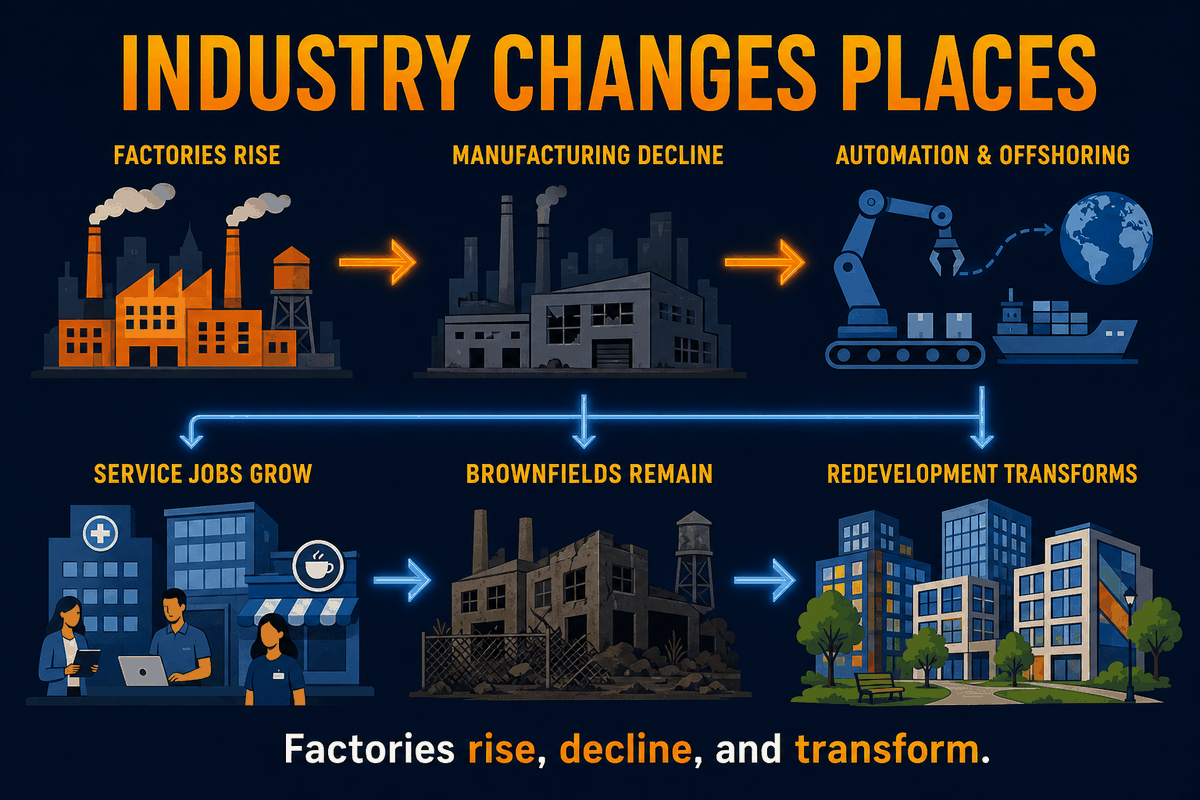
Industrialization is the growth of manufacturing, factories, mechanized production, and industrial employment in an economy. Deindustrialization is the decline of manufacturing employment or industrial activity in a region, often caused by automation, outsourcing, offshoring, trade competition, rising costs, or economic restructuring. In industrialization and deindustrialization AP Human Geography, these concepts explain changing jobs, regions, migration, brownfields, and postindustrial economies.
Say it fast: Industrialization grows factory production; deindustrialization reduces manufacturing activity.
AP clue: If the question mentions factory growth, manufacturing decline, Rust Belt, automation, outsourcing, offshoring, brownfields, or postindustrial economies, think industrialization and deindustrialization.
Unit 7 hub → Agglomeration → Industrialization and Deindustrialization
Why Industrialization and Deindustrialization Matter in AP Human Geography
Industrialization and deindustrialization AP Human Geography explains how factory growth and manufacturing decline reshape jobs, cities, migration, tax revenue, land use, and regional identity — not just national GDP totals on a chart.
Deindustrialization connects to factory closures, brownfields, Rust Belt decline, and postindustrial service growth — and often links to outsourcing and offshoring when production moves elsewhere.
Strong AP answers separate manufacturing output, manufacturing employment, and economic restructuring. A factory can produce more with fewer workers — that is not the same as industrial growth for every worker in the region.
Industrial change sits at the center of Unit 7 because development is not a single upward line. Countries and regions can industrialize, peak, and then lose factory jobs while total income still rises. Geographers study who gains, who loses, and how landscapes change when smokestacks close or new plants open. A steel town in Ohio, a textile city in northern England, and a new assembly zone in Southeast Asia may sit at different points on the same global story — growth in one place can coincide with decline somewhere else when supply chains reorganize.
On the exam, prompts rarely ask you to recite definitions alone. They show maps of closed plants, tables with falling manufacturing employment, photos of abandoned warehouses, or narratives about robotics and trade. Your job is to name the process, cite the evidence, explain a cause or effect, and mention redevelopment when the stimulus includes cleanup or retraining. When you see both factory icons and service-sector growth in the same region, explain the sequence: industrialization may have happened decades earlier, while the current trend is deindustrialization and postindustrial restructuring.
- Industrialization explains manufacturing growth, infrastructure investment, and urban-industrial expansion.
- Deindustrialization explains job loss, brownfields, out-migration, and regional decline.
- AP questions often ask for causes, consequences, and policy or redevelopment responses.
- Separate factory output from factory employment — automation can raise one while cutting the other.
- Postindustrial shift does not mean the economy disappears; services and knowledge work often grow.
AP clue: Factory growth → industrialization. Manufacturing job loss, closures, brownfields → deindustrialization.
What is industrialization?
Industrialization is the growth of manufacturing, factories, mechanized production, and industrial employment in an economy. AP Human Geography uses industrialization to explain how regions develop secondary-sector jobs, build infrastructure, attract labor, and transform landscapes through factory growth and urban-industrial expansion.
Industrialization Explained
Industrialization is the growth of manufacturing, factories, mechanized production, and industrial employment in an economy. It transforms how goods are made, where people work, and how regions connect to global markets.
When a region industrializes, you often see rising investment in transport networks, energy supply, and urban infrastructure. Workers migrate from rural areas or from other countries to fill factory jobs. Cities grow around mills, ports, and assembly plants. National income may rise as value-added manufacturing replaces raw export dependence — a pattern dependency theory contrasts with more balanced development paths.
- Manufacturing and factory production expand — more goods are processed and assembled locally rather than shipped out as raw materials only.
- Mechanization and technology increase output per worker; early industrialization adds jobs even as machines spread.
- Secondary-sector employment rises — classify these jobs using the economic sectors framework before you compare countries.
- Infrastructure and transportation improve — rail, highways, ports, and power grids support industrial location decisions.
- Urbanization and labor migration bring workers to industrial districts; agglomeration can pull related firms into the same corridor.
- Rostow takeoff connection — rapid factory investment and leading sectors mark Rostow's takeoff in many textbook examples.
- Trade-offs — industrialization can raise living standards and tax revenue but may also bring pollution, unsafe conditions, or inequality if benefits are uneven.
Industrialization is not automatically permanent. Regions that build factories today can lose them later when costs, technology, or trade patterns shift — which is why AP Human Geography pairs industrialization with deindustrialization in the same unit.
What is industrialization?
Industrialization is the growth of manufacturing, factories, mechanized production, and industrial employment in an economy. AP Human Geography uses industrialization to explain how regions develop secondary-sector jobs, build infrastructure, attract labor, and transform landscapes through factory growth and urban-industrial expansion.
Deindustrialization Explained
Deindustrialization is the decline of manufacturing employment or industrial activity in a region. It describes places where factories close, industrial jobs disappear, and the economic role of manufacturing shrinks — even if some production continues elsewhere or with fewer workers.
A critical AP distinction: deindustrialization can happen while manufacturing output still rises nationally. Automation and robotics allow fewer workers to produce the same or greater volume. Students who equate output with employment miss one of the most common exam traps.
- Manufacturing employment falls in the region even when a few high-tech plants remain.
- Automation reduces labor needs — robotics and computerized assembly replace repetitive factory work.
- Outsourcing and offshoring move stages of production to lower-cost firms or countries; see the dedicated outsourcing and offshoring guide for how the terms differ.
- Trade competition and rising costs — labor, land, or energy expenses can push firms toward cheaper locations.
- Sector shift — employment often moves toward tertiary and quaternary work in postindustrial economies.
- Not total collapse — deindustrialization does not mean zero factories or zero economy; it means manufacturing is less central to local jobs and identity.
Regional deindustrialization can coincide with national service-sector growth. A country may still rank high on HDI or development indicators while specific cities lose mill jobs — geography asks you to read the scale in the prompt.
What is deindustrialization?
Deindustrialization is the decline of manufacturing employment or industrial activity in a region. It often results from automation, outsourcing, offshoring, trade competition, rising costs, or relocation. On the exam, deindustrialization explains factory closures, job loss, brownfields, out-migration, and postindustrial restructuring.
Industrialization vs Deindustrialization
Use this table before you pick an answer — the direction of change in manufacturing employment and factory investment usually tells you which process the stimulus describes.
| Feature | Industrialization | Deindustrialization |
|---|---|---|
| Main process | Growth of manufacturing, factories, and industrial employment | Decline of manufacturing employment or industrial importance in a region |
| Sector shift | Employment moves toward secondary manufacturing; primary share may fall | Manufacturing share falls; tertiary and quaternary shares often rise |
| Employment pattern | Factory jobs increase; migration toward industrial districts | Factory jobs decrease; out-migration or underemployment may follow |
| Common location clue | New plants, rail and port investment, industrial parks, smokestacks | Closed plants, brownfields, Rust Belt labels, empty warehouses |
| Possible benefit | Higher output, wages, infrastructure, and development momentum | Cleaner air if polluting plants close; space for redevelopment |
| Possible cost | Pollution, labor exploitation, rapid urban crowding | Job loss, tax-base decline, abandoned land, regional stigma |
| AP exam clue | Factory growth, mechanization, takeoff, new industrial zones | Manufacturing decline, automation, offshoring, brownfields, restructuring |
When a prompt mentions both trends, explain the sequence: many regions industrialized in the nineteenth and twentieth centuries, peaked in factory employment, and then deindustrialized as technology and global competition reshaped production. The comparison is about direction and local impact, not moral judgment. A country can host growing high-tech manufacturing in one state while another state loses apparel and furniture plants — always match your label to the scale and evidence in the stimulus.
Causes of Industrialization
Industrial growth rarely happens by accident. Firms and governments choose locations where inputs, labor, energy, and markets align — the same logic Weber's Least Cost Theory formalizes. These nine causes appear repeatedly in AP stimuli.
Transportation improvements
Railroads, highways, ports, and canals lower the cost of moving raw materials and finished goods, pulling factories toward accessible corridors.
Access to raw materials
Coal, iron ore, timber, and other inputs reduce transport costs for bulk-reducing industries near resource sites.
Capital investment
Banks, investors, and government funds finance machinery, plants, and infrastructure that make large-scale production possible.
Labor supply
A growing workforce — including migrants — provides the hands and skills factories need, especially during early industrial expansion.
Energy sources
Coal, hydroelectric power, oil, and later reliable grids supply the fuel factories require to run machines and smelters.
Technology
Mechanization, assembly lines, and later robotics increase output and can initially expand factory employment before automation cuts it.
Agglomeration
Related firms cluster to share suppliers, skilled labor, services, and infrastructure — lowering total cost.
Government policy
Tariffs, subsidies, tax breaks, and special economic zones can deliberately attract or protect manufacturing.
Access to markets
Large urban populations and export gateways let factories sell goods without excessive shipping expense — a market-orientation pull.
Industrialization in one region can depend on core-periphery relationships: cores often host advanced manufacturing and decision-making while peripheries may supply raw materials — a pattern Wallerstein's world-systems theory also describes.
Causes of Deindustrialization
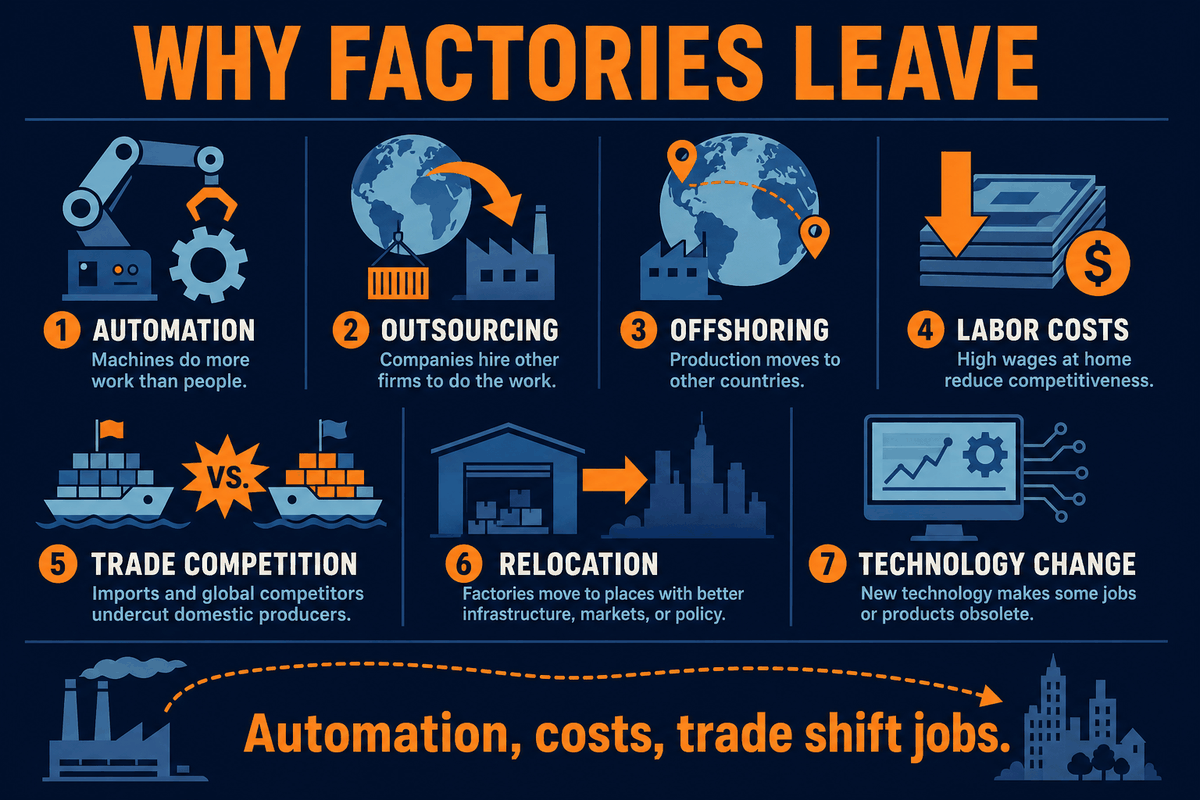
Deindustrialization happens when the advantages that once held factories in place weaken. Causes often overlap — a plant may automate, then offshore remaining labor-intensive stages. Name the cause the stimulus emphasizes.
- Automation — robotics and computerized systems replace workers; output can rise while employment falls.
- Outsourcing — firms contract production to another company, sometimes domestically, reducing in-house factory jobs.
- Offshoring — production moves to another country to cut labor costs; domestic plants close or shrink.
- Global competition — imports from lower-cost regions undercut local manufacturers on price.
- Rising labor or land costs — wages, rents, and taxes in older industrial cities push firms outward.
- Decline of older industries — steel, textiles, and heavy manufacturing lose demand or efficiency versus newer sectors.
- Relocation to lower-cost regions — plants move within a country (e.g., Sun Belt) or abroad.
- Policy and trade changes — trade agreements, tariffs, or deregulation shift comparative advantage.
- Changing consumer demand — preferences for services, digital goods, or different products reduce factory orders.
Each cause connects to wider Unit 7 themes: automation to technology and productivity; offshoring to global division of labor; competition to unequal exchange and trade networks. On FRQs, one well-explained cause beats a list of five unexplained terms. If the stimulus names robotics, write automation; if it names Bangladesh or maquiladoras, write offshoring — match the vocabulary to the evidence provided.
What causes deindustrialization?
Common causes include automation that replaces workers, outsourcing and offshoring that move production elsewhere, global competition from lower-cost regions, rising labor or land costs, decline of older industries, changing consumer demand, and policy or trade shifts. A strong answer names the specific cause shown in the stimulus.
Effects of Deindustrialization
When factories leave, consequences ripple through labor markets, public finance, migration, and land use. AP prompts often ask for one economic effect and one land-use or demographic effect — plan both before you write.
- Manufacturing job loss — displaced workers may face unemployment or lower-wage service jobs without retraining.
- Unemployment or underemployment — official rates may hide part-time or informal work that pays less than old factory wages.
- Out-migration — especially younger workers seeking jobs elsewhere, aging the remaining population.
- Tax-base decline — closed plants reduce property and payroll taxes that fund schools, roads, and services.
- Abandoned factories — empty buildings signal decline and may attract vandalism or safety hazards.
- Brownfields — polluted or contaminated sites complicate reuse and can blight neighborhoods.
- Urban or regional decline — shrinking cities lose retail, transit ridership, and political influence.
- Retraining needs — workers must learn skills for logistics, health care, technology, or other growing sectors.
- Service or knowledge shift — postindustrial employment grows in offices, hospitals, universities, and tech firms.
- Redevelopment opportunities — rail lines, riverfront land, and industrial shells can host new uses after cleanup.
Effects are uneven. Some suburbs gain logistics warehouses while inner-city mill towns lose jobs. Some workers retrain successfully; others face long-term wage loss. Mention inequality when the stimulus shows divided outcomes — a link to development and inequality indicators.
Demographic effects matter as much as economic ones. When younger workers leave, schools may close, housing demand falls, and political representation shrinks. Aging populations that remain may depend on fixed incomes and limited local services. Social effects — loss of community identity tied to a mill, rising vacancy rates, or increased crime near abandoned sites — appear in narrative FRQs even when the rubric asks for an economic consequence. Pair job loss with out-migration when both are supported by the stimulus.
What are the effects of deindustrialization?
Effects can include manufacturing job loss, unemployment, out-migration, tax-base decline, abandoned factories, brownfields, regional or urban decline, retraining needs, and a shift toward service or knowledge sectors. Some regions also pursue redevelopment through cleanup, infrastructure reuse, and attracting new industries.
Rust Belt and Brownfields
Rust Belt is the common label for older U.S. manufacturing regions — especially parts of the Midwest and Northeast — where steel, auto, and heavy industry shed jobs from the late twentieth century onward. The name comes from rusting factories and equipment, not from a formal government boundary. On AP exams, Rust Belt clues signal regional deindustrialization, not automatic failure of every city in the zone.
Some Rust Belt cities rebounded with universities, medical centers, tech offices, or logistics hubs. Others continue to struggle with population loss and weak tax bases. The label describes industrial history and restructuring pressure — read the stimulus for whether redevelopment is underway.
Brownfields are abandoned or underused industrial or commercial properties where redevelopment may be complicated by real or suspected contamination. After deindustrialization, brownfields dot riverfronts, rail corridors, and inner suburbs. Cleanup costs, liability rules, and environmental health concerns can delay reuse for years.
- Brownfields can become parks, housing, warehouses, or tech offices after remediation — they are not permanently useless.
- Contaminated soil and groundwater raise cleanup expense and health risks — strong FRQs acknowledge both challenge and opportunity.
- Postindustrial restructuring ties brownfield reuse to service-sector and logistics growth on legacy industrial land.
- Compare regional decline in the core-periphery model when prompts scale beyond one U.S. city.
International examples also fit: former mining valleys in Wales, shuttered textile districts in Lancashire, Ruhr Valley restructuring in Germany, and docklands awaiting redevelopment in Baltimore or Liverpool share brownfield logic even without the Rust Belt name. The AP exam may use any of these settings — focus on the clues (closed plants, polluted land, service recruitment) rather than memorizing one U.S. map outline.
Redevelopment politics also matter. Cleanup grants, tax incentives for new employers, and community opposition to toxic remediation can speed or delay reuse. A strong answer notes that brownfields are both an environmental problem and a potential asset when rail, river, or highway access survives after the factory closes.
Economic Restructuring Timeline
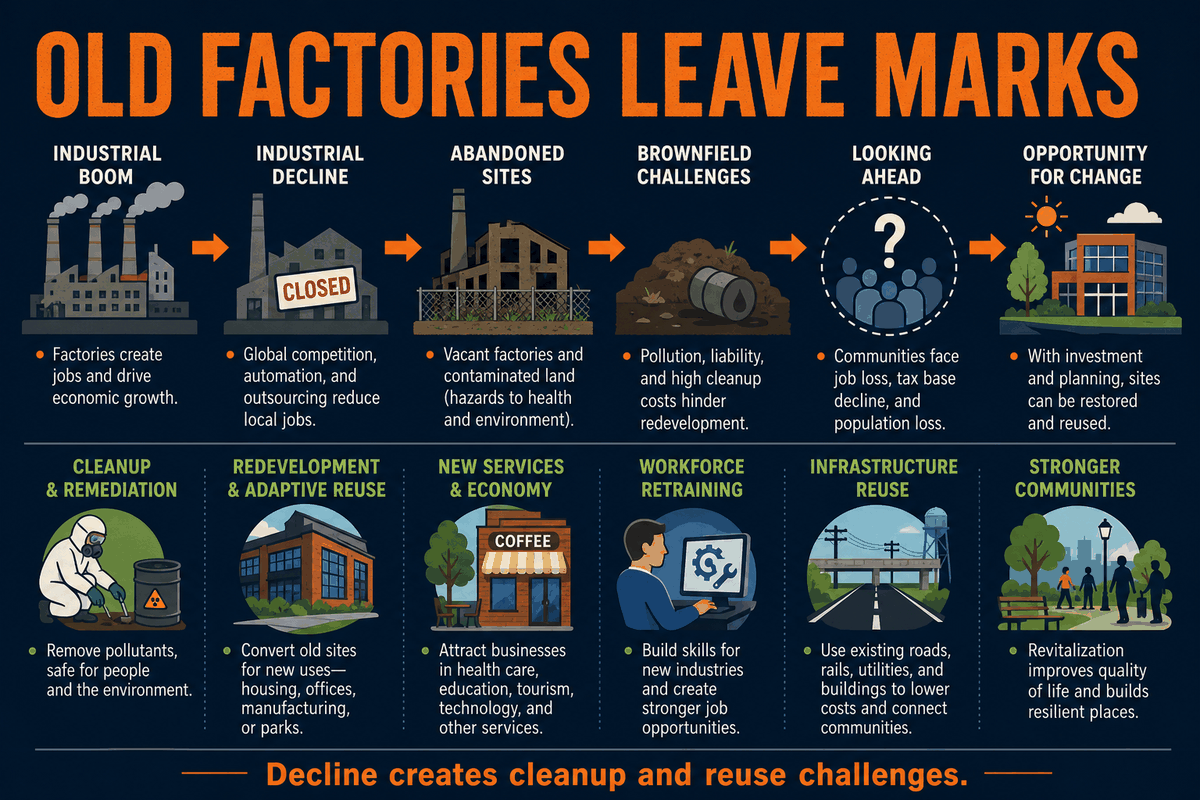
Many industrial regions follow a similar sequence over decades. Use this timeline to organize FRQ paragraphs — causes early, effects in the middle, responses at the end.
- Manufacturing growth — factories expand, rail and ports improve, secondary employment rises during industrialization.
- Industrial employment peak — factory jobs reach their highest share; the region's identity ties to mills and assembly plants.
- Automation and global competition — robotics, imports, and cost pressure begin reducing labor needs and plant viability.
- Factory closures or relocation — plants shut down or move; outsourcing and offshoring accelerate job loss.
- Job loss and brownfields — unemployment, out-migration, tax-base decline, and abandoned polluted sites mark deindustrialization effects.
- Retraining, service-sector shift, redevelopment — communities pursue cleanup, new industries, health care, logistics, and education jobs in a postindustrial mix.
The timeline is not instant. Some regions stall at step five for decades; others skip quickly to logistics and tech on cleaned industrial land. Sustainable development questions ask whether redevelopment balances economic, social, and environmental goals.
Deindustrialization, Outsourcing, and Offshoring
Outsourcing means hiring another company to perform work your firm used to do in-house — it can happen domestically or abroad. Offshoring means moving production or services to another country. The concepts overlap but are not identical: a firm can outsource to a domestic supplier without offshoring, or offshore while still owning the foreign plant.
Both can contribute to deindustrialization when domestic factory jobs disappear. AP prompts may describe apparel sewn overseas, call centers moved to another region, or auto parts sourced from maquiladora zones. Your answer should name the mechanism shown — contract abroad (outsourcing + offshoring) versus machine replacement (automation).
For maquiladora examples, trade rules, and wage comparisons, continue to the full outsourcing and offshoring study guide. Pair that reading with industrial location theory when the prompt asks why production crossed a border.
- Outsourcing focuses on who performs the work — another firm versus your own employees.
- Offshoring focuses on where the work happens — another country versus domestic sites.
- Domestic deindustrialization can coincide with industrialization in receiving countries — scale matters.
- Core-periphery patterns may shift as factories move, but power in commodity chains does not always follow.
Industrial Change Trap Fixer
Replace weak assumptions with stronger AP moves when industrial change clues appear on the exam.
| Trap | Why it is wrong | Stronger AP move |
|---|---|---|
| Deindustrialization means no industry exists | Manufacturing can decline without every plant disappearing | Describe falling manufacturing employment or industrial importance with evidence |
| Factory output and factory jobs are the same | Automation can raise output while cutting workers | Separate production volume from employment trends in the stimulus |
| Automation and offshoring are identical | Automation replaces labor with technology; offshoring moves work geographically | Name the specific mechanism — robotics versus production abroad |
| Rust Belt means every city failed | Some cities retrain, redevelop, or pivot to services and tech | Use Rust Belt as a regional industrial-decline clue, not a verdict on every place |
| Brownfields cannot be reused | Cleanup and remediation can enable new development | Acknowledge contamination challenge and possible redevelopment after cleanup |
| Industrialization is always positive | Pollution, inequality, and labor abuse can accompany factory growth | Note benefits and costs when the prompt allows balanced analysis |
| Deindustrialization is always only local | Trade, offshoring, and global competition connect regions across borders | Link local job loss to wider trade or technology causes when shown |
| Postindustrial means no economy | Services, logistics, health care, and tech jobs often replace factory work | Describe sector shift toward tertiary and quaternary employment |
Map and Data Clue Practice
Practice reading a regional stimulus like an AP map or data question. Draft your answer, then open the model explanation.
A region once had many steel and automobile factories. Over time, factory employment declined, some plants closed, brownfields appeared, younger workers migrated away, and local governments began promoting retraining, logistics, health care, and technology jobs.
- Which process is shown?
- What are two visible clues?
- What is one economic effect?
- What is one possible redevelopment response?
Reveal model explanation
1. Process: Deindustrialization — manufacturing employment declined, factories closed, and the regional economy shifted away from heavy industry.
2. Two clues: Closed steel and automobile plants; brownfields on former industrial land; out-migration of younger workers (any two with evidence).
3. Economic effect: Unemployment or tax-base decline as factories closed and payroll tax revenue fell.
4. Redevelopment response: Worker retraining, brownfield cleanup, recruiting logistics or health care firms, or reusing rail and highway access for new industry.
Why this earns credit: Names deindustrialization, cites stimulus clues, separates effect from response, and stays grounded in the data provided.
Industrial Change Cause Sorter
Read each clue and classify it as Industrialization, Deindustrialization Cause, Deindustrialization Effect, Redevelopment Response, or Not Enough Evidence. Score 12 clues with instant feedback.
How to Use Industrialization and Deindustrialization in FRQs
Identify the process → cite the clue → explain the cause, effect, or response.
Weak answer
Factories left and the place got worse.
Better answer
The region shows deindustrialization because manufacturing employment declined, factories closed, and brownfields appeared. A likely cause is automation, outsourcing, offshoring, or competition from lower-cost regions. Effects can include job loss, tax-base decline, out-migration, and redevelopment needs.
Sentence starters
- The process shown is industrialization because…
- The process shown is deindustrialization because…
- One cause of deindustrialization is…
- One economic consequence is…
- One land-use consequence is…
- One redevelopment response is…
A strong answer separates the process from its cause, consequence, and policy response. Use sector vocabulary when the prompt tracks employment shifts from manufacturing to services.
How do you use deindustrialization on an AP Human Geography FRQ?
Identify the process with stimulus evidence (factory closures, job loss, brownfields), explain a cause (automation, outsourcing, offshoring, competition), describe an economic or demographic effect, and note a redevelopment response when relevant (retraining, brownfield cleanup, new sector recruitment).
FRQ Practice and Industrial Change Sprints
Full FRQ
A region once dominated by steel and automobile manufacturing now has fewer factory jobs, several abandoned industrial sites, out-migration of younger workers, and local efforts to clean up brownfields and attract logistics, health care, and technology firms.
- A. Identify the economic process shown.
- B. Explain one cause of the process.
- C. Explain one economic or demographic consequence.
- D. Explain one redevelopment response.
Planning hint
A: deindustrialization. B: automation, offshoring, trade competition, or rising costs. C: unemployment, out-migration, or tax-base decline. D: brownfield cleanup, retraining, or recruiting new sectors.
Reveal rubric, model answer, and weak vs better samples
Rubric (4 points typical)
- 1 pt — Deindustrialization (decline of manufacturing employment or industrial activity)
- 1 pt — Valid cause: automation, outsourcing, offshoring, competition, costs, or relocation with explanation
- 1 pt — Valid consequence: job loss, out-migration, tax-base decline, or similar with explanation
- 1 pt — Valid response: brownfield cleanup, retraining, infrastructure reuse, or new industry recruitment
Model A: Deindustrialization — the region lost manufacturing jobs and industrial activity as steel and auto production declined.
Model B: Global competition and offshoring allowed firms to produce elsewhere at lower cost, closing domestic plants.
Model C: Out-migration of younger workers reduced population and weakened the local labor market.
Model D: Brownfield cleanup and recruiting logistics, health care, and technology firms reuses industrial land and replaces lost factory wages.
Common weak answer: Factories closed and everything got bad.
Better answer: The region shows deindustrialization because steel and automobile manufacturing employment fell, plants closed, and abandoned sites appeared. Offshoring and competition from lower-cost producers likely caused firms to relocate production. Younger workers migrated away, shrinking the workforce and tax base. Local governments respond by cleaning brownfields and attracting logistics, health care, and technology employers to retrain workers and reuse industrial infrastructure.
Why this earns credit: Names the process, explains cause and consequence with evidence, and describes a specific redevelopment response tied to the stimulus.
Industrial change sprint 1
A factory increases output but employs fewer workers because of robotics.
- A. Identify one cause of manufacturing job decline.
- B. Explain why output and employment can move in different directions.
Reveal sprint rubric and model
Sprint rubric (2 points)
- 1 pt — Automation (or robotics / technology replacing labor)
- 1 pt — Machines increase productivity so fewer workers produce the same or greater output
Model A: Automation — robotics replaces human labor on the assembly line.
Model B: Robotics raises labor productivity, so the factory can produce more steel or parts with fewer employees; output rises while manufacturing employment falls — a classic deindustrialization pattern at the plant level.
Industrial change sprint 2
An abandoned factory site may be polluted but is near rail and highways.
- A. Identify the land-use term.
- B. Explain one redevelopment challenge or opportunity.
Reveal sprint rubric and model
Sprint rubric (2 points)
- 1 pt — Brownfield (abandoned or underused industrial land with possible contamination)
- 1 pt — Challenge: cleanup cost or pollution risk; OR opportunity: rail/highway access for logistics or redevelopment
Model A: Brownfield — abandoned industrial land that may require environmental remediation.
Model B: Contamination raises cleanup costs and health risks, but proximity to rail and highways offers an opportunity for logistics warehouses or redeveloped office space after remediation.
Common Mistakes
Saying deindustrialization means zero factories
Wrong: Deindustrialization means every factory disappears and no industry remains.
Better: It usually means a decline in manufacturing employment or industrial importance, not the disappearance of all production.
Confusing automation with offshoring
Wrong: Automation and offshoring are the same process of job loss.
Better: Automation replaces labor with technology; offshoring moves production to another country.
Treating manufacturing output and employment as the same
Wrong: If factory output rises, manufacturing jobs must rise too.
Better: Output may rise while employment falls if productivity or automation increases.
Saying brownfields are useless
Wrong: Brownfields can never be reused because they are polluted.
Better: Brownfields may be redeveloped after cleanup, but contamination can make reuse difficult.
Ignoring redevelopment responses
Wrong: Deindustrialization FRQs only need to describe decline with no policy answer.
Better: AP answers should mention retraining, brownfield cleanup, infrastructure reuse, and attracting new industries when relevant.
AP Exam Clues
Process vocabulary
- industrialization
- deindustrialization
- manufacturing decline
- factory closure
- economic restructuring
- postindustrial economy
- service-sector shift
- retraining
- redevelopment
Regional and land clues
- Rust Belt
- brownfields
- abandoned industrial land
- closed steel or auto plants
- out-migration
- tax-base decline
- empty warehouses
- cleanup and reuse
- infrastructure reuse
Cause clues
- automation
- robotics
- outsourcing
- offshoring
- global competition
- rising labor costs
- trade policy change
- not output = employment
- not zero factories
AP clue: Decision rule: If the prompt shows factory growth, use industrialization. If it shows manufacturing job loss, factory closures, brownfields, or service-sector restructuring, use deindustrialization.
Practice MCQs
9 AP-style questions on industrialization and deindustrialization ap human geography. Choices shuffle at display time.
Definition industrialization
Question 1
Which statement best defines industrialization?
Explanation: Industrialization is the expansion of manufacturing, factory production, mechanization, and industrial employment.
Why the tempting wrong answer fails: Decline is deindustrialization; quinary shift alone is sector change; polluted land is a brownfield clue.
AP clue: Factory growth, manufacturing expansion, mechanized production → industrialization.
Definition deindustrialization
Question 2
Which statement best defines deindustrialization?
Explanation: Deindustrialization is the reduction of manufacturing employment or industrial importance in a region.
Why the tempting wrong answer fails: Takeoff is industrial growth; clustering is agglomeration; SEZs attract industry rather than describe decline.
AP clue: Manufacturing job loss, factory closures, industrial decline → deindustrialization.
Comparison
Question 3
A region adds new factories, expands rail access, and increases secondary-sector employment. Another region loses factory jobs while service jobs grow. Which comparison is correct?
Explanation: New factories and rising manufacturing employment signal industrialization; job loss with service growth fits deindustrialization.
Why the tempting wrong answer fails: Not all regions decline simultaneously; services replacing manufacturing is decline, not growth; job change alone is not industrialization.
AP clue: Factory growth vs manufacturing job loss → industrialization vs deindustrialization.
Automation
Question 4
A steel mill installs robotics and produces more steel with fewer workers. Local manufacturing employment falls. Which cause of deindustrialization is most directly shown?
Explanation: Robotics that raises output while cutting workers is a classic automation cause of manufacturing job decline.
Why the tempting wrong answer fails: Offshoring requires relocation abroad; agglomeration explains clustering; brownfields are land-use effects, not the cause shown.
AP clue: Robotics, fewer workers, higher output → automation as deindustrialization cause.
Outsourcing / offshoring
Question 5
A U.S. apparel company contracts production to a firm in Bangladesh and later closes its domestic sewing plants. Which pair of concepts best explains the job loss?
Explanation: Contracting abroad combines outsourcing (another firm) and offshoring (another country), both deindustrialization causes.
Why the tempting wrong answer fails: Clustering grows industry; cotton extraction is primary work; traditional society is Rostow stage 1, not apparel relocation.
AP clue: Production abroad, domestic plant closures → outsourcing and offshoring.
Rust Belt
Question 6
A map highlights older manufacturing cities in the U.S. Midwest and Northeast with closed auto and steel plants, population loss, and economic restructuring. Which regional label fits best?
Explanation: Closed auto and steel plants in the Midwest/Northeast with decline is the classic Rust Belt deindustrialization pattern.
Why the tempting wrong answer fails: Sun Belt growth is a different U.S. pattern; SEZs are planned investment districts; primate city is urban hierarchy, not regional industrial decline.
AP clue: Midwest/Northeast factory decline, auto and steel closures → Rust Belt.
Brownfields
Question 7
An abandoned factory site may contain polluted soil but sits near highways and rail lines. Which term best describes the land?
Explanation: Abandoned, possibly polluted industrial land awaiting reuse is a brownfield — a common deindustrialization land-use clue.
Why the tempting wrong answer fails: Greenfield is pristine land; exclave is political geography; footloose describes industry type, not land condition.
AP clue: Abandoned factory, polluted soil, redevelopment potential → brownfield.
Postindustrial
Question 8
Employment data show rising shares of tertiary and quaternary jobs and falling manufacturing employment, while total GDP still grows. Which process is most likely underway?
Explanation: Growing services and knowledge jobs with falling manufacturing employment describes postindustrial restructuring, not total economic collapse.
Why the tempting wrong answer fails: Primary expansion is the opposite direction; economies can restructure without disappearing; traditional society is Rostow's first stage.
AP clue: Service and knowledge job growth, manufacturing share falls → postindustrial economy.
FRQ application
Question 9
A region once dominated by steel manufacturing now has fewer factory jobs, abandoned industrial sites, out-migration of younger workers, and local efforts to clean brownfields and attract logistics and health care firms. Which FRQ answer best applies deindustrialization?
Explanation: Fewer factory jobs, closures, brownfields, out-migration, and service recruitment are deindustrialization clues — name process, effect, and response.
Why the tempting wrong answer fails: Job loss contradicts industrial growth; clustering ignores decline evidence; urbanization is population shift, not manufacturing restructuring.
AP clue: Steel decline, brownfields, out-migration, service recruitment → deindustrialization on FRQs.
FAQ
What is industrialization in AP Human Geography?
Industrialization is the growth of manufacturing, factories, mechanized production, and industrial employment in an economy. AP Human Geography uses industrialization to explain how regions develop secondary-sector jobs, build transport and energy infrastructure, attract labor, urbanize, and transform landscapes through factory expansion and economic development — often linked to Rostow's takeoff stage.
What is deindustrialization in AP Human Geography?
Deindustrialization is the decline of manufacturing employment or industrial activity in a region. It can result from automation, outsourcing, offshoring, trade competition, rising labor or land costs, technology change, or relocation to lower-cost areas. Deindustrialization does not mean all economic activity disappears — employment often shifts toward tertiary and quaternary sectors.
What is the difference between industrialization and deindustrialization?
Industrialization expands manufacturing, factory production, and industrial employment. Deindustrialization reduces manufacturing employment or industrial importance in a region. Industrialization often raises output and secondary-sector jobs; deindustrialization often brings factory closures, job loss, brownfields, out-migration, and postindustrial restructuring even when some production continues.
What causes deindustrialization?
Common causes include automation that replaces workers, outsourcing and offshoring that move production elsewhere, global competition from lower-cost regions, rising labor or land costs, decline of older industries, changing consumer demand, industrial relocation, and policy or trade changes. Name the specific cause shown in the stimulus rather than listing every possibility.
What are the effects of deindustrialization?
Effects can include manufacturing job loss, unemployment or underemployment, out-migration, tax-base decline, abandoned factories, brownfields, regional or urban decline, retraining needs, and a shift toward service or knowledge sectors. Some communities also pursue redevelopment through brownfield cleanup, infrastructure reuse, and recruiting logistics, health care, or technology firms.
What is the Rust Belt?
The Rust Belt refers to older manufacturing regions — especially in parts of the U.S. Midwest and Northeast — associated with factory decline, deindustrialization, and economic restructuring after heavy industry such as steel and automobile production lost jobs to automation, competition, and relocation. It is an AP clue for regional manufacturing decline, not a label for every struggling city.
What are brownfields?
Brownfields are abandoned or underused industrial or commercial sites that may be contaminated or polluted. They often appear after deindustrialization when factories close. Brownfields can be redeveloped for new uses — logistics, housing, parks, or technology offices — but cleanup costs and environmental risk can make reuse difficult.
How are outsourcing and offshoring related to deindustrialization?
Outsourcing contracts work to another company; offshoring moves production or services to another country. Both can reduce domestic manufacturing employment and contribute to deindustrialization, but they are not identical — a firm can outsource domestically without offshoring, or offshore while still owning the operation abroad.
What is a postindustrial economy?
A postindustrial economy is one where tertiary and quaternary employment — services, information, research, and technology — grows faster than manufacturing. Manufacturing output may continue, but the share of jobs in factories often falls. Postindustrial change follows or accompanies deindustrialization in many high-income regions.
How do you write about deindustrialization on an AP Human Geography FRQ?
Identify deindustrialization with stimulus evidence (factory closures, job loss, brownfields), explain a cause (automation, outsourcing, offshoring, competition), describe an economic or demographic effect (unemployment, out-migration, tax-base decline), and note a redevelopment response when relevant (retraining, brownfield cleanup, infrastructure reuse, new industry recruitment).