Dependency connects to core-periphery logic, Wallerstein world systems theory, neocolonialism, unequal exchange, and commodity dependence in Unit 7.
What is dependency theory in AP Human Geography?
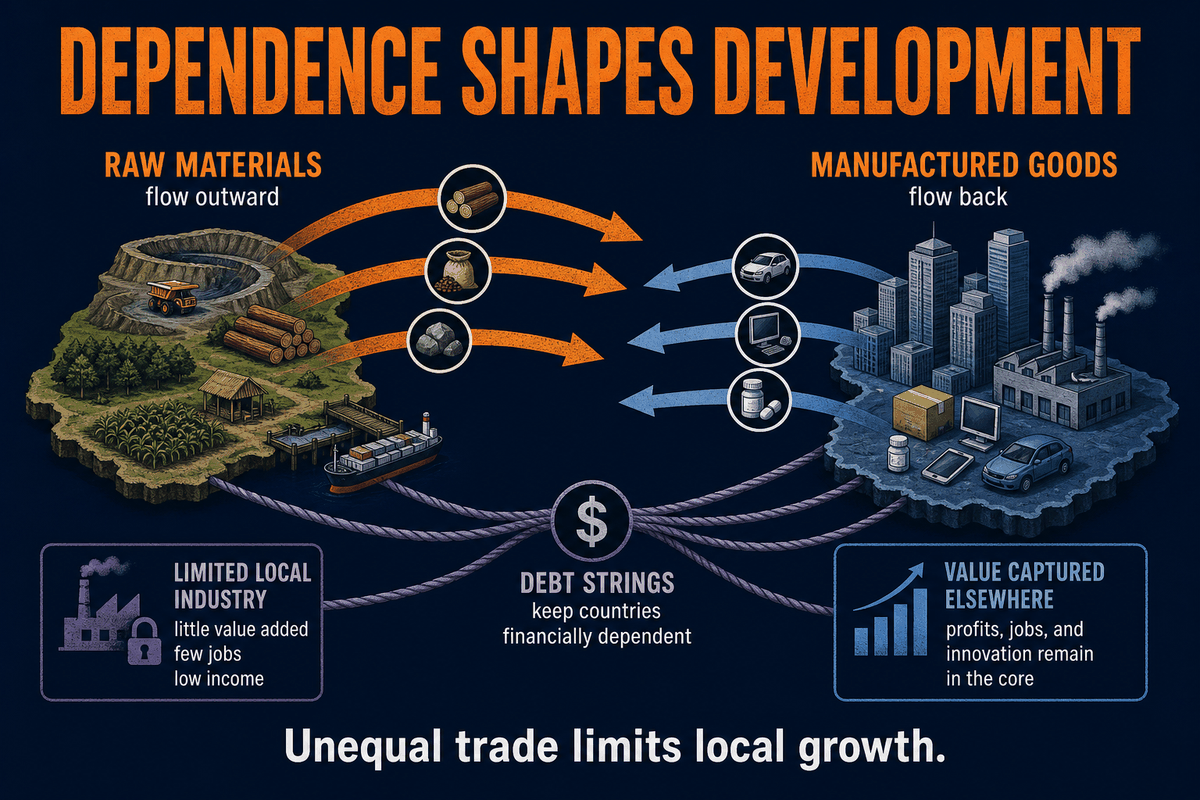
Dependency theory explains underdevelopment as a result of unequal relationships between more powerful and less powerful economies. It argues that some countries remain dependent because they export low-value raw materials or labor, import higher-value manufactured goods, rely on foreign capital, and have less control over profit, technology, and decision-making. In dependency theory AP Human Geography, the theory is often compared with Rostow and Wallerstein.
Say it fast: Dependency theory = underdevelopment caused by unequal external relationships.
AP clue: If the question mentions unequal exchange, neocolonialism, commodity dependence, foreign control, historical extraction, or dependence on core economies, think dependency theory.
Unit 7 hub → Core-Periphery Model → Dependency Theory
Why Dependency Theory Matters in AP Human Geography
Dependency theory AP Human Geography challenges the idea that countries are poor only because of internal barriers. It explains how global trade, historical extraction, and foreign control can shape underdevelopment.
AP prompts often compare dependency with Rostow's stages. Pair trade evidence with HDI or economic sectors when a stimulus mixes dependence with living standards or employment data.
Strong AP answers name dependency theory, cite unequal trade or foreign-control clues, explain the mechanism limiting development, and contrast Rostow or Wallerstein when the stem points elsewhere.
- Dependency theory is a major structural development framework in Unit 7.
- It explains how external relationships can produce or maintain underdevelopment.
- Neocolonialism, commodity dependence, and value capture appear often on exams.
- The theory is useful but simplified — agency and domestic policy still matter.
AP clue: Unequal exchange, neocolonialism, commodity dependence, foreign control, historical extraction → dependency theory.
What is dependency theory?
Dependency theory explains underdevelopment through unequal relationships between more powerful and less powerful economies. Dependent places often export low-value raw materials or labor, import higher-value manufactured goods, and rely on foreign capital with less control over technology, profit, and decision-making. AP Human Geography uses it to analyze global inequality, neocolonialism, and commodity dependence — often alongside Rostow and Wallerstein.
Dependency Theory Explained
Dependency theory focuses on external relationships between economies rather than only internal national conditions. Underdevelopment can be produced by unequal global structures that limit independent development even when a country produces goods or gains some industry.
- Less powerful economies may export raw materials, agricultural goods, or low-wage labor.
- More powerful economies may control technology, finance, markets, trade rules, and high-value production.
- Dependence can continue after formal colonialism through neocolonial economic control.
- Dependency theory is often associated with critiques of modernization models such as Rostow.
When a stimulus emphasizes five national stages or takeoff, check Rostow's model before defaulting to dependency.
How does dependency theory explain underdevelopment?
Underdevelopment can result from structural dependence, not only internal barriers. Less powerful economies may remain tied to core markets through unequal exchange, commodity dependence, debt, and foreign control of processing or branding. Value capture by outside firms can limit local investment in health, education, and diversified industry even when exports grow.
How Dependency Forms
Dependency is not one event — it builds through trade, investment, and historical power relationships. Use this table to match causes to AP clues.
| Cause | How it creates dependence | AP clue |
|---|---|---|
| Colonial extraction | Historical removal of labor, land, and resources shaped weak local industry and trade ties | Colonial history, plantation economies, resource ports |
| Commodity dependence | Income relies on few low-value exports vulnerable to world price swings | One crop or mineral dominates exports, unstable budgets |
| Foreign direct investment control | Outside firms own mines, factories, or brands and send profit abroad | Multinational corporation, foreign ownership, repatriated profits |
| Debt and loans | Repayment pressures limit spending on health, education, or diversification | IMF loans, debt crisis, infrastructure borrowing |
| Unequal trade terms | Low-value exports exchanged for high-value imports reinforce dependence | Raw exports, expensive manufactured imports |
| Limited local industrialization | Processing, technology, and branding stay outside the country | No local factories, assembly only, imported machinery |
| Foreign ownership of resources | Core firms control extraction, transport, and global sales | Foreign mining company, offshore headquarters |
| Export dependence | National economy relies on sales to core markets rather than diversified demand | Single buyer country, terms of trade, export quota |
Unequal Exchange and Commodity Dependence
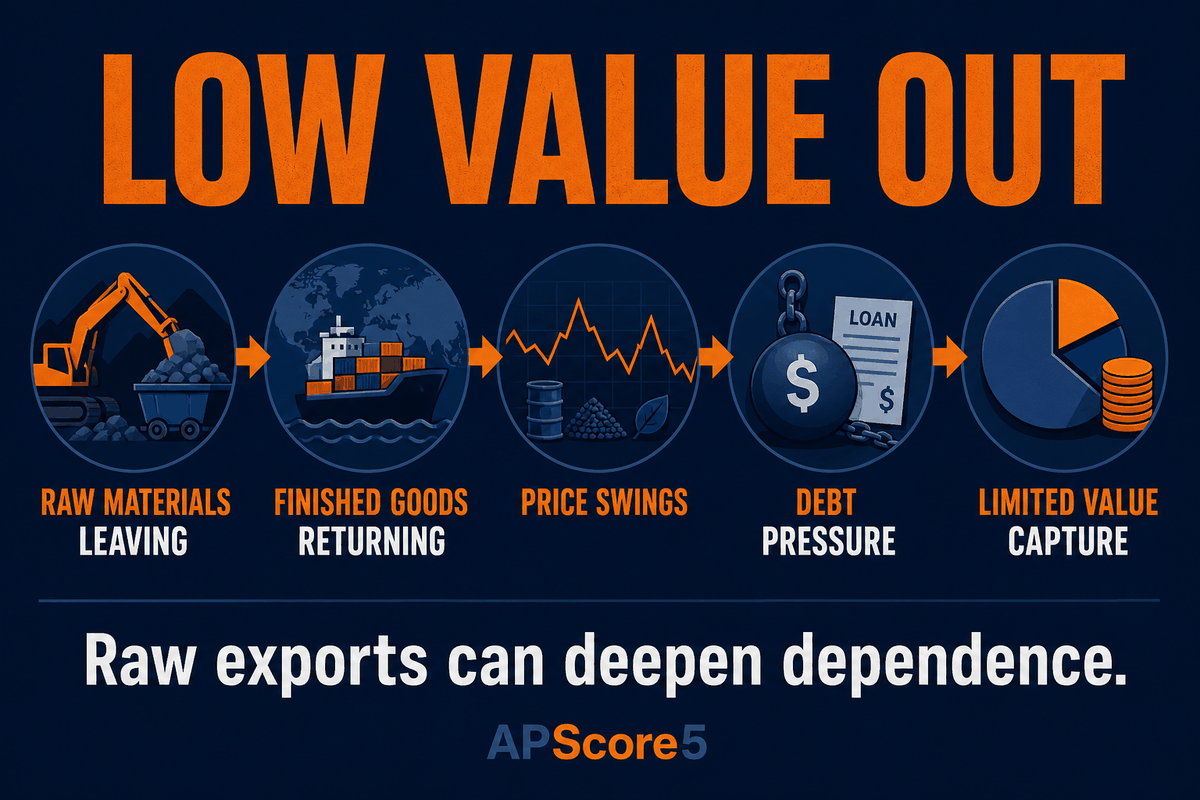
Unequal exchange happens when countries export lower-value goods and import higher-value goods, services, or technology. The trading relationship can transfer more surplus to powerful economies while dependent places capture less profit locally.
- Commodity dependence means relying heavily on one or a few raw material exports.
- World price changes can make national income unstable and limit long-term planning.
- Less value is captured locally when processing, branding, finance, and technology are controlled elsewhere.
- Pair export data with development indicators when output grows but HDI gains stay weak.
Historical Extraction and Neocolonialism
Colonialism extracted labor, land, and resources while building trade systems that favored colonial powers. Neocolonialism describes continued economic influence after political independence.
- Outside firms, debt, trade rules, or investment patterns can shape policy and development choices.
- Formal sovereignty does not automatically end unequal economic relationships.
- AP credit requires explaining the mechanism — foreign ownership, loans, unequal terms — not only naming colonial history.
- Neocolonial clues often appear with foreign control of mining, processing, branding, or infrastructure loans.
Dependency vs Rostow
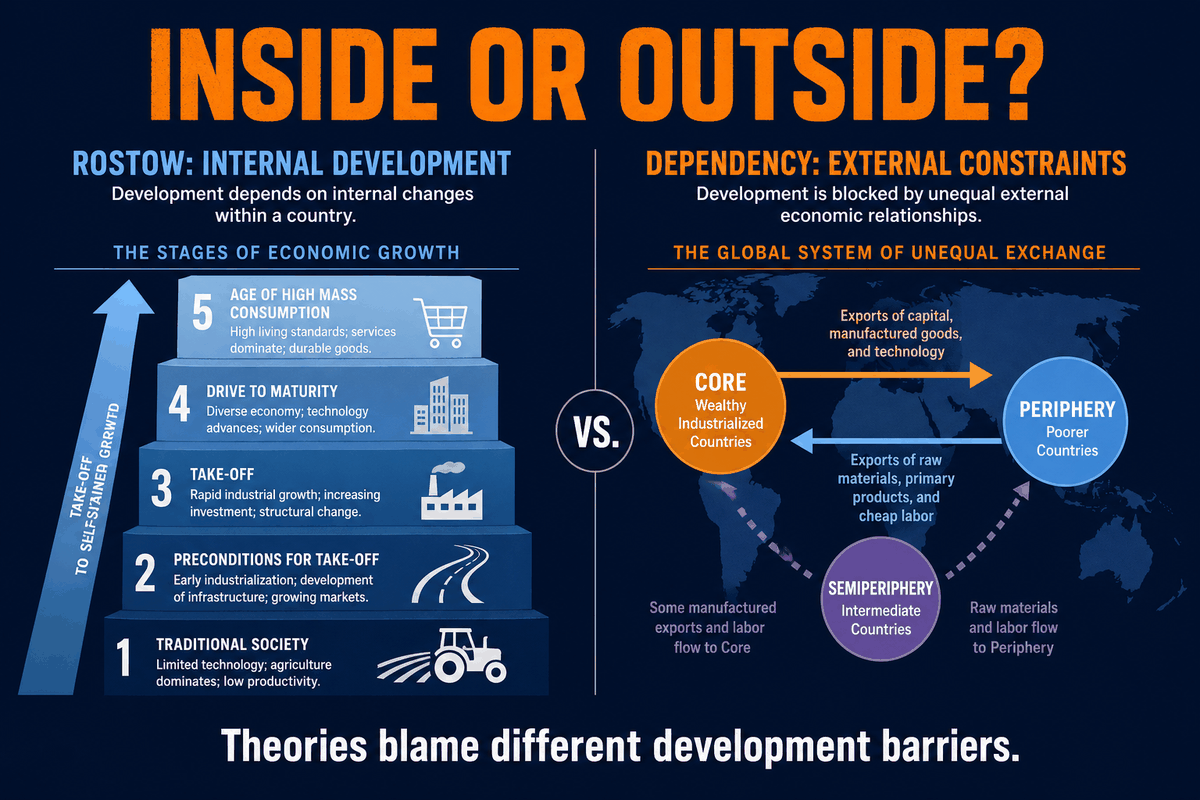
Pick the framework that matches the prompt — internal stages and takeoff point to Rostow; unequal trade and foreign control point to dependency theory.
| Feature | Rostow | Dependency theory |
|---|---|---|
| Main cause of development/underdevelopment | Internal investment, infrastructure, and industrial stages | External unequal relationships, extraction, and dependence |
| Focus | National modernization ladder through five stages | Global trade, debt, foreign firms, and value capture |
| View of poor countries | Behind on a similar path toward mass consumption | Structurally dependent on core economies and unequal exchange |
| Best AP clue | Takeoff, preconditions, five stages, mass consumption | Raw exports, foreign control, neocolonialism, commodity dependence |
| Weakness | Western-centered, linear, may ignore global inequality | May understate agency; not all trade or FDI is harmful |
| FRQ move | Name the stage and cite internal investment or industry clues | Name dependency, cite unequal relationship evidence, explain mechanism |
How is dependency theory different from Rostow?
Rostow explains development as national modernization stages driven largely by internal investment, infrastructure, and industrial takeoff. Dependency theory emphasizes external unequal relationships — historical extraction, neocolonial control, commodity dependence, and value capture by core economies. Rostow uses a ladder metaphor; dependency focuses on trade, debt, and foreign firm control.
Dependency vs Wallerstein
Both theories address global inequality and external relationships, but they emphasize different vocabulary and mechanisms.
- Wallerstein classifies countries into core, semi-periphery, and periphery roles in the world economy.
- Dependency theory emphasizes how unequal relationships keep some places dependent through trade, debt, extraction, and foreign control.
- Dependency is often more direct about exploitation, colonial history, and underdevelopment mechanisms.
- If the prompt labels core, semi-periphery, and periphery roles, lead with Wallerstein; if it stresses foreign firms, commodity dependence, or neocolonial control, lead with dependency.
| Feature | Wallerstein | Dependency theory |
|---|---|---|
| Main unit | World-system roles: core, semi-periphery, periphery | Dependent versus dominant economic relationships |
| Key vocabulary | World economy, structural roles, commodity chains | Unequal exchange, neocolonialism, commodity dependence |
| Historical emphasis | Long-term world-system evolution | Colonial extraction and continued economic control |
| Best AP clue | Core/semi-periphery/periphery labels in global prompts | Foreign control, raw exports, debt, neocolonial relationships |
| FRQ move | Assign role and explain uneven development in the world system | Name dependency, explain mechanism limiting local value capture |
Dependency and Core-Periphery
Dependency theory often uses core-periphery logic: core economies capture high-value activities while periphery economies supply raw materials and labor.
- Core areas may control finance, technology, branding, and decision-making.
- Periphery areas may depend on core markets for investment, imports, and demand.
- Dependency explains why the relationship can limit independent development — not only that inequality exists.
- Core-periphery can appear at global, national, regional, and urban scales; dependency often stresses global trade and historical power.
Dependency Trap Fixer
Replace weak assumptions with stronger AP moves when dependency clues appear on the exam.
| Trap | Why it is wrong | Stronger AP move |
|---|---|---|
| Dependency theory says poor countries do nothing | The theory stresses constraints, not zero agency | Acknowledge external limits while noting domestic policy and choices still matter |
| Dependency and Rostow say the same thing | One is external dependence; the other is internal stages | Contrast unequal trade with takeoff or five-stage clues |
| Dependency only means political colonies | Neocolonial economic control can continue after independence | Explain foreign firms, debt, or unequal trade mechanisms |
| All trade creates dependency | Not every trade relationship is unequal or permanent | Focus on value capture, commodity dependence, and foreign control evidence |
| FDI is always harmful | Investment outcomes depend on ownership and profit flows | Describe whether FDI builds local industry or extracts surplus |
| Dependency explains every development problem | Culture, politics, environment, and policy also shape places | State one limitation on full FRQs |
| Commodity exports always prevent growth | Exports can fund development when value is captured locally | Explain whether processing, branding, and profit stay in the country |
| Core-periphery and dependency are identical | Core-periphery is a spatial pattern; dependency stresses mechanisms of dependence | Use core-periphery for roles; dependency for unequal exchange and neocolonial control |
Unequal Exchange Practice
Practice reading a commodity-chain stimulus like an AP question. Draft your answer, then open the model explanation.
Country A exports raw cacao beans at unstable prices. Foreign firms process the cacao, brand the chocolate, control global marketing, and capture most profit. Country A imports expensive finished goods and borrows money for infrastructure.
- Which theory best explains this pattern?
- What is one dependency clue?
- How does value capture affect development?
- How would Rostow explain the problem differently?
Reveal model explanation
Theory: Dependency theory best explains the pattern.
Clue: Unequal exchange and limited local value capture — raw exports while foreign firms control processing, branding, marketing, and profit.
Value capture: Country A captures less surplus for health, education, and diversified industry despite producing cacao.
Rostow contrast: Rostow would focus more on internal modernization stages and investment; dependency focuses on external unequal relationships and foreign control.
Why this earns credit: Names the theory, cites specific evidence, explains the mechanism, and contrasts Rostow.
Strengths and Limitations
Strengths
- Explains global inequality and historical extraction in trade relationships.
- Highlights unequal exchange, commodity dependence, and neocolonial control.
- Challenges overly simple modernization models that ignore external power.
- Useful for commodity-chain stimuli and FRQ analysis in Unit 7.
Limitations
- Can understate local agency and domestic policy choices.
- May overgeneralize diverse countries into one dependent category.
- Not all trade or foreign direct investment produces dependence.
- Some countries have used trade and investment for development gains.
- Culture, politics, and environment may also matter beyond economic dependence alone.
What are the limitations of dependency theory?
Dependency theory can understate local agency, domestic policy, and cases where trade or foreign investment supports development. It may overgeneralize diverse countries and not explain every cultural or environmental factor. Not all trade or FDI produces dependence — outcomes depend on ownership, profit flows, and local linkages. Pair with HDI or Gini when prompts ask about quality of life inside a country.
Dependency Clue Sorter
Read each clue and classify it as Dependency Theory, Rostow / Modernization, Wallerstein / World Systems, Core-Periphery Pattern, or Not Enough Evidence. Score 12 clues with instant feedback.
How to Use Dependency Theory in FRQs
Name the theory → identify unequal relationship → explain how dependence limits development.
Weak answer
The country is poor because of dependency.
Better answer
Dependency theory explains the country's underdevelopment through unequal external relationships. The country exports low-value raw materials while foreign firms control processing, branding, technology, and profit. This limits local value capture and can keep the economy dependent on core markets, foreign capital, or unstable commodity prices.
Sentence starters
- The theory shown is dependency theory because…
- One dependency clue is…
- The country remains dependent because…
- Value is captured outside the country when…
- This differs from Rostow because…
- One limitation of dependency theory is…
A strong answer identifies the unequal relationship, explains the mechanism, and connects it to underdevelopment or limited local value capture.
FRQ Practice and Dependency Sprints
Full FRQ
Country A exports raw minerals and agricultural commodities. Foreign corporations control processing, transportation, branding, and global marketing. Country A imports expensive manufactured goods and depends on foreign loans for infrastructure.
- A. Identify the development theory best shown.
- B. Explain one clue that supports your answer.
- C. Explain how value capture can limit development.
- D. Explain one limitation of dependency theory.
Planning hint
A: dependency theory. B: raw exports plus foreign control of processing/branding. C: profit and technology leave the country. D: agency, not all FDI harmful, or diverse outcomes.
Reveal rubric, model answer, and weak vs better samples
Rubric (4 points typical)
- 1 pt — Dependency theory (or equivalent structural external-relationship theory)
- 1 pt — Clue: raw exports, foreign corporate control, manufactured imports, or foreign loans
- 1 pt — Value capture limits local investment in industry, health, or education
- 1 pt — Valid limitation: agency, not all trade harmful, or other factors matter
Model A: Dependency theory.
Model B: Country A exports raw commodities while foreign corporations control processing, transport, branding, and marketing — a dependency clue of unequal exchange and foreign control.
Model C: Value capture sends profit and high-value decisions abroad, limiting funds for diversified industry, infrastructure quality, and human development despite resource exports.
Model D: Dependency theory can understate domestic policy choices, and not all foreign investment or trade produces permanent dependence.
Common weak answer: The country is dependent so it cannot develop.
Better answer: Dependency theory explains underdevelopment through unequal external relationships: Country A exports low-value raw materials while foreign firms control processing, branding, and global marketing, capturing most profit. Value capture limits local surplus for diversified industry and services, while manufactured imports and foreign loans reinforce dependence — though domestic policy and investment terms still influence outcomes.
Why this earns credit: Names the theory, cites specific evidence, explains value capture, and states a limitation.
Dependency sprint 1
A country depends on one raw material export, and world price changes create unstable income.
- A. Identify the dependency concept shown.
- B. Explain why this can limit development.
Reveal sprint rubric and model
Sprint rubric (2 points)
- 1 pt — Commodity dependence (or export dependence on few low-value goods)
- 1 pt — Price volatility limits stable investment in health, education, or diversified industry
Model A: Commodity dependence.
Model B: Unstable export income makes long-term development planning difficult and can trap governments in debt or austerity when prices fall.
Dependency sprint 2
A student says dependency theory and Rostow's model are basically the same.
- A. Explain one difference between the theories.
- B. Identify one AP clue that points to dependency theory.
Reveal sprint rubric and model
Sprint rubric (2 points)
- 1 pt — Rostow = internal stages; dependency = external unequal relationships (valid contrast)
- 1 pt — Valid dependency clue: unequal exchange, foreign control, commodity dependence, or neocolonialism
Model A: Rostow explains development as national modernization stages; dependency explains underdevelopment through unequal global trade and foreign control of value chains.
Model B: Foreign firms controlling processing and branding while a country exports raw materials points to dependency theory, not Rostow's stage ladder.
Common Mistakes
Saying dependency theory means countries are helpless
Wrong: Poor countries cannot change because dependency theory says so.
Better: Dependency theory emphasizes external constraints, but domestic choices and agency still matter.
Confusing dependency with Rostow
Wrong: Both theories say countries grow through the same five internal stages.
Better: Rostow focuses on internal stages; dependency focuses on external unequal relationships.
Saying all trade is bad
Wrong: Any trade relationship creates permanent underdevelopment.
Better: Dependency theory criticizes unequal trade and value capture, not every trade relationship.
Treating FDI as always harmful
Wrong: Foreign investment always traps countries in dependency.
Better: Foreign investment can help or hurt depending on ownership, labor conditions, profit flows, and local linkages.
Ignoring the mechanism
Wrong: The country is poor because of dependency — no further explanation.
Better: AP answers should explain how raw exports, debt, foreign control, or value capture limit development.
AP Exam Clues
Dependency vocabulary
- dependency theory
- dependency
- unequal exchange
- commodity dependence
- neocolonialism
- underdevelopment
- historical extraction
- foreign control
Trade and power clues
- raw material exports
- low-value exports
- high-value imports
- debt
- foreign loans
- foreign firms
- value capture
- core markets
Contrast clues
- not Rostow stages alone
- not rich vs poor only
- not all trade is bad
- not helpless countries
- mechanism required
- vs Wallerstein roles
- vs internal takeoff
- exploitation
AP clue: Decision rule: If the prompt says underdevelopment is caused by unequal external economic relationships, think dependency theory.
Practice MCQs
9 AP-style questions on dependency theory ap human geography. Choices shuffle at display time.
Definition
Question 1
Which statement best defines dependency theory?
Explanation: Dependency theory stresses unequal trade, foreign control, historical extraction, and dependence on core economies — not internal stages alone.
Why the tempting wrong answer fails: Five stages are Rostow; multi-scale roles alone are core-periphery; HDI is a composite index.
AP clue: Unequal exchange, neocolonialism, commodity dependence, foreign control → dependency theory.
Unequal exchange
Question 2
A country exports cheap raw minerals and imports expensive manufactured goods while borrowing for infrastructure. Which concept fits best?
Explanation: Exporting low-value goods and importing higher-value products is a classic unequal exchange and dependency clue.
Why the tempting wrong answer fails: Mass consumption is Rostow stage 5; agglomeration is industrial clustering; sustainability is a separate framework.
AP clue: Raw exports, expensive imports, debt → unequal exchange.
Commodity dependence
Question 3
A national economy earns most income from one crop export, and world price swings cause budget crises. What does this best illustrate?
Explanation: Depending heavily on one or few raw commodities exposes countries to price volatility and limits diversified development.
Why the tempting wrong answer fails: Quinary is top services; maturity is Rostow; Gini measures inequality, not export concentration.
AP clue: One raw export, price swings, unstable income → commodity dependence.
Neocolonialism
Question 4
After political independence, foreign corporations still control mining, loans shape policy, and finished goods are imported from former colonial partners. What term fits best?
Explanation: Neocolonialism describes economic control through firms, debt, trade, or investment after colonies gain independence.
Why the tempting wrong answer fails: Suburbanization is urban sprawl; centripetal forces are political; DTM is population change.
AP clue: Independence plus foreign firm or debt control → neocolonialism.
Value capture
Question 5
Raw cacao is exported cheaply; foreign firms process, brand, and market chocolate, capturing most profit. What does this best illustrate?
Explanation: When processing, branding, finance, and marketing are controlled elsewhere, local economies capture less development benefit from exports.
Why the tempting wrong answer fails: Primary sector can still employ many workers; Weber explains factory sites; SEZs are policy districts.
AP clue: Raw export, foreign branding and profit → value capture.
vs Rostow
Question 6
A student says Rostow and dependency theory explain development the same way. Which correction is strongest?
Explanation: Rostow is a national stage ladder; dependency focuses on trade, extraction, debt, and foreign control of value chains.
Why the tempting wrong answer fails: Both address economic change; HDI is not dependency; neocolonial control fits dependency better.
AP clue: Internal stages vs external dependence → contrast Rostow and dependency.
vs Wallerstein
Question 7
A prompt assigns countries core, semi-periphery, and periphery roles in the world economy. Which theory is most directly named?
Explanation: Core, semi-periphery, and periphery role labels are central to Wallerstein, though dependency shares overlapping inequality themes.
Why the tempting wrong answer fails: Takeoff is one Rostow stage; Weber is industrial location; formal/informal is labor classification.
AP clue: Core, semi-periphery, periphery labels → Wallerstein; unequal dependence → dependency.
Limitation
Question 8
Which statement is a valid limitation of dependency theory?
Explanation: Domestic policy, diversified exports, and beneficial investment matter — dependency is structural but not deterministic for every case.
Why the tempting wrong answer fails: Industrial growth can occur in dependent ties; indicators still matter; loans can help or hurt depending on terms.
AP clue: Agency, mixed FDI outcomes, diverse countries → state a limitation on FRQs.
FRQ application
Question 9
Country A exports raw minerals. Foreign corporations control processing, transport, branding, and global marketing. Country A imports manufactured goods and relies on foreign loans. Which FRQ answer best applies dependency theory?
Explanation: Name dependency theory, cite raw exports plus foreign control of processing and profit, explain limited value capture, and note a limitation if asked.
Why the tempting wrong answer fails: Trade patterns need structural theory, not stage 1 alone; core-periphery also applies globally; HDI does not replace dependency analysis.
AP clue: Raw exports, foreign firms, loans, manufactured imports → dependency FRQ evidence.
FAQ
What is dependency theory in AP Human Geography?
Dependency theory explains underdevelopment as a result of unequal relationships between more powerful and less powerful economies. It argues that some countries remain dependent because they export low-value raw materials or labor, import higher-value manufactured goods, rely on foreign capital, and have less control over profit, technology, and decision-making. In AP Human Geography, dependency theory is often compared with Rostow and Wallerstein.
How does dependency theory explain underdevelopment?
Underdevelopment can be produced by unequal global economic structures, not only by internal barriers inside a country. Less powerful economies may rely on exporting raw materials or low-wage labor while more powerful economies control technology, finance, markets, trade rules, and high-value production. Dependence can continue after formal colonialism through neocolonial relationships, debt, and foreign firm control.
What is unequal exchange?
Unequal exchange happens when countries export lower-value goods and import higher-value goods. A dependent economy may send out raw materials or agricultural products while importing expensive manufactured goods, technology, or services. The relationship can transfer more economic benefit to powerful economies and limit local value capture, reinforcing underdevelopment over time.
What is commodity dependence?
Commodity dependence means relying heavily on one or a few raw material exports for national income. When world prices fall, government revenue and investment can become unstable. Countries may export low-value commodities while importing higher-value manufactured goods, leaving less profit for local industrialization, health, or education gains.
What is neocolonialism?
Neocolonialism describes continued economic influence after political independence. Outside firms, debt, trade rules, or investment patterns can shape development decisions even when a country is formally sovereign. AP answers should explain the mechanism — such as foreign ownership, loans, or unequal trade — not only name colonial history.
What is the difference between dependency theory and Rostow's model?
Rostow explains development as national modernization stages driven largely by internal investment, infrastructure, and industrial growth toward mass consumption. Dependency theory emphasizes external unequal relationships, historical extraction, commodity dependence, neocolonial control, and limited local value capture. Rostow focuses on what happens inside a country; dependency focuses on global economic power and trade.
What is the difference between dependency theory and Wallerstein's world systems theory?
Both address global inequality and external relationships. Wallerstein classifies countries into core, semi-periphery, and periphery roles in the world economy. Dependency theory emphasizes how unequal relationships keep some places dependent through trade, debt, extraction, and foreign control. Dependency is often more direct about exploitation, colonial history, and underdevelopment mechanisms.
What is an example of a dependency theory clue?
A country exports raw minerals at low prices while foreign corporations control processing, transport, branding, and global marketing. The country imports expensive manufactured goods and depends on foreign loans for infrastructure. AP stimuli may also mention unequal exchange, commodity dependence, neocolonialism, foreign control, or historical extraction.
What are the limitations of dependency theory?
Dependency theory can understate local agency and domestic policy choices. It may overgeneralize diverse countries, and not all trade or foreign direct investment produces dependence. Some countries have used trade and investment for development, and culture, politics, and environment also shape outcomes. The theory is useful but simplified for AP analysis.
How do you write about dependency theory on an AP Human Geography FRQ?
Name dependency theory, identify the unequal relationship with specific evidence (raw exports, foreign firms, debt, manufactured imports), explain how dependence or value capture limits development, and state a limitation when asked. Contrast Rostow if the prompt describes internal stages, and contrast Wallerstein if the prompt emphasizes core, semi-periphery, and periphery role labels.