Agglomeration connects to Weber's Least Cost Theory as a formal third cost factor that can pull factories toward clusters even when transport is slightly higher.
What is agglomeration in AP Human Geography?
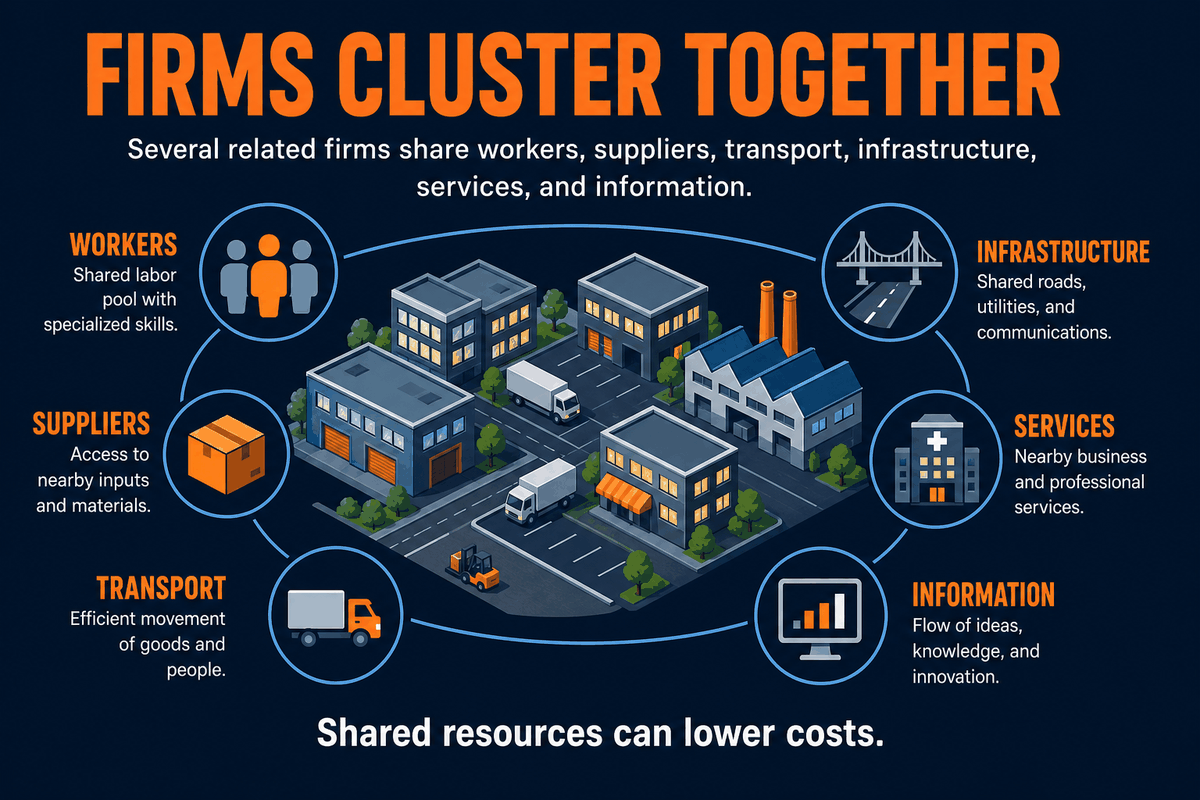
Agglomeration is the clustering of firms, industries, or economic activities in one area because being close together can reduce costs or increase efficiency. In agglomeration AP Human Geography, clustering helps explain industrial clusters, shared labor pools, supplier networks, infrastructure advantages, knowledge spillovers, and why firms locate near related businesses.
Say it fast: Agglomeration = firms cluster because closeness creates advantages.
AP clue: If the question mentions clustering, shared suppliers, shared labor, infrastructure, knowledge spillovers, economies of scale, or firms locating near related industries, think agglomeration.
Unit 7 hub → Weber's Least Cost Theory → Agglomeration
Why Agglomeration Matters in AP Human Geography
Agglomeration AP Human Geography explains why related firms cluster in industrial districts, technology corridors, port zones, and supplier networks — not randomly across the landscape.
Cluster jobs link to economic sectors — especially secondary manufacturing — and to industrial location theory when prompts list ports, labor pools, or footloose talent beyond clustering alone.
Strong AP answers name the specific cluster benefit, explain how it lowers cost or improves efficiency, and note a possible diseconomy when congestion or land prices rise.
- Agglomeration explains why industries cluster in districts, corridors, and port zones.
- AP questions may ask for both benefits and costs of clustering.
- Shared labor, suppliers, infrastructure, and knowledge spillovers are core exam clues.
- Clustering is useful but not always positive — crowding can create diseconomies.
AP clue: Clustering, shared suppliers, shared labor, knowledge spillovers, economies of scale → agglomeration.
What is agglomeration in AP Human Geography?
Agglomeration is the clustering of firms, industries, or economic activities in one area because proximity can reduce costs or increase efficiency. AP Human Geography uses agglomeration to explain industrial clusters, shared labor pools, supplier networks, infrastructure advantages, knowledge spillovers, and why related businesses locate near each other.
Agglomeration Explained
Agglomeration means the clustering of economic activity — firms locate near related firms because proximity can reduce costs or increase efficiency.
- Clustering can provide shared workers, suppliers, services, infrastructure, transport, and information.
- Agglomeration creates external economies of scale — benefits that come from locating near others.
- Successful clusters can attract more related firms over time.
- Excessive clustering can also create congestion, pollution, and high land costs.
For the wider site-factor list — markets, energy, footloose industries — see industrial location theory after you master clustering benefits.
Why do firms cluster together?
Firms cluster because closeness can provide shared workers, suppliers, services, infrastructure, transport, and information. Clustering can lower search costs, reduce transport for parts and services, and create external economies of scale. Over time, successful clusters can attract even more related firms.
Benefits of Agglomeration
Use this table before you pick an answer — name the specific benefit the stimulus emphasizes, not clustering alone.
| Benefit | How It Helps Firms | AP Clue | Possible Limitation |
|---|---|---|---|
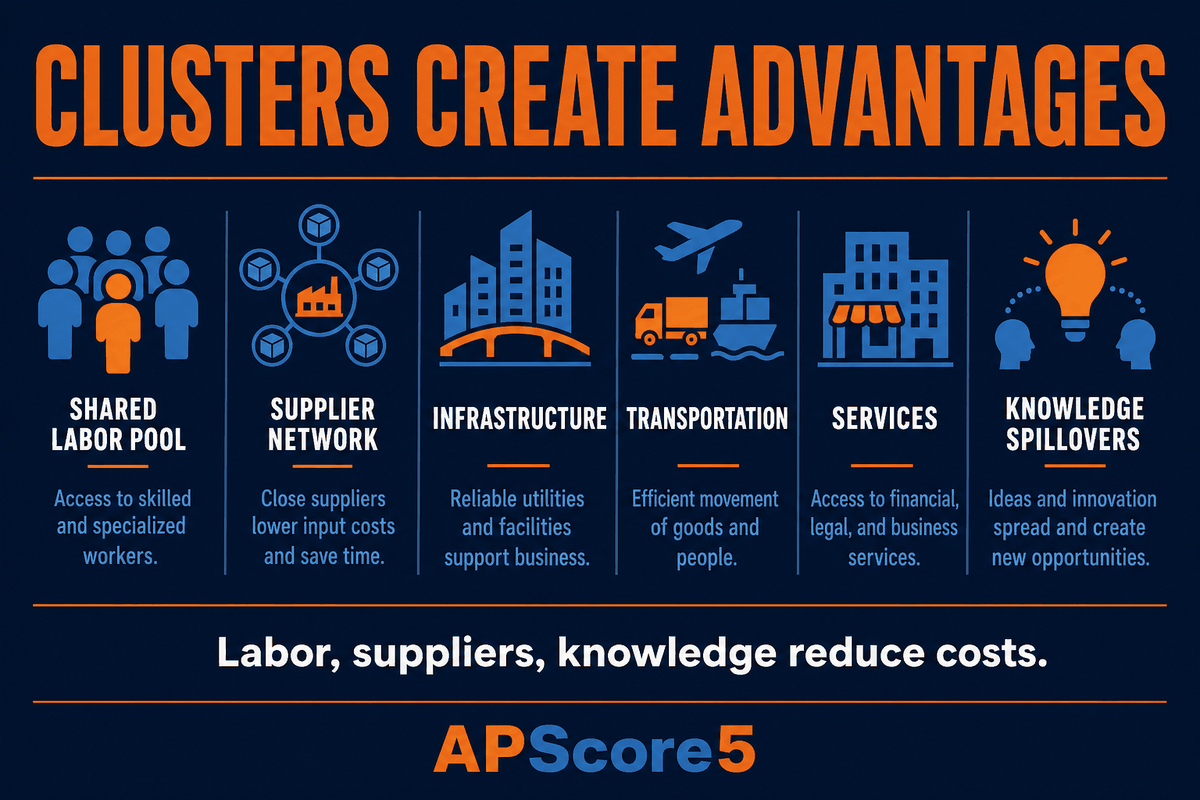
| Shared labor pool | Firms hire skilled workers faster; workers gain job options | Trained workers nearby, faster hiring, labor market depth | Competition for workers can raise wages |
| Supplier network | Nearby parts makers and inputs cut search and transport costs | Parts suppliers, logistics firms, industrial district | Supplier dependence if one link fails |
| Specialized services | Consultants, repair, and business services reduce downtime | Machine repair, legal, accounting, design services nearby | Service costs may rise in hot clusters |
| Shared infrastructure | Utilities, warehouses, and facilities lower operating costs | Shared utilities, warehouses, industrial parks | Overloaded infrastructure if cluster grows too fast |
| Transportation access | Ports, highways, rail, and airports reduce movement costs | Port city, rail hub, highway interchange, logistics corridor | Congestion on crowded transport links |
| Knowledge spillovers | Ideas spread through contact, job switching, and networks | Workers change firms, university research nearby, tech corridor | Firms may lose talent to competitors in the cluster |
| Innovation | Face-to-face contact and research partnerships speed new products | University lab, R&D park, startup ecosystem | High rents can push small innovators outward |
| Reputation or branding | Cluster identity attracts talent, investment, and customers | Silicon Valley, automotive corridor, fashion district label | Brand halo does not guarantee every firm succeeds |
What are agglomeration economies?
Agglomeration economies are cost advantages firms gain by locating near related businesses, suppliers, workers, services, and infrastructure. Benefits include shared labor pools, supplier networks, specialized services, transport access, and knowledge spillovers. These external economies can lower total cost even when rent inside the cluster is higher.
Supplier Networks and Services
Supplier networks let firms share nearby parts makers, repair services, logistics companies, consultants, and specialized business services. Proximity lowers transaction and transport costs for inputs and support.
- Just-in-time delivery works better when suppliers sit close to assembly plants.
- Machine repair, legal, accounting, and design services cluster with industry.
- Supplier networks are a strong AP clue for industrial clustering.
- Link supplier access to industrial location theory when the prompt mixes clustering with raw-material or market orientation.
Knowledge Spillovers and Innovation
Knowledge spillovers happen when ideas spread faster because related firms, workers, universities, and research groups are close together. Face-to-face contact, job switching, and informal networks can increase innovation.
- Technology corridors and university towns show knowledge spillovers in action.
- Workers who move between related firms carry skills and ideas across the cluster.
- Research partnerships between firms and universities accelerate product development.
- High-skill clusters behave differently from smokestack manufacturing districts — name the spillover mechanism on FRQs.
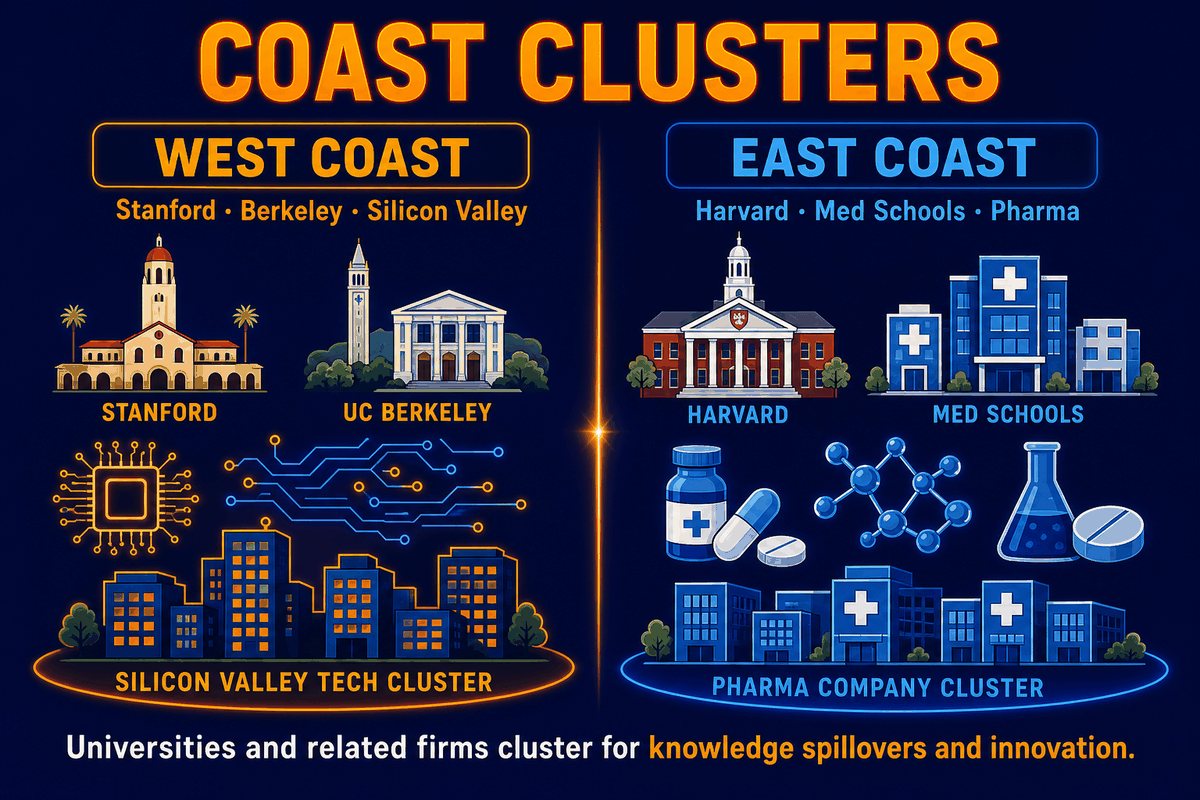
Real U.S. examples show the pattern on both coasts: the West Coast Silicon Valley cluster sits near Stanford and UC Berkeley, where tech firms, startups, and research labs share talent and ideas. On the East Coast, Harvard, nearby medical colleges, and many pharma companies form a biotech and health-sciences agglomeration built on shared research, skilled labor, and specialized services.
Transportation and Infrastructure Advantages
Clusters often form near ports, highways, rail lines, airports, utilities, and logistics hubs. Shared infrastructure reduces movement and operating costs for firms in the district.
- Break-of-bulk points and port cities attract warehouses and export-oriented clusters.
- Shared utilities and warehouses lower per-firm infrastructure expense.
- Transport access connects industrial location to urban and regional geography.
- Overcrowded roads and ports can become diseconomies when the cluster grows too large.
Agglomeration in Weber's Least Cost Theory
Weber's Least Cost Theory includes agglomeration as one of three major cost factors alongside transportation and labor. Firms may choose a cluster even if transport costs are slightly higher when shared labor, suppliers, services, and infrastructure lower total cost.
- Agglomeration savings can offset higher rent or longer freight for some industries.
- Weber treats clustering as a formal pull factor — not an afterthought.
- Congestion or high land costs can limit agglomeration benefits inside the model.
- Go deeper on transport and labor pulls in the Weber's Least Cost Theory study guide.
How do you use agglomeration on an AP Human Geography FRQ?
Name agglomeration, identify the specific cluster benefit with stimulus evidence (suppliers, labor pool, port, university, services), and explain how it lowers cost or improves efficiency. Connect to Weber when clustering shifts least-cost location. Note a possible diseconomy if the prompt mentions congestion or rising land prices.
Agglomeration vs Diseconomies
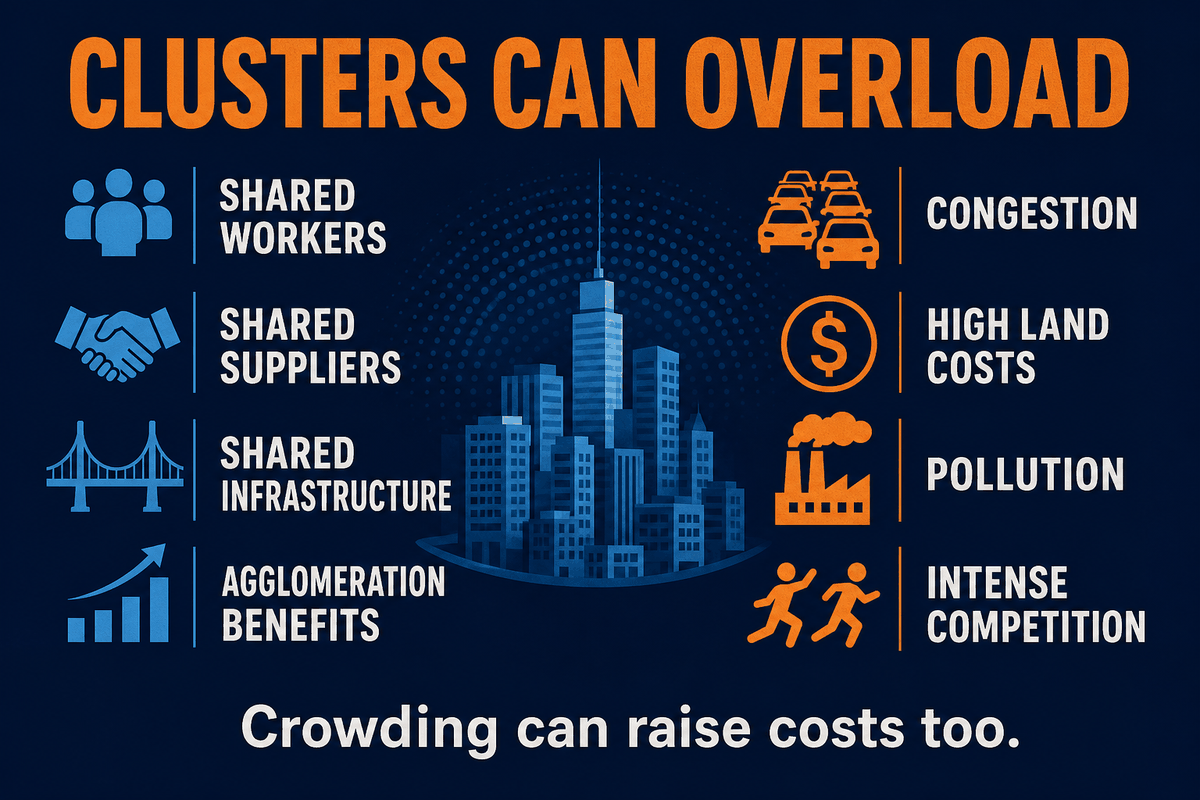
Agglomeration economies are benefits from clustering; diseconomies of agglomeration are higher costs when clustering becomes excessive. Good AP answers explain both sides when the stimulus allows it.
- Benefits: shared labor, suppliers, infrastructure, services, knowledge spillovers.
- Costs: congestion, pollution, high land prices, labor competition, overcrowded infrastructure.
- Rising land prices and traffic can signal that diseconomies are starting to offset cluster benefits.
- Do not assume every cluster always lowers every cost with no downside.
What are diseconomies of agglomeration?
Diseconomies of agglomeration are higher costs that result when clustering becomes excessive. Examples include congestion, pollution, high land prices, overcrowded infrastructure, and competition for workers that pushes wages up. Good AP answers explain both agglomeration benefits and possible diseconomies.
Agglomeration Trap Fixer
Replace weak assumptions with stronger AP moves when clustering clues appear on the exam.
| Trap | Why it is wrong | Stronger AP move |
|---|---|---|
| Agglomeration only means population growth | Population growth alone does not explain economic clustering logic | Agglomeration means clustering of firms or industries for economic advantage |
| All clustering is beneficial | Excessive clustering can raise land prices and congestion costs | Name specific benefits and note possible diseconomies when asked |
| Agglomeration and urbanization are identical | Urbanization is population shift; agglomeration is economic clustering | Separate population growth in cities from firms clustering for cost advantage |
| Agglomeration means firms are randomly close | Clustering follows shared labor, suppliers, infrastructure, and knowledge logic | Explain why proximity lowers cost or improves efficiency |
| Diseconomies are unrelated to agglomeration | Diseconomies are costs that can result from excessive clustering | Pair agglomeration benefits with congestion or high land prices when shown |
| Weber ignores agglomeration | Weber includes agglomeration as a formal third cost factor | Connect cluster benefits to Weber least-cost location when relevant |
| Agglomeration only happens in manufacturing | Technology, logistics, and service clusters also show agglomeration | Apply clustering logic to tech corridors and supplier networks too |
| Knowledge spillovers only happen online | Face-to-face contact and job switching spread ideas in physical clusters | Cite university research, worker mobility, or informal networks as spillover clues |
Cluster Clue Practice
Practice reading a clustering stimulus like an AP map or data question. Draft your answer, then open the model explanation.
A region has several related firms, specialized suppliers, logistics companies, repair services, skilled workers, training programs, and nearby research institutions. More firms move there even though land prices are rising.
- What concept is shown?
- What are two benefits of clustering?
- What is one possible diseconomy?
- How does this connect to Weber's Least Cost Theory?
Reveal model explanation
1. Concept: Agglomeration — related firms cluster near shared workers, suppliers, services, logistics, and research institutions.
2. Two benefits: Lower search costs for labor and supplier access; infrastructure sharing and knowledge spillovers from nearby research institutions.
3. Possible diseconomy: Rising land prices or congestion as more firms enter the cluster.
4. Weber connection: Agglomeration can pull firms toward the cluster if shared labor, suppliers, and infrastructure reduce total cost below a more isolated site.
Why this earns credit: Names agglomeration, cites specific benefits with evidence, notes a diseconomy, and connects to Weber as a cost factor.
Agglomeration Benefit Sorter
Read each clue and classify it as Shared Labor Pool, Supplier / Service Network, Knowledge Spillover, Infrastructure / Transport, or Diseconomy of Agglomeration. Score 12 clues with instant feedback.
How to Use Agglomeration in FRQs
Name agglomeration → identify the cluster benefit → explain how it lowers cost or improves efficiency.
Weak answer
Businesses are near each other.
Better answer
The region shows agglomeration because related firms cluster near shared suppliers, skilled labor, transport infrastructure, and services. This can lower costs by reducing supplier search time, improving access to workers, and spreading information across the cluster. However, too much clustering can create diseconomies such as congestion and high land prices.
Sentence starters
- The concept shown is agglomeration because…
- One benefit of clustering is…
- This lowers costs by…
- A possible diseconomy is…
- In Weber's model, agglomeration can…
- The cluster attracts more firms because…
A strong answer names the specific benefit of clustering and explains how it reduces cost or increases efficiency.
FRQ Practice and Cluster Decision Sprints
Full FRQ
A region contains several related manufacturing firms, specialized suppliers, logistics companies, repair services, skilled workers, training centers, and nearby research institutions. More firms move into the region even though land prices and traffic congestion are increasing.
- A. Identify the industrial location concept shown.
- B. Explain one benefit firms gain from clustering.
- C. Explain one diseconomy that may result from clustering.
- D. Explain how agglomeration connects to Weber's Least Cost Theory.
Planning hint
A: agglomeration. B: shared labor, suppliers, infrastructure, or knowledge spillovers. C: rising land prices or congestion. D: agglomeration as a Weber cost factor that can lower total cost.
Reveal rubric, model answer, and weak vs better samples
Rubric (4 points typical)
- 1 pt — Agglomeration (clustering of related firms for economic advantage)
- 1 pt — Valid benefit: shared labor, suppliers, services, infrastructure, or knowledge spillovers with explanation
- 1 pt — Valid diseconomy: rising land prices, congestion, pollution, or labor competition
- 1 pt — Weber link: agglomeration can pull firms toward cluster when benefits reduce total cost
Model A: Agglomeration — related firms cluster near shared suppliers, workers, services, and research institutions.
Model B: Firms gain supplier access and a shared skilled labor pool, reducing search and hiring costs.
Model C: Rising land prices and traffic congestion increase costs for new entrants — diseconomies of agglomeration.
Model D: In Weber's model, agglomeration is a formal cost factor; clustering can lower total cost through shared labor and suppliers even if transport is slightly higher.
Common weak answer: Firms are close because it is convenient.
Better answer: The region shows agglomeration because related manufacturing firms cluster near specialized suppliers, logistics companies, skilled workers, training centers, and research institutions. One benefit is a shared labor pool that reduces hiring time. A diseconomy is rising land prices and traffic congestion as more firms enter. In Weber's Least Cost Theory, agglomeration can pull firms toward the cluster when shared suppliers and labor lower total cost below a more isolated site.
Why this earns credit: Names the concept, cites a specific benefit and diseconomy with evidence, and connects to Weber as a cost factor.
Cluster sprint 1
A technology firm locates near universities, research labs, and similar firms.
- A. Identify one agglomeration benefit.
- B. Explain how it can improve innovation.
Reveal sprint rubric and model
Sprint rubric (2 points)
- 1 pt — Knowledge spillover or shared labor pool (or equivalent cluster benefit)
- 1 pt — University research, job switching, or informal contact spreads ideas and speeds innovation
Model A: Knowledge spillover — universities and research labs sit near related technology firms.
Model B: Proximity to universities and similar firms lets workers and researchers share ideas through partnerships, hiring, and informal contact, accelerating product development and innovation in the cluster.
Cluster sprint 2
An industrial district becomes expensive because of congestion and rising rents.
- A. Identify the problem.
- B. Explain how it can reduce the benefits of agglomeration.
Reveal sprint rubric and model
Sprint rubric (2 points)
- 1 pt — Diseconomies of agglomeration (congestion and rising rents / land costs)
- 1 pt — Higher costs can offset shared labor and supplier benefits, pushing some firms outward
Model A: Diseconomies of agglomeration — congestion and rising rents.
Model B: When land prices and congestion rise, the cost of staying in the cluster can exceed the savings from shared suppliers and labor, reducing net agglomeration benefits and encouraging some firms to relocate.
Common Mistakes
Saying agglomeration just means a lot of people
Wrong: Agglomeration is the same as population growth in a city.
Better: Agglomeration means clustering of economic activities, firms, or industries.
Saying all clustering is good
Wrong: Every cluster always lowers every cost with no downside.
Better: Clustering can create benefits, but congestion, land costs, pollution, and competition can create diseconomies.
Ignoring the specific benefit
Wrong: Firms cluster because they are close — no further explanation needed.
Better: AP answers should name shared labor, suppliers, infrastructure, services, or knowledge spillovers.
Confusing agglomeration with urbanization
Wrong: Urbanization and agglomeration are the same process.
Better: Urbanization is population growth in cities; agglomeration is clustering for economic advantage.
Forgetting Weber
Wrong: Weber's model has nothing to do with clustering.
Better: Weber includes agglomeration as a cost factor that can pull firms toward clusters.
AP Exam Clues
Agglomeration vocabulary
- agglomeration
- clustering
- industrial cluster
- agglomeration economies
- economies of scale
- external economies
- shared labor pool
- supplier network
- specialized services
Spatial clues
- logistics hub
- knowledge spillovers
- innovation
- infrastructure sharing
- industrial district
- tech corridor
- port or rail access
- university research nearby
Contrast clues
- diseconomies
- congestion
- high land costs
- not urbanization alone
- not random proximity
- Weber agglomeration factor
- benefits vs costs of clustering
- pollution and overcrowding
AP clue: Decision rule: If related firms cluster to share workers, suppliers, infrastructure, services, or knowledge, use agglomeration.
Practice MCQs
8 AP-style questions on agglomeration ap human geography. Choices shuffle at display time.
Definition
Question 1
Which statement best defines agglomeration?
Explanation: Agglomeration is clustering of related firms or activities because closeness creates cost or efficiency advantages.
Why the tempting wrong answer fails: Five stages are Rostow; unequal exchange is dependency theory; rural-to-urban shift alone is migration or urbanization.
AP clue: Clustering, shared suppliers, shared labor, economies of scale → agglomeration.
Industrial clustering
Question 2
A map shows several related automotive firms, parts suppliers, repair services, and skilled workers in one industrial district. Which concept best explains the pattern?
Explanation: An industrial district with suppliers, services, and skilled workers is a classic agglomeration clustering clue.
Why the tempting wrong answer fails: DTM is population change; commodity dependence is export concentration; suburbanization is residential spread.
AP clue: Related firms, parts suppliers, repair services, industrial district → agglomeration.
Shared labor pool
Question 3
A company hires skilled technicians quickly because many trained workers already live near the industrial cluster. Which agglomeration benefit is shown?
Explanation: Many trained workers nearby create a shared labor pool — a core agglomeration benefit for clustered firms.
Why the tempting wrong answer fails: Job switching fits knowledge spillovers; bulk-gaining is location orientation; dependence is a development theory.
AP clue: Trained workers nearby, faster hiring, skilled labor pool → shared labor pool.
Supplier network
Question 4
Several parts makers, logistics firms, and machine-repair services locate near factories in the same district. Which benefit best explains why firms cluster there?
Explanation: Nearby parts makers, logistics, and repair services form a supplier and service network — a key agglomeration benefit.
Why the tempting wrong answer fails: Traditional society is Rostow stage 1; market orientation pulls toward consumers; GII measures inequality.
AP clue: Parts suppliers, logistics firms, repair services nearby → supplier network.
Knowledge spillover
Question 5
Workers move between related technology firms and spread ideas through informal contact. Which agglomeration benefit is most directly shown?
Explanation: Job switching and informal contact spread ideas across related firms — classic knowledge spillover in agglomeration.
Why the tempting wrong answer fails: Labor pool is worker availability without idea spread; bulk-reducing is weight logic; mass consumption is Rostow.
AP clue: Workers change firms, spread ideas, informal contact → knowledge spillover.
Infrastructure / transport
Question 6
Firms in a cluster share access to a port, rail line, and highway interchange. Which agglomeration benefit is most directly shown?
Explanation: Shared port, rail, and highway access lowers transport costs for firms in the cluster — an infrastructure advantage.
Why the tempting wrong answer fails: Congestion is a diseconomy, not the benefit shown; footloose is less transport-dependent; core-periphery is uneven development.
AP clue: Port, rail line, highway hub, shared transport → infrastructure advantage.
Diseconomies
Question 7
Traffic congestion, pollution, and rising land prices make an industrial district more expensive for new firms. Which concept best describes the problem?
Explanation: Congestion, pollution, and rising land prices are diseconomies — costs that can offset agglomeration benefits.
Why the tempting wrong answer fails: Economies are benefits, not costs; raw-material orientation is site logic; takeoff is one Rostow stage.
AP clue: Congestion, pollution, high land prices, overcrowding → diseconomies of agglomeration.
FRQ application
Question 8
A region has related manufacturing firms, specialized suppliers, logistics companies, skilled workers, training centers, and research institutions. More firms move in even though land prices are rising. Which FRQ answer best applies agglomeration?
Explanation: Related firms, suppliers, logistics, workers, training, and research institutions are agglomeration clues — name benefits and note rising land prices as a possible diseconomy.
Why the tempting wrong answer fails: Urbanization is population shift; Weber includes agglomeration; dependency is a development theory, not a cluster model.
AP clue: Suppliers, skilled workers, research institutions, firms moving in → agglomeration on FRQs.
FAQ
What is agglomeration in AP Human Geography?
Agglomeration is the clustering of firms, industries, or economic activities in one area because being close together can reduce costs or increase efficiency. AP Human Geography uses agglomeration to explain industrial clusters, shared labor pools, supplier networks, infrastructure advantages, knowledge spillovers, and why firms locate near related businesses.
Why do firms cluster together?
Firms cluster because proximity can provide shared workers, suppliers, services, infrastructure, transport, and information. Clustering can lower search costs, reduce transport for parts and business services, and create external economies of scale. Successful clusters can attract even more related firms over time, though excessive clustering can also create diseconomies.
What are agglomeration economies?
Agglomeration economies are cost advantages firms gain by locating near related businesses, suppliers, workers, services, and infrastructure. Benefits include shared labor pools, supplier networks, specialized services, transport access, and knowledge spillovers. These external economies can lower total cost even when rent or congestion inside the cluster rises.
What is a shared labor pool?
A shared labor pool exists when many trained or skilled workers live near an industrial cluster. Firms benefit from faster hiring and reduced search costs; workers benefit from more job options in related industries. Labor market depth is a common AP clue for agglomeration, though competition for workers can also raise wages.
What are knowledge spillovers?
Knowledge spillovers happen when ideas, skills, and innovation spread between related firms, workers, universities, and research groups in a cluster. Face-to-face contact, job switching, and informal networks can accelerate innovation — especially in technology and high-skill industrial districts.
How does agglomeration relate to Weber's Least Cost Theory?
Weber includes agglomeration as one of three major cost factors alongside transportation and labor. Firms may choose a cluster even if transport costs are slightly higher because shared labor, suppliers, services, and infrastructure can lower total cost. Agglomeration savings can pull a factory toward an industrial district when clustering benefits outweigh extra freight or land expense.
What are diseconomies of agglomeration?
Diseconomies of agglomeration are higher costs that result when clustering becomes excessive. Examples include congestion, pollution, high land prices, overcrowded infrastructure, and competition for workers that pushes wages up. Good AP answers explain both agglomeration benefits and possible diseconomies when a stimulus mentions rising rents or traffic.
What is the difference between agglomeration and urbanization?
Urbanization is the growth of city population as people move from rural to urban areas. Agglomeration is the clustering of firms or economic activities for cost or efficiency advantages — shared labor, suppliers, infrastructure, and knowledge. A city can grow without strong industrial clustering, and clusters can form in suburban or specialized districts beyond the urban core alone.
What are examples of agglomeration clues on the AP exam?
AP clues include industrial clusters, shared labor pools, supplier networks, specialized services, logistics hubs, knowledge spillovers, infrastructure sharing, and firms locating near related industries. Stimuli may also mention economies of scale, external economies, innovation districts, or rising land prices and congestion as possible diseconomies.
How do you write about agglomeration on an AP Human Geography FRQ?
Name agglomeration, identify the specific cluster benefit with stimulus evidence (suppliers, labor pool, port, university, services), and explain how it lowers cost or improves efficiency. Connect to Weber when clustering shifts least-cost location. Note a possible diseconomy if the prompt mentions congestion, pollution, or rising land prices.