HDI gives a broader view of development than GDP or GNI alone by combining health, education, and income into one composite score.
What is HDI in AP Human Geography?
HDI, or the Human Development Index, is a development indicator that combines health, education, and income into one score. In HDI AP Human Geography, HDI is useful because it measures development more broadly than GDP alone by including life expectancy, schooling, and GNI per capita.
Say it fast: HDI = health + education + income.
AP clue: If the question asks for a broader measure of development or compares quality of life across countries, think HDI.
Unit 7 hub → Measures of Development → HDI
Why HDI Matters in AP Human Geography
HDI AP Human Geography answers a core exam question: how do geographers measure human development when income alone misses health, schooling, and quality of life?
AP stimuli often compare HDI with GDP per capita or GNI — pair HDI evidence with other development indicators when the table mixes scores.
Strong AP answers name which HDI component changed, explain what it suggests, and note that HDI still has limitations — inequality, gender, regional, and environmental data may be needed.
- HDI helps show quality of life beyond average income.
- AP questions often compare HDI with GDP or GNI on the same table.
- HDI combines three dimensions — health, education, and income.
- HDI should be paired with Gini, GII, regional, or environmental indicators when the prompt asks about inequality or sustainability.
AP clue: Broader development, quality of life, composite index → name HDI and identify health, education, or income.
What is HDI?
HDI (Human Development Index) is a composite development indicator that blends health, education, and income into one score from low to high human development. Geographers use it to compare quality of life across countries when GDP or GNI alone would miss schooling gains or health outcomes. On the exam, name HDI when a prompt asks for a broader development measure.
HDI Explained
HDI stands for Human Development Index. It is a composite index that combines three dimensions — health, education, and income — into one score used to compare countries and regions.
- Scores usually range from low to high human development (often shown on a 0 to 1 scale).
- HDI is broader than GDP because it includes life expectancy and schooling, not just economic output.
- HDI is widely used on maps, tables, and FRQs when prompts ask for a multidimensional development measure.
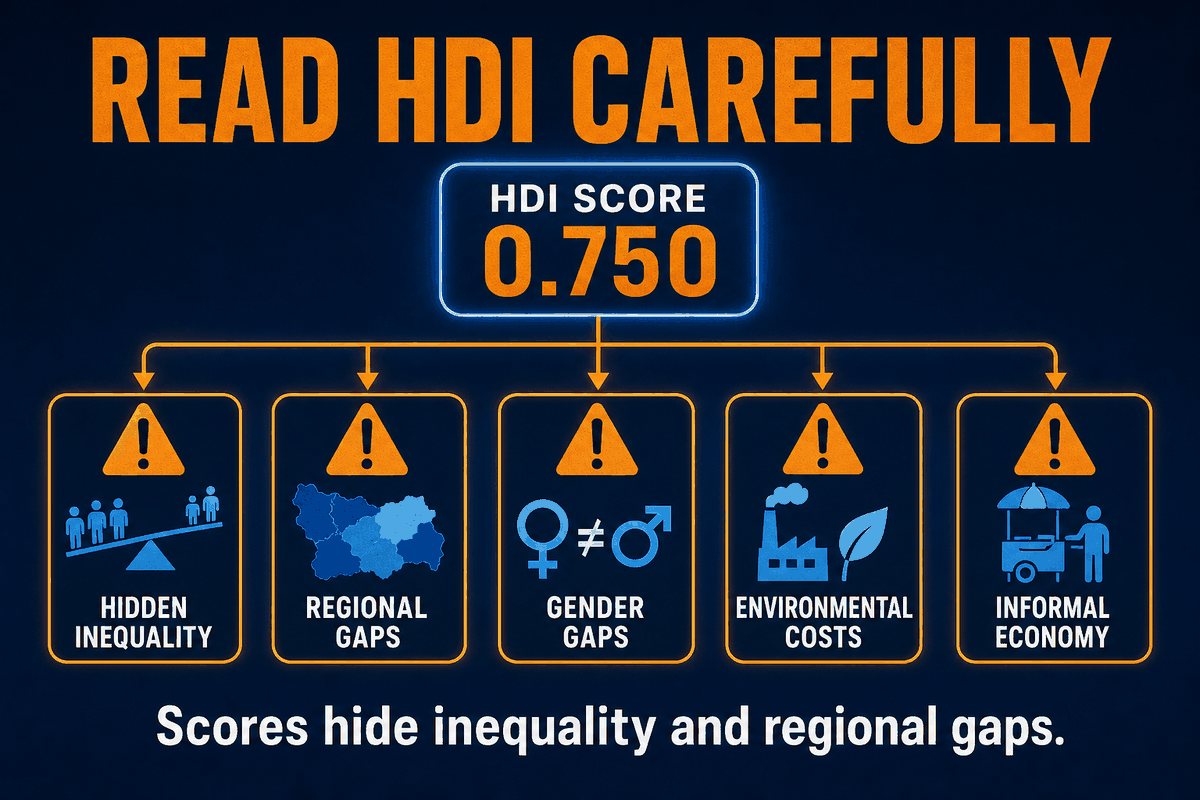
- HDI is not perfect — national averages can hide inequality, regional gaps, and environmental trade-offs.
When you read an HDI map or table, ask which component drives the score and whether sector structure or income patterns help explain the pattern.
What are the three components of HDI?
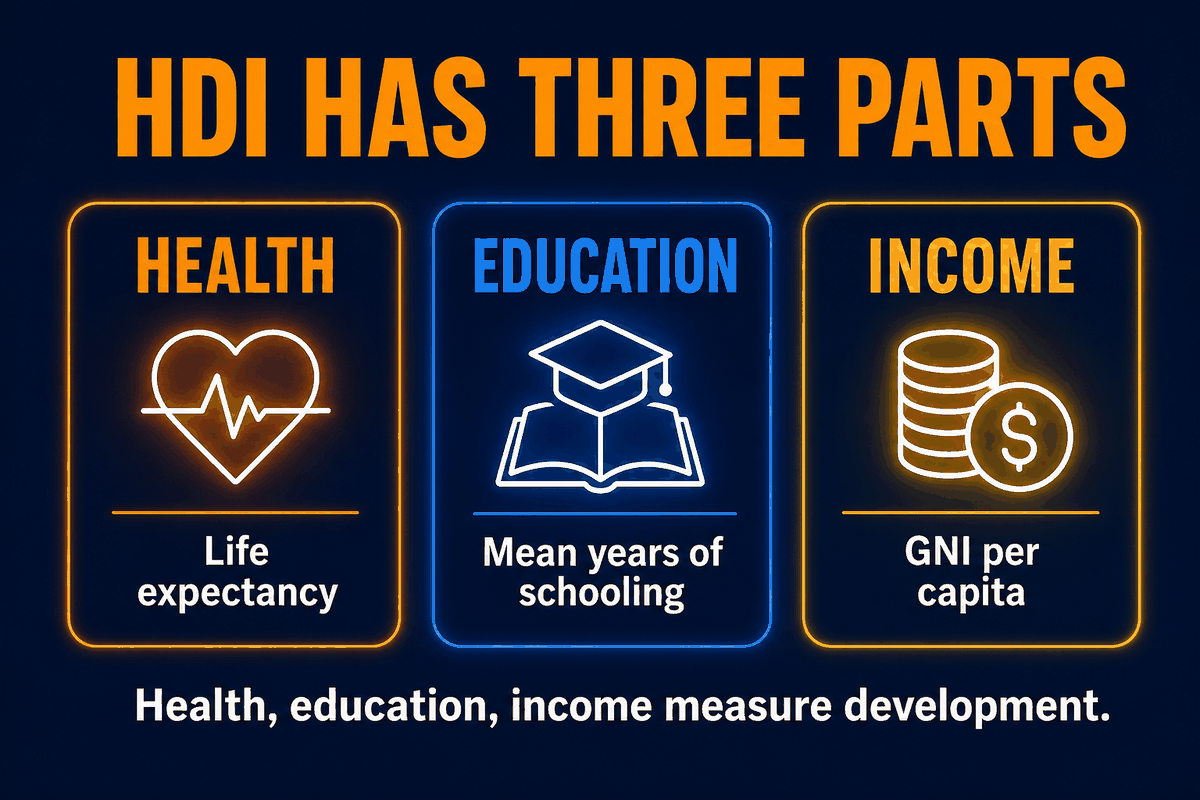
The three HDI components are health (life expectancy at birth), education (mean and expected years of schooling), and income (GNI per capita, adjusted for purchasing power). Each pillar captures a different dimension of human development. Strong AP answers identify which component a table row or map color represents before interpreting the pattern.
The Three Components of HDI
Every HDI score rests on three pillars. Learn what each measures before you interpret any stimulus.
| HDI Component | What It Measures | AP Clue | Why It Matters | Common Mistake |
|---|---|---|---|---|
| Health | Life expectancy at birth | Survival, health care, disease | Shows living conditions and health access | Thinking life expectancy equals perfect health for everyone |
| Education | Mean and expected years of schooling | School access, human capital | Reflects education opportunity and skilled labor | Assuming years of schooling prove school quality |
| Income | GNI per capita (PPP-adjusted) | Standard of living, resident income | Captures average economic well-being | Treating income pillar as total GDP |
Health Component: Life Expectancy
The health pillar uses life expectancy at birth. It represents health conditions, survival, and broader quality of life.
- Connected to health care access, nutrition, sanitation, safety, and disease burden.
- Higher life expectancy usually suggests stronger social development and better living conditions.
- Public health investments — clinics, vaccination, clean water — can raise this component even before income catches up.
- Limitation: national life expectancy is an average that can hide regional or group differences.
Education Component: Schooling
The education pillar reflects access to schooling and human capital through mean years of schooling and expected years of schooling.
- Connects to literacy, skilled labor, and long-term development opportunity.
- Gains in expected years of schooling for girls and boys can raise HDI even when GDP growth is slow.
- More students completing secondary school signals expanding education access.
- Limitation: years of schooling do not always show school quality, curriculum depth, or learning outcomes.
Income Component: GNI Per Capita
The income pillar uses GNI per capita, adjusted for purchasing power, to compare average standard of living across countries.
- Shows resident income and economic well-being, not just production inside borders.
- Export growth, remittances, or foreign investment can raise GNI per capita and the income pillar.
- PPP adjustment helps compare what money actually buys in different economies.
- Limitation: averages can hide inequality — wealth may concentrate among top earners while many remain poor.
HDI vs GDP
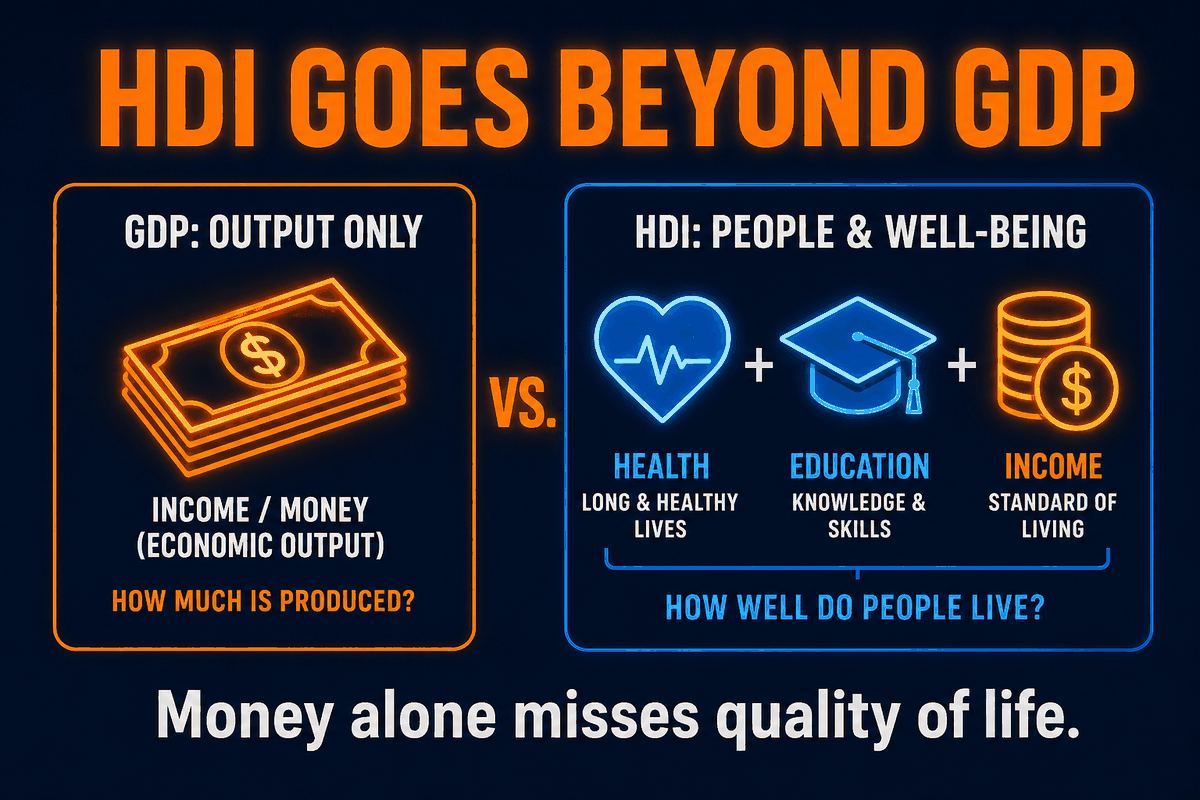
GDP measures the total value of goods and services produced within a country's borders. GDP per capita divides that total by population to show average economic output per person.
HDI combines income (GNI per capita) with health (life expectancy) and education (schooling). That makes HDI better for quality-of-life comparisons when health and education outcomes diverge from income.
- GDP can be high while inequality or poor social outcomes remain — HDI helps reveal those gaps.
- A country may rank lower on GDP per capita yet show higher HDI if life expectancy and schooling are strong.
- Neither GDP nor HDI alone proves full development — pair indicators and name limitations.
Uneven global HDI patterns also connect to dependency theory when extraction economies grow in output but lag in health and education gains.
Why is HDI better than GDP alone?
GDP measures total economic output, but it does not show health, education, or quality of life. HDI adds life expectancy and schooling to income so you can compare human development more fairly. A country may rank lower on GDP per capita yet show stronger HDI if health and education outcomes are high — a common AP comparison pattern.
HDI Trap Fixer
AP HDI questions reward careful reading. Use this table to replace weak assumptions with stronger moves.
| Trap | Why It Is Wrong | Stronger AP Move |
|---|---|---|
| HDI is the same as GDP | GDP measures output; HDI blends health, education, and income | Name HDI as a composite index, not GDP |
| High HDI means no poverty | HDI is a national average, not a poverty count | Pair HDI with poverty or Gini data |
| HDI proves equality | HDI does not measure income distribution | Check Gini or GII for inequality |
| HDI measures environmental sustainability | HDI has no direct environmental pillar | Add environmental or sustainability indicators |
| HDI shows regional variation perfectly | National HDI can hide internal gaps | Request regional or subnational data |
| HDI captures informal work fully | Informal activity may be undercounted in income data | Note informal economy limits on the table |
| HDI alone proves development | No single index captures every dimension | Combine HDI with Gini, GII, or regional evidence |
| HDI tells the cause of development | HDI describes outcomes, not causes | Explain process separately — policy, investment, or trade |
Read the HDI Table
Practice reading mixed HDI clues like an AP stimulus. Draft your answer, then open the model explanation.
Country A has high GNI per capita, medium life expectancy, and low expected years of schooling.
Country B has medium GNI per capita, high life expectancy, and high expected years of schooling.
- Which country may have stronger human development?
- Which HDI components support that answer?
- Why is income alone not enough?
- What additional indicator would you request?
Reveal model explanation
1. Stronger human development: Country B may lead if health and education outcomes outweigh Country A's income advantage.
2. Supporting components: Country B's high life expectancy and high expected years of schooling (health and education pillars).
3. Income alone: High GNI per capita does not guarantee long life or schooling access — HDI exists because dimensions can diverge.
4. Additional indicator: Request Gini, GII, regional data, environmental indicators, or informal-economy data before a complete development claim.
Why this earns credit: Names HDI components, compares patterns, and limits the claim — the same habit needed on full FRQs.
HDI Strengths and Limitations
Strengths
- Combines multiple dimensions of human development in one score.
- Better than GDP alone for quality-of-life comparison across countries.
- Easy to read on maps and tables for cross-country ranking.
- Useful for AP data interpretation when prompts mix health, education, and income.
Limitations
- Can hide income inequality and regional differences within a country.
- Does not directly measure environmental sustainability or resource depletion.
- Does not fully capture gender inequality — pair with GII when the prompt asks.
- May miss informal work, political freedoms, and cultural factors.
- Should be paired with Gini, GII, poverty, environmental, and regional data.
Sustainable development prompts often ask you to weigh HDI gains against environmental and social trade-offs that the index does not show directly.
What are the limitations of HDI?
HDI can hide income inequality, regional gaps within a country, gender disparities, environmental costs, informal work, and political freedoms. National HDI scores are averages, not distribution measures. Pair HDI with Gini, GII, poverty data, regional breakdowns, or environmental indicators before claiming full development.
HDI Component Builder
Read each clue and classify it as Health Component, Education Component, Income Component, or HDI Limitation. Score 12 clues with instant feedback.
How to Use HDI in FRQs
Name HDI → identify the component → explain what it shows → name one limitation if asked.
Weak answer
The country is developed because HDI is high.
Better answer
The country has high human development because HDI combines life expectancy, education, and GNI per capita. This gives a broader view than GDP alone because it includes health and schooling, but HDI can still hide inequality or regional differences.
Sentence starters
- HDI measures…
- One HDI component is…
- This suggests human development because…
- HDI is broader than GDP because…
- One limitation of HDI is…
- Another indicator needed is…
A strong answer explains at least one HDI component and avoids claiming that HDI alone proves every part of development. Link HDI trends to Rostow's stages only when the prompt asks about modernization process — indicators still need named evidence.
How do you use HDI on an AP Human Geography FRQ?
Name HDI, identify the relevant component (health, education, or income), explain what the stimulus data shows, and state one limitation when asked. Avoid claiming HDI alone proves every part of development. Strong answers compare HDI to GDP when the table shows both and request a second indicator such as Gini or GII.
FRQ Practice and HDI Data Sprint
Full FRQ
A table shows that Country X has higher GDP per capita than Country Y, but Country Y has higher life expectancy, higher expected years of schooling, and a higher HDI score.
- A. Define HDI.
- B. Explain why Country Y may have higher human development despite lower GDP per capita.
- C. Identify one HDI component shown in the table.
- D. Explain one limitation of using HDI alone.
Planning hint
Label A as composite definition, B as health + education outweighing income, C as life expectancy or schooling, D as inequality/regional/environmental limit.
Reveal rubric, model answer, and weak vs better samples
Rubric (4 points typical)
- 1 pt — Accurate definition of HDI (composite of health, education, income)
- 1 pt — Country Y higher human development because life expectancy and/or schooling are higher despite lower GDP per capita
- 1 pt — Identifies life expectancy or expected years of schooling (health or education component)
- 1 pt — One limitation (inequality, regional gaps, environment, informal work, etc.)
Model A: HDI is a composite index combining health (life expectancy), education (schooling), and income (GNI per capita) to measure human development.
Why this earns the point: Names HDI as composite and lists all three dimensions.
Model B: Country Y may have higher human development because its higher life expectancy and expected years of schooling raise HDI even though GDP per capita is lower — HDI weights health and education alongside income.
Model C: Life expectancy (health component) or expected years of schooling (education component).
Model D: HDI can hide income inequality, regional gaps, or environmental costs, so Gini or regional data would be needed for a fuller claim.
Common weak answer: Country X is more developed because GDP per capita is higher.
Better answer: Country X may have higher average economic output, but Country Y's higher life expectancy, schooling, and HDI suggest stronger human development — GDP per capita alone cannot prove overall development without health and education evidence.
HDI data sprint
A country's HDI rises because life expectancy and schooling improve, while GNI per capita stays nearly the same.
- A. Identify which HDI components changed.
- B. Explain why HDI can rise without major income growth.
Reveal sprint rubric and model
Sprint rubric (2 points)
- 1 pt — Health (life expectancy) and education (schooling) components changed
- 1 pt — HDI is composite; gains in health/education can raise the score without large income growth
Model A: The health component (life expectancy) and education component (schooling) improved.
Model B: HDI combines health, education, and income, so improvements in life expectancy and schooling can raise the overall score even when GNI per capita changes little.
Common Mistakes
Saying HDI only measures income
Wrong: HDI is just another income score like GDP per capita.
Better: HDI combines health, education, and income.
Treating HDI and GDP as the same
Wrong: HDI and GDP always measure the same thing.
Better: GDP measures output; HDI measures broader human development.
Thinking high HDI means no inequality
Wrong: A high HDI score proves everyone shares equally in development.
Better: HDI can hide income inequality, regional gaps, and group differences.
Saying HDI directly measures sustainability
Wrong: High HDI proves the country is environmentally sustainable.
Better: HDI does not directly measure environmental impact.
Forgetting to name the component
Wrong: The country's HDI is high, so it is developed.
Better: AP answers should say whether the evidence is health, education, or income.
AP Exam Clues
HDI clues
- HDI
- Human Development Index
- composite index
- quality of life
- development indicator
Component clues
- life expectancy
- expected years of schooling
- mean years of schooling
- GNI per capita
- health
- education
- income
Compare clues
- GDP alone
- GDP vs HDI
- broader measure
- human development
AP clue: Decision rule: If a prompt asks for a broader development measure than GDP, use HDI and explain health, education, and income.
Practice MCQs
7 AP-style questions on hdi ap human geography. Choices shuffle at display time.
HDI definition
Question 1
Which statement best defines the Human Development Index (HDI)?
Explanation: HDI blends life expectancy, schooling, and GNI per capita into one development score.
Why the tempting wrong answer fails: GDP measures output; Gini measures inequality; sector shares describe employment structure.
AP clue: Broader development, composite index, quality of life → HDI.
HDI components
Question 2
Which set best lists the three components of HDI?
Explanation: HDI combines life expectancy (health), mean and expected years of schooling (education), and GNI per capita (income).
Why the tempting wrong answer fails: GDP/GNI/PPP are economic totals; sectors classify work; Gini is inequality, not an HDI pillar.
AP clue: HDI = health + education + income composite.
Health component
Question 3
Which indicator represents the health component of HDI?
Explanation: The health pillar uses life expectancy, reflecting survival, health care, nutrition, and disease burden.
Why the tempting wrong answer fails: GNI per capita is the income pillar; schooling is education; Gini measures inequality.
AP clue: Life expectancy, survival, health outcomes → health component.
Education component
Question 4
Which indicators represent the education component of HDI?
Explanation: HDI's education dimension uses mean and expected years of schooling to capture access to education and human capital.
Why the tempting wrong answer fails: Life expectancy and infant mortality are health; GDP/PPP are economic; Gini and GII measure inequality.
AP clue: Schooling years, education access → education component.
Income component
Question 5
Which measure represents the income component of HDI?
Explanation: HDI's income pillar uses GNI per capita adjusted for purchasing power to compare standard of living.
Why the tempting wrong answer fails: Total GDP is not the HDI income measure; schooling and infant mortality belong to other dimensions.
AP clue: GNI per capita, standard of living, income pillar → income component.
HDI vs GDP
Question 6
Why is HDI often more useful than GDP alone for comparing quality of life?
Explanation: GDP tracks economic output, while HDI adds life expectancy and schooling to income for a broader human development picture.
Why the tempting wrong answer fails: HDI and GDP per capita differ; GDP excludes health and education; HDI is not an environmental index.
AP clue: Quality of life, beyond GDP, health + education + income → HDI vs GDP.
HDI limitation / FRQ
Question 7
Country X has a high HDI score but a high Gini coefficient and large regional income gaps. Which FRQ conclusion is strongest?
Explanation: HDI is a national composite that can hide inequality and internal variation — pair it with Gini or regional data.
Why the tempting wrong answer fails: High HDI does not disprove inequality; Gini helps interpret distribution; HDI is not an environmental measure.
AP clue: High HDI + inequality language → name limitation + second indicator.
FAQ
What is HDI in AP Human Geography?
HDI, or the Human Development Index, is a composite development indicator that combines health, education, and income into one score. In AP Human Geography, HDI is useful because it measures development more broadly than GDP alone by including life expectancy, schooling, and GNI per capita.
What does HDI stand for?
HDI stands for Human Development Index. It is a composite index used to compare human development across countries by blending health (life expectancy), education (schooling), and income (GNI per capita) into one score.
What are the three components of HDI?
The three components of HDI are health (life expectancy at birth), education (mean and expected years of schooling), and income (GNI per capita, adjusted for purchasing power). Together they provide a broader development measure than any single economic indicator.
Why is HDI better than GDP alone?
GDP measures economic output, but it does not show health outcomes, education access, or quality of life. HDI combines income with life expectancy and schooling, so it supports fairer comparisons when countries have similar GDP per capita but different social outcomes.
What is the health component of HDI?
The health component of HDI uses life expectancy at birth. It reflects health care access, nutrition, sanitation, safety, and disease burden. Higher life expectancy usually suggests stronger quality of life, though national averages can hide regional or group differences.
What is the education component of HDI?
The education component uses mean years of schooling and expected years of schooling. It reflects access to education and human capital formation. More schooling supports skilled labor and opportunity, but years of schooling alone do not always show school quality.
What is the income component of HDI?
The income component uses GNI per capita, adjusted to compare purchasing power across countries. It shows average standard of living, but averages can hide inequality if wealth concentrates among top earners.
What are the limitations of HDI?
HDI can hide income inequality, regional differences within a country, gender disparities, environmental costs, informal work, and political freedoms. Strong AP answers pair HDI with Gini, GII, poverty data, regional breakdowns, or environmental indicators before making a complete development claim.
How is HDI used to compare countries?
Geographers compare HDI scores to rank or contrast human development levels across countries and regions. Because HDI blends health, education, and income, it helps reveal quality-of-life gaps that GDP or GNI alone might miss when average income looks similar.
How do you write about HDI on an AP Human Geography FRQ?
Name HDI, identify the relevant component (health, education, or income), explain what the stimulus data shows, and state one limitation when asked. Avoid claiming HDI alone proves every dimension of development. Strong answers compare HDI to GDP when both appear and request a second indicator such as Gini or GII.