Antecedent boundary
Definition: A boundary drawn before major settlement or before the cultural landscape developed.
AP clue: The line existed before many people lived there.
Example: Parts of the U.S.–Canada border are often used as an example.
Unit 4 Learning Journey · Step 5 of 14
Types of boundaries in AP Human Geography describe how political boundaries are created, what they follow, and how they appear on maps.
Some boundaries were drawn before settlement, some after people already lived there, and some were forced by outside powers. Others follow physical features like rivers or use straight geometric lines. This guide helps you identify boundary types quickly on AP maps, MCQs, and FRQs.
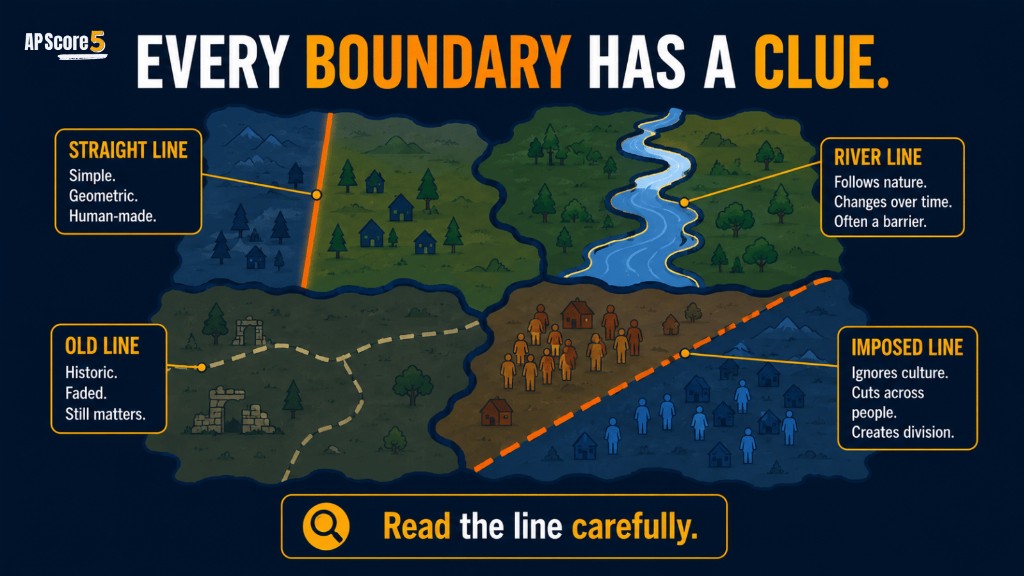
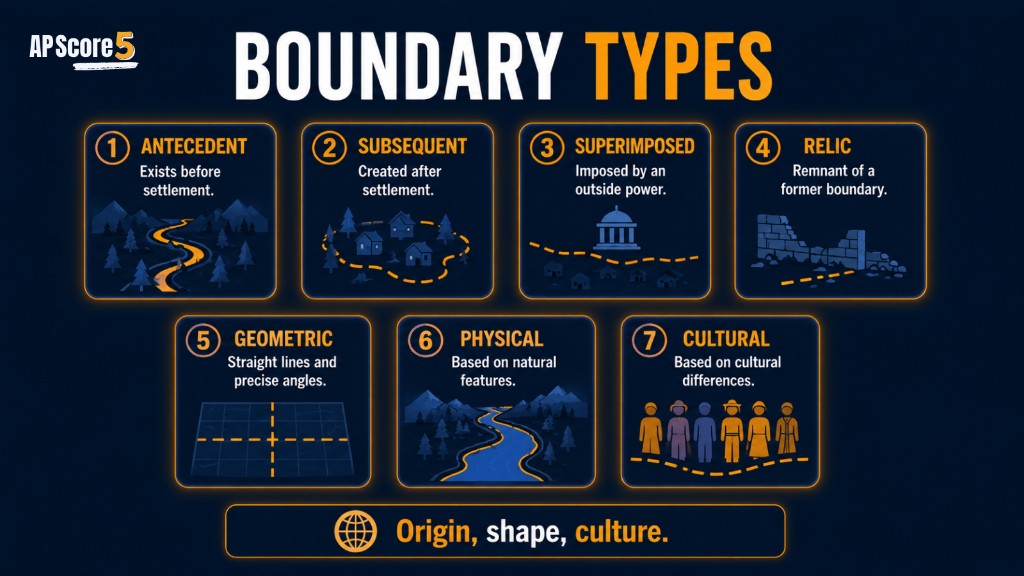
The main types of boundaries in AP Human Geography include antecedent, subsequent, consequent, superimposed, relic, geometric, physical, and cultural boundaries. Antecedent boundaries existed before major settlement, subsequent boundaries formed after settlement, superimposed boundaries were imposed by outside powers, relic boundaries are no longer official but still visible, geometric boundaries use straight lines, and physical boundaries follow natural features.
You already learned that political boundaries separate political units and show where authority applies. This page adds the next skill: identifying what kind of boundary you are looking at. AP questions often describe when a boundary was created, who created it, what it follows, or whether it still matters today.
Meaning: Boundaries organize state power across space.
Meaning: Boundaries can be classified by origin, shape, and relationship to people.
You are on Step 5 of the Unit 4 sequence.
Meaning: Some boundary types are best understood by when and how they formed.
For conflict patterns tied to borders, preview boundary disputes after you can name the boundary type from map clues.
Boundary types become easier when you group them into three categories: origin, shape, and relationship to culture or physical geography.
| Category | Question to Ask | Boundary Types |
|---|---|---|
| Origin | When and how did the boundary form? | Antecedent, subsequent, consequent, superimposed, relic |
| Shape or form | What does the boundary look like? | Geometric, physical |
| Human relationship | Does the line follow cultural patterns? | Cultural, ethnographic, linguistic, religious |
Origin-based boundary types classify boundaries by when and how they were created.
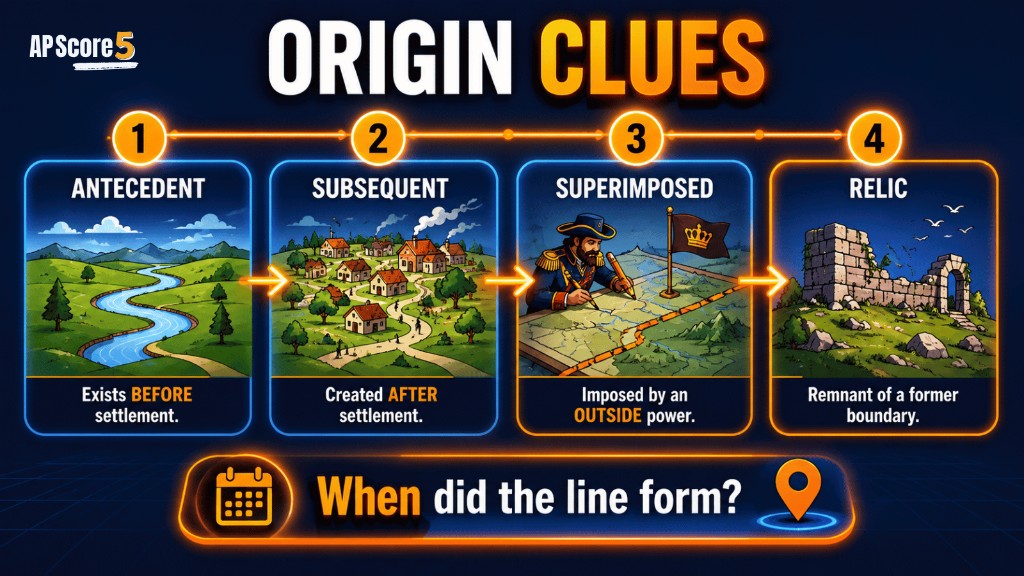
Definition: A boundary drawn before major settlement or before the cultural landscape developed.
AP clue: The line existed before many people lived there.
Example: Parts of the U.S.–Canada border are often used as an example.
Definition: A boundary drawn after settlement patterns developed.
AP clue: The boundary reflects existing cultural, ethnic, religious, or language patterns.
Example: Some European boundaries reflect historical cultural divisions.
Definition: A type of subsequent boundary drawn to separate groups based on cultural, ethnic, religious, or linguistic differences.
AP clue: The boundary is created because of cultural differences.
Example: India–Pakistan partition is often discussed with religious division.
Definition: A boundary forced on a region by an outside or conquering power, often ignoring local cultural patterns.
AP clue: Colonial power drew the line; local groups were ignored.
Example: Many boundaries in Africa created during European colonialism.
Definition: A boundary that no longer functions as an official political boundary but still affects the cultural landscape.
AP clue: The boundary is gone legally but still visible or meaningful.
Example: Berlin Wall; former East/West Germany division.
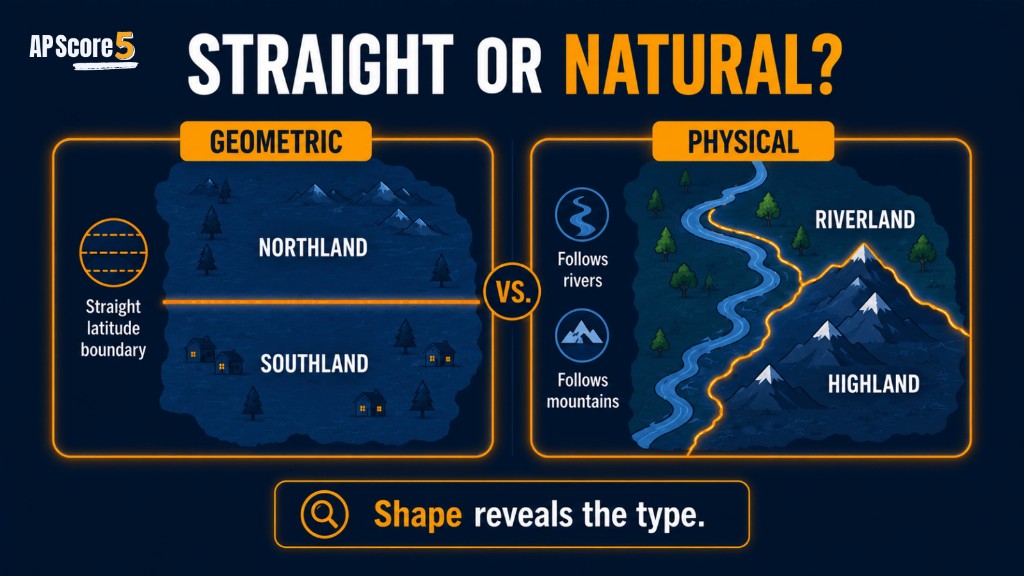
Some boundaries are classified by what they look like or what feature they follow.
| Boundary Type | Simple Meaning | AP Clue | Example |
|---|---|---|---|
| Geometric boundary | Straight-line boundary, often based on latitude or longitude | Looks straight on map | 49th parallel between U.S. and Canada |
| Physical boundary | Boundary following a natural feature | River, mountain, desert, lake | Rio Grande, Pyrenees |
| Natural boundary | Another term often used for physical boundary | Uses natural landscape | Mountain ranges or rivers |
A cultural boundary follows differences in human patterns such as language, religion, ethnicity, or nationality. Cultural boundaries may be formal political boundaries, but they can also describe cultural separation without a formal state border.
Cultural lines often overlap with nation-state mismatches when borders split or combine identity groups.
| Boundary Type | Best Definition | Main Clue | AP Example |
|---|---|---|---|
| Antecedent | Formed before major settlement | Before people settled | U.S.–Canada sections |
| Subsequent | Formed after settlement | Reflects existing patterns | European boundaries |
| Consequent | Created to separate cultural groups | Religion/language/ethnicity | India–Pakistan |
| Superimposed | Imposed by outside power | Colonial or outside control | Colonial Africa |
| Relic | No longer official but still visible | Former boundary still affects landscape | Berlin Wall |
| Geometric | Straight-line boundary | Latitude/longitude/straight line | 49th parallel |
| Physical | Follows natural feature | River/mountain/desert | Rio Grande |
| Cultural | Follows human differences | Language/religion/ethnicity | Language boundary |
AP Human Geography questions often test clues, not just memorized definitions. When you see a boundary on a map or in a scenario, ask what the question is emphasizing.
Geometric boundary and often used with antecedent boundary discussion.
Physical boundary between the United States and Mexico.
Relic boundary because it no longer functions as an official boundary but still symbolizes and shaped the landscape.
Superimposed boundaries because European powers drew many borders without fully respecting local ethnic or cultural patterns.
Consequent boundary example often discussed with religious division and political separation.
Subsequent or cultural boundary examples depending on prompt wording.
Examples can be complex. For AP scoring, match the example to the clue in the question.
| Confusing Pair | Difference | Memory Clue |
|---|---|---|
| Antecedent vs subsequent | Before settlement vs after settlement | Antecedent = before |
| Subsequent vs consequent | Consequent is a cultural-reason type of subsequent boundary | Consequent follows cultural consequence |
| Superimposed vs geometric | Superimposed is about who imposed it; geometric is about shape | Outside power vs straight line |
| Physical vs cultural | Natural feature vs human pattern | Landscape vs people |
| Relic vs historical example | Relic must still affect the landscape or memory | Gone but still visible/meaningful |
Read each scenario like a map lab case. Tap Identify the boundary type when you are ready to check your answer.
A boundary was drawn before large-scale settlement occurred in the region.
Boundary type: Antecedent boundary
A boundary follows a river between two states.
Boundary type: Physical boundary
A colonial power drew a straight line through the territory of several ethnic groups.
Boundary type: Superimposed boundary; may also be geometric if the line is straight
A boundary was created after settlement and reflects existing language regions.
Boundary type: Subsequent boundary / cultural boundary
A wall no longer serves as an official boundary but still affects the city’s landscape and memory.
Boundary type: Relic boundary
A boundary follows a line of latitude.
Boundary type: Geometric boundary
A boundary separates two religious populations.
Boundary type: Consequent or cultural boundary, depending on wording
A boundary was drawn to separate groups after conflict over national identity.
Boundary type: Consequent boundary
A mountain range separates two political units.
Boundary type: Physical boundary
A boundary was created after settlement patterns already existed.
Boundary type: Subsequent boundary
| Mistake | Better AP Understanding |
|---|---|
| “Geometric and superimposed mean the same thing” | Geometric describes shape; superimposed describes origin |
| “Physical boundaries are always natural and peaceful” | Physical boundaries can still be disputed |
| “Relic means old” | Relic means no longer official but still visible or meaningful |
| “Subsequent and consequent are always separate ideas” | Consequent is often treated as a subtype of subsequent based on cultural differences |
| “Every straight line is superimposed” | Straight lines are geometric; they are only superimposed if imposed by outside power |
| “Cultural boundaries are always official state borders” | Cultural boundaries can be formal or informal |
Choices shuffle on each load. Tap an answer for instant feedback.
Which type of boundary is drawn before major settlement occurs?
A boundary drawn by colonial powers that ignores local ethnic groups is best described as:
A boundary that follows a river is usually classified as:
A straight-line boundary based on latitude or longitude is called:
The former Berlin Wall is often used as an example of which boundary type?
A boundary created after settlement that reflects religious differences is most likely:
Which clue best indicates a subsequent boundary?
Open each card, draft your response, then reveal the rubric and sample when ready. Identify the clue first: timing, shape, outside power, natural feature, or cultural pattern.
Tip: Outline on paper first, then type a polished version here to compare with the sample.
A. An antecedent boundary is drawn before major settlement or before the cultural landscape develops.
B. A subsequent boundary is drawn after settlement patterns have developed.
C. Antecedent boundaries form before settlement; subsequent boundaries form after settlement and often reflect existing cultural patterns.
D. Knowing when a boundary formed helps explain whether it divided communities that already lived there or reflected patterns that existed before the line was drawn—both can shape long-term conflict.
Status: Draft your answer first—then open the rubric or sample.
Tip: Outline on paper first, then type a polished version here to compare with the sample.
A. A superimposed boundary is imposed by an outside or conquering power, often ignoring local cultural patterns.
B. European colonial powers drew many African boundaries without fully respecting existing ethnic, linguistic, or cultural patterns, which is why they are classic superimposed examples.
C. A relic boundary no longer functions as an official political boundary but still affects the cultural landscape.
D. Relic boundaries can shape architecture, memory, infrastructure, identity, and settlement patterns long after the line stops being official.
Status: Draft your answer first—then open the rubric or sample.
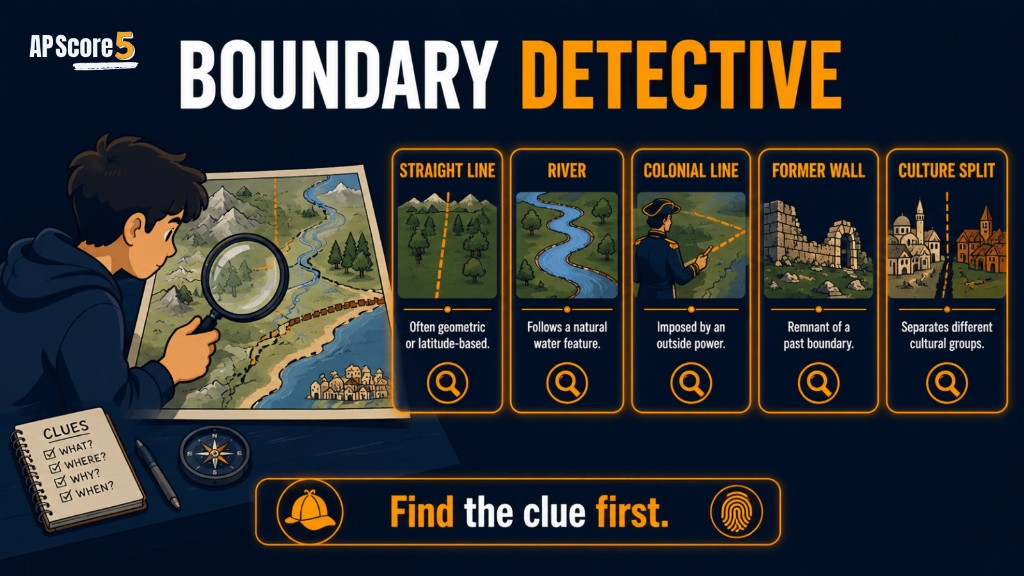
When answering boundary type FRQs, identify the clue first: timing, shape, outside power, natural feature, or cultural pattern.
The main types of boundaries in AP Human Geography include antecedent, subsequent, consequent, superimposed, relic, geometric, physical, and cultural boundaries.
An antecedent boundary is a boundary drawn before major settlement occurs or before the cultural landscape develops.
A subsequent boundary is a boundary drawn after settlement patterns have developed, often reflecting existing cultural, ethnic, religious, or language patterns.
A superimposed boundary is a boundary imposed by an outside or conquering power, often ignoring local cultural or ethnic patterns.
A relic boundary is a boundary that no longer functions as an official political boundary but still affects the cultural landscape, memory, or spatial organization of a place.
A geometric boundary is a straight-line boundary, often based on latitude or longitude. A physical boundary follows a natural feature such as a river, mountain, desert, or lake.
An antecedent boundary forms before major settlement, while a subsequent boundary forms after settlement patterns have developed.
Superimposed boundaries are important because they can divide cultural groups, combine rival groups, and create long-term political conflict when outside powers ignore local patterns.
Look for the clue in the map or scenario. Straight lines suggest geometric boundaries, rivers or mountains suggest physical boundaries, colonial influence suggests superimposed boundaries, and former boundaries that still matter suggest relic boundaries.
You now know how to identify the major types of boundaries. Continue the Unit 4 journey with Antecedent, Subsequent, Superimposed, and Relic Boundaries, or test yourself with Unit 4 practice questions.
You finished Step 5 of the Unit 4 sequence. Use the path below to move backward for review or forward to origin boundary types and the rest of the unit.