A voting group is placed almost entirely into one district and wins that district by a huge margin.
Diagnosis: Packing because the group is concentrated into one district, wasting extra votes.
Unit 4 Learning Journey · Step 13
Gerrymandering in AP Human Geography is the drawing of electoral district boundaries to give one political group an advantage in elections.
Gerrymandering matters because district lines can change how votes turn into seats. By packing voters into a few districts or cracking voters across many districts, mapmakers can weaken or strengthen political representation. This guide teaches you how to recognize gerrymandering, explain its effects, and answer AP-style map questions.
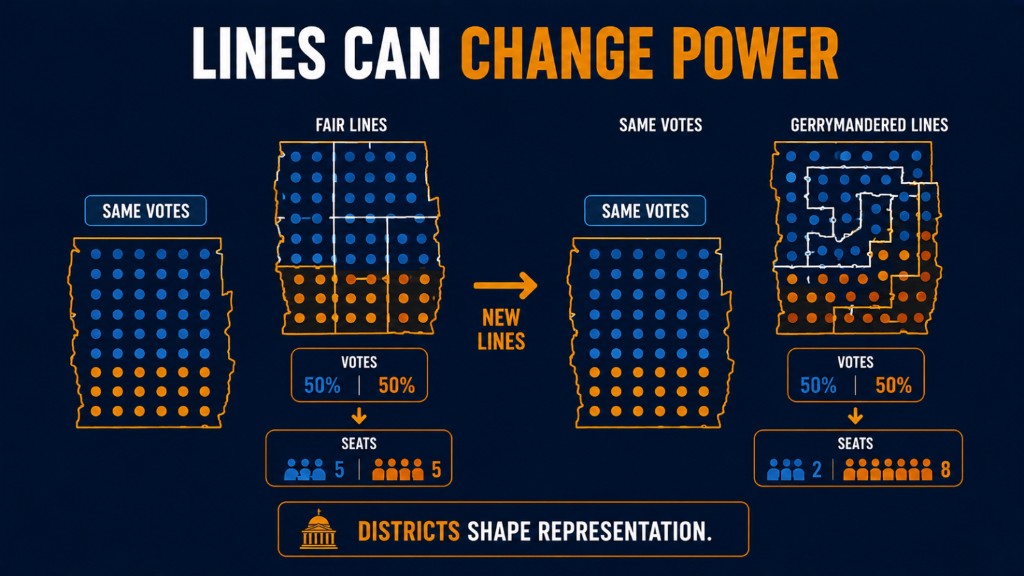
The previous page explained centripetal and centrifugal forces that unify or divide states. Gerrymandering focuses on a specific political geography problem: how internal electoral boundaries shape representation and power. It connects back to political boundaries because district lines are boundaries drawn for political purposes.
Meaning: Some forces pull states together, while others push them apart.
Meaning: Electoral boundaries can be drawn to shape political representation and advantage.
You are on Step 13 of the Unit 4 sequence.
Meaning: Students apply the full Unit 4 journey through MCQs and FRQs.
Connect district drawing to types of boundaries when you compare how different boundary types organize space, and review the full unit with Unit 4 practice questions.
Gerrymandering is the drawing of electoral district boundaries to favor one political party, group, or interest. In AP Human Geography, gerrymandering shows how political boundaries can affect representation, voting power, and election outcomes. The two most important techniques are packing, which concentrates voters into a small number of districts, and cracking, which spreads voters across many districts to weaken their influence.
Students often confuse redistricting and gerrymandering. Redistricting is the process of redrawing electoral district boundaries. Gerrymandering is when those boundaries are drawn unfairly to advantage one group.
| Concept | Simple Meaning | AP Clue | Example |
|---|---|---|---|
| Redistricting | Redrawing electoral districts | Boundaries are updated after population change | Districts adjusted after census data |
| Gerrymandering | Redrawing districts for political advantage | Boundaries create unfair representation | Districts drawn to favor one party or group |
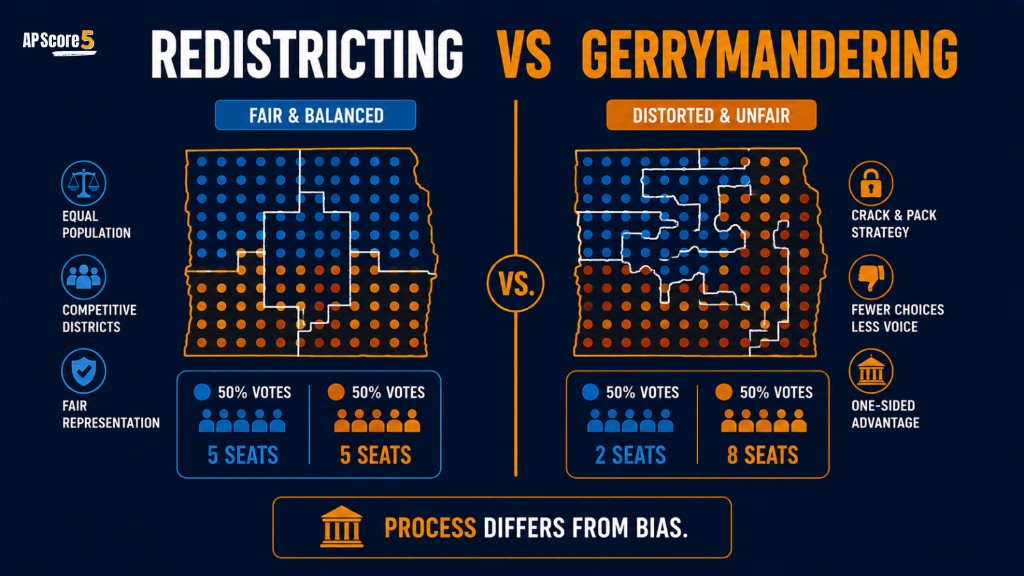
Gerrymandering matters because it can change the relationship between votes and representation. A group can win many votes but receive fewer seats if district boundaries are drawn against it.
District boundaries can change who gets elected.
Some voters may have less influence if they are packed or cracked.
A party may win more seats than its vote share suggests.
District lines can weaken or sometimes concentrate minority voting power.
Safe districts may reduce competition and make representatives less responsive.
Unfair-looking maps can reduce trust in political institutions.
Packing and cracking are the two most important gerrymandering methods for AP Human Geography.
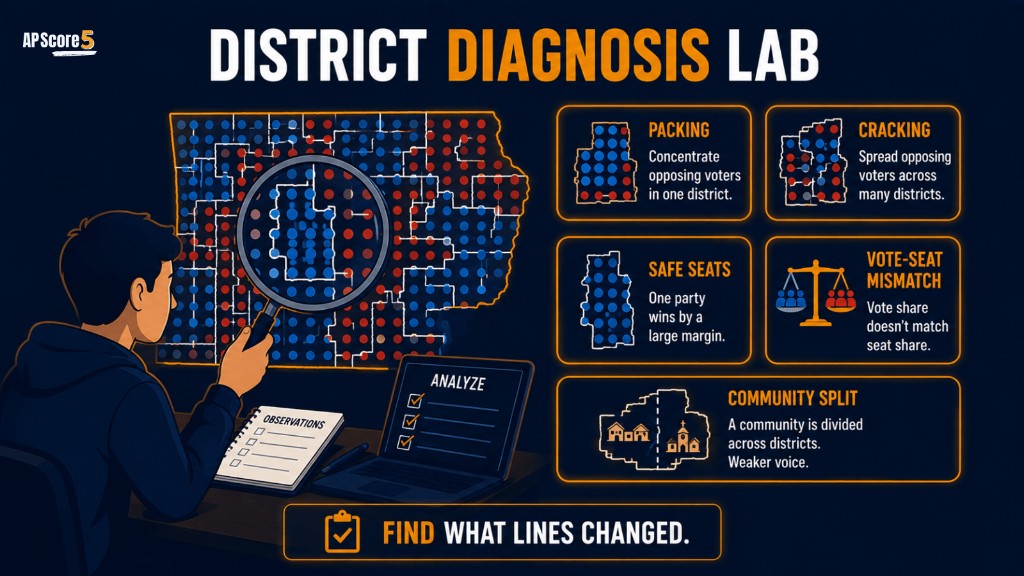
Packing: Putting many voters from one group into a small number of districts. This can make that group win a few districts by large margins while reducing its influence elsewhere.
Cracking: Splitting voters from one group across many districts so they cannot form a majority in any one district.
| Method | What Happens | Goal | AP Clue |
|---|---|---|---|
| Packing | Voters are concentrated into few districts | Waste extra votes in safe districts | One group wins a few districts by huge margins |
| Cracking | Voters are split across many districts | Prevent group from winning districts | One group is spread thin and loses many districts |
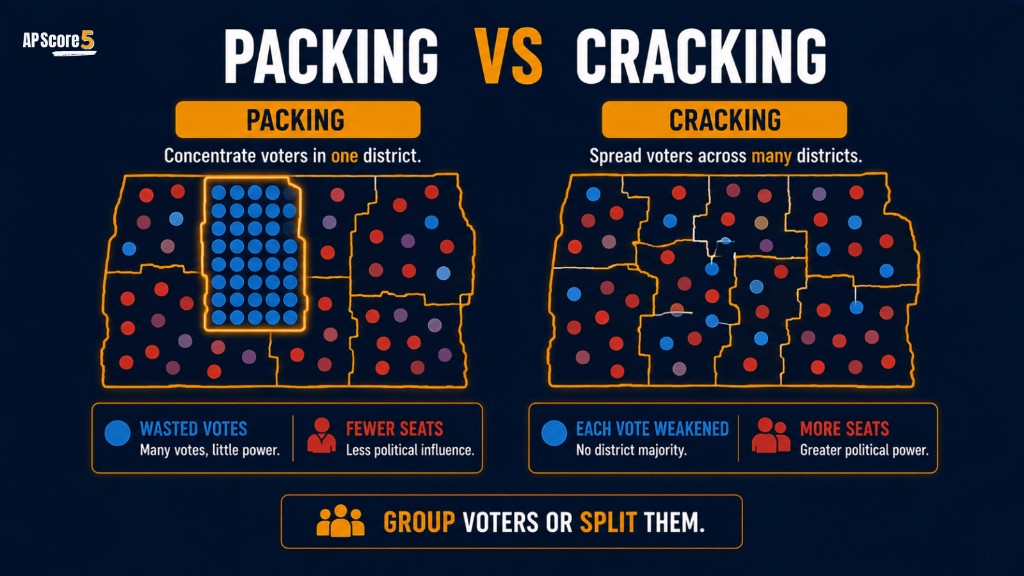
Gerrymandering often creates wasted votes. A wasted vote is a vote that does not help a candidate win more representation. Votes can be wasted when a group loses many districts narrowly or wins a few districts by huge margins.
A vote-seat mismatch happens when a party or group receives a large share of votes but wins a much smaller or larger share of seats because of district boundaries.
| Pattern | What It Means | Gerrymandering Link |
|---|---|---|
| Packed district | Group wins one district by a huge margin | Extra votes are wasted |
| Cracked voters | Group loses many districts narrowly | Votes are spread too thin |
| Vote-seat mismatch | Seats do not match vote share | District map may advantage one group |
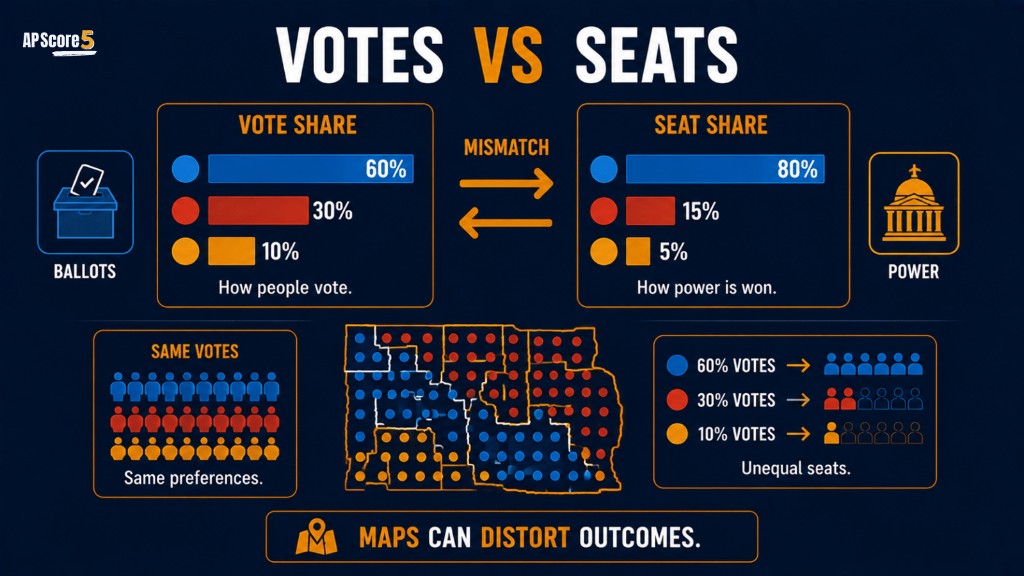
AP questions may show a district map, voting pattern, or description of election outcomes. Do not rely only on weird district shapes. Some strange shapes may follow real communities or physical geography. Look for representation effects.
Gerrymandering is political geography because it shows how space, boundaries, and power are connected. District lines decide which voters are grouped together, which candidates can win, and which communities receive representation.
| Boundary Choice | Political Effect |
|---|---|
| Group voters together | Can create safe seats or packed districts |
| Split voters apart | Can weaken a group’s ability to win seats |
| Draw competitive districts | Can increase electoral competition |
| Draw safe districts | Can reduce competition |
| Separate communities | Can weaken community representation |
| Combine communities strategically | Can strengthen or weaken a group’s power |
A group’s voters are placed into one district where they win by a very large margin, reducing their influence in surrounding districts.
A group’s voters are split among several districts so they are a minority in each one.
Districts are drawn to give one political party an advantage.
Districts are drawn in ways that affect racial or ethnic groups’ voting power.
District boundaries make one party very likely to win, reducing competition.
A neighborhood or community with shared interests is divided among districts, weakening its representation.
For AP Human Geography, focus on the spatial logic: how boundaries group or divide voters and how that affects representation.
Read each scenario and decide what the district lines did to voter power. Tap Reveal diagnosis when you are ready.
A voting group is placed almost entirely into one district and wins that district by a huge margin.
Diagnosis: Packing because the group is concentrated into one district, wasting extra votes.
A voting group is divided among five districts and loses narrowly in each one.
Diagnosis: Cracking because the group is split across districts so it cannot win.
A state redraws district lines after population change without evidence of political advantage.
Diagnosis: Redistricting, not necessarily gerrymandering.
A party wins 48% of the vote but 70% of the seats because of district boundaries.
Diagnosis: Possible vote-seat mismatch caused by gerrymandering.
A district map separates a compact community into several districts, weakening its voting influence.
Diagnosis: Cracking or community splitting.
A district contains voters from one party far beyond what is needed to win.
Diagnosis: Packing.
A strange-shaped district is drawn to connect voters from the same political group.
Diagnosis: Possible gerrymandering if the shape creates political advantage.
A map creates many safe districts with little competition.
Diagnosis: Possible gerrymandering if boundaries reduce competition through partisan advantage.
A minority community gains a district where it can elect a preferred representative.
Diagnosis: Could increase representation; explain carefully based on the prompt.
District boundaries are drawn so one group’s voters are scattered too thinly to elect candidates.
Diagnosis: Cracking.
| Mistake | Better AP Understanding |
|---|---|
| “Any weird-shaped district is gerrymandering” | Shape alone is not enough; explain the political effect |
| “Redistricting and gerrymandering are the same” | Redistricting is normal; gerrymandering is biased redistricting |
| “Packing and cracking are the same” | Packing concentrates voters; cracking splits voters apart |
| “Gerrymandering only affects parties” | It can affect parties, racial groups, ethnic groups, communities, or interest groups |
| “More votes always means more seats” | District boundaries can create vote-seat mismatch |
| “Safe districts are always illegal” | For AP, focus on how boundaries affect competition and representation |
| “Majority-minority districts are always gerrymandering” | They can affect representation in complex ways; explain the prompt carefully |
Choices shuffle on each load. Tap an answer for instant feedback.
Which statement best defines gerrymandering in AP Human Geography?
What is the difference between redistricting and gerrymandering?
A voting group is concentrated into one district where it wins by a huge margin. Which technique is shown?
A voting group is split among several districts so it cannot win any district. Which technique is shown?
Which is the best AP-style evidence of gerrymandering?
How can gerrymandering affect representation?
Which statement is a common mistake?
Open each card, draft your response, then reveal the rubric and sample when ready. In gerrymandering FRQs, always explain what the district lines do to voting power, representation, or seat outcomes.
Tip: Explain what the district lines do to voting power, representation, or seat outcomes.
A. Gerrymandering is drawing electoral district boundaries to advantage one political party, group, or interest.
B. Packing concentrates voters into a few districts; cracking splits voters across districts so they cannot win.
C. Gerrymandering can create vote-seat mismatch, weakening a group’s ability to elect preferred representatives.
D. Unusual shapes may follow communities or geography; AP answers must explain how lines affect voting power or representation.
Status: Draft your answer first—then open the rubric or sample.
Tip: Explain what the district lines do to voting power, representation, or seat outcomes.
A. Redistricting is redrawing electoral district boundaries, often after a census.
B. Redistricting becomes gerrymandering when lines are drawn to pack or crack voters for political advantage.
C. Cracking can spread a group’s voters so they lose many districts narrowly.
D. Packing can waste a group’s votes in districts it wins by huge margins.
Status: Draft your answer first—then open the rubric or sample.
In gerrymandering FRQs, always explain what the district lines do to voting power, representation, or seat outcomes.
Gerrymandering is the drawing of electoral district boundaries to give one political party, group, or interest an advantage in elections.
Redistricting is the normal process of redrawing electoral district boundaries, while gerrymandering is biased redistricting designed to create political advantage.
Packing is concentrating voters from one group into a small number of districts so their extra votes are wasted in districts they already win.
Cracking is splitting voters from one group across multiple districts so they cannot form a majority and win representation.
Gerrymandering can weaken or strengthen a group’s voting power, create safe districts, reduce competition, and cause a mismatch between vote share and seat share.
Look for evidence that district boundaries pack or crack voters, separate communities, create safe districts, or produce vote-seat mismatch.
No. A strange shape alone is not enough. AP answers should explain how the district boundaries affect political power or representation.
A vote-seat mismatch occurs when a party or group’s share of seats does not match its share of votes because of how district boundaries are drawn.
Gerrymandering is important because it shows how political boundaries shape representation, voting power, and election outcomes inside a state.
Packing concentrates voters from one group into a few districts, while cracking splits voters from one group across many districts so they have less chance to win representation.
You now understand how electoral boundaries can shape political power. Continue to Unit 4 Practice Questions, or review Political Boundaries if you want the broader boundary foundation.
You finished Step 13 of the Unit 4 sequence. Use the path below to move backward for review or forward to Unit 4 practice questions.