A national holiday celebrates a shared founding story and is widely observed across the state.
Force answer: Centripetal force because it builds shared national identity.
Unit 4 Learning Journey · Step 12
Centripetal and centrifugal forces in AP Human Geography explain why some states stay unified while others face division, instability, devolution, separatism, or conflict.
Centripetal forces pull people together and strengthen state unity. Centrifugal forces push people apart and weaken state unity. This guide helps you identify both force types, connect them to real examples, and answer AP-style MCQs and FRQs with clear reasoning.
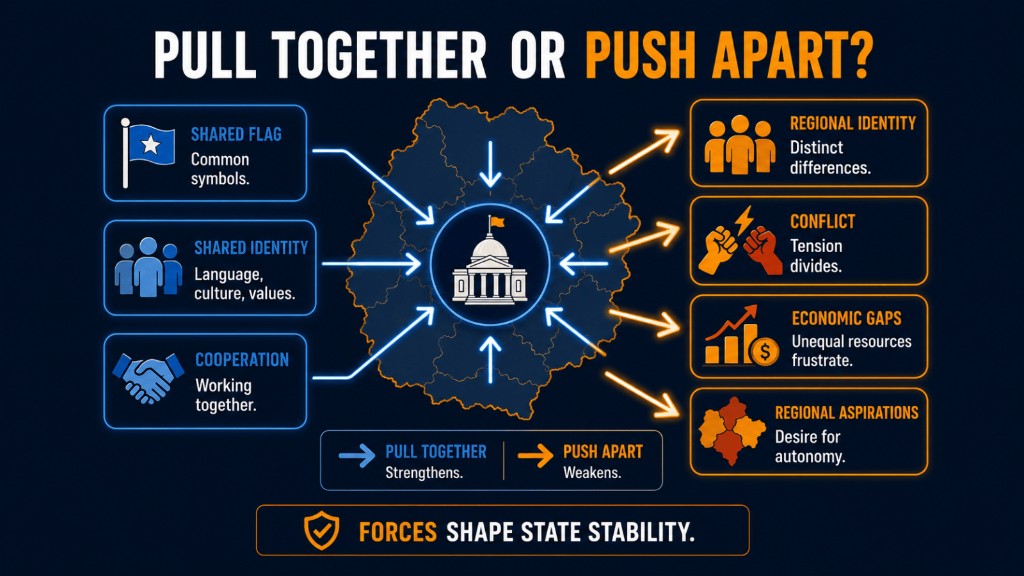
The previous page explained devolution, which often happens when regional pressures push power away from the center. Centripetal and centrifugal forces explain the broader pattern: some forces strengthen state unity, while other forces weaken it.
Meaning: Power moves from central governments toward regional or local governments.
Meaning: Some forces pull states together, while others push them apart.
You are on Step 12 of the Unit 4 sequence.
Meaning: Political boundaries can be drawn to shape representation and power.
Connect unity and division to federal vs unitary states when internal power structure affects stability, and to sovereignty when a state must maintain authority over its territory.
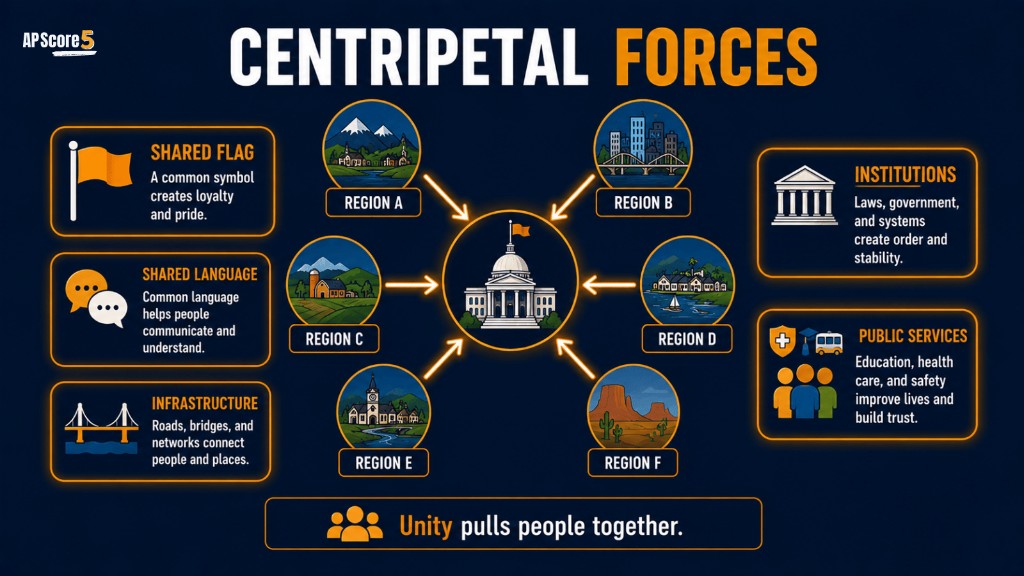
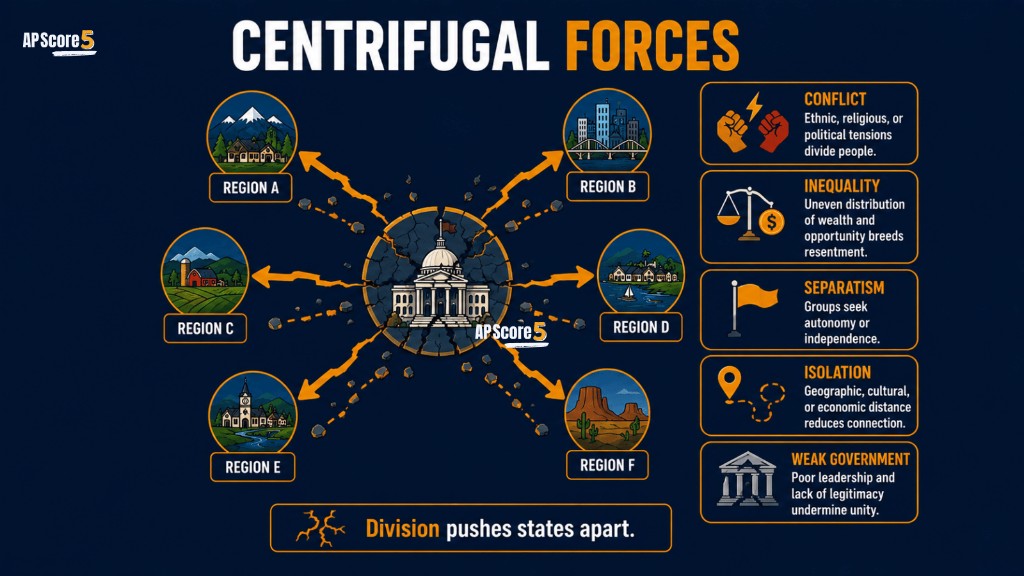
Centripetal forces are factors that unify a state and strengthen national cohesion. Centrifugal forces are factors that divide a state and weaken national cohesion. In AP Human Geography, centripetal forces can include shared identity, strong institutions, national symbols, economic integration, and effective infrastructure. Centrifugal forces can include ethnic conflict, economic inequality, regionalism, separatism, weak institutions, physical isolation, and political instability.
Do not memorize examples first. Ask what effect the force has on the state.
Does it pull the state together or push it apart?
Centripetal force
Centrifugal force
A centripetal force is a factor that promotes unity, stability, or cohesion within a state.
Centripetal forces help people feel connected to the state and to each other. They can reduce conflict, build national identity, strengthen institutions, and support political stability.
A centrifugal force is a factor that creates division, instability, conflict, separatism, or fragmentation within a state.
Centrifugal forces weaken state unity by increasing regional tension, identity conflict, economic resentment, political distrust, or demands for autonomy or independence.
| Feature | Centripetal Force | Centrifugal Force |
|---|---|---|
| Direction | Pulls people together | Pushes people apart |
| Effect on state | Strengthens unity | Weakens unity |
| Political effect | Supports stability | Creates conflict or instability |
| Identity effect | Builds shared identity | Strengthens regional or separate identity |
| Common clues | national symbols, shared language, strong institutions | separatism, inequality, ethnic tension, weak institutions |
| AP question | What unifies the state? | What divides the state? |
| Force Type | Centripetal Example | Centrifugal Example |
|---|---|---|
| Cultural | Shared language or national identity | Ethnic, linguistic, or religious conflict |
| Economic | Interconnected regional economies | Regional inequality or resource resentment |
| Political | Strong institutions and inclusive representation | Corruption, exclusion, weak government |
| Physical | Transportation links across regions | Mountains, islands, or distance isolating regions |
| Historical | Shared founding story or national memory | History of oppression, conquest, or independence |
| Social | Common civic identity or public trust | Discrimination, social division, minority exclusion |
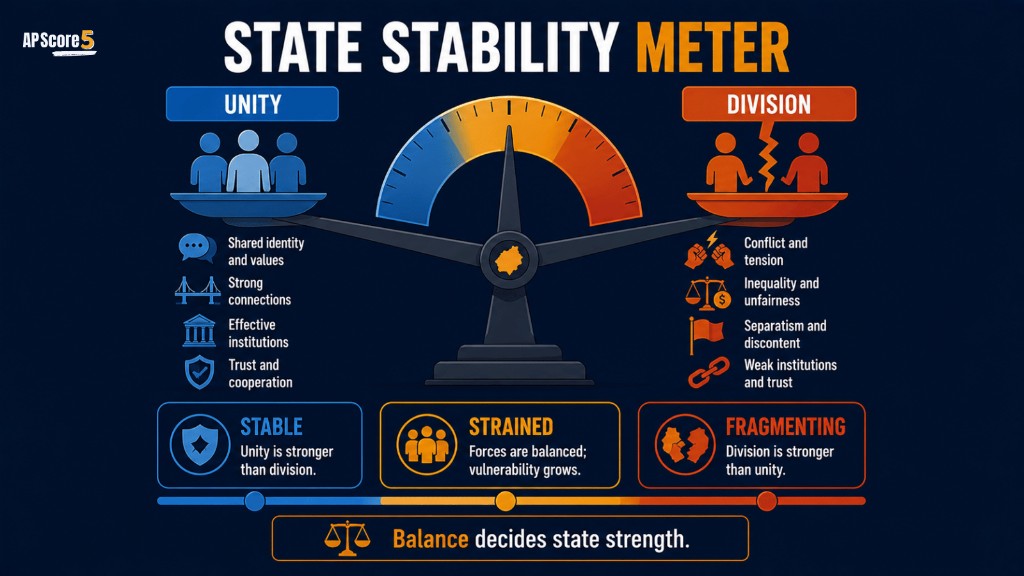
Centripetal and centrifugal forces are useful because they help geographers explain state stability. A state is more stable when centripetal forces are stronger than centrifugal pressures. A state becomes less stable when centrifugal pressures overwhelm unifying forces.
Strong centripetal forces and manageable centrifugal pressures.
Both unifying and dividing forces are visible.
Centrifugal forces dominate and may produce devolution, separatism, conflict, or state breakup.
Devolution often happens when centrifugal forces create pressure for regional autonomy. A central government may transfer power to regional governments to reduce tension and keep the state together. But devolution can also strengthen regional identity and lead to greater demands for independence.
A region feels culturally, economically, politically, or physically separate.
The central government grants more autonomy or regional power.
Possible outcome: Tension decreases if the region feels represented, or increases if autonomy strengthens separatism.
Go deeper on power transfer in the devolution guide—this page focuses on the pull-vs-push framework.
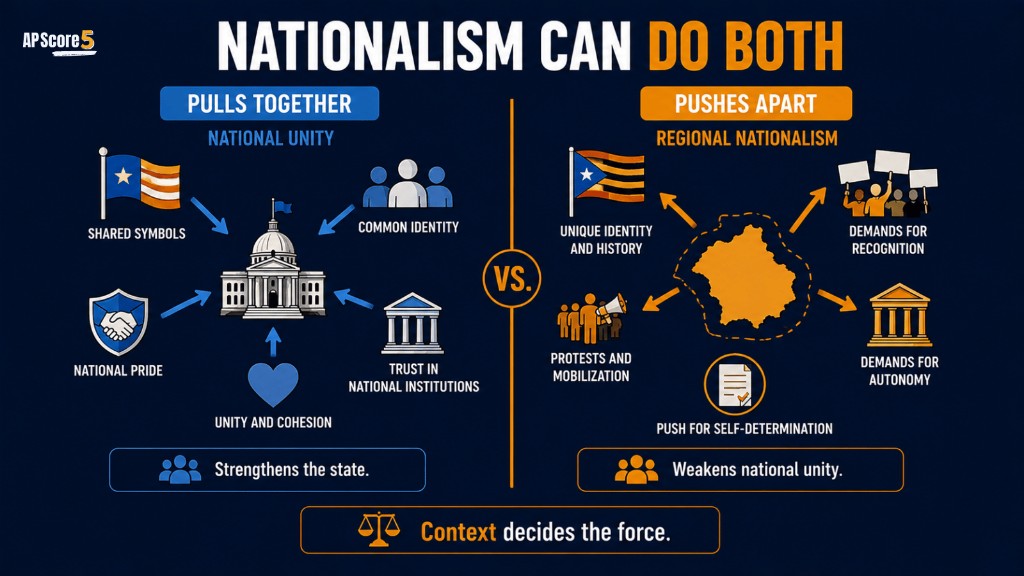
Nationalism can be centripetal or centrifugal depending on the scale and context.
Centripetal nationalism: Nationalism can unify people around a shared national identity, flag, history, language, or government.
Centrifugal nationalism: Regional or minority nationalism can divide a state if a group wants autonomy, devolution, or independence.
| Situation | Effect | Force Type |
|---|---|---|
| Shared national identity strengthens the state | Unity increases | Centripetal |
| Minority nationalist movement demands independence | Division increases | Centrifugal |
| National holiday builds shared memory | Unity increases | Centripetal |
| Regional identity movement rejects central government | Division increases | Centrifugal |
Flags, anthems, holidays, monuments, and national ceremonies can build shared identity.
Roads, railways, internet networks, and transportation systems can connect regions and strengthen integration.
When groups feel represented, trust in the state can increase.
Identity conflict can weaken national unity and increase regional tension.
A region may feel exploited, neglected, or unfairly treated by the central government.
Mountains, islands, long distances, or poor connectivity can make regions feel isolated.
Groups demanding independence can weaken state unity.
Examples are not magic labels. The same broad category can be centripetal or centrifugal depending on the effect described in the prompt.
Read each scenario and decide whether it shows a centripetal force, a centrifugal force, or devolution as a response. Tap Reveal force answer when you are ready.
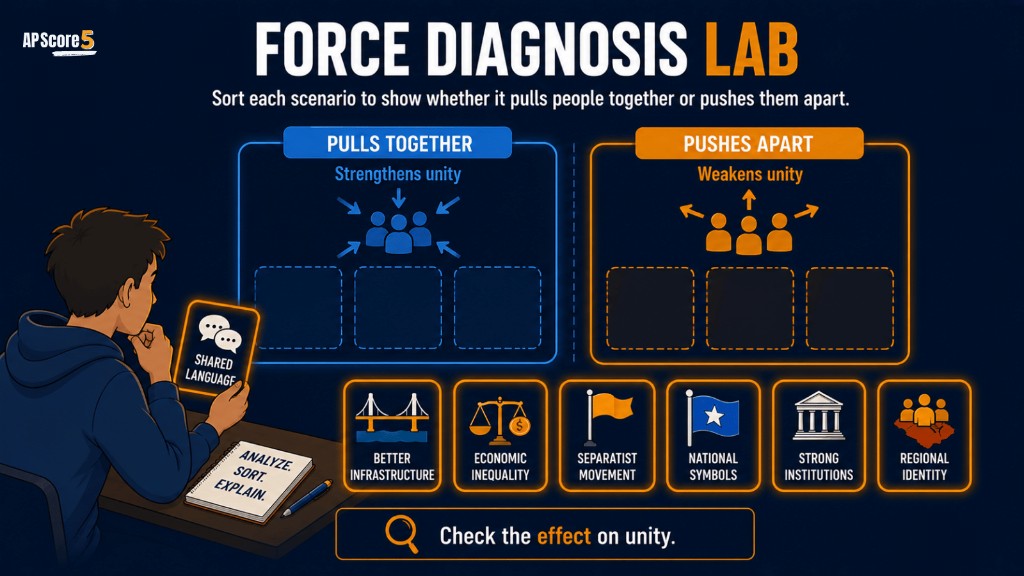
A national holiday celebrates a shared founding story and is widely observed across the state.
Force answer: Centripetal force because it builds shared national identity.
A region with a distinct language demands independence from the central government.
Force answer: Centrifugal force because it increases separatist pressure.
A new high-speed rail system connects distant regions to the capital and each other.
Force answer: Centripetal force because infrastructure strengthens integration.
A wealthy region argues that it pays too much tax and demands greater autonomy.
Force answer: Centrifugal force because economic resentment increases regional tension.
A government includes minority groups in political representation.
Force answer: Centripetal force because inclusion can strengthen loyalty and stability.
A mountain region is physically isolated and feels ignored by the central government.
Force answer: Centrifugal force because isolation and neglect can weaken unity.
A shared language is promoted through schools and national media.
Force answer: Centripetal force if it builds shared identity across the state.
A minority language is suppressed, causing protests and regional resentment.
Force answer: Centrifugal force because exclusion increases division.
A central government grants autonomy to a region to reduce separatist pressure.
Force answer: Devolution as a response to centrifugal forces.
Corruption weakens trust in national institutions across multiple regions.
Force answer: Centrifugal force because weak institutions reduce unity and stability.
| Mistake | Better AP Understanding |
|---|---|
| “Centripetal always means good” | It means unifying, but unification can still be forced or contested |
| “Centrifugal always means independence” | It means divisive pressure, not always state breakup |
| “Nationalism is always centripetal” | Nationalism can unify or divide depending on scale |
| “Religion is always centrifugal” | Shared religion can unify; religious conflict can divide |
| “Language is always centripetal” | Shared language can unify; language suppression can divide |
| “Devolution is a centrifugal force” | Devolution is often a response to centrifugal pressure |
| “Examples are fixed labels” | The prompt’s effect on unity determines the answer |
Choices shuffle on each load. Tap an answer for instant feedback.
Which statement best defines a centripetal force in AP Human Geography?
Which statement best defines a centrifugal force?
A national holiday that strengthens shared identity is most likely:
A region with a distinct language demands independence from the central government. This is best described as:
Why can nationalism be either centripetal or centrifugal?
Which is the best AP clue for identifying centrifugal forces?
Which statement is a common mistake?
Open each card, draft your response, then reveal the rubric and sample when ready. In centripetal/centrifugal FRQs, always explain the effect on unity: does the force strengthen the state or weaken it?
Tip: Explain the effect on state unity—does the force strengthen the state or weaken it?
A. A centripetal force promotes unity, cohesion, or stability within a state.
B. A centrifugal force creates division, instability, conflict, separatism, or fragmentation within a state.
C. National symbols such as a flag or anthem can build shared identity and strengthen state unity.
D. A centrifugal force can create pressure for autonomy, leading the central government to devolve power to regional governments.
Status: Draft your answer first—then open the rubric or sample.
Tip: Explain the effect on state unity—does the force strengthen the state or weaken it?
A. Nationalism can be centripetal when it builds shared loyalty to the state and its symbols.
B. Nationalism can be centrifugal when a regional group uses identity to demand autonomy or independence.
C. Regional economic inequality can make a region feel neglected or exploited by the central government.
D. A state can strengthen centripetal forces by building infrastructure that connects regions and promotes integration.
Status: Draft your answer first—then open the rubric or sample.
In centripetal/centrifugal FRQs, always explain the effect on unity: does the force strengthen the state or weaken it?
Centripetal forces unify a state and strengthen cohesion, while centrifugal forces divide a state and weaken cohesion.
A centripetal force is a factor that promotes unity, stability, or cohesion within a state.
A centrifugal force is a factor that creates division, instability, conflict, separatism, or fragmentation within a state.
Examples of centripetal forces include shared national identity, national symbols, common language, strong institutions, economic integration, infrastructure, and inclusive government.
Examples of centrifugal forces include ethnic conflict, religious conflict, regional inequality, separatism, weak institutions, physical isolation, political exclusion, and resource resentment.
Centripetal forces pull a state together, while centrifugal forces push a state apart.
Yes. Nationalism can be centripetal when it unifies people around a shared state identity, but centrifugal when regional or minority nationalism pushes for autonomy or independence.
Centrifugal forces can create pressure for devolution when regions demand more autonomy because of identity, economic inequality, distance, resources, or political demands.
Devolution is not exactly the same as a centrifugal force. Devolution is often a government response to centrifugal pressure.
Ask what effect the force has on the state. If it strengthens unity, it is centripetal. If it increases division, instability, separatism, or conflict, it is centrifugal.
Language can be either centripetal or centrifugal. A shared language can unify a state, but language differences, language suppression, or regional language movements can divide a state.
You now understand what pulls states together and what pushes them apart. Continue the Unit 4 journey with Gerrymandering, or test yourself with Unit 4 practice questions.
You finished Step 12 of the Unit 4 sequence. Use the path below to move backward for review or forward to gerrymandering and the rest of the unit.