1. A country has one dominant national identity, and its political borders closely match that group’s homeland.
Label: Nation-state
Unit 4 Learning Journey · Step 3
Stateless nation AP Human Geography is one of the most important Unit 4 terms because it shows what happens when a nation has shared identity but no fully independent sovereign state.
Students often think every nation has a country, but political geography is messier than that. Sometimes a nation controls a state, sometimes it has no state, sometimes one state contains many nations, and sometimes one nation is split across multiple states. This page shows how to recognize each pattern on the AP exam.
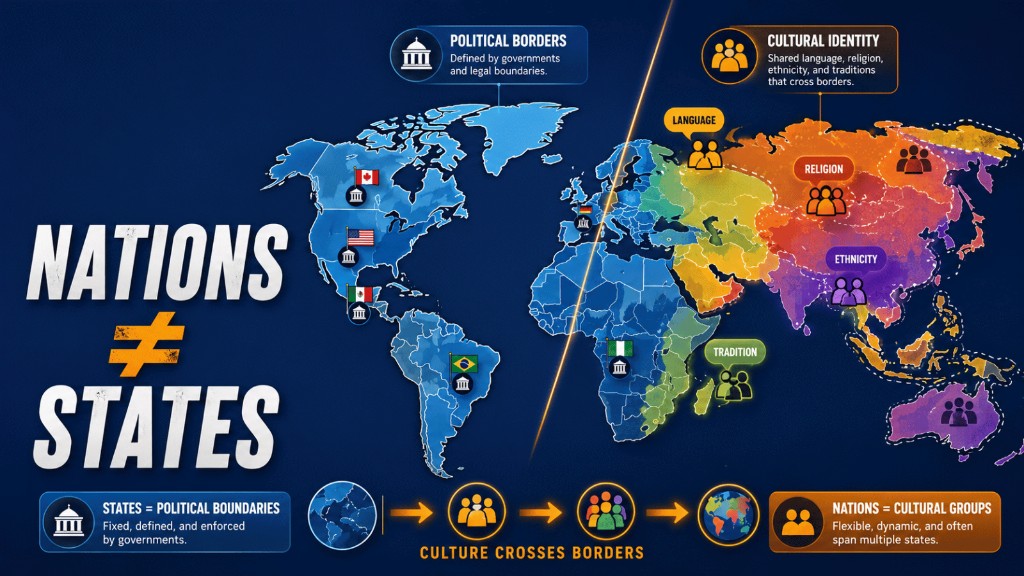
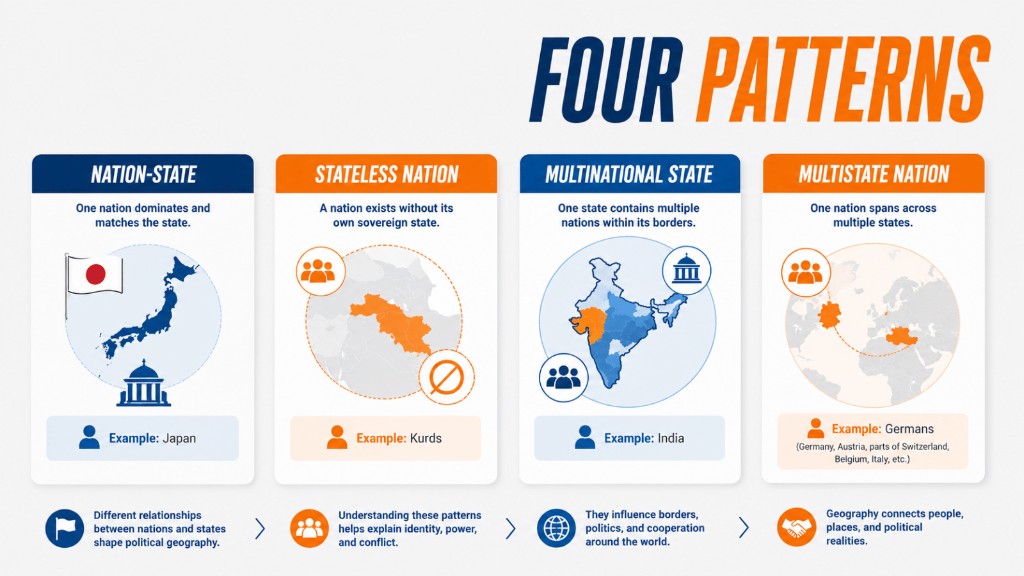
A nation-state is a state whose borders closely match one main nation. A stateless nation is a nation that does not have its own fully independent sovereign state. A multinational state is one state that contains multiple nations or national identities. A multistate nation is one nation that is spread across more than one state.
| Term | Simple meaning | Map pattern | AP example |
|---|---|---|---|
| Nation-state | One main nation mostly matches one state | Nation and state overlap | Japan (often used as close) |
| Stateless nation | Nation without its own sovereign state | Nation has identity but no state | Kurds |
| Multinational state | One state contains multiple nations | Many nations inside one state | United Kingdom |
| Multistate nation | One nation stretches across multiple states | One nation across borders | Koreans in North and South Korea |
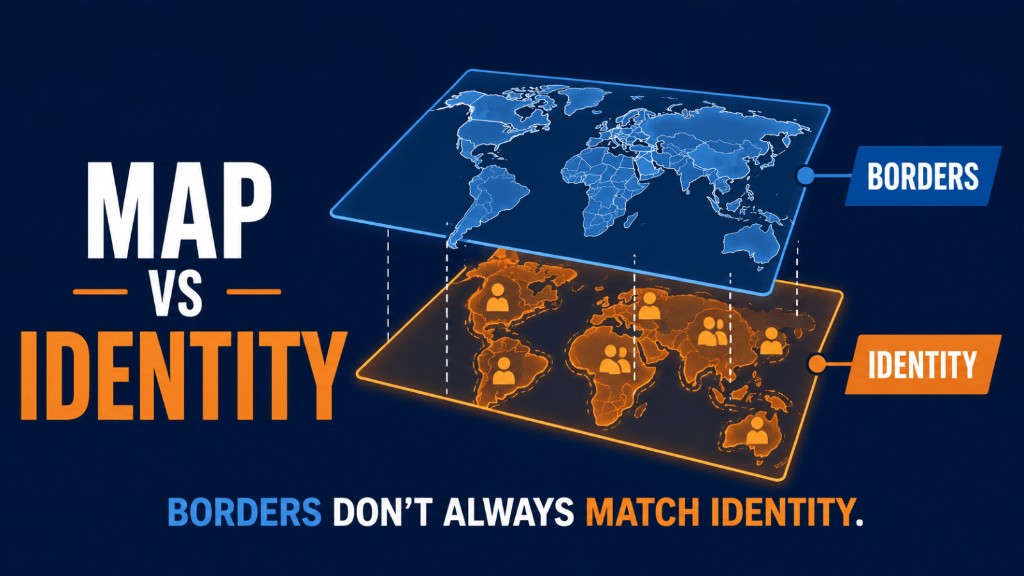
You already learned that a state is political, a nation is cultural, and sovereignty gives a state authority over territory. This page adds the next layer: political borders and national identity do not always match.
Meaning: Political territory is different from cultural identity.
Meaning: Nations and states may overlap, split, or fail to match.
You are on Step 3 of the Unit 4 sequence.
Meaning: Borders shape how states control territory.
The easiest way to answer AP questions is to ask two questions: Where are the political borders? and Where is the national identity?
If borders and identity mostly match, think nation-state. If identity exists without sovereignty, think stateless nation. If one state contains multiple national identities, think multinational state. If one nation is divided across multiple states, think multistate nation.
A nation-state is a state whose political boundaries closely match the territory of one main nation. In a nation-state, most people share a strong national identity, and the state often uses language, schools, laws, symbols, and culture to reinforce unity.
Examples: Japan (often used as a close example), Iceland, and Portugal (sometimes cited in Europe).
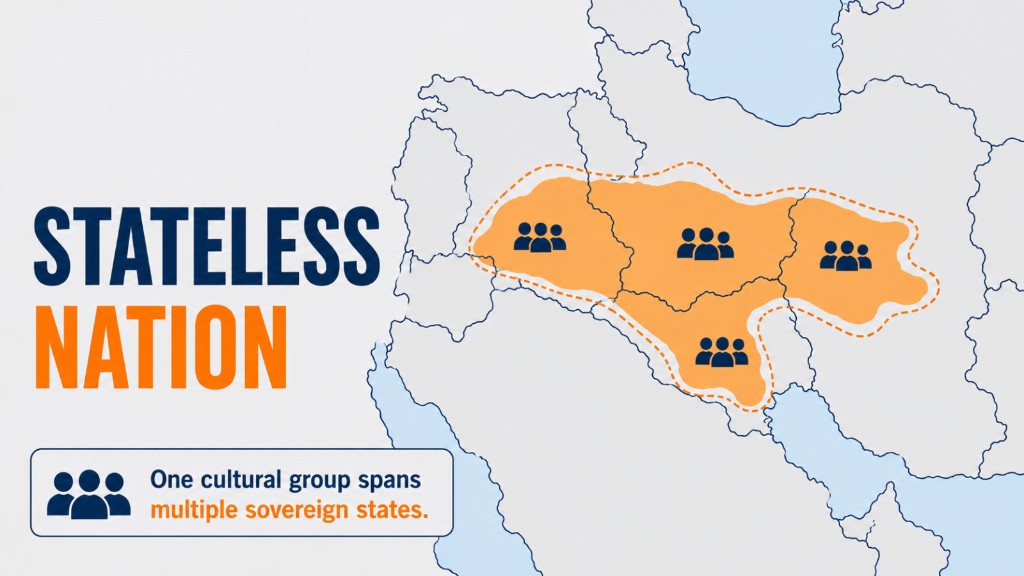
A stateless nation is a nation with shared identity, history, culture, or homeland claims but no fully independent sovereign state of its own.
Focus example: The Kurds are the most common AP Human Geography example. Kurdish populations live across parts of Turkey, Iraq, Iran, and Syria, but there is no fully independent, internationally recognized Kurdish state.
Also discussed: Palestinians, Basques, and Roma (depending on prompt wording).
A multinational state is one sovereign state that contains two or more nations or national identities inside its borders.
Focus example: The United Kingdom is often used because English, Scottish, Welsh, and Northern Irish identities exist inside one sovereign state.
Also discussed: Canada, Russia, India, and Belgium.
A multistate nation is one nation or cultural group that is spread across more than one state.
Focus example: Koreans are a common example because Korean national identity is split between North Korea and South Korea, two separate sovereign states.
Also discussed: Arabs across several states; Hungarians in Hungary and neighboring countries (use carefully depending on context).
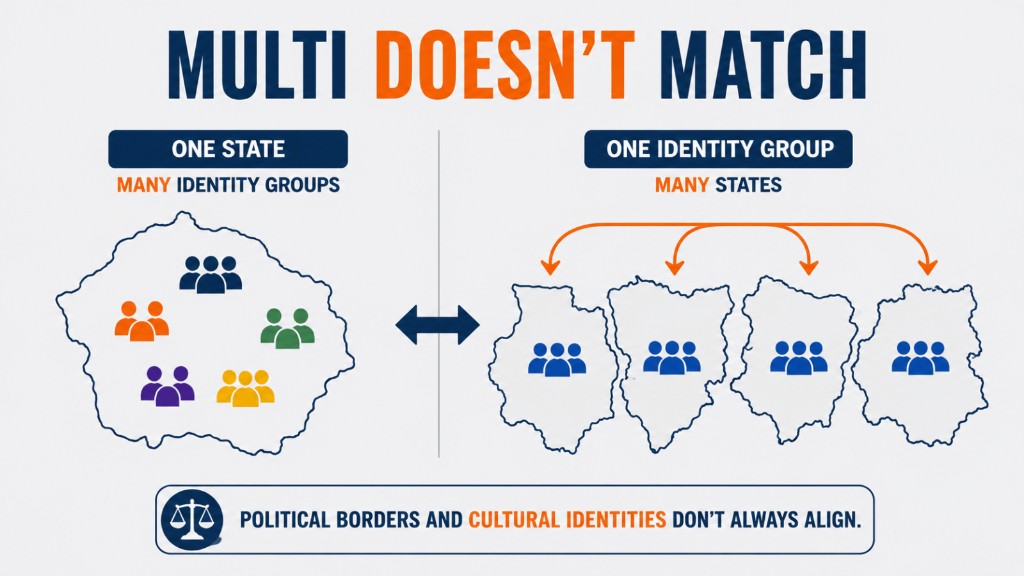
A multinational state is one state with many nations. A multistate nation is one nation across many states.
| Confusing pair | How to remember | Example |
|---|---|---|
| Multinational state | Many nations inside one state | United Kingdom |
| Multistate nation | One nation across many states | Koreans in North and South Korea |
Read each scenario, choose a label in your head, then tap Show correct label on each identity card.
Map clues: one government, many groups → multinational. Identity clues: shared culture, no country → stateless. Overlap clues: one dominant culture matches borders → nation-state. Split clues: same nation, two states → multistate.
1. A country has one dominant national identity, and its political borders closely match that group’s homeland.
Label: Nation-state
2. A cultural group shares history and language but has no fully independent recognized state.
Label: Stateless nation
3. One sovereign state contains several national groups with distinct identities.
Label: Multinational state
4. One nation is divided between two or more sovereign states.
Label: Multistate nation
5. The Kurds share identity across Turkey, Iraq, Iran, and Syria without a fully recognized Kurdish state.
Label: Stateless nation
6. The United Kingdom includes English, Scottish, Welsh, and Northern Irish identities.
Label: Multinational state
7. Korean identity exists in both North Korea and South Korea.
Label: Multistate nation
8. Japan is often described as a close match between state and nation.
Label: Nation-state
Close nation-state example. Political borders and national identity mostly align, although no state is perfectly uniform.
Stateless nation example. Shared identity and homeland region, but no fully independent recognized Kurdish state.
Multinational state example. One sovereign state with multiple national identities.
Multistate nation example. One nation divided between North Korea and South Korea.
Multinational state because of French-speaking Quebec and other regional or national identities.
Often discussed as a stateless nation or contested sovereignty example.
Examples can be politically complex. For AP Human Geography, focus on the vocabulary relationship: identity, state borders, and sovereignty.
When national identity and political borders do not match, states may experience political pressure. Groups may demand autonomy, independence, recognition, or better representation.
| Mismatch | Possible political result |
|---|---|
| Stateless nation | Independence movement or autonomy demand |
| Multinational state | Devolution, federalism, or separatism |
| Multistate nation | Cross-border tension or reunification movement |
| Nation-state | Strong national unity, but possible minority issues |
Link these patterns to devolution, federal vs unitary states, and centripetal and centrifugal forces.
| Mistake | Better AP understanding |
|---|---|
| “Every nation has a state” | Some nations are stateless |
| “Every state is a nation-state” | Many states contain multiple nations |
| “Multinational and multistate mean the same thing” | Multinational = many nations in one state; multistate = one nation in many states |
| “Kurds are a country” | Kurds are usually cited as a stateless nation |
| “United Kingdom is one nation-state” | It is better understood as a multinational state |
| “Korea is stateless” | Koreans are better used as a multistate nation example |
Choices shuffle on each load. Tap an answer for instant feedback.
Which term describes a nation that does not have its own fully independent sovereign state?
Which example is most commonly used as a stateless nation in AP Human Geography?
Which term best describes one state containing multiple national identities?
Which term best describes one nation spread across more than one state?
Why is Japan often used as a close example of a nation-state?
What is the best memory trick for multinational state vs multistate nation?
Open each card, draft your response, then reveal the rubric and sample when ready.
Tip: Outline on paper first, then type a polished version here to compare with the sample.
A. A stateless nation is a nation with shared identity, history, or homeland claims but no fully independent, internationally recognized sovereign state.
B. The Kurds share Kurdish language, history, and homeland regions across parts of Turkey, Iraq, Iran, and Syria, but there is no widely recognized independent Kurdistan.
C. When a stateless nation seeks sovereignty or greater autonomy, it can fuel devolution or independence movements, creating political tension inside existing states.
Status: Draft your answer first—then open the rubric or sample.
Tip: Outline on paper first, then type a polished version here to compare with the sample.
A. A multinational state is one sovereign state that contains two or more nations or national identities within its borders.
B. The United Kingdom includes English, Scottish, Welsh, and Northern Irish national identities under one recognized government, so it is multinational rather than a tight nation-state.
C. A centrifugal force could be Scottish independence sentiment or uneven economic development that pulls regions away from unity.
D. A centripetal force could be shared currency, Parliament, monarchy, or national infrastructure that encourages cooperation across the UK.
Status: Draft your answer first—then open the rubric or sample.
A stateless nation is a group of people with shared identity, history, culture, or homeland claims but no fully independent sovereign state of their own.
The Kurds are the most common AP Human Geography example of a stateless nation because Kurdish people share a national identity but do not have a fully independent internationally recognized state.
A nation-state is a state whose political boundaries closely match the territory of one main nation or cultural group.
A multinational state is one sovereign state that contains two or more nations or national identities inside its borders.
A multistate nation is one nation or cultural group that is spread across more than one state.
A multinational state is one state with multiple nations inside it. A multistate nation is one nation spread across multiple states.
The United Kingdom is considered a multinational state because it includes multiple national identities, including English, Scottish, Welsh, and Northern Irish identities, inside one sovereign state.
Koreans are often used as a multistate nation example because one Korean national identity is divided between two sovereign states: North Korea and South Korea.
The Kurds are considered a stateless nation because they share a common identity and homeland region across parts of Turkey, Iraq, Iran, and Syria, but they do not have a fully independent internationally recognized Kurdish state.
You now understand why nations and states do not always match. Continue the Unit 4 journey with Political Boundaries, or test yourself with Unit 4 practice questions.
You finished Step 3 of the Unit 4 sequence. Use the path below to move backward for review or forward to political boundaries and the rest of the unit.
These topics connect directly to nation-state mismatches, devolution pressure, and forces that unite or divide states.