A region with a distinct language gains more control over education policy from the central government.
Pressure answer: Devolution caused by cultural identity.
Unit 4 Learning Journey · Step 11
Devolution in AP Human Geography is the transfer of political power from a central government to regional, local, or subnational governments.
Devolution happens when regions want more control over local decisions, identity, language, resources, or political power. It can reduce conflict by giving regions autonomy, but it can also increase separatist pressure if regional identity grows stronger. This guide helps you identify devolution causes, examples, effects, and AP-style clues.
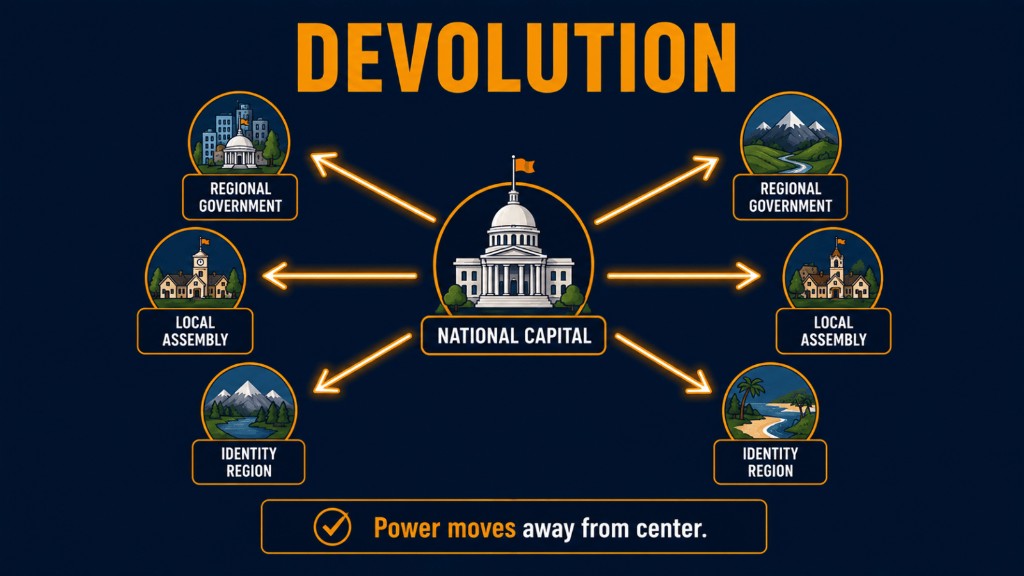
The previous page compared federal and unitary states by asking where power is located inside a state. Devolution goes one step further: it explains what happens when power moves away from the center and toward regional governments.
Meaning: States organize political power in centralized or shared ways.
Meaning: Power shifts from the central government toward regional or local governments.
You are on Step 11 of the Unit 4 sequence.
Meaning: Some forces pull states together, while others push them apart.
Connect devolution to sovereignty when a state keeps international authority while shifting internal power, and to nation-state mismatches when regional identity does not match the state boundary.
Devolution is the transfer of power from a central government to regional or local governments. In AP Human Geography, devolution usually happens because regions want more control over political decisions, culture, language, resources, or identity. Devolution can help keep a state together by granting autonomy, but it can also encourage separatism if regions push for more independence.
Students often confuse devolution and federalism because both involve regional governments. The difference is simple: federalism is a structure; devolution is a process.
| Concept | Simple Meaning | AP Clue | Example |
|---|---|---|---|
| Federalism | Power is shared between central and regional governments | Constitutionally protected regional power | United States, Canada, Germany, India |
| Devolution | Power is transferred from central government to regions | Central government grants more regional authority | Scotland, Wales, Northern Ireland, Catalonia, Quebec |
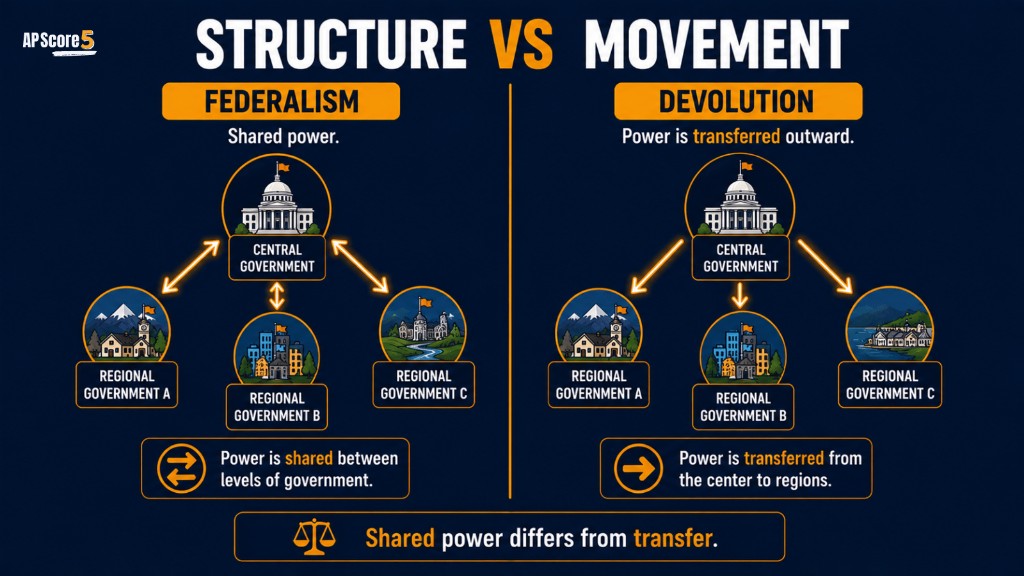
Review how states organize power in the federal vs unitary states guide—this page focuses on power shifting away from the center.
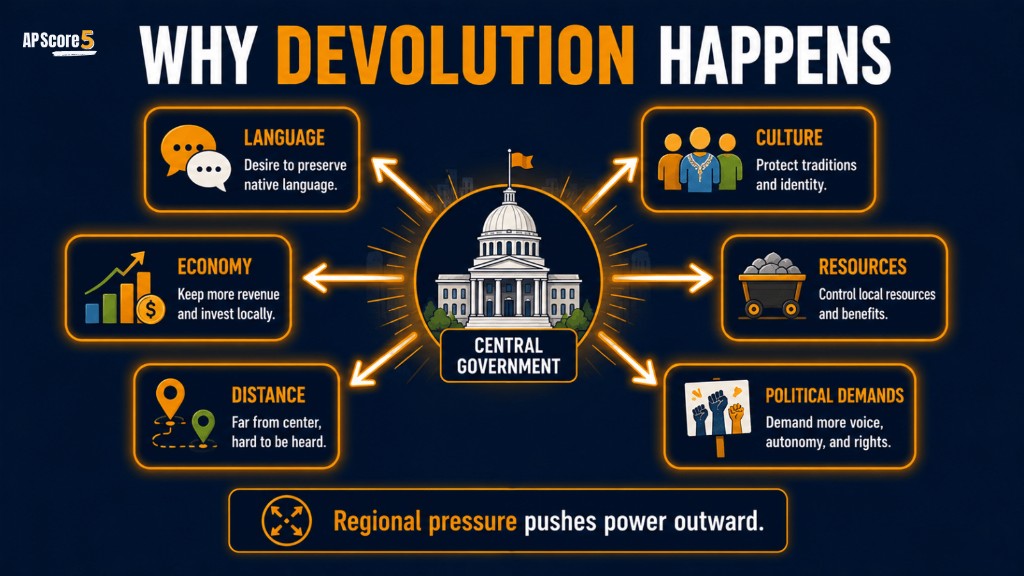
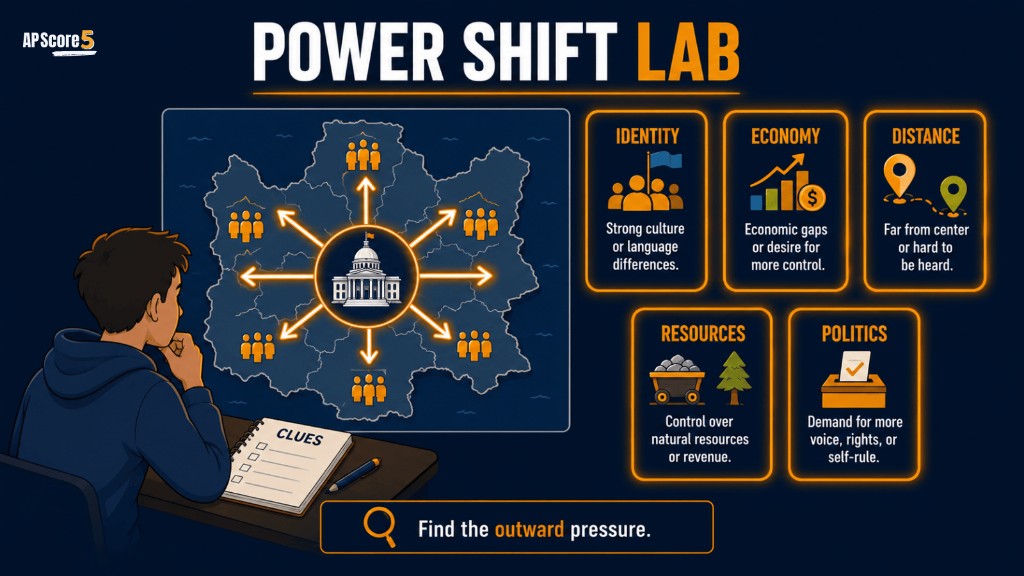
Devolution happens when regions feel that the central government does not fully represent their needs, identity, economy, or geography.
A region may have a distinct language, religion, ethnicity, or culture and want more control.
A wealthy region may feel it contributes more than it receives, or a poorer region may feel neglected.
Mountains, islands, distance, or difficult terrain can separate regions from the central government.
Regional parties or movements may demand more autonomy, representation, or self-government.
A region may have a history of independence, separate institutions, or strong regional memory.
Regions may want more authority over oil, minerals, water, farmland, tourism, or local revenue.
Devolution can strengthen a state or weaken it depending on how regional autonomy affects unity.
| Effect | How It Can Help | How It Can Create Risk |
|---|---|---|
| Regional autonomy | Regions feel heard and represented | Regions may demand even more power |
| Conflict reduction | Can reduce separatist pressure | Can encourage independence movements |
| Policy flexibility | Regions can solve local problems | Uneven policies may create inequality |
| Identity recognition | Protects language or culture | Regional nationalism may grow |
| State unity | Keeps regions inside the state | Weakens central control if poorly managed |
Centrifugal forces are forces that divide or weaken a state. Devolution often happens when centrifugal pressures are strong, such as regional identity, separatism, economic inequality, or distance from the capital.
But devolution can also be used as a strategy to reduce centrifugal pressure by giving regions more autonomy.
Regional identity, separatism, economic resentment, physical distance, minority nationalism.
Central government grants regional powers to reduce pressure and keep the state together.
Go deeper on unity and division in the centripetal and centrifugal forces guide—the next step in the Unit 4 journey.
Devolution can change how power is distributed inside a state, but it does not automatically destroy sovereignty. The state can remain sovereign internationally while giving regional governments more authority internally.
The state’s legal authority over territory.
The internal transfer of some power to regional governments.
Review the foundation in the sovereignty guide when AP questions ask whether a state still controls its territory.
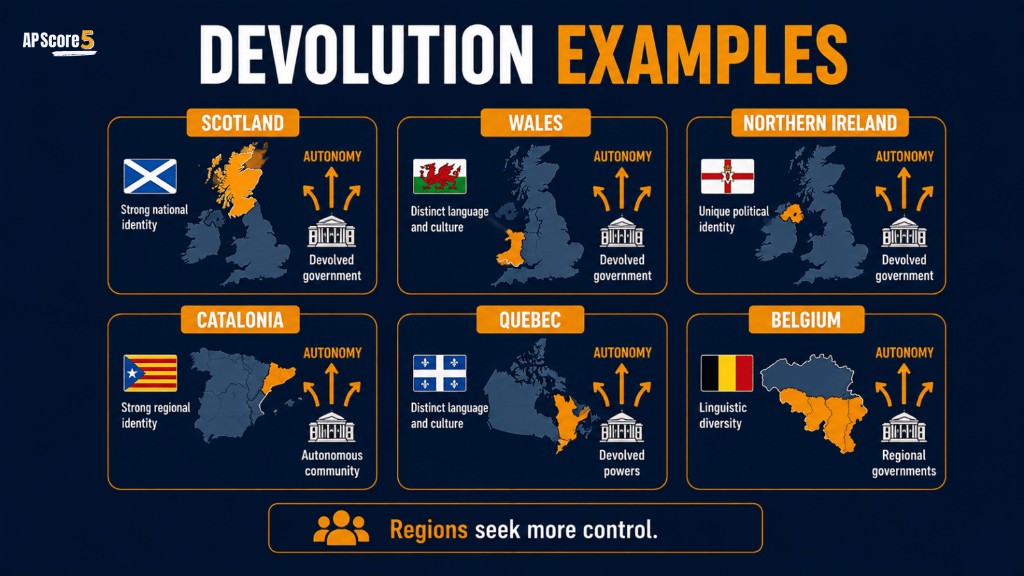
Scotland, Wales, and Northern Ireland have received devolved powers, but the United Kingdom is usually described as a unitary state with devolution.
Often used as a devolution example because Scotland has its own parliament and strong regional identity, and some political movements support independence.
Often used as a devolution example because Wales has gained regional governing powers and has a distinct cultural and linguistic identity.
Often used as a devolution example because it has a regional assembly and a complex political identity shaped by history, religion, and governance.
Often used as a regional autonomy and separatist movement example because of distinct language, culture, economy, and political identity within Spain.
Often used as a devolution/regional autonomy example because of French language, cultural identity, and autonomy debates within Canada.
Often used as an example of power-sharing and regional division because of linguistic and regional differences between Flemish and Walloon communities.
Examples can fit more than one concept. Always match the example to the AP prompt: transfer of power, regional identity, autonomy demand, or separatist pressure.
| Pressure Type | What It Means | AP Example Clue |
|---|---|---|
| Cultural | Region has distinct language, religion, ethnicity, or identity | language rights, regional culture |
| Economic | Region wants more control over wealth, taxes, resources, or development | oil, tourism, revenue, inequality |
| Physical | Region is separated by distance, mountains, islands, or poor connectivity | remote region, island, mountain region |
| Political | Region wants more representation, autonomy, or self-rule | regional party, autonomy vote |
| Historical | Region remembers past independence or separate institutions | former kingdom, historic region |
Devolution and separatism are related but not the same. Devolution gives a region more power within the state. Separatism is a movement to break away and form a separate state.
More regional power inside the existing state.
A region wants independence from the existing state.
Read each scenario and identify what pressure is pushing power from the center toward regions. Tap Reveal pressure answer when you are ready.
A region with a distinct language gains more control over education policy from the central government.
Pressure answer: Devolution caused by cultural identity.
A wealthy region argues that it pays too much tax to the national government and wants more fiscal control.
Pressure answer: Devolution pressure caused by economic differences.
An island region far from the capital gains local authority over transportation and development.
Pressure answer: Devolution caused partly by physical separation and distance.
A regional political party demands more autonomy and wins seats in a regional assembly.
Pressure answer: Devolution pressure caused by political demands.
A region with a history of independence wants more control over laws and cultural policy.
Pressure answer: Devolution pressure caused by historical identity.
A central government grants regional powers to reduce separatist pressure.
Pressure answer: Devolution used to manage centrifugal forces.
A region wants full independence and to become a separate state.
Pressure answer: Separatism, not just devolution.
A country creates regional assemblies with authority over local services.
Pressure answer: Devolution if power moves from the center to regional governments.
A minority language region receives control over language policy in schools.
Pressure answer: Devolution caused by cultural and linguistic identity.
A region demands control over local oil revenue and resource policy.
Pressure answer: Devolution pressure caused by resource control and economic interests.
| Mistake | Better AP Understanding |
|---|---|
| “Devolution means a country breaks apart” | Devolution can give regions more power without independence |
| “Devolution and federalism are the same” | Federalism is a structure; devolution is a transfer of power |
| “Devolution always weakens a state” | It can reduce conflict by giving regions autonomy |
| “Devolution always solves conflict” | It can also increase separatist pressure |
| “Any local government means devolution” | Devolution means power was transferred from the center to regions |
| “Devolution ends sovereignty” | A state can remain sovereign while devolving internal powers |
Choices shuffle on each load. Tap an answer for instant feedback.
Which statement best defines devolution in AP Human Geography?
Which situation is the best example of devolution?
Which factor can cause devolution?
What is the difference between federalism and devolution?
Why might devolution reduce political conflict?
Why might devolution increase political tension?
Which statement is a common mistake?
Open each card, draft your response, then reveal the rubric and sample when ready. In devolution FRQs, always name the pressure, explain the power shift, and describe the effect on state unity.
Tip: Name the pressure, explain the power shift, and describe the effect on state unity.
A. Devolution is the transfer of power from a central government to regional or local governments.
B. A distinct language or culture can cause a region to demand more control over education and cultural policy.
C. A wealthy region may demand more control over taxes or local revenue it generates.
D. Devolution can reduce tension by giving regions more autonomy while keeping them inside the state.
Status: Draft your answer first—then open the rubric or sample.
Tip: Name the pressure, explain the power shift, and describe the effect on state unity.
A. Devolution gives a region more power inside the state, while separatism seeks independence from the state.
B. Scotland gained a devolved parliament with authority over some regional policy.
C. Devolution can respond to centrifugal forces by granting autonomy to regions with strong identity or political demands.
D. Devolution can increase separatist pressure if regional institutions strengthen identity and demands for independence.
Status: Draft your answer first—then open the rubric or sample.
In devolution FRQs, always name the pressure, explain the power shift, and describe the effect on state unity.
Devolution is the transfer of political power from a central government to regional or local governments.
Devolution can be caused by cultural identity, language differences, ethnic identity, economic inequality, resource control, physical separation, historical identity, or regional political demands.
Common AP Human Geography examples include Scotland, Wales, Northern Ireland, Catalonia, Quebec, and Belgium's regional power-sharing.
Federalism is a structure where power is shared between central and regional governments. Devolution is the process of transferring power from the central government to regional governments.
Devolution gives a region more power within the existing state, while separatism is a movement to break away and form a separate state.
Devolution can reduce conflict by giving regions more control over local policy, culture, language, resources, or representation.
Devolution can increase conflict if regional autonomy strengthens separatist movements or encourages regions to demand independence.
No. A country can remain sovereign internationally while transferring some internal powers to regional or local governments.
Look for power moving from the central government to regional governments, especially because of regional identity, economic differences, distance, resources, or political demands.
Devolution is not exactly the same as a centrifugal force. Centrifugal forces are pressures that divide a state, while devolution is a government response that transfers power to regions and may either reduce or increase those pressures.
You now understand why power sometimes moves away from the center. Continue the Unit 4 journey with Centripetal and Centrifugal Forces, or test yourself with Unit 4 practice questions.
You finished Step 11 of the Unit 4 sequence. Use the path below to move backward for review or forward to centripetal and centrifugal forces and the rest of the unit.