Japan
Often used as a close example of a nation-state because it has a strong shared national identity, although no state is perfectly culturally uniform.
Term confusion solved · Unit 4
State, nation, and nation-state in AP Human Geography are three political geography terms students often mix up, but they mean different things on the AP exam.
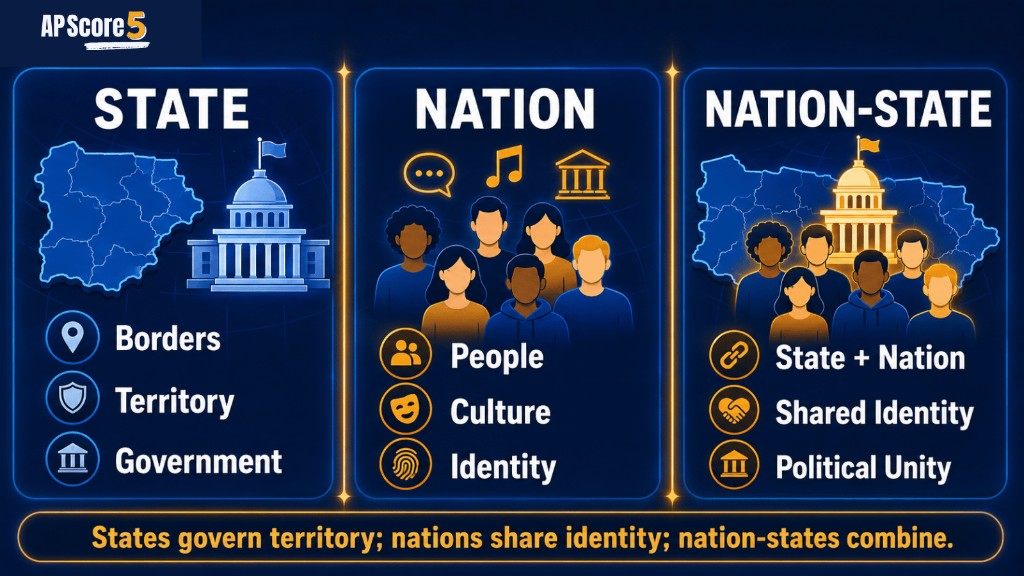
A state is a political unit with territory, government, and sovereignty. A nation is a group of people with shared culture, identity, or history. A nation-state is when the borders of a state mostly match the territory of one nation.
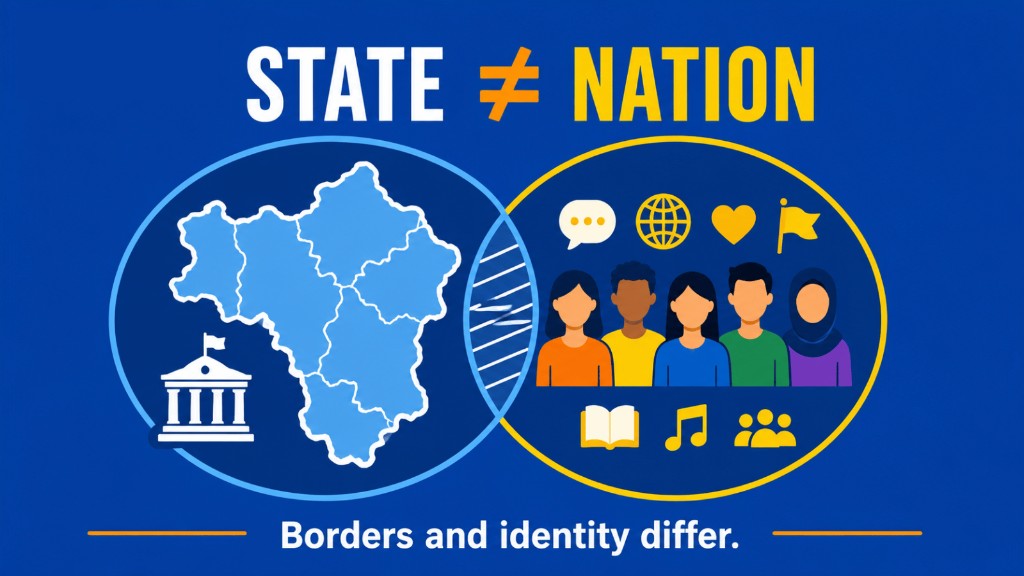
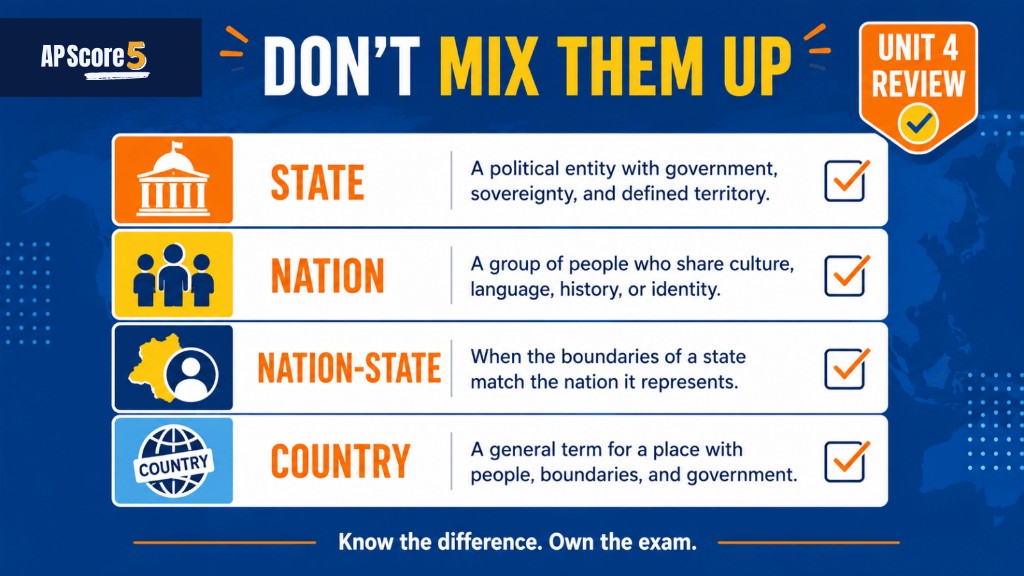
A state is a sovereign political unit with defined territory and government. A nation is a group of people who share a common identity, culture, language, history, or homeland. A nation-state is a state whose political boundaries closely match the territory of a single nation.
A state is based on political borders, while a nation is based on shared identity.
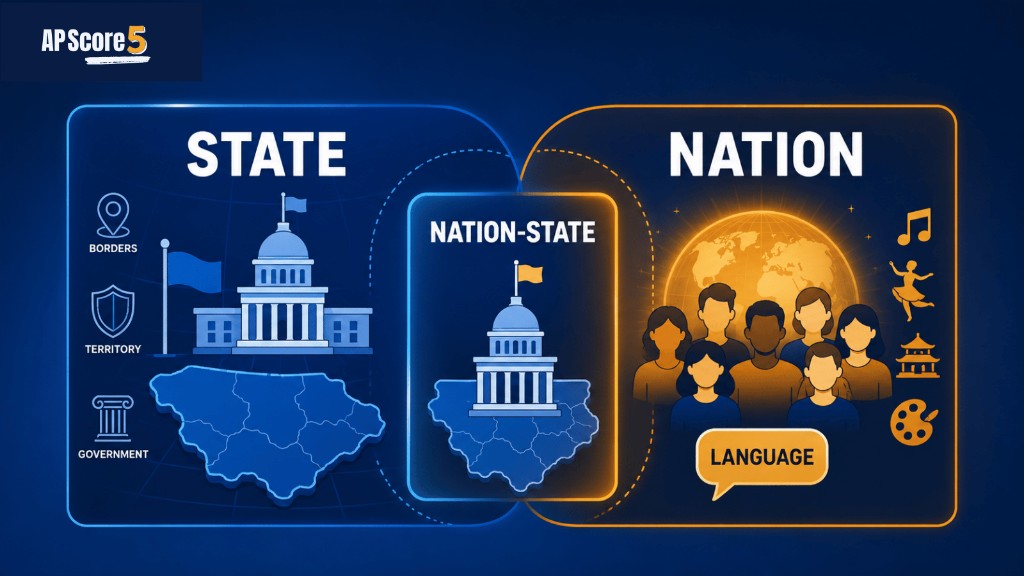
| Term | Simple Meaning | Main Focus | AP Example |
|---|---|---|---|
| State | Political unit with territory and sovereignty | Government and borders | France, Japan, United States |
| Nation | Cultural group with shared identity | People and identity | Kurds, Palestinians, Koreans |
| Nation-state | A state mostly made up of one nation | Political borders + cultural identity | Japan (often cited as a close example) |
| Country | Everyday word often used for a state | Informal term | Canada, Brazil, India |
Unit 4 is about how political power is organized across space. You need state, nation, and nation-state vocabulary to interpret sovereignty, boundaries, devolution, nationalism, and supranational cooperation.
Many AP questions test whether you can separate political territory from cultural identity. Mixing the words is one of the fastest ways to lose points on MCQs and FRQs.
A state is an independent political unit with defined boundaries, a permanent population, a government, and sovereignty (final authority inside its borders).
Recognized land with borders on a map.
People who live there year-round.
Institutions that make and enforce laws.
No higher political authority over the state.
Examples: United States, Mexico, France, India.
A nation is a group of people with a shared identity. A nation does not always have its own state—you can be a nation without controlling an internationally recognized government.
Identity can come from language, religion, ethnicity, shared history, a common homeland, or cultural traditions.
Examples: Kurds, Palestinians, Basques, Koreans (as a cultural nation across borders).
When a nation lacks its own state, AP Human Geography calls it a stateless nation—a label that shows up often on stimulus questions.
A nation-state exists when the political boundaries of a state closely match the territory of one main nation. You should see one dominant national identity, strong links between government and culture, and often a shared language or history.
Examples: Japan is often used as a close example; Iceland can work as a relatively tight match. Most countries are not perfect nation-states because they include multiple cultural groups.
In everyday speech, people say “country” when they mean an independent state. On the AP exam, state is the more precise academic term for a sovereign political unit with borders and government.
| Question | Best Term |
|---|---|
| Has government and borders? | State |
| Has shared culture or identity? | Nation |
| Has political borders that match one main nation? | Nation-state |
| Everyday casual term for a state? | Country |
Read each mini-scenario, pick your answer in your head, then tap Reveal answer. Use the visual below to connect clues about borders, government, culture, and identity to the right term.
1. A territory has a government, borders, laws, and international recognition.
Answer: State
2. A cultural group shares language and history but does not have an internationally recognized country.
Answer: Nation
3. A country’s political borders closely match the homeland of one dominant cultural group.
Answer: Nation-state
4. A group of people lives across several countries but shares a common identity.
Answer: Nation (or multistate nation, depending on the example)
5. A country contains many different nations or ethnic groups.
Answer: Multinational state
| Mistake | Better AP Understanding |
|---|---|
| “State means U.S. state only” | In AP Human Geography, state usually means sovereign country |
| “Nation and country are the same” | Nation is cultural; country/state is political |
| “Every state is a nation-state” | Many states include multiple nations |
| “A nation always has borders” | Some nations are stateless |
| “Country is the official AP term” | State is usually the more precise AP term |
Japan, the Kurds, the United Kingdom, and Korea show how political territory and national identity can line up—or fail to match.
Often used as a close example of a nation-state because it has a strong shared national identity, although no state is perfectly culturally uniform.
A common example of a stateless nation—shared identity without a fully independent recognized state.
A multinational state because it includes English, Scottish, Welsh, and Northern Irish identities inside one sovereign state.
One nation divided between two states: North Korea and South Korea—a multistate nation story.
A state with sovereignty and defined territory, but not a nation-state in the strict cultural sense because it contains many cultural groups.
Tap an answer to see immediate feedback. Choices are shuffled on each load.
Which term best describes an independent political unit with defined territory, government, and sovereignty?
A group of people shares a language, history, and cultural identity but does not control an independent state. Which term best applies?
Which is the best description of a nation-state?
Why are the Kurds often discussed in AP Human Geography?
Which clue most strongly points to the term “state”?
Three Unit 4 prompts below work like exam day: open a card, write your response on paper or in the draft box, check the self-review list, then reveal the rubric and sample answer when you are ready—no peeking early.
Tip: Outline on paper first, then type a polished version here to compare with the sample.
A. A state is a sovereign political unit with defined territory, a permanent population, a government, and recognition by other states.
B. A nation is a group with shared identity (language, religion, ethnicity, history, or homeland). Nations can exist across borders or inside another state without having their own government—like the Kurds.
C. Devolution shifts power from the center to regions. If you confuse nation with state, you miss why Scottish or Catalan movements want more autonomy inside the United Kingdom or Spain rather than inventing a new word for “country.”
Status: Draft your answer first—then open the rubric or sample.
The United Kingdom includes English, Scottish, Welsh, and Northern Irish identities within one recognized government and territory.
Tip: Outline on paper first, then type a polished version here to compare with the sample.
A. A multinational state is a sovereign state that includes more than one nation or distinct cultural group within its borders.
B. The UK is not a perfect nation-state because political borders enclose several nations (English, Scottish, Welsh, Northern Irish)—cultural homogeneity does not match the map.
C. A centripetal force: shared institutions such as the pound, Parliament in London for some UK-wide policy, or national sports teams that create common symbols.
D. A centrifugal force: Scottish independence referenda debates or regional resentment over economic investment—identity politics pulling power away from the center.
Status: Draft your answer first—then open the rubric or sample.
Kurdish populations live in parts of Turkey, Iraq, Iran, and Syria without a fully independent, internationally recognized Kurdish state. Koreans share identity across North Korea and South Korea.
Tip: Outline on paper first, then type a polished version here to compare with the sample.
A. A stateless nation is a cultural group with a shared identity and homeland claim but without an independent, internationally recognized state.
B. Kurds share Kurdish language and history across several countries but do not control a sovereign Kurdistan recognized like France or Japan—so they are a nation without a matching state.
C. Stateless nations may face marginalization, limited self-rule, or conflict because host states control their territory and foreign policy.
D. Koreans illustrate a multistate nation: one nation divided between two states (North and South Korea). Kurds illustrate statelessness—identity without a state—rather than a nation split into two recognized countries.
Status: Draft your answer first—then open the rubric or sample.
Claim → evidence → geographic reasoning. Name the term, give a real place example, then explain why it matters for power, borders, or identity.
A state is a political unit with territory, government, and sovereignty. A nation is a group of people with shared culture, identity, history, or homeland.
In everyday language, country and state are often used the same way. In AP Human Geography, state is the more precise term for a sovereign political unit.
A nation-state is a state whose political boundaries closely match the territory of one main nation or cultural group.
No. Many states contain multiple nations, ethnic groups, languages, or regional identities, so they are not perfect nation-states.
The Kurds are a common AP Human Geography example of a stateless nation because they share a national identity but do not have a fully independent recognized state.
AP Human Geography questions often test whether students can separate political territory from cultural identity. This distinction is important for sovereignty, nationalism, devolution, and boundary questions.
In AP Human Geography, a state is the precise term for a sovereign political unit with territory, government, and borders. Country is the everyday word people often use for a state.
Use this quick review to avoid mixing up political borders, government, identity, and everyday country language.
Ready to keep studying Unit 4? Go back to the AP Human Geography Unit 4 study guide or try Unit 4 practice questions.