Two states disagree about the meaning of wording in a treaty that describes a boundary.
Diagnosis: Definitional dispute
Unit 4 Learning Journey · Step 7
Boundary disputes in AP Human Geography are conflicts over how political boundaries are defined, where they are located, how they are managed, or who controls resources near them.
Not every border conflict is the same. Some disputes are about the wording of a treaty, some are about the exact location of a line, some are about how a border operates, and some are about resources. This guide helps you diagnose what the dispute is really about.
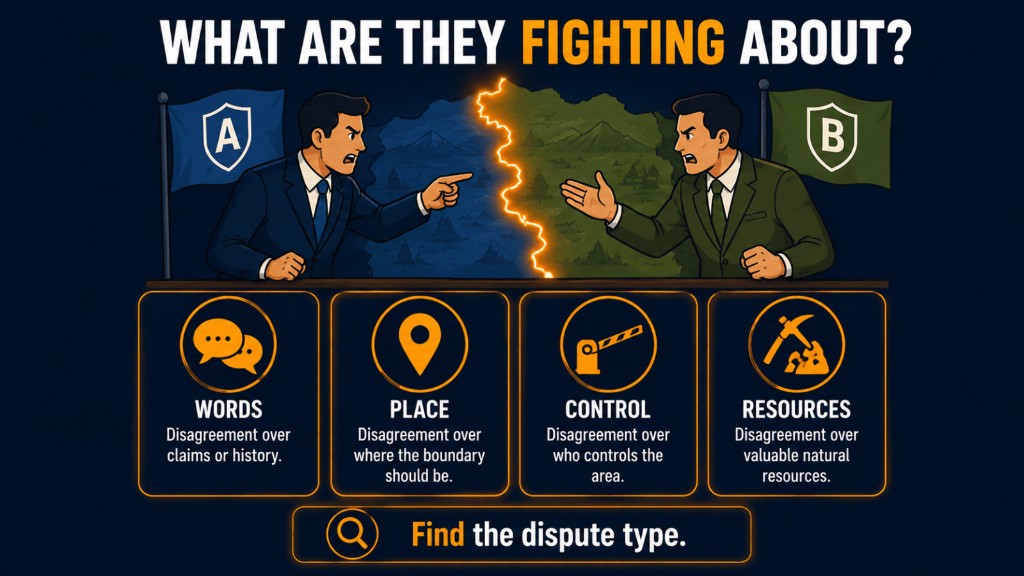
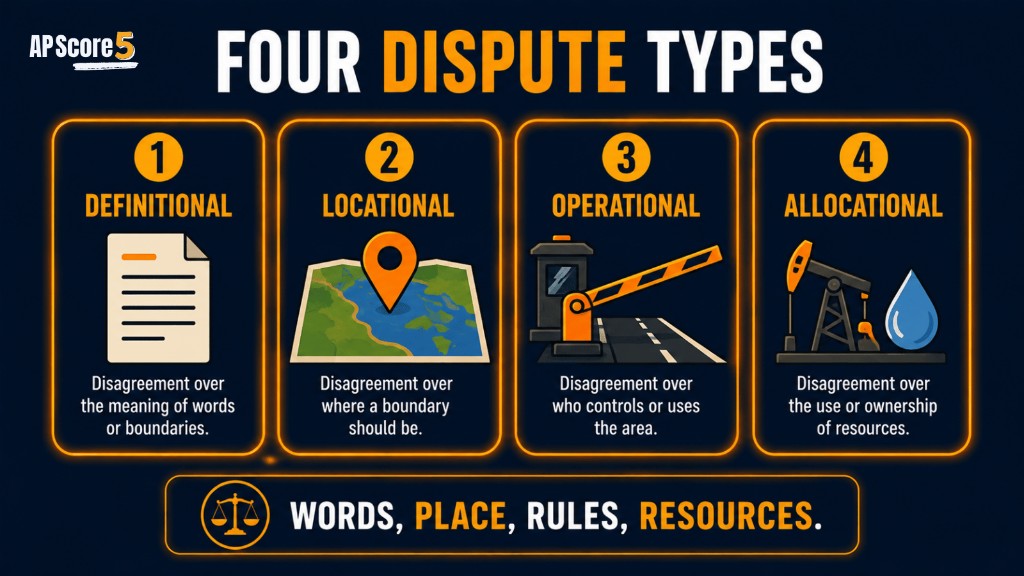
Boundary disputes are disagreements between states or groups over political boundaries. In AP Human Geography, the four main boundary dispute types are definitional disputes, locational disputes, operational disputes, and allocational disputes. Definitional disputes involve the legal meaning of a boundary, locational disputes involve where the boundary is placed, operational disputes involve how the boundary is managed, and allocational disputes involve resources near or across the boundary.
The previous pages taught what political boundaries are and how different boundary types form. Origin-based boundaries explain when and why a line was drawn. Boundary disputes are the next step because once a line exists, states or groups may disagree about what the line means, where it should be, how it should function, or who controls nearby resources.
Meaning: Some boundaries form before settlement, after settlement, through outside imposition, or as former boundaries.
Meaning: States or groups disagree about the boundary’s meaning, location, operation, or resources.
You are on Step 7 of the Unit 4 sequence.
Meaning: States use boundaries and territory to mark, defend, and control space.
To identify a boundary dispute type, do not start with the country name. Start with the problem.
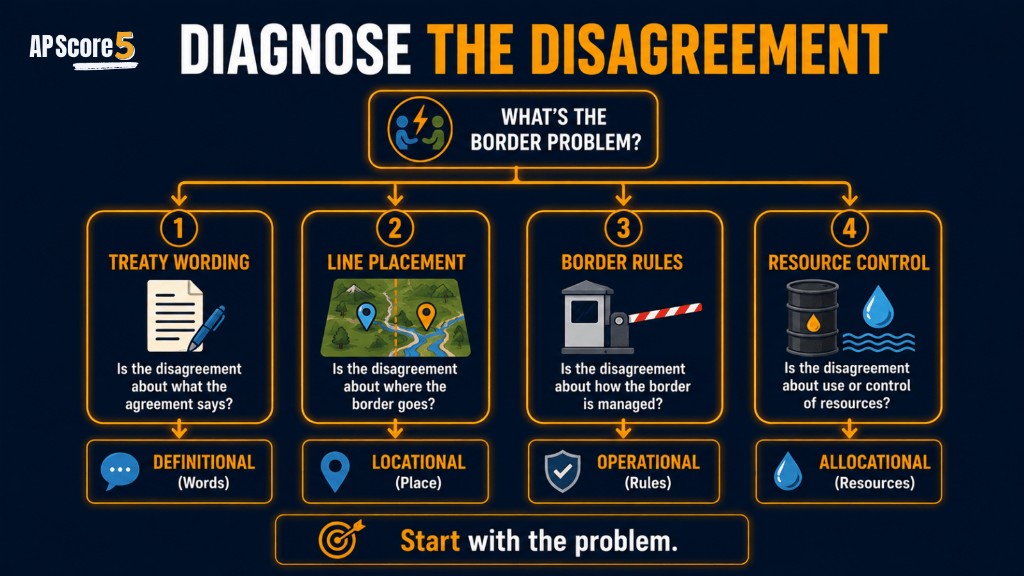
A definitional boundary dispute occurs when states or groups disagree over the legal language, wording, or interpretation of a boundary agreement.
The boundary may already be described in a treaty or legal document, but the wording is unclear or interpreted differently. The conflict is about what the written boundary definition means.
A locational boundary dispute occurs when states or groups agree that a boundary exists but disagree over where it should be located on the ground or map.
The dispute is about placement. The boundary may be legally defined, but one side argues that the line has been incorrectly mapped, surveyed, marked, or placed.
An operational boundary dispute occurs when states or groups disagree over how a boundary should function or be managed.
The dispute is not mainly about where the line is. It is about how the boundary operates in daily life: border crossings, migration, trade, patrols, customs, checkpoints, security, or enforcement.
An allocational boundary dispute occurs when states or groups disagree over the use, control, or ownership of resources near or across a boundary.
The boundary may be accepted, but resources create conflict. These disputes often involve oil, water, minerals, fish, farmland, rivers, maritime zones, or offshore energy.
Many maritime resource conflicts connect to maritime boundaries and EEZ claims when the prompt focuses on fishing, oil, or offshore zones.
| Dispute Type | Core Problem | Best Clue | Simple Example Type |
|---|---|---|---|
| Definitional | What does the boundary wording mean? | Treaty language or legal meaning | Ambiguous boundary agreement |
| Locational | Where exactly is the boundary? | Placement, maps, surveys | Line drawn in disputed location |
| Operational | How does the boundary work? | Crossings, security, migration, customs | Checkpoint or border control conflict |
| Allocational | Who controls the resource? | Oil, water, minerals, fish, EEZ | Offshore oil or river water dispute |
Students often confuse definitional and locational disputes because both can involve maps and legal documents.
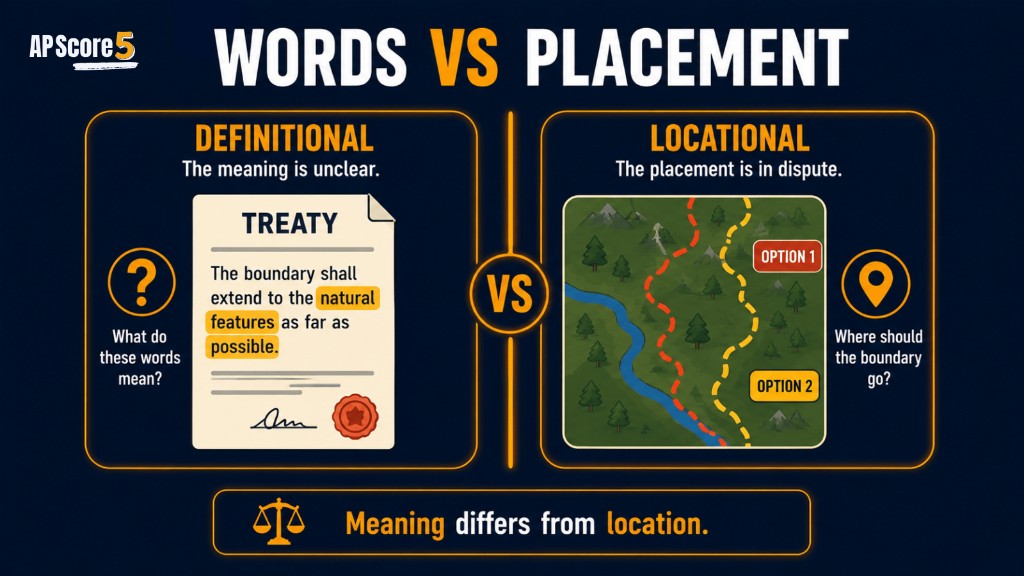
The argument is about what the boundary description means.
The argument is about where the boundary actually lies.
If two states disagree about the wording in a treaty, it is definitional. If they agree on the treaty but disagree where the line should be placed on the ground, it is locational.
Students also confuse operational and allocational disputes because both can happen at an already existing boundary.
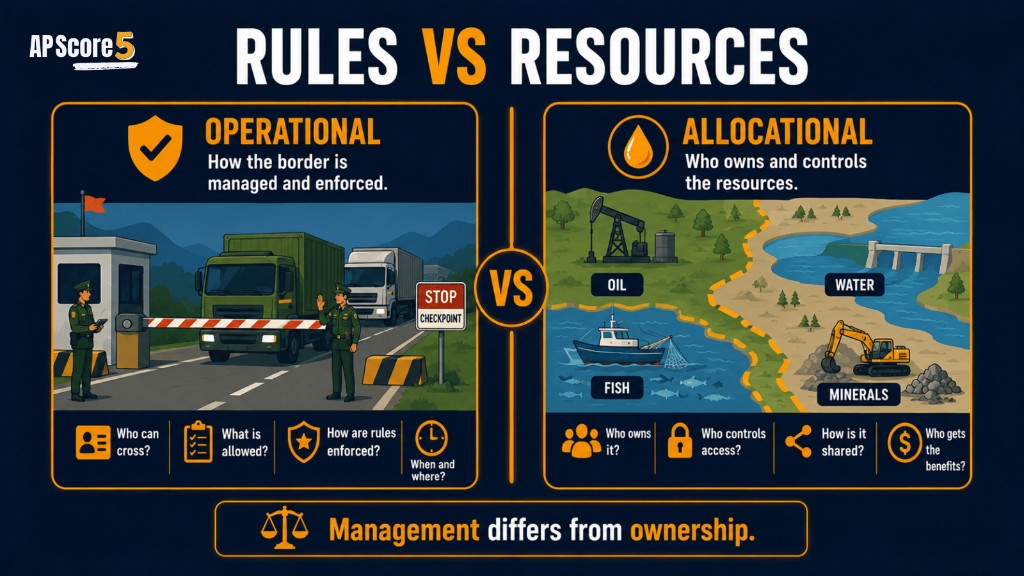
The argument is about how the boundary is managed.
The argument is about who controls resources.
A conflict over border checkpoints is operational. A conflict over oil, water, fish, or minerals is allocational.
Use careful wording. Do not overclaim or oversimplify real-world disputes. Focus on the AP concept.
Often used as a territorial and boundary conflict example involving India and Pakistan. Depending on the prompt, it may involve locational, territorial, sovereignty, or identity issues.
Often used for maritime and allocational disputes because states disagree over islands, shipping routes, maritime claims, oil, fish, and EEZ-related resources.
Can be used for operational dispute examples when the focus is migration enforcement, border security, checkpoints, and cross-border movement.
Can be used to understand allocational disputes when the focus is water access and control.
A classic definitional dispute setup when the conflict is about what a written boundary agreement means.
Can create locational disputes when a boundary follows a river and the river moves or is mapped differently.
Examples can fit different categories depending on the wording. Always match the example to the dispute clue in the prompt.
Work each scenario like a border conflict case. Tap Diagnose the disagreement when you are ready to check your answer.
Two states disagree about the meaning of wording in a treaty that describes a boundary.
Diagnosis: Definitional dispute
Two states agree a boundary exists but disagree where the line should be placed on the ground.
Diagnosis: Locational dispute
Two states argue over border checkpoints, customs rules, and crossing procedures.
Diagnosis: Operational dispute
Two states argue over offshore oil fields near a maritime boundary.
Diagnosis: Allocational dispute
A river changes course, and two states disagree about whether the boundary moved with it.
Diagnosis: Locational dispute
A state argues that another state is not enforcing border security properly.
Diagnosis: Operational dispute
Two states disagree over fishing rights in a shared water area.
Diagnosis: Allocational dispute
A boundary agreement uses unclear language, and both states interpret it differently.
Diagnosis: Definitional dispute
Countries disagree about how migrants and goods should move across a border.
Diagnosis: Operational dispute
Two states dispute mineral rights near their shared boundary.
Diagnosis: Allocational dispute
| Mistake | Better AP Understanding |
|---|---|
| “All boundary disputes are about where the line is” | Only locational disputes are mainly about boundary placement |
| “Definitional and locational are the same” | Definitional is about wording; locational is about placement |
| “Operational disputes are about resources” | Operational disputes are about border management |
| “Allocational means location” | Allocational means resource control or distribution |
| “Every border conflict has one simple label” | The prompt wording decides the best AP answer |
| “Maritime disputes are always locational” | Many maritime disputes are allocational if the focus is oil, fish, or EEZ resources |
Choices shuffle on each load. Tap an answer for instant feedback.
Which type of boundary dispute involves disagreement over treaty wording or legal interpretation?
Two states agree that a boundary exists but disagree where the line should be placed on the ground. Which dispute type is this?
A disagreement over customs rules, checkpoints, and border crossings is most likely:
Two countries disagree over offshore oil rights near a maritime boundary. Which dispute type fits best?
Which memory trick is correct?
A river shifts course and two states disagree about the boundary's exact location. Which dispute type is most likely?
Why can South China Sea disputes be described as allocational in many AP Human Geography contexts?
Open each card, draft your response, then reveal the rubric and sample when ready. In boundary dispute FRQs, name the disagreement first: wording, placement, management, or resources.
Tip: Name the disagreement first—wording, placement, management, or resources.
A. A locational boundary dispute is a disagreement over where a boundary should be located on the ground or map.
B. An operational boundary dispute is a disagreement over how a boundary should be managed or function.
C. Locational disputes concern placement; operational disputes concern management, crossing, enforcement, security, or border rules.
D. Boundary disputes can increase checkpoints, limit migration, restrict trade, or delay border crossings when states disagree about border rules or placement.
Status: Draft your answer first—then open the rubric or sample.
Tip: Name the disagreement first—wording, placement, management, or resources.
A. An allocational boundary dispute is a disagreement over resource use, control, ownership, or distribution near or across a boundary.
B. Water, oil, fish, and minerals create disputes because states compete for economic value, energy, food supplies, water access, or strategic control.
C. A definitional boundary dispute is a disagreement over the legal wording or interpretation of a boundary agreement.
D. Unclear treaty language can lead states to interpret the same boundary agreement differently, creating a definitional dispute.
Status: Draft your answer first—then open the rubric or sample.
In boundary dispute FRQs, name the disagreement first: wording, placement, management, or resources.
Boundary disputes are disagreements between states or groups over how political boundaries are defined, where they are located, how they are managed, or who controls resources near them.
The four main types of boundary disputes are definitional, locational, operational, and allocational disputes.
A definitional boundary dispute is a disagreement over the legal wording, meaning, or interpretation of a boundary agreement.
A locational boundary dispute is a disagreement over where a boundary should be placed on the ground or shown on a map.
An operational boundary dispute is a disagreement over how a boundary should function or be managed, including checkpoints, migration rules, customs, security, or enforcement.
An allocational boundary dispute is a disagreement over the use, control, ownership, or distribution of resources near or across a boundary.
A definitional dispute is about the wording or legal meaning of a boundary, while a locational dispute is about where the boundary is placed.
An operational dispute is about border management or rules, while an allocational dispute is about control of resources such as oil, water, fish, minerals, or farmland.
A dispute over offshore oil, river water, fishing rights, minerals, or maritime resources is an allocational boundary dispute because the conflict centers on resource control.
Ask what the conflict is about. Wording means definitional, placement means locational, border management means operational, and resources mean allocational.
A definitional boundary dispute is about the legal wording or meaning of a boundary, while an operational boundary dispute is about how the boundary is managed through rules, checkpoints, security, migration, or trade.
You now know how to diagnose the four major boundary dispute types. Continue the Unit 4 journey with Territoriality, or test yourself with Unit 4 practice questions.
You finished Step 7 of the Unit 4 sequence. Use the path below to move backward for review or forward to territoriality and the rest of the unit.