A country’s constitution gives regional governments protected authority over education and policing.
Power answer: Federal state because regional governments have protected authority.
Unit 4 Learning Journey · Step 10
Federal vs unitary states in AP Human Geography describes how political power is organized between the national government and regional governments inside a state.
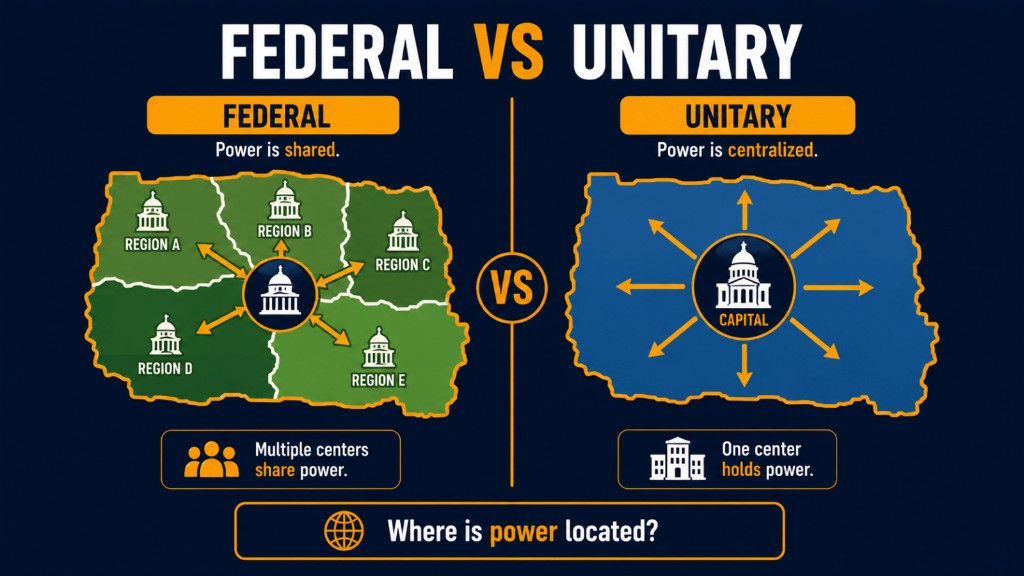
In a federal state, power is shared between the central government and regional units. In a unitary state, most power is concentrated in the central government. This guide helps you identify each system, compare examples, avoid common mistakes, and connect the concept to devolution.
The previous page explained choke points, where strategic locations can control movement and global flows. This page turns inward and asks how power is organized inside a state. Some states share authority with regional governments, while others keep most authority at the national level.
Meaning: Narrow strategic places can control movement, trade, energy, and military access.
Meaning: States organize internal political power in centralized or shared ways.
You are on Step 10 of the Unit 4 sequence.
Meaning: Power can shift from central governments to regional governments.
Connect internal power to territoriality when regions claim or defend local control, and preview devolution when power moves from the center to regions.
A federal state divides political power between a central government and regional governments, such as states, provinces, or regions. A unitary state concentrates most political power in the central government, while local governments usually have authority granted by the national government. In AP Human Geography, federal systems are often used in large or diverse states, while unitary systems are often used in smaller, compact, or more centralized states.
To identify a federal or unitary state, do not start by memorizing the country. Start by asking where real political power is located.
Who has real decision-making authority?
Federal state
Unitary state
A federal state is a state where political power is divided between a central government and regional governments.
Regional governments in a federal system have real authority. They may control some decisions about education, policing, transportation, taxes, elections, language policy, land use, or local laws depending on the country’s constitution.
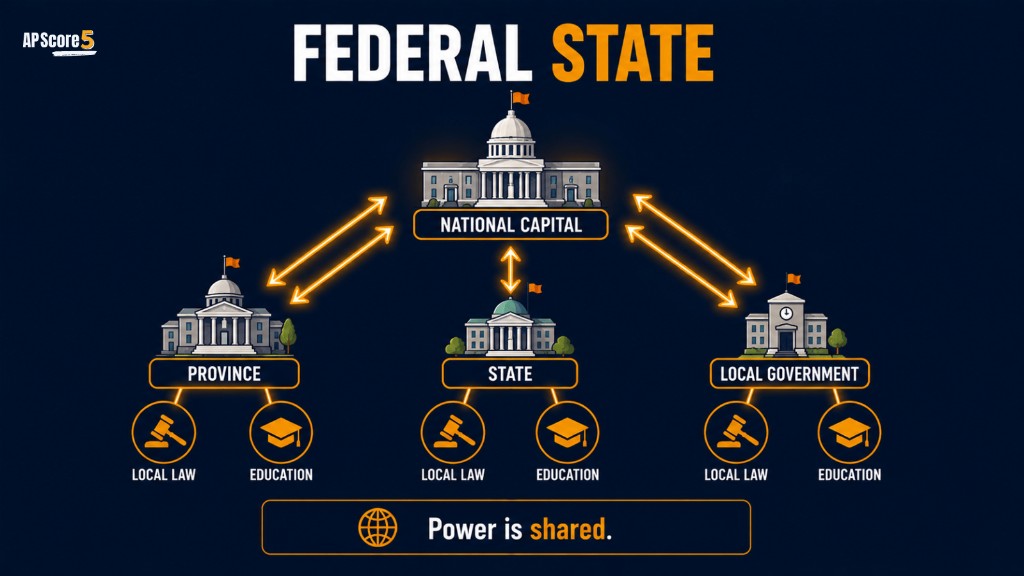
Federal systems can help large or diverse states govern more effectively because regional governments can respond to local needs while still remaining part of the larger state.
Federal systems help govern large spaces by dividing responsibilities.
Federalism can give different regions more control over local culture, language, or policy.
Sharing power can reduce pressure from groups that want autonomy.
Regional governments may understand local needs better than the central government.
Federalism can balance national unity with regional self-government.
A unitary state is a state where most political power is concentrated in the central government.
Local or regional governments may still exist in a unitary state, but their authority usually comes from the central government. The national government can often change, limit, or reorganize local authority more easily than in a federal system.
Important nuance: A unitary state can still have local governments or devolved regions. The key question is whether regional power is constitutionally protected or granted by the central government.
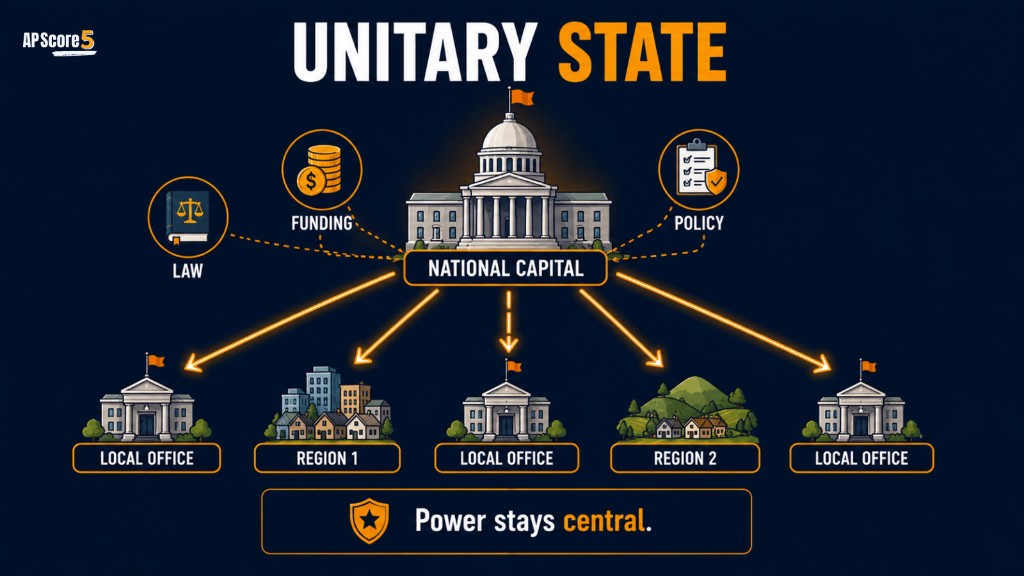
Unitary systems can help a state make decisions quickly, apply laws uniformly, and maintain strong central coordination.
Centralized authority can make national decisions faster.
The same rules can apply across the country more easily.
A strong center can promote shared national identity.
The national government can coordinate policy, funding, and planning.
Unitary systems are often easier to manage in smaller or more compact states.
| Feature | Federal State | Unitary State |
|---|---|---|
| Power location | Shared between central and regional governments | Concentrated in central government |
| Regional authority | Protected or constitutionally significant | Usually granted by central government |
| Local laws | May vary by region | More likely to be uniform nationally |
| Best AP clue | Regions have real power | Center controls most decisions |
| Common context | Large, diverse, or regionally varied states | Smaller, compact, or centralized states |
| Examples | United States, Canada, Germany, India | France, Japan, China, Kenya |
AP questions often describe a policy or conflict and ask students to recognize how power is organized. Use the question: who makes the decision?

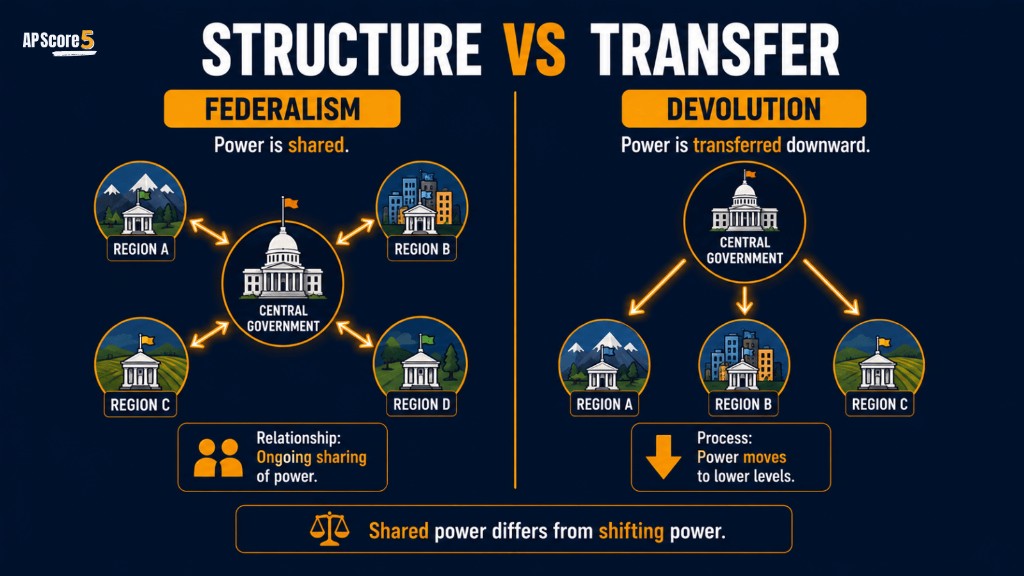
Federalism and devolution are related but not identical. Federalism is a system where power is divided between central and regional governments. Devolution is the transfer of power from a central government to regional or local governments.
A structure of shared power.
A process of transferring power downward.
Go deeper on power transfer in the devolution guide—this page focuses on where power is located inside the state.
| System | Advantages | Disadvantages |
|---|---|---|
| Federal | Handles diversity, supports regional needs, spreads power, allows local policy variation | Can create regional inequality, policy inconsistency, conflict between levels |
| Unitary | Efficient decisions, uniform laws, strong national coordination, simpler administration | Can ignore regional differences, overcentralize power, increase regional resentment |
Federal system with national and state governments sharing authority.
Federal system shaped partly by regional and linguistic differences.
Federal system used in a large and diverse state with many languages and regions.
Federal system where Länder have important regional authority.
Often used as a unitary example because political authority has historically been centralized.
Unitary state with strong national authority and local governments operating within national structure.
Unitary state with strong central control, even though it has local and regional administrative divisions.
Often described as unitary with devolution because some powers have been transferred to Scotland, Wales, and Northern Ireland.
Examples can be complex. For AP questions, match the example to the clue: shared protected power or centralized authority.
Read each scenario and decide whether it shows a federal state, a unitary state, or devolution. Tap Reveal power answer when you are ready.
A country’s constitution gives regional governments protected authority over education and policing.
Power answer: Federal state because regional governments have protected authority.
A national government can reorganize local governments and remove powers it previously granted.
Power answer: Unitary state because local authority depends on the central government.
A large, diverse state gives provinces significant control over language and local policy.
Power answer: Federal state because power is shared with regional units.
A compact state applies the same national laws across most of the country through a strong central government.
Power answer: Unitary state because authority is centralized.
A country transfers some power from the central government to regional governments.
Power answer: Devolution. This may happen inside a unitary or federal system.
A state has regional governments, but the national government can change their authority.
Power answer: Likely unitary because regional power is granted by the center.
A country has states or provinces with constitutionally protected powers.
Power answer: Federal state.
A national government controls most major policy decisions and local governments mainly administer national policy.
Power answer: Unitary state.
A country balances national unity with regional autonomy to manage ethnic or linguistic diversity.
Power answer: Federal state.
A central government grants Scotland, Wales, and Northern Ireland some regional powers.
Power answer: Devolution within a mostly unitary state.
| Mistake | Better AP Understanding |
|---|---|
| “Federal means democratic” | Federalism is about power distribution, not whether a state is democratic |
| “Unitary means authoritarian” | Unitary systems can be democratic or authoritarian |
| “Any country with regions is federal” | Unitary states also have regions, but the center controls their authority |
| “Federalism and devolution are the same” | Federalism is a structure; devolution is a process |
| “Examples are always simple” | The AP prompt decides which feature matters |
| “Central government has no power in federal systems” | Federal states still have national authority over major issues |
Choices shuffle on each load. Tap an answer for instant feedback.
Which statement best describes a federal state?
Which statement best describes a unitary state?
Which AP clue best suggests a federal system?
Which AP clue best suggests a unitary system?
Why might a large, diverse country choose a federal system?
What is the difference between federalism and devolution?
Which statement is a common mistake?
Open each card, draft your response, then reveal the rubric and sample when ready. In federal/unitary FRQs, always explain where power is located and why that location matters.
Tip: Explain where power is located and why that structure matters.
A. A federal state divides power between a central government and regional governments.
B. A unitary state concentrates most power in the central government.
C. A large or diverse state may use federalism so regions can address local needs while remaining part of the national state.
D. A federal system can create policy inconsistency or conflict between central and regional governments.
Status: Draft your answer first—then open the rubric or sample.
Tip: Explain where power is located and why that structure matters.
A. Federalism is a shared-power structure, while devolution is the transfer of power from the center to regions.
B. Devolution in the United Kingdom transferred some powers to Scotland, Wales, and Northern Ireland.
C. Devolution can reduce tension by giving regions more control over local policy and identity.
D. Devolution can increase tension if regions push for greater independence or if other regions demand similar powers.
Status: Draft your answer first—then open the rubric or sample.
In federal/unitary FRQs, always explain where power is located and why that location matters.
A federal state divides power between central and regional governments, while a unitary state concentrates most power in the central government.
A federal state is a state where political power is shared between a central government and regional governments such as states, provinces, or regions.
A unitary state is a state where most political power is concentrated in the central government, even if local governments exist.
Examples of federal states include the United States, Canada, Germany, India, Brazil, Australia, Nigeria, and Switzerland.
Examples of unitary states include France, Japan, China, Kenya, New Zealand, South Korea, Sweden, and the United Kingdom.
Large or diverse countries may use federal systems to let regional governments handle local needs, reduce conflict, and balance national unity with regional autonomy.
Yes. A unitary state can have local or regional governments, but their authority usually comes from the central government.
Federalism is a system where power is shared between central and regional governments. Devolution is the transfer of power from the central government to regional governments.
Ask where real political power is located. If regions have protected authority, think federal. If the central government controls regional authority, think unitary.
The United Kingdom is usually described as a unitary state with devolution because Parliament remains the central authority, even though Scotland, Wales, and Northern Ireland have received some regional powers.
You now understand how states organize power internally. Continue the Unit 4 journey with Devolution, or test yourself with Unit 4 practice questions.
You finished Step 10 of the Unit 4 sequence. Use the path below to move backward for review or forward to devolution and the rest of the unit.