A boundary was established before major settlement occurred in the region.
Diagnosis: Antecedent boundary
Unit 4 Learning Journey · Step 6
Antecedent boundary in AP Human Geography means a political boundary that existed before major settlement or before the cultural landscape fully developed.
This page compares antecedent, subsequent, superimposed, and relic boundaries because these four terms are often confused. The key question is simple: when did the boundary form, who created it, and does it still function today? Once you learn those clues, AP map and FRQ questions become much easier.
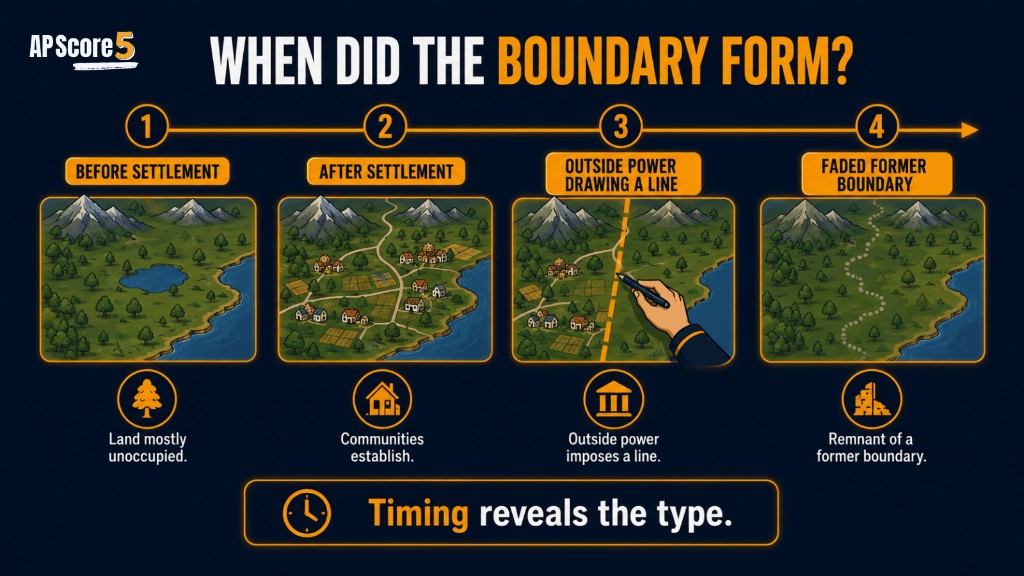
An antecedent boundary forms before major settlement or before the cultural landscape develops. A subsequent boundary forms after settlement patterns develop and often reflects cultural or social patterns. A superimposed boundary is forced onto a region by an outside power, often ignoring local cultural patterns. A relic boundary no longer functions as an official political boundary but still affects the landscape, memory, or identity of a place.
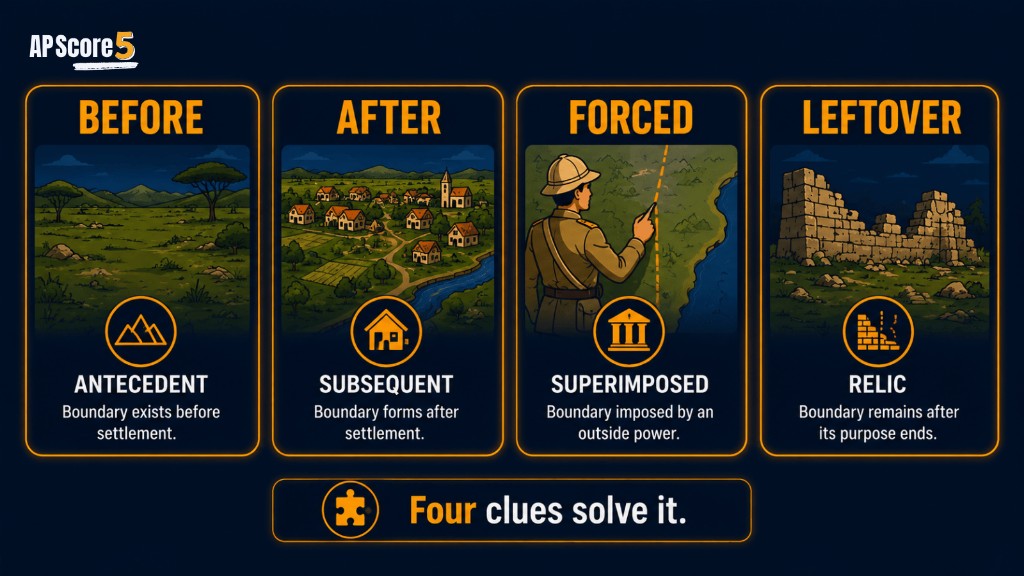
The previous page introduced all major boundary types on the Types of Boundaries guide. This page goes deeper into four origin-based boundaries: antecedent, subsequent, superimposed, and relic. These terms help geographers explain when a boundary formed, whether it matched local settlement patterns, whether outside powers imposed it, and whether it still shapes the landscape today.
Meaning: Boundary types can be classified by origin, shape, and culture.
Meaning: Antecedent, subsequent, superimposed, and relic boundaries are classified by how and when they formed.
You are on Step 6 of the Unit 4 sequence.
Meaning: Boundaries can create conflict over definition, location, operation, or resources.
Need the foundation first? Review political boundaries before you move on to origin clues and disputes.
These four boundary types make more sense when placed on a timeline.
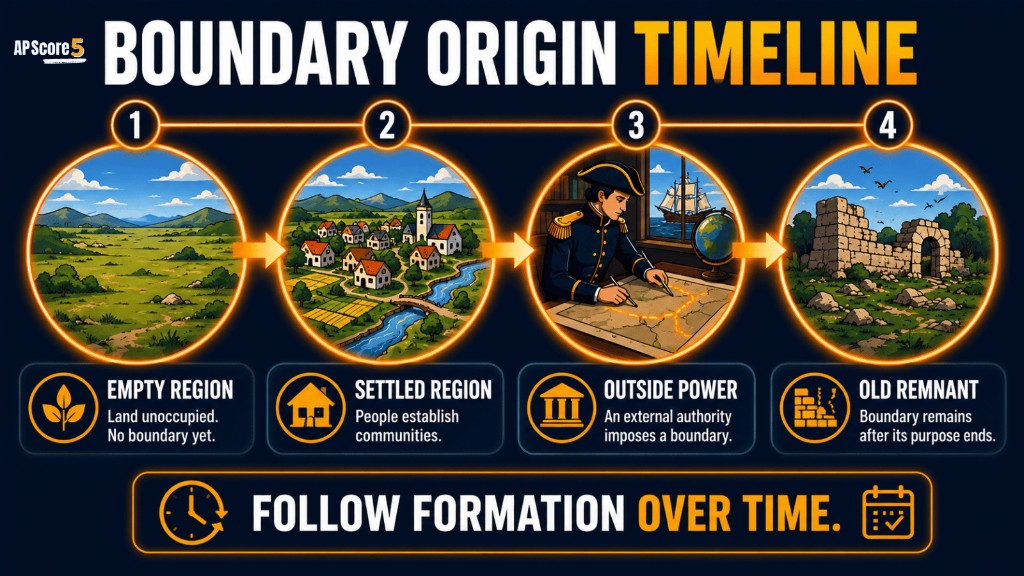
Antecedent boundary
Subsequent boundary
Superimposed boundary
Relic boundary
A boundary can sometimes fit more than one description depending on the prompt. AP questions usually give a clue that points to the best answer.
An antecedent boundary is a political boundary that existed before major settlement or before the cultural landscape developed around it.
Because the boundary comes before major population patterns, it usually does not split an already-developed cultural landscape. It may later influence where people settle, trade, or build infrastructure.
Important nuance: The U.S.–Canada boundary can also be described as geometric in places, especially along the 49th parallel. That does not make it wrong as an antecedent example when the prompt focuses on timing. Geometric describes shape; antecedent describes timing.
A subsequent boundary is a political boundary created after settlement patterns already exist.
Subsequent boundaries often reflect existing cultural, ethnic, linguistic, religious, or economic patterns. They may be drawn to separate groups or to match a developed landscape.
Important nuance: A consequent boundary is often treated as a subtype of subsequent boundary when the line is drawn specifically to separate cultural groups. See the broader Types of Boundaries guide for how consequent fits the full list.
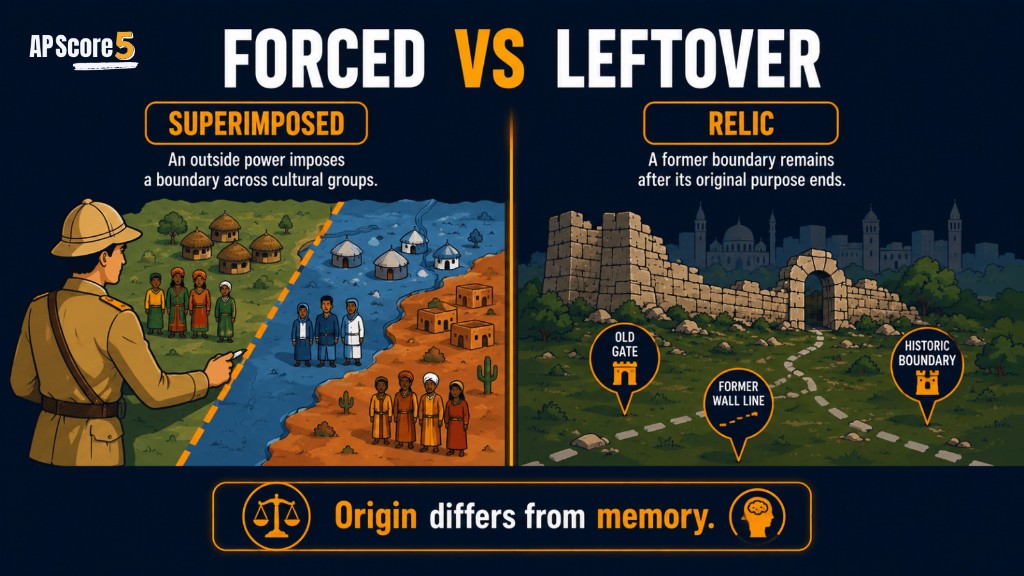
A superimposed boundary is a boundary imposed on a region by an outside or conquering power, often ignoring local cultural, ethnic, linguistic, or religious patterns.
Superimposed boundaries are important because they can divide groups, combine rival groups, or create long-term political instability. They are often associated with colonialism.
Important nuance: A boundary can be both geometric and superimposed if it is a straight line imposed by outsiders. Geometric describes the shape. Superimposed describes who imposed it and how it formed.
A relic boundary is a former political boundary that no longer functions officially but still affects the cultural landscape, memory, infrastructure, identity, or settlement patterns.
Relic boundaries matter because political lines can shape places even after they disappear from official maps. They may remain visible in architecture, roads, land use, identity, or local memory.
Important nuance: Relic does not just mean old. A relic boundary must no longer function officially but still leave a visible or meaningful trace.
| Boundary Type | Core Question | Best Definition | AP Clue | Example |
|---|---|---|---|---|
| Antecedent | Did it come before settlement? | Boundary formed before major settlement/cultural landscape | Before settlement | U.S.–Canada sections |
| Subsequent | Did it come after settlement? | Boundary formed after settlement patterns developed | After settlement, follows people | Some European cultural boundaries |
| Superimposed | Was it forced by outsiders? | Boundary imposed by outside power, often ignoring local patterns | Colonial, outside power | Colonial African boundaries |
| Relic | Is it no longer official but still visible? | Former boundary that still affects the landscape | Gone but still matters | Berlin Wall |
| Confusing Pair | Difference | Memory Trick |
|---|---|---|
| Antecedent vs subsequent | Before settlement vs after settlement | Antecedent = before |
| Subsequent vs consequent | Consequent is a cultural-reason type of subsequent boundary | Consequent follows cultural consequences |
| Superimposed vs geometric | Superimposed = origin; geometric = shape | Who drew it vs what it looks like |
| Relic vs old boundary | Relic must no longer function officially but still matter | Gone but still seen |
| Superimposed vs subsequent | Superimposed is imposed by outsiders; subsequent forms after settlement and may reflect local patterns | Outside force vs local pattern |
Often discussed with antecedent and geometric boundary concepts. If the prompt emphasizes timing before settlement, think antecedent. If the prompt emphasizes a straight line or 49th parallel, think geometric.
Often used as superimposed examples because European powers drew many boundaries without fully matching local ethnic or cultural patterns.
Used as a relic boundary example because it no longer functions as an official political boundary but still has historical, cultural, and spatial meaning.
Often discussed as a consequent/subsequent boundary because it was connected to religious and cultural separation after settlement patterns existed.
Can be subsequent when boundaries reflect long-developed language, ethnic, or cultural regions.
Examples are not magic labels. Always match the example to the clue in the prompt.
Work each scenario like a timeline lab case. Tap Reveal diagnosis when you are ready to check your answer.
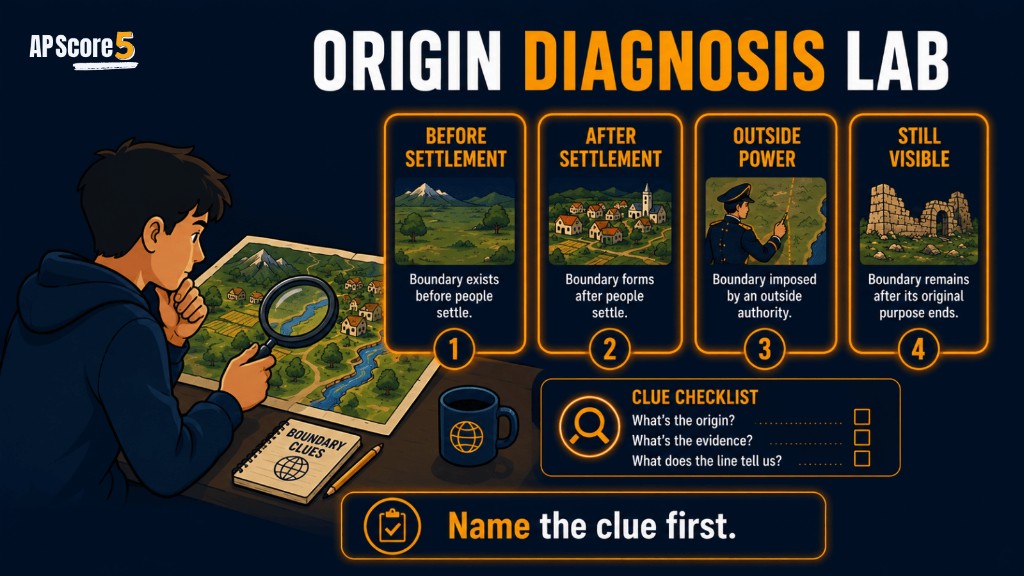
A boundary was established before major settlement occurred in the region.
Diagnosis: Antecedent boundary
A boundary was drawn after people already lived in the area and reflects language regions.
Diagnosis: Subsequent boundary
A colonial government drew a boundary through several ethnic groups.
Diagnosis: Superimposed boundary
A former wall no longer marks an official border but still affects the city’s landscape and memory.
Diagnosis: Relic boundary
A boundary follows the 49th parallel and is described as a straight line.
Diagnosis: Geometric boundary, but if the prompt focuses on timing before settlement, it may also be antecedent.
A boundary separates two religious groups after political negotiations.
Diagnosis: Consequent or subsequent boundary
A boundary was forced onto a region by an empire without local input.
Diagnosis: Superimposed boundary
A former border still influences roads, neighborhoods, or identity even though it is no longer official.
Diagnosis: Relic boundary
A boundary is created after settlement and follows existing ethnic patterns.
Diagnosis: Subsequent boundary
A boundary existed before the cultural landscape developed around it.
Diagnosis: Antecedent boundary
| Mistake | Better AP Understanding |
|---|---|
| “Antecedent means old” | Antecedent means before major settlement or cultural landscape development |
| “Subsequent means any later boundary” | Subsequent usually forms after settlement and often reflects human patterns |
| “Superimposed means straight” | Superimposed is about outside imposition, not shape |
| “Relic just means historical” | Relic means no longer official but still visible or meaningful |
| “Every colonial boundary is automatically geometric” | Some are geometric, but colonial origin points to superimposed |
| “Examples always have one label” | AP prompts decide the best label based on the clue |
Choices shuffle on each load. Tap an answer for instant feedback.
Which type of boundary forms before major settlement or before the cultural landscape develops?
A boundary drawn after settlement that reflects existing language patterns is most likely:
A colonial power draws a boundary through several ethnic groups without local input. Which term fits best?
The Berlin Wall no longer functions as an official political boundary, but it still has historical and spatial meaning. Which boundary type is this?
Which clue best identifies an antecedent boundary?
Why can a boundary be both geometric and superimposed?
Which statement best explains a relic boundary?
Open each card, draft your response, then reveal the rubric and sample when ready. In boundary FRQs, always name the clue: timing, outside power, local culture, or former boundary.
Tip: Outline on paper first, then type a polished version here to compare with the sample.
A. An antecedent boundary is drawn before major settlement or before the cultural landscape develops.
B. A subsequent boundary is drawn after settlement patterns have developed.
C. Antecedent boundaries form before settlement; subsequent boundaries form after settlement and often reflect existing cultural patterns.
D. Knowing when a boundary formed helps explain whether it divided communities that already lived there or reflected patterns that existed before the line was drawn—both can shape long-term conflict.
Status: Draft your answer first—then open the rubric or sample.
Tip: Outline on paper first, then type a polished version here to compare with the sample.
A. A superimposed boundary is imposed by an outside or conquering power, often ignoring local cultural patterns.
B. European colonial powers drew many African boundaries without fully respecting existing ethnic, linguistic, or cultural patterns, which is why they are classic superimposed examples.
C. A relic boundary no longer functions as an official political boundary but still affects the cultural landscape.
D. Relic boundaries can shape architecture, memory, infrastructure, identity, and settlement patterns long after the line stops being official.
Status: Draft your answer first—then open the rubric or sample.
In boundary FRQs, always name the clue: timing, outside power, local culture, or former boundary.
An antecedent boundary is a political boundary that existed before major settlement or before the cultural landscape developed.
A subsequent boundary is a political boundary created after settlement patterns developed, often reflecting existing cultural, ethnic, religious, or language patterns.
A superimposed boundary is a boundary imposed by an outside or conquering power, often ignoring local cultural, ethnic, linguistic, or religious patterns.
A relic boundary is a former political boundary that no longer functions officially but still affects the cultural landscape, memory, identity, or spatial organization of a place.
An antecedent boundary forms before major settlement or cultural landscape development, while a subsequent boundary forms after settlement patterns have developed.
A superimposed boundary is imposed by an outside power, often over local patterns. A relic boundary is a former boundary that no longer functions officially but still remains visible or meaningful.
Many colonial African boundaries are called superimposed because European powers drew them over existing ethnic, linguistic, and cultural patterns with limited local input.
The Berlin Wall is a relic boundary because it no longer functions as an official political boundary, but it still has historical, cultural, and spatial meaning.
Yes. A boundary can be geometric because it is straight and superimposed because it was imposed by an outside power. Geometric describes shape, while superimposed describes origin.
An antecedent boundary is classified by timing because it existed before major settlement, while a superimposed boundary is classified by origin because it was imposed by an outside power, often ignoring local patterns.
You now know how to tell the four major origin-based boundary types apart. Continue the Unit 4 journey with Boundary Disputes, or test yourself with Unit 4 practice questions.
You finished Step 6 of the Unit 4 sequence. Use the path below to move backward for review or forward to boundary disputes and the rest of the unit.