Heterozygote is intermediate
Incomplete dominance is likely.
AP Biology · Unit 5 Learning Journey
Non-Mendelian genetics describes inheritance patterns that do not follow simple dominant-recessive predictions. These patterns include incomplete dominance, codominance, multiple alleles, polygenic traits, sex-linked traits, linked genes, and environmental effects. In AP Biology Unit 5, the key skill is identifying the inheritance pattern before predicting genotypes and phenotypes.
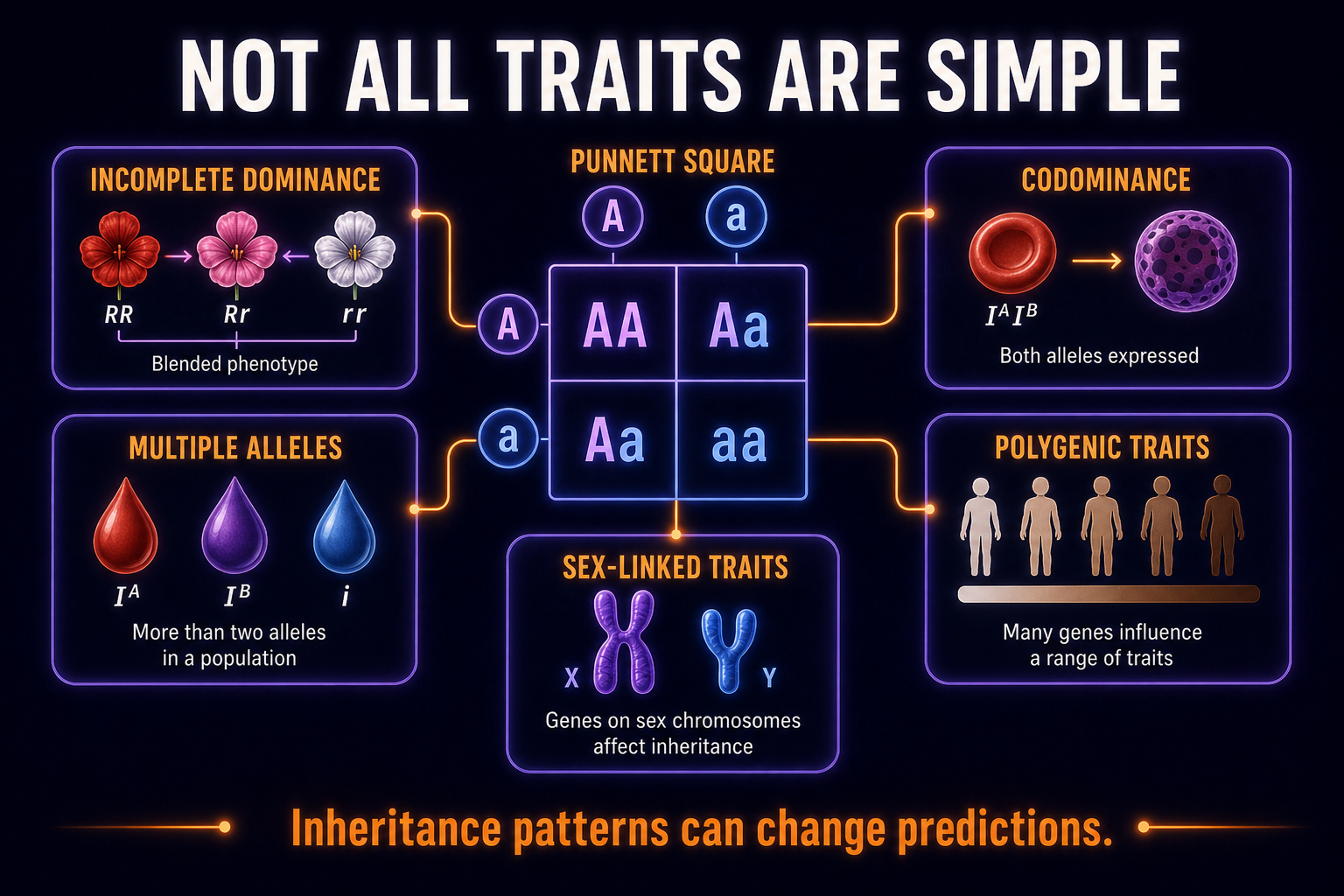
The previous guide, Punnett Squares, showed how to model inheritance probabilities. This page explains why not every trait fits a simple dominant-recessive Punnett square. After this page, study Chi-Square Test for Genetics to compare expected inheritance ratios with observed data.
Non-Mendelian genetics includes inheritance patterns that do not follow simple complete dominance. In these patterns, heterozygotes may show blended traits, both alleles may be expressed, more than two alleles may exist in a population, or multiple genes may influence one trait. AP Biology uses non-Mendelian genetics to test whether students can identify the inheritance pattern before predicting outcomes.
Non-Mendelian genetics changes how traits are predicted.
Complete dominance is the simple Mendelian pattern where a dominant allele masks a recessive allele in a heterozygote. This is the baseline pattern students compare against.
Incomplete dominance occurs when the heterozygote has an intermediate phenotype. The heterozygote does not look exactly like either homozygote.
Codominance occurs when both alleles are fully expressed in the heterozygote. The traits are shown together rather than blended.
Multiple alleles means more than two allele versions exist in the population. ABO blood type is the classic AP Biology example.
Polygenic traits are influenced by multiple genes. These traits often show continuous variation rather than simple categories.
Sex-linked traits are controlled by genes on sex chromosomes. X-linked recessive traits often appear more often in males.
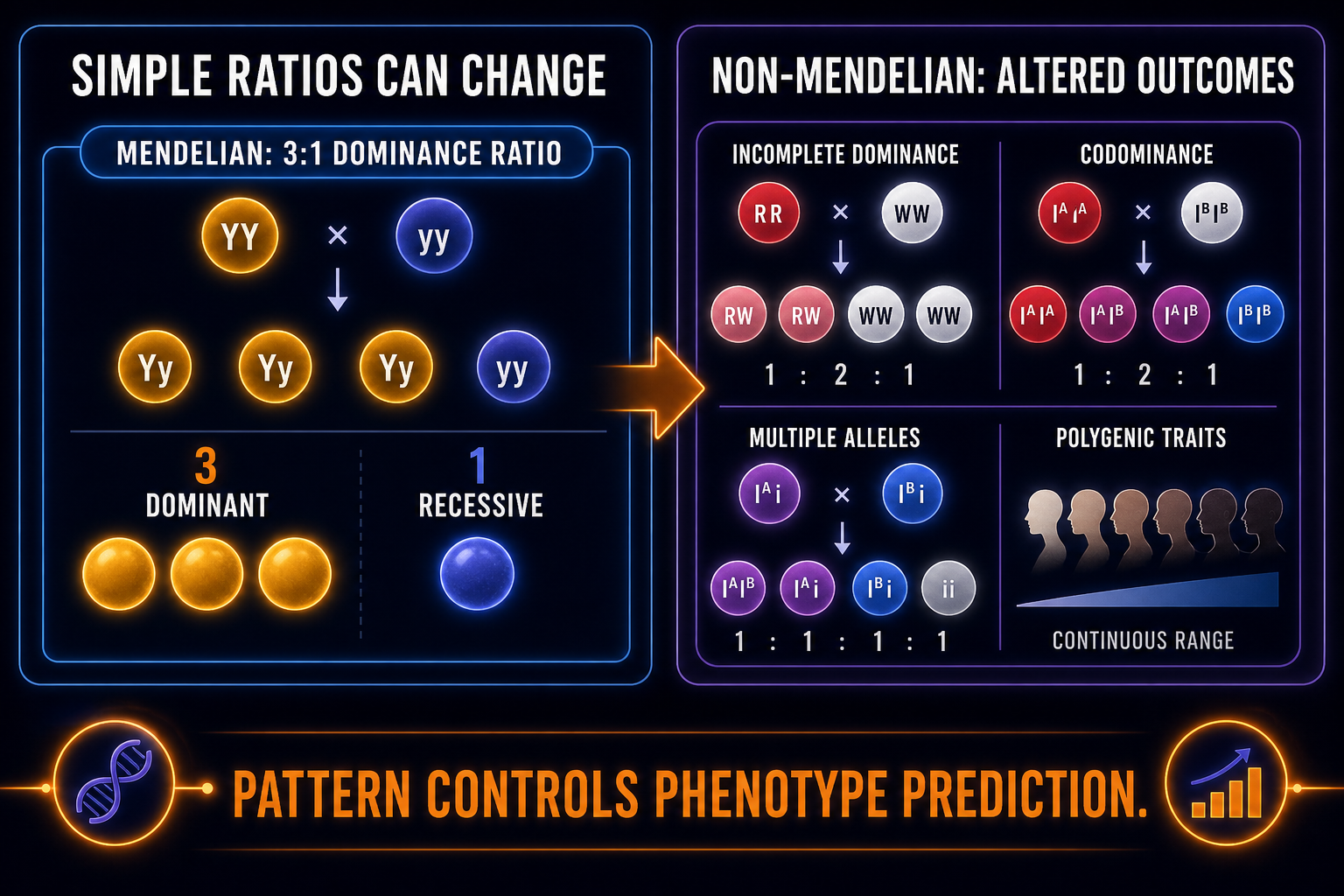
Mendelian genetics often assumes complete dominance, two alleles, and independent assortment. Non-Mendelian genetics modifies one or more of those assumptions. The Punnett square may still be useful, but the way you interpret heterozygotes and phenotype ratios changes. For the classic 3:1 monohybrid pattern under complete dominance, see the monohybrid crosses guide.
| Pattern | Heterozygote phenotype | AP clue |
|---|---|---|
| Complete dominance | Dominant phenotype | Dominant masks recessive |
| Incomplete dominance | Intermediate phenotype | Blended or in-between |
| Codominance | Both traits expressed | Both alleles show |
| Multiple alleles | Depends on allele pair | More than two alleles in population |
| Polygenic inheritance | Range of phenotypes | Many genes affect one trait |
| Sex-linked inheritance | Differs by sex | X-linked or sex chromosome clue |
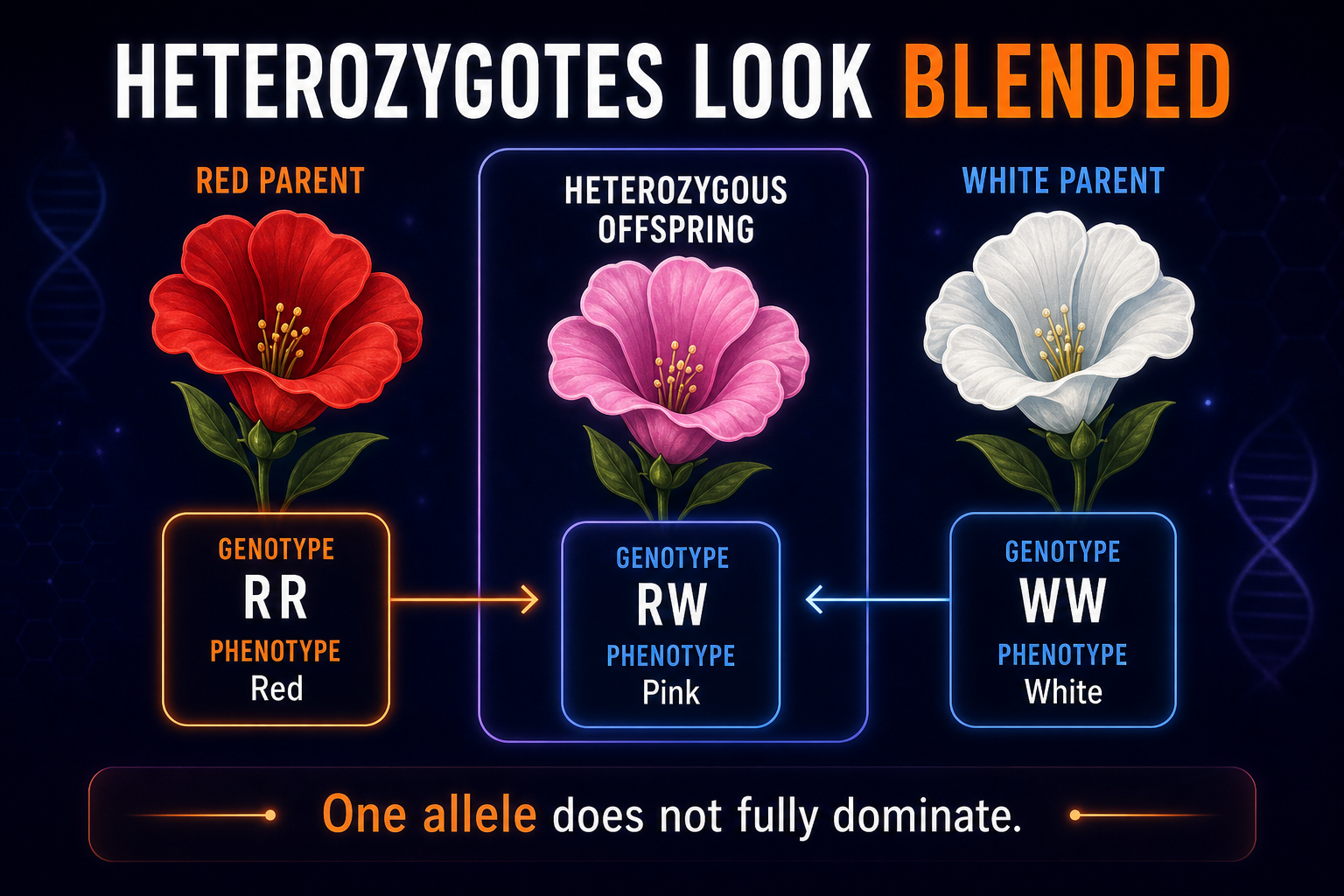
Incomplete dominance occurs when the heterozygote phenotype is intermediate between the two homozygous phenotypes. A common example is red and white flowers producing pink heterozygotes. The important AP Biology idea is that the heterozygote has its own phenotype instead of simply showing the dominant trait.
Direct answer: Incomplete dominance means the heterozygote shows an intermediate phenotype.
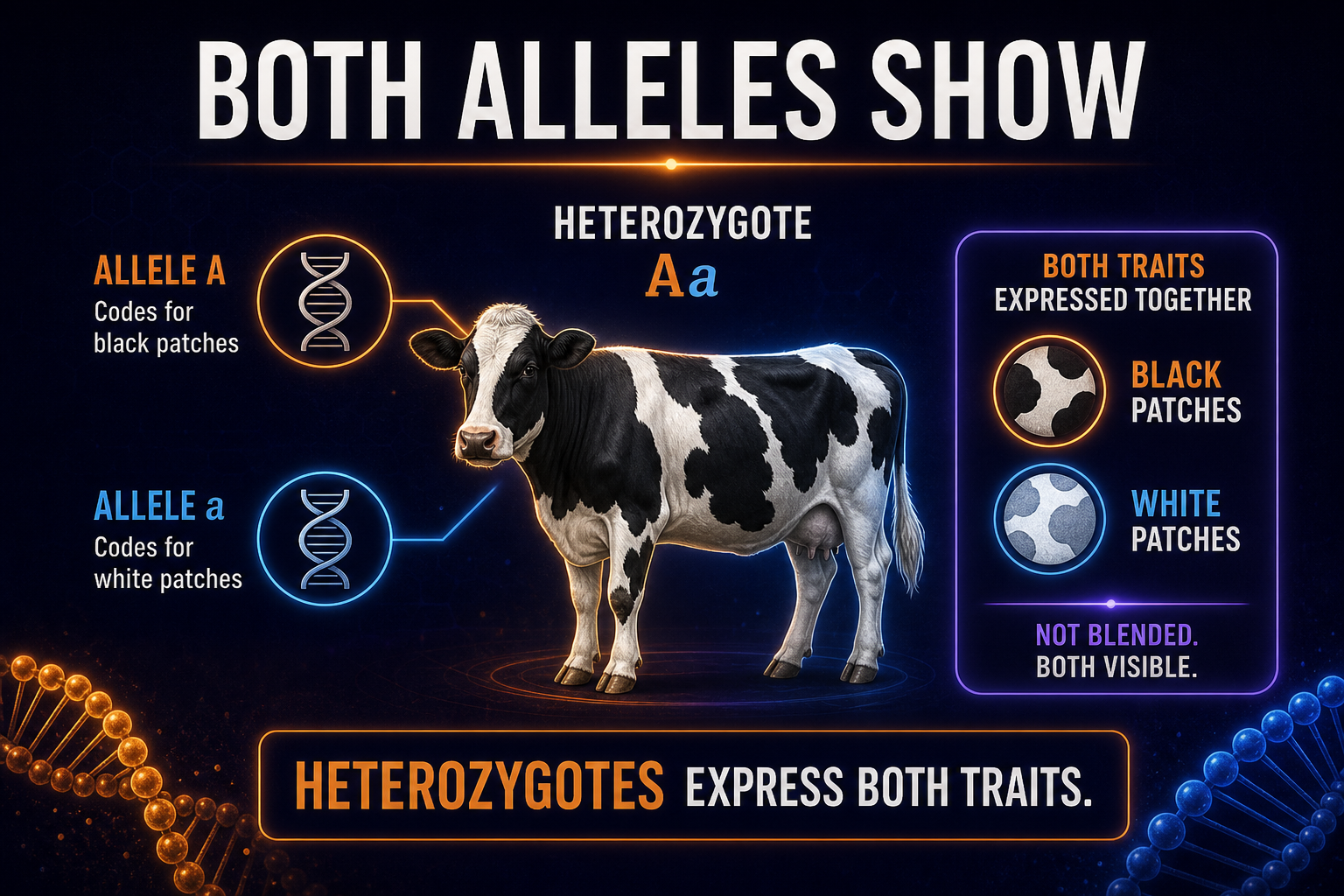
Codominance occurs when both alleles are expressed in the heterozygote. Unlike incomplete dominance, the traits are not blended into an intermediate phenotype. Instead, both versions are visible or detectable.
Direct answer: Codominance means both alleles show at the same time.
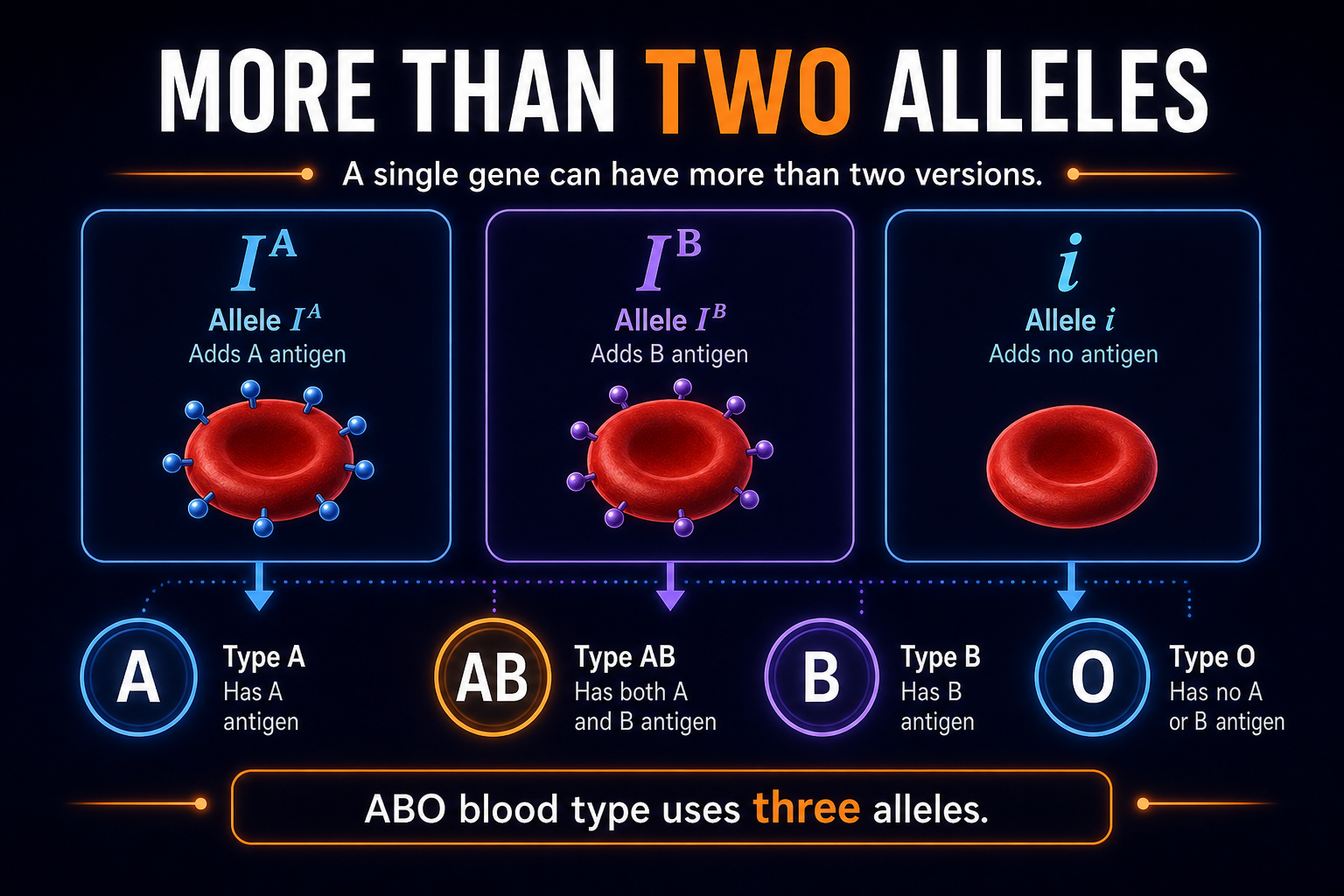
Multiple alleles means a gene has more than two allele versions in the population. ABO blood type is the classic example because the population has IA, IB, and i alleles. An individual still inherits only two alleles, but more than two versions exist in the population.
| Genotype | Blood type phenotype | Pattern |
|---|---|---|
| IAIA or IAi | Type A | A allele expressed |
| IBIB or IBi | Type B | B allele expressed |
| IAIB | Type AB | Codominance |
| ii | Type O | Recessive phenotype |
Polygenic traits are controlled by multiple genes. Instead of producing simple categories, these traits often show a range of phenotypes. Human height and skin pigmentation are common examples used to show continuous variation.
Sex-linked traits are controlled by genes located on sex chromosomes. X-linked recessive traits often appear more frequently in males because males typically have only one X chromosome. AP Biology may test this using pedigrees or Punnett squares that track X and Y chromosomes.
For a focused deep dive, see sex-linked traits.
Linked genes are located close together on the same chromosome and tend to be inherited together. This can make offspring ratios differ from what independent assortment predicts. Crossing over can sometimes separate linked genes, and recombination frequency can be used to estimate how far apart genes are.
See linked genes and recombination frequency for map-distance reasoning.
Incomplete dominance is likely.
Codominance is likely.
Codominance and multiple alleles are involved.
Multiple alleles are being tested.
Polygenic inheritance is likely.
Consider X-linked inheritance.
Linked genes may be involved.
Check whether Mendelian assumptions are violated.
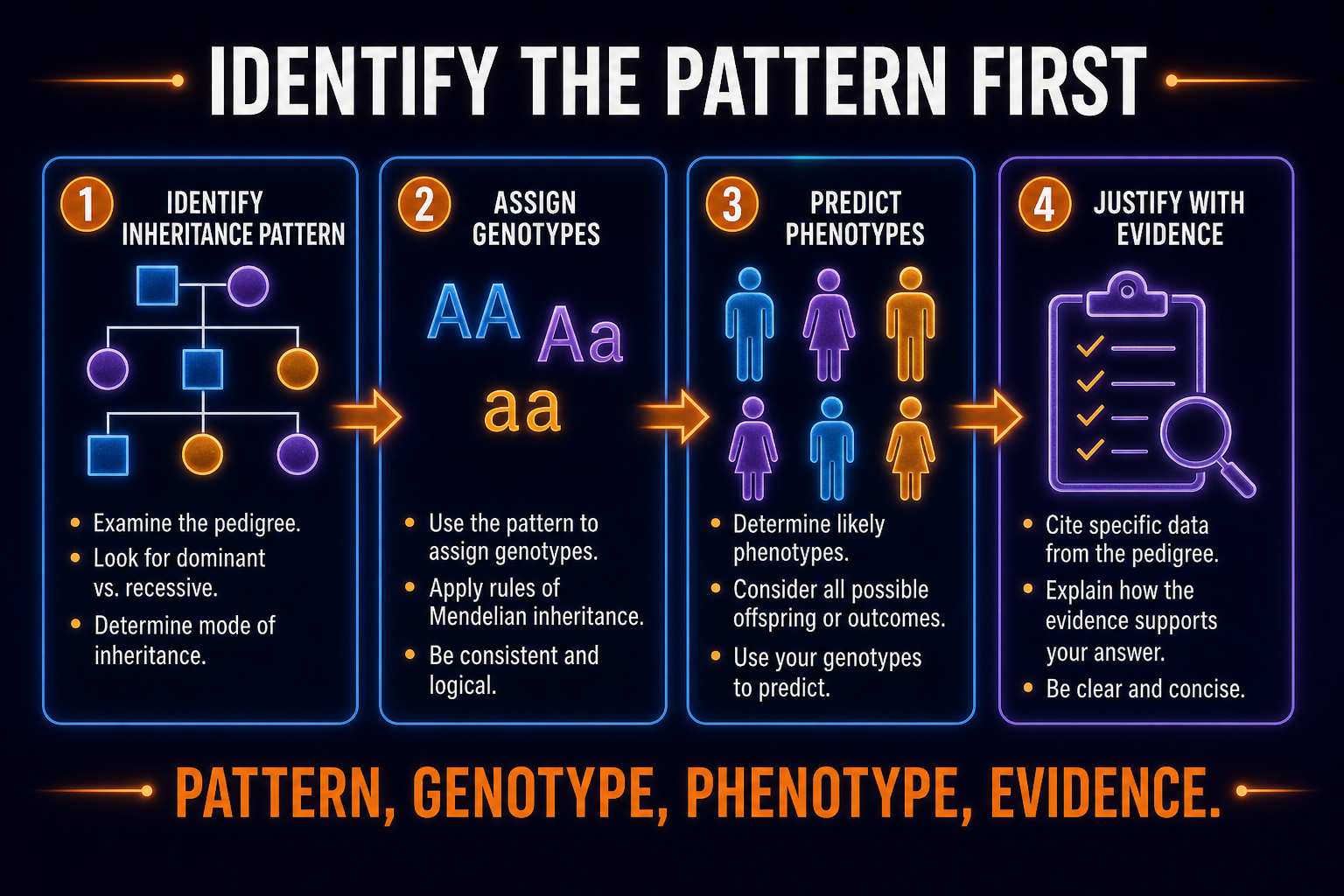
Read heterozygote and offspring clues before assigning alleles.
State whether the heterozygote blends, shows both alleles, or follows sex linkage.
Use the correct pattern with a Punnett square or pedigree logic.
Cite prompt data that supports your pattern choice and ratios.
This pattern is ___ because the heterozygote ___. The expected genotypes are ___, and the phenotypes are ___ because ___.
Fix: Read the prompt for heterozygote clues.
Fix: Incomplete dominance blends; codominance shows both.
Fix: A population can have many allele versions, but an individual usually inherits two.
Fix: Polygenic means many genes; multiple alleles means many versions of one gene.
Fix: Check whether the trait pattern differs between males and females.
Fix: A 3:1 ratio usually assumes complete dominance and simple Mendelian inheritance.
Revealed: 0 of 5 scenarios
Red flowers crossed with white flowers produce pink flowers.
Answer: This is incomplete dominance because the heterozygote has an intermediate phenotype.
A heterozygote shows both black and white patches.
Answer: This is codominance because both alleles are expressed.
A gene has IA, IB, and i alleles in the population.
Answer: This is multiple alleles, and ABO blood type also includes codominance.
A trait appears across a continuous range.
Answer: This suggests polygenic inheritance because multiple genes affect the phenotype.
Males are affected more often than females in a pedigree.
Answer: This can suggest X-linked inheritance.
Answer all eight questions. Choices shuffle on reload—focus on mechanism, not letter memorization.
More drills: Unit 5 practice questions, practice by topic, or daily AP Biology practice.
Open each card, draft your response, then reveal the rubric and sample. For more free-response practice, open the Unit 5 FRQ guide.
In a flower species, red flowers crossed with white flowers produce pink offspring.
The pattern is incomplete dominance because red × white produces pink heterozygotes with an intermediate phenotype. A pink × pink cross gives 1 red : 2 pink : 1 white offspring if allele symbols are used consistently and phenotypes are assigned to genotypes correctly.
Status: Draft your answer first—then open the rubric or sample.
In a blood type problem, one parent has type AB blood and the other has type O blood.
The AB parent can contribute IA or IB; the O parent contributes i. Offspring can be type A (IAi) or type B (IBi). ABO blood type is non-Mendelian because the population has multiple alleles and IA and IB are codominant in type AB individuals.
Status: Draft your answer first—then open the rubric or sample.
Non-Mendelian genetics includes inheritance patterns that do not follow simple dominant-recessive rules. These patterns can involve incomplete dominance, codominance, multiple alleles, polygenic traits, sex-linked traits, or linked genes. AP Biology tests whether you can identify the pattern before predicting outcomes.
Mendelian genetics often assumes complete dominance and predictable dominant-recessive ratios. Non-Mendelian genetics changes those assumptions, so heterozygotes or offspring ratios may look different. The Punnett square may still work, but the interpretation changes.
Incomplete dominance occurs when the heterozygote has an intermediate phenotype. For example, red and white flowers may produce pink heterozygotes. The key clue is that one allele does not fully mask the other.
Codominance occurs when both alleles are expressed in the heterozygote. The traits appear together rather than blending. ABO blood type includes codominance because IA and IB are both expressed in type AB blood.
Multiple alleles means more than two allele versions exist for a gene in the population. An individual usually still inherits only two alleles. ABO blood type is the classic example because IA, IB, and i exist in the population.
Polygenic inheritance occurs when multiple genes influence one trait. These traits often show continuous variation instead of simple categories. Height and skin pigmentation are common examples.
Sex-linked traits are controlled by genes on sex chromosomes. X-linked recessive traits often appear more often in males because males typically have only one X chromosome. AP Biology may test this pattern using pedigrees.
Linked genes are genes located close together on the same chromosome. They tend to be inherited together more often than genes that assort independently. Crossing over can sometimes separate linked alleles.
Yes, Punnett squares can still show possible genotypes. The difference is that phenotype interpretation depends on the inheritance pattern. Incomplete dominance, codominance, and sex-linked traits require different reasoning than complete dominance.
Start by identifying the inheritance pattern from the prompt. Then explain how the heterozygote or offspring data support that pattern. Finish by predicting genotypes and phenotypes using the correct pattern.