Add recombinant offspring
44 + 40 = 84
AP Biology · Unit 5 Heredity
Linked genes are genes located close together on the same chromosome. Because they are physically near each other, they tend to be inherited together instead of following the classic independent assortment pattern. In AP Biology Unit 5, recombination frequency helps you estimate how often crossing over separates linked genes and how far apart those genes are on a chromosome.
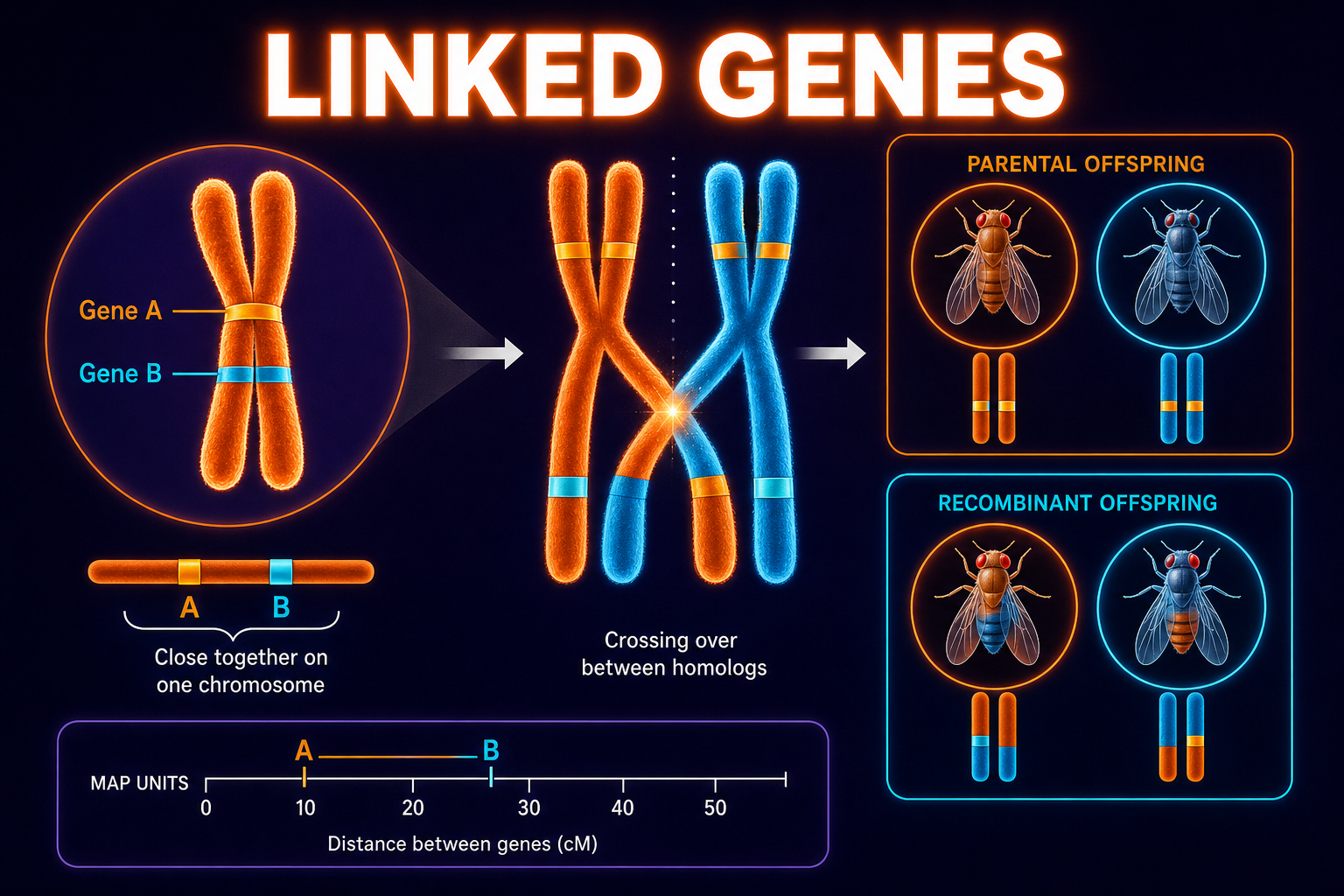
Linked genes are genes located close together on the same chromosome. Because they are near each other, they tend to be inherited together and may not follow independent assortment. Crossing over can separate linked genes, and recombination frequency measures how often recombinant offspring appear.
Linked genes stay together unless crossing over separates them.
Genes on the same chromosome are physically connected. If two genes are very close together, crossing over is less likely to separate them. As a result, parent allele combinations appear more often than recombinant combinations.
Linkage shows up most clearly in testcross data, where you can count how often offspring match the original parent chromosome arrangements versus new recombinant combinations. Before you analyze ratios, make sure you understand meiosis and how gametes form, because linkage reasoning always connects offspring counts back to chromosome behavior during meiosis.
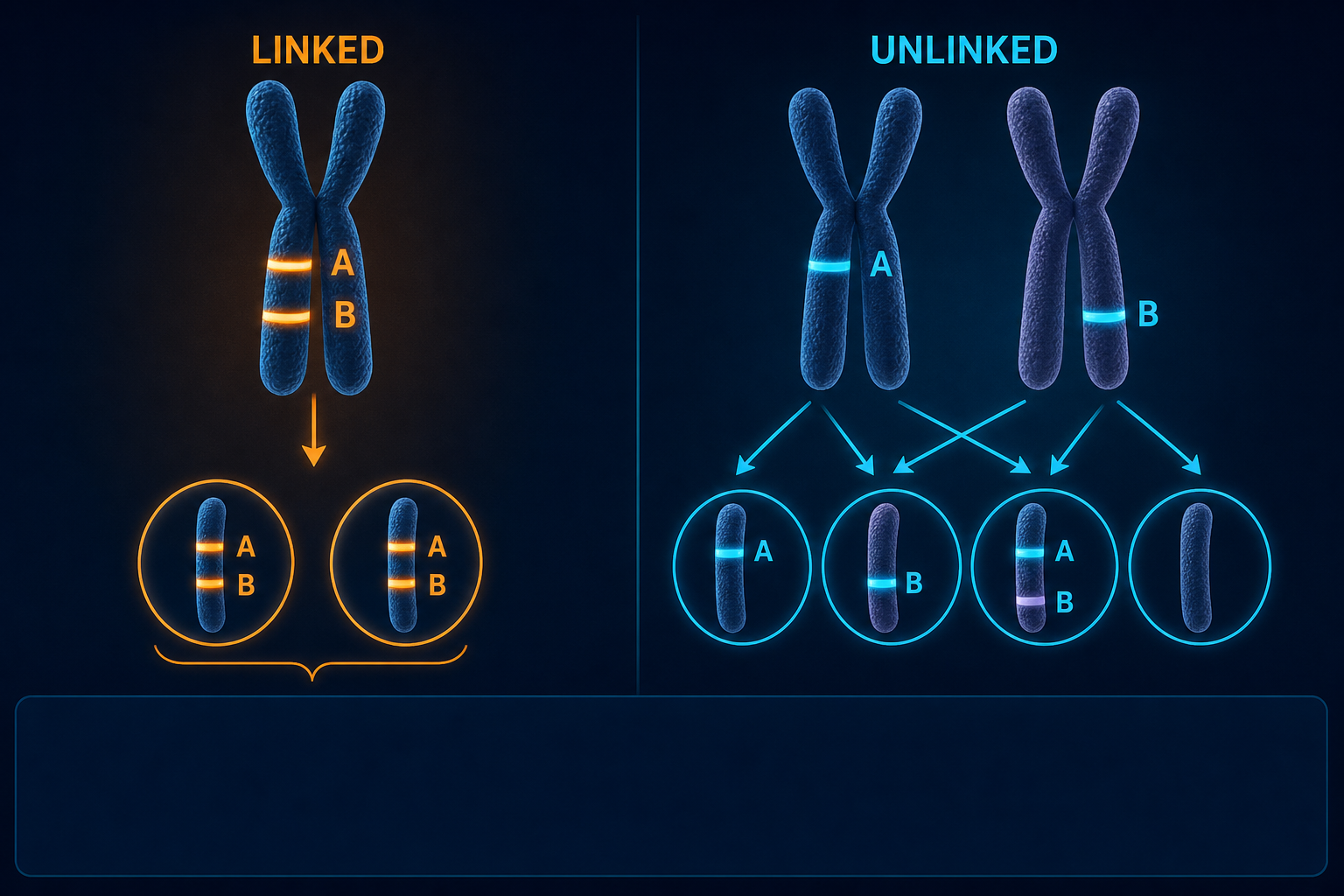
| Feature | Linked Genes | Independently Assorting Genes |
|---|---|---|
| Location | Same chromosome, close together | Different chromosomes or far apart |
| Inheritance pattern | Often inherited together | Sort into gametes independently |
| Expected offspring | More parental types | Mendelian expected ratios more likely |
| Crossing over effect | Can create recombinants | Less relevant for independent chromosome sorting |
| AP clue | Observed ratios do not fit expected independent assortment | Classic dihybrid ratios may appear |
Review independent assortment when genes on different chromosomes or far apart assort into gametes on their own.
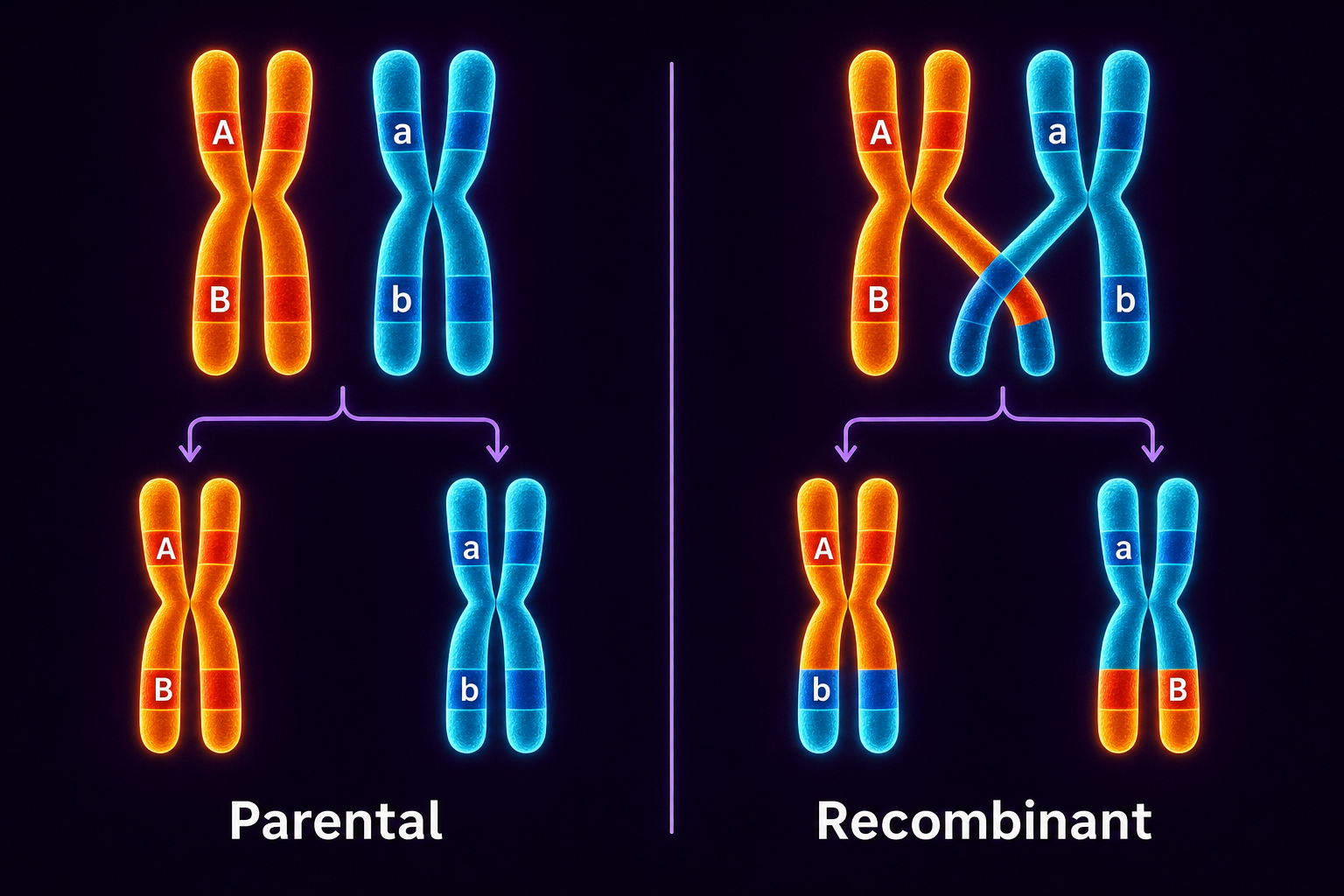
Parental offspring have allele combinations that match the parent chromosomes. Recombinant offspring have new allele combinations created by crossing over. In linkage problems, parental types are usually more common than recombinant types.
| Offspring Type | Meaning | AP Clue |
|---|---|---|
| Parental type | Same allele combination as parent chromosomes | More common |
| Recombinant type | New allele combination from crossing over | Less common |
| Equal types | May suggest independent assortment | Not strongly linked |
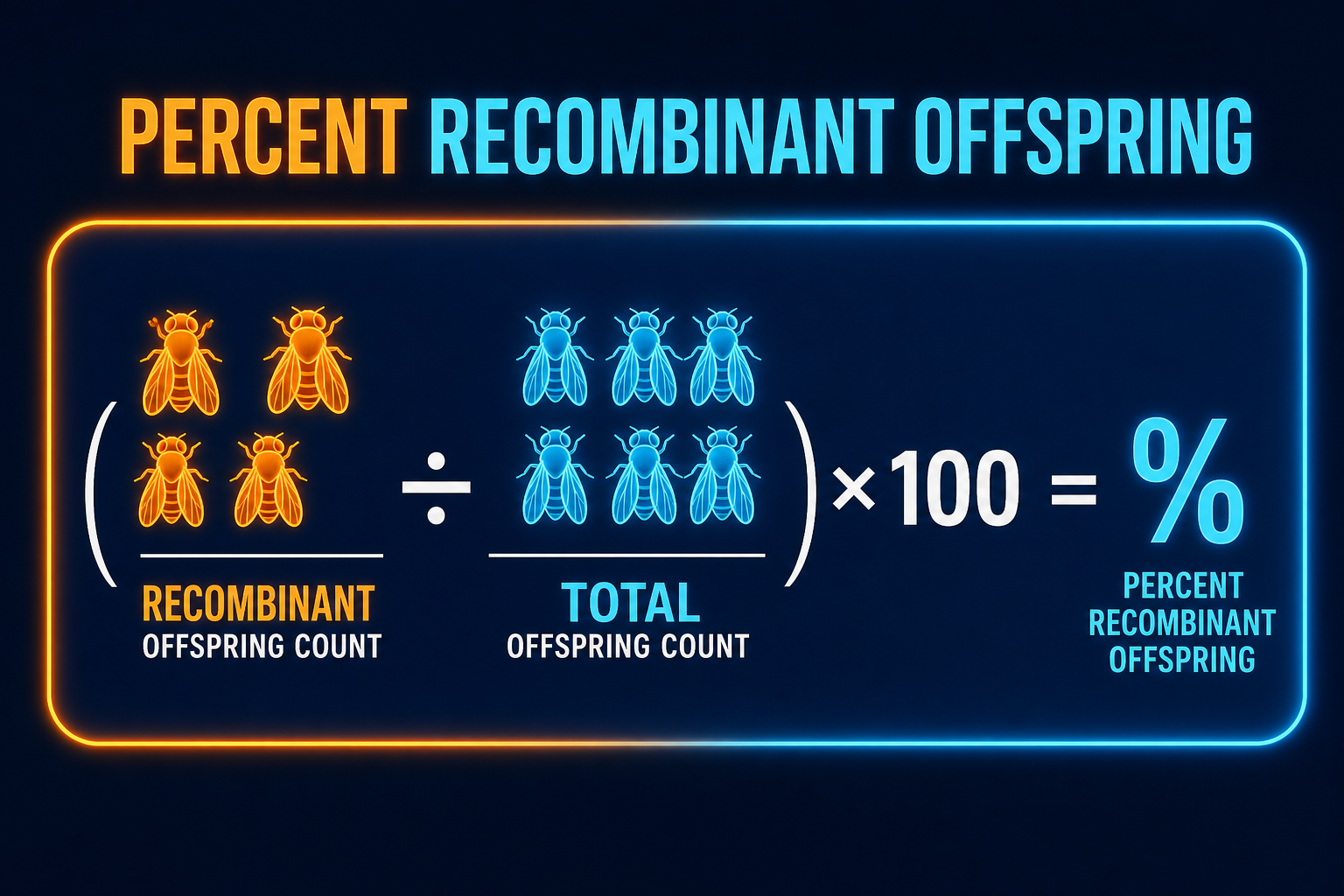
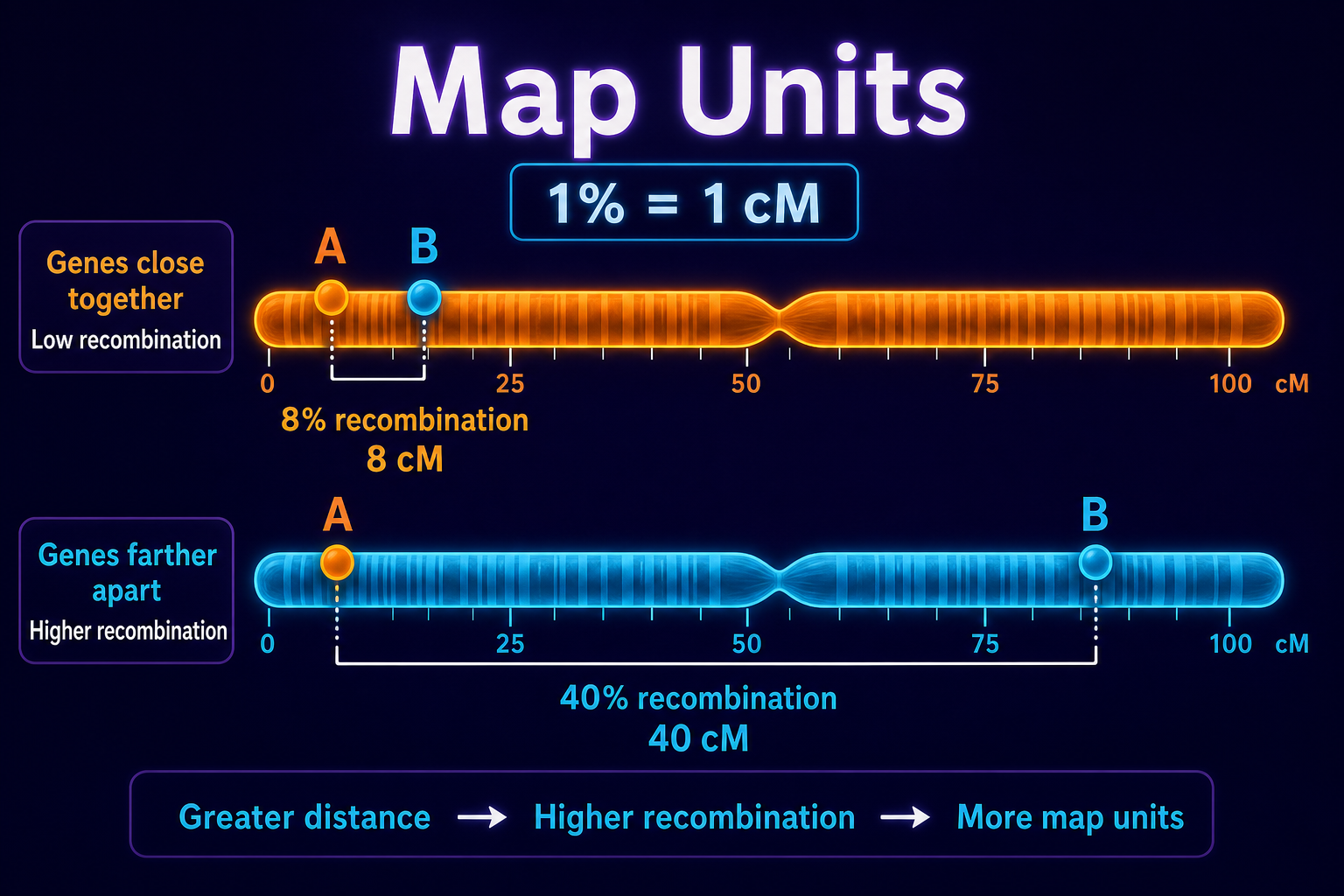
To calculate recombination frequency, add all recombinant offspring, divide by the total number of offspring, and multiply by 100. The answer is a percentage. In simple AP Biology gene mapping, 1% recombination frequency equals about 1 map unit.
Example: If 84 recombinant offspring appear out of 1000 total offspring: 84 ÷ 1000 × 100 = 8.4%. So the genes are about 8.4 map units apart.
Use this quick calculator to practice converting offspring counts into recombination frequency and map units.
This calculator is for AP Biology practice and simplified linkage problems. It stores no personal data.
Recombination frequency can estimate how far apart two genes are on a chromosome. A recombination frequency of 8.4% means the genes are about 8.4 map units apart. Genes that are farther apart have a higher chance of crossing over between them.
On many exams, map units are described interchangeably with centimorgans (cM). You do not need advanced mapping algorithms for AP Biology—focus on converting offspring counts into a percentage, then treating that percentage as approximate map distance between two linked loci.
A testcross produces the following offspring:
44 + 40 = 84
420 + 496 + 44 + 40 = 1000
84 ÷ 1000 × 100 = 8.4%
The genes are about 8.4 map units apart.
Conclusion: Because parental types are much more common than recombinant types, the genes are likely linked.
If you are still building Punnett square habits, review Punnett squares first, then return here when a dihybrid or testcross result does not match Mendelian expectations. Linkage problems are data-heavy: the AP point is that observed counts, not assumed ratios, tell you whether genes assort independently.
Crossing over exchanges DNA between homologous chromosomes during prophase I of meiosis. If crossing over occurs between two linked genes, the allele combination can change and recombinant offspring can appear.
Review crossing over for the full meiosis mechanism.
A classic AaBb × AaBb dihybrid cross can produce a 9:3:3:1 phenotype ratio when genes assort independently. Linked genes may not produce this ratio because the alleles are physically located near each other and tend to travel together.
Review dihybrid crosses for expected independent-assortment ratios. Use a chi-square test for genetics when you need to compare observed counts to a predicted ratio. For how variation arises in Unit 5 overall, see genetic variation.
→ linked genes
→ linkage clue
→ crossing over clue
→ recombination frequency
→ possible linkage
→ possible linked genes
→ genes may assort independently
→ recombination formula
Fix: Crossing over can separate linked genes if it occurs between them.
Fix: Linked genes are physically close on the same chromosome. Sex-linked traits are on sex chromosomes.
Fix: Add all recombinant offspring before dividing by total offspring.
Fix: Recombination frequency uses recombinant offspring divided by total offspring.
Fix: Linked genes can break classic independent assortment ratios.
Fix: Values near or above 50% usually suggest genes are not linked in simple AP Biology analysis.
Answer all eight questions. Choices shuffle on reload—focus on data reasoning, not letter memorization.
More drills: Unit 5 practice questions.
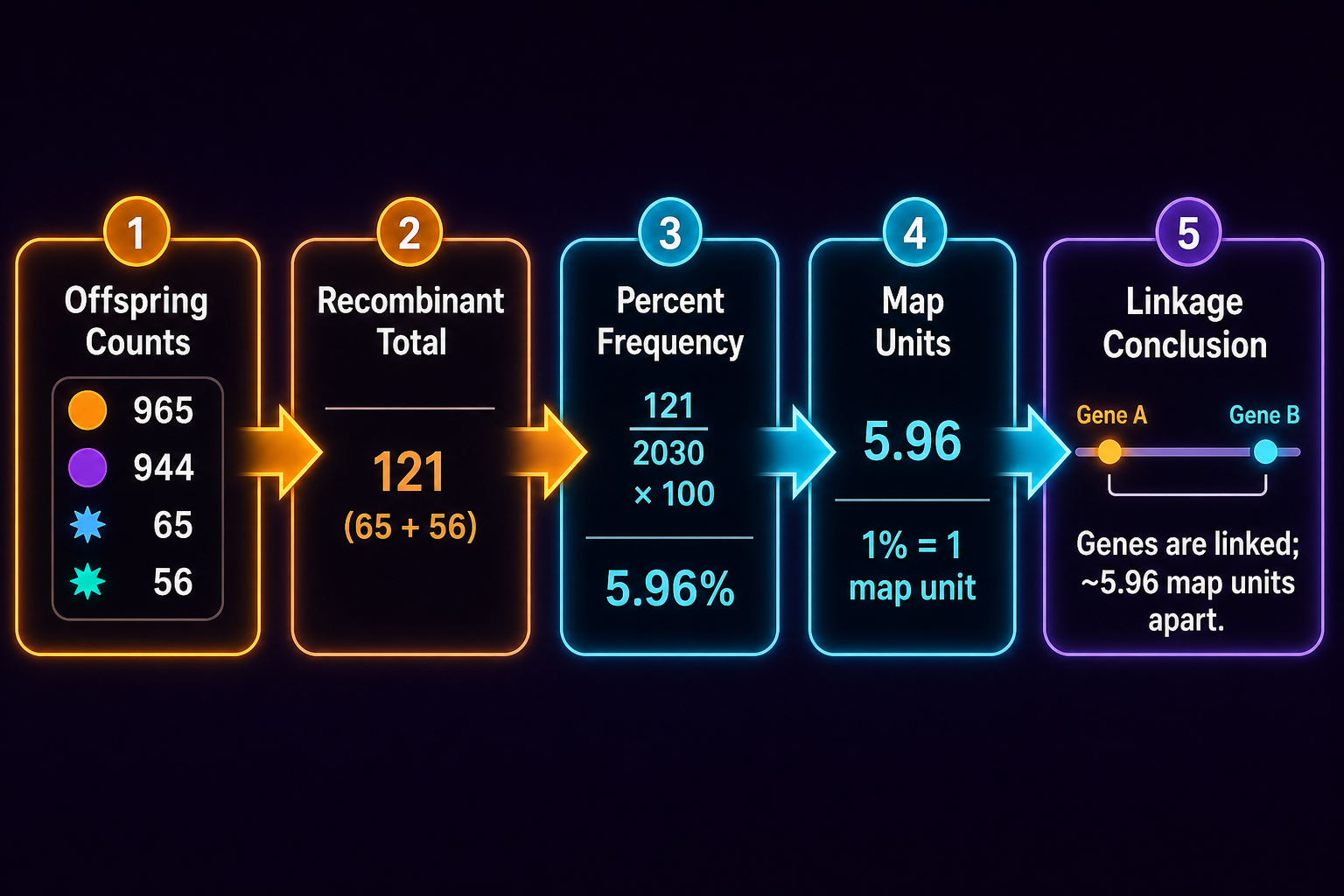
A testcross produces 420 parent-like offspring of one type, 496 parent-like offspring of a second type, 44 recombinant offspring of one type, and 40 recombinant offspring of a second type. Calculate the recombination frequency and interpret what it means.
The recombinant offspring are 44 and 40, for a total of 84 recombinant offspring. The total number of offspring is 420 + 496 + 44 + 40 = 1000. The recombination frequency is 84 ÷ 1000 × 100 = 8.4%. This means the genes are approximately 8.4 map units apart. Because the recombination frequency is low and parental types are much more common than recombinant types, the genes are likely linked.
Status: Draft your answer first—then open the rubric or sample.
A student expects a 9:3:3:1 ratio from a dihybrid cross, but the offspring show many more parental combinations than recombinant combinations. Explain why linked genes could cause this pattern.
Linked genes could explain the pattern because linked genes are close together on the same chromosome and tend to be inherited together. A 9:3:3:1 ratio assumes independent assortment, but linked genes do not always assort independently. Recombinant combinations can still occur if crossing over happens between the genes, but if crossing over is rare, parental combinations will be more common. This makes the observed offspring ratios differ from the expected independent assortment ratio.
Status: Draft your answer first—then open the rubric or sample.
Linked genes are genes located close together on the same chromosome. Because they are physically near each other, they tend to be inherited together instead of assorting independently.
Recombination frequency measures how often crossing over separates linked genes. It is calculated from the proportion of recombinant offspring in a cross.
Add all recombinant offspring, divide by total offspring, and multiply by 100. The result is a percentage that estimates map distance in simple AP Biology problems.
Recombination frequency = (recombinant offspring ÷ total offspring) × 100.
Parental offspring have allele combinations that match the original parent chromosomes. They are usually more common when genes are linked.
Recombinant offspring have new allele combinations created by crossing over between linked genes. They are usually less common than parental types.
Crossing over can separate linked genes if a crossover occurs between them. Recombinant offspring reveal that crossing over happened.
Map units estimate distance between genes on a chromosome. In simple problems, 1% recombination frequency equals about 1 map unit.
A low recombination frequency suggests the genes are close together on the chromosome and are likely linked.
A frequency near 50% usually suggests the genes are not linked in simple AP Biology linkage analysis and may assort independently.
Linked genes are close together on the same chromosome. Sex-linked traits are determined by genes on sex chromosomes such as the X chromosome.
The 9:3:3:1 ratio assumes independent assortment. Linked genes on the same chromosome tend to be inherited together, so parental combinations appear more often.
Identify recombinant offspring, add totals, calculate recombinant ÷ total × 100, interpret map units, and explain whether parental types being more common supports linkage.