Dominant phenotype
At least one dominant allele may be present.
AP Biology · Unit 5 Learning Journey
Mendelian genetics explains how alleles pass from parents to offspring and how inheritance patterns can predict traits. In simple Mendelian inheritance, dominant and recessive alleles combine to create genotypes and phenotypes. In AP Biology Unit 5, the key skill is using allele logic to predict outcomes and justify inheritance patterns with evidence.
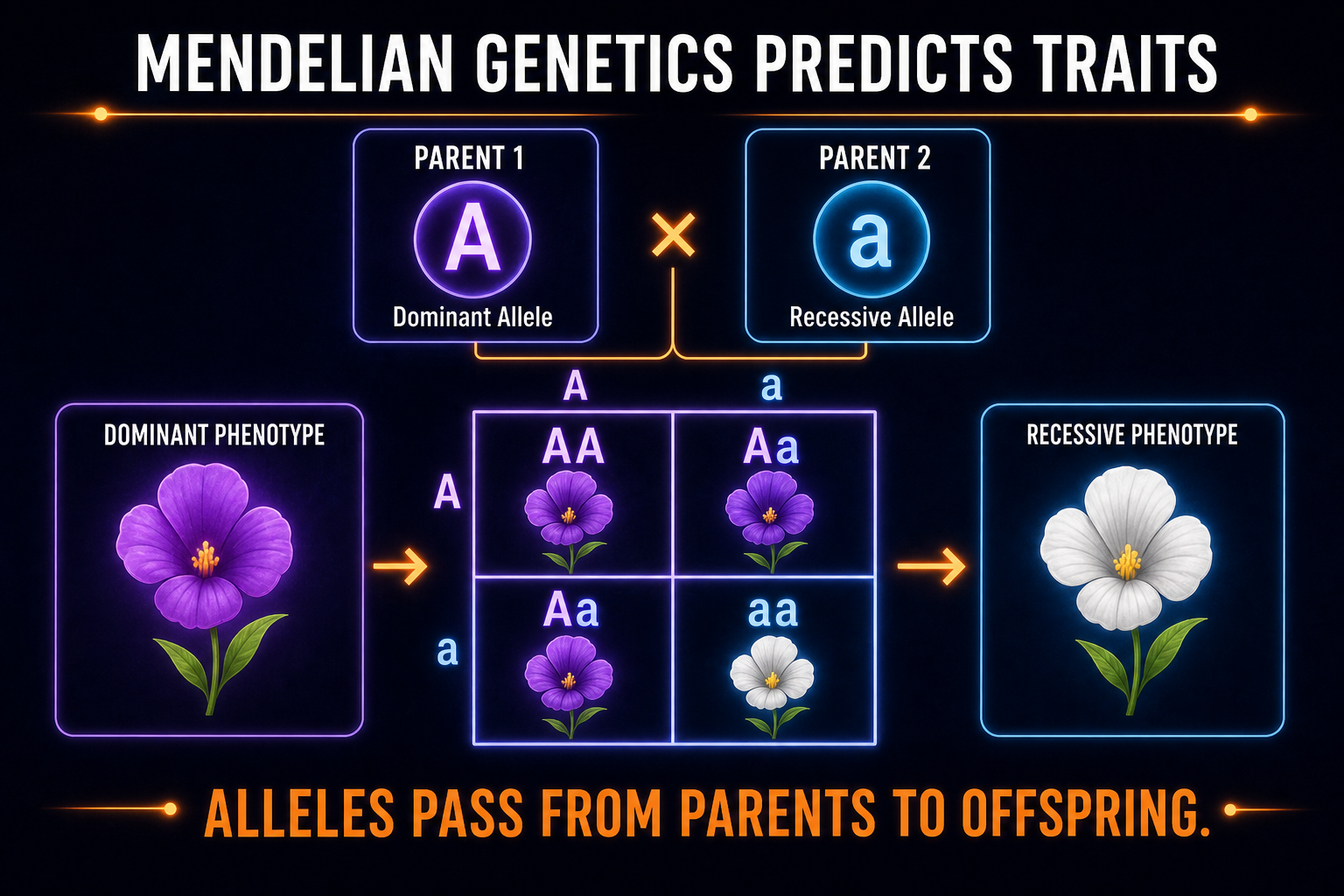
The previous guide, Independent Assortment, explained how chromosome pairs sort into gametes. Mendelian genetics turns that chromosome movement into inheritance predictions by tracking alleles from parents to offspring. After this page, study Punnett Squares to practice calculating genotype and phenotype probabilities.
Mendelian genetics is the study of how alleles are inherited from parents and how those alleles predict traits in offspring. It focuses on patterns such as dominant and recessive inheritance, segregation of alleles into gametes, and independent assortment of unlinked genes. AP Biology uses Mendelian genetics to connect meiosis, Punnett squares, probability, and trait prediction.
Mendelian genetics tracks alleles to predict traits.
A gene is a DNA sequence that helps determine a trait. Different versions of a gene are called alleles.
An allele is a version of a gene. Offspring inherit alleles from parents through gametes.
A genotype is the allele combination an organism has, such as AA, Aa, or aa.
A phenotype is the expressed trait. In simple dominant-recessive inheritance, AA and Aa may show the same dominant phenotype.
Mendelian genetics uses allele combinations to predict likely offspring outcomes. Punnett squares are one tool for modeling those probabilities.
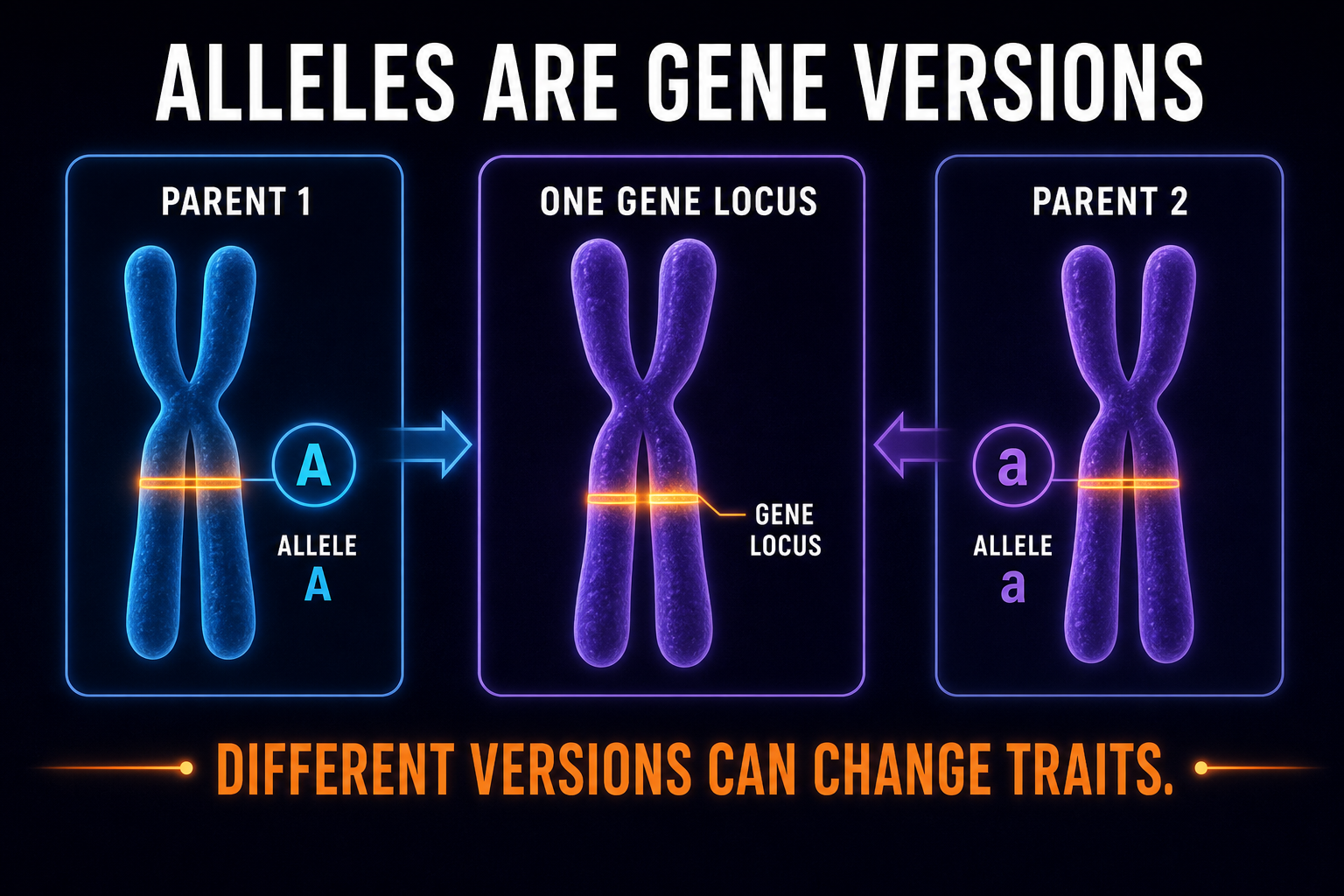
An allele is a version of a gene. For many Mendelian problems, each organism has two alleles for a gene, one inherited from each parent. During meiosis, alleles separate into gametes, which is why offspring receive one allele from each parent.
Direct answer: A gene is the trait-related DNA region; an allele is a version of that gene.
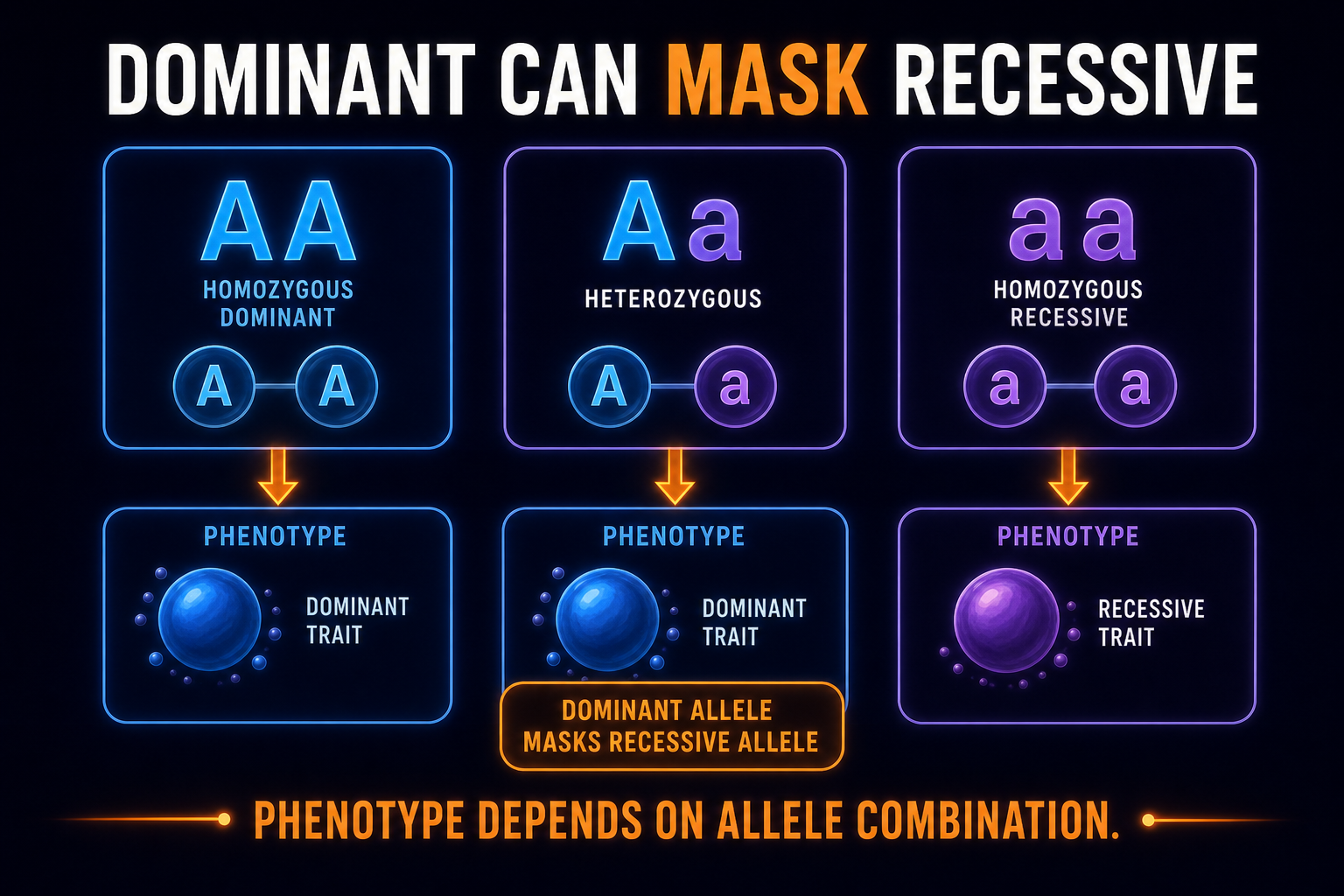
In simple Mendelian inheritance, a dominant allele can be expressed when only one copy is present. A recessive allele is expressed only when two recessive copies are present. This is why a heterozygous genotype can show the dominant phenotype.
| Genotype | Allele combination | Common phenotype result |
|---|---|---|
| AA | Two dominant alleles | Dominant phenotype |
| Aa | One dominant, one recessive | Dominant phenotype |
| aa | Two recessive alleles | Recessive phenotype |
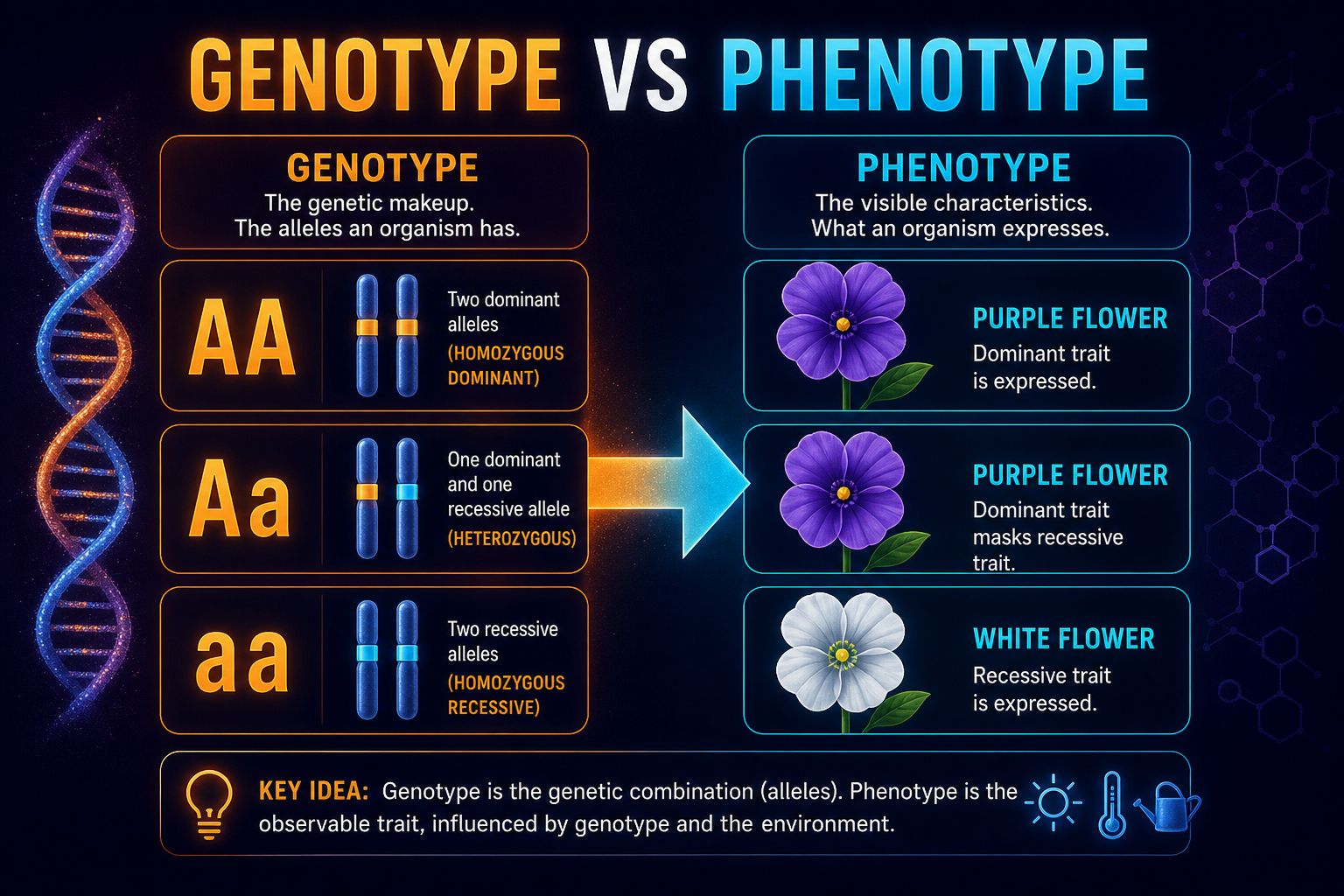
Genotype refers to the allele combination an organism has. Phenotype refers to the observable or measurable trait that results from genotype and sometimes environment. AP Biology often asks students to distinguish genotype ratios from phenotype ratios.
| Term | Meaning | Example |
|---|---|---|
| Genotype | Allele combination | AA, Aa, aa |
| Phenotype | Expressed trait | purple flower, white flower |
| Homozygous | Two matching alleles | AA or aa |
| Heterozygous | Two different alleles | Aa |
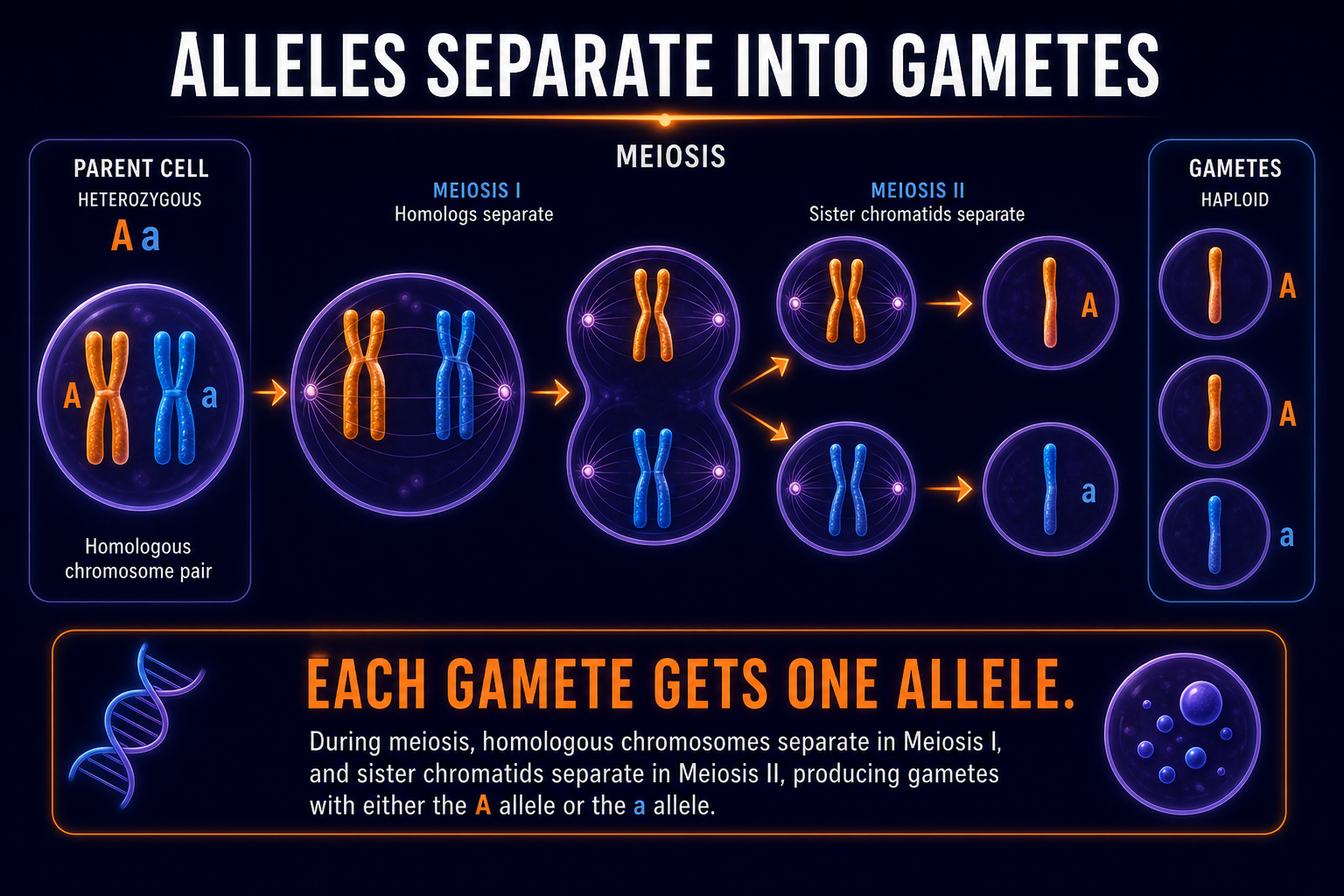
Mendel's law of segregation states that the two alleles for a gene separate during gamete formation. This happens because homologous chromosomes separate during meiosis I. As a result, each gamete receives only one allele for a gene.
Direct answer: Segregation explains why each gamete carries one allele from each allele pair.
See meiosis for the full cell-division context and independent assortment for how different genes can sort into gametes.
Mendel's law of independent assortment states that alleles for different genes can be passed into gametes independently. This works best when genes are unlinked, meaning they are on different chromosomes or far apart on the same chromosome. AP Biology often connects this idea to dihybrid crosses.
| Mendel's law | What it means | Meiosis connection |
|---|---|---|
| Segregation | Allele pairs separate | Homologous chromosomes separate |
| Independent assortment | Different genes can sort independently | Chromosome pairs orient randomly |
| Dominance | One allele can mask another | Heterozygote phenotype |
Continue with independent assortment and dihybrid crosses for two-gene prediction practice.
Punnett squares are diagrams that use Mendelian allele logic to predict possible offspring outcomes. They do not guarantee exact offspring numbers; they show probability. To use a Punnett square well, students must know the parent genotypes, possible gametes, and how genotypes translate into phenotypes.
Next guide: Punnett Squares
At least one dominant allele may be present.
Usually two recessive alleles are required.
The genotype has two different alleles.
Law of segregation is involved.
Independent assortment may apply.
Track allele combinations, not just visible traits.
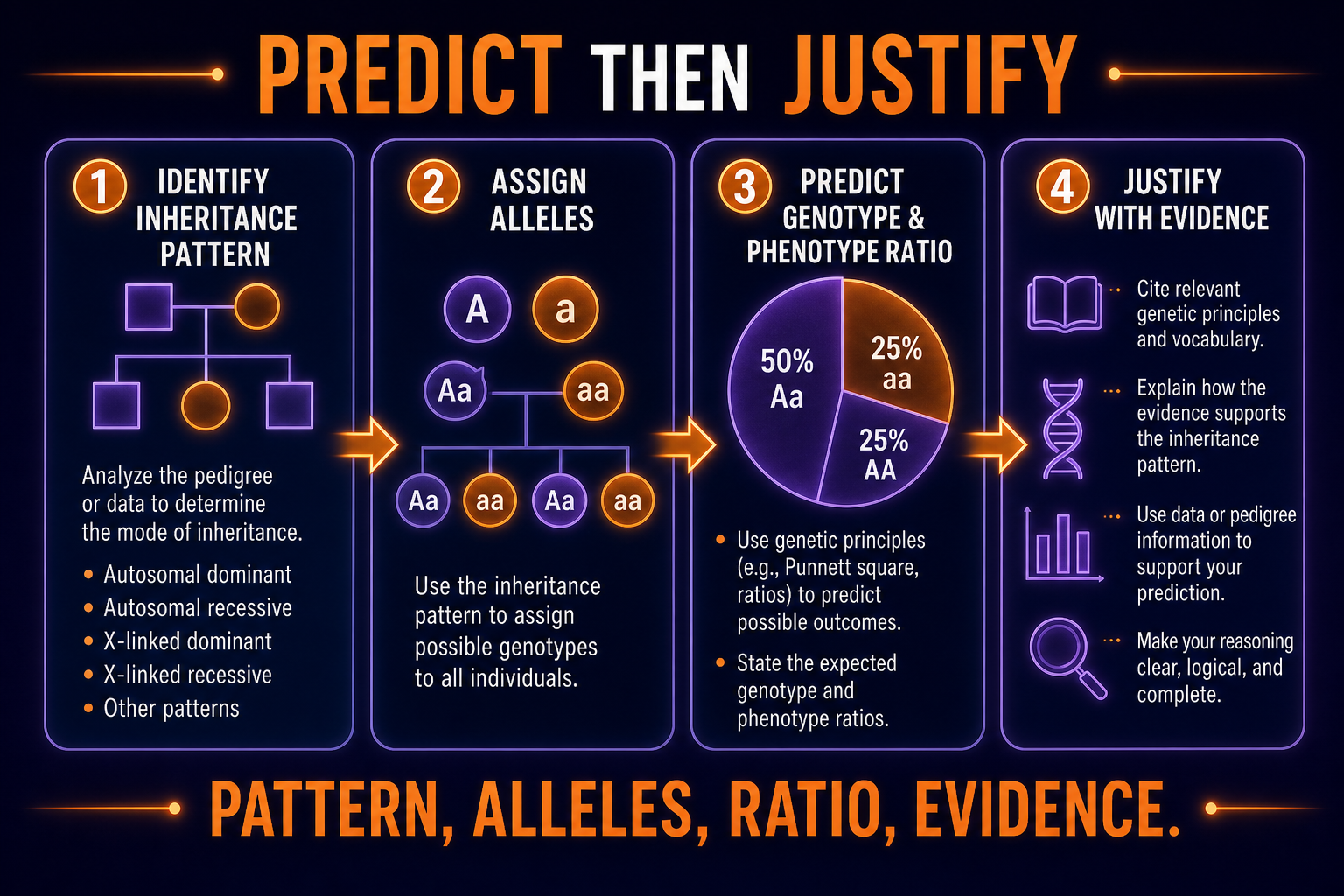
Decide whether simple dominance, recessive expression, or non-Mendelian patterns fit the data.
Use consistent letters and define which allele is dominant or recessive.
List gametes or build a Punnett square, then report ratios.
Connect predictions to segregation, dominance, or data from the prompt.
Because ___ is dominant/recessive, the genotype ___ produces ___. The expected offspring outcome is ___ because ___.
Fix: Dominant means expressed in a heterozygote, not more frequent.
Fix: Genotype is allele combination; phenotype is expressed trait.
Fix: Segregation puts one allele into each gamete.
Fix: Some traits follow non-Mendelian inheritance patterns.
Fix: You need parent genotypes before predicting offspring.
Fix: AP questions may ask for genotype ratios too.
Revealed: 0 of 4 scenarios
An organism has genotype Aa.
Answer: The organism is heterozygous and may show the dominant phenotype in simple Mendelian inheritance.
A trait appears only when genotype is aa.
Answer: The trait is likely recessive in this simple inheritance model.
Alleles A and a separate into different gametes.
Answer: This is Mendel's law of segregation.
Two genes are on different chromosomes.
Answer: They may assort independently during meiosis.
Answer all eight questions. Choices shuffle on reload—focus on mechanism, not letter memorization.
More drills: Unit 5 practice questions, practice by topic, or daily AP Biology practice.
Open each card, draft your response, then reveal the rubric and sample. For more free-response practice, open the Unit 5 FRQ guide.
A plant trait follows simple dominant-recessive inheritance. A heterozygous plant is crossed with a homozygous recessive plant.
The heterozygous parent produces gametes with A or a; the homozygous recessive parent produces only a gametes. Offspring genotypes are expected in a 1 Aa : 1 aa ratio. With complete dominance, Aa shows the dominant phenotype and aa shows the recessive phenotype, so the phenotype ratio also depends on how dominance is defined in the prompt.
Status: Draft your answer first—then open the rubric or sample.
A student claims that a dominant allele must be more common in a population.
The student is incorrect: a dominant allele is not necessarily more common. Dominance describes how an allele affects phenotype when paired with a recessive allele in a heterozygote. Allele frequency measures how often an allele appears in a population, which is separate from whether that allele is dominant or recessive in a given inheritance pattern.
Status: Draft your answer first—then open the rubric or sample.
Mendelian genetics is the study of how alleles are passed from parents to offspring in predictable patterns. It includes dominant and recessive inheritance, segregation, and independent assortment. AP Biology uses it to connect meiosis with trait prediction.
An allele is a version of a gene. Offspring inherit alleles from parents through gametes. Different allele combinations can lead to different genotypes and phenotypes.
Genotype is the allele combination an organism has, such as AA, Aa, or aa. Phenotype is the expressed trait, such as flower color or disease status. AP Biology often asks students to report both genotype and phenotype ratios.
A dominant allele is expressed in a heterozygote when paired with a recessive allele. Dominant does not mean more common, stronger, or better. It only describes how the allele affects phenotype in a specific inheritance pattern.
A recessive allele is usually expressed only when two recessive copies are present. In a heterozygote, the recessive allele may be masked by the dominant allele. Recessive traits can still be common or rare depending on allele frequency.
Mendel's law of segregation states that allele pairs separate during gamete formation. Each gamete receives one allele from each pair. This law connects directly to homologous chromosome separation during meiosis.
Mendel's law of independent assortment states that alleles for different genes can sort into gametes independently. This is most accurate for genes on different chromosomes or far apart on the same chromosome. Linked genes are an important exception.
Mendelian genetics provides the allele rules that Punnett squares use. A Punnett square models possible offspring genotypes and phenotypes based on parent gametes. It shows probability, not a guarantee for every offspring.
No. Some traits follow non-Mendelian patterns such as incomplete dominance, codominance, multiple alleles, polygenic inheritance, or sex-linked inheritance. AP Biology often asks students to identify when simple dominance is not enough.
Start by identifying the inheritance pattern and assigning allele symbols clearly. Then predict genotypes and phenotypes using gametes or a Punnett square. Finish by explaining the result with ratios, probability, or evidence from the prompt.