Random orientation
Independent assortment is likely.
AP Biology · Unit 5 Learning Journey
Independent assortment is the random orientation and separation of homologous chromosome pairs during meiosis I. This process gives gametes different combinations of maternal and paternal chromosomes. In AP Biology Unit 5, independent assortment matters because it explains how meiosis creates genetic variation without changing DNA sequences.
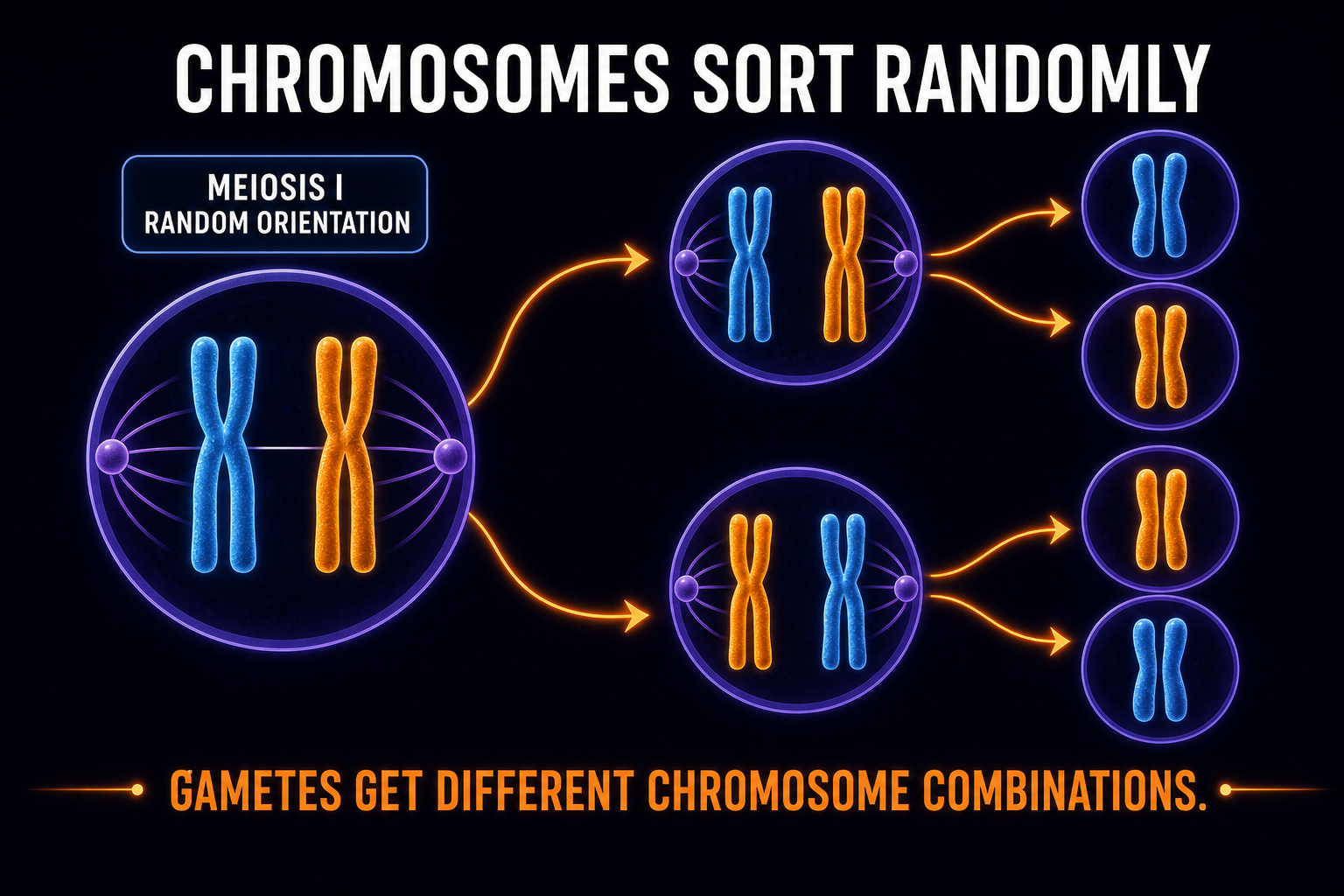
The previous guide, Crossing Over, showed how homologous chromosomes exchange DNA segments. This page explains another source of variation: random chromosome sorting during meiosis I. After this page, study Mendelian Genetics to connect chromosome sorting to inheritance patterns and allele prediction.
Independent assortment is the random orientation and separation of homologous chromosome pairs during meiosis I. Because each chromosome pair can line up in different ways, gametes receive different combinations of maternal and paternal chromosomes. This increases genetic variation and helps explain why offspring can inherit different trait combinations.
Independent assortment randomly sorts chromosome pairs into gametes.
Independent assortment involves homologous chromosome pairs. Each pair contains one chromosome inherited from each parent.
During metaphase I, homologous pairs can line up in different orientations. Which homolog faces which pole is random.
During anaphase I, homologous chromosomes separate. The random orientation affects which chromosome combination enters each gamete.
Different gametes receive different combinations of chromosomes. This creates genetic variation without exchanging DNA segments.
If a question mentions random orientation, chromosome sorting, or different maternal and paternal combinations, independent assortment is probably involved.
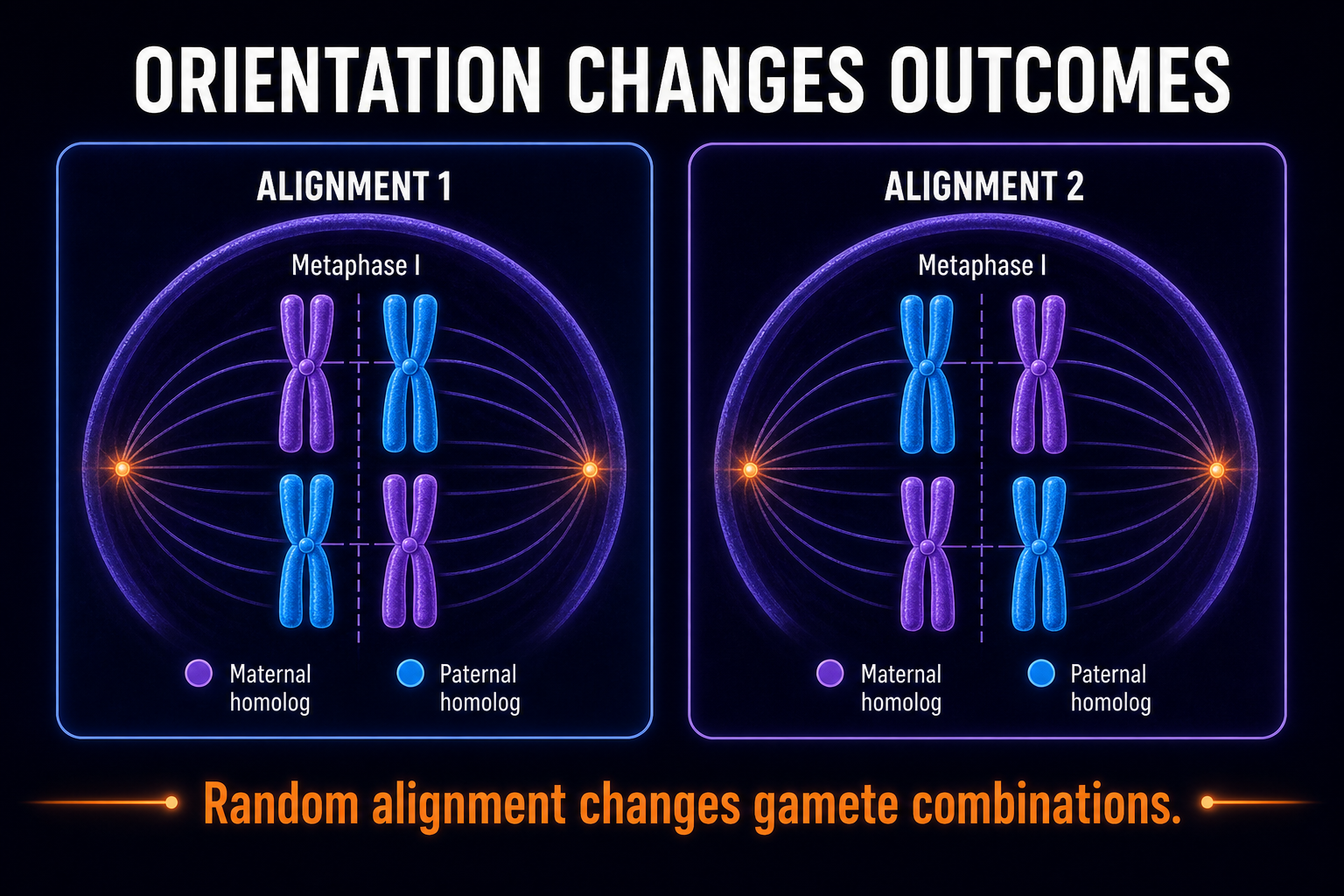
Independent assortment begins when homologous chromosome pairs line up randomly during metaphase I of meiosis. Each pair can orient with either the maternal or paternal homolog facing a particular pole. When the homologs separate, that random orientation affects which chromosomes end up together in gametes.
Direct answer: Independent assortment depends on random chromosome-pair orientation in meiosis I.
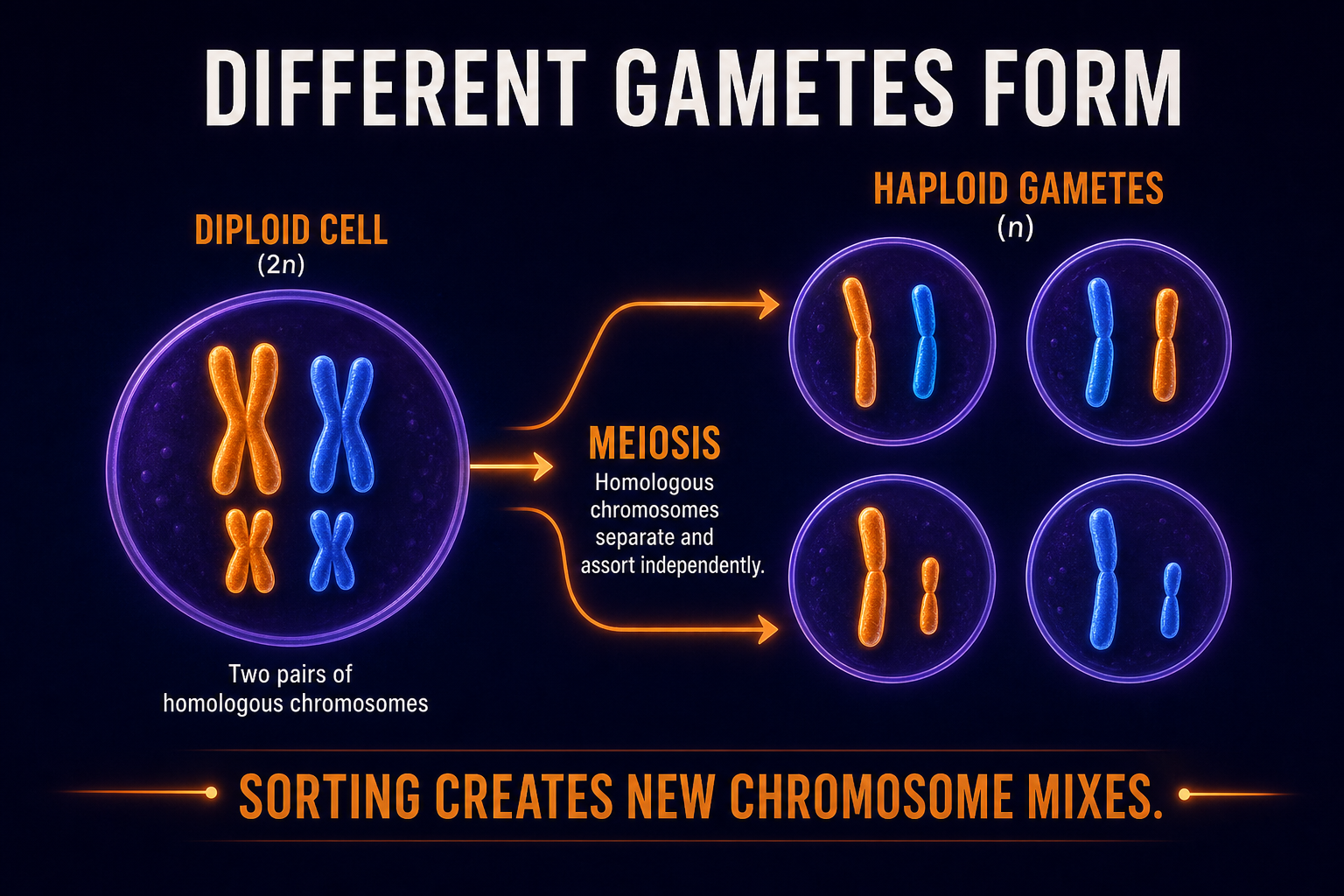
Because each homologous chromosome pair sorts independently, gametes can receive many possible combinations of maternal and paternal chromosomes. The more chromosome pairs an organism has, the more possible combinations can form. This is one reason sexual reproduction produces genetically diverse offspring.
Mendel's law of independent assortment states that alleles for different genes can be passed to gametes independently of one another. This works most clearly when genes are on different chromosomes or far apart on the same chromosome. AP Biology often connects this law to dihybrid crosses and the 9:3:3:1 ratio.
Continue with Mendelian genetics and dihybrid crosses for prediction practice.
Independent assortment applies most clearly when genes are unlinked. Unlinked genes are usually on different chromosomes or far enough apart that crossing over separates them often. Genes that are close together on the same chromosome may be linked and inherited together more often than expected.
| Gene relationship | What happens | AP clue |
|---|---|---|
| Unlinked genes | Assort independently | Different chromosomes or far apart |
| Linked genes | Inherited together more often | Same chromosome, close together |
| Recombination | Can separate linked alleles | Crossing over creates new combinations |
| Dihybrid cross | Often assumes independent assortment | Expected 9:3:3:1 ratio |
See linked genes and recombination frequency when inheritance does not match independent assortment expectations.
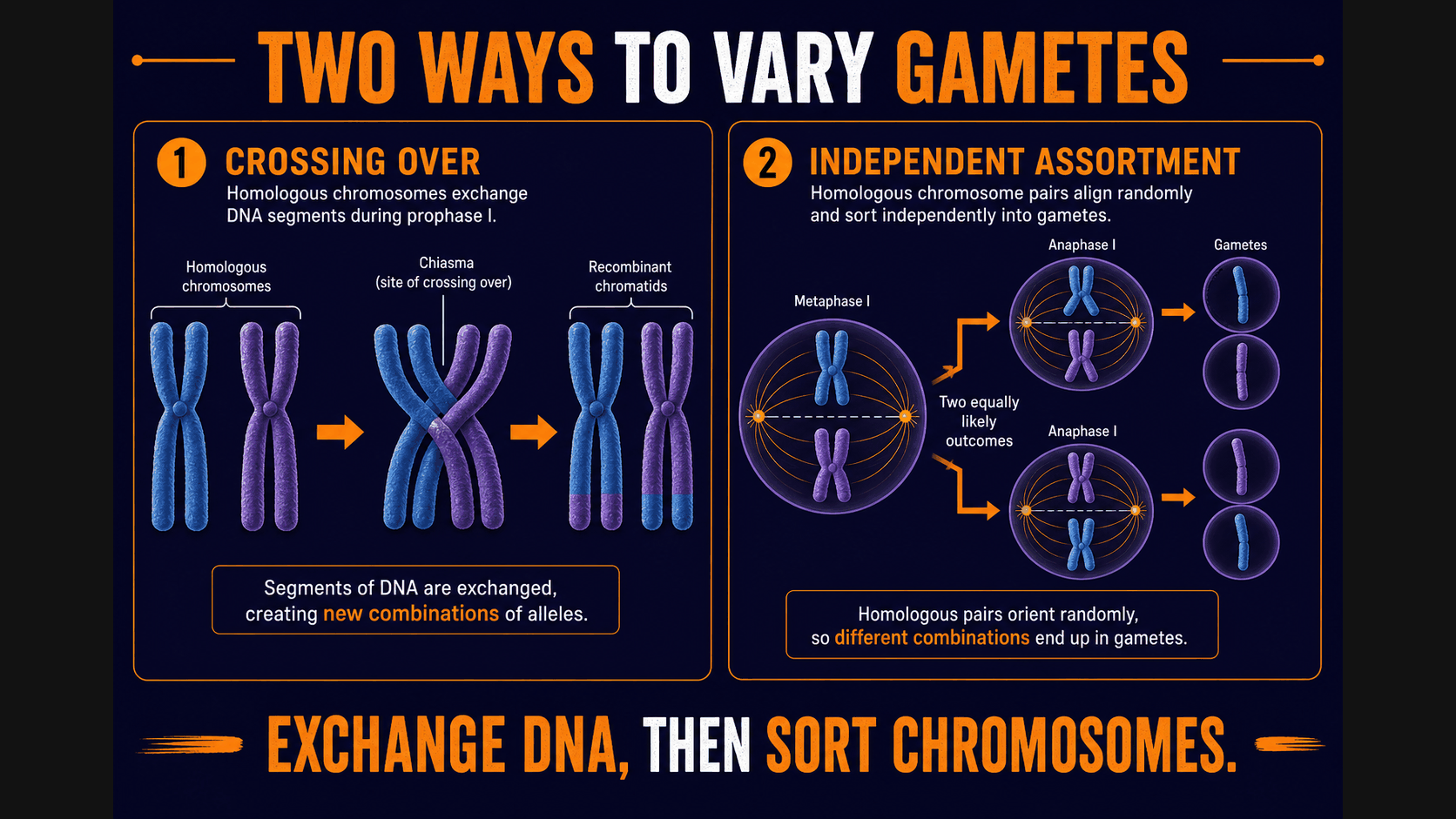
Independent assortment and crossing over both increase genetic variation, but they work differently. Independent assortment sorts whole homologous chromosomes into gametes based on random orientation. Crossing over exchanges DNA segments between homologous chromosomes during prophase I.
| Feature | Independent assortment | Crossing over |
|---|---|---|
| Main action | Sorts homologous chromosomes | Exchanges DNA segments |
| When | Metaphase I / Anaphase I | Prophase I |
| Changes DNA sequence? | No | Rearranges DNA segments |
| Creates | New chromosome combinations | Recombinant chromosomes |
| AP clue | Random orientation | Recombination or chiasma |
Full guide: crossing over study guide.
Independent assortment is likely.
Track chromosome sorting into gametes.
Independent assortment may explain variation.
They are likely to assort independently.
A dihybrid cross may assume independent assortment.
Consider linked genes instead of independent assortment.
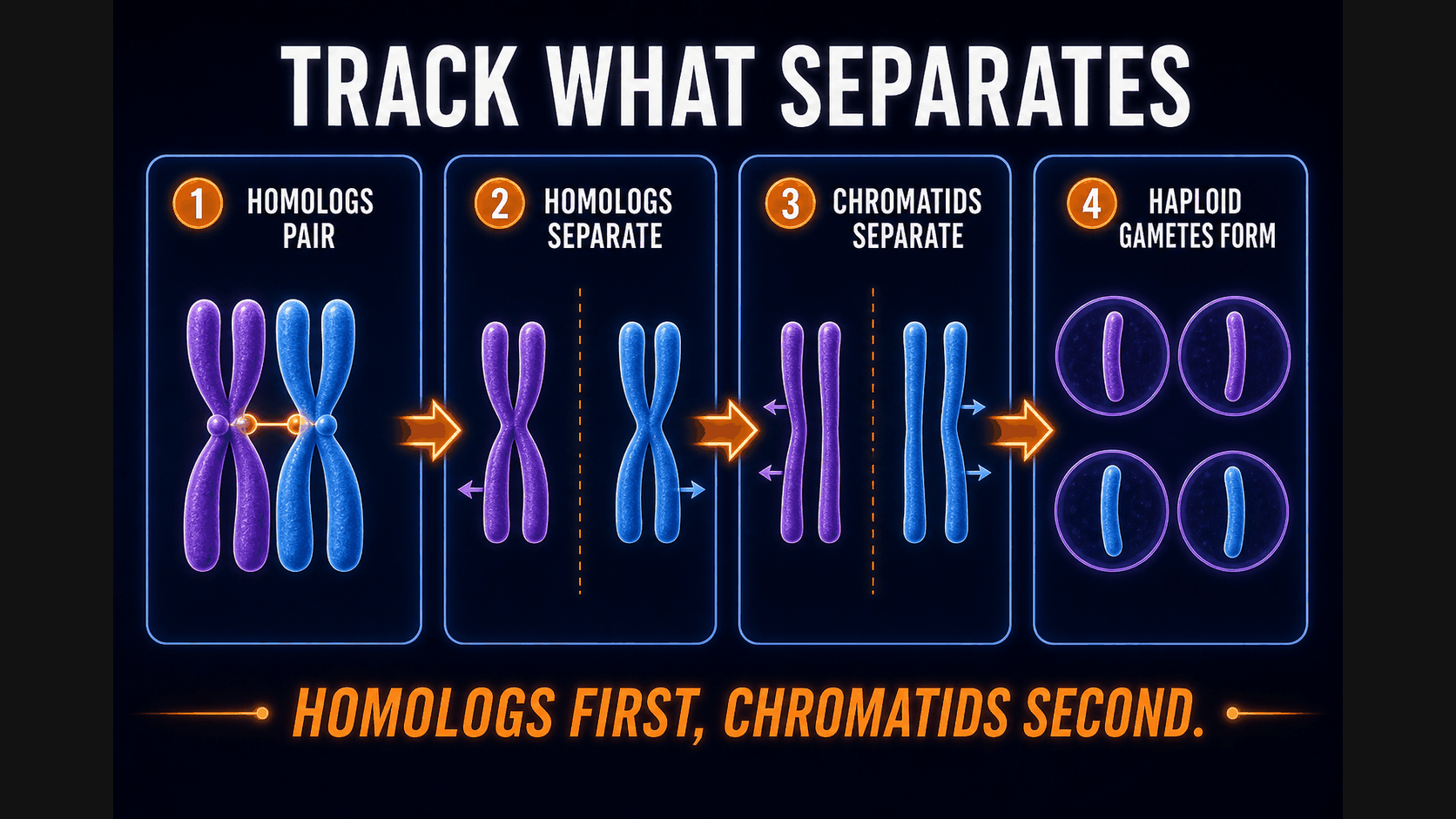
Homologous chromosome pairs line up randomly during meiosis I.
Each pair separates independently at anaphase I.
Gametes receive different maternal and paternal chromosome mixes.
Link varied gametes to offspring diversity or ratios.
During meiosis I, homologous chromosome pairs ___. Because each pair sorts ___, gametes can receive ___. This increases variation because ___.
Fix: Crossing over swaps DNA; independent assortment sorts whole chromosomes.
Fix: Independent assortment depends on homologous chromosome behavior in meiosis I.
Fix: Independent assortment involves homologous chromosome pairs, not single chromatids.
Fix: Linked genes are inherited together more often.
Fix: It creates new combinations of chromosomes and alleles.
Fix: The 9:3:3:1 ratio assumes independent assortment of unlinked genes.
Revealed: 0 of 4 scenarios
Homologous pairs line up randomly during metaphase I.
Answer: This is independent assortment because chromosome-pair orientation is random.
A gamete receives one maternal chromosome and one paternal chromosome from different pairs.
Answer: This can result from independent assortment.
A question describes DNA segment exchange between homologs.
Answer: That is crossing over, not independent assortment.
Two genes are close together on the same chromosome and inherited together.
Answer: Those genes may be linked and may not assort independently.
Answer all eight questions. Choices shuffle on reload—focus on mechanism, not letter memorization.
More drills: Unit 5 practice questions, practice by topic, or daily AP Biology practice.
Open each card, draft your response, then reveal the rubric and sample. For more free-response practice, open the Unit 5 FRQ guide.
During meiosis I, two homologous chromosome pairs line up at the metaphase plate in different possible orientations.
The process is independent assortment during meiosis I. Homologous chromosome pairs can line up in different orientations at metaphase I, so when homologs separate, gametes receive different combinations of maternal and paternal chromosomes. These varied gametes increase genetic variation among offspring without creating new genes.
Status: Draft your answer first—then open the rubric or sample.
A student assumes two genes will assort independently, but both genes are located very close together on the same chromosome.
The student may be wrong because linked genes on the same chromosome are often inherited together, not independently. Independently assorting genes are usually on different chromosomes or far apart. Crossing over during prophase I can sometimes exchange DNA between homologs and create recombinant chromosomes that separate alleles that were previously linked.
Status: Draft your answer first—then open the rubric or sample.
Independent assortment is the random orientation and separation of homologous chromosome pairs during meiosis I. It causes gametes to receive different combinations of maternal and paternal chromosomes. This increases genetic variation among offspring.
Independent assortment is based on chromosome behavior during meiosis I, especially random orientation during metaphase I. Homologous chromosome pairs line up in different possible ways before they separate. The orientation affects which chromosomes enter each gamete.
Independent assortment creates different combinations of chromosomes in gametes. Because each homologous pair sorts independently, gametes can receive many possible maternal and paternal chromosome mixes. These different gametes can lead to genetically different offspring.
No. Independent assortment sorts whole chromosomes into gametes, while crossing over exchanges DNA segments between homologous chromosomes. Both increase variation, but they happen through different mechanisms.
Mendel's law of independent assortment means that alleles for different genes can be passed into gametes independently. This is most accurate for genes on different chromosomes or genes far apart on the same chromosome. Linked genes are an important exception.
Unlinked genes are genes that assort independently because they are on different chromosomes or far apart on the same chromosome. They are less likely to be inherited together as a fixed pair. AP Biology often uses unlinked genes in dihybrid cross problems.
Linked genes are genes located close together on the same chromosome. They tend to be inherited together more often because crossing over is less likely to separate them. Linked genes can make inheritance patterns differ from simple independent assortment expectations.
Dihybrid crosses often assume that two genes assort independently. When this assumption holds, a classic heterozygous dihybrid cross can produce a 9:3:3:1 phenotype ratio. If genes are linked, that expected ratio may not appear.
Independent assortment does not create new genes. It creates new combinations of chromosomes and alleles in gametes. That distinction matters because AP Biology expects precise explanations of genetic variation.
Start by describing random orientation of homologous chromosome pairs during meiosis I. Then explain how independent separation creates different gamete combinations. Finish by connecting those combinations to genetic variation or inheritance ratios.